
Why Your Brain Won’t Let You Sleep After Trauma: The Safety Paradox Explained
There is a moment, familiar to trauma survivors, when lying in bed does not feel like preparing for rest. It feels like preparing for something else entirely.
Sleep requires vulnerability. The body releases its guard. The mind reduces its monitoring. For most people, this transition is automatic. For trauma survivors, it feels like handing over your defenses to a world that has already proven itself dangerous once.
The question this article asks is not “why can’t you sleep?” It is why does your brain believe sleep is unsafe? And more importantly: what can you do about it?
This is why your brain won’t let you sleep after trauma — a guide to understanding and rebuilding the neurological conditions under which your nervous system considers sleep safe.
⚡ Core Takeaway: Safety First — Sleep Follows
- The Problem: Trauma makes the brain equate vulnerability with danger; sleep requires the opposite state
- The Signal: Rebuilding safety signals (physical, environmental, ritual) gradually recalibrates the amygdala’s threat threshold
- The Protocol: The Sanctuary Protocol creates a multi-layered safety architecture — physical security, sensory anchoring, and ritual confirmation

Why Does Trauma Make It So Hard to Fall Asleep at Night?
Direct Answer: Trauma rewires the brain’s threat detection system. After trauma, the brain’s danger-identification circuits become permanently calibrated toward survival — and sleep is the most physiologically vulnerable state of human existence. For trauma survivors, letting go of consciousness is not restful; it feels like lowering your defenses.
Mechanism: van der Kolk (2014), The Body Keeps the Score, documents how trauma reorganizes the nervous system around a persistent threat posture. Walker (2017), Why We Sleep, describes the amygdala as the brain’s threat sentinel — always watching for danger, especially during the vulnerable hours of sleep. After trauma, the amygdala becomes hypervigilant: its threshold for detecting danger drops, meaning neutral stimuli get misread as threats. Sleep onset — the moment when the prefrontal cortex reduces monitoring and the body enters atonia — feels like the moment when you are most exposed to danger. The brain resists it accordingly. This is not a psychological response. It is a neurobiological adaptation: the brain has decided, at a survival level, that sleep is unsafe.
Actionable Advice: Understanding that this response is neurological — not a character flaw or a sign of weakness — is the first step. The next step is building a safety architecture around the sleep period so that the brain’s threat calculation shifts. You are not fighting your trauma. You are rebuilding the neurological conditions under which your nervous system considers sleep safe.
What Happens in Your Brain When Sleep Feels Like a Threat?
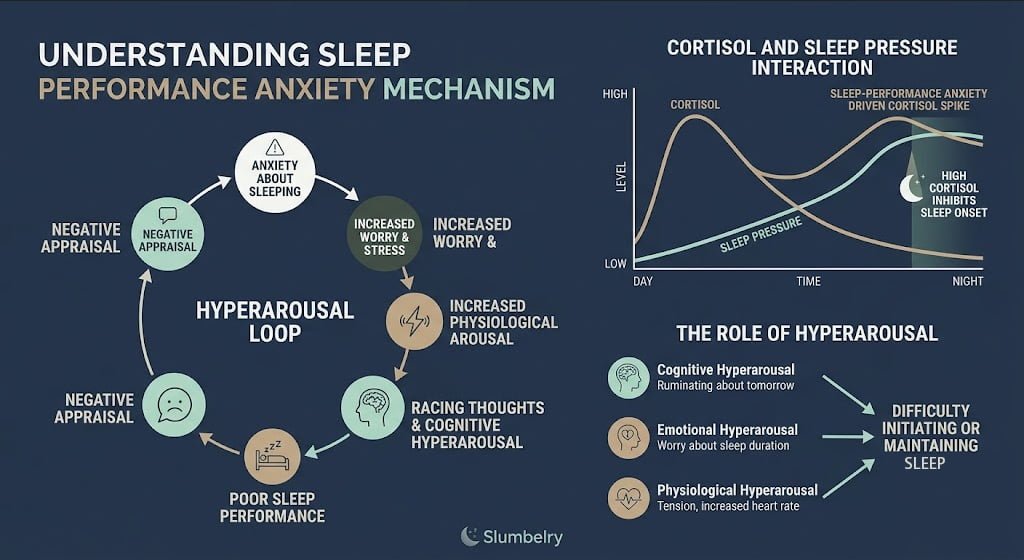
Direct Answer: The hypothalamic-pituitary-adrenal (HPA) axis — the body’s stress response system — stays activated at bedtime. Instead of cortisol dropping to its lowest point of the day (as it should before sleep), it remains elevated. The body is physiologically prepared for danger while lying in bed.
Mechanism: Walker (2017) documents the normal cortisol rhythm: cortisol peaks in the early morning (waking) and reaches its daily minimum in the late evening, facilitating sleep onset. For trauma survivors, this rhythm is disrupted. The HPA axis, having been chronically activated during the traumatic event and its aftermath, remains in a state of elevated baseline activation. Cortisol does not fall sufficiently at night, preventing the parasympathetic state required for sleep. Simultaneously, the amygdala — the brain’s threat detector — stays active, monitoring the bedroom environment for danger signals. The result: a nervous system that is simultaneously exhausted and too alert to sleep. The body is ready for fight-or-flight at the exact moment it should be transitioning to rest.
Actionable Advice: The goal is not to “relax harder” — it is to reduce the HPA axis activation that is keeping cortisol elevated at night. Grounding techniques, breathwork, and the Sanctuary Protocol (see H2-6) all work by activating the parasympathetic nervous system and signaling safety to the amygdala.
Why Does Hypervigilance Peak at Night When There Are Fewer Distractions?
Direct Answer: During the day, the brain has external stimuli competing for its attention. At night, in the dark, in the quiet — there is nothing to compete with the internal threat-monitoring system. The hypervigilance becomes the loudest signal in the room.
Mechanism: Stanley (2018), How to Sleep Well, describes how hypervigilance is amplified by the absence of competing sensory input. During the day, visual, auditory, and social stimulation provides a constant stream of data confirming that the environment is safe. At night, these confirmation signals disappear. The bedroom — quiet, dark, often isolated — gives the trauma-trained brain nothing to counter its threat assessment. The nervous system fills the silence with the only signal it has been trained to broadcast: danger. This is why trauma survivors often report that the nighttime hours are the most difficult — not because the threat is greater, but because the evidence for safety is absent.
Actionable Advice: Reintroduce safety signals into the nighttime environment: a warm amber nightlight (not darkness), a consistent pre-sleep routine that ends with a safety affirmation, and a comfortable physical environment that the brain learns to associate with safety rather than danger.
What Is the Difference Between Normal Sleep Anxiety and Trauma-Driven Sleep Fear?
Direct Answer: Normal sleep anxiety is about worrying whether you will fall asleep or how you will perform the next day. Trauma-driven sleep fear is about surviving the night — your nervous system genuinely believes that sleep will make you vulnerable to harm.
Mechanism: Walker (2017) distinguishes between acute stress responses (a normal, time-limited reaction to a specific stressor) and post-traumatic stress responses (a persistent rewiring of the threat-response system). Normal sleep anxiety responds to sleep hygiene improvements, relaxation techniques, and education about sleep processes. Trauma-driven sleep fear does not respond to these alone — it requires rebuilding the neurological conditions under which the brain considers sleep safe. The key distinguishing feature: trauma-driven sleep fear typically involves flashbacks, nightmares, or intense body-based distress at sleep onset — not just worry about performance.
Actionable Advice: Self-assessment: Do you experience intrusive images, body sensations, or memories at bedtime — or is your difficulty primarily about not being able to “switch off”? The former suggests trauma-driven fear requiring a more comprehensive approach. The latter may respond to general sleep improvement techniques. If you are unsure, consult a trauma-informed therapist.
How Does REM Sleep Trigger Nightmares and Flashbacks for Trauma Survivors?
Direct Answer: During REM sleep, the brain is in an active processing state — processing emotional memories through the hippocampus and amygdala. For trauma survivors, this processing can reactivate the original trauma, producing nightmares or embodied flashbacks that feel as real as the original event.
Mechanism: Walker (2017) documents that REM sleep is the brain’s primary period for emotional memory processing — the hippocampus replays and sorts the day’s experiences, and the amygdala tags emotionally significant memories. In PTSD, the amygdala’s tagging threshold is permanently lowered, meaning ordinary memories get stored with trauma-level emotional intensity. During REM sleep, when these memories are processed, the associated fear response is reactivated — producing nightmares or somatic flashbacks. The physical body, in full REM atonia, cannot act out the fear physically (which is what differentiates nightmares from REM Behavior Disorder), but the subjective experience can be indistinguishable from the original trauma. This is why many trauma survivors avoid sleep — not because they do not want to rest, but because they are trying to avoid reliving their trauma.
Actionable Advice: For trauma-related nightmares, image rehearsal therapy (IRT) — where you consciously rewrite the nightmare script while awake — has strong evidence. Prazosin (prescription) is the pharmacological gold standard for trauma nightmares. Both work alongside, not instead of, the Sanctuary Protocol.
What Is the Sanctuary Protocol and How Does It Rebuild Sleep Safety?
Direct Answer: The Sanctuary Protocol is a multi-layered safety architecture specifically designed for trauma survivors. It works by systematically replacing the bedroom’s threat associations with safety signals — physical, environmental, and ritual-based.
Mechanism: Littlehales (2016), Sleep, describes how the brain forms conditioned associations between environments and states of alertness. For trauma survivors, the bedroom may have become a threat environment — a place where the trauma occurred, or a place where hypervigilance was chronically activated. The Sanctuary Protocol rebuilds this association through: (1) Physical security — locks, cameras, a phone within reach, establishing control over the environment. (2) Sensory anchoring — a specific scent, texture, or sound associated with safety, creating a consistent sensory entry point to rest. (3) Ritual confirmation — a pre-sleep routine that ends with an explicit safety affirmation, verbally confirming to the nervous system that the space is safe. Over time, these layered signals accumulate to recalibrate the amygdala’s threat assessment of the bedroom.
Actionable Advice: Build your Sanctuary Protocol today: Lock all doors and windows before your pre-sleep routine begins. Choose one grounding object (a weighted blanket, a specific pillow, a piece of clothing) and keep it in bed with you every night. Add a warm amber light — dim enough not to disrupt melatonin, bright enough to confirm where you are when you wake. End your routine with: “I am safe. I am in my room. The danger is in the past.”
Why Do Grounding Techniques Work for Nighttime Trauma Responses?
Direct Answer: Grounding techniques work by redirecting the brain’s attention from the traumatic memory or anticipatory threat to the present physical moment — interrupting the threat loop before it escalates into a full trauma response.
Mechanism: van der Kolk (2014) describes how trauma lives partially in body memory — the physical sensations that the body learned during the traumatic event, which get reactivated whenever the brain perceives a partial match to the original context. Grounding techniques — the 5-4-3-2-1 method (name 5 things you see, 4 you hear, 3 you can touch, 2 you smell, 1 you taste), bilateral stimulation, or body-scan meditation — work by activating the prefrontal cortex and interrupting the amygdala’s threat cascade. By redirecting attention to present-moment sensory reality, grounding gives the nervous system concrete, undeniable evidence that the threat is not present. The technique is not about relaxation — it is about survival. The goal is to interrupt the trauma response before it peaks, giving the rational brain a chance to assess the situation accurately.
Actionable Advice: Practice the 5-4-3-2-1 grounding method now so it is available to you at 3 AM: Name 5 things you can see, 4 you can hear, 3 you can physically feel, 2 you can smell, and 1 you can taste. The more specific and physical your answers, the more effective the technique. The goal is to flood your prefrontal cortex with present-moment sensory data, short-circuiting the amygdala’s threat assessment.
How Does Sleep Deprivation From Trauma Create a Vicious Cycle With PTSD?
Direct Answer: Sleep deprivation worsens PTSD symptoms. PTSD worsens sleep deprivation. Each feeds the other, creating a self-reinforcing downward spiral that gets progressively harder to break without intervention.
Mechanism: Walker (2017) documents that sleep deprivation increases amygdala reactivity by up to 60% — meaning a sleep-deprived brain responds to neutral stimuli as if they were threats with significantly higher intensity. For trauma survivors, this means nightmares, hypervigilance, and trauma responses are all amplified by the sleep deprivation they themselves produced. Simultaneously, Littlehales (2016) describes how chronic sleep deprivation impairs the prefrontal cortex’s ability to regulate the amygdala — meaning the part of the brain that can say “this is not dangerous” is itself weakened. The result: a trauma survivor who cannot sleep becomes progressively worse at regulating their trauma responses, which keeps them awake longer, which worsens their regulation capacity, and so on. Breaking this cycle requires interrupting the loop at any point — ideally through improving sleep quality, not just sleep quantity.
Actionable Advice: Focus on sleep efficiency — the percentage of time in bed actually spent asleep — rather than total hours. A shorter, higher-quality sleep window is more restorative and less likely to produce frustrating awakenings. The Sleep Window Protocol (sleep only when genuinely sleepy, get out of bed after 15 minutes of wakefulness, return when sleepy again) prevents the bed from becoming a threat environment.
When Should Trauma-Related Sleep Issues Be Treated by a Professional?
Direct Answer: When nightmares are frequent and severe, when flashbacks occur at bedtime, when you have thoughts of harming yourself or others at night, or when self-help strategies have not produced improvement after 4–6 weeks.
Mechanism: AASM Clinical Guidelines and PTSD treatment protocols identify several clinical thresholds: frequent severe nightmares (more than 2–3 per week that significantly impair functioning), recurrent daytime flashbacks or intrusive trauma memories, active suicidal ideation connected to bedtime, and co-occurring substance use. These indicators suggest that the trauma-related sleep issue has crossed from a sleep problem into a PTSD symptom complex requiring clinical treatment. Evidence-based treatments include: Trauma-Focused CBT (TF-CBT), Prolonged Exposure therapy (PE), EMDR (Eye Movement Desensitization and Reprocessing), and prazosin for nightmares (prescribed by a psychiatrist).
Actionable Advice: If you experience frequent nightmares that feel like real flashbacks, persistent thoughts of self-harm at bedtime, or flashbacks triggered by the bedroom environment, please reach out to a trauma-informed therapist. The Sanctuary Protocol and grounding techniques are powerful complements to professional treatment — but they are not substitutes for clinical care when trauma responses are this active.
How to Build a Sustainable Sleep Safety Routine After Trauma (Step-by-Step)
Direct Answer: A sustainable routine has three components: a consistent physical environment, a consistent temporal window, and a consistent safety ritual. The goal is to make safety a habit, not an effort.
Mechanism: Littlehales (2016) and Stanley (2018) both document that the nervous system learns through repetition. A consistent sleep environment — same room, same temperature, same lighting, same bedding — teaches the nervous system that this context is safe for sleep. A consistent temporal window — going to bed and waking up at the same time every day, including weekends — stabilizes the circadian rhythm and reduces the nightly uncertainty about when sleep will come. A consistent safety ritual — a sequence of actions that ends with a verbal safety affirmation — provides a deliberate, conscious signal of safety to complete the neurological reconsolidation. Each repetition of the routine reinforces the previous one. Over time — typically 6–8 weeks of consistent practice — the bedroom becomes neurologically associated with safety rather than danger, and sleep becomes possible without conscious effort.
Actionable Advice: Start with one element only: the safety affirmation. Every night, before you get into bed, say out loud: “I am safe. I am in my room. The danger is in the past.” Say it even if you do not believe it yet. The repetition is the mechanism. Once that is habitual, add the physical security check (locks, phone, comfort object). Then add the temporal consistency (same bedtime, same wake time). Do not try to do everything at once.

Frequently Asked Questions
Why does trauma make it so hard to fall asleep?
Direct Conclusion: Trauma rewires the brain’s threat detection system. After trauma, the amygdala — the brain’s danger sentinel — stays hypervigilant at bedtime. Sleep requires vulnerability, and vulnerability feels dangerous to a trauma-trained nervous system. This is not a psychological response; it is a neurobiological adaptation. The brain has decided, at a survival level, that sleep is unsafe.
What is hypervigilance and why does it get worse at night?
Direct Conclusion: Hypervigilance is a state of persistently elevated threat monitoring. It gets worse at night because the brain has fewer external stimuli competing for attention, and the quiet, dark bedroom gives hypervigilance nothing to counter it. During the day, normal environmental feedback signals safety. At night, those signals disappear, and the trauma-trained brain fills the silence with threat-assessment. This is why trauma survivors often describe the nighttime hours as the most difficult.
Is my sleep issue PTSD or just regular insomnia?
Direct Conclusion: The key distinguishing feature: PTSD-related sleep issues typically involve nightmares, flashbacks, or body-based distress at bedtime or during the night — not just difficulty falling asleep. Regular insomnia is primarily about quantity and quality of sleep. Trauma-related sleep issues are about survival. If you experience intrusive images, body sensations, or memories at bedtime, or wake up from sleep in a panicked state, your issue likely goes beyond standard insomnia. A trauma-informed clinician can help you determine the answer.
How do nightmares and REM sleep relate to trauma?
Direct Conclusion: During REM sleep, the brain processes emotional memories through the hippocampus and amygdala. In PTSD, the amygdala’s tagging threshold is permanently lowered, meaning ordinary memories get stored with trauma-level emotional intensity. When these memories are processed during REM, the full fear response is reactivated — producing nightmares or somatic flashbacks. This is why trauma survivors often avoid sleep: not because they do not want to rest, but because they are trying to avoid reliving their trauma.
What is the Sanctuary Protocol for trauma and sleep?
Direct Conclusion: The Sanctuary Protocol is a multi-layered safety architecture for trauma survivors: (1) Physical security — locks, phone within reach, establishing control. (2) Sensory anchoring — a specific grounding object (weighted blanket, specific pillow), providing a consistent safety signal. (3) Warm amber nightlight — confirming your location when you wake, countering the disorientation of hypervigilance. (4) Safety affirmation — a spoken statement confirming safety at the end of the pre-sleep routine. Over 6–8 weeks, these signals rebuild the amygdala’s threat assessment of the bedroom.
Can grounding techniques really help with nighttime trauma responses?
Direct Conclusion: Yes — but only when practiced correctly. Grounding works by activating the prefrontal cortex with present-moment sensory data, interrupting the amygdala’s threat cascade before it peaks. The key is specificity: name 5 things you see that are specific and physical (“my blue pillow,” not just “things”), 4 sounds, 3 physical sensations, 2 smells, 1 taste. Vague grounding (“I notice I feel stressed”) activates anxiety. Specific sensory grounding (“my weighted blanket weighs exactly 12 pounds”) activates the present-moment, short-circuiting the threat loop.
Why does sleep deprivation from trauma make PTSD worse?
Direct Conclusion: Sleep deprivation increases amygdala reactivity by up to 60%. A sleep-deprived brain responds to neutral stimuli with significantly higher fear intensity. Simultaneously, sleep deprivation weakens the prefrontal cortex’s ability to regulate the amygdala — the part of the brain that can say ‘this is not dangerous’ is itself impaired. For trauma survivors, this means nightmares and hypervigilance are amplified by the sleep deprivation they produced, which deepens PTSD symptoms, which worsens sleep. Breaking this cycle requires improving sleep quality, not just duration.
How do I know if I need professional help for trauma-related sleep issues?
Direct Conclusion: Seek professional help if: nightmares are frequent and severe (more than 2–3 per week impairing functioning), flashbacks occur at bedtime, you have thoughts of self-harm at night, grounding and the Sanctuary Protocol have not improved symptoms after 6–8 weeks, or you are using alcohol or substances to get to sleep. Evidence-based treatments include Trauma-Focused CBT, EMDR, Prolonged Exposure therapy, and prazosin for nightmares (prescribed). The Sanctuary Protocol complements professional treatment — it is not a substitute for clinical care.
Can sleep medication help trauma survivors?
Direct Conclusion: Sleep medication can provide short-term relief for acute insomnia, but it does not address the underlying trauma response that is keeping you awake. For trauma-related sleep issues, addressing the trauma response itself — through therapy, the Sanctuary Protocol, and grounding — is the path to sustainable improvement. If you are currently using alcohol, benzodiazepines, or over-the-counter sleep aids to get to sleep, please consult a doctor before discontinuing — sudden withdrawal from these substances can be dangerous and should be medically supervised.
What is the single most important thing for rebuilding sleep safety after trauma?
Direct Conclusion: Consistency over intensity. The nervous system learns through repetition, not through dramatic single efforts. Doing the Sanctuary Protocol perfectly for one night and skipping it for three will not rebuild anything. Doing it imperfectly — same elements, same time, every night — for 6–8 weeks is the mechanism. Start small, start today, and keep going.
Ready to Transform Your Recovery?
If trauma has made your bedroom feel unsafe, take action today. Discover science-backed solutions designed to support your nervous system — not fight it.
Take the Sleep Assessment Explore Our Sanctuary CollectionThe Slumbelry Commitment
Sleep is the most vulnerable state of human existence. It is where we heal, reset, and grow.
At Slumbelry, we do not just sell sleep products; we advocate for your physiological right to rest. From ergonomic support to light management, every solution we offer is designed with one obsession: Respecting your Biology.
Science is our language, but your recovery is our purpose. You take care of everything else in your life — let us take care of your nights.
Rest Deeply,
The Slumbelry Team