
Constructive Worrying: How to Clear Your Mental Inbox Before Bed
Why Your Brain Won’t Stop Worrying at Night — And How to Clear Your Mental Inbox
It is 10:47 PM. You are in bed. The lights are off. And your brain has just opened its 24-hour customer service line — with no wait time and no human representative available.
cognitive offloading for sleep is the science-backed answer to this. And it starts not with meditation, not with deep breathing, and certainly not with “just trying harder.” It starts with a notebook.
In this guide: the neuroscience of why your brain runs overnight shift, the cognitive offloading research that explains why writing works, and the exact Worry Journal protocol that turns a racing mind into a sleeping one — in 10 minutes flat.
⚡ Core Takeaway: Offload Your Brain Before It Offloads to You
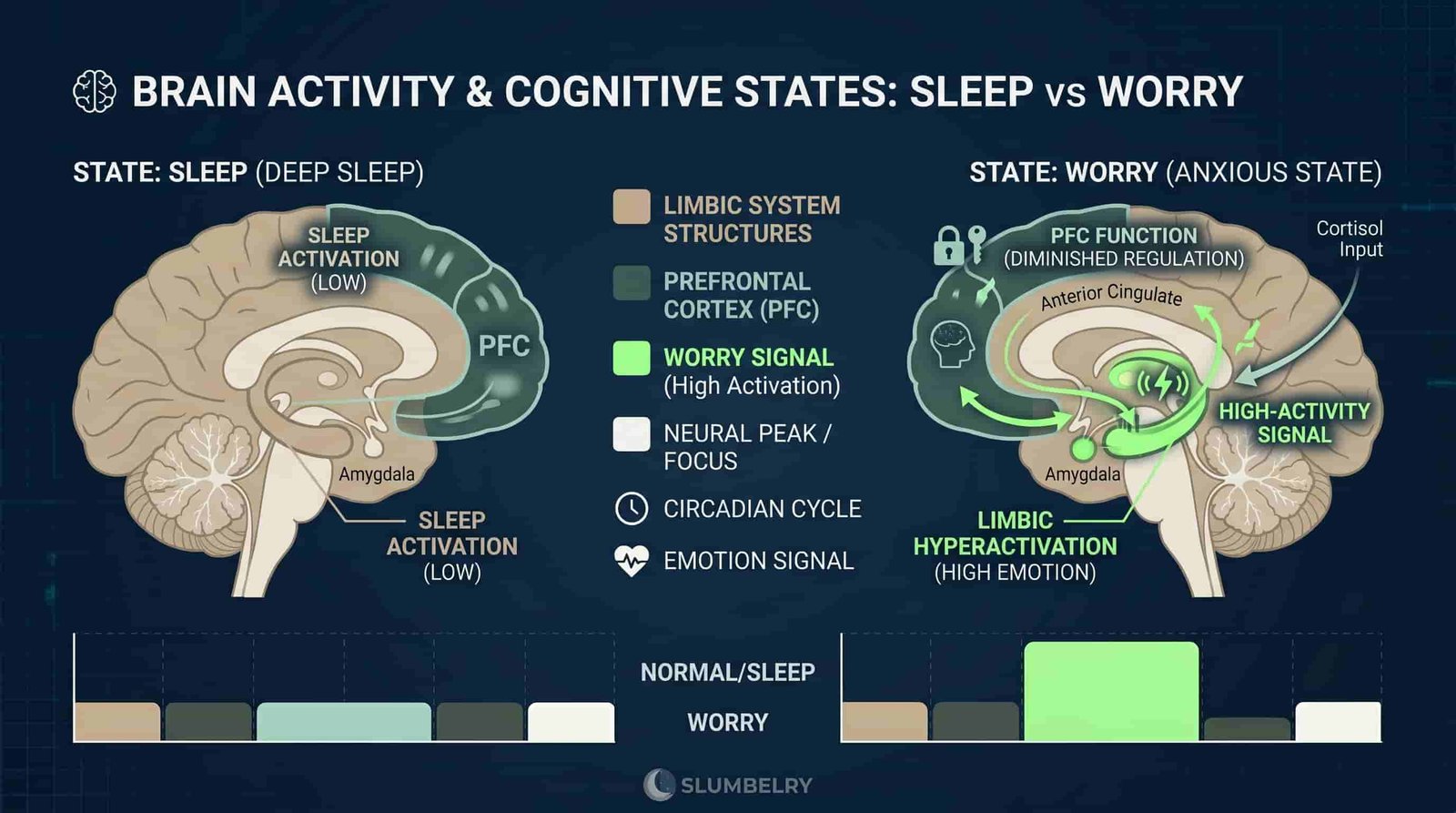
- The Problem: Unresolved worry keeps the prefrontal cortex active — the exact brain state that is biologically incompatible with sleep
- The Fix: The Worry Journal offloads cognitive burden onto paper, signaling to your brain that all work is done
- The Timing: Do the Worry Journal 90 minutes before bed — not at the bedside when cortisol is already rising

Why Does Your Brain Choose Bedtime to Solve Problems?
Direct Answer: Because your brain is a problem-solving machine that never fully powers down — and bedtime is when the prefrontal cortex, freed from daytime demands, finally has the bandwidth to run its threat-assessment algorithms on everything you ignored during the day.
Mechanism: McKenna’s sleep hypnosis research and Walker (2017) both confirm that the brain’s default-mode network (DMN) — the “background processing” system — activates when external tasks subside. The DMN is responsible for rumination, threat simulation, and future-planning. During the day, executive function (prefrontal cortex) suppresses the DMN. At night, without external stimulation, the DMN activates unchecked — and it does not distinguish between “real threats” and “unfinished to-do lists.” Your brain runs simulations of tomorrow’s meeting, last week’s argument, and next month’s rent, all labeled as equally urgent. This is not psychological weakness; it is neurobiology.
Actionable Advice: Understand that the racing brain at night is not broken — it is following its evolutionary programming. The goal is not to suppress it, but to give it a structured task that signals “all outstanding items have been processed.” That task is cognitive offloading.
What Is Cognitive Offloading and Why Does It Work for Sleep?
Direct Answer: Cognitive offloading is the process of transferring information from your brain to an external storage system — and research in the Journal of Experimental Psychology found that writing a to-do list for just five minutes before bed shortened sleep onset by an average of nine minutes.
Mechanism: The principle is elegant: your brain does not need to hold an item if an external system holds it reliably. When you write down a worry, your brain’s “open loop” — an unfinished cognitive task that consumes working memory — closes. The Journal of Experimental Psychology research showed that the more specific the list, the stronger the effect. Non-specific worry (“everything I need to do”) does not offload — the brain still holds the unresolved categories. Writing “call dentist about rescheduling appointment, 10am, not 11am” does offload because the item becomes fully resolved in the external system. Applied to sleep, cognitive offloading means transferring open loops — tasks, worries, half-formed plans — onto paper, so your brain can enter its maintenance mode without keeping one eye on the inbox.
Actionable Advice: Use the Worry Journal not as a diary, but as an external hard drive. Write specific, concrete next steps — not feelings. “Pick up dry cleaning Saturday, 9am” offloads. “I am worried about the week ahead” does not.
How Does Worrying Physically Keep You Awake (Beyond Just Feeling Anxious)?
Direct Answer: Worrying activates the HPA axis — the same physiological fight-or-flight system that would activate if you were facing a predator. Cortisol and adrenaline rise, heart rate increases, and the brain shifts from sleep-compatible theta waves to alert beta waves. This is not “feeling anxious” — it is measurable autonomic nervous system activation that is biologically incompatible with sleep.
Mechanism: Walker (2017) documents that the mere act of anticipating a stressful event — which is what worry does — elevates cortisol even if the event never occurs. The brain’s threat-assessment center (the amygdala) cannot distinguish between “I am being chased by a lion” and “I am worried about tomorrow’s presentation.” Both trigger identical cortisol responses. Sleep requires the ventrolateral preoptic area (VLPO) — the sleep-onset switch — to activate. VLPO is suppressed by elevated cortisol and norepinephrine. The more you worry, the more cortisol you produce, the harder it is for the VLPO to initiate sleep. This creates a vicious cycle:睡不着 → worry about not sleeping → cortisol rises →睡不着.
Actionable Advice: The Worry Journal works precisely because it addresses the cognitive source of the cortisol spike — the open loop — rather than trying to manage the physiological result through relaxation techniques. Close the loop, reduce the cortisol signal.
What Is the Worry Journal and How Do You Actually Do It?
Direct Answer: The Worry Journal is a structured cognitive offloading tool with four columns: the worry, the next concrete action, whether it is in your control, and a physical closing ritual. It takes 10–15 minutes, done 90 minutes before bed.
Mechanism: Stanley (2018), How to Sleep Well, describes structured worry time as a cornerstone of CBT-I-based approaches. The key insight is that your brain needs to see the worry as “processed,” not “suppressed.” The journal structure forces specificity: vague worries (“everything is a mess”) stay in the brain because they cannot be resolved. Specific worries (“need to confirm the flight time before midnight Sunday”) can be resolved in the journal, and the brain registers the resolution. The Four-Column method: (1) What am I worried about? (2) What is the ONE next concrete action? (3) Is this in my control? (4) If no, write “Out of my control — practice acceptance.” Then close the book. Literally close it. The physical act of closing the notebook signals to your brain that the session is over.
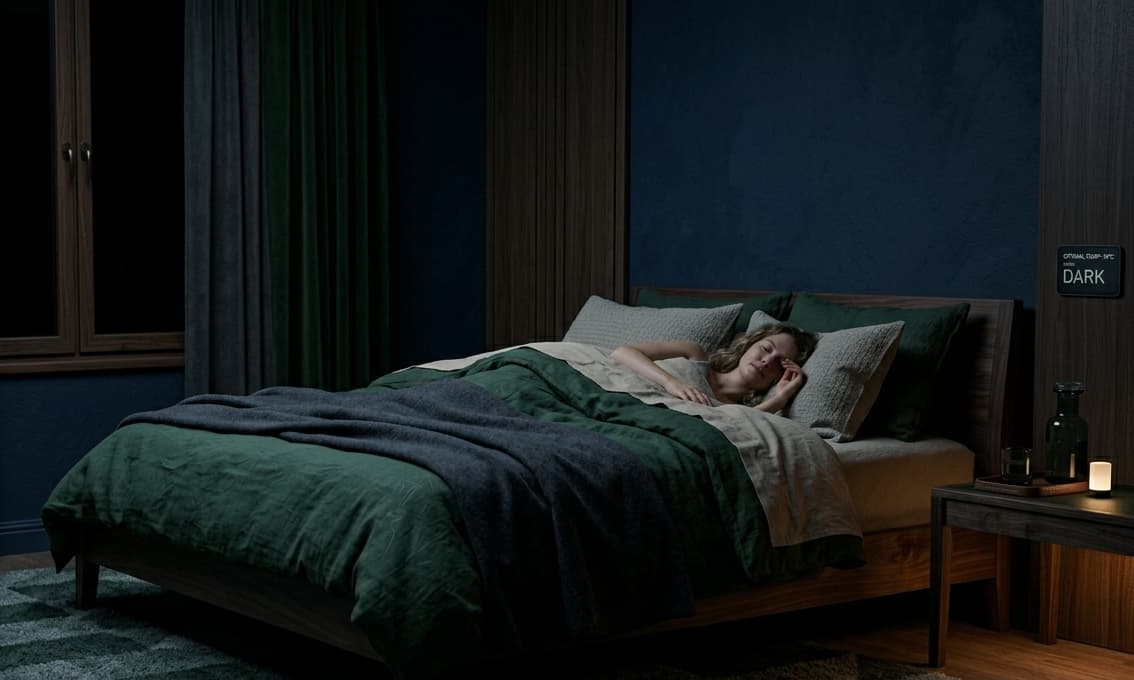
Actionable Advice: Tonight: get a dedicated notebook. At 9:30 PM (90 minutes before your target bedtime), spend 10–15 minutes writing. Face the notebook away from you or close it after the session. Place it somewhere outside the bedroom if possible — so the bedroom remains a sleep-only zone.
Why Does Writing Things Down Work Better Than Just Thinking About Them?
Direct Answer: Because thinking about a problem keeps it in working memory — the same limited-capacity system your brain uses for sleep onset. Writing transfers the problem to an external system, freeing working memory for its actual job: falling asleep.
Mechanism: The cognitive offloading effect has been replicated across multiple domains. When you write a number down, you no longer need to hold it in your head — your brain offloads the storage function. The same applies to worries and tasks. The hippocampus — the brain region that processes threat and memory — treats writing in a journal as a “committed decision” rather than an “open loop.” Research shows that writing about emotions (expressive writing) does not produce the same sleep benefit as writing about tasks and plans — because only task offloading closes the cognitive loop. The item must be specific and resolved in the journal, not just expressed.
Actionable Advice: Do not use the Worry Journal as a feelings diary. Use it as an external storage device. Write the exact worry, then the exact next action. If there is no action, write “Out of control — acceptance.” That specificity is what closes the loop.
How Is Productive Worry Different From Unproductive Rumination?
Direct Answer: Productive worry is time-limited, specific, and action-oriented — it produces a next step. Rumination is open-ended, abstract, and emotionally driven — it loops without resolution. Only productive worry can be offloaded; rumination feeds on itself.
Mechanism: McKenna and Meadows (sleep science) distinguish between “worry” — a cognitive process with a goal (problem-solving) — and “rumination” — a repetitive emotional loop with no goal. Worry activates the prefrontal cortex briefly and then resolves. Rumination keeps the prefrontal cortex online in a loop, preventing the brain from entering sleep mode. The Worry Journal’s structured format is specifically designed to convert rumination into worry: by forcing a “next action” and “in control or not” assessment, you push the brain from the emotional loop into the problem-solving mode — and problem-solving has a defined endpoint.
Actionable Advice: If you reread your worry and cannot identify a next action, you are ruminating — not worrying. The journal will tell you this. When you catch yourself in rumination, do not try to solve it in the journal. Write “Out of my control” and close the book. Trying to solve unresolvable problems in the journal recreates the loop you are trying to escape.
What Is the 90-Minute Pre-Bed Worry Window and Why Does Timing Matter?
Direct Answer: The 90-minute pre-bed window is when cortisol is naturally declining and adenosine (sleep pressure) is accumulating. Doing cognitive offloading during this window leverages the brain is natural transition state, rather than fighting it.
Mechanism: Walker (2017) documents that cortisol peaks in the morning and reaches its nadir around midnight. Cortisol begins rising again from around 2–3 AM to prepare for wakefulness. The period from roughly 9–11 PM is the cortisol trough — when the arousal system is at its lowest baseline of the day. This is the optimal window for cognitive offloading because the brain is already beginning its transition to sleep-compatible states (increasing theta and delta EEG activity). Attempting to do the Worry Journal at 11:30 PM, when cortisol has already started rising and sleep pressure has partially dissipated, is less effective. The session must end at least 30 minutes before target bedtime — so your brain has time to register “all loops closed” before you enter the bedroom.
Actionable Advice: Set a daily alarm for 9:30 PM labeled “Worry Journal.” Do it at the same time every night, including weekends, for 21 days. After 21 days of consistency, your brain will anticipate the offloading ritual at 9:30 PM and begin winding down preemptively.
Can CBT-I Techniques Alone Clear Your Mental Inbox Without Medication?
Direct Answer: Yes — and for chronic insomnia driven by worry and rumination, CBT-I is the first-line treatment recommended by the American Academy of Sleep Medicine (AASM), outperforming medication on every long-term measure.
Mechanism: Walker (2017) reviews the comparative outcomes: CBT-I produces durable improvements in sleep onset and maintenance that medication cannot match, because medication addresses the symptom (sleeplessness) while CBT-I addresses the mechanism (the conditioned arousal response to the bed). For worry-driven insomnia specifically, the combination of stimulus control (removing sleep-incompatible activities from the bedroom), cognitive restructuring (challenging catastrophic sleep beliefs), and sleep restriction (reducing time in bed to build sleep pressure) is clinically proven to reduce insomnia severity scores by 50–60%. The Worry Journal is a cognitive restructuring tool that fits within the broader CBT-I framework.
Actionable Advice: If you have tried the Worry Journal consistently for 4 weeks without improvement, consider a formal CBT-I program (many are available online). CBT-I apps and programs are more accessible than ever and do not require medication.
Why Does Sleep State Misperception Make Worrying at Night Feel Worse?
Direct Answer: Because sleep state misperception (SSM) makes you believe you were awake for far longer than you were — which triggers anxiety about “not sleeping enough,” which produces more cortisol, which creates the very wakefulness you feared.
Mechanism: Dr. W. Chris Winter (The Sleep Solution) documents that insomniacs consistently overestimate how long they were awake by 30–50 minutes per night. During light N1 and N2 sleep, your brainwave patterns are similar to wakefulness — but you are asleep. The insomniac’s hypervigilant monitoring system registers each micro-arousal as a full wake event, producing a cumulative overestimate that feels devastating but is physiologically inaccurate. When you add worry to SSM, the combination is especially destructive: you wake, you worry, the cortisol spike makes you more alert, you notice being awake more, you worry more about how bad this is. The Worry Journal does not just address the worry — it gives you an accurate frame: you likely slept more than you think, and the journal has already processed the worry items, so there is nothing left for the brain to run overnight.
Actionable Advice: If you wake at 3 AM and the journal is closed, remind yourself: “The worrying session is over. The brain has received the signal.” Use the journal as a reality check: when you close it at 9:45 PM, the work is done. Nothing more requires your attention tonight.
How to Build a Sustainable Pre-Sleep Worry Journal Routine (Step-by-Step)
Direct Answer: This is not a one-night experiment — it is a behavioral routine that takes 21 days to become automatic. Follow this protocol consistently, at the same time, with the same physical setup, and your brain will learn to treat the journal as the signal that the day’s cognitive work is complete.
Mechanism: Littlehales (2016), Sleep, describes the pre-sleep routine as a neurological cue — the same way a bedtime story signals a child is time to sleep, the Worry Journal signals the adult brain that it is safe to power down. Neuroplasticity requires repetition: the first night you use the journal, your brain is skeptical. By night 21, the routine has built a consistent neural pathway: journal = all loops closed = safe to sleep. This is the same principle behind sleep hygiene rituals worldwide, adapted for the cognitive offloading framework.
Actionable Advice: Step 1: Set a daily alarm at 9:30 PM labeled “Worry Journal — cognitive offloading for sleep.” Step 2: Use a physical notebook, placed at a desk or table, not in bed. Step 3: Write for 10–15 minutes only. If nothing is on your mind, write “Day complete — no outstanding items.” Step 4: For each worry, fill in all four columns: the worry, the next action, in control or not, acceptance statement. Step 5: Close the book with intention. Step 6: Place the notebook outside the bedroom or face-down on a shelf. Step 7: Enter the bedroom only when genuinely sleepy. Repeat for 21 consecutive nights. Combine with Slumbelry ergonomic support to minimize physical micro-arousals during the sleep window.
Frequently Asked Questions
Does journaling before bed actually help with anxiety and sleep?
Direct Conclusion: Yes — specifically, cognitive offloading for sleep through structured task journaling has research backing. A Journal of Experimental Psychology study found that writing a specific to-do list for just 5 minutes before bed shortened sleep onset by an average of 9 minutes. The key distinction: you must write specific next-action items, not emotional expressions. Expressive journaling about feelings without resolution does not produce the same sleep benefit.
What is the difference between productive worry and rumination?
Direct Conclusion: Productive worry is specific, time-limited, and action-oriented — it ends when you have a next step. Rumination is abstract, open-ended, and emotionally driven — it loops without resolution. The Worry Journal is designed to convert rumination into productive worry by forcing a next-action response. If you write a worry and cannot identify a next action, write ‘Out of my control — acceptance’ and close the book. That is not failure; that is the journal working correctly.
How long before bed should you do the Worry Journal?
Direct Conclusion: Aim for 90 minutes before target bedtime — approximately 9:30 PM for an 11 PM bedtime. This window corresponds to the cortisol trough, when the arousal system is at its lowest baseline of the day, making it easier for your brain to accept the ‘all loops closed’ signal. The session itself takes 10–15 minutes. Leave at least 30 minutes between closing the journal and entering the bedroom.
What if I have no solutions for my worries — what do I write?
Direct Conclusion: Write exactly that: ‘Out of my control — practicing acceptance.’ The journal is not a problem-solving tool for unresolvable situations. Its purpose is to identify what is in your control and process it, while explicitly noting what is not. The act of writing ‘out of my control’ closes the cognitive loop as effectively as writing a next action — the brain registers both as processed items.
Does the Worry Journal work for people with clinical anxiety or depression?
Direct Conclusion: It can help with the sleep-disruption component of anxiety, but it is not a standalone treatment for clinical anxiety disorders. If you have GAD, panic disorder, or clinical depression, the Worry Journal should be used alongside appropriate psychological treatment. However, even in clinical populations, cognitive offloading reduces sleep-onset latency. Talk to your therapist about integrating it into your broader treatment plan.
How many worries should you write in one session?
Direct Conclusion: Write everything that is active, but cap the session at 10–15 minutes. If you have more than 10 active worries, prioritize the three most urgent and note the rest as ‘to review tomorrow morning.’ The session should feel like a data-processing task, not an emotional excavation. The goal is cognitive offloading, not catharsis.
Can I just type in my phone instead of using a physical notebook?
Direct Conclusion: A physical notebook is preferred because the sensory act of writing — the pen on paper, closing the book — provides additional sensory cues that reinforce the ‘session is over’ signal to your brain. Phone typing lacks the tactile closing ritual. That said, if physical disability or timing constraints make a notebook impractical, typing on your phone in a dedicated app, followed by physically placing the phone outside the bedroom, is an acceptable alternative.
Why do I feel more anxious after writing my worries down?
Direct Conclusion: This usually means you are using the journal as an expressive tool rather than an offloading tool. If you are writing about feelings without resolving them into next actions, you are reminding your brain of every unresolved item rather than closing them. Make sure every entry has a next-action column filled in. If a worry has no solution, the ‘Out of my control — acceptance’ line closes the loop. The journal should feel like completing a task list, not opening an emotional floodgate.
What should I do if worries come back after I have closed the journal?
Direct Conclusion: Note the worry on a separate piece of paper or a notes app, and tell yourself: ‘This is for tomorrow’s session.’ The key rule: the bedroom is for sleep, not for re-engaging with the journal. If a worry returns after closing, it goes into the ‘tomorrow’ inbox. Opening the journal in bed to re-process defeats the entire cognitive offloading purpose — your brain must learn that the journal is closed once the session ends.
What is the single most important thing to remember about the Worry Journal?
Direct Conclusion: It is not a feelings diary — it is an external hard drive for your brain. Every entry must end with a specific next action or an ‘out of my control — acceptance’ statement. If your journal entries are emotionally expressive but unresolved, you are maintaining the open loops rather than closing them. Write to close the loop, not to express the feelings.
Ready to Transform Your Recovery?
If your brain has been running overnight shifts, take action today. Discover science-backed solutions for better rest.
Take the Sleep Assessment Explore Our Cooling MattressThe Slumbelry Commitment
Sleep is the most vulnerable state of human existence. It is where we heal, reset, and grow.
At Slumbelry, we do not just sell sleep products; we advocate for your physiological right to rest. From ergonomic support to light management, every solution we offer is designed with one obsession: Respecting your Biology.
Science is our language, but your recovery is our purpose. You take care of everything else in your life — let us take care of your sleep.
Rest Deeply,
The Slumbelry Team