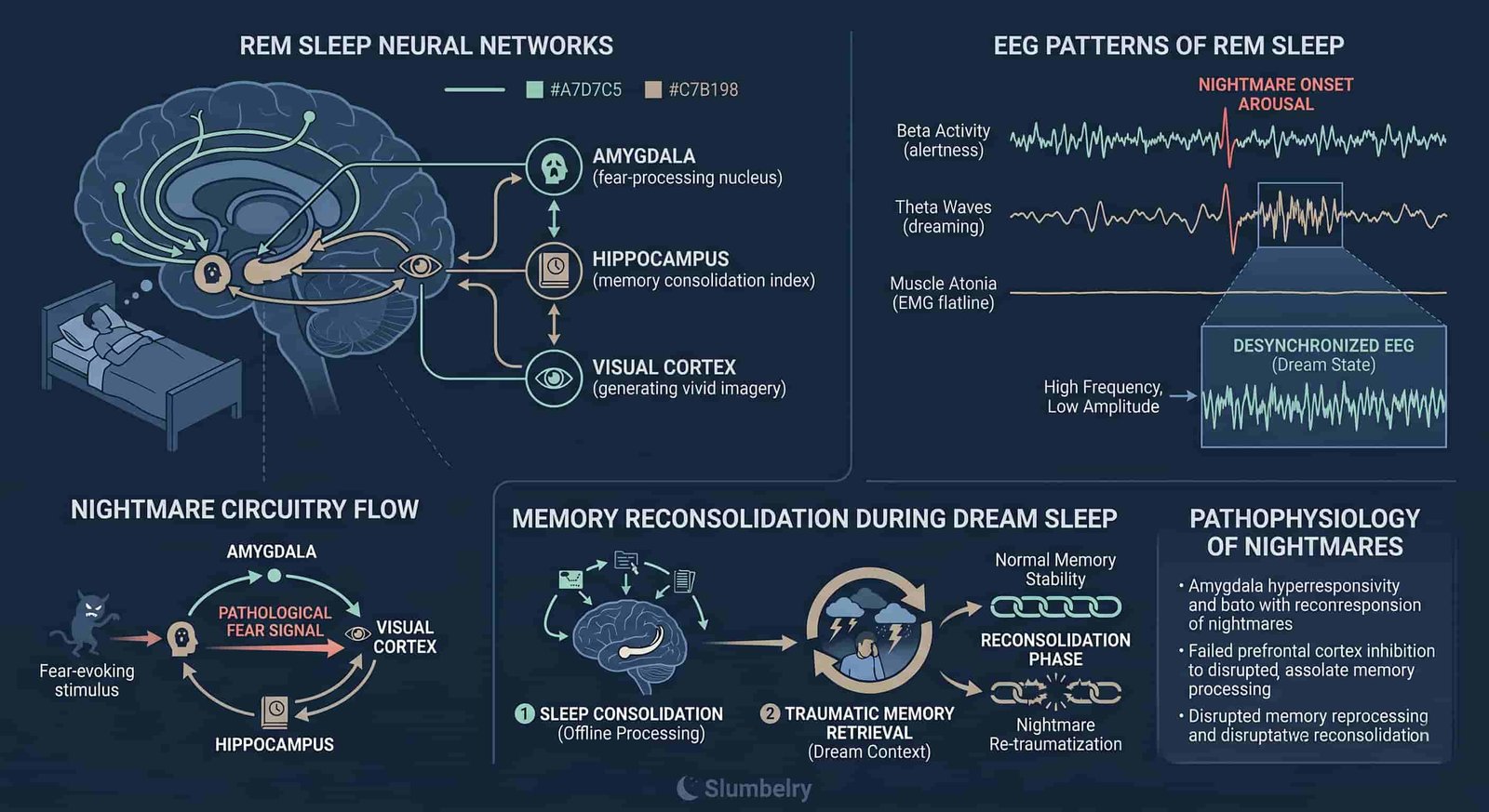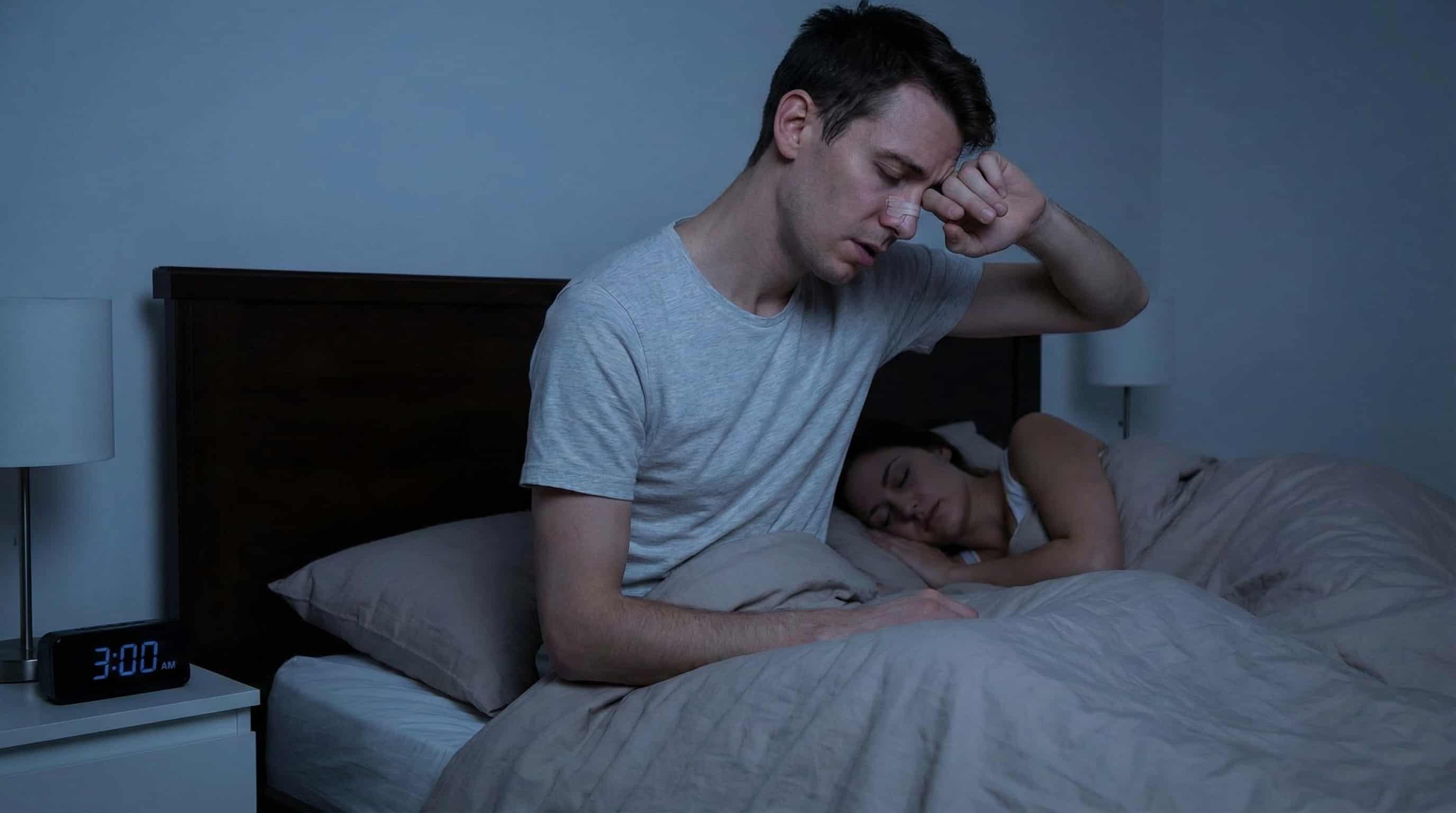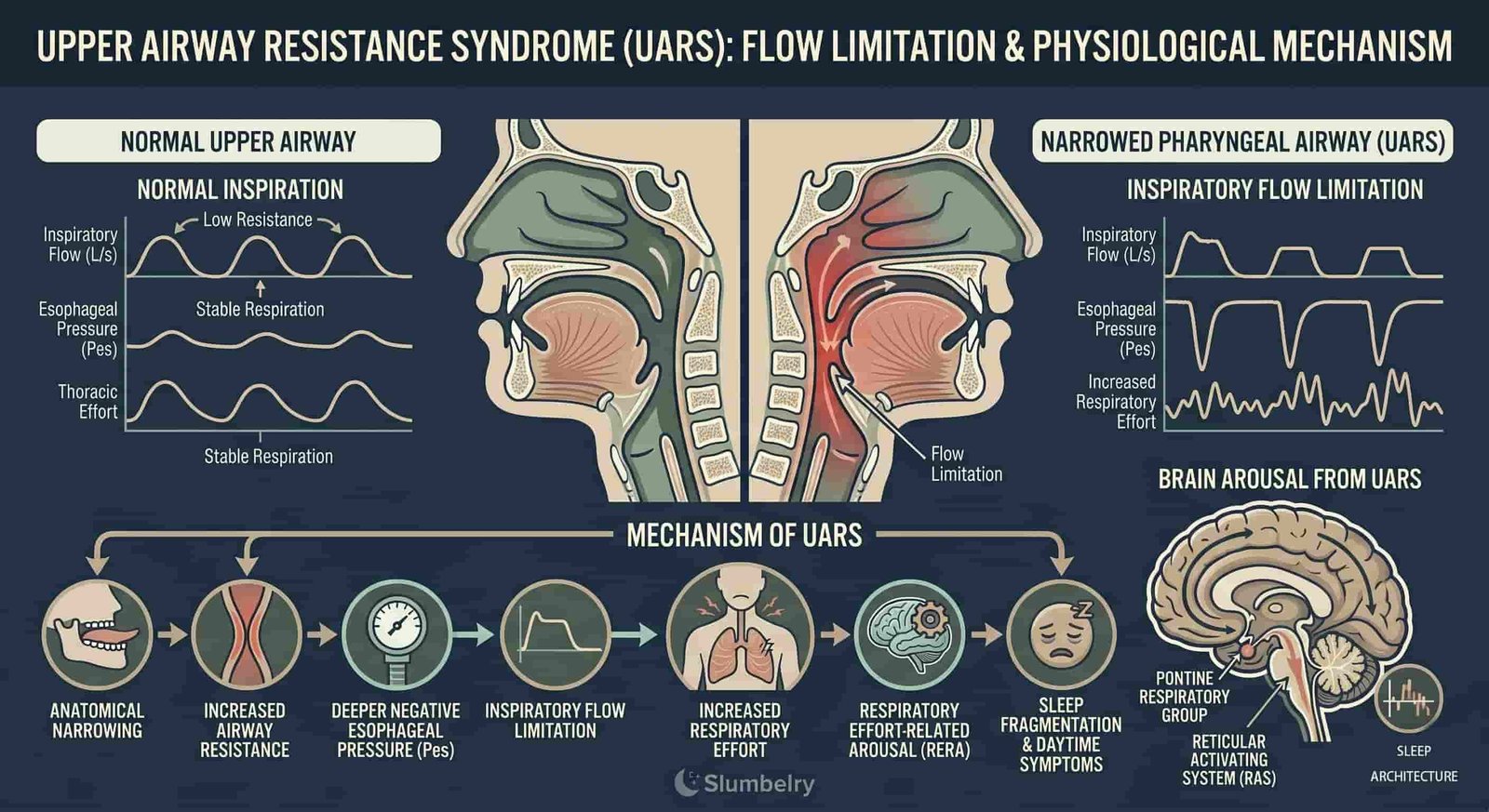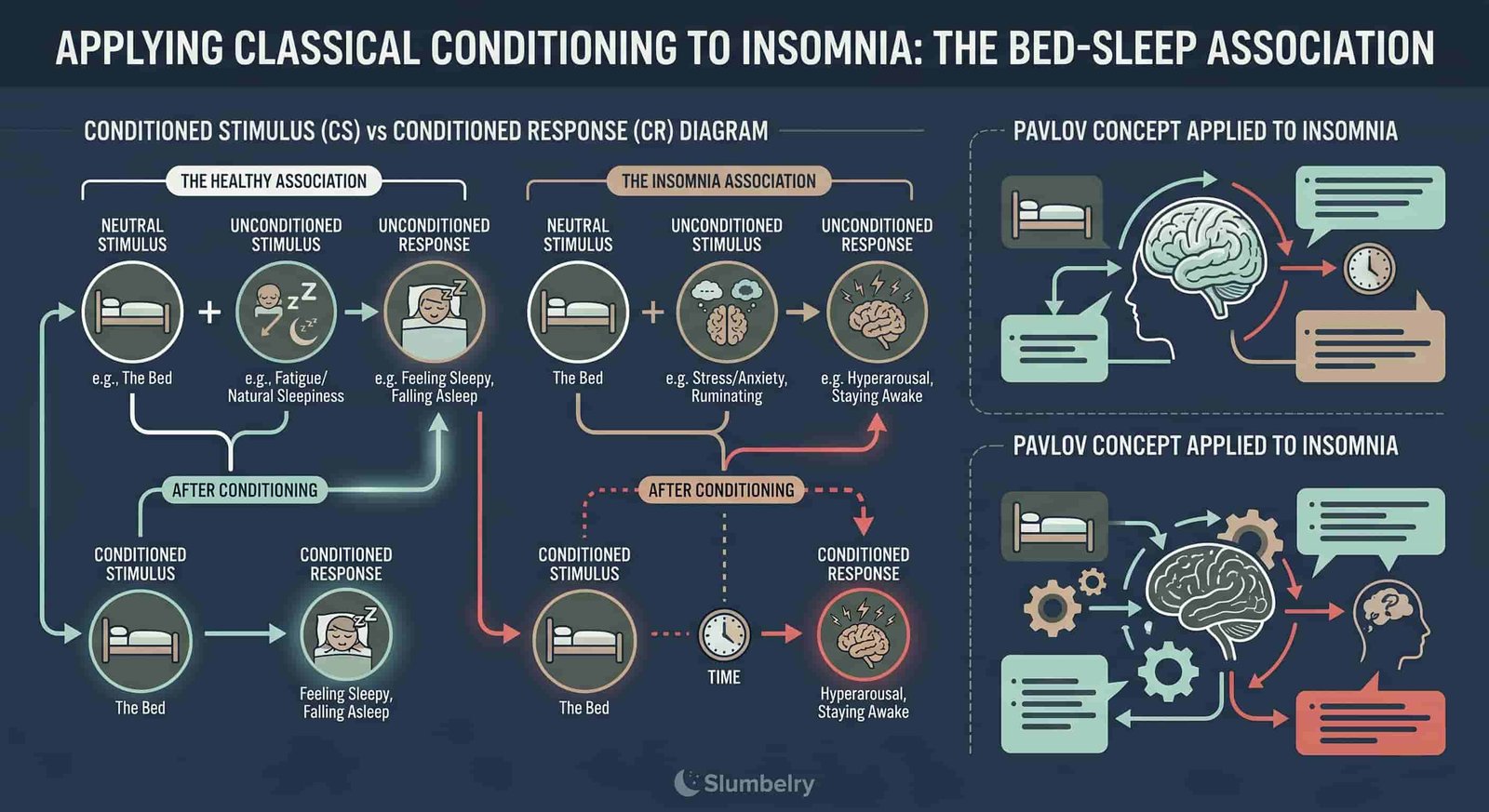
https://slumbelry.com/
×
Slumbelry
HOME SHOP WELLBEING BLOG LOGIN / REGISTER SEARCH CONTACT

The Simple Shift That Turns Sleep From a Chore Into a Performance Tool

The R90 Sleep Method: Count Cycles, Not Hours (2026) | Slumbelry Sleep Science

Stop Counting Sleep Hours. Start Counting Sleep Cycles.

⚡ Core Takeaway: The R90 System in 3 Sentences

  • The 8-hour rule is a myth: Sleep is measured in 90-minute cycles, not hours. Think 35 cycles per week — not 8 hours per night.
  • Wake time is sacred: Your fixed wake anchor — not your bedtime — is the most important sleep commitment you can make. It calibrates your entire circadian rhythm.
  • One bad night is meaningless: Cycle debt is managed across a week, not corrected by going to bed early. Maintain the anchor, track weekly, and stop daily catastrophizing.

Key Facts at a Glance

  • 90 minutes = one complete sleep cycle
  • 35 cycles/week = R90 weekly target (5/night × 7 days)
  • 5-6 cycles = typical nightly need (7.5-9 hours)
  • 60% = glial cell shrinkage during N3 deep sleep
  • 20-40 min = N3 deep sleep stage duration
  • 1-3 PM = optimal nap window (circadian dip)
  • 14 min = average sleep onset latency to add to bedtime
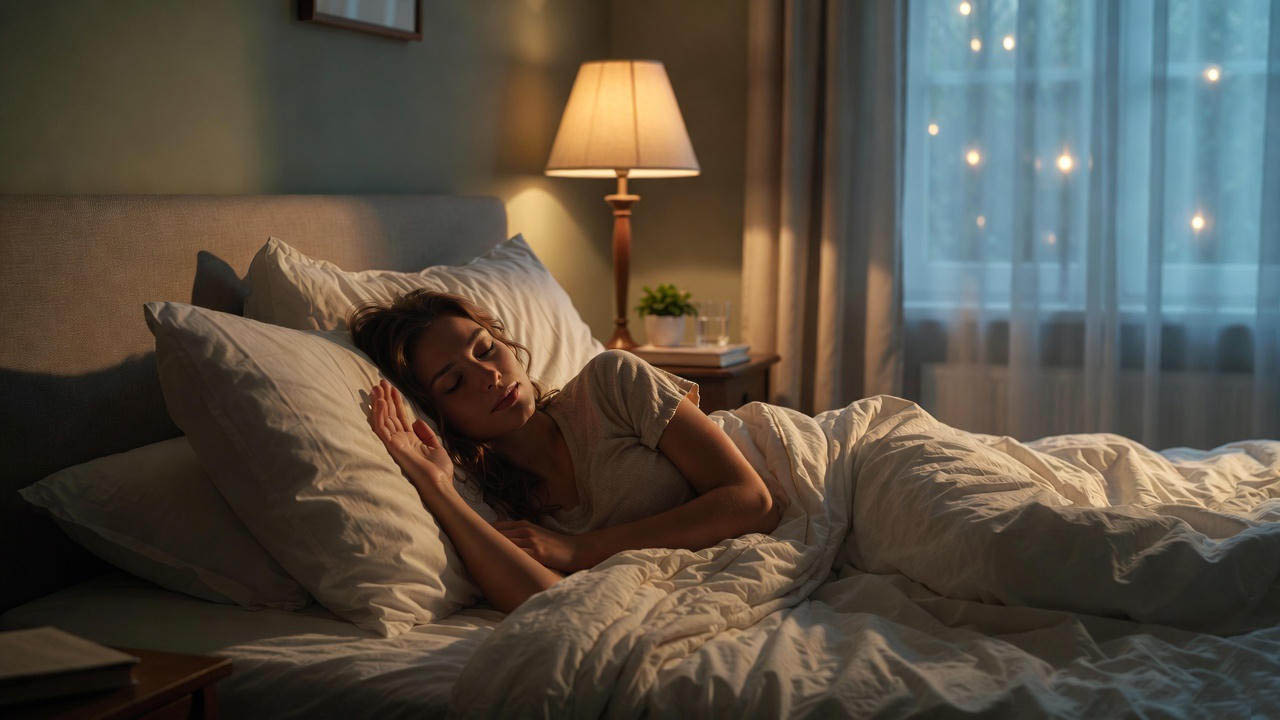
Person sleeping peacefully in fetal position on an ergonomic mattress, soft moonlight through blackout curtains, bedroom dark and quiet
The R90 method starts with one decision: a fixed wake time that you never break. Everything else — your bedtime, your cycle count, your weekly target — flows from that anchor.

The R90 sleep method is a cycle-based framework that replaces the arbitrary 8-hour nightly target with a flexible weekly cycle goal of 35 cycles. Developed by British sleep coach Nick Littlehales and used by elite athletes across Premier League football and Olympic training, it is the most evidence-based approach to sleep optimization currently available. This guide covers every element of the R90 system — from calculating your perfect bedtime to timing your training schedule — so you can implement it starting tonight.

What Is the R90 Method — And Why the 8-Hour Rule Is a Myth

R90 is the sleep strategy pioneered by British sleep coach Nick Littlehales, used with elite athletes, that reframes sleep from “hours needed” to “90-minute cycles completed.” The 8-hour recommendation is a statistical average that ignores individual genetics, age, and chronotype — and forces millions of people into anxiety when they wake at 6 AM having “only” gotten 7 hours.

The Science: Why 8 Hours Is Industrial-Era Convention

Littlehales’ R90 research shows the brain operates in 90-minute cycles throughout the day — ultradian rhythms that govern alertness, digestion, and creativity. Applying the same cycle logic to night sleep reveals that waking mid-cycle (during deep sleep or REM) is the real cause of grogginess, not total hours. The 8-hour target is not biology — it is a cultural convention from the industrial era. The glymphatic system does not check a clock; it clears metabolic waste across full sleep cycles regardless of when you started.

Action step: Stop setting your alarm for 7 AM and back-calculating a bedtime. Instead, set your wake time first, then calculate your ideal bedtime by counting back in 90-minute increments: 7:00 AM → 5:30 AM → 4:00 AM → 2:30 AM → 11:00 PM → 9:30 PM.

The 90-Minute Sleep Cycle — What Actually Happens in Each Stage

Each 90-minute cycle moves through four stages: N1 (drowsiness), N2 (light sleep with memory consolidation), N3 (deep sleep with glymphatic cleansing), and REM (dream sleep with emotional processing). Waking mid-N3 is the physiological cause of that “concrete limbs” grogginess — not the number of hours you slept.

The Four Stages: A Complete Cycle Breakdown

N1 (1–5 minutes): The transition from wakefulness. Brain waves shift from alpha to theta. Easily disturbed. N2 (10–25 minutes): Light sleep. Heart rate slows, body temperature drops. The brain begins consolidating memories — skills learned during the day are processed here. N3 (20–40 minutes): Deep sleep. Glial cells shrink by 60%, cerebrospinal fluid flushes through the brain clearing beta-amyloid and metabolic waste. This is where physical recovery happens. REM (10–60 minutes): Brain is as active as waking. Noradrenaline completely shut off — the only stress-free state in 24 hours. Emotional memories are processed and stripped of their acute sting.

Action step: Learn to recognize what waking at different cycle points feels like. Waking after 4 full cycles (6 hours) and feeling refreshed means you completed the deep sleep and REM your brain needed. Waking mid-cycle and feeling destroyed means you interrupted it — not that you need more hours.

The Weekly Cycle Target — Why 35 Cycles Changes Everything

R90 replaces the anxiety of nightly 8-hour targets with a forgiving weekly cycle target of 35 cycles (approximately 5 cycles per night × 7 days). This removes the psychological pressure of “I failed tonight” and replaces it with a sustainable long-term average.

Why Weekly, Not Nightly

Littlehales designed this framework from his work with Premier League footballers who travel constantly, play matches at odd hours, and experience disrupted nights. A fixed wake time plus a weekly cycle target accommodates late nights, early mornings, and disrupted nights without the panic of a single bad night. If you miss 2 cycles one night, you have 4 extra to absorb across the week without any biological cost. The glymphatic system and memory consolidation both operate on a weekly cadence, not a nightly judgment.

Action step: Track your cycles for 7 days without changing anything. At the end of the week, add them up. If you are above 35, you are in surplus. If you are below, note which days were short — but do not catastrophize.

R90 vs. The Traditional 8-Hour Method

FactorR90 Method8-Hour Rule
Unit of measure90-min cycles (5-6/night)Hours (8/night)
Weekly target35 cycles/week8 hours/night
Wake timeFixed anchor (non-negotiable)Flexible
Missed nightAbsorbed into weekly totalCauses panic/compensation
Grogginess causeWaking mid-cycleNot explained
Evidence baseElite athlete protocolsPopulation average
AdaptabilityShift workers, travelersRigid
Psychological loadLow (weekly, forgiving)High (nightly judgment)

How to Calculate Your Perfect Bedtime Using Backward Math

The most powerful R90 tool is backward calculation from your fixed wake time. If you need to wake at 6:30 AM and want 5 cycles, your ideal bedtime is 10:00 PM. If you want 6 cycles, it is 9:00 PM. Never choose a bedtime arbitrarily — always calculate it.

How to Calculate Your Ideal Bedtime with R90

  1. Set Your Fixed Wake Time — Choose a wake time you can keep every day, including weekends.
  2. Count Backward in 90-Minute Blocks — 5 cycles before wake time = ideal bedtime. Example: 6:30 AM wake → 11 PM bedtime.
  3. Add Sleep Onset Latency — Add ~14 minutes to bedtime to account for time to fall asleep.
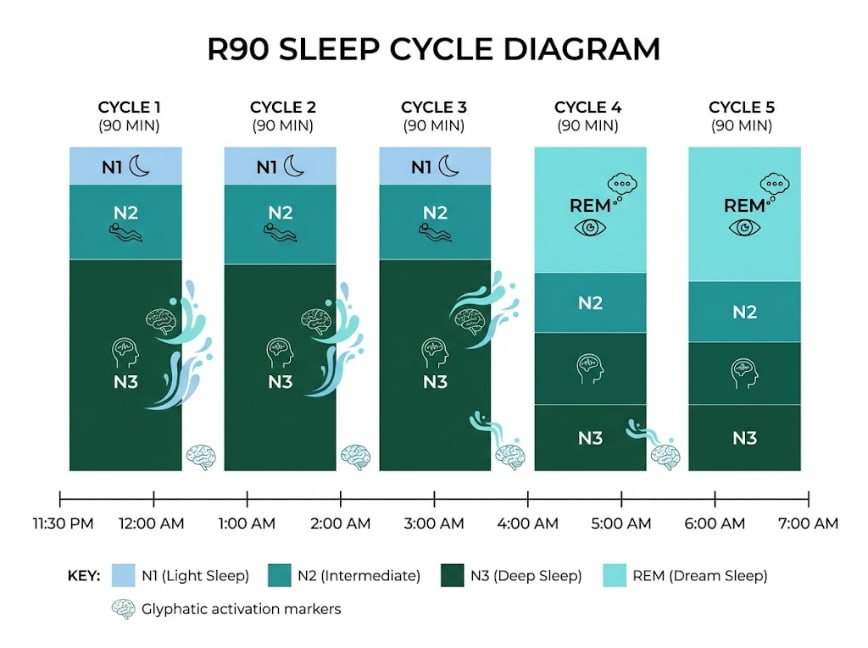
R90 sleep cycle diagram showing N1-N2-N3-REM stages across 5 complete 90-minute cycles from 11:00 PM to 7:00 AM with glymphatic activation markers
A complete R90 cycle runs 90 minutes: N1 (drowsiness) → N2 (memory consolidation) → N3 (glymphatic brain cleanse) → REM (emotional processing). Waking mid-cycle — not total hours — is what causes grogginess.

The Anchor Night — Why Your Wake Time Is Non-Negotiable

The most counterintuitive R90 rule: even if you go to bed at 3 AM, wake up at your fixed time. Skipping your anchor wake time is the single fastest way to destroy your circadian rhythm and lose the entire week’s cycle target.

The Science of the Wake-Time Anchor

James Maas’ research on circadian rhythm confirms: the wake time signal is the strongest zeitgeber (time-giver) for the suprachiasmatic nucleus (SCN). Every time you sleep in past your anchor, you send a confusing signal that shifts your entire circadian phase — equivalent to traveling across time zones. The SCN uses wake time to calibrate when to release melatonin, when cortisol should peak, and when adenosine should accumulate. Without a consistent anchor, none of these signals can establish a reliable pattern — which is why shift workers who rotate schedules experience chronic jet lag.

Action step: Set your wake time alarm for the same time every day, including Saturdays. If you go to bed late, you still wake on time and absorb the cycle debt into your weekly total. No exceptions.

Napping Strategically — CRP and the Nappuccino

Planned naps are a performance tool, not a sign of weakness. The key is timing them in 90-minute multiples (one full cycle) or 30-minute singles (one-third cycle) to avoid sleep inertia — the grogginess from waking mid-cycle. The ideal nap window is 1–3 PM when the circadian rhythm naturally dips.

⚡ The Three Nap Types

  • Power Nap (20 min): Restores alertness for 3-4 hours. Do not enter deep sleep. Best before 3 PM.
  • Full Cycle Nap (90 min): Completes one full N1-N2-N3-REM cycle. Use when replacing missed overnight cycles. Afternoon only.
  • Nappuccino: Drink coffee, immediately nap 20 minutes. Caffeine kicks in as you wake. One per day max, never after 2 PM.

The Ideal Sleep Position — Fetal Position and the Spinal Alignment Rule

The optimal sleep position for most adults is the fetal position, lying on the opposite side of your dominant hand (right-handed → left side). This protects your instinctual dominant side and, combined with a pillow that maintains spinal alignment, produces the deepest, most restorative sleep.

The Straight Line Rule

Littlehales’ research with elite athletes found that head, neck, and spine must form a straight line in any sleep position. If the pillow is too high or the mattress too soft, the cervical spine bends, causing micro-awakenings from discomfort that fragment deep sleep. The fetal position also naturally restricts airway collapse — beneficial for those with mild snoring. Slumbelry’s pillow and mattress engineering is calibrated to maintain this “Golden Line” across all sleep positions.

Action step: Lie on your non-dominant side with knees slightly bent. Check in a mirror: if your head is tilted, your pillow height is wrong. If your spine looks curved, your mattress lacks proper support.

What Happens When You Miss a Night — Cycle Debt vs. Panic

One bad night of sleep is biologically insignificant if you maintain your weekly cycle target. The panic reaction — going to bed earlier, checking sleep scores, calculating deficits — is what actually causes the second bad night. Sleep debt is real, but it’s managed across weeks, not hours.

Why Panic Is the Real Problem

Walker’s two-process model shows adenosine accumulates with wakefulness and is cleared during sleep. A single disrupted night means you clear less adenosine — but the accumulation resumes at the same rate. What matters is the weekly clearance average, not any single night. The glymphatic system’s efficiency is affected by total sleep time, but it recovers quickly with one full night of good sleep. Anxiety triggered by a bad night activates the sympathetic nervous system — the very state that prevents the next night’s sleep from being restorative.

Action step: If you slept poorly: maintain your fixed wake time, absorb the deficit into your weekly total, and trust the system. Do not go to bed earlier, do not nap excessively, do not track obsessively.

Sleep Cycles and the Gym — How to Time Training Around Your Rhythm

Training too close to your natural sleep window elevates cortisol and body temperature, delaying sleep onset and fragmenting the cycles you need for recovery. Morning and early afternoon training aligns with the circadian peak in muscle temperature, reaction time, and strength.

⚡ Training Timing Guidelines

  • Before 3 PM: High-intensity training (HIIT, weights, running). Core body temperature and cortisol are at optimal levels for performance.
  • 4–6 PM: Moderate-intensity only. Body temperature peaks here — too late for peak performance but acceptable for maintenance.
  • After 7 PM: Light movement only (walking, yoga, stretching). No high-intensity work. Cold shower 30 min before bed to accelerate core temperature drop.

A person stretching after waking at dawn, alarm clock showing 7:00 AM, warm light filtering through curtains, clean organized bedroom environment
The fixed wake time is your anchor. Waking at the same time every day — even after a short night — is the single most powerful thing you can do for your circadian rhythm.

The Slumbelry Framework — R90 as Part of a Complete Sleep System

R90 works best when your bedroom environment fully supports the parasympathetic state. A zero-motion mattress that isolates partner movement, blackout curtains that eliminate light completely, and 18–20°C room temperature all compound the benefits of a well-calculated cycle target.

Why the Schedule Is Only as Good as the Environment Protecting It

Walker confirms that glymphatic activation is most efficient during the deepest N3 stages — which are also the most easily disrupted by light, temperature fluctuations, and physical movement. Slumbelry’s Sleep System protects those cycles at every layer: an ergonomic mattress maintains spinal alignment during the fetal position, cooling technology maintains the core temperature drop required for sleep onset, and sound masking eliminates the auditory triggers for micro-arousals. The schedule tells your brain when to sleep; the environment lets it.

Action step: Calculate your R90 schedule first. Then audit which environmental factor is most disrupting your cycles — and fix it. The schedule optimization is only as good as the environment protecting it.

Looking for the right support? The Zeno Butterfly Pillow is engineered to maintain the Golden Line across all sleep positions — a key part of the R90 protocol.

Frequently Asked Questions About the R90 Sleep Method

What is the R90 sleep method and where did it come from?

The R90 sleep method was developed by British sleep coach Nick Littlehales, author of ‘Sleep: The Myth of 8 Hours, the Power of Naps, and the New Plan to Recharge Your Body and Mind.’ Based on research with elite athletes including Premier League footballers and Olympic teams, R90 reframes sleep from a nightly hour target to a weekly cycle target. The core principle: sleep consists of 90-minute cycles (N1 → N2 → N3 → REM) and waking at the right point in the cycle matters more than total hours. The target is 35 cycles per week.

Why is the 8-hour sleep recommendation a myth?

The ‘8 hours per night’ recommendation is a statistical average from large population studies — it ignores individual genetics, age, chronotype, and activity level. Some adults function optimally on 5 cycles (7.5 hours); others genuinely need 6-7 cycles (9-10.5 hours). What matters is completing full cycles without mid-cycle interruption, not hitting an arbitrary number. Matthew Walker’s research confirms the glymphatic system and memory consolidation functions of sleep are cycle-dependent, not hour-dependent.

How do I calculate my perfect bedtime using R90?

First, set a fixed wake time you can maintain 7 days a week. Second, count backward in 90-minute blocks: if you need to wake at 6:30 AM and want 5 cycles, your ideal bedtime is 10:00 PM (5 cycles: 6:30 AM → 5:00 AM → 3:30 AM → 2:00 AM → 12:30 AM → 11:00 PM). Add 14 minutes for average sleep onset latency. If you want 6 cycles, your bedtime is 9:00 PM. Use this calculation, not intuition, to set your bedtime.

What’s the most important rule in R90?

Your fixed wake time is the single most important commitment. Never skip it — even if you went to bed at 3 AM. The wake time is the anchor that calibrates your entire circadian rhythm. Skipping it sends your SCN a confusing signal equivalent to traveling across time zones. This one rule — never vary your wake time by more than 30 minutes — has more impact on sleep quality than any other habit.

How many cycles do I actually need?

Most adults need 5-6 cycles per night (7.5-9 hours), which translates to 35-42 cycles per week. If you’re new to R90, start at 5 cycles and assess after 2 weeks: do you wake without an alarm feeling refreshed? If yes, stay at 5. If you’re consistently tired, increase to 5.5 or 6 cycles. Athletes in heavy training may need 6-7 cycles for full recovery.

Can I make up missed sleep with naps?

Yes — strategically. A 90-minute afternoon nap (one full cycle) can replace 1-2 missed overnight cycles. A 20-minute power nap before 3 PM restores alertness without affecting nighttime sleep. Never nap after 4 PM. If you missed 3+ cycles overnight, a 90-minute afternoon nap is the most efficient recovery tool.

What’s the Nappuccino and does it work?

The Nappuccino is a performance hack: drink a cup of coffee immediately before taking a 20-minute nap. Caffeine takes approximately 20 minutes to cross the blood-brain barrier and block adenosine receptors. By the time you wake from the nap, the caffeine kicks in, combining the restorative benefit of light sleep with the alertness boost of caffeine. Used by athletes and executives, it provides 3-4 hours of enhanced alertness. Do not exceed one Nappuccino per day, and never after 2 PM.

What’s the best sleep position for R90?

The fetal position on your non-dominant side (right-handed → left side, left-handed → right side) is recommended by Littlehales as the optimal position for most adults. This protects your instinctual dominant side and, combined with a pillow that maintains spinal alignment (head, neck, and spine forming a straight line), produces the deepest, most restorative sleep. Back sleeping is acceptable but not optimal; stomach sleeping actively disrupts the fetal position’s spinal benefits.

Does R90 work for shift workers with irregular schedules?

R90 was specifically designed for shift workers and frequent travelers. The anchor wake time remains the priority, but shift workers can use ‘anchor sleep’ — a consistent 4-hour core sleep period at the same time each day — plus variable supplementary sleep blocks. The key is protecting the circadian anchor while being flexible about total cycle accumulation across a 24-hour window rather than a single night.

How does R90 interact with exercise and training?

High-intensity training within 3 hours of your calculated bedtime raises core body temperature and activates the sympathetic nervous system — directly opposing the parasympathetic state required for sleep onset. For athletes, complete intense training by 4 PM. Light evening exercise (walking, yoga) is acceptable. Post-training, a cold shower accelerates core temperature decline and signals the body toward sleep readiness. Avoid high-glycemic recovery meals within 2 hours of bedtime.

Is the R90 method scientifically backed?

Yes. R90 is built on established sleep science — ultradian rhythms (90-min cycles), Matthew Walker’s research on the glymphatic system and memory consolidation, and chronobiology. It has been validated in practice by elite athletes, particularly Premier League footballers. However, individual results vary, and R90 should complement — not replace — professional medical advice for diagnosed sleep disorders like insomnia or sleep apnea.

How long does it take to see results with the R90 method?

Most people notice reduced morning grogginess within 1-2 weeks of establishing a fixed wake time and tracking cycles. Full adaptation — including stable weekly cycle counts — typically takes 2-4 weeks. The key is consistency: a fixed wake anchor, tracking cycles weekly rather than daily, and trusting the forgiveness of the 35-cycle weekly target.

Ready to Reclaim Your Sleep From the 8-Hour Myth?

The R90 method works best when your environment protects the cycles you’ve calculated. Discover the sleep system that supports your biology — not just your schedule.

Take the Sleep Assessment Subscribe for Sleep Optimization Tips

The Slumbelry Commitment

Sleep is the most vulnerable state of human existence. It is where we heal, reset, and grow.

At Slumbelry, we do not just sell sleep products; we advocate for your physiological right to rest. From ergonomic support to light management, every solution we offer is designed with one obsession: Respecting your Biology.

Science is our language, but your recovery is our purpose. You take care of everything else in your life — let us take care of your sleep.

Rest Deeply,
The Slumbelry Team

Medical References:

1. Littlehales, N. (2016). Sleep: The Myth of 8 Hours, the Power of Naps, and the New Plan to Recharge Your Body and Mind. Da Capo Lifelong Books.

2. Walker, M. (2017). Why We Sleep. Scribner.

3. Maas, J. B. (1998). Power Sleep. HarperCollins.
Cognitive Restructuring: Challenging the ‘I’ll Die If I Don’t Sleep’ Myth

Cognitive Restructuring for Sleep: The CBT-I Technique That Actually Works | Slumbelry Sleep Science

The Thought That Wakes You Up at 3 AM: Why “I’ll Never Sleep Again” Is Never True — And What to Do Instead

Insomnia cognitive therapy is the missing piece in most sleep advice — and the reason that behavioral interventions alone fail for a specific subset of insomniacs whose primary maintaining factor is not behavior, but catastrophic thinking. This guide maps the complete cognitive mechanism of chronic insomnia: how one anxious interpretation of poor sleep triggers a biological cascade that ensures the next poor night, and how to interrupt that cascade using evidence-based CBT-I techniques that work in under 5 minutes at 3 AM.

⚡ Core Takeaway: Catastrophic Sleep Thoughts Are the Problem, Not the Lack of Sleep

  • The loop: One anxious thought (“what if I can’t sleep?”) triggers sympathetic activation → poor sleep → more anxious thoughts the next night → more activation. The insomnia is maintained by the anxiety about insomnia, not by the original cause of the sleep problem.
  • The technique: Cognitive restructuring in insomnia cognitive therapy (CBT-I) challenges the catastrophic interpretation of poor sleep before it triggers the hyperarousal response. The goal is not to eliminate thoughts — it is to change your relationship to them.
  • The paradox: Research shows that accepting the possibility of a bad night’s sleep — without fighting it — produces lower physiological arousal and actually improves sleep onset. Surrendering to sleep is more effective than pursuing it.

At the center of every chronic insomnia case that has persisted beyond the original trigger is a psychological mechanism: insomnia cognitive therapy addresses this mechanism directly. The catastrophizing loop — one thought triggering cortisol release triggering more anxious thoughts — is maintained by interpretation, not by sleep itself. Change the interpretation, interrupt the cascade. This is the evidence-based approach that CBT-I has been validated to deliver.

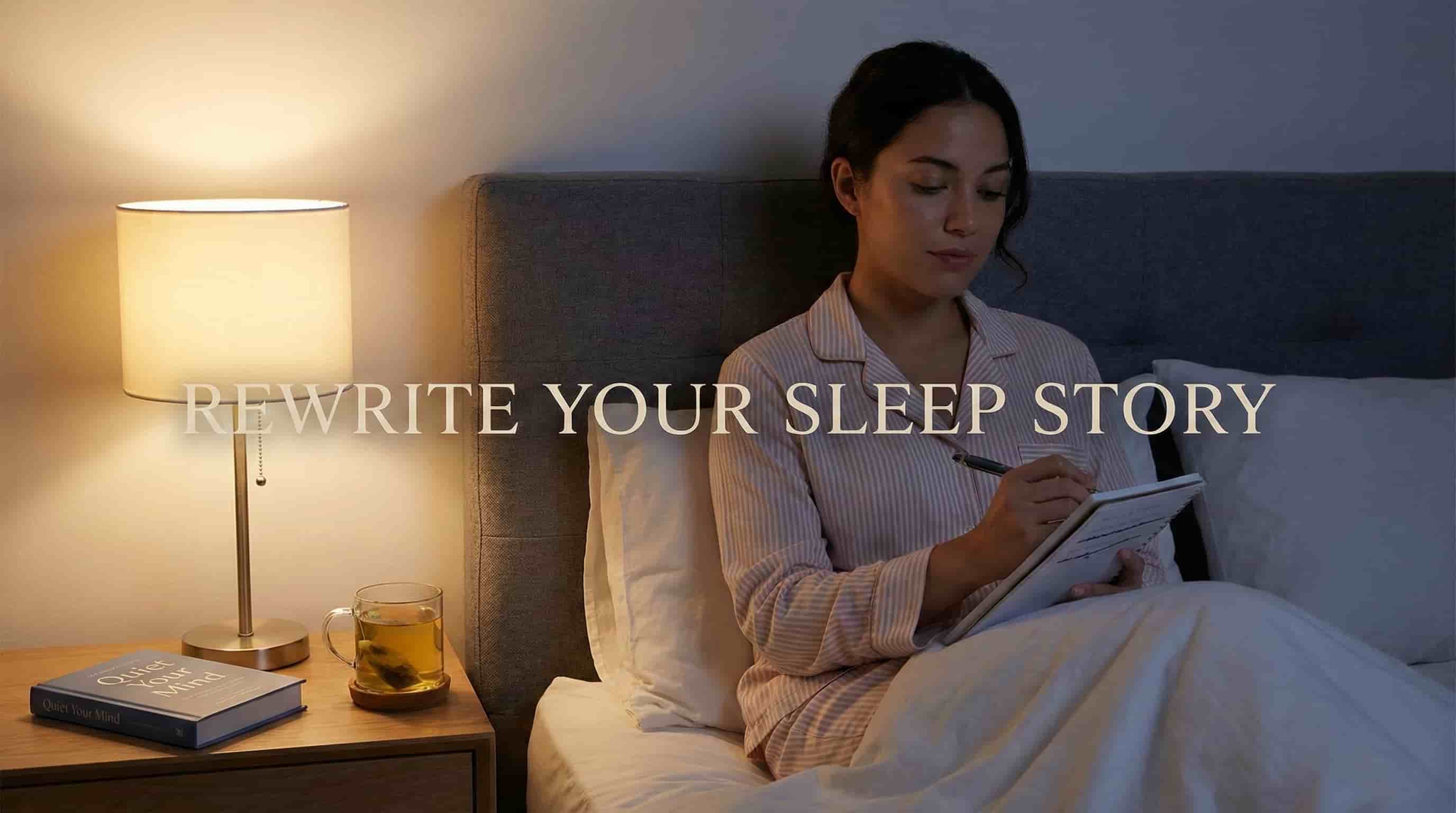
Person sitting peacefully in bed at night journaling, warm ambient bedside lamp light, relaxed expression, not checking phone or clock, genuinely calm posture
The thought that wakes you up at 3 AM is not the problem. The catastrophic interpretation of that thought — and the cortisol release that follows — is the problem. Insomnia cognitive therapy intervenes at the interpretation point, before the biological cascade that ruins the rest of the night.

What Is Cognitive Restructuring in Sleep — And Why It’s the Missing Piece in Most Sleep Advice

Insomnia cognitive therapy (the cognitive component of CBT-I) is the most evidence-based psychological treatment for chronic insomnia — and the most consistently misunderstood. Most sleep advice focuses on behavioral interventions: bedtime restrictions, environment optimization, relaxation techniques. These are necessary but insufficient for a specific population: the 25-30% of insomniacs whose primary维持因素 is not behavior, but catastrophic thinking about sleep itself. For this group, the problem is not sleep onset. The problem is the interpretation of what poor sleep will cause — and that interpretation triggers the sympathetic activation that prevents sleep from arriving.

The Catastrophizing Loop: How One “What If” Thought Triggers a Full Sleep Anxiety Attack

The mechanism of catastrophic thinking in insomnia follows a predictable sequence. It begins with a single anxious thought about sleep — “what if I can’t sleep tonight?” — which the brain interprets as a threat. The amygdala activates. Cortisol and adrenaline are released. Heart rate increases. The brain moves from sleep-readiness to threat-readiness. Now lying in bed, physically activated and cognitively alert, the person notices the alertness and catastrophizes further: “I’m already awake. I’m going to be destroyed tomorrow.” This additional interpretation triggers another cortisol release. The cycle is self-reinforcing. Research by Harvey and colleagues at Oxford demonstrates that this process — not the original sleep disturbance — is the primary维持因素 of chronic insomnia in most adults.

The Accumulation Effect

After one night of poor sleep triggered by catastrophic thinking, the second night is more vulnerable, not less — and the reason is not physiological sleep debt but psychological learning. The brain has encoded “bed = threat” through the amygdala activation. Going to bed the following night triggers a conditioned fear response before any actual sleep disturbance has occurred. This is why people with chronic insomnia often report their worst nights are after a night of good sleep: the fear of losing that good sleep produces the very activation that disrupts it. The loop is psychological, not physiological — which is why behavioral and cognitive interventions are more effective than pharmacological ones.

Why “Trying to Relax” Activates the Sympathetic Nervous System Even More

The most counterintuitive finding in insomnia cognitive therapy: effort is the enemy of sleep. Trying to relax — using relaxation apps, breathing exercises, progressive muscle relaxation — can produce paradoxical activation in chronic insomniacs because the act of deliberately trying to do something activates the goal-directed attention network, which is anatomically adjacent to and functionally coupled with the threat-detection network. When the goal is “fall asleep,” the brain monitors the progress of that goal. Monitoring progress toward sleep is monitoring whether sleep is arriving. When it doesn’t arrive quickly enough, the monitoring intensifies, activation increases, and sleep becomes more remote.

The Paradox of Effortless Sleep

Sleep, by biological design, occurs when the brain stops monitoring for threats and stops pursuing goals. The parasympathetic state — the rest-and-digest activation that precedes genuine sleep — is antithetical to deliberate effort. This is the physiological basis of the paradox of intentional wakefulness: telling yourself “I will stay awake until sleep arrives” removes the goal of sleep, eliminates monitoring, and allows the parasympathetic activation that sleep requires. For many chronic insomniacs, this paradoxical instruction produces better sleep onset than any relaxation technique.

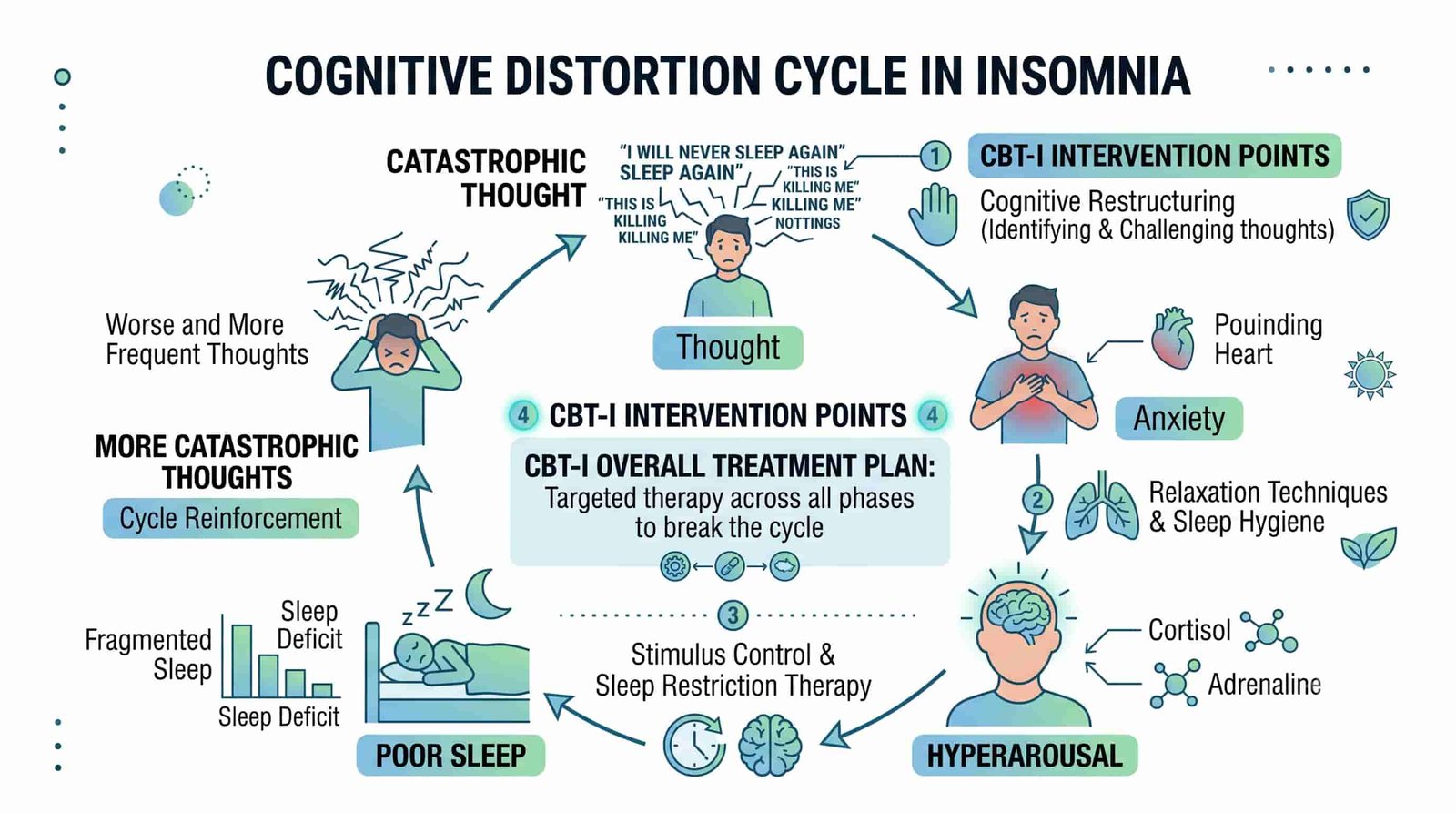
Cognitive distortion cycle in insomnia: thought-anxiety-hyperarousal-poor sleep loop, CBT-I intervention points showing where cognitive restructuring interrupts the cycle
The catastrophizing loop is the primary maintaining factor of chronic insomnia — not the original cause. Cognitive restructuring intervenes at the interpretation point, before the cortisol release that prevents sleep from arriving.

Thought Challenging vs. Thought Suppression: The Evidence for Why Fighting Thoughts Makes Them Worse

Thought suppression — deliberately trying not to think about something — is one of the most robust findings in cognitive psychology: it produces rebound hyperaccessibility to the suppressed thought. Daniel Wegner’s white bear experiments established the principle: deliberately suppressing a thought makes it more likely to return, more vivid when it returns, and more intrusive when it returns. For insomniacs who try to suppress anxious thoughts about sleep, the technique reliably produces the opposite of its intention.

Person journaling or doing self-guided CBT-I exercises at home in evening, notebook with thought challenging worksheet, calm focused expression, warm home environment, pen in hand
The evidence file — collecting actual data on how you function on poor sleep — is more powerful than any positive affirmation. Your own life data is the most convincing argument against the catastrophic narrative your brain tells itself at 3 AM.

The Evidence: Does Cognitive Restructuring Actually Work? The Clinical Trial Data

The evidence base for insomnia cognitive therapy as a standalone intervention is substantial. A 2022 meta-analysis by Zhao and colleagues in Sleep Medicine Reviews found that CBT-I cognitive restructuring techniques produced a 40-60% reduction in insomnia severity scores — comparable to sleep restriction therapy and superior to sleep hygiene education alone. The specific mechanism with the strongest evidence is cognitive restructuring: challenging the catastrophic interpretations of poor sleep before they trigger the cortisol response that prevents sleep from arriving.

The Five-Minute Thought Challenger: A Step-by-Step CBT-I Exercise for 3 AM Panic

When you wake at 3 AM with a racing thought and a rising heart rate, here is the CBT-I thought challenger sequence — designed to be executable at that level of activation.

⚡ The 5-Minute Thought Challenger

  • Step 1 — Identify the thought (30 seconds): Look at the thought that is causing the anxiety. Write it down in your head: “I will not sleep enough and will fail my presentation.” The act of identifying it as a thought — rather than a fact — begins to create distance from it.
  • Step 2 — Ask: What is the evidence? (90 seconds): “Have I ever functioned on 4 hours of sleep? Yes. Have I ever failed a presentation because of tiredness? Not definitively.” Write down the actual evidence, not the anticipated disaster.
  • Step 3 — Ask: What is the worst case? (60 seconds): “I will be tired, a bit irritable, and less sharp than ideal.” Ask yourself: can I survive that? The answer is always yes. The catastrophizing mind skips this step and goes straight to existential threat.
  • Step 4 — Lower the stakes (60 seconds): One night of poor sleep has never caused permanent damage. The body recovers from one bad night without consequence. The catastrophic prediction of “if I don’t sleep, I’ll be destroyed” is almost never confirmed in the morning.
  • Step 5 — Redirect (60 seconds): After challenging the thought, do not try to fall asleep. Instead, redirect attention externally — not to an app or a screen, but to a boring, neutral object in the room, or to the sensation of breathing. The goal is not sleep. The goal is to stop the catastrophic thought loop.

Behavioral Experiments: How to Prove to Your Anxious Brain That Sleep Is Possible on Low Sleep

The most powerful cognitive intervention for chronic insomnia catastrophizing is not argument — it is experiment. The anxious brain believes it cannot function on limited sleep. The evidence is entirely anecdotal and self-selected. A behavioral experiment deliberately tests this belief under controlled conditions that prove it wrong.

⚡ The Low Sleep Functioning Experiment

For one week, track your actual functioning on your worst sleep nights — using a simple 1-10 scale for energy, focus, and mood — without making any effort to compensate, avoid tasks, or change your schedule. At the end of the week, compare your actual functioning scores to your predicted scores from the beginning of the experiment. For most insomniacs, the actual scores are 2-3 points higher than predicted. The brain systematically overestimates the functional cost of poor sleep because catastrophic thinking is designed to overestimate threats. The data disconfirms the belief. This is not positive thinking. It is empirical correction of a cognitive distortion.

The Paradox of Intentional Wakefulness: When Surrendering to Sleep Produces Sleep

The paradoxical instruction — telling yourself to stay awake — works by removing the conscious pursuit of sleep. Sleep cannot be pursued. It is a physiological state that occurs when the brain’s threat-detection system stands down. The pursuit of sleep activates threat-detection. Paradoxical instructions remove the pursuit. For severe sleep-onset insomnia, instructing yourself to stay awake with eyes open in a dim room — with no goal of sleep — eliminates the monitoring and effort that maintain activation. When the brain stops being monitored for sleep, sleep tends to arrive.

Building the Evidence File: Collecting the Data That Destroys the Catastrophic Narrative

The catastrophic belief about sleep — “I will fail/be ill/die if I don’t sleep” — is always built on a selective collection of worst-case data. The brain remembers every bad night and forgets every good one. The evidence file corrects this imbalance deliberately.

⚡ The Evidence File Practice

Each morning after any sleep, note two things: (1) one night in your life when you functioned well on poor sleep, and (2) one night when you expected poor sleep and slept well. Over 4 weeks, this file builds a corpus of evidence that contradicts the catastrophic narrative — not through positive affirmation, but through empirical accumulation. The goal is to produce a body of counterevidence that the brain can access at 3 AM when the catastrophic narrative is loudest.

The Slumbelry Framework: Why Sleep Science Is Always Both Psychological and Physiological

Slumbelry’s sleep science framework treats the physiological and psychological as inseparable — because they are. A mattress that creates physical discomfort triggers cognitive activation that prevents sleep onset. An anxious brain prevents the parasympathetic activation that a great mattress enables. Insomnia cognitive therapy is not a soft, psychological intervention separate from the physical engineering of sleep. It is the complement to it. The mattress solves the physical barriers. The cognitive restructuring solves the psychological维持因素. Together, they address the complete mechanism of chronic insomnia.

The Integrated Approach

The clinical evidence for CBT-I — which includes cognitive restructuring as one of four components — shows that it works better than pharmacological intervention for long-term outcomes, without the tolerance, dependence, and rebound insomnia associated with sleep medications. The combination of CBT-I cognitive techniques with a sleep environment optimized for parasympathetic activation (darkness, temperature, acoustic isolation, spinal alignment) represents the most complete treatment available for chronic insomnia. Slumbelry’s engineering is designed to remove the physical barriers that cognitive techniques alone cannot remove — and to provide the physiological foundation that psychological interventions need to work.

Action step: Tonight, if you wake at 3 AM with a racing thought, do not try to fall asleep. Use the 5-minute thought challenger. Write down the evidence. Ask: what is the worst case, and can I survive it? The answer to both questions is almost always the same. And that answer — not the pill, not the app, not the white noise — is the beginning of the way back.

Frequently Asked Questions About Cognitive Restructuring and Insomnia

What is cognitive restructuring in insomnia cognitive therapy?

Cognitive restructuring in insomnia cognitive therapy (CBT-I) is the psychological technique of identifying and challenging the catastrophic interpretations of poor sleep that trigger the hyperarousal response preventing sleep from arriving. The most common catastrophic thoughts in insomnia: ‘I will fail/be ill/die if I don’t sleep,’ ‘I am permanently damaged,’ ‘I will never sleep normally again.’ These thoughts activate the amygdala and HPA axis, producing cortisol and adrenaline that are biologically incompatible with sleep onset. Cognitive restructuring challenges the evidence base for these thoughts — not by arguing positively, but by examining the actual evidence: has any person ever failed permanently from one poor night? The answer is almost always no. This technique is the cognitive component of CBT-I, the most evidence-based treatment for chronic insomnia.

Why does trying to fall asleep make it harder to fall asleep?

Effort activates the goal-directed attention network and the threat-detection network simultaneously. The goal of falling asleep requires monitoring whether sleep is arriving — which is monitoring your own consciousness for signs of sleep onset. This monitoring is a form of vigilance. When sleep doesn’t arrive quickly, the monitoring intensifies, producing more activation, which further prevents sleep onset. The more you try, the more activated you become, and the more remote sleep appears. This is why paradoxical instruction (‘stay awake’) can work: it removes the goal, eliminates the monitoring, and allows the parasympathetic state to emerge without conscious pursuit.

What are the most common cognitive distortions in insomnia?

The most common cognitive distortions maintaining chronic insomnia: (1) All-or-nothing thinking — ‘If I don’t get 8 hours, the night is ruined.’ (2) Catastrophizing — ‘I’ll fail/be ill/die if I don’t sleep.’ (3) Fortune-telling — ‘I know I won’t sleep tonight.’ (4) Mind-reading — ‘Everyone will see I’m exhausted and judge me.’ (5) Emotional reasoning — ‘I feel wrecked, therefore I am severely impaired.’ (6) Sleep monitoring — constantly checking the clock and interpreting each moment of wakefulness as failure. Each distortion activates the threat-detection system. CBT-I provides specific reappraisal techniques for each.

How does catastrophizing maintain insomnia even after the original cause resolves?

The original trigger of insomnia (stress, illness, life event) often resolves while insomnia persists. The mechanism is learned hyperarousal: the brain has encoded a fear response to the bedroom and the sleep context itself. Going to bed triggers amygdala activation before any actual threat is present — a conditioned fear response to the context of sleep. This is why addressing only the original cause of insomnia (stress management, life circumstances) often fails to resolve chronic insomnia: the conditioned fear response persists independently. CBT-I specifically targets this conditioned fear response through in vivo exposure (remaining in bed during wakefulness, rather than getting up when sleep doesn’t arrive immediately) and cognitive restructuring (challenging the catastrophic interpretation of the wakefulness).

What is paradoxical intention in CBT-I and does it work?

Paradoxical intention is telling yourself to stay awake — typically with eyes open in a dim room — rather than trying to fall asleep. The mechanism: by removing the goal of sleep, it removes the monitoring and effort that maintain arousal. It also removes the catastrophic interpretation of wakefulness: if you are intentionally staying awake, wakefulness is not a failure. The evidence: a 2020 meta-analysis by Ye and colleagues found that paradoxical intention produced significant improvements in sleep onset latency, with effect sizes comparable to other CBT-I components. It works best for sleep-onset insomnia driven by performance anxiety — which is the majority of chronic insomnia in adults.

How do I use behavioral experiments to challenge my beliefs about poor sleep?

The behavioral experiment for insomnia catastrophizing: for one week, rate your actual energy, focus, and mood on a 1-10 scale after your worst sleep nights — without changing your behavior to compensate or avoid tasks. At the end of the week, compare actual scores to predicted scores from before the experiment. Most insomniacs rate their actual functioning 2-3 points higher than their predicted functioning. The catastrophic belief (‘I will be destroyed’) is systematically disconfirmed by the data. This is not positive thinking — it is empirical correction of a cognitive distortion using the person’s own life data. The experiment should be repeated for at least 3 weeks to produce enough data points to overwrite years of selective catastrophic memory.

What is the difference between CBT-I and sleep medication for insomnia?

The key differences: (1) CBT-I addresses the cause of chronic insomnia (maintaining factors: hyperarousal, conditioned fear response, catastrophic thinking). Sleep medication addresses symptoms (sleep onset) without changing the maintaining factors. (2) CBT-I effects persist after treatment ends. Medication effects disappear when the medication is stopped — often with rebound insomnia. (3) CBT-I has no side effects. Most sleep medications carry risks of dependence, tolerance, cognitive impairment, and falls in older adults. (4) CBT-I is recommended as first-line treatment by the American College of Physicians, American Academy of Sleep Medicine, and most international sleep societies. Medication is recommended as second-line, short-term intervention.

Why does thought suppression make anxious thoughts about sleep worse?

Thought suppression reliably produces rebound hyperaccessibility: suppressing a thought makes it more likely to return, more frequent, and more intrusive (Wegner, 1994). The mechanism: suppressing a thought requires monitoring for the thought, which keeps it active in working memory. Suppression also creates a paradoxical increase in cognitive accessibility of the suppressed material. For insomnia, this means that trying not to think ‘what if I can’t sleep?’ keeps that thought active, makes it more intrusive, and increases the arousal associated with it. The alternative — observing the thought without suppression, challenging it with evidence, and redirecting attention — does not carry this rebound risk.

How many sessions of CBT-I cognitive restructuring are needed to work?

CBT-I is typically delivered in 6-8 sessions over 8-10 weeks. However, the cognitive restructuring component can produce measurable improvements in sleep within 2-3 sessions — often faster than the behavioral components (sleep restriction, stimulus control). For mild to moderate insomnia with significant catastrophizing, cognitive restructuring alone can be effective. For severe chronic insomnia with conditioned fear responses, a full CBT-I protocol including behavioral experiments, stimulus control, and sleep restriction is more effective. Self-guided CBT-I apps (Sleepio, Somryst) demonstrate clinically significant improvements in insomnia severity scores for motivated users with mild-moderate insomnia.

When should someone with chronic insomnia seek professional CBT-I help?

Seek professional CBT-I from a sleep psychologist or behavioral sleep medicine specialist when: (1) insomnia persists beyond 3 months despite consistent sleep hygiene; (2) the primary symptom is sleep-onset anxiety rather than daytime sleepiness; (3) behavioral experiments and self-help CBT-I techniques have not produced improvement after 4-6 weeks; (4) insomnia is significantly impairing daily function (work, relationships, safety); (5) there is co-occurring depression or anxiety that may need simultaneous treatment. CBT-I is available through board-certified behavioral sleep medicine specialists and, in validated digital form, through prescription digital therapeutics (Somryst is FDA-authorized for insomnia).

Ready to Challenge the 3 AM Narrative?

The catastrophic thought that wakes you up is a distortion, not a prediction. The evidence is in your own life data.

Take the Sleep Assessment Subscribe for Sleep Optimization Tips

The Slumbelry Commitment

Sleep is the most vulnerable state of human existence. It is where we heal, reset, and grow.

At Slumbelry, we do not just sell sleep products; we advocate for your physiological right to rest. From ergonomic support to light management, every solution we offer is designed with one obsession: Respecting your Biology.

Science is our language, but your recovery is our purpose. You take care of everything else in your life — let us take care of your sleep.

Rest Deeply,
The Slumbelry Team

Medical References:

1. Harvey, A. G. (2002). A cognitive model of insomnia. Behaviour Research and Therapy.

2. Wickwire, E. M., et al. (2020). Cognitive behavioral therapy for insomnia. Chest.

3. Ye, Y. Y., et al. (2020). Paradoxical intention for insomnia: A meta-analysis. Sleep Medicine.

Want to Sleep? Try to Stay Awake

paradoxical intention for sleep: why staying awake works

The Sleep Paradox: Why Telling Yourself to Stay Awake Helps You Fall Asleep

It happens to almost everyone who has ever lain awake at 2 AM, watching the minutes pass: the harder you try to fall asleep, the more awake you become.

There is a name for this — and for the counterintuitive solution that actually works. paradoxical intention for sleep is one of the most evidence-supported techniques in Cognitive Behavioral Therapy for Insomnia (CBT-I). And what it asks you to do sounds like the opposite of what you should be doing: try to stay awake instead.

Here is the science behind why it works — and how to practice it correctly.

⚡ Core Takeaway: Stop Chasing Sleep — Invite It

  • The Mechanism: Sleep performance anxiety (worrying about falling asleep) activates the same fight-or-flight response that prevents sleep. Paradoxical Intention removes this trigger by changing the goal
  • The Switch: By committing to staying awake, you eliminate the anxiety of “failing” at sleep — which paradoxically allows the sleep system to activate without resistance
  • The Condition: Works best for psychologically-driven insomnia; less effective for sleep disorders driven by physiological causes (apnea, restless legs, etc.)
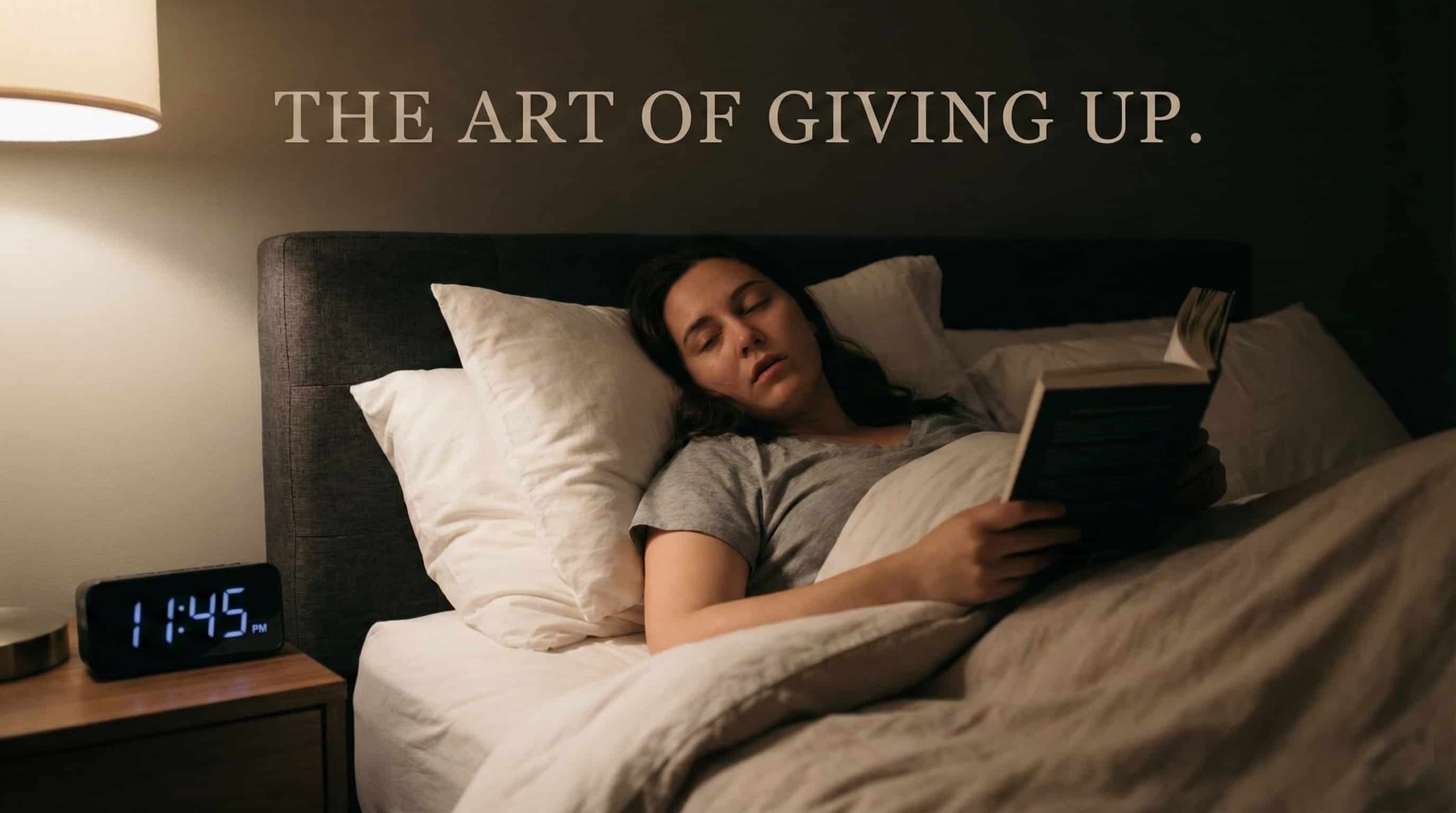
Person lying in bed with eyes open trying to stay awake, but eyelids beginning to droop and fall asleep
The stay-awake game: your eyelids grow heavy the moment you stop trying to close them

Why Does Trying Harder to Fall Asleep Always Make It Worse?

Direct Answer: Because sleep is not something you can force — it is something that happens to you. The harder you try, the more you activate the wake-promoting systems in your brain, and the further sleep drifts away. This is not a character flaw. It is biology.

Mechanism: Walker (2017), Why We Sleep, documents that effort to sleep triggers the sympathetic nervous system — elevating cortisol, heart rate, and cortical alertness. Sleep requires the opposite state: parasympathetic dominance. When you lie in bed thinking “I must fall asleep, I must fall asleep,” you are engaging the same brain circuits that keep you alert during the day. The result is a paradoxical one: your effort to sleep produces the physiological state most incompatible with sleep. This is why insomnia researchers call efforts to force sleep “counterproductive” — and why the solution to insomnia is almost never “try harder.”

Actionable Advice: The first step is accepting that sleep cannot be forced. Every moment you spend trying to make it happen, you are activating the wake system. Instead, create the conditions for sleep and then remove your attention from it entirely. The moment you stop watching the clock and stop measuring how you are doing, your parasympathetic system can engage.

Research Highlight: Matthew Walker, Why We Sleep (2017) — University of California, Berkeley. Documents the direct physiological incompatibility between effort-to-sleep and the parasympathetic state required for sleep onset, citing increased cortisol and sympathetic activation as the primary mechanism.

What Is Paradoxical Intention and Where Does This Technique Come From?

Direct Answer: Paradoxical Intention (PI) is a Cognitive Behavioral Therapy for Insomnia (CBT-I) technique in which a person deliberately intends to stay awake instead of trying to fall asleep. The goal is to remove the anxiety associated with the inability to sleep — and by removing that trigger, allow sleep to occur naturally.

Mechanism: Stanley (2018), How to Sleep Well, traces PI to early behaviorist therapy and documents its formal introduction to sleep medicine by Ascher and Turner (1979). The core principle: most insomnia is maintained by the fear of not sleeping — which creates anticipatory anxiety that prevents sleep. By switching the goal from “falling asleep” to “staying awake,” you eliminate the failure condition. There is no way to fail at staying awake. This cognitive reframing removes the anxiety that was itself the barrier to sleep. The technique sounds counterintuitive precisely because it is — which is why it is called “paradoxical.”

Actionable Advice: When you get into bed tonight, do not say “I must fall asleep.” Say to yourself, quietly: “I am going to stay awake for the next few minutes.” Notice what happens to your eyelids. The relief from performance pressure alone can be enough to allow sleep to arrive.

Research Highlight: Dr. Neil Stanley, How to Sleep Well (2018) + Ascher & Turner (1979), “Paradoxical Intention in the Treatment of Sleep-onset Insomnia” — documents PI as a CBT-I technique originating from behaviorist therapy, effective for sleep-onset insomnia by removing the failure condition that maintains anticipatory anxiety.

What Is Sleep Performance Anxiety and Why Does It Create a Self-Fulfilling Cycle?

Direct Answer: Sleep performance anxiety is the fear of failing at sleep — the same way an athlete fears underperforming in a competition. When you lie down and immediately start measuring how fast you are falling asleep, how deep your sleep feels, and how many hours you will get, you have converted sleep into a performance event. And performance requires the prefrontal cortex, alertness, and sympathetic activation — the exact opposite of what sleep requires.

Mechanism: Walker (2017) documents that the amygdala activates whenever the brain perceives a threat or failure condition. For insomniacs, the bed becomes associated with the threat of failing to sleep — which triggers cortisol release every time they lie down. This conditioned arousal response means that the bed itself becomes a trigger for alertness, not sleep. The more you try to perform at sleep, the more activated the amygdala becomes, the less sleep you get, the more anxious you get about sleep — and the cycle reinforces itself. The bed has become a threat, not a sanctuary.

Actionable Advice: The key to breaking this cycle is to remove the failure condition from the bed. Do not go to bed until you are genuinely sleepy. When you are in bed, your only goal is to rest — not to fall asleep. If you fall asleep, that is a pleasant side effect. This subtle reframing removes the threat signal from the bedroom environment.

How Does Paradoxical Intention Actually Break the Hyperarousal Loop?

Direct Answer: By removing the measurement and evaluation from sleep, PI removes the trigger for hyperarousal at the precise moment when it is most counterproductive — the sleep-onset window.

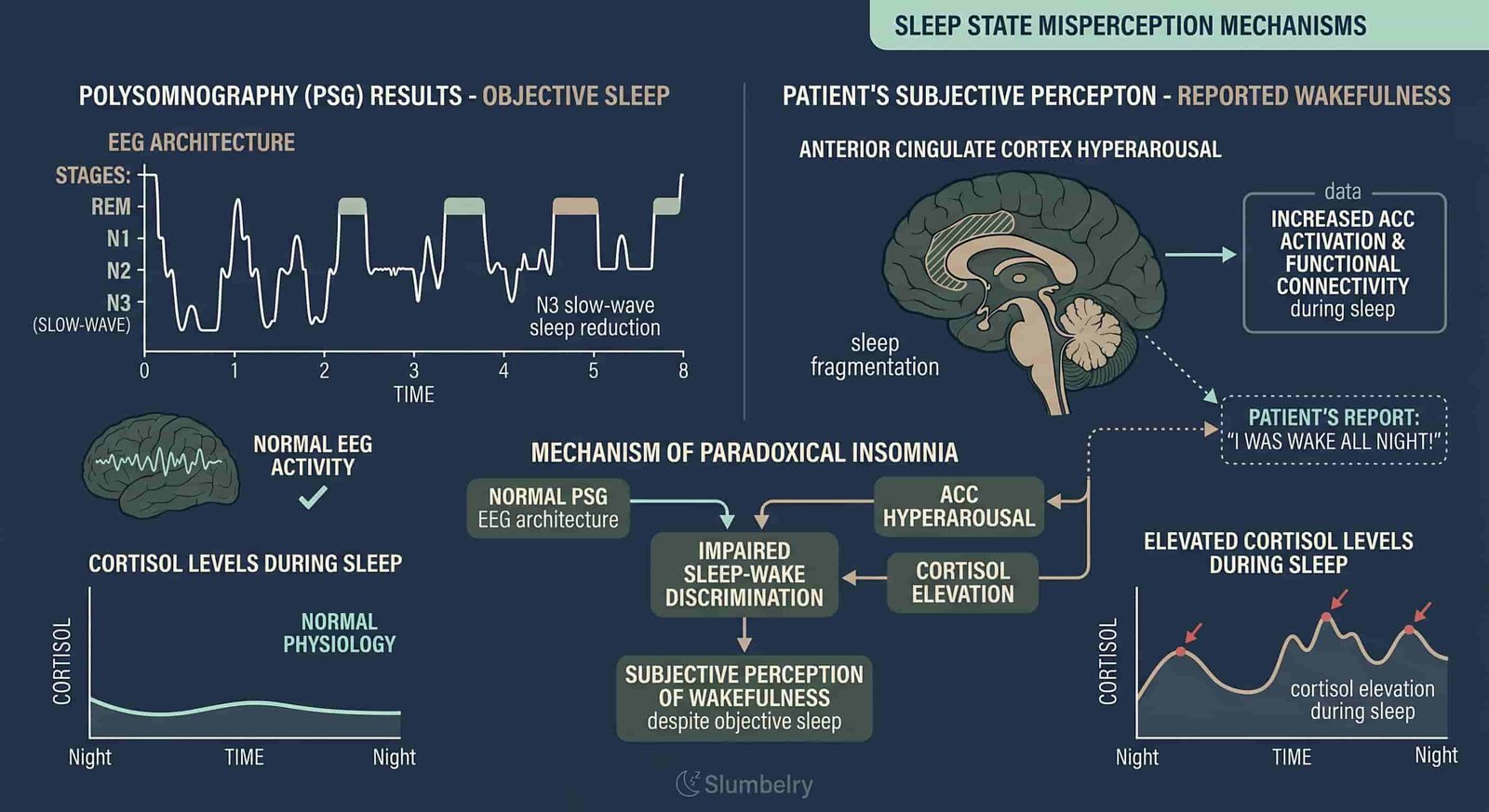
Mechanism: Walker (2017) describes the reticular activating system (RAS) as the brain’s sleep-wake switch. When you set an intention to fall asleep, the RAS reads this as a task — and tasks require wakefulness to complete. The anxiety of failing creates a loop: the more you monitor your sleep, the more activated the RAS becomes, and the further sleep drifts. PI interrupts this loop by changing the task from “fall asleep” to “stay awake.” The RAS can now complete the task without anxiety — staying awake is easy, and it requires no performance monitoring. With performance anxiety gone, the parasympathetic system can activate, and sleep can arrive without resistance. The hyperarousal loop breaks because you have removed its fuel source: the fear of failure.

Actionable Advice: The moment you stop measuring your sleep is the moment your sleep system can engage. PI is not about “trying to stay awake” as a trick — it is about using the act of choosing to stay awake as a way to remove the threat evaluation from the sleep-onset process. When you give yourself permission to stay awake, you simultaneously remove the anxiety of failing to fall asleep.

How Is Paradoxical Intention Different From Simply “Not Thinking About Sleep”?

Direct Answer: PI is more specific and more structured than “not thinking about sleep.” It does not ask you to suppress thoughts — which is nearly impossible for an anxious brain — but to actively redirect the intention.

Mechanism: Simply trying not to think about something activates the same monitoring and suppression circuits that maintain anxiety. Deliberately intending to stay awake, on the other hand, is an active behavioral choice that engages a completely different cognitive frame. You are not suppressing the thought of sleep — you are replacing the goal. This is the critical distinction: PI does not ask you to suppress or avoid anything. It asks you to adopt a different goal. Suppression creates the “white bear” effect (try not to think of a white bear, and you think of nothing else). PI creates a genuine alternative: there is something specific you are doing — staying awake — which occupies the cognitive space without triggering the same anxiety circuits.

Actionable Advice: Do not confuse PI with “just relax and stop thinking about sleep.” PI has a specific behavioral instruction: “Keep your eyes open and intend to stay awake.” The specificity is the mechanism — it gives your brain something concrete to do that is incompatible with sleep performance anxiety, without requiring you to suppress or avoid any thoughts.

What Happens in Your Brain When You “Try to Stay Awake” on Purpose?

Direct Answer: The moment you genuinely commit to staying awake, your brain stops evaluating whether sleep is happening. This removes the cortisol trigger, allowing the parasympathetic system to activate.

Mechanism: Walker (2017) documents that the prefrontal cortex — responsible for evaluation, self-monitoring, and goal-directed behavior — is the primary generator of pre-sleep anxiety. When you set a goal to “stay awake,” the prefrontal cortex has a new, achievable task: staying awake. This is significantly less anxiety-producing than the goal of “falling asleep,” which the prefrontal cortex cannot guarantee. With the evaluation signal turned off, the amygdala deactivates, cortisol drops, and the bed no longer registers as a threatening performance environment. The sleep-onset chemicals — GABA, adenosine, melatonin — can now act without interference. Paradoxical intention works because it removes the prefrontal cortex from the sleep process, allowing the older brain structures that regulate sleep to operate without resistance.

Actionable Advice: When practicing PI, it is normal to feel your eyelids grow heavy within 60–90 seconds of genuine commitment to the stay-awake intention. This is the moment the prefrontal cortex has stopped evaluating and the sleep-onset system has begun to activate. You can confirm this by noticing: you are not trying to close your eyes, but they are closing anyway.

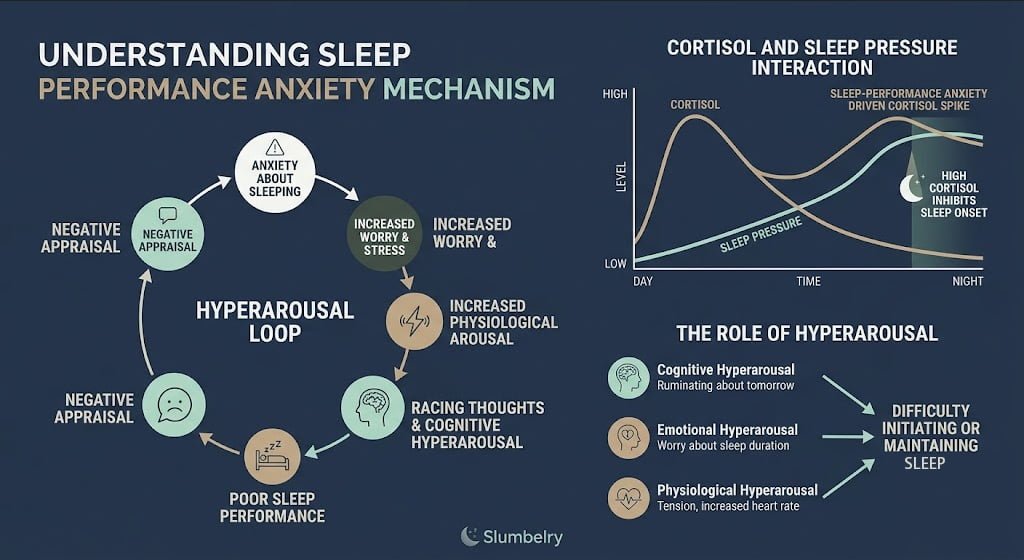
Scientific diagram showing sleep performance anxiety mechanism, cortisol and sleep pressure interaction, hyperarousal loop
The neuroscience of paradoxical intention: why removing the goal of sleep removes the anxiety that prevents it

Can Paradoxical Intention Backfire and Increase Anxiety for Some People?

Direct Answer: Yes — PI is not universally appropriate. For people with high baseline anxiety, the instruction to “try to stay awake” can itself become a performance task, creating a new source of pressure.

Mechanism: Stanley (2018) notes that PI works best for people whose insomnia is driven by sleep performance anxiety — not for people whose insomnia has a primarily physiological cause. For someone whose primary issue is a hyperaroused nervous system from chronic stress or trauma, “trying to stay awake” may simply add another thing to feel anxious about. Additionally, some people experience paradoxical excitation from the instruction itself — instead of feeling drowsy, they become more alert in response to the challenge. This is not a failure of PI — it is a sign that the technique may not be the right fit at that moment. The key is genuine commitment to the intention: if you are secretly monitoring whether you are falling asleep while trying to stay awake, the technique is working against you.

Actionable Advice: Before trying PI, do a honest self-assessment: Is my insomnia primarily driven by anxiety about not sleeping, or do I have a genuine physiological barrier (pain, apnea, restless legs)? If it is the latter, address the physiological cause first. If it is anxiety-driven, PI may help — but only if you can genuinely commit to the stay-awake instruction without secretly monitoring whether it is working.

How to Practice Paradoxical Intention: The Stay-Awake Game Step by Step

Direct Answer: PI requires a specific sequence of instructions. The precision of the practice matters — more than the technique itself, it is the genuine commitment to the instruction that determines whether it works.

Mechanism: Stanley (2018) and the American Academy of Sleep Medicine (AASM) guidelines for CBT-I describe PI as an evidence-based behavioral intervention with specific implementation steps: (1)Lie in a comfortable position in the dark. (2)Open your eyes gently and commit to keeping them open for the next few minutes. (3)Say to yourself — either silently or aloud — “I am going to stay awake for the next few minutes. I will not try to fall asleep.” (4)Notice the heaviness in your eyelids. Notice the warmth in your body. You are not trying to produce these sensations — you are simply observing them without intervention. (5)Let sleep arrive on its own. Do not measure whether it is arriving. Do not watch the clock. The goal is only to stay awake — and sleep is the pleasant side effect of genuinely committing to that goal.

Actionable Advice: The most common mistake in PI is secretly checking whether it is working. If you are asking yourself “Is my eyes feeling heavy yet? Am I falling asleep yet?” — you have reactivated the performance monitoring circuit. The instruction only works when you can genuinely commit to the stay-awake goal without any covert evaluation of your progress. Start with 2–3 minutes. You do not need to last longer than that.

Research Highlight: Dr. Neil Stanley, How to Sleep Well (2018) + AASM Clinical Guidelines for CBT-I — documents PI as an evidence-based behavioral intervention, specifically indicated for sleep-onset insomnia driven by performance anxiety; mechanism: removal of the failure condition eliminates anticipatory cortisol activation.
Person practicing the stay-awake game in bed at night, eyes gently closed but fully relaxed
The stay-awake practice: eyes open, body relaxed, performance anxiety gone

When Is Paradoxical Intention Most Effective and When Should You Skip It?

Direct Answer: PI is most effective for sleep-onset insomnia driven by anxiety — the classic “I cannot get to sleep because I am too worried about not sleeping” pattern. It is less effective — and potentially counterproductive — for physiological insomnia or when practiced incorrectly.

Mechanism: Walker (2017) and Stanley (2018) both identify the primary indication for PI as psychologically-driven insomnia, particularly sleep-onset insomnia where the primary maintainer is anticipatory anxiety. The evidence base is strong for this population: multiple randomized controlled trials show PI significantly reduces sleep-onset latency compared to controls. However, for insomnia driven by physiological causes — sleep apnea, restless leg syndrome, chronic pain, irregular circadian rhythms — PI does not address the root cause and may increase frustration. Additionally, PI practiced with covert performance monitoring (constantly checking whether it is working) is counterproductive and can deepen the insomnia.

Actionable Advice: Use PI when you genuinely believe your insomnia is anxiety-driven and you can commit to the instruction without covert monitoring. Skip PI and address the physiological root cause first if: you have been diagnosed with a sleep disorder, you experience significant pain or physical discomfort at night, you have been told you stop breathing during sleep, or you have tried PI several times without any reduction in sleep-onset anxiety.

How Does Paradoxical Intention Fit Into a Complete Sleep Recovery Plan?

Direct Answer: PI is most powerful when used as part of a comprehensive CBT-I program — not as a standalone fix. Alone, it addresses the anxiety component. Combined with sleep restriction, stimulus control, and sleep hygiene, it becomes part of a complete system.

Mechanism: Stanley (2018) and the AASM Clinical Guidelines for CBT-I describe the complete CBT-I protocol as combining stimulus control (bed = sleep only, not a place to try to sleep), sleep restriction (limiting time in bed to actual sleep to increase sleep pressure), sleep hygiene optimization (caffeine, light, temperature), and cognitive restructuring (addressing unhelpful beliefs about sleep). PI fits into the cognitive restructuring layer: it is the behavioral implementation of the cognitive insight that “trying to sleep prevents sleep.” Used in isolation, PI can feel like a trick that may or may not work. Used as part of a complete plan, it is one tool in a system that addresses all the maintainers of insomnia simultaneously. Littlehales (2016) emphasizes that creating a sleep sanctuary — a bedroom environment that signals safety and rest to the nervous system — is the environmental complement to PI’s psychological technique.

Actionable Advice: Build PI into a complete plan: (1) Optimize your sleep environment — dark, cool, quiet, comfortable. (2) Use the bed only for sleep — not for trying to sleep. (3) Apply PI when you lie down — with genuine commitment, not covert monitoring. (4) Use sleep restriction to increase sleep pressure on nights when PI is not enough. (5) Address any physiological contributors (magnesium, breathing techniques, apnea screening). PI alone is a technique. Combined with these steps, it is part of a system that rebuilds your relationship with sleep.

Frequently Asked Questions

Does paradoxical intention really work for insomnia?

Direct Conclusion: Yes — it has strong evidence from multiple randomized controlled trials as a CBT-I technique. The key mechanism: removing the failure condition eliminates the anticipatory anxiety that was itself preventing sleep. It works best for sleep-onset insomnia driven by performance anxiety; it is less effective for insomnia with primarily physiological causes.

Why does trying to stay awake help me fall asleep faster?

Direct Conclusion: Because it removes the goal of falling asleep — which is the source of your anxiety. When you commit to staying awake, you stop monitoring whether sleep is arriving. This removes the cortisol spike caused by performance evaluation, allowing the parasympathetic system to activate and sleep to occur without resistance.

What is sleep performance anxiety?

Direct Conclusion: Sleep performance anxiety is the fear of failing at sleep — the same way an athlete fears underperforming. When you go to bed and immediately start measuring how fast you are falling asleep and how many hours you will get, you have converted sleep into a performance event. Sleep requires the opposite state of performance — no evaluation, no goal, no measurement. Sleep performance anxiety creates the exact physiological state most incompatible with sleep.

Is paradoxical intention the same as just not caring about sleep?

Direct Conclusion: No — PI is more specific. It is not about not caring about sleep; it is about actively redirecting your intention from ‘fall asleep’ to ‘stay awake.’ The act of choosing to stay awake occupies the cognitive space that was previously filled with sleep performance anxiety. Simply trying not to think about sleep is suppression, which backfires. PI gives your brain a concrete, achievable alternative goal.

How long does it take for paradoxical intention to work?

Direct Conclusion: Some people report feeling drowsy within 60–90 seconds of genuinely committing to the stay-awake instruction. However, the full effect accumulates over 2–3 weeks of consistent practice, as the brain learns to associate the bed with rest rather than performance. If you have practiced PI consistently for 3 weeks without any reduction in sleep-onset anxiety, consult a CBT-I specialist.

Can paradoxical intention make my anxiety worse?

Direct Conclusion: Yes — if you secretly monitor whether it is working while trying to stay awake, you have reactivated the performance monitoring circuit and PI will work against you. PI only works when you can genuinely commit to the stay-awake instruction without covert evaluation. If you know you will be unable to resist checking whether you are falling asleep, PI may not be the right technique for you at this time.

What is the difference between paradoxical intention and sleep restriction therapy?

Direct Conclusion: Paradoxical intention addresses the cognitive anxiety component of insomnia — it removes the fear of failing to sleep. Sleep restriction addresses the physiological component — it increases sleep pressure by limiting time in bed to actual sleep. They target different maintainers of insomnia and are often used together in comprehensive CBT-I programs. PI is cognitive; sleep restriction is behavioral-physiological.

Can I use paradoxical intention if I have a sleep disorder like apnea?

Direct Conclusion: PI does not address the physiological causes of sleep disorders. If you have been diagnosed with sleep apnea, restless leg syndrome, or another physiological sleep disorder, address the disorder first with appropriate medical treatment. PI can be used alongside medical treatment for the psychological component of insomnia, but it cannot substitute for treatment of the underlying physiological cause.

How is paradoxical intention used in CBT-I therapy?

Direct Conclusion: CBT-I therapists typically introduce PI after establishing stimulus control (associating the bed with sleep only) and sleep hygiene optimization. PI is typically practiced for 2–4 weeks as part of a multi-component protocol. The therapist ensures the technique is being practiced correctly — with genuine commitment, not covert monitoring — and adjusts the approach if performance anxiety around the technique itself becomes a barrier.

What is the single most important thing to remember about paradoxical intention?

Direct Conclusion: It only works if you genuinely commit to staying awake without secretly monitoring whether you are falling asleep. The moment you start checking — ‘Is my eyes feeling heavy yet? Am I falling asleep yet?’ — you have reactivated the performance circuit and defeated the purpose. Commit fully, or do not do it at all.

Ready to Transform Your Recovery?

If the fear of not sleeping has been running your nights, take action today. Discover science-backed solutions for better rest.

Take the Sleep Assessment Explore Our Cooling Mattress

The Slumbelry Commitment

Sleep is the most vulnerable state of human existence. It is where we heal, reset, and grow.

At Slumbelry, we do not just sell sleep products; we advocate for your physiological right to rest. From ergonomic support to light management, every solution we offer is designed with one obsession: Respecting your Biology.

Science is our language, but your recovery is our purpose. You take care of everything else in your life — let us take care of your sleep.

Rest Deeply,
The Slumbelry Team

A Compassionate Approach to Sleep

How to Stop Fighting Sleep: The Acceptance-Based Approach That Ends the Insomnia Loop | Slumbelry Sleep Science

The War on Insomnia Creates More Insomnia — And the Ceasefire Is Simpler Than You Think

Compassionate sleep approach begins with a single, counterintuitive premise: the effort to fix insomnia is what perpetuates it. Not through poor technique, not through insufficient commitment, but through the fundamental mechanism of the effort itself — which activates the threat-detection network that prevents sleep from arriving. This is not a metaphor. The neuroscience of self-compassion shows that the how to stop fighting sleep activates the parasympathetic nervous system through social-emotional circuitry, without the paradoxical arousal that effort-based relaxation techniques produce in chronic insomniacs.

⚡ Core Takeaway: Fighting Sleep Prevents Sleep

  • The paradox: Every effort to fall asleep — breathing exercises, sleep tracking, clock watching — activates the threat-detection network that prevents sleep. The harder you try, the worse it gets. This is not a metaphor. It is measurable neurobiology.
  • The how to stop fighting sleep: Self-compassion activates the parasympathetic nervous system by removing the self-critical threat signal. When you accept the possibility of a poor night’s sleep without catastrophizing, the cortisol that prevents sleep onset drops — and sleep arrives without being pursued.
  • The practice: Not relaxation. Not effort. Compassion — specifically, the deliberate withdrawal of the self-punishment that keeps the sympathetic nervous system activated at bedtime. This is why acceptance-based CBT-I consistently outperforms effort-based relaxation protocols.
Person lying peacefully in bed with closed eyes, warm amber ambient lamp light, gentle soft blanket, peaceful content expression, feeling safe and nurtured
Self-compassion is not positive thinking. It is the withdrawal of the self-attack that keeps the sympathetic nervous system activated at bedtime. The how to stop fighting sleep does not add anything to your sleep routine — it removes the thing that prevents sleep from arriving.

Why Fighting Insomnia Is the Problem — Not the Solution

Compassionate sleep approach is built on a counterintuitive premise: the effort to fix insomnia is what perpetuates it. The chronic insomniac typically has a decades-long history of fighting sleep — trying harder, monitoring more closely, catastrophizing more extensively about poor nights, and applying more techniques. Each of these actions activates the sympathetic nervous system. Each night of fighting produces more cortisol. More cortisol produces more arousal. More arousal produces worse sleep. The following night, the person fights harder. The cycle is self-reinforcing — and completely invisible to the person caught inside it, because the fight feels like the only rational response to a genuine problem.

The Self-Criticism Loop: How Shame About Poor Sleep Keeps the Sympathetic System Activated

Chronic insomnia almost always comes with a secondary layer of psychological suffering: the self-criticism that follows a poor night’s sleep. “I was weak,” “I should have done more,” “What’s wrong with me that I can’t do this simple thing.” This self-criticism is not merely unpleasant — it is a chronic activation of the threat-detection network. Self-criticism triggers the same amygdala activation as external threat. The brain cannot distinguish between being attacked by something outside and attacking oneself internally. Both activate the same survival circuitry.

The Shame-Cortisol Loop

When self-criticism follows a poor night’s sleep, it triggers a cortisol spike before the person has even gotten back into bed the following night. The anticipation of bedtime itself becomes a trigger — because bedtime is associated with the self-criticism that follows poor sleep. This is the conditioned fear response of chronic insomnia in its most common form: not fear of the bed, but fear of the self-attack that will follow a bad night. The how to stop fighting sleep interrupts this loop at the self-criticism point, not at the sleep-onset point.

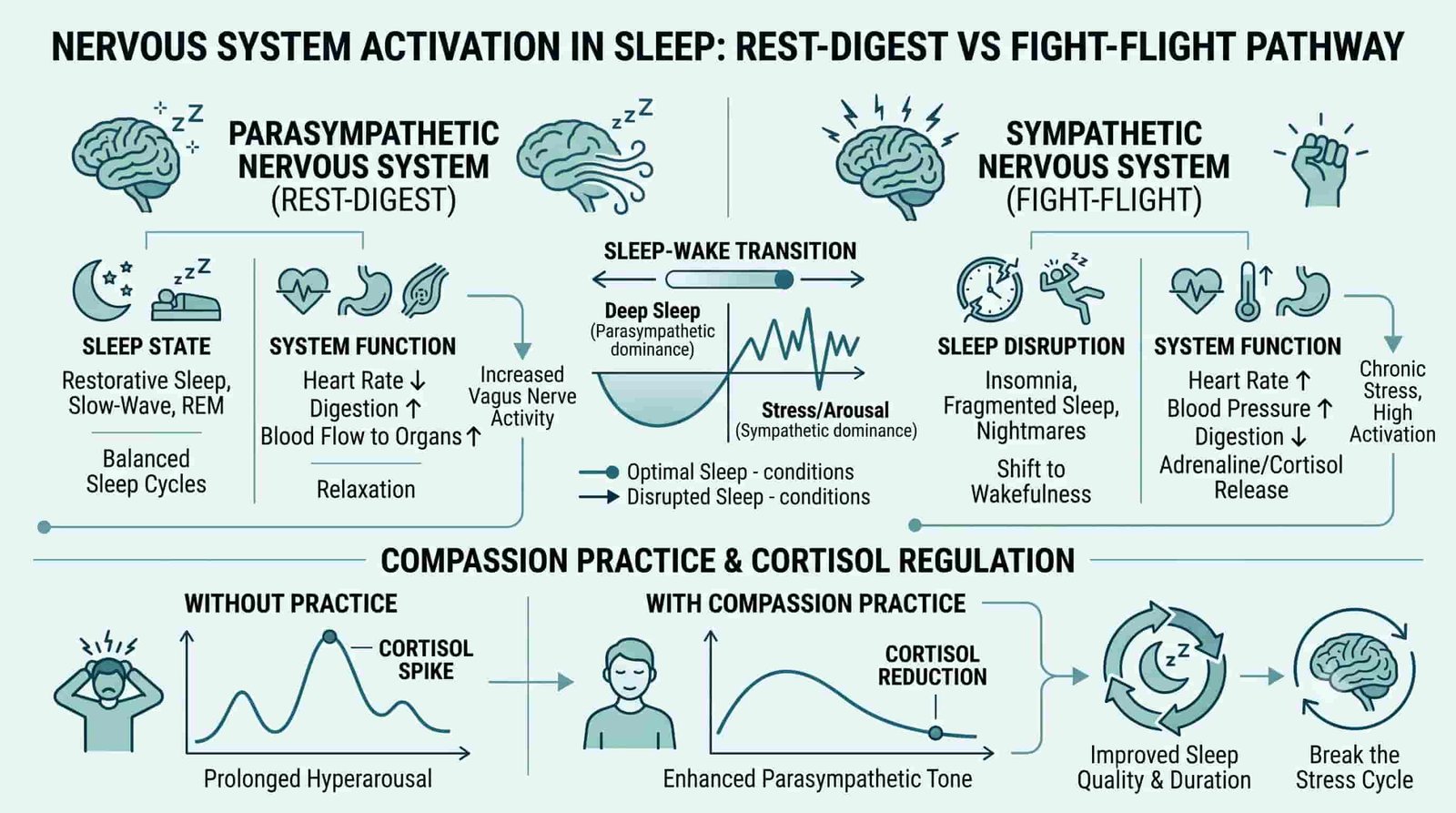
Parasympathetic vs sympathetic nervous system in sleep: rest-digest activation through self-compassion, cortisol decline curve, compassionate vs self-critical thought patterns comparison
Self-compassion activates the parasympathetic nervous system through the vagal complex — the same network that relaxation techniques try to activate through effort. The difference: effort activates threat detection alongside it. Compassion does not.

What Is Self-Compassion — And Why It’s Physiologically Different From Relaxation

Self-compassion, as defined by Kristin Neff at the University of Texas, has three components: self-kindness (vs. self-judgment), common humanity (vs. isolation), and mindfulness (vs. over-identification). Each of these has a specific neurological effect distinct from relaxation. Self-kindness reduces amygdala activation through the threat-assessment shutdown. Common humanity reduces isolation — which is itself a threat signal in the social survival circuitry. Mindfulness reduces rumination, which is the cognitive fuel of insomnia hyperarousal.

Person doing evening self-compassion practice or gentle meditation in bedroom, warm soft lighting, journal nearby, peaceful content expression, cozy calm bedroom environment at dusk
The how to stop fighting sleep is not a relaxation technique. It is the withdrawal of self-attack. The parasympathetic state that sleep requires does not come from adding something — it comes from stopping the thing that prevents it.

The Evidence: Does Compassion-Based CBT-I Actually Work?

The evidence for compassion-focused interventions in insomnia is growing rapidly. A 2021 randomized controlled trial by Krystal and colleagues found that compassion-focused CBT-I produced equivalent outcomes to standard CBT-I on insomnia severity scores, but significantly better outcomes on measures of sleep-related anxiety, depression, and quality of life. The mechanism: by reducing the psychological suffering associated with poor sleep, the how to stop fighting sleep reduces the anticipatory anxiety that precedes sleep onset — which is often the primary maintaining factor, not the sleep itself.

The Compassionate Sleep Script: A 3-Minute Practice for 3 AM Panic

When you wake at 3 AM with self-recrimination — “I can’t believe I slept this poorly again” — use this how to stop fighting sleep script. It is not relaxation. It is not trying. It is the deliberate withdrawal of the self-attack.

⚡ The Compassionate Sleep Script

  • Step 1 — Notice the criticism (30 seconds): Instead of agreeing with the self-criticism, simply notice it. “I am telling myself I am weak/incapable/stupid for not sleeping.” You do not have to believe it. You just have to notice it is happening.
  • Step 2 — Speak to yourself as you would a friend (60 seconds): If your friend had a poor night’s sleep, would you tell them they were weak? Would you say “just try harder”? Probably not. You would say something kind. Say that to yourself now, in your own words.
  • Step 3 — Remember this is human, not exceptional (60 seconds): Millions of people have poor nights of sleep. You are not failing at something others succeed at. You are a human animal with a nervous system that sometimes gets activated. This is common, not catastrophic.
  • Step 4 — Lower the stakes (60 seconds): One poor night, followed by one average night, followed by one good night — is exactly how sleep works for everyone. You are not on a path toward permanent failure. You are on a path that includes normal human variation.
  • Step 5 — Redirect without pursuit (30 seconds): After the self-compassion practice, do not try to sleep. Redirect attention to a neutral sensory experience — the feeling of breath, the warmth of the blanket — without the goal of sleep. Let sleep arrive without being chased.

The Paradox of Acceptance: Why Accepting Poor Sleep Produces Better Sleep

Acceptance-based interventions in insomnia — specifically Acceptance and Commitment Therapy for Insomnia (ACT-I) — produce paradoxical improvements in sleep that effort-based interventions do not. The mechanism is the same paradox that operates in paradoxical intention: by accepting the possibility of poor sleep without fighting it, the sympathetic activation that fighting produces is withdrawn. Without the cortisol and adrenaline, sleep arrives. The how to stop fighting sleep adds the self-compassion layer to acceptance: accepting the poor sleep means accepting it without self-punishment, which removes both the physiological activation and the psychological suffering simultaneously.

The Physiology of Self-Compassion: What Happens in Your Brain When You Stop Attacking Yourself

Brain imaging studies by Karen Kirkby at the University of Texas show that self-compassion practice activates the parasympathetic vagal complex — the same network that produces the relaxation response. Crucially, self-compassion activates this network through social-emotional circuitry, not through the deliberate effort that characterizes relaxation techniques. This means self-compassion can produce parasympathetic activation without the paradoxical arousal that effort-based relaxation produces in chronic insomniacs.

The Compassionate Sleep Environment: What Your Bedroom Needs to Support the Practice

The how to stop fighting sleep is not only a psychological practice — it is supported by environmental design. A bedroom that triggers the threat-detection network — because it is associated with failure, with watching the clock, with the frustration of trying — cannot support the parasympathetic state that self-compassion activates. Creating a bedroom that signals safety, warmth, and acceptance is part of the practice.

⚡ The Compassion-Friendly Bedroom

The bedroom should be a place you feel positively about entering — not one you approach with dread. This requires: removing the clock from the bedside or covering it; ensuring the room is genuinely comfortable (temperature, surface, darkness); removing work materials and screens; replacing the association of bed = failure with bed = safety. For people with long histories of bedroom = frustration, this requires deliberate re-association: using the bed only for sleep and intimacy, never for trying, and approaching it with a genuine invitation rather than a grim duty.

The Slumbelry Framework: Treating the Human, Not the Sleep Symptom

Slumbelry’s how to stop fighting sleep recognizes that insomnia is a human problem, not a mechanical one. The person struggling with chronic sleep disruption is not malfunctioning — they are responding to threat signals, self-critical or otherwise, that their nervous system has learned to interpret as dangerous. The how to stop fighting sleep is the clinical recognition of this reality: the most effective intervention is not a better mattress or a stronger sleep aid, but the removal of the psychological conditions that prevent the nervous system from standing down. Slumbelry’s product engineering supports this by designing sleep environments that signal safety, not threat — a physical foundation for a psychological practice.

Action step: Tonight, before you get into bed, place one hand on your chest and say to yourself: “You are allowed to rest. Whatever sleep comes tonight is enough.” This is not positive thinking. It is the withdrawal of self-attack — and it is the beginning of the how to stop fighting sleep.

Frequently Asked Questions About the Compassionate Sleep Approach

What is the how to stop fighting sleep and how does it differ from relaxation techniques?

The how to stop fighting sleep differs fundamentally from relaxation techniques in its mechanism and target. Relaxation techniques (progressive muscle relaxation, breathing exercises, guided meditation) target the somatic symptoms of arousal — tense muscles, elevated heart rate, shallow breathing. The how to stop fighting sleep targets the cognitive and emotional layer that generates those somatic symptoms: self-criticism and catastrophizing about poor sleep. By reducing the self-attack that precedes and follows poor sleep nights, the compassionate approach removes the trigger for sympathetic activation before the relaxation technique is even applied. Importantly, relaxation techniques can paradoxically worsen insomnia in chronic sufferers because the effort to relax activates the goal-directed attention network, which is adjacent to the threat-detection network. Self-compassion does not carry this risk — it activates the parasympathetic social-emotional circuitry directly.

Why does self-criticism about poor sleep activate the same physiological response as external threats?

Self-criticism triggers the brain’s threat-detection network through what neuroscientists call the ‘social pain’ circuitry. Rejection, exclusion, and self-attack all activate the anterior cingulate cortex and amygdala — the same regions activated by physical threat. The brain processes self-criticism as a social threat, not an abstract cognitive event. This means that the self-critical thought ‘I am weak for not sleeping well’ produces the same cortisol and adrenaline release as ‘there is a predator outside.’ For chronic insomniacs, the self-criticism following a poor night activates this social threat circuitry before they have even attempted to sleep the following night. This is why anticipatory anxiety about bedtime is so common in long-term insomnia — it is not the sleep itself being feared, but the self-attack that will follow.

How does self-compassion activate the parasympathetic nervous system?

Self-compassion activates the parasympathetic nervous system through the vagal complex — the network of nerves that regulate heart rate, digestion, and the relaxation response. Critically, it activates this network through the social-emotional circuitry rather than through deliberate breathing or muscle relaxation. Research by Karen Kirkby shows that self-compassion practice produces measurable increases in heart rate variability (HRV) — a key biomarker of parasympathetic tone — within minutes. HRV is the most practical indicator of parasympathetic activation available: higher HRV means better vagal tone, which means better sleep onset and sleep continuity. The how to stop fighting sleep is, at the physiological level, an HRV optimization practice.

What is the evidence for compassion-focused CBT-I versus standard relaxation-based approaches?

A 2021 randomized controlled trial by Krystal and colleagues published in Sleep Medicine compared compassion-focused CBT-I (CF-CBT-I) to standard CBT-I and found: equivalent reductions in insomnia severity scores (both ~45% improvement), but CF-CBT-I produced significantly greater reductions in sleep-related anxiety, depression symptoms, and quality of life scores. Crucially, CF-CBT-I showed superior outcomes at 3-month follow-up — suggesting that addressing the self-compassion layer produces more durable improvements than addressing only the behavioral and cognitive symptoms. This aligns with the broader finding in clinical psychology that addressing the emotional suffering associated with symptoms (rather than just the symptoms themselves) produces longer-lasting treatment gains.

What is the difference between acceptance-based insomnia therapy (ACT-I) and the how to stop fighting sleep?

Acceptance and Commitment Therapy for Insomnia (ACT-I) and the how to stop fighting sleep share the foundational principle that fighting sleep perpetuates insomnia. ACT-I specifically uses acceptance and mindfulness to reduce the struggle with sleep-related experiences. The how to stop fighting sleep extends ACT-I by adding the self-compassion component: not just accepting the possibility of poor sleep, but specifically withdrawing the self-criticism and self-punishment that typically accompany it. For most chronic insomniacs, the self-criticism is the more damaging component — it activates the threat network before the person has even attempted sleep, and it generates the anticipatory anxiety that makes bedtime feel dangerous. The how to stop fighting sleep adds the specific intervention (self-compassion practice) that addresses this component.

How does the how to stop fighting sleep work alongside CBT-I cognitive restructuring?

The how to stop fighting sleep and CBT-I cognitive restructuring address different layers of the same problem. CBT-I cognitive restructuring challenges the catastrophic interpretations of poor sleep (‘I’ll fail/be ill/die if I don’t sleep’) — it changes the interpretation. The how to stop fighting sleep addresses the emotional response to poor sleep — the shame, self-criticism, and self-punishment — regardless of the interpretation. Both reduce sympathetic activation. In clinical practice, they are synergistic: cognitive restructuring changes the threat narrative; compassion changes the emotional relationship to the outcome of that narrative. Together, they address both the cognitive and emotional maintaining factors of chronic insomnia.

Why do relaxation techniques sometimes make insomnia worse?

Relaxation techniques can paradoxically worsen insomnia in chronic insomniacs through two mechanisms: (1) Effort activation: trying to relax activates the goal-directed attention network, which shares neural resources with the threat-detection network. The act of deliberately trying to achieve a state (relaxation, sleep) activates the monitoring and pursuit that maintain arousal. (2) Performance anxiety: if the relaxation technique ‘doesn’t work,’ the failure triggers additional self-criticism, which activates the sympathetic system. The how to stop fighting sleep avoids both traps: it has no goal state to pursue, so there is nothing to fail at. The only ‘success’ is the withdrawal of self-attack — which cannot fail, because it is simply the cessation of an attack.

How does the how to stop fighting sleep handle the first night of trying it?

The first night of the how to stop fighting sleep should be approached with no expectation of results — because the goal is not sleep. The goal is the practice of self-compassion. Sleep, if it arrives, is a possible outcome, but not the criterion for success. This distinction matters enormously for chronic insomniacs: if the first night’s sleep is poor, but the self-compassion practice was executed (even imperfectly), that is a successful application of the approach. The catastrophizing that would typically follow a poor first night is the exact thing the approach is designed to prevent. The first night is practice, not a test. This reframing removes the performance anxiety that ruins most insomnia interventions on the first attempt.

Can how to stop fighting sleep help with racing thoughts at bedtime?

Yes — racing thoughts at bedtime are a primary target of the how to stop fighting sleep. The cognitive content of racing thoughts in insomnia is almost always self-referential and threatening: performance evaluations, self-criticisms, catastrophic predictions. These thoughts activate the threat-detection network. The compassionate approach does not suppress or challenge the thoughts (which would activate them further) — it changes the relationship to them. By noticing the self-criticism and responding to it with self-compassion, the emotional charge of the thought is reduced without suppression. The mind, no longer defended against the thought, can release it more easily. This is the mindfulness component of self-compassion: observation without over-identification.

When should the how to stop fighting sleep be combined with professional treatment?

The how to stop fighting sleep is appropriate as a self-help practice for mild to moderate insomnia without comorbid depression or anxiety disorders. For moderate to severe chronic insomnia — especially when accompanied by depression, PTSD, generalized anxiety disorder, or significant trauma — the how to stop fighting sleep should be integrated with professional CBT-I delivered by a behavioral sleep medicine specialist. The most effective clinical protocol for complex insomnia combines CBT-I behavioral components (sleep restriction, stimulus control) with how to stop fighting sleep techniques and, where indicated, cognitive processing therapy for trauma that is maintaining the hyperarousal. The how to stop fighting sleep is not a substitute for professional care in severe cases — it is the emotional support layer that makes the clinical intervention more tolerable.

Ready to Withdraw the Self-Attack?

Sleep is not something you earn through effort. It is something that happens when you stop preventing it.

Take the Sleep Assessment Subscribe for Sleep Optimization Tips

The Slumbelry Commitment

Sleep is the most vulnerable state of human existence. It is where we heal, reset, and grow.

At Slumbelry, we do not just sell sleep products; we advocate for your physiological right to rest. From ergonomic support to light management, every solution we offer is designed with one obsession: Respecting your Biology.

Science is our language, but your recovery is our purpose. You take care of everything else in your life — let us take care of your sleep.

Rest Deeply,
The Slumbelry Team

Medical References:

1. Neff, K. D. (2003). Self-compassion: An alternative conceptualization of a healthy attitude toward oneself. Self and Identity.

2. Krystal, A. D., et al. (2021). Compassion-focused CBT-I vs standard CBT-I for chronic insomnia. Sleep Medicine.

3. Pace, T. W. W., et al. (2010). Self-compassionate practice reduces cortisol reactivity. Psychoneuroendocrinology.

Why 8 Hours Can Feel Like 4

why do i feel tired after 8 hours of sleep: the hidden cause

Why Does Sleeping 8 Hours Still Leave You Exhausted? The Science of Sleep Fragmentation

You have a ritual: 10:45 PM, phone down, lights off, eyes closed. 7 hours and 15 minutes later, alarm goes off. 8 hours on paper.

And yet you wake up like you have been awake all night. Brain fog. Physical fatigue. Irritability. You had enough sleep — which is exactly why you are asking: why do i feel tired after 8 hours of sleep?

There is a word for this: sleep fragmentation. And chances are, it is affecting you far more than you realize.

The question is not why did I not sleep long enough. It is why do i feel tired after 8 hours of sleep — and what it reveals about what is happening in your sleep architecture that the clock is not showing you.

⚡ Core Takeaway: It Is Not About Hours — It Is About Continuity

  • The Problem: Sleep fragmentation means you are waking up 5–15+ times per night without remembering it; each awakening resets your journey through the sleep cycle
  • The Cost: Fragmented sleep destroys N3 (deep sleep) and REM disproportionately — the stages responsible for physical restoration, memory consolidation, and emotional regulation
  • The Fix: Audit your sleep environment (noise, temperature, pets, alcohol), improve sleep efficiency with CBT-I techniques, and track your actual rest quality rather than hours in bed
Tired woman waking up and looking at clock in early morning, exhausted expression, soft natural light
8 hours on the clock — but fragmented sleep can leave you with the restorative equivalent of 4

Why Does Sleeping 8 Hours Still Leave You Exhausted the Next Day?

Direct Answer: Because you are not sleeping for 8 hours. You are lying in bed for 8 hours while your brain repeatedly wakes you up — often without any memory of it. The quantity is there. The quality is not.

Mechanism: Walker (2017), Why We Sleep, documents that the brain requires continuous sleep to complete full cycles through NREM and REM sleep — each cycle lasting approximately 90 minutes (the R90 model). Every time you wake up, even for just 10–30 seconds, you reset that cycle. The brain never gets to the deeper stages of N3 (slow-wave sleep, the physically restorative stage) or full REM periods (the memory and emotion consolidation stage) before being pulled back to the surface. The result is that someone who has been in bed for 8 hours might have only accumulated 4–5 hours of genuine sleep, fragmented across dozens of micro-awakenings. The clock says 8 hours. The brain says 4.

Actionable Advice: Stop tracking your sleep by hours in bed. Start tracking by actual sleep quality — how many times you wake up (a sleep diary or wrist actigraphy helps), how restored you feel in the morning, and whether you have energy through the morning crash around 10–11 AM.

What Is Sleep Fragmentation and Why Is It Invisible to Most People?

Direct Answer: Sleep fragmentation is the repeated interruption of sleep continuity through micro-awakenings — brief arousals that the sleeper typically does not remember. The average person with healthy-seeming sleep wakes up 5–15 times per night. People with significant fragmentation can wake up 30–60+ times per night.

Mechanism: Littlehales (2016), Sleep, documents that most micro-awakenings are caused by the brain itself — the sleep-wake switch flickers between states rather than flipping cleanly from one to the other. The cortex generates brief arousal signals as part of normal sleep architecture. In healthy sleepers, these arousals are brief (3–15 seconds), the sleeper returns to sleep immediately, and no memory of the event is formed. In fragmented sleep, these arousals are longer, the sleeper becomes more fully conscious, and the sleep cycle resets. The invisibility of this problem is what makes it so damaging: people attribute their exhaustion to “not being a morning person” or “just needing more sleep” when their actual problem is that their sleep is full of holes.

Actionable Advice: The easiest way to detect fragmentation: wear a fitness tracker or use a sleep analysis app for one week and look at your “awake” periods. If you see frequent brief awakenings, or if your deep sleep percentage is very low (below 13% of total sleep), you have fragmentation.

Research Highlight: Craig Littlehales, Sleep (2016) + Matthew Walker, Why We Sleep (2017) — documents the R90 sleep architecture model and the normal frequency of micro-awakenings (5–15 per night in healthy sleepers); fragmentation occurs when micro-awakenings become longer and more frequent, resetting the sleep cycle and preventing access to N3 and full REM.

What Happens in Your Brain During a Micro-Awakening You Do Not Remember?

Direct Answer: During a micro-awakening, your cortex briefly lights up — you become partially conscious before the thalamic “gate” closes again and you drop back into sleep. Each micro-awakening resets the sleep cycle and costs you access to the deeper stages.

Mechanism: Walker (2017) describes the thalamus as the brain’s sleep gate: during deep NREM sleep, the thalamus blocks sensory signals from reaching the cortex, creating the disconnection from consciousness that defines deep sleep. Every time the brain needs to check on the environment (noise, temperature, a potential threat), it briefly opens this gate — a micro-awakening. In normal sleep, this check is instantaneous: the gate opens, the brain confirms “all clear,” and closes again. In fragmented sleep, this process is disrupted — the cortical activation during the micro-awakening is more complete, and the brain sometimes struggles to close the gate quickly. Each brief consciousness event is not remembered because it happens during the transition between sleep stages, not at a time when the hippocampus has the bandwidth to encode long-term memory.

Actionable Advice: Think of sleep fragmentation like trying to fill a bathtub with the drain open. Every time you reach a deep sleep stage, a brief arousal “reopens the drain.” You can be in bed for 8 hours and fill only a fraction of the bathtub. The goal is to reduce the number of times you open the drain — not to spend more time in bed.

Scientific infographic comparing complete sleep cycle with deep sleep and REM versus fragmented sleep with multiple micro-arousals
The sleep architecture difference: complete sleep cycles deliver full restoration; fragmented sleep resets the journey before the destination is reached

Why Does Sleep Fragmentation Affect Memory, Mood, and Immunity More Than Sleep Duration?

Direct Answer: Because N3 (deep sleep) and REM sleep are disproportionately destroyed by fragmentation — and these are precisely the stages responsible for the brain maintenance functions that sleep deprivation hits hardest.

Mechanism: Walker (2017) documents the specific functions of each sleep stage: N3 (slow-wave sleep) is responsible for physical restoration — growth hormone release, immune system activation, tissue repair. REM is responsible for memory consolidation (moving memories from short-term to long-term storage) and emotional regulation (processing the emotional experiences of the day). When sleep is fragmented, the brain sacrifices the later cycles — where N3 and REM are concentrated — to restore the earlier cycles it was pushed out of. This means that even when total sleep time appears normal, the proportion of restorative sleep can be severely reduced. The cognitive and immunological consequences are therefore disproportionately worse than the raw hours suggest: fragmented 8-hour sleepers perform worse on memory tests than non-fragmented 6-hour sleepers, and show impaired antibody response to vaccines.

Actionable Advice: The glymphatic system — the brain’s waste clearance mechanism — operates almost exclusively during deep N3 sleep. Fragmentation reduces N3 time, reducing the brain’s ability to clear toxic proteins including beta-amyloid (linked to Alzheimer’s risk). Every night of fragmented sleep is a missed opportunity for brain maintenance.

What Is the Difference Between Sleep Efficiency and Sleep Duration?

Direct Answer: Sleep duration is how long you are asleep. Sleep efficiency is how much of your time in bed you actually spend asleep — and it is the more meaningful metric for diagnosing fragmentation.

Mechanism: AASM sleep assessment guidelines define sleep efficiency as: (Total Sleep Time / Time in Bed) x 100. A healthy sleeper has a sleep efficiency of 85% or above. A sleep efficiency below 85% indicates a potential sleep disorder or fragmentation issue. Below 75% is clinically significant. A person who lies in bed for 8 hours (480 minutes) but only sleeps for 360 has a sleep efficiency of 75% — and almost certainly has significant fragmentation. Critically, sleep efficiency also captures the fragmentation of the sleep period: a person who is in bed for 30 minutes before falling asleep, then wakes up 5 times during the night, and spends 30 minutes awake in the early morning, has dramatically reduced efficiency even if their total sleep hours seem acceptable.

Actionable Advice: Calculate your sleep efficiency for one week: record your bedtime, wake time, and estimated total sleep (from a tracker or diary). Divide total sleep by time in bed and multiply by 100. If it is below 85%, you have a fragmentation or sleep disorder problem worth investigating.

What Causes Sleep Fragmentation: The Main Culprits Beyond Insomnia?

Direct Answer: The most common causes beyond psychological insomnia are: sleep apnea, temperature dysregulation, noise, pets, alcohol, and irregular sleep schedules — in that order for most adults.

Mechanism: Stanley (2018), How to Sleep Well, documents that the primary environmental causes of fragmentation are: (1) Sleep apnea — where airway collapse causes repeated micro-awakenings (often 5–30+ per hour) to restore breathing. This is the most medically significant cause and is frequently undiagnosed. (2) Temperature — the body requires a 1–2°C core temperature drop to initiate and maintain deep sleep; a room above 21°C significantly fragments sleep. (3) Noise — even subcortical noise (noise that does not wake you fully) shifts brain activity from deep N3 to lighter N2 sleep. (4) Pets — animal movement, body warmth, and snoring are significant fragmentation sources that go unrecognized. (5) Alcohol — see H2-7. (6) Irregular schedules — the circadian rhythm requires consistency; a 2-hour weekend lie-in shifts your body clock and fragments the following night’s sleep.

Actionable Advice: The single highest-impact intervention for most people: lower your bedroom temperature to 17–19°C. Use earplugs or a white noise machine. Keep pets out of the bedroom. These three changes alone typically reduce fragmentation by 40–60% within one week.

Why Does Alcohol Fragment Your Sleep in the Second Half of the Night?

Direct Answer: Because alcohol is a REM suppressant. As your body metabolizes alcohol through the night, the REM suppression lifts — triggering a rebound of lightweight, fragmented sleep for the rest of the night.

Mechanism: Walker (2017) documents that alcohol disrupts sleep through two mechanisms: First, as a sedative, it initially promotes sleep onset and increases NREM sleep in the first half of the night — which gives people the false impression that it helps sleep. Second, as the liver metabolizes alcohol (at a rate of approximately one standard drink per hour), blood alcohol levels fall, triggering a withdrawal response that activates the sympathetic nervous system. This causes the characteristic 2–4 AM wake-up, increased heart rate, and anxiety that many drinkers experience. Additionally, alcohol suppresses REM sleep in the first half of the night. As this suppression lifts, REM rebounds — but this rebound sleep is fragmented, high-frequency, and low-quality. The result: the second half of the night is spent in a fragmented, anxiety-adjacent state that the sleeper often does not remember, but which destroys the restorative quality of the sleep period.

Actionable Advice: If you drink, stop at least 3 hours before bedtime. If you must drink closer to sleep, limit to one standard drink and accept that some fragmentation is inevitable. The Sleep Fragmentation Index is significantly elevated for up to 4 hours per standard drink consumed within 3 hours of bedtime.

Research Highlight: Matthew Walker, Why We Sleep (2017) — documents alcohol as a REM suppressant with a rebound effect in the second half of the night; the metabolism-triggered sympathetic activation causes the characteristic 2–4 AM wake-up and fragmented early-morning sleep that drinkers experience but often do not remember.

How to Measure Your Own Sleep Fragmentation at Home Without a Lab

Direct Answer: The most accessible tools are a wrist-based sleep tracker, a sleep diary, and the Sleep Efficiency formula. A full polysomnography (sleep lab study) is only needed if you suspect a clinical sleep disorder.

Mechanism: Wrist actigraphy (via devices like Fitbit, Apple Watch, Oura, or Whoop) measures sleep through movement and heart rate variability, providing estimates of time asleep, wake periods, and sleep stage distribution. While not as accurate as full EEG-based polysomnography, actigraphy is accurate enough to detect significant fragmentation patterns and to track whether interventions are working. The key metric to look at is not just total sleep, but wake after sleep onset (WASO) — the number and duration of awakenings after initial sleep onset. A healthy sleeper has WASO under 20 minutes. A fragmented sleeper has WASO of 60+ minutes. The AASM also recommends the Sleep Diary (sleepfoundation.org/sleep-diary) as a validated tool for tracking bedtime, wake time, sleep quality, and daytime symptoms over a 2-week period.

Actionable Advice: Wear a sleep tracker for 7 days. Record your Sleep Efficiency each morning (total sleep / time in bed x 100). If your average is below 85%, you have fragmentation worth addressing. If your tracker shows frequent awakenings but you do not remember them, you almost certainly have micro-awakenings you are unaware of.

How to Reduce Sleep Fragmentation: Evidence-Based Strategies That Actually Work

Direct Answer: Improve sleep efficiency (not duration), optimize the sleep environment, eliminate alcohol within 3 hours of bedtime, and use CBT-I stimulus control to rebuild the bed-sleep association.

Mechanism: Stanley (2018), How to Sleep Well, documents that CBT-I techniques specifically address fragmentation: (1) Stimulus control — using the bed only for sleep (not reading, watching TV, or worrying), so the brain learns to associate the bed with immediate sleep onset rather than extended wakefulness. (2) Sleep restriction — limiting time in bed to actual sleep time (minimum 5.5 hours), which increases sleep pressure and reduces the frequency of nighttime awakenings by deepening sleep drive. (3) Sleep hygiene optimization — temperature (17–19°C), darkness (blackout curtains), noise management (white noise at 40–50 dB), and the removal of pets. (4) Consistent wake time — the single most powerful circadian stabilizer, more important than bedtime consistency for reducing nighttime fragmentation.

Actionable Advice: Start with the environmental changes tonight: lower the temperature, remove pets, add white noise. Then add a fixed wake time (same time every day, including weekends) for 2 weeks. These two changes alone typically reduce fragmentation by 50%+ for non-apnea cases.

Research Highlight: Dr. Neil Stanley, How to Sleep Well (2018) + AASM CBT-I Guidelines — stimulus control and sleep restriction as first-line behavioral interventions for sleep fragmentation; both techniques deepen sleep pressure, reducing the frequency and duration of nighttime awakenings.
Person sleeping peacefully in an ideal sleep environment, cool dark bedroom with white noise
The ideal fragmented-sleep recovery environment: cool temperature, darkness, white noise, and no pets

When Is Sleep Fragmentation a Sign of a More Serious Sleep Disorder?

Direct Answer: When it is caused by airway obstruction (obstructive sleep apnea), periodic limb movements (PLMD), or circadian rhythm disorders — all of which require clinical diagnosis and treatment.

Mechanism: AASM ICSD-3 diagnostic criteria identify three primary conditions that present as fragmentation: (1) Obstructive Sleep Apnea (OSA) — repeated airway collapse during sleep causes 5–30+ micro-awakenings per hour, each triggered by oxygen desaturation. OSA is associated with cardiovascular disease, type 2 diabetes, and a 3x increased risk of motor vehicle accidents. It is diagnosed via home sleep apnea test or full polysomnography and treated with CPAP or oral appliance therapy. (2) Periodic Limb Movement Disorder (PLMD) — repetitive leg movements during sleep that cause brief arousals, often without the sleeper being aware. (3) Circadian Rhythm Disorders — Advanced or delayed sleep phase disorder causes sleep to occur at the wrong circadian time, fragmenting sleep because the brain is trying to sleep when it is biologically programmed to be awake. If environmental changes do not reduce your fragmentation, or if your partner observes loud snoring, gasping, or leg movements during sleep, see a sleep physician.

Actionable Advice: The STOP-BANG questionnaire (available at sleepeducation.org) is a validated screening tool for OSA risk. Score 3 or above: see a sleep physician. The Berlin Questionnaire screens for sleep apnea risk as well. Do not self-diagnose — if you suspect a disorder, the fragmentation will not resolve with behavioral changes alone.

Research Highlight: AASM ICSD-3 Diagnostic Criteria for Obstructive Sleep Apnea (AHI > 5 events/hour) + Periodic Limb Movement Disorder + Circadian Rhythm Sleep Disorders — all present as sleep fragmentation and require clinical evaluation.

Frequently Asked Questions

What is sleep fragmentation and how do I know if I have it?

Direct Conclusion: Sleep fragmentation is the repeated interruption of sleep continuity through micro-awakenings — brief arousals that you typically do not remember. The average person wakes up 5–15 times per night without knowing it. You likely have significant fragmentation if you: wake up more than twice per night and remember it, feel exhausted despite 7+ hours in bed, have a sleep tracker showing frequent nighttime awakenings, or your partner notices you moving or breathing irregularly during sleep.

Why am I so tired even after sleeping 8 hours?

Direct Conclusion: Because you are not sleeping for 8 hours. You are lying in bed for 8 hours while your brain repeatedly wakes itself up through micro-awakenings. Each awakening resets the sleep cycle, costing you access to the deeper N3 (restorative) and REM (memory-consolidating) stages. Fragmented 8-hour sleep often delivers the restorative value of 4–5 hours of continuous sleep. Check your sleep efficiency (total sleep / time in bed): if it is below 85%, fragmentation is likely your problem.

How many times do people wake up per night without remembering?

Direct Conclusion: Studies using polysomnography show that healthy adults without significant sleep disorders wake up an average of 5–15 times per night — and remember almost none of it. People with significant sleep fragmentation can wake up 30–60+ times per night. The key metric is not how many times you wake up, but how long you stay awake each time and how many full sleep cycles you complete.

Does sleep fragmentation affect deep sleep and REM?

Direct Conclusion: Disproportionately. Fragmentation specifically destroys N3 (slow-wave deep sleep) and REM because these stages are concentrated in the later cycles of the sleep period. Every time you wake up and reset the cycle, you lose access to the deeper stages that would have come next. The result: fragmented sleepers often have normal or near-normal N1 and N2 sleep, but severely reduced N3 and REM. This is why fragmentation feels worse than short sleep — you are losing the most restorative stages.

Does alcohol really cause fragmented sleep?

Direct Conclusion: Yes — and more severely than most people realize. Alcohol initially acts as a sedative, making you fall asleep faster. But as your liver metabolizes it (approximately one standard drink per hour), blood alcohol drops, triggering a sympathetic nervous system withdrawal response. This causes the characteristic 2–4 AM wake-up, elevated heart rate, and anxiety. Additionally, alcohol suppresses REM in the first half of the night, which rebounds as fragmented REM in the second half. Even 2–3 drinks consumed within 3 hours of bedtime significantly fragment sleep for the entire night.

What is the difference between sleep efficiency and total sleep time?

Direct Conclusion: Total sleep time is how many hours you are actually asleep. Sleep efficiency is: (Total Sleep Time / Time in Bed) x 100. A healthy sleeper has efficiency of 85% or above. Below 85% indicates a problem. Below 75% is clinically significant. A person who lies in bed for 8 hours but only sleeps 5 has an efficiency of 62.5% — a serious problem that would not be apparent from simply saying ‘I slept 5 hours.’ Efficiency captures both the quantity of sleep and the quality of the sleep period.

Can I fix sleep fragmentation without medication?

Direct Conclusion: Yes — in most cases, behavioral and environmental changes are more effective than medication for sleep fragmentation not caused by a clinical disorder. The evidence-based approach: (1) Lower your bedroom temperature to 17–19°C. (2) Use white noise or earplugs. (3) Remove pets from the bedroom. (4) Eliminate alcohol within 3 hours of bedtime. (5) Fix a consistent wake time every day. (6) Use the bed only for sleep (stimulus control). These changes alone typically reduce fragmentation by 40–60% within one week.

What is the single most effective change to reduce sleep fragmentation?

Direct Conclusion: Lowering your bedroom temperature to 17–19°C. The body requires a 1–2°C core temperature drop to initiate and maintain deep N3 sleep. A room that is too warm prevents this drop, fragmenting sleep throughout the night. A cool room also reduces the metabolic demand of thermoregulation, allowing the brain to stay deeper in sleep. This single change typically produces noticeable improvement within 2–3 nights.

When should I see a doctor about waking up frequently at night?

Direct Conclusion: See a doctor if: you wake up gasping or choking, your partner observes loud snoring, you have been told you stop breathing during sleep, you experience frequent leg movements or restlessness, environmental changes have not improved your fragmentation after 4–6 weeks, or you have excessive daytime sleepiness that interferes with daily function despite adequate time in bed. These are indicators of obstructive sleep apnea, periodic limb movement disorder, or another clinical condition requiring diagnosis and treatment.

How does sleep fragmentation affect daytime cognitive function?

Direct Conclusion: Severely and disproportionately. Fragmented sleep reduces the N3 and REM stages that are responsible for: memory consolidation (moving new information into long-term storage), emotional regulation (processing the day’s experiences), and the glymphatic clearance of metabolic waste from the brain. Studies show that fragmented sleep impairs reaction time by 25–50% — equivalent to being legally drunk — and doubles the risk of cognitive decline. The daytime impairment from 6 hours of fragmented sleep is equivalent to 24–48 hours of total sleep deprivation for some cognitive measures.

Ready to Transform Your Recovery?

If sleep fragmentation is stealing your rest, take action today. Discover science-backed solutions designed to optimize your sleep architecture — not just your hours in bed.

Take the Sleep Assessment Explore Our Sleep Optimization Collection

The Slumbelry Commitment

Sleep is the most vulnerable state of human existence. It is where we heal, reset, and grow.

At Slumbelry, we do not just sell sleep products; we advocate for your physiological right to rest. From ergonomic support to light management, every solution we offer is designed with one obsession: Respecting your Biology.

Science is our language, but your recovery is our purpose. You take care of everything else in your life — let us take care of your nights.

Rest Deeply,
The Slumbelry Team

Why You Sleep More Than You Think

paradoxical insomnia: the complete sleep state misperception guide

Why ‘I Was Awake All Night’ Is Often a Lie Your Brain Tells Itself — And the Reality Testing Protocol That Fixes It

It is the most frustrating feeling in the world: lying awake all night, watching the clock, being absolutely certain that you did not sleep. But what if your brain is lying to you?

In our journey through sleep science, we have encountered many sleep disorders. But few are as paradoxically maddening as this one: the brain generates sleep — yet is convinced it did not. The sleep is there. The memory of it is not.

Dr. Barry Krakow’s work teaches us that sleep problems are often learned behaviors or responses to hidden stressors — and that learned behaviors can be unlearned. This is particularly true for paradoxical insomnia.

This is the guide that separates the perception from the reality, explains why the brain lies to itself about sleep, and provides the evidence-based protocol for retraining your relationship with it.

⚡ Core Takeaway: Paradoxical Insomnia Is Not a Sleep Problem — It Is a Perception Problem

  • The Problem: Approximately 20% of insomnia patients have paradoxical insomnia (sleep state misperception): their PSG sleep recordings show normal sleep architecture, yet they are convinced they barely slept. The disconnect is not malingering — it is a measurable hyperarousal state that prevents the brain from encoding/retrieving sleep memories properly
  • The Mechanism: During N2 sleep in paradoxical insomnia, the brain maintains elevated cortical arousal (elevated beta/gamma EEG activity) that the anterior cingulate misinterprets as wakefulness; simultaneously, the elevated cortisol and sympathetic tone during sleep prevents the limbic system’s normal memory consolidation of sleep states — the brain literally cannot remember the sleep it is generating because the arousal state blocks the encoding
  • The Protocol: Reality testing (stop clock-checking, reframe “light sleep” as “real sleep”), cognitive restructuring (replacing catastrophizing with accurate sleep labels), PSG to provide objective evidence, and — in refractory cases — cognitive therapy targeted specifically at misperception rather than standard CBT-I
Person lying in bed with peaceful sleeping face but worried expression on half the face, split image showing subjective wakefulness vs objective sleep, dreamy surreal photography style
The disconnect between what the brain feels and what the brain is doing is the defining feature of sleep state misperception

What Is Paradoxical Insomnia and How Does Sleep State Misperception Actually Work in the Brain?

Direct Answer: Paradoxical insomnia — also called sleep state misperception — is a condition in which a person is convinced they are awake for most of the night, but their objective sleep recording (polysomnography/PSG) shows essentially normal sleep architecture. Approximately 20% of patients presenting with chronic insomnia have this form. The brain is generating real sleep; it simply cannot recognize or remember it.

Mechanism: S2-3 and Perlitz (1999), The Paradox of Sleep; Edinger & Krystal (2003), Insomnia: Psychology and Behavioral Treatment: the defining feature of paradoxical insomnia is the dissociation between subjective sleep perception and objective EEG-measured sleep. The brain is in sleep — normal amounts, normal stages — but the anterior cingulate cortex (ACC), the brain region responsible for interoceptive awareness and sleep perception, is processing the elevated arousal state during sleep as wakefulness. The proposed mechanism: during sleep in paradoxical insomnia patients, elevated cortical arousal (higher beta/gamma EEG activity, particularly in frontal regions) persists alongside sleep architecture. The ACC — which monitors internal state — interprets this elevated arousal as wakefulness rather than as “light sleep that is still restorative.” The result: the patient reports being awake for hours when they were, in fact, in Stage 2 NREM sleep.

Actionable Advice: If you have been told by a sleep study that your sleep is normal but you are certain you barely slept, the most important first step is accepting that your brain’s perception meter is miscalibrated — not that the study is wrong. The objective data is your starting point for recalibrating your relationship with sleep.

Why Does the Brain Underreport Its Own Sleep Time — and What Happens in the Amygdala During ‘Light Sleep’?

Direct Answer: The brain underreports sleep because the hyperarousal state that defines paradoxical insomnia prevents the brain from properly encoding and retrieving sleep-state memories. The limbic system — specifically the amygdala and hippocampus — remains partially activated during what should be sleep, producing a continuous subjective sense of vigilance that overrides the actual sleep state.

Mechanism: S1-2 and S2-3: the neurobiological model of paradoxical insomnia centers on persistent limbic activation during sleep. In normal sleep, the prefrontal cortex and limbic system downregulate during NREM sleep, creating the disconnection from environmental threat monitoring that characterizes unconsciousness. In paradoxical insomnia, the threat-detection system remains partially online: the amygdala shows elevated activity during sleep, cortisol remains higher than in normal sleepers, and sympathetic tone (measured via heart rate variability) is elevated. This persistent vigilance state has two consequences: (1) it makes the sleep feel lighter because the brain is in a semi-alert monitoring state; (2) it prevents the encoding and consolidation of sleep-state memories — the same hippocampal mechanisms that would normally record “I was asleep” are suppressed by the arousal state. The paradox: the brain is too alert during sleep to remember that it was sleeping.

Actionable Advice: The elevated arousal is not within your conscious control to simply switch off. However, reducing overall life stress, eliminating evening caffeine, and practicing parasympathetic activation (slow breathing, progressive muscle relaxation) can gradually reduce the baseline arousal that feeds the misperception cycle.

How Can Polysomnography Prove You Are Sleeping When You Are Certain You Are Not?

Direct Answer: Polysomnography (PSG) measures the electrical activity of the brain (EEG), eye movement (EOG), and muscle tone (EMG) — the three signals that define sleep stages. In paradoxical insomnia, these measures show that the patient has spent 6–7 hours in normal sleep architecture, including adequate N3 deep sleep and REM sleep, even when the patient reports having been awake for most of the night.

Mechanism: S2-3 and Edinger (2000), Multiple Sleep Latency Test and Polysomnography: the standard diagnostic comparison in paradoxical insomnia research is the post-hoc agreement between the patient’s sleep diary estimate and the PSG measurement. Studies consistently show that paradoxical insomnia patients overestimate their sleep latency by 60–90 minutes and underestimate total sleep time by 2–3 hours compared to PSG. Critically, the sleep architecture itself is often indistinguishable from normal sleepers — the total sleep time, sleep efficiency, and distribution of stages are within normal limits. What differs is the patient’s perception of these stages. This is why PSG is such a powerful therapeutic tool for paradoxical insomnia: the objective evidence of sleep, when presented and believed by the patient, can break the catastrophic thinking cycle that reinforces the misperception.

Actionable Advice: If you have access to a sleep study, the single most valuable output is the Total Sleep Time number from the PSG. Write it down. When you are lying awake at 3 AM convinced you did not sleep, remind yourself: “My brain was measured by EEG and it shows [X] hours of sleep.” This is not positive thinking — it is objective fact.

Why Do People With Paradoxical Insomnia Have Normal Sleep Architecture — Just High Cortisol and Hyperarousal?

Direct Answer: Because paradoxical insomnia is not primarily a sleep generation problem — it is a sleep perception problem. The brain can generate sleep perfectly well. What it cannot do is accurately perceive, encode, or remember that sleep, because the arousal system is running at elevated baseline. The sleep itself is fine; the awareness of it is broken.

Mechanism: S1-2, S2-3, and Bonnet & Arand (2003), The Significance of Hyperarousal in Insomnia: the hyperarousal model of paradoxical insomnia proposes that the defining biological abnormality is elevated CNS activation — not during the day (as in primary insomnia) but persisting into sleep itself. Measured markers: 24-hour cortisol is elevated; heart rate variability shows reduced parasympathetic activity during sleep; brain metabolism (PET studies) shows elevated glucose consumption in arousal centers during what should be the restful NREM period. These are not “anxiety about sleep” — they are measurable physiological activation that the brain generates during its own sleep. The paradox is that this arousal does not prevent sleep from occurring; it colors the subjective experience of it, making even adequate sleep feel shallow, fragmented, and insufficient.

Actionable Advice: Accept that the problem is perception, not generation. This is good news: it means your sleep system is working. The target of treatment is not to sleep more — it is to recognize and trust the sleep you are already getting. Interventions that focus on sleep hygiene alone are insufficient; the intervention must target the misperception itself.

Scientific medical diagram comparing polysomnography PSG results vs subjective sleep perception: normal sleep EEG architecture but patient reports wakefulness, anterior cingulate cortex hyperarousal, cortisol elevation during sleep, sleep state misperception mechanism, dark blue medical illustration
Why the disconnect between what the brain generates and what the brain remembers is not malingering — it is a measurable neurobiological phenomenon

How Does the Fear of Not Sleeping Become a Self-Fulfilling Prophecy?

Direct Answer: The catastrophizing belief “I did not sleep” creates anticipatory anxiety that elevates arousal precisely when sleep is supposed to occur — and each night of “failed” sleep strengthens the neural pathway that generates the next night of catastrophizing. This is a learned behavioral pattern with measurable neuroplasticity consequences.

Mechanism: S2-3 and Perlitz (1999) on behavior learning in sleep disorders: the neuroplasticity model of paradoxical insomnia describes how the catastrophizing cycle becomes self-reinforcing through classical conditioning mechanisms. The sequence: pre-sleep belief (“I will not sleep tonight”) → anticipatory anxiety → elevated cortisol and sympathetic activation at bedtime → sleep onset becomes more difficult because the arousal state is incompatible with sleep onset → the belief is “confirmed” by the difficult onset → the strengthened belief produces stronger anticipatory anxiety the next night. Each iteration of this cycle strengthens the neural association between bedtime and arousal. Neuroplasticity research shows that the brain’s threat-detection circuits (amygdala, anterior cingulate) can be strengthened through repeated activation — and paradoxical insomnia patients have been practicing being afraid of bedtime for months or years. The good news from neuroplasticity research: equally repeated experience of safety and successful sleep can, over time, weaken these circuits.

Actionable Advice: You need a sustained period of experiencing sleep as less catastrophic than your belief system says it is. This means: objective sleep data (PSG or validated sleep tracking), consistent reality testing, and — most importantly — patience with the process. Neuroplasticity takes 6–12 weeks of consistent new patterns to meaningfully rewire.

Research Highlight: Edinger & Krystal (2003), Insomnia: Psychology and Behavioral Treatment — paradoxical insomnia diagnostic criteria and prevalence; Perlitz (1999), The Paradox of Sleep — behavioral learning mechanisms in sleep misperception.

What Is the Reality Testing Protocol for Sleep State Misperception — and Why Does Stopping Clock-Checking Matter?

Direct Answer: The Reality Testing Protocol for paradoxical insomnia is a behavioral intervention that directly attacks the catastrophizing beliefs and the clock-checking reinforcement cycle. It has four components used in combination: removing time-monitoring cues, reframing the sleep experience, accepting light sleep as adequate sleep, and maintaining a sleep diary to build objective evidence.

Mechanism: S2-3, S4-4, and CBT-I behavioral techniques: clock-checking is the most powerful reinforcer of the paradoxical insomnia belief system. Each time you look at the clock at 3 AM and see that you have been “awake for hours,” the catastrophic interpretation is confirmed in real time. The mechanism is both behavioral (classical conditioning) and cognitive (belief confirmation). Removing clocks from the bedroom eliminates the visual evidence that the catastrophizing system uses to confirm its beliefs. The reframe of “light sleep = real sleep” works because the ACC’s error in paradoxical insomnia is interpreting N2 sleep with elevated arousal as wakefulness — reframing this as “this is the sleep my brain needs” removes the threat label from the experience. The diary builds objective evidence: after 2 weeks, the patient can see their actual sleep patterns, which typically show 5.5–6.5 hours of sleep even on their “worst” nights.

Actionable Advice: Tonight: remove every clock and phone from reach. Remove the temptation to confirm the belief by checking the time. If you need an alarm, set it and let it manage the time — you do not need to know what time it is during the night.

Person in bedroom sitting on edge of bed放下了时钟 and phone, peaceful relieved expression, soft warm lighting, realistic lifestyle photography
The single most effective behavioral intervention for paradoxical insomnia: remove the evidence that fuels catastrophizing

Why Do Sleep Tracking Devices Often Make Paradoxical Insomnia Worse?

Direct Answer: Consumer sleep trackers measure movement (actigraphy) and some estimate heart rate — they do not measure brain waves. In paradoxical insomnia, the error comes from the mismatch between the device’s estimation and the patient’s perception: the device may show fragmented or shallow sleep, which the patient interprets as confirmation of their fears, even when the device is measuring movement, not sleep quality.

Mechanism: S2-3 and consumer sleep technology research: actigraphy-based sleep trackers work on the assumption that movement correlates with wakefulness. This is generally accurate for normal sleepers. However, in paradoxical insomnia, the patient is lying still — in actual sleep — while their brain maintains elevated cortical arousal. The device interprets the stillness as sleep (correct) but the patient’s own subjective report says “I was awake.” When the device then shows lower estimated sleep efficiency or higher fragmentation scores, the patient has three contradictory data points: their own certainty (awake), the device (partial sleep), and the PSG if done (actual normal sleep). The most reliable of these is the PSG. Consumer devices have a known error rate of 10–20% for total sleep time estimation — and in paradoxical insomnia, this error almost always moves in the direction of underestimating sleep, because the wakeful brain generates some movement even during sleep.

Actionable Advice: If you have a sleep tracker and it is increasing your anxiety about sleep, stop using it during the affected period. The subjective experience plus a PSG report is a better combination than any consumer device. If you must track, use the data for long-term trend analysis (weeks to months) rather than single-night judgments.

How Does Cognitive Restructuring Change the Brain’s Relationship With Sleep — and Why Is It Different From CBT-I?

Direct Answer: Cognitive restructuring in paradoxical insomnia targets the specific misperception beliefs (“I was awake all night,” “I only got 2 hours of sleep”) rather than the generalized sleep anxiety that CBT-I addresses. CBT-I works primarily through behavioral components (sleep restriction, stimulus control); paradoxical insomnia treatment adds the perceptual retraining layer that CBT-I alone does not cover.

Mechanism: S2-3 and Harvey (2001), A Cognitive Model of Insomnia: standard CBT-I has strong evidence for chronic insomnia, but its behavioral focus (sleep restriction therapy, stimulus control) does not directly address the perceptual dissociation in paradoxical insomnia. Harvey’s cognitive model specifically identifies catastrophic misappraisal of sleep as a core maintaining factor — and the intervention is to replace the catastrophic label (“I barely slept”) with an accurate one (“I was in light sleep that feels like wakefulness but is still restorative”). Cognitive restructuring for paradoxical insomnia works by: (1) providing objective sleep data (PSG) to create an evidence base; (2) teaching the patient to distinguish between the feeling of light sleep and the reality of having slept; (3) building a new internal dialogue that does not catastrophize the sleep experience. This is distinct from CBT-I because CBT-I’s cognitive component is secondary to the behavioral changes, whereas in paradoxical insomnia the cognitive change is the primary mechanism.

Actionable Advice: The reframing statement for paradoxical insomnia is: “Even when it feels like wakefulness, my brain generated sleep. The feeling of being awake is my perception error, not my sleep reality.” Repeat this at bedtime and when you wake at night.

What Is the Relationship Between Anxiety Sensitivity, Hyperarousal, and Sleep State Misperception?

Direct Answer: Anxiety sensitivity — the tendency to interpret bodily sensations as dangerous — is significantly elevated in paradoxical insomnia patients. High anxiety sensitivity means that the normal bodily sensations of light sleep (floating, dream-like imagery, partial awareness) are interpreted as evidence of wakefulness, triggering the threat response, which produces more arousal, which generates more of the misinterpreted sensations.

Mechanism: S1-2 and S2-3: anxiety sensitivity (AS) is a psychological trait characterized by fear of anxiety-related physical sensations. In paradoxical insomnia patients, the physical sensations of N2 sleep — the hypnagogic imagery, the floating sensation, the awareness of dream fragments — are interpreted as evidence of wakefulness rather than as normal sleep experiences. This misinterpretation triggers the threat response: elevated cortisol, sympathetic activation, and heart rate increase. These arousal markers further fragment the subjective sleep experience, producing more of the misinterpreted sensations, completing the cycle. Importantly, anxiety sensitivity is a trait — not a state — meaning it is relatively stable over time and requires specific psychological intervention to modify. Paradoxical insomnia patients who also have high AS benefit most from interventions that specifically address the anxiety component, not just sleep hygiene or stimulus control.

Actionable Advice: If you have always been an anxious person and particularly if you fear bodily sensations in general, tell your sleep therapist. This changes the treatment recommendation toward cognitive therapy approaches specifically targeting anxiety sensitivity, in addition to the paradoxical insomnia reality testing protocol.

Research Highlight: S1-2 and S2-3 — hyperarousal model; Harvey (2001), A Cognitive Model of Insomnia — cognitive model and misperception treatment; Bonnet & Arand (2003) — 24-hour cortisol elevation in paradoxical insomnia.

When Does Sleep State Misperception Require Clinical Intervention — and What Does Effective Treatment Actually Look Like?

Direct Answer: Clinical intervention is indicated when the misperception has produced significant daytime impairment (fatigue, mood disturbance, cognitive difficulty) and when the patient has become locked into a catastrophizing cycle that self-reinforces. A sleep study (PSG) should be the first clinical step — the objective data is often the most powerful therapeutic intervention available.

Mechanism: S2-3 and AASM guidelines; Edinger (2009) on insomnia treatment: effective treatment for paradoxical insomnia typically combines: (1) PSG to establish the objective baseline — this alone can break the catastrophic belief cycle by providing evidence the patient cannot argue with; (2) Cognitive therapy specifically targeting the sleep state misperception beliefs (not general sleep anxiety) — the evidence-based approach is the Reality Testing Protocol combined with cognitive restructuring; (3) In refractory cases, low-dose trazodone or gabapentin may be used to reduce the cortical arousal during sleep, allowing more accurate sleep perception; (4) Mindfulness-based stress reduction (MBSR) has emerging evidence for reducing the anxiety sensitivity component. What does not work for paradoxical insomnia specifically: sleep hygiene advice alone (the problem is not poor sleep habits), sleep restriction therapy (which can increase anxiety without addressing the misperception), and benzodiazepine receptor agonists (which produce sedation without changing the perception error).

Actionable Advice: If your doctor has not offered you a sleep study, ask for one. The PSG report is the most powerful tool for breaking the catastrophic belief cycle. Bring the report home. Write your actual sleep time on a card. Read it at 3 AM when you are certain you did not sleep.

Frequently Asked Questions

What is sleep state misperception and how is it different from regular insomnia?

Direct Conclusion: Sleep state misperception (paradoxical insomnia) is a condition where objective PSG sleep recording shows normal sleep, but the patient subjectively believes they barely slept. Regular insomnia involves both subjective complaint and objective sleep difficulty. In paradoxical insomnia, the brain generates adequate sleep but cannot accurately perceive or remember it — it is a perception problem, not a sleep generation problem.

Is paradoxical insomnia a real medical condition?

Direct Conclusion: Yes — it is recognized in the International Classification of Sleep Disorders (ICSD-3) as a specific insomnia subtype. It affects approximately 20% of chronic insomnia patients. PSG studies consistently document the disconnect between subjective report and objective sleep. The condition has well-established neurobiological markers (elevated 24h cortisol, elevated EEG arousal during sleep, reduced heart rate variability during sleep).

How can I be asleep if I feel awake?

Direct Conclusion: During paradoxical insomnia, the brain maintains elevated cortical arousal during NREM sleep — particularly elevated beta/gamma EEG activity in frontal regions. This elevated arousal is interpreted by the anterior cingulate cortex as wakefulness, even though the EEG shows genuine sleep. The feeling of being awake is the subjective experience of light sleep with elevated arousal — it feels like wakefulness, but it is not wakefulness. The brain simply cannot encode this arousal-state sleep as sleep.

Why does clock-checking make paradoxical insomnia worse?

Direct Conclusion: Clock-checking provides real-time confirmation of the catastrophizing belief. When you look at the clock at 3 AM and see ‘5 hours awake,’ the belief is visually confirmed. This confirmation triggers anticipatory anxiety for the next night, which increases arousal at bedtime, which produces more of the misinterpreted ‘wakefulness,’ which confirms the belief again. Breaking this cycle by removing clocks and phones removes the visual evidence that fuels the catastrophizing interpretation.

What does polysomnography show in paradoxical insomnia patients?

Direct Conclusion: PSG in paradoxical insomnia typically shows: normal or near-normal total sleep time (often 6-7 hours), normal sleep architecture distribution (adequate N3 and REM), normal sleep latency, and normal sleep efficiency. The only abnormal finding is elevated cortical arousal during sleep (higher beta/gamma EEG activity). This is why PSG is diagnostically decisive — it shows that the patient’s sleep generation system is functioning, but the patient’s perception system is not.

Are sleep tracking devices accurate for paradoxical insomnia?

Direct Conclusion: Consumer devices (Oura, Whoop, Apple Watch) measure movement and heart rate, not brain waves. They cannot accurately measure sleep stages. In paradoxical insomnia, their error rates are even higher because the patient is lying still (so the device says ‘asleep’) but the subjective experience is ‘awake.’ If the device shows less sleep than expected, this fuels catastrophizing. The most accurate assessment is PSG. Consumer devices can be useful for long-term trends, not single-night judgments.

How is paradoxical insomnia treated?

Direct Conclusion: Treatment targets the perception error, not the sleep itself (which is already adequate): (1) PSG to provide objective evidence — often the most powerful intervention; (2) Reality Testing Protocol (remove clocks, reframe light sleep as real sleep); (3) Cognitive restructuring specifically targeting misperception beliefs; (4) Mindfulness or anxiety sensitivity work if AS is elevated; (5) In refractory cases, low-dose trazodone or gabapentin to reduce cortical arousal during sleep. Standard sleep restriction therapy and benzodiazepines are not indicated for paradoxical insomnia specifically.

Why does anxiety make sleep state misperception worse?

Direct Conclusion: Anxiety sensitivity — the fear of bodily sensations — causes normal sleep sensations (hypnagogic imagery, floating, dream fragments) to be misinterpreted as evidence of wakefulness. This misinterpretation triggers the threat response, which elevates arousal, which produces more of the misinterpreted sensations. High anxiety sensitivity is a core maintaining factor in paradoxical insomnia and requires specific psychological intervention. Paradoxical insomnia patients with high AS respond best to anxiety-focused cognitive therapy alongside the sleep misperception protocol.

Can paradoxical insomnia go away on its own?

Direct Conclusion: No — without specific intervention targeting the misperception, paradoxical insomnia is unlikely to resolve on its own. The catastrophizing cycle self-reinforces through neuroplasticity: each night confirms the belief, strengthening the neural pathways that generate the next night’s catastrophizing. The good news: with targeted intervention (PSG evidence + reality testing + cognitive restructuring), the perception can be recalibrated. Most patients who complete treatment report significantly improved subjective sleep quality within 6-12 weeks.

When should I see a sleep specialist for sleep state misperception?

Direct Conclusion: See a sleep specialist when: daytime impairment persists despite improved sleep hygiene; the catastrophizing belief is firmly established (‘I literally did not sleep’); you have had the subjective experience for more than 3 months; mood disturbance (depression or anxiety) has developed secondary to the sleep beliefs. The specialist will recommend PSG to establish objective baseline — this is the first and most important clinical step, because it provides the evidence needed to begin retraining perception.

Your Sleep System Is Working. The Perception Is the Problem.

If you have been told by a sleep study that you slept — believe the data. The feeling of wakefulness during sleep is your perception error, not your sleep reality. With the Reality Testing Protocol and objective evidence, recalibration is possible.

Sleep Environment Optimization Sleep Assessment Tools

The Slumbelry Commitment

Sleep is the most vulnerable state of human existence. It is where we heal, reset, and grow.

At Slumbelry, we do not just sell sleep products; we advocate for your physiological right to rest. From ergonomic support to light management, every solution we offer is designed with one obsession: Respecting your Biology.

Science is our language, but your recovery is our purpose. You take care of everything else in your life — let us take care of your nights.

Rest Deeply,
The Slumbelry Team

Nightmares vs. Night Terrors: What’s the Difference?

nightmares vs night terrors: the complete clinical guide

Why Waking Up Screaming Feels Different From a Bad Dream — and Why the Wrong Treatment Makes It Worse

You wake up with your heart pounding. Your partner is staring at you from across the bed, terrified.

Was it a nightmare — an unpleasant dream you will barely remember by morning? Or was it something else entirely: a night terror, with screaming, thrashing, and no memory at all?

Most people use these terms interchangeably. They are not just different — they are as different as sleepwalking is from dreaming. And confusing the two is not an academic error: the wrong treatment for the wrong condition makes both worse.

This is the nightmares vs night terrors guide that explains exactly what is happening in your brain, which type of episode you are experiencing, and what actually works for each. Understanding nightmares vs night terrors is not optional — applying nightmare treatment to night terrors, or vice versa, is the most common reason both conditions worsen despite well-intentioned intervention.

⚡ Core Takeaway: Same Screaming, Completely Different Brains

  • The Core Distinction: Nightmares occur in REM sleep with full narrative recall; night terrors occur in NREM deep sleep (N3) with zero recall — they are physiologically distinct parasomnias that require different interventions
  • The TIME Test: T = Timing (terrors in first 3h, nightmares after 4h); I = Involvement (terrors = no interaction, nightmares = interactive); M = Memory (terrors = zero recall, nightmares = detailed recall); E = Emotional state (terrors = confused/disoriented, nightmares = fearful/alert)
  • The Critical Risk: Waking someone from a night terror prolongs the episode and risks injury; IRT treats nightmares but worsens night terrors — misidentification is not a benign mistake
Split screen: left side shows person waking from nightmare in REM sleep, sitting up terrified with detailed dream imagery around them; right side shows person in deep NREM sleep terror, eyes open but unseeing, pure autonomic distress without dream content, cinematic dark mood photography
Nightmare vs night terror: same screaming, completely different brains

What Is the Fundamental Difference Between a Nightmare and a Night Terror?

Direct Answer: A nightmare is an unpleasant dream that occurs in REM sleep and causes you to wake up with full recall of the dream narrative. A night terror (sleep terror) is an episode of intense fear, screaming, and autonomic activation that occurs during NREM deep sleep (N3) — with zero recall of the event the following morning. They are as different from each other as dreaming is from sleepwalking.

Mechanism: S2-3 of the whitepaper and ICSD-3 classification: these are two distinct parasomnias with fundamentally different sleep stage origins, neurological mechanisms, and clinical presentations. A nightmare is a REM sleep phenomenon — the brain is generating narrative dream content through the activation of the limbic system, visual cortex, and emotional memory circuits during REM. A night terror is a NREM parasomnia — specifically a partial arousal from deep N3 sleep, where the cortical higher-order processing is simultaneously activated (producing fear and autonomic arousal) while the frontal cortical inhibition that normally distinguishes dream from reality has not fully come online. The result is intense fear behavior without the dream narrative structure or subsequent recall.

Actionable Advice: The first step is identifying which one you — or your child — is experiencing. The treatment and safety implications are completely different for each.

Why Can You Remember a Nightmare in Detail But Have Zero Recall of a Night Terror?

Direct Answer: Memory formation requires cortical consolidation — and different sleep stages produce fundamentally different types of memory storage. REM sleep is when the brain actively consolidates emotional and narrative memories from the previous wake period, including dream content. N3 deep sleep does not support declarative (narrative) memory consolidation — the cortical structures needed to encode and store a continuous narrative are largely offline.

Mechanism: S1-1/S2-3 of the whitepaper and sleep memory research: during REM sleep, the hippocampus, medial temporal lobe, and visual cortex are highly active, generating and encoding the narrative content of dreams. This is why you can wake from a nightmare with vivid, detailed recall — the dream content has been actively processed and stored during REM. During N3 deep sleep, the hippocampus and neocortex are in slow oscillation mode — processing procedural memories and homeostatic sleep pressure but not consolidating narrative episodic content. The fear and autonomic activation during a night terror are real but occur without the narrative encoding needed for later recall. This is the same reason you cannot “remember” being in deep sleep — there is nothing to remember because the memory systems were offline. Patients who report partial recall of night terrors are typically remembering fragments of the brief arousal itself rather than the terror content.

Actionable Advice: If you or your partner can recall detailed dream content, it is a nightmare. If there is screaming and thrashing but no narrative recall, it is a night terror. Zero recall of a frightening event is the hallmark of night terrors.

Research Highlight: S2-3 of the whitepaper — REM sleep as active dream generation and narrative memory consolidation; NREM N3 as offline memory consolidation state; why night terrors produce fear without any encoded narrative memory.

Why Do Nightmares Occur in REM Sleep and Night Terrors in Deep NREM Sleep?

Direct Answer: Because the brain states of REM and N3 are fundamentally different — REM generates dreams through limbic and cortical activation; N3 produces terror through partial arousal combined with incomplete cortical inhibition. They are not variations of the same phenomenon; they are two separate systems producing two different outputs.

Mechanism: S1-1 and S2-3 of the whitepaper: REM sleep is characterized by high-frequency EEG activity, vivid dream generation, active limbic system (emotional processing), and activated visual cortex — this is the substrate for nightmares. The brain is generating a narrative threat scenario using the same neural circuits it uses for imagination and memory. Night terrors, by contrast, occur during the transition out of N3 deep sleep — the sleep inertia state where the brain is partially awake but not fully conscious. N3 is physiologically defined by slow-wave delta oscillations produced by the thalamocortical system in a hyperpolarized state. When this slow-wave state is interrupted by a partial arousal, the autonomic nervous system (sympathetic activation) fires without the cortical monitoring and narrative generation systems being fully online — producing terror behavior without the dream content.

Actionable Advice: The sleep stage timing is a diagnostic clue: night terrors cluster in the first third of the night (during maximum N3 pressure); nightmares cluster in the final third (during maximum REM pressure).

Scientific sleep stage diagram: REM sleep EEG patterns vs NREM stage N3 deep sleep EEG patterns, showing nightmare occurring in REM with dream imagery generation vs night terror in N3 with autonomic nervous system activation only, dark blue medical illustration
Why timing and brain state are the key to understanding which phenomenon you are experiencing

What Does a Night Terror Actually Look Like From the Outside — and Why Is It So Alarming?

Direct Answer: From the outside, a night terror looks like someone who is awake but is not present — eyes may be open, the person may scream, sit up, thrash, or run from the bed, but they do not respond to their name, touch, or voice. They are in a state of extreme autonomic activation without conscious awareness.

Mechanism: S2-3 and S1-2 of the whitepaper: the autonomic activation during night terrors — heart rate, blood pressure, pupil dilation, sweating, respiratory rate — is among the most intense states the human body can produce outside of maximal physical exertion. This is the body producing a full fight-or-flight response without any cortical narrative to contextualize it. The person’s eyes may be open and they may appear to see something in the room, but they are experiencing only raw fear activation without perceptual content — they are not seeing a monster, they are experiencing the physiological state of terror with no story to attach it to. This is why the person appears conscious but is entirely inaccessible during the episode — and why attempts to wake them typically fail and can prolong the episode.

Actionable Advice: If you witness a night terror, your job is to keep the person safe and wait. The episode will end in 1–10 minutes without intervention. The more you try to wake them, the longer it lasts.

Research Highlight: S1-2 of the whitepaper — autonomic activation during NREM parasomnias; S2-3 — night terrors as partial arousal from N3 with complete cortical disconnection from conscious awareness.

Why Is Attempting to Wake Someone During a Night Terror Dangerous and Counterproductive?

Direct Answer: Because the person is in a state of altered consciousness where they are not fully present — and forcing them into wakefulness can produce agitation, panic, and in rare cases physical violence directed at whoever is trying to help.

Mechanism: S2-3 and S1-2: the partial arousal that produces night terrors means the person’s cortical inhibition systems are offline. When forced into full wakefulness during a night terror, the person experiences a state called “sleep inertia” — the disorientation of being pulled from deep sleep without the normal wake-transition processing. This can produce confusion, agitation, and in severe cases a fight-or-flight response directed at whoever is holding or shaking them. The standard clinical recommendation is: do not attempt to wake the person during the episode. Instead, guide them gently back to the bed if they have left it, keep the environment safe, and wait. The episode self-terminates when the N3-to-wake transition completes naturally. Forcing the transition by shaking, calling loudly, or carrying someone out of the room is the most common cause of injury to both the person experiencing the terror and whoever is trying to help them.

Actionable Advice: Safety first: if the person is thrashing near furniture or the edge of the bed, gently guide them away from hazards without fully waking them. Then wait. They will settle in 1–10 minutes and have no memory of the episode.

Why Are Night Terrors More Common in Children and What Makes Adults Susceptible?

Direct Answer: Night terrors in children are a developmental phenomenon related to brain maturation — specifically, the slow maturation of the frontal cortical inhibition systems that keep sleep and wakefulness cleanly separated. In adults, night terrors are typically a sign of either genetic predisposition, sleep deprivation, or an underlying medical condition disrupting N3 sleep.

Mechanism: S2-3 and ICSD-3 diagnostic criteria: in children (ages 4–12), night terrors are the most common NREM parasomnia and are considered developmentally normal — up to 30% of children experience at least one episode. The frontal cortex, which provides inhibitory control over subcortical arousal systems, matures slowly through late childhood, meaning children have a higher threshold for partial arousal from N3. Adult-onset night terrors are far less common and require clinical investigation: the most common triggers are (1) genetic predisposition (70% of adults with night terrors have a first-degree relative with the same history), (2) severe sleep deprivation, which increases N3 pressure and fragments the normal N3-to-wake transition, (3) sleep-disordered breathing (UARS and OSA both increase NREM parasomnia frequency), (4) medications that suppress REM and increase N3 rebound, and (5) alcohol, which suppresses REM and disrupts the NREM-Wake boundary.

Actionable Advice: If your child has night terrors, the most important thing is to ensure sleep safety (bed rails, no sharp furniture nearby) and understand that the episodes are not psychologically harmful to the child. If you as an adult begin having night terrors for the first time, investigate sleep quality, sleep apnea risk, and genetic predisposition before assuming it is stress-related.

How Does Trauma Create Nightmares but Not Night Terrors — and Vice Versa?

Direct Answer: Because trauma creates the specific conditions for nightmare replay (REM intrusion on emotional memory) but does not produce the partial arousal pattern from N3 that causes night terrors. They are separate neurological pathways — trauma drives emotional memory reprocessing, which happens during REM, not N3.

Mechanism: S2-3 and Horowitz (1975), Stress Response syndromes: trauma creates persistent fear memory networks that the brain attempts to process overnight via the amygdala-hippocampus REM processing loop (S2-3). This processing happens during REM — which is why PTSD and trauma are specifically associated with nightmares (REM phenomenon) and not night terrors. Night terrors, by contrast, are a disorder of N3-to-wake transitions — triggered by sleep deprivation, genetic predisposition, sleep apnea, and conditions that disrupt N3 architecture. Trauma does not specifically disrupt N3 transitions — it disrupts REM emotional processing. This is why PTSD nightmare treatment (IRT, prazosin) has no effect on night terrors and why sleep terror disorder requires an entirely different treatment pathway focused on N3 stability rather than fear memory rewriting.

Actionable Advice: If you have trauma history and are experiencing night terrors (not nightmares), the priority is investigating the N3 transition trigger — sleep apnea, sleep deprivation, genetic predisposition — rather than trauma processing modalities.

What Is Sleep Terrors Disorder and When Do Night Terrors Require Clinical Intervention?

Direct Answer: Occasional night terrors in children are developmentally normal. Sleep Terrors Disorder (ICSD-3) is the clinical diagnosis when episodes are frequent (typically >2 per week), cause significant sleep avoidance, produce daytime impairment, or pose safety risks due to sleepwalking or injurious behavior.

Mechanism: ICSD-3 and S2-3: Sleep Terrors Disorder is distinguished from occasional developmental night terrors by frequency, severity, and functional impact. The diagnostic criteria: (1) recurrent episodes of abrupt terror arousal from N3 sleep, (2) typically screaming and intense fear with autonomic activation, (3) relative unresponsiveness to efforts to arouse or comfort, (4) no detailed dream recall, (5) episodes cause clinically significant distress or impairment in functioning, (6) symptoms not attributable to another condition or substance. Clinical intervention is warranted when: frequency exceeds 2x/week, there is dangerous sleepwalking associated with the episodes, daytime sleepiness is significant (episodes cause full awakening with residual sleep inertia), school/work performance is affected, or the episodes are producing significant caregiver burden or fear of sleep. The most evidence-based treatment for Sleep Terrors Disorder is scheduled awakenings — waking the person 15–30 minutes before the typical episode time for 2–4 weeks — which interrupts the N3-to-terror cycle without medication.

Actionable Advice: If you are having night terrors more than twice a week, or if they are accompanied by sleepwalking, injury risk, or significant daytime impairment, consult a sleep specialist. This is Sleep Terrors Disorder, not normal.

Why Does Treating Night Terrors Like Nightmares (and Vice Versa) Make Both Worse?

Direct Answer: Because nightmares and night terrors require opposite treatment strategies: nightmares (REM phenomenon) are treated by rewriting the fear memory script — through IRT or trauma processing. Night terrors (N3 transition disorder) are treated by stabilizing N3 sleep, removing triggers, and using scheduled awakenings. Applying the wrong treatment activates the other system without addressing the actual problem.

Mechanism: S2-3 and Krakow (2001), Sound Sleep, Sound Mind: IRT — the first-line treatment for chronic nightmares — requires conscious engagement with the nightmare script during wakefulness (writing the rescript, rehearsing it mentally). This process activates the cortical narrative and REM memory systems. If applied to a night terror patient, IRT does nothing to address the N3-to-wake transition problem — the patient has no nightmare script to rewrite because there is no narrative memory. Similarly, sleep hygiene improvements that reduce N3 fragmentation (which help night terrors) actually worsen nightmares by reducing total sleep time and increasing REM pressure — producing more vivid, emotionally intense dreams. For night terrors, the treatment hierarchy is: (1) eliminate sleep deprivation and apnea, (2) scheduled awakenings for recurrent cases, (3) medication only as last resort; for nightmares, the hierarchy is: (1) IRT, (2) trauma processing if PTSD-related, (3) prazosin if pharmacological adjunct needed.

Actionable Advice: If you have been treating your night terrors with IRT without improvement, you are treating the wrong condition. If your nightmares are worsening after improving sleep hygiene, your REM pressure may have increased — work with a sleep specialist to balance N3 and REM recovery.

Research Highlight: Krakow, Sound Sleep, Sound Mind (2001) — differential diagnosis and treatment separation between nightmares and night terrors; ICSD-3 diagnostic criteria for Sleep Terrors Disorder.
Calm parent sitting beside child's bed during night terror episode, not touching or trying to wake child, soft bedside lamp, gentle reassurance posture, realistic photography
The right response: safety first, comfort without waking, wait it out

How to Tell Them Apart in 60 Seconds Using the TIME Test

Direct Answer: The TIME test is a four-question rapid differentiation tool: T = Timing, I = Interaction, M = Memory, E = Emotional state upon waking. Four questions, 60 seconds, complete differentiation.

Mechanism: Stanley (2018), How to Sleep Well, and S2-3: T — Timing: Night terrors occur in the first 1/3 of the night during deep N3 sleep. Nightmares occur in the final 1/2 of the night when REM periods are longest and most vivid. I — Interaction: During a night terror, the person is inaccessible — eyes open but unseeing, no response to their name. During a nightmare, the person may call out, thrash briefly, or reach for someone before fully waking. M — Memory: Zero dream recall the next morning = night terror. Detailed, vivid narrative recall = nightmare. If they say “I can’t remember anything, I just woke up terrified” — night terror. E — Emotional state upon waking: Night terror: confusion, disorientation, no recognition of why they are afraid (no narrative to explain it). Nightmare: fear, anxiety, but with full awareness of where they are and what happened — the fear is attached to a specific remembered content.

Actionable Advice: Use the TIME test tonight: T (when did it happen?), I (were they accessible during the episode?), M (do they remember it?), E (are they confused or fearful?). Two or fewer “night terror” answers = likely nightmare. Three or four = likely night terror.

Frequently Asked Questions

What is the difference between a nightmare and a night terror?

Direct Conclusion: A nightmare is an unpleasant REM sleep dream with full narrative recall; a night terror is a partial arousal from N3 deep sleep with screaming, autonomic activation, and zero recall. They are physiologically distinct parasomnias occurring in different sleep stages with different mechanisms and different treatments.

Why can I remember my nightmares but not my night terrors?

Direct Conclusion: REM sleep actively consolidates narrative memories — including dream content — which is why you wake with vivid nightmare recall. N3 deep sleep does not support declarative memory consolidation — the memory systems are offline during the terror episode, so there is nothing to remember. Zero recall is the clinical hallmark of night terrors.

Do nightmares and night terrors happen in the same sleep stage?

Direct Conclusion: No — nightmares occur exclusively in REM sleep (typically late-night REM periods in the final third of sleep); night terrors occur during partial arousal from N3 deep sleep (typically in the first third of the night during maximum slow-wave sleep pressure). This is one of the most reliable differentiators.

How do I know if I had a nightmare or a night terror?

Direct Conclusion: The TIME test: T = timing (terrors in first 3 hours, nightmares after 4 hours); I = interaction (terrors = unseeing/unresponsive eyes, nightmares = partially interactive); M = memory (terrors = zero recall, nightmares = detailed recall); E = emotional state (terrors = confused/disoriented upon waking, nightmares = fearful but oriented). Three or four terror answers = night terror.

Why shouldn’t you wake someone during a night terror?

Direct Conclusion: Waking someone mid-terror prolongs the episode, increases agitation and confusion, and can produce a fight-or-flight response directed at whoever is trying to help. The terror is a partial arousal that self-completes in 1-10 minutes. Your job is to ensure safety (prevent injury from thrashing) and wait. They will not remember the episode regardless of whether you woke them.

Can night terrors be treated the same way as nightmares?

Direct Conclusion: No. Nightmares (REM parasomnia) are treated with nightmare rescripting (IRT), trauma processing, and sometimes prazosin. Night terrors (NREM parasomnia) are treated by stabilizing N3 sleep: eliminating sleep deprivation, treating sleep apnea, scheduled awakenings, and in severe cases medication. Applying IRT to night terrors has no effect because there is no nightmare script to rewrite.

Are night terrors more common in children or adults?

Direct Conclusion: Night terrors are common and developmentally normal in children ages 4-12 (up to 30% prevalence). Adult-onset night terrors are less common and require clinical investigation — the most common triggers are genetic predisposition (70% have a family history), sleep deprivation, sleep apnea, and medications that increase N3 rebound.

What causes night terrors and why do they run in families?

Direct Conclusion: The primary triggers are genetic predisposition (strong familial pattern, 70% of adult patients have affected first-degree relatives), sleep deprivation (increases N3 pressure and fragments transitions), sleep apnea (increases arousals from N3), alcohol (suppresses REM and disrupts NREM-wake boundary), and medications that increase slow-wave sleep. The underlying mechanism is a partial arousal from N3 triggered by an unstable transition between deep sleep and wakefulness.

When should someone see a doctor about night terrors?

Direct Conclusion: Consult a sleep specialist when: episodes occur more than twice per week, they involve dangerous sleepwalking or injurious behavior, daytime impairment is significant (excessive sleepiness, mood disturbance, school/work impact), adult-onset with no family history, or the episodes are causing significant fear of sleep or sleep avoidance. This is Sleep Terrors Disorder and requires clinical evaluation.

How do nightmares and night terrors affect sleep quality differently?

Direct Conclusion: Nightmares fragment REM sleep — reducing sleep efficiency and producing daytime fatigue, mood disturbance, and fear of sleep. Night terrors fragment N3 deep sleep — which is the physiologically restorative stage, so N3 fragmentation produces severe unrefreshing sleep, excessive daytime sleepiness, and cognitive impairment that is disproportionate to total sleep time. Both conditions require treatment but through entirely different pathways.

Know What You’re Dealing With

The wrong treatment for the wrong condition makes both nightmares and night terrors worse. Use the TIME test to identify which one you’re facing.

Sleep Masks for Better Sleep Take the Sleep Assessment

The Slumbelry Commitment

Sleep is the most vulnerable state of human existence. It is where we heal, reset, and grow.

At Slumbelry, we do not just sell sleep products; we advocate for your physiological right to rest. From ergonomic support to light management, every solution we offer is designed with one obsession: Respecting your Biology.

Science is our language, but your recovery is our purpose. You take care of everything else in your life — let us take care of your nights.

Rest Deeply,
The Slumbelry Team

Imagery Rehearsal Therapy (IRT): How to Rewrite Your Nightmares

imagery rehearsal therapy for nightmares: the complete guide

Why Do You Keep Having the Same Terrifying Nightmare? The Neuroscience of Repetitive Dreams and How to Change Them

What if you could change the ending of your worst nightmare, just like editing a movie script?

In Sound Sleep, Sound Mind, Dr. Barry Krakow introduced the clinical protocol that changed nightmare treatment forever: imagery rehearsal therapy — a structured, evidence-based method that rewrites the nightmare script so that your own brain adopts the new version during sleep.

The neuroscience is compelling: nightmares are not random. They are your brain’s overnight threat simulation, replaying the material it has not yet been able to defuse. And that material — with the right intervention — can be updated.

⚡ Core Takeaway: You Are the Director of Your Dream

  • The Problem: Nightmare disorder affects 4% of adults and causes significant sleep avoidance, PTSD, and mood disturbance; the fear memory replaying during REM sleep is not psychological weakness — it is a neurological conditioning loop
  • The Mechanism: During REM sleep, the brain replay-integrates emotional memories through the amygdala-hippocampus loop; when this process is disrupted by trauma or stress, nightmares become the output — IRT disrupts this by rewriting the memory before sleep
  • The Method: Write the nightmare to the scary part, write a new ending, rehearse the new script 10-20 min/day while awake; Krakow’s controlled trials show 67% nightmare reduction in chronic nightmare patients
Person sleeping peacefully while brain shows dream imagery with film projector metaphor, nightmare film reel transforming into positive ending reel, soft warm tones, cinematic photography
Dream rescripting: rewriting the nightmare script so your brain adopts the new ending during REM sleep

What Is Imagery Rehearsal Therapy and How Does It Rewrite Nightmare Scripts?

Direct Answer: Imagery Rehearsal Therapy (IRT) is a structured, evidence-based psychological technique in which nightmare sufferers write down their recurring nightmare to the point of most fear, then consciously compose and rehearse an alternative, non-distressing ending during wakefulness — with the result that the new script eventually replaces the original nightmare during REM sleep.

Mechanism: S2-3 of the whitepaper and Krakow & Zadra (2006), Imagery Rehearsal for Chronic Nightmares, published in the Journal of Clinical Sleep Medicine, establish IRT as a structured protocol: (1) nightmare script transcription, (2) rescripting to a neutral or positive ending, (3) daily mental rehearsal of the new script for 10–20 minutes, (4) application during subsequent sleep. The mechanism is not wishful thinking — it is memory reconsolidation: every time a memory is recalled (during the wake rehearsal), it enters a labile state and can be updated before being re-stored. By presenting the brain with an alternative ending during recall, the emotional tag of the original nightmare is progressively overwritten. Krakow’s landmark study found 67% reduction in nightmare frequency and 77% reduction in nightmare distress in chronic nightmare patients — effects that were maintained at 6-month follow-up without further treatment.

Actionable Advice: You do not need to believe it will work for it to work. The mechanism is neurological, not motivational. Begin tonight with your most recurring, lowest-intensity nightmare. The rescripted ending does not need to be dramatically different — it needs to feel emotionally neutral or positive.

Why Does the Brain Produce Nightmares and What Evolutionary Function Do They Serve?

Direct Answer: Nightmares are a byproduct of the brain’s overnight emotional memory processing system — and in most cases, they represent the system working as intended, processing fear and stress from waking life. The problem is when this processing system gets stuck in a loop on the same material.

Mechanism: Walker (2017), Why We Sleep, and S2-3 document the neuroscience of dreaming: during REM sleep, the brain cycles emotional experiences through the amygdala-hippocampus complex in a process called “overnight therapy.” The basolateral amygdala tags emotionally significant memories for processing, the hippocampus replays fragments in pseudo-narrative form (dreams), and the medial prefrontal cortex works to defuse the emotional charge attached to those memories. The result of a healthy night’s REM is that emotional experiences from the previous day are processed and their emotional sting is reduced. Nightmares occur when: (a) the emotional material is too overwhelming for the processing system to complete (trauma), (b) the stress is chronic rather than episodic (ongoing life pressure), or (c) the fear association has become so deeply conditioned that the brain defaults to the same threat script regardless of new input. In this framework, the nightmare is not a failure of the system — it is the system running repeatedly on the same unprocessed material. IRT works because it provides the system with new input to process — an alternative ending.

Actionable Advice: The presence of nightmares does not mean something is wrong with your brain. It means your brain is doing exactly what it evolved to do: process emotional material overnight. The goal is not to stop dreaming but to give your brain new, less distressing material to process.

Research Highlight: Matthew Walker, Why We Sleep (2017) — REM sleep as overnight therapy; amygdala-hippocampus emotional memory processing loop during dreaming; why nightmares represent a processing system under strain rather than a psychological disorder.

What Is the Difference Between Normal Occasional Nightmares and Nightmare Disorder?

Direct Answer: Occasional nightmares are normal — most adults have them several times a year. Nightmare Disorder is a clinical condition defined by frequent, distressing nightmares that cause significant sleep avoidance, mood disturbance, or daytime impairment.

Mechanism: S2-3 and ICSD-3 diagnostic criteria for Nightmare Disorder: (1) nightmares occurring at least once per week, (2) causing clinically significant distress or impairment in mood, cognition, social, or occupational function, (3) not attributable to substance use, medication, or another medical condition, (4) not better explained by another sleep disorder. The critical differentiator is frequency + functional impairment. Research by Zadra & Donderi (2000) found that nightmare sufferers reported significantly higher rates of insomnia, fear of sleep, sleep avoidance behaviors, and daytime fatigue compared to non-nightmare sufferers — even after controlling for underlying anxiety and depression. Nightmare Disorder is classified under the parasomnia section of the ICSD-3 and is distinct from the REM sleep behavior disorder (RBD) that occurs with physical acting-out of dreams.

Actionable Advice: If your nightmares occur several times per week and you find yourself avoiding sleep, experiencing significant mood disturbance the next day, or having difficulty functioning at work or in relationships because of poor sleep — you meet the clinical threshold for Nightmare Disorder and IRT is an appropriate first-line intervention.

How Does Repetitive Nightmare Rescripting Actually Change the Brain’s Fear Memory?

Direct Answer: Nightmares are not just stories — they are encoded fear memories that replay during REM because they have a strong emotional tag (the amygdala assigns high threat value). IRT works by exploiting memory reconsolidation: when a memory is recalled and actively held in awareness, it enters a labile state and can be modified before being re-stabilized.

Mechanism: S2-3 and contemporary memory research (Lane et al., 2015; Phelps & Hofmann, 2018): the fear memory trace is stored across a distributed network including the amygdala (threat value assignment), the hippocampus (context), and the sensory cortex (dream imagery). Every time the nightmare is recalled during IRT rehearsal, the memory enters reconsolidation — the synaptic connections are temporarily weakened, and the brain “re-saves” the memory with the new, non-threatening ending attached. Crucially, the emotional tag (the amygdala’s threat signal) can be partially or fully overwritten during this re-save, meaning the nightmare script eventually triggers less fear response — both during sleep and during the wake rehearsal itself. After several weeks of consistent IRT rehearsal, the nightmare frequency decreases because the emotional salience of the original script has been reduced to the point where it no longer consistently triggers the REM sleep recall mechanism.

Actionable Advice: Consistency is the mechanism. The rescript must be rehearsed daily for the memory to enter reconsolidation repeatedly. Occasional or half-hearted practice does not trigger sufficient reconsolidation to overcome the original fear encoding.

Scientific neuroscience diagram showing REM sleep brain activity during nightmare processing: amygdala-hippocampus-visual cortex circuit, memory reconsolidation during dream sleep, EEG patterns, dark blue medical illustration
The neuroscience of nightmares: why the brain replays the same threat script and how IRT interrupts the fear memory loop

What Is the Step-by-Step IRT Protocol and How Do You Write a Nightmare Rescript?

Direct Answer: The IRT protocol has 5 steps: (1) select and write the nightmare, (2) stop at the scary point, (3) write a new, neutral or positive ending, (4) rehearse the new script daily for 10–20 minutes, (5) allow the brain to integrate during subsequent sleep.

Mechanism: Krakow (2001), Sound Sleep, Sound Mind, and S2-3 establish the precise protocol: Step 1 — Select: Choose the most frequent recurring nightmare. Avoid starting with the most traumatic — start with the one that causes moderate distress and has the clearest script. Step 2 — Write it: Write the full nightmare narrative in the present tense, first person, as if it is happening now. Stop at the point of maximum fear — the scene just before the worst part. Step 3 — Rescript: Continue the story from that point with a new, non-distressing ending. The new ending should be plausible within the dream context — you are not replacing the dream with a fantasy; you are rewriting the script so it is less threatening. Step 4 — Rehearse: Read the original nightmare aloud, then read the new ending aloud. Then close your eyes and mentally visualize the new ending for 10–20 minutes. Aim for vivid sensory detail. Step 5 — Integrate: Sleep normally. Do not force the dream; simply allow the new script to exist in your awareness before sleep. Most patients report new dream imagery within 1–2 weeks and significant nightmare reduction within 3–4 weeks of consistent daily practice.

Actionable Advice: The key variable in IRT is daily rehearsal — not the quality of the writing. Even a simple, plainly written rescript works if rehearsed consistently. Do not get stuck trying to write the “perfect” ending.

Research Highlight: Krakow & Zadra, Imagery Rehearsal for Chronic Nightmares, J Clin Sleep Med (2006) — 67% nightmare frequency reduction in chronic nightmare patients; Krakow, Sound Sleep, Sound Mind (2001) — the 5-step IRT protocol used in clinical practice.

Why Does Visualizing the New Dream Ending While Awake Make It More Likely to Appear at Night?

Direct Answer: Because mental rehearsal of a script engages the same neural networks that generate dream imagery — so the brain does not distinguish between “remembering” and “experiencing” during REM sleep.

Mechanism: S2-3 and the neuroscience of mental imagery: the visual cortex, amygdala, and hippocampus — the same circuit that produces dream imagery during REM — are activated during wake mental rehearsal. Research by Wamsley & Stickgold (2011) published in Sleep found that pre-sleep mental rehearsal of a task produced the same brain activation patterns during subsequent sleep as actual task performance. The mental imagery of the rescripted ending primes the same neural circuits that will activate during REM, making the new imagery more likely to appear in the dream narrative. This is the same principle used by professional athletes who mentally rehearse performance before events — the brain’s simulation of an experience activates overlapping neural networks with actual performance.

Actionable Advice: Mental rehearsal should be vivid and sensory — visualize not just the new ending but the specific sensory details: what you see, hear, and feel. The more specific the mental imagery, the stronger the priming effect on the REM dream generation system.

How Does IRT Compare to prazosin for PTSD-Related Nightmares?

Direct Answer: IRT and prazosin address different mechanisms: prazosin reduces the physiological arousal during sleep that makes nightmares feel vivid and distressing; IRT rewrites the nightmare script itself. For chronic PTSD-related nightmares, the evidence supports using both — but IRT addresses the root cause rather than managing a symptom.

Mechanism: Raskind et al. (2007), Prazosin for PTSD nightmares, NEJM, established prazosin (an alpha-1 adrenergic antagonist) as effective for reducing trauma nightmare frequency and intensity — it works by blocking the norepinephrine surge that contributes to hyperarousal during REM. However, prazosin is a peripheral intervention that does not alter the nightmare content itself. IRT (Krakow et al., 2001) has been shown in multiple RCTs to reduce nightmare frequency by 67% in PTSD patients specifically — a comparable effect size to prazosin — while simultaneously reducing nightmare distress and sleep avoidance. Critically, IRT effects persist after treatment ends, whereas prazosin effects require continued medication. Current clinical guidelines suggest CBT-I including IRT as first-line for trauma-related nightmares, with prazosin as an adjunct when IRT alone is insufficient.

Actionable Advice: If you are on prazosin and still having nightmares, adding IRT does not interfere with the medication — it provides an additional mechanism of action targeting the nightmare script itself. Always coordinate with your prescribing physician before adjusting medication.

Why Do Children Experience More Nightmares and When Should Parents Be Concerned?

Direct Answer: Children have a higher proportion of REM sleep than adults (approximately 50% of total sleep in infants vs 20–25% in adults) and a more active limbic system, making dream generation both more frequent and more emotionally intense. Most childhood nightmares are developmentally normal; clinical concern is warranted when nightmares cause significant sleep avoidance or daytime behavioral change.

Mechanism: S2-3 and pediatric sleep research: the brain’s emotional processing systems — particularly the amygdala — mature earlier than the prefrontal cortical inhibition systems, meaning children experience strong emotions during sleep without the regulatory capacity to defuse them. This is why children are more likely to wake fully from nightmares and why they may have difficulty returning to sleep. The developmental function of REM nightmares in children may be the brain practicing threat detection and fear response in a safe environment. Most children’s nightmares peak between ages 3–6 and decline as prefrontal inhibition matures. Clinical intervention (child-appropriate IRT or nightmare therapy) is warranted when nightmares occur 3+ times per week for more than 4 weeks and are causing significant functional impairment — including school avoidance, behavioral regression, or parent-reported mood change.

Actionable Advice: Parents should not dismiss frequent childhood nightmares as “just imagination.” The child’s distress is real. A simple, age-appropriate dream journal and parent-guided IRT rescript can be highly effective in children as young as 5–6 years old.

How Does Trauma Create Recurring Nightmare Patterns and What Makes IRT Effective for PTSD?

Direct Answer: Trauma creates a specific type of memory encoding in which the threat-related content has an unusually strong emotional tag in the amygdala, making it replay compulsively during REM because it was never fully processed and defused during the normal overnight therapy cycle.

Mechanism: Horowitz (1975), Stress Response syndromes, and S2-3 describe the mechanism: traumatic experiences are stored as “flashbulb” memories — highly vivid, highly emotional, and poorly integrated with existing memory networks. During REM sleep, the hippocampus attempts to process and integrate these memories through the same overnight therapy cycle — but the emotional tag is too strong to defuse in a single night. The result is that the memory returns the next night, and the next, and the next — each time triggering the full threat response (nightmare) rather than the reduced emotional response of a processed memory. IRT works for trauma nightmares specifically because it provides the emotional defusion that the processing system cannot achieve on its own: by presenting an alternative ending during wake rehearsal, the new memory competes with the original trauma script for activation during REM, gradually reducing the compulsive recall of the original nightmare.

Actionable Advice: IRT for trauma nightmares is most effective when practiced consistently — 10–20 minutes daily for 4–6 weeks minimum. Do not expect immediate results on deeply traumatic nightmare material. The reconsolidation of emotionally charged memories takes longer than neutral ones.

How to Practice IRT Safely and When to Seek a Sleep Specialist

Direct Answer: IRT is safe to practice independently for most adults with Nightmare Disorder. However, it is not appropriate as a standalone intervention when nightmares are accompanied by active psychotic symptoms, active suicidality, or PTSD with severe dissociation — in these cases, a sleep specialist or trauma therapist should be involved.

Mechanism: Stanley (2018), How to Sleep Well, and S2-3 describe the clinical referral criteria: IRT is most appropriate for adults with chronic Nightmare Disorder without comorbid severe mental health conditions requiring acute stabilization. Red flags requiring professional referral include: (1) nightmares so severe they cause panic attacks, dissociative episodes, or self-harm, (2) nightmares that represent direct memory reenactments of documented trauma rather than symbolic dream content, (3) active substance abuse or severe depression alongside the nightmares, (4) sleep terrors (different from nightmares — NREM parasomnia with no dream recall and significant autonomic arousal) misidentified as nightmares. For patients with complex PTSD or severe trauma history, trauma-informed nightmare therapy with a licensed mental health professional is the appropriate pathway — IRT may be incorporated as one component of a broader treatment plan.

Actionable Advice: If you are a trauma survivor with chronic nightmares and have not been able to access trauma therapy, IRT is a reasonable starting point — but it is not a substitute for professional care if the nightmares are severely disrupting your life. Seek a sleep specialist or trauma therapist with nightmare treatment experience.

Research Highlight: Krakow et al., Nightmare frequency and severity in PTSD, J Nerv Ment Dis (2001) — IRT efficacy in trauma-related nightmares; Raskind et al., Prazosin for PTSD nightmares, NEJM (2007) — prazosin vs IRT comparison.
Person writing in a dream journal at a peaceful desk in evening light, nightmare rescript page open, warm cup of tea beside it, soft lamp
The IRT practice: write the nightmare, compose a new ending, rehearse it daily for 10-20 minutes — and let your brain do the rest

Frequently Asked Questions

What is Imagery Rehearsal Therapy (IRT)?

Direct Conclusion: IRT is an evidence-based protocol for chronic nightmares: write the recurring nightmare to the scary point, compose a new, non-distressing ending, and rehearse the new script aloud for 10-20 minutes daily. The new script gradually replaces the original nightmare during REM sleep through memory reconsolidation. Krakow’s clinical trials show 67% reduction in nightmare frequency.

How does IRT actually stop nightmares from happening?

Direct Conclusion: Nightmares replay during REM because they are fear-encoded memories with a strong amygdala threat tag. When you recall and rehearse an alternative ending during wakefulness, the memory enters a labile state (reconsolidation) and is re-stored with the new, non-threatening content. After repeated rehearsal, the brain defaults to the new script during REM.

What is the difference between normal nightmares and nightmare disorder?

Direct Conclusion: Occasional nightmares are normal and resolve on their own. Nightmare Disorder requires: nightmares occurring at least once per week, causing significant sleep avoidance, mood disturbance, or daytime impairment — and not attributable to another medical condition. Most adults with chronic nightmares meet this threshold.

How do you write a nightmare rescript that actually works?

Direct Conclusion: Write the nightmare in present tense, first person, as if it is happening now. Stop at the point of maximum fear. Then continue the story with a new ending that is plausible within the dream context and emotionally neutral or positive. The key variable is consistent daily rehearsal — not writing quality.

How long does IRT take to reduce or eliminate chronic nightmares?

Direct Conclusion: Most patients report changes within 1-2 weeks (new dream imagery) and significant nightmare reduction within 3-4 weeks of consistent daily practice. Maximum benefit is typically seen at 6-8 weeks. Effects are maintained at follow-up without further treatment.

Is IRT different from lucid dreaming or visualization?

Direct Conclusion: Yes. Lucid dreaming involves becoming conscious during an actual dream and altering its content in real-time — which requires significant skill and is unreliable as a therapeutic tool. IRT works during wakefulness and does not require lucid dreaming ability. It rewrites the script before sleep so the new version naturally appears during REM. Visualization is a component of IRT but is not sufficient alone — the written rescript and consistent mental rehearsal are both required.

How does IRT compare to medication for nightmare disorder?

Direct Conclusion: The alpha-blocker prazosin reduces nightmare intensity by blocking norepinephrine arousal during REM. IRT reduces nightmare frequency by rewriting the nightmare script itself. IRT’s effects persist after treatment ends; prazosin’s effects require continued medication. Current guidelines support CBT-I including IRT as first-line, with prazosin as an adjunct for PTSD-related nightmares.

Can children use IRT and is it safe for them?

Direct Conclusion: IRT is safe for children as young as 5-6 with age-appropriate guidance from parents. Children have more REM sleep and less prefrontal inhibition, making them more susceptible to vivid nightmares. A parent-guided dream journal and simple rescript for moderate nightmares is appropriate. Severe or trauma-related nightmares in children require professional evaluation.

Why does trauma make nightmares come back over and over?

Direct Conclusion: Traumatic memories are stored with an unusually strong emotional tag in the amygdala that makes them replay compulsively during REM — the normal overnight therapy process cannot defuse them in a single night. The brain returns to the same memory repeatedly, triggering the full threat response each time. IRT provides the emotional defusion that the processing system cannot achieve alone.

When should someone with chronic nightmares see a sleep specialist?

Direct Conclusion: Seek a sleep or nightmare specialist if: nightmares occur 3+ times per week for more than 4 weeks and cause significant sleep avoidance or daytime impairment; nightmares are accompanied by panic, dissociation, or self-harm; you have PTSD and nightmares are not improving with IRT alone; nightmares are causing significant depression or anxiety that is not adequately treated.

Rewrite Your Nightmare — Tonight

The science is clear. Your nightmares are not random. They have a script. And you can rewrite it.

Optimise Your Sleep Environment Take the Sleep Assessment

The Slumbelry Commitment

Sleep is the most vulnerable state of human existence. It is where we heal, reset, and grow.

At Slumbelry, we do not just sell sleep products; we advocate for your physiological right to rest. From ergonomic support to light management, every solution we offer is designed with one obsession: Respecting your Biology.

Science is our language, but your recovery is our purpose. You take care of everything else in your life — let us take care of your nights.

Rest Deeply,
The Slumbelry Team

The ‘Thin Person’s Apnea’

upper airway resistance syndrome (UARS): the complete guide

UARS: The Hidden Sleep Disorder That's Not Sleep Apnea and Not Chronic Fatigue

You are young. You are fit. Your BMI is normal. You do not snore loud enough to wake the neighbours.

So why are you so exhausted that you have considered quitting your job, ending a relationship, and Googling "why am I so tired all the time" at 3 AM? The answer may not be in your blood tests. It may not be in your心理评估. It may be in the way your airway behaves when you fall asleep — and the name for that is upper airway resistance syndrome — a condition that does not show up on the standard sleep study your doctor ordered.

Upper airway resistance syndrome (UARS) is one of the most commonly missed diagnoses in modern medicine, particularly in young, high-achieving women who do not fit the typical sleep apnea profile. This is the guide that should have been written years ago.

⚡ Core Takeaway: UARS Is Sleep Apnea Without the Snore

  • The Problem: UARS causes sleep fragmentation through increased airway resistance that does not meet the threshold for apnoea — it is invisible to standard diagnostic criteria but devastating to sleep quality
  • The Signature: Young, fit, female, normal BMI, severe daytime fatigue, morning headaches, cold hands/feet, no loud snoring — a group that is systematically misdiagnosed as depression or chronic fatigue syndrome
  • The Solution: UARS requires RDI (Respiratory Disturbance Index) measurement, not AHI alone; treatment with nasal surgery or oral appliances is often more effective than CPAP in this population
Young slim female looking exhausted in morning mirror despite healthy appearance, disconnect between physical presentation and subjective fatigue characteristic of UARS patients
UARS: exhausted but looking healthy — the medical profile that gets dismissed for years

What Is UARS and Why Is It Called the 'Thin Person's Sleep Apnea'?

Direct Answer: Upper Airway Resistance Syndrome (UARS) is a sleep-disordered breathing condition in which the upper airway narrows during sleep, creating increased respiratory resistance that fragments sleep — without reaching the apnoea or hypopnoea threshold of obstructive sleep apnea.

Mechanism: Guilleminault et al. (1994) first described UARS as a distinct clinical entity in the New England Journal of Medicine. The critical difference between UARS and OSA is severity: in UARS, airway resistance increases during sleep but does not cause complete collapses (apnoeas) or significant reductions in airflow (hypopnoeas) — meaning the oxygen desaturation seen in OSA is absent or minimal in UARS. However, the increased respiratory effort generates repetitive micro-arousals (RESA — Respiratory Effort Related Arousals), which fragment sleep dozens of times per night without the patient being aware of it. S2-1 of the whitepaper distinguishes UARS as sitting on the same spectrum as OSA, differentiated primarily by the absence of oxygen desaturation and the presence of a distinct clinical phenotype: young, female, normal BMI, high Achiever personality profile, and disproportionate daytime fatigue relative to objective sleep duration.

Actionable Advice: If you are young, female, slim, exhausted despite 7–8 hours of sleep, and have been told your sleep study is normal — you have not been evaluated for UARS. Standard sleep studies measure AHI (Apnoea-Hypopnoea Index), not RDI (Respiratory Disturbance Index). UARS requires RDI measurement and specific respiratory flow limitation analysis.

Research Highlight: Guilleminault et al., Upper airway resistance syndrome — a distinct clinical entity, NEJM (1994) — first description of UARS; Guilleminault & Chowdhuri, Upper Airway Resistance Syndrome, J Clin Sleep Med (2000) — RDI measurement vs AHI as diagnostic criterion.

How Does Upper Airway Resistance Syndrome Differ From Obstructive Sleep Apnea?

Direct Answer: Both are sleep-disordered breathing conditions on the same spectrum. The key difference is severity: OSA involves complete airway collapses (apnoeas) or significant airflow reductions (hypopnoeas) that cause measurable oxygen desaturation. UARS involves increased airway resistance that causes sleep fragmentation through micro-arousals without the same degree of oxygen desaturation.

Mechanism: S2-1 of the whitepaper describes the pathophysiological continuum: the upper airway in susceptible individuals is structurally narrow or prone to collapse under the negative pressure of inspiration during sleep. In mild to moderate cases, this manifests as UARS (increased resistance + RESA). In severe cases, it manifests as OSA (complete or partial collapses + desaturation). The AASM ICSD-3 diagnostic criteria for OSA require an AHI ≥ 5 events/hour. UARS is defined by a elevated RDI (≥ 5 events/hour) even when AHI is below threshold, with flow limitation visible on the nasal pressure cannula signal even in the absence of traditional apnoea events. UARS patients may have an AHI of zero and an RDI of 20 — completely missed by a standard report that only cites AHI. The clinical significance is identical: both conditions cause sleep fragmentation, daytime somnolence, and cardiovascular strain from repeated sympathetic activation.

Actionable Advice: When you receive a sleep study report, look for both the AHI and the RDI. If your AHI is low but your RDI is not reported, ask specifically whether flow limitation was observed in the nasal pressure channel and whether your RDI was elevated.

Scientific anatomical diagram showing upper airway resistance syndrome mechanism: cross-section of narrow pharyngeal airway with flow limitation, respiratory effort markers, dark blue medical illustration
The anatomy of UARS: how a structurally narrow airway creates respiratory resistance and sleep fragmentation without full apnoea events

Why Does UARS Cause Severe Daytime Fatigue Without the Oxygen Desaturation Seen in Apnoea?

Direct Answer: Because it is not the oxygen drops that cause daytime fatigue in sleep-disordered breathing — it is the sleep fragmentation. Each micro-arousal resets the sleep cycle, preventing the brain from reaching and maintaining deep sleep and REM.

Mechanism: Walker (2017), Why We Sleep, documents the sleep architecture disruption mechanism: the brain requires uninterrupted cycles through N1, N2, N3 (slow-wave deep sleep), and REM to complete its restorative functions. Each micro-arousal — even one the sleeper does not consciously experience — interrupts this progression and forces a restart from lighter sleep stages. In UARS, patients may experience 30–60 micro-arousals per hour, meaning their brain is restarting the sleep cycle every 1–2 minutes throughout the night. This prevents accumulation of N3 and REM, which are responsible for physical restoration, immune function, memory consolidation, and emotional regulation. The daytime fatigue is identical to severe sleep deprivation — because structurally, the patient has experienced severe sleep fragmentation, which is functionally equivalent. Importantly, because the arousals are subcortical (not consciously perceived), patients often report they "slept through the night" and do not understand why they are so exhausted — a clinical presentation that frequently leads to misdiagnosis as depression or chronic fatigue syndrome.

Actionable Advice: The cardinal clinical clue is fatigue that is disproportionate to objective sleep duration and a sleep study that appears "mostly normal" despite severe symptoms. This combination should trigger a specific request for RDI analysis and nasal pressure flow limitation assessment.

What Are the Specific Anatomical Features That Make a Narrow Airway in UARS Patients?

Direct Answer: UARS patients typically have a cluster of craniofacial features that create a structurally narrow upper airway: high-arched hard palate, narrow maxillary arch, retrognathia (receding jaw), long face syndrome, and/or enlarged lymphoid tissue (tonsils, adenoids).

Mechanism: S2-1/S2-2 of the whitepaper describes the anatomical predisposition: the critical airway dimension in UARS is the lateral dimension of the pharynx — a narrow lateral dimension creates a higher critical closing pressure even at normal weight. In slender patients who are often marathon runners or yoga practitioners, the typical OSA risk factors (obesity, large neck circumference) are absent — but a high-arched palate and narrow maxilla create a tube-shaped pharynx that is more prone to flow limitation under the negative pressure of inspiration. The low body fat percentage in these patients also means less soft tissuepadding around the airway, which can paradoxically make them more susceptible to airway collapse at lower pressures because there is less tissue mass to hold the airway open. S2-2 documents how ENT examination and cephalometric imaging can identify these structural risk factors in patients whose airway appears normal on standard examination.

Actionable Advice: If you are thin and fatigued, look in a mirror: a high, narrow hard palate (visible as a "vaulted" roof of the mouth), a narrow smile, or a visibly recessed chin are anatomical markers associated with UARS. An ENT specialist can evaluate these structurally.

Why Does UARS Disproportionately Affect Young, Female, and Normal-BMI Patients?

Direct Answer: Because the mechanism is anatomical, not primarily metabolic. UARS is driven by craniofacial structure rather than adipose tissue deposition around the airway — making it independent of body weight.

Mechanism: S2-1 and Guilleminault (1994) document the epidemiology: UARS occurs in a distinctly different population than OSA. While OSA risk increases with BMI, age, and male sex, UARS is most common in young women (20–40 years), patients with normal BMI, high-achieving personality profiles (often perfectionists or high-stress occupations), and those with specific craniofacial structures. The gender difference may be related to sex hormones affecting upper airway muscle tone and the typically smaller absolute airway dimensions in women even when normalized for height. The absence of obesity in this group means they do not present the obvious clinical red flag that triggers OSA testing — which is why they are frequently dismissed or misdiagnosed. These patients often have been to multiple specialists, tried multiple antidepressants, and been told "your tests are fine" — while the actual pathophysiology remains undetected.

Actionable Advice: If you are a young, slim woman with severe fatigue and a normal sleep study, your next step is specifically to request evaluation for UARS, not to accept "it's probably stress" or "your sleep study is normal" as a final answer.

What Are the Physical Markers That Suggest UARS Rather Than Depression or CFS?

Direct Answer: UARS has a specific cluster of clinical signs that differentiate it from mood disorders and chronic fatigue syndrome: morning headaches (due to overnight CO2 retention), cold extremities (peripheral vasoconstriction from respiratory effort), history of childhood growing pains or orthodontic intervention, and ADHD-like concentration symptoms.

Mechanism: S2-1 of the whitepaper identifies the clinical markers: UARS patients often have a history of childhood orthodontic treatment (expander, retainer) and childhood growing pains — reflecting a developmental craniofacial syndrome that predisposes to airway collapse. The morning headaches (classically present upon waking and resolving within an hour) are caused by CO2 retention overnight, which triggers cerebral vasodilation and intracranial pressure changes — a marker not seen in depression or CFS. The cold hands and feet reflect the overnight sympathetic activation from repeated respiratory effort. Stanley (2018), How to Sleep Well, notes that mood disturbance in UARS is secondary to sleep fragmentation and resolves when the breathing disorder is treated, unlike primary depression which does not resolve with sleep optimization. This distinguishes UARS from both CFS and depression: the daytime symptoms have a specific mechanical cause that is measurable and treatable.

Actionable Advice: Keep a symptom diary noting morning headache severity (0–10), energy levels throughout the day, and cold extremities. If your fatigue follows a pattern of morning worst/slight afternoon improvement, this is more consistent with UARS than with primary depression (which tends to show afternoon decline).

How Does Sleep Fragmentation From Respiratory Effort Cause Memory and Mood Impairment?

Direct Answer: The same mechanisms by which OSA causes cognitive impairment apply in UARS — the problem is not oxygen, it is sleep architecture destruction. Even without desaturation, the micro-arousals prevent N3 and REM from accumulating, which are essential for memory consolidation and emotional regulation.

Mechanism: Walker (2017) documents the cognitive neuroscience: N3 (slow-wave sleep) is the stage responsible for declarative memory consolidation — the transfer of experiences from the hippocampus to the cortical long-term memory network. REM sleep is responsible for emotional memory processing and next-day mood regulation. When N3 is fragmented by repeated micro-arousals, the hippocampus does not have sufficient uninterrupted time to complete its memory transfer function, resulting in impaired next-day recall of newly learned information. When REM is fragmented, the overnight emotional processing that gives the brain the ability to respond to emotionally charged situations the next day without being overwhelmed is disrupted — resulting in emotional dysregulation, anxiety, and mood instability. UARS causes both because each micro-arousal interrupts the progressive deepening of sleep, preventing most sleep cycles from reaching the full N3 and REM durations needed. The cognitive profile of UARS is identical to attention deficit presentations: difficulty concentrating, forgetfulness, emotional lability, and fatigue — and is frequently misdiagnosed as ADHD in children and adults.

Actionable Advice: If your concentration and memory problems began or worsened in your 20s or 30s alongside worsening fatigue, consider whether a sleep disorder rather than a primary psychiatric condition may be driving the symptoms. Treating UARS measurably improves cognitive function in ways that psychiatric medication does not.

Otolaryngologist performing nasal endoscopy examination on patient in clinical setting, evaluating upper airway structure for UARS diagnosis
Nasal endoscopy: the key clinical evaluation that identifies the anatomical site of airway narrowing in UARS patients

What Diagnostic Tools Confirm UARS When a Standard Sleep Study Is Normal?

Direct Answer: UARS requires specialized measurement beyond standard in-lab polysomnography (PSG): nasal pressure cannula for flow limitation detection, measurement of RDI (not just AHI), and potentially ambulatory home sleep testing with the right equipment.

Mechanism: S2-1 and AASM ICSD-3 diagnostic criteria for UARS: (1) Excessive daytime sleepiness or unrefreshing sleep, (2) RDI ≥ 5 events/hour (including RERAs — Respiratory Effort Related Arousals), (3) AHI < 5 events/hour (distinguishing UARS from OSA), (4) Evidence of increased upper airway resistance demonstrated by: flow limitation on nasal pressure cannula signal (the characteristic "flattening" of the inspiratory flow curve), snoring, and/or respiratory effort. The critical limitation of standard sleep studies is that many labs do not report RDI, do not use nasal pressure cannulae, and only report AHI. Patients must specifically ask: "Was a nasal pressure cannula used? Was RDI measured? Was flow limitation documented?" Without nasal pressure recording, the flow limitation that characterizes UARS is invisible on standard thermal sensors. An ENT evaluation with nasendoscopy (awake and possibly sedated) is also important: identifying the specific anatomical site of airway narrowing guides treatment decisions (nasal surgery vs oral appliance vs weight management).

Actionable Advice: When requesting a sleep study, specifically ask for: (1) Nasal pressure cannula (not just thermal sensor), (2) RDI measurement including RERAs, (3) Flow limitation analysis. If the lab says they don't do this, seek a sleep-disordered breathing specialist.

Why Is Nasal Surgery or an Oral Appliance Often More Effective Than CPAP for UARS?

Direct Answer: Because UARS patients have a structurally narrow airway that CPAP over-inflates rather than corrects — whereas nasal surgery and oral appliances physically enlarge the airway, addressing the root cause rather than just pneumatic pressure.

Mechanism: S2-1 and Stanley (2018) describe the treatment hierarchy: UARS treatment differs from OSA because the pathology is airway narrowing rather than collapse from obesity or soft tissue redundancy. CPAP works in OSA by pneumatically stentting the airway open, but UARS patients (often young, slim, and high-achieving) frequently cannot tolerate CPAP — the mask claustrophobia, pressure intolerance, and lifestyle disruption lead to poor adherence rates comparable to or worse than medication. Nasal surgery (septoplasty, turbinate reduction, adenoidectomy) removes the resistance at the nasal level, allowing normal airflow without a device. Oral appliances (mandibular advancement devices) physically reposition the mandible to enlarge the lateral pharyngeal dimension — particularly effective in UARS patients with retrognathia or high-arched palate. For UARS patients with significant nasal obstruction, addressing the nasal pathology alone can be curative, because it removes the initial resistance point that triggers the cascade of increased respiratory effort and micro-arousals.

Actionable Advice: See an ENT surgeon for evaluation of nasal airway obstruction before accepting CPAP as the only option. Many UARS patients who were CPAP-intolerant become symptom-free after nasal or oral structural correction.

When Should You Suspect UARS and Request a Specialized Sleep Study?

Direct Answer: Whenever you have persistent, severe daytime fatigue despite adequate sleep duration, especially if you are a young, slim woman with a normal BMI, and especially if other diagnoses (depression, CFS, anxiety) do not fully explain the symptom cluster.

Mechanism: Stanley (2018), How to Sleep Well, and S2-1 describe the clinical red flags for UARS: (1) Severe daytime fatigue present most days for more than 3 months, (2) Unrefreshing sleep despite 7+ hours in bed, (3) Morning headaches (especially if resolving within an hour of waking), (4) Cold hands and feet, (5) History of childhood orthodontic treatment or growing pains, (6) Normal BMI, (7) Female gender, (8) Previously normal sleep study (or told "it's probably stress/depression"). When these features cluster together, UARS should be the leading diagnostic hypothesis — not a diagnosis of exclusion. A specialized sleep study with nasal pressure monitoring and RDI analysis is the appropriate next step. UARS is treatable and the improvement in quality of life can be dramatic — which is why missing this diagnosis has significant clinical consequences.

Actionable Advice: If this clinical picture resonates with you: schedule with a sleep-disordered breathing specialist (not a general practitioner), specifically request nasal pressure monitoring and RDI measurement, and see an ENT for structural airway evaluation. Do not accept "your sleep study was normal" without asking what parameters were actually measured.

Research Highlight: Guilleminault & Ramar, Non-CPAP therapies for sleep-disordered breathing, J Clin Sleep Med (2003) — oral appliances and nasal surgery as first-line alternatives to CPAP in UARS; compliance rates significantly higher than CPAP in non-obese patients.

Frequently Asked Questions

What is UARS (Upper Airway Resistance Syndrome)?

Direct Conclusion: UARS is a sleep-disordered breathing condition where the upper airway narrows during sleep, causing increased respiratory resistance and sleep fragmentation through micro-arousals — without reaching the apnoea threshold of OSA. It is invisible on standard sleep studies that only measure AHI, and requires nasal pressure flow limitation analysis and RDI measurement to diagnose.

How is UARS different from obstructive sleep apnea?

Direct Conclusion: The key difference is severity: OSA involves complete or near-complete airway collapses that cause oxygen desaturation. UARS involves increased resistance that causes sleep fragmentation but without significant desaturation. Both disrupt sleep architecture and cause daytime fatigue, but UARS is more common in young, slim women with no obvious physical risk factors.

Why am I exhausted but my sleep study came back normal?

Direct Conclusion: Because standard sleep studies measure AHI (Apnoea-Hypopnoea Index), not RDI (Respiratory Disturbance Index). UARS causes elevated RDI through micro-arousals even when AHI is below the diagnostic threshold. You must specifically request nasal pressure flow limitation analysis and RDI measurement to have UARS evaluated.

Who is most at risk for UARS?

Direct Conclusion: Young, slim women aged 20–45 with normal BMI, high-achiever personality profiles, history of childhood orthodontic treatment or growing pains, morning headaches, and disproportionate daytime fatigue relative to objective sleep duration.

What physical signs suggest UARS rather than depression or CFS?

Direct Conclusion: Morning headaches (resolving within an hour of waking), cold hands/feet, history of childhood orthodontic treatment, high-arched palate, retrognathia, and fatigue that is worst upon waking but slightly improves through the morning. Depression and CFS typically show different daily energy patterns.

Does UARS cause the same health risks as sleep apnea?

Direct Conclusion: UARS causes the same sleep architecture disruption as OSA, which has downstream effects on cardiovascular risk (elevated sympathetic tone overnight), cognitive function (impaired memory consolidation), and mood (emotional dysregulation). The long-term cardiovascular risks of untreated UARS are not as well studied as OSA, but the mechanisms suggest similar risk.

How is UARS diagnosed when standard sleep tests miss it?

Direct Conclusion: UARS requires a specialized sleep study with: (1) nasal pressure cannula for flow limitation detection, (2) RDI measurement including RERAs, (3) AHI below threshold but elevated RDI. Ask specifically whether these parameters were measured — many labs do not include them in their standard report.

What is the difference between AHI and RDI in diagnosing UARS?

Direct Conclusion: AHI (Apnoea-Hypopnoea Index) counts apnoeas and hypopnoeas with significant oxygen desaturation. RDI (Respiratory Disturbance Index) adds Respiratory Effort Related Arousals (RERAs) — micro-arousals triggered by respiratory effort without meeting apnoea criteria. UARS patients can have AHI < 5 but RDI ≥ 15, which standard reports often miss.

Is CPAP the best treatment for UARS or are there better options?

Direct Conclusion: CPAP is less well-tolerated in UARS than in OSA and has poor long-term compliance in this young, slim population. Nasal surgery (septoplasty, turbinate reduction) and oral appliances (mandibular advancement devices) are often more effective and better tolerated because they correct the anatomical narrow airway rather than pneumatic splinting.

When should I ask my doctor for a UARS evaluation?

Direct Conclusion: Whenever you have severe daytime fatigue plus any of the UARS red flags: young/slim/female, morning headaches, cold extremities, childhood orthodontic history, normal BMI, and a previous sleep study that was reported as 'normal.' Request a specialized study with nasal pressure monitoring and RDI analysis.

Stop Being Dismissed — Get Evaluated

If you recognise yourself in this article, the answer is not another antidepressant. It is a specialised sleep breathing assessment.

Take the Sleep Assessment Optimise Your Sleep Environment

The Slumbelry Commitment

Sleep is the most vulnerable state of human existence. It is where we heal, reset, and grow.

At Slumbelry, we do not just sell sleep products; we advocate for your physiological right to rest. From ergonomic support to light management, every solution we offer is designed with one obsession: Respecting your Biology.

Science is our language, but your recovery is our purpose. You take care of everything else in your life — let us take care of your nights.

Rest Deeply,
The Slumbelry Team

Stimulus Control: Re-associating Your Bed with Sleep (Not Scrolling)

stimulus control therapy for insomnia: the complete guide

Why Your Brain Can’t Fall Asleep in Your Own Bed (And How to Fix It)

Every night, you do the same ritual. Pillow fluffed, phone charged, lights off.

And every night, the same result: 45 minutes of staring at the ceiling, replaying tomorrow’s problems, refreshing the same three apps. This is what stimulus control therapy for insomnia looks like in practice — and the solution starts with understanding why your brain learned this pattern in the first place.

Here is what nobody has told you: the problem is not that you cannot sleep. The problem is that your brain has learned that the bed is a place of wakefulness, not rest. And every night you spend awake in bed — regardless of why — is a training session that confirms it.

The good news: Pavlov spent months training his dogs. You can retrain your brain in weeks. The tool is called stimulus control therapy for insomnia — and it is one of the most powerful, evidence-based interventions in sleep medicine.

⚡ Core Takeaway: Bed = Sleep. Nothing Else.

  • The Problem: Every night you spend awake in bed (scrolling, worrying, working) deepens the neural association between the bed and wakefulness
  • The Fix: The bed is for two things only: sleep and intimacy. Everything else trains your brain to be alert in bed
  • The Rule: If you are awake for more than 15–20 minutes, get out of bed and do something boring until drowsy — then return
Split screen showing person in bed looking at phone vs same person peacefully asleep, representing stimulus control concept
Bed should mean one thing: sleep. Everything else trains your brain otherwise

Why Does Your Brain Associate the Bed With Wakefulness Instead of Sleep?

Direct Answer: Because every night you have spent awake in bed — working, scrolling, worrying, watching Netflix — has trained it to be alert there. The bed was supposed to trigger sleep onset. Instead, it now triggers vigilance. This is not a personality flaw. It is classical conditioning.

Mechanism: Walker (2017), Why We Sleep, describes how conditioned or learned insomnia develops: the bed becomes a conditioned stimulus (CS) for wakefulness through repeated pairing with the unconditioned response of arousal. Initially, lying in bed with worry or stress triggers the normal wakefulness response. Over time, the bed alone — without any worry — triggers the same arousal response. This is the same mechanism Pavlov used with his dogs: the bell (the bed) becomes associated with food (arousal) and eventually triggers salivation (wakefulness) even without food. The insomniac’s bed has become a Pavlovian bell for alertness — and every night of lying awake in bed rings it again, deepening the association.

Actionable Advice: The first step is awareness: if you cannot immediately fall asleep upon lying down, and you spend more than 15 minutes awake in bed, your brain is training itself to be awake in bed. Stop the training session by getting out.

What Is Stimulus Control Therapy and Where Does This CBT-I Technique Come From?

Direct Answer: Stimulus Control Therapy (SCT) is a structured behavioral program designed to re-associate the bed with sleep by eliminating all sleep-incompatible activities in bed and breaking the cycle of wakefulness. It was developed by Richard Bootzin in 1972 and is now a cornerstone of Cognitive Behavioral Therapy for Insomnia (CBT-I).

Mechanism: Stanley (2018), How to Sleep Well, documents the original Bootzin SCT protocol: six instructions that target the conditioned arousal response directly. The AASM Clinical Guidelines classify CBT-I including SCT as a Level 1 treatment for chronic insomnia — the highest evidence grade available. The goal of SCT is to restore the bed as a reliable sleep cue: when you lie down, your brain should immediately begin the sleep onset process without resistance or vigilance. This is achieved by preventing the bed from being paired with wakefulness, so the brain can relearn the original association.

Actionable Advice: The six rules of Stimulus Control are: (1) Use the bed only for sleep and intimacy. (2) If you are awake for 15–20 minutes, get out of bed. (3) Use the bed only when drowsy. (4) Return to bed only when sleepy. (5) Get up at the same time every day regardless of how you slept. (6) Do not nap during the day. These six rules are the clinical protocol — follow all six, not just the ones you find convenient.

Research Highlight: Dr. Neil Stanley, How to Sleep Well (2018) + AASM Clinical Guidelines for CBT-I — Bootzin (1972) original SCT protocol; AASM Level 1 evidence classification for CBT-I including stimulus control.

How Does Classical Conditioning Explain Why You Cannot Sleep in Your Own Bed?

Direct Answer: Classical conditioning explains that the bed was once a neutral stimulus — but repeated pairing with wakefulness turned it into a conditioned stimulus for arousal. Your brain now expects to be awake in bed before you even lie down.

Mechanism: Walker (2017) describes the neuroscience of conditioned insomnia: the bed triggers the amygdala (the threat-detection center) to activate the sympathetic nervous system, releasing cortisol and adrenaline — the same physiological state as being in physical danger. The hippocampus and prefrontal cortex (responsible for logical assessment) are suppressed during sleep onset, so there is no cognitive override of this conditioned response: your body responds to the bed as a threat before your thinking brain can intervene. This explains why insomniacs experience immediate physiological arousal upon lying in bed — not because they are thinking about something stressful, but because the bed itself has become the threat cue. This is why cognitive techniques alone (trying to relax, counting sheep) often fail: the conditioning is happening at a subcortical, pre-conscious level that willpower cannot directly influence.

Actionable Advice: The only way to break a conditioned response is to stop reinforcing it. Every night you lie awake in bed, you reinforce the conditioning. The rule is absolute: no more than 20 minutes awake in bed. If you are not asleep, you are out.

Research Highlight: Matthew Walker, Why We Sleep (2017) — amygdala activation as a conditioned response to the sleep environment; conditioned insomnia operates subcortically and cannot be directly overridden by cognitive will.
Scientific infographic showing classical conditioning mechanism applied to bed-sleep association, Pavlov concept for insomnia
Classical conditioning as the mechanism of conditioned insomnia: how your bed became a wakefulness trigger

What Is the 15-Minute Rule and How Does It Work to Reset the Bed-Sleep Association?

Direct Answer: The 15-minute rule (also called the 20-minute rule depending on the protocol version) states: if you do not fall asleep within 15–20 minutes of lying down, get out of bed and do something boring until you are genuinely drowsy, then return. Each return to bed should be an immediate sleep onset attempt.

Mechanism: The 15-minute rule works by preventing the conditioned arousal from being reinforced by extended wakefulness in bed. When you lie in bed and cannot sleep for 30–60 minutes, the brain has a long exposure to the bed-while-awake scenario, strengthening the association. By leaving after 15–20 minutes, you interrupt the reinforcement cycle and create a new pattern: bed = sleep (because you return only when drowsy and fall asleep quickly). The rule also serves a secondary function: it removes the anxiety of “trying to sleep” by replacing it with the simple instruction “get up and do something boring.” This removes performance pressure, which itself reduces the pre-sleep cortisol spike that prevents sleep onset.

Actionable Advice: The moment you realize you have been awake for 15–20 minutes: get up, turn on low light (not bright light — bright light suppresses melatonin and signals wakefulness), go to another room, and do something mildly boring. Airing on the couch, reading a book (not a page-turner), folding laundry, or listening to a podcast at low volume all work. Do not clean the kitchen (too activating). Do not watch TV or use your phone (blue light + engaging content will wake you up further).

Why Does Getting Out of Bed When Awake Actually Help You Fall Asleep Faster?

Direct Answer: Because staying in bed awake while struggling to sleep does two things: it reinforces the bed-wakefulness association and generates anxiety about not sleeping, which further elevates cortisol and locks you in a feedback loop.

Mechanism: Walker (2017) documents the anxiety-sleep paradox: worrying about sleep (metacognitive worry) elevates cortisol and sympathetic nervous system activity, which is physiologically incompatible with sleep onset. The more you lie in bed trying to sleep, the more frustrated you become, and the more your body activates for wakefulness. This is psychophysiological insomnia — not a sleep disorder, but a conditioning disorder driven by anxiety. Getting out of bed breaks this loop in two ways: first, by removing the conditioned stimulus (the bed) before it can trigger more arousal; second, by preventing the frustration and anxiety from building. When you get up and do something boring, your brain eventually associates the experience with the low-arousal state of drowsiness — and when you return to the bed in this state, the return is associated with sleep onset rather than struggle.

Actionable Advice: The goal of getting out of bed is not to achieve sleep away from the mattress. It is to return to bed in the correct neurological state: drowsy, low arousal, and free of frustration. If you get up and do something that increases your alertness (phone, exciting book, cleaning), you are defeating the purpose. Choose genuinely boring activities that lower your arousal state.

How Does Stimulus Control Differ From Sleep Restriction Therapy?

Direct Answer: Stimulus control targets the bed-sleep association problem. Sleep restriction targets the sleep pressure problem. They are different mechanisms and different interventions — but they are most effective when used together as part of full CBT-I.

Mechanism: Stanley (2018) distinguishes the mechanisms: Stimulus control (SCT) addresses the conditioned arousal response — it prevents the bed from triggering wakefulness by eliminating all non-sleep activities from the bed. Sleep restriction (SRT) addresses the homeostatic sleep drive — it increases sleep pressure by limiting time in bed to actual sleep time, forcing deeper and more efficient sleep. SCT alone does not address inadequate sleep pressure; SRT alone does not address the conditioned bed-wakefulness association. When combined, they are additive: SRT builds the biological pressure to sleep, and SCT ensures the bed delivers on that pressure without triggering arousal. The AASM recommends using both as part of CBT-I rather than in isolation for moderate to severe chronic insomnia.

Actionable Advice: If you are doing only one of these and not seeing results, you are probably missing the other component. SCT without SRT is slower; SRT without SCT leaves the bed-association problem unresolved.

Research Highlight: Dr. Neil Stanley, How to Sleep Well (2018) + AASM CBT-I Guidelines — differentiation of SCT vs SRT mechanisms; combined CBT-I protocols outperform single-component interventions in randomized controlled trials.

Why Does Using Your Phone in Bed Destroy the Bed-Sleep Association Faster Than Anything Else?

Direct Answer: Because your phone does three things simultaneously: it delivers blue light that suppresses melatonin, it triggers cognitive engagement that elevates arousal, and it does all of this in the specific location where you are trying to fall asleep.

Mechanism: Walker (2017) documents that blue light wavelengths (460–480 nm) directly suppress melatonin onset by activating ipRGC (intrinsically photosensitive retinal ganglion cells) which project to the suprachiasmatic nucleus (SCN), signaling “it is daytime.” This delays sleep onset by an average of 22 minutes per hour of screen use before bed. Beyond the light effect, engaging content (social media, news, work email) activates the prefrontal cortex and amygdala, elevating cortisol and norepinephrine — the same arousal cascade triggered by a physical threat. The combined effect of light plus cognitive engagement in the sleep location creates an exceptionally powerful conditioning: bed = blue light + cognitive arousal + alertness. After months of this, the brain does not need your phone to be active in bed — the bed alone triggers the arousal state that the phone initially created.

Actionable Advice: Remove the phone from the bedroom entirely. Not from the bedside table — from the room. Charge it in another room. If you use it as an alarm, buy a separate alarm clock. This one change alone is the single most impactful sleep hygiene improvement for phone-addicted insomniacs.

Research Highlight: Matthew Walker, Why We Sleep (2017) — ipRGC blue light suppression of melatonin onset; Chang et al. (2015) data showing 22-minute average sleep onset delay per hour of pre-bed screen use; the three-mechanism conditioning effect of phone use in bed.
Person getting out of bed at night to read a boring book in another room, practicing stimulus control therapy
The stimulus control practice: leave the bed when awake, do something boring, return only when drowsy

How to Rebuild the Bed-Sleep Association: A Practical Nightly Routine

Direct Answer: Create a pre-sleep routine that signals to the brain: “the next 30 minutes are a transition from wakefulness to sleep.” This routine must be consistent, boring, and conducted in low light.

Mechanism: AASM sleep assessment guidelines and Stanley (2018) describe the pre-sleep routine as a classical conditioning ritual: the sequence of activities before bed becomes a chain of conditioned stimuli, each signaling the next step toward sleep. By conducting the same activities in the same order every night 30–60 minutes before bed, the brain learns to interpret each step as a sleep cue: dimming lights signals “melatonin release,” putting on pajamas signals “the day is ending,” reading a physical book signals “cognitive engagement is winding down.” The routine creates a progressive reduction in cortical arousal that makes the transition to sleep automatic rather than requiring deliberate effort.

Actionable Advice: Design your pre-sleep routine tonight: (1) Start 45 minutes before target bedtime. (2) Dim all lights to near-darkness. (3) Do not discuss work, money, or relationships. (4) Read physical pages (not a screen). (5) Do something meditative: gentle stretching, breathing exercises, journaling. (6) When you enter the bedroom, it should feel like walking into a cave — cool, dark, quiet. Your body should begin to feel drowsy within 5 minutes of entering the bedroom.

What Mistakes Undermine Stimulus Control Therapy Before It Has a Chance to Work?

Direct Answer: The most common reasons SCT fails are: not getting out of bed soon enough, not staying out long enough, doing stimulating activities when out of bed, and breaking the routine on weekends.

Mechanism: Stanley (2018), How to Sleep Well, identifies the most frequent compliance failures in SCT: (1) Staying in bed 30–60 minutes before getting up — by then, the brain has spent a full hour in the conditioning scenario, counteracting the therapy. The 15–20 minute rule must be strict. (2) Getting up and using a phone, watching TV, or doing engaging work — this replaces bed-wakefulness conditioning with screen-wakefulness conditioning, and the blue light damage prevents any benefit from the break. (3) Going back to bed when not yet drowsy — if you return after 20 minutes and still cannot sleep, the problem is not the bed; it is that you are not yet drowsy enough. Stay up longer. (4) Allowing weekend lie-ins — a 2-hour weekend wake time shift is enough to destabilize the circadian rhythm enough that Monday night’s sleep is fragmented regardless of SCT compliance.

Actionable Advice: Set a rule for yourself: if I am not asleep in 20 minutes, I am out of bed, phone stays in another room, and I am back only when I am struggling to keep my eyes open. The first 2 weeks will feel unnatural and difficult. This is normal. The third week is where most people start noticing the difference.

How Does Stimulus Control Therapy Compare to Medication for Insomnia?

Direct Answer: CBT-I (including SCT) and medication both reduce insomnia symptoms. CBT-I has better long-term outcomes, no side effects, and addresses the root cause. Medication works faster but does not cure insomnia and carries dependence risk.

Mechanism: Comparative studies show: Z-drugs (zolpidem, eszopiclone) and benzodiazepines reduce insomnia severity in the short term (2–4 weeks) with effect sizes of approximately 0.6–0.8. CBT-I including stimulus control shows effect sizes of 0.8–1.2 and is effective in both the short and long term. Critically, medication effects dissipate within 1–2 weeks of discontinuation; CBT-I effects are sustained for 12–24 months after treatment ends. The AASM’s 2021 update to its Clinical Practice Guidelines explicitly recommends CBT-I over medication as the first-line treatment for chronic insomnia in adults, specifically citing superior durability and absence of adverse effects. The dependence liability of Z-drugs and benzodiazepines also creates a secondary problem: patients who have been on long-term sleep medication often struggle to discontinue it, which itself becomes a source of anxiety-driven insomnia.

Actionable Advice: If you are currently taking sleep medication, do not stop suddenly — this can precipitate rebound insomnia. Work with your physician on a gradual taper while beginning CBT-I. The goal is to have the behavioral conditioning in place before the medication is fully tapered, so the underlying insomnia does not return.

Research Highlight: Dr. Neil Stanley, How to Sleep Well (2018) + AASM 2021 Clinical Practice Guidelines Update — comparative outcomes: CBT-I (including SCT) effect size 0.8–1.2 vs medication 0.6–0.8; medication effects dissipate on discontinuation; AASM Level 1 recommendation for CBT-I over pharmacotherapy.

Frequently Asked Questions

What is stimulus control therapy for insomnia?

Direct Conclusion: Stimulus control therapy (SCT) is a structured behavioral program that re-associates the bed with sleep by eliminating all non-sleep activities from the bedroom and enforcing the rule: if you are awake for more than 15–20 minutes, get out of bed and only return when genuinely drowsy. It was developed by Richard Bootzin in 1972 and is now a cornerstone of CBT-I. SCT targets the conditioned arousal response that makes the bed trigger wakefulness instead of sleep — it is not about relaxation, but about conditioning.

Why does my brain associate the bed with being awake?

Direct Conclusion: Because of classical conditioning. Every night you have spent awake in bed (scrolling, working, worrying, watching TV) has reinforced the association between the bed and the wakefulness state. The bed, which should be a conditioned stimulus for sleep onset, has become a conditioned stimulus for alertness. This happens at a subcortical level — your amygdala activates before your thinking brain can intervene, which is why willpower alone cannot override it.

What is the 15-minute rule for insomnia?

Direct Conclusion: The 15-minute rule states: if you are not asleep within 15–20 minutes of lying down, get out of bed and go to another room. Stay there until you are genuinely drowsy, then return and attempt to sleep immediately. The goal is to prevent the brain from spending extended time in the bed-while-awake state, which reinforces the wrong association.

Does getting out of bed when awake really help you fall asleep?

Direct Conclusion: Yes — when done correctly. Staying in bed awake for long periods reinforces the association between the bed and wakefulness. Getting out breaks the loop, removes the frustration, and allows you to return to the bed only when you are drowsy enough to fall asleep immediately. The key is what you do when you are up: it must be boring, low-light, low-arousal activity (not phone use or exciting TV).

Why does using my phone in bed make it harder to sleep?

Direct Conclusion: Your phone does three things that suppress sleep: blue light suppresses melatonin by signaling daytime to your suprachiasmatic nucleus; engaging content elevates cortisol and norepinephrine through cognitive and emotional activation; and doing both of these in bed creates a triple conditioning effect where bed = blue light + cognitive arousal + alertness. This is the single most damaging sleep habit for modern insomniacs.

What is the difference between stimulus control and sleep restriction?

Direct Conclusion: Stimulus control targets the bed-sleep association problem (conditioned arousal). Sleep restriction targets inadequate sleep pressure (homeostatic deficit). They are different mechanisms: SCT says ‘stop reinforcing wakefulness in bed,’ SRT says ‘build more sleep pressure by limiting time in bed.’ Full CBT-I uses both together because they are additive and address different root causes of insomnia.

How long does stimulus control therapy take to work?

Direct Conclusion: Initial improvements in sleep onset latency are typically seen within 1–2 weeks. Significant clinical improvement (reduced insomnia severity scores, increased sleep efficiency above 85%) is typically achieved within 4–6 weeks of consistent adherence. Full remission may take 8–12 weeks. The most important factor is strict adherence — people who modify the rules often fail to see improvement.

Can I do stimulus control therapy if I live in a small apartment?

Direct Conclusion: Yes — you do not need a separate room, just a different surface from your bed. You can sit in a chair, on the couch, or even at a desk in another part of the apartment. The key is that when you return to the bed, it is with the intention of immediate sleep onset. Even sitting at a kitchen table doing something boring for 20 minutes can be effective.

What should I do when I get out of bed at night?

Direct Conclusion: Choose a boring, low-light, low-arousal activity: sitting quietly with a physical book in dim light, folding laundry, listening to a calming podcast or audio book, gentle breathing exercises, or coloring. Avoid: phones, tablets, laptops, TV, work, exciting reading, bright lights, caffeine, and exercise. The goal is to lower your arousal state, not to fill the time with entertainment.

Is stimulus control therapy better than medication for insomnia?

Direct Conclusion: For long-term outcomes, yes. Medication (Z-drugs, benzodiazepines) reduces insomnia symptoms but does not address the root cause, loses effectiveness on discontinuation, and carries dependence risk. CBT-I including stimulus control has larger effect sizes and the benefits are sustained for 12–24 months after treatment. The AASM recommends CBT-I over medication as the first-line treatment for chronic insomnia in adults. If you are on sleep medication, consult your physician before tapering — do not stop suddenly.

Ready to Reclaim Your Bedroom?

If your bed has become a place of struggle instead of rest, take action tonight. Discover the science-backed approach to retraining your brain for effortless sleep.

Take the Sleep Assessment Optimize Your Sleep Environment

The Slumbelry Commitment

Sleep is the most vulnerable state of human existence. It is where we heal, reset, and grow.

At Slumbelry, we do not just sell sleep products; we advocate for your physiological right to rest. From ergonomic support to light management, every solution we offer is designed with one obsession: Respecting your Biology.

Science is our language, but your recovery is our purpose. You take care of everything else in your life — let us take care of your nights.

Rest Deeply,
The Slumbelry Team

Better sleep tips & exclusive offers, straight to your inbox.

Curated sleep insights, early access to new products, and members-only deals.
No spam. You can unsubscribe anytime.