
The Hidden Killer (Worse Than Drunk Driving?)
The Science Is Clear: Drowsy Driving Kills. Why Does Nobody Take It Seriously?
We would never dream of drinking three beers and getting behind the wheel of a 4,000-pound vehicle at 70 mph. Yet, millions of Americans do exactly that every single day — not with alcohol, but with drowsy driving.
Studies from Dawson & Reid (1997) and Williamson & Feyer (2000) have established an uncomfortable fact: 18 hours awake produces cognitive impairment equivalent to a BAC of 0.05%. 24 hours awake is equivalent to 0.10% — above the legal drunk driving threshold in every US state. This means that the average American driver, chronically sleep-deprived and running on caffeine and willpower, is getting behind the wheel every morning in a state that would legally constitute intoxication.
The difference? There is no breathalyzer for drowsiness. There is no social stigma. And critically — the drowsy driver often does not know they are impaired until they are already unconscious.
⚡ Core Takeaway: Sleep Is the Only Cure for Sleepiness
- The Data: 18 hours awake = 0.05% BAC legally equivalent impairment; 24 hours = 0.10% BAC — exceeding the legal drunk driving limit in all US states
- The Microsleep: At 60 mph, a 3-second microsleep means traveling 270 feet (almost the length of a football field) with your eyes open but your brain offline
- The Solution: Pull over and nap (20-minute caffeine + nap = Nappuccino method); willpower does not cure sleepiness any more than it cures thirst
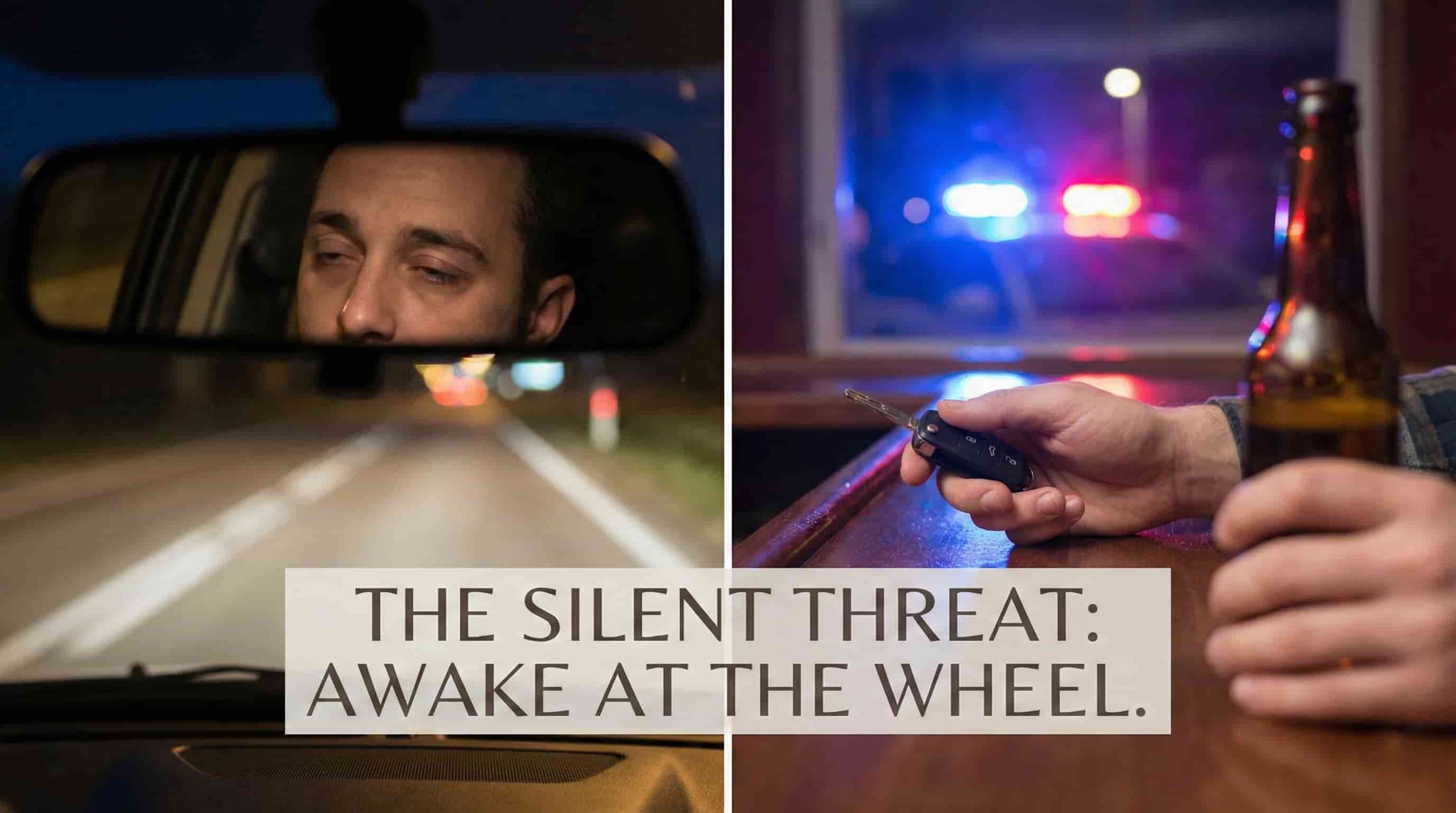
What Is Drowsy Driving and Why Is It Called the Silent Killer of Roads?
Direct Answer: Drowsy driving is operating a vehicle while sleep-deprived to the point of impaired reaction time, judgment, and awareness. It is called the silent killer because, unlike drunk driving, there are no field sobriety tests, no legal limits, and no social stigma — and because drowsy drivers often do not realize they are impaired until it is too late.
Mechanism: S1-1/S1-2 of the whitepaper and AAA Foundation (2016) data establish the scale: drowsy driving accounts for approximately 6,400 fatalities per year in the US alone — a figure that is likely significantly underreported because drowsy driving crashes are often classified as single-vehicle run-off-road accidents without witness testimony of sleepiness. The National Highway Traffic Safety Administration (NHTSA) estimates drowsy driving crashes cost $12.5 billion annually. Unlike alcohol-impaired drivers who typically slow their reaction time progressively, drowsy drivers can have moments of complete unconsciousness (microsleeps) with zero reaction capacity — making them more dangerous per event than drunk drivers in the final seconds before impact.
Actionable Advice: The critical danger of drowsy driving is that insight is lost at the exact moment it is most needed. You do not feel drowsy the way you feel drunk — you feel “fine” until your brain suddenly goes offline. This is why self-assessment is unreliable and why the only safe approach is prevention through adequate sleep before any significant drive.
How Many Hours of Sleep Deprivation Makes Driving as Dangerous as Drunk Driving?
Direct Answer: 17–18 hours of wakefulness produces impairment equivalent to a blood alcohol concentration (BAC) of 0.05%. 24 hours awake produces impairment equivalent to 0.10% BAC — above the legal driving limit in every US state.
Mechanism: Dawson & Reid (1997) — the seminal study published in Nature that first quantified the equivalence — measured cognitive impairment in participants at 17 hours awake and compared it to participants at 0.05% BAC. The results showed identical impairment profiles on tests of reaction time, vigilance, and decision-making. Williamson & Feyer (2000) extended this, demonstrating that 18 hours of sleep deprivation produced performance impairments equivalent to 0.05% BAC and that 24 hours produced impairments equivalent to 0.10% BAC. Critically, this means that if you woke at 6 AM and are driving home at 11 PM — having been awake for 17 hours — you are driving with the equivalent impairment of someone who is almost at the legal drunk driving threshold. You would not get in a car with a friend who had drunk three beers. Yet millions of drivers do this every night on American highways without a second thought.
Actionable Advice: Treat your drive the same way you treat a drinking decision: if you are significantly sleep-deprived, do not drive. Get sleep first, or find an alternative. The calculation is simple: one night of poor sleep before a long drive is not “probably fine” — it is “I am impaired.”
What Exactly Happens in Your Brain During a Microsleep at 60 mph?
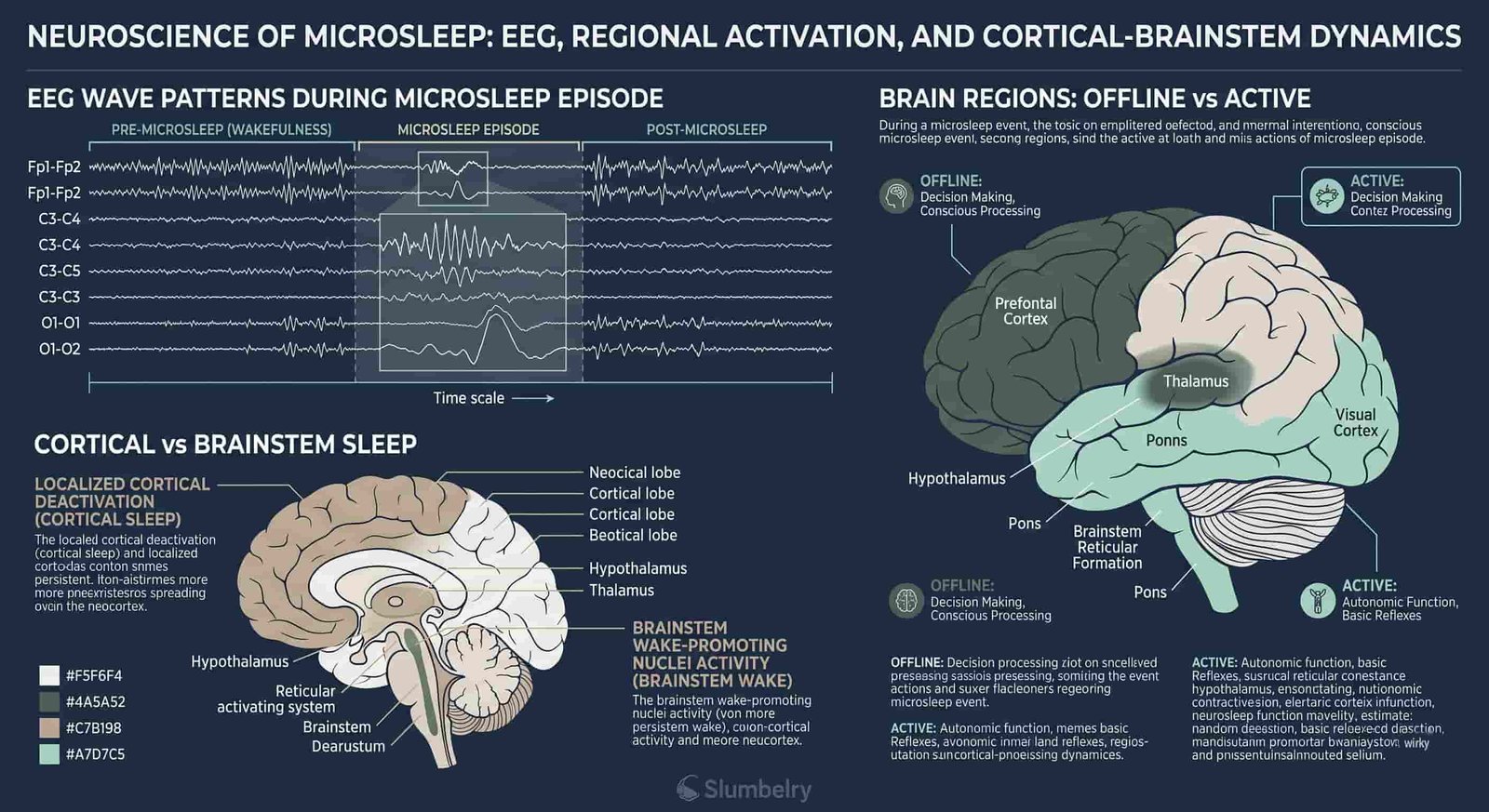
Direct Answer: During a microsleep, your cortex — the part of the brain responsible for conscious awareness, planning, and voluntary movement — goes partially or fully offline. Your brain cycles between sleep and wakefulness in seconds, and you lose all voluntary control of the vehicle during each episode.
Mechanism: S1-1/S1-2 of the whitepaper and sleep deprivation neuroscience: microsleeps occur when the brain’s sleep-wake switch — located in the hypothalamus and brainstem — briefly activates the sleep-promoting ventrolateral preoptic area (VLPO) and deactivates the wake-promoting arousal systems (locus coeruleus, tuberomammillary nucleus). At 60 mph, a 3-second microsleep means the vehicle travels approximately 270 feet — almost the length of a football field — without any driver input. At 70 mph this extends to 308 feet. The terrifying corollary is that a microsleep can end with a collision before the driver ever becomes aware they were unconscious. The brain’s error-monitoring systems — which would normally alert you to the fact that something is wrong — are also offline during the microsleep, meaning the first indication of the episode may be the sound of gravel, a car horn, or the impact itself.
Actionable Advice: The microsleep is not preceded by a warning you can act on. If you feel a microsleep “coming on,” it has already started. The only intervention is to not be in a situation where microsleeps can occur — which means getting adequate sleep before driving.
Why Do Your Eyes Stay Open During a Microsleep If Your Brain Is Offline?
Direct Answer: Because the brainstem — the primitive part of the brain that controls basic life functions including eye movements and posture — remains active during a microsleep, while the cortex — the seat of conscious awareness — partially or fully shuts down.
Mechanism: S1-2 documents the neuroanatomical basis: sleep and wakefulness are not binary states but a spectrum controlled by different neural circuits. The brainstem arousal system maintains basic physiological functions (breathing, heart rate, eye position, postural tone) even during microsleep, which is why the eyelids may not close and the body remains in a driving posture. The cortex, however, is what generates conscious awareness, continuous attention, and voluntary motor control — and it is specifically these functions that go offline during a microsleep. This dissociation between “awake” (brainstem) and “conscious” (cortex) is what makes microsleeps so dangerous: the eyes of the driver are open, the hands are on the wheel, but there is no driver behind the eyes. This is also why dashcam footage of drowsy driving crashes often shows the vehicle drifting with no corrective input — the brainstem is maintaining posture but the cortical override that would initiate correction is absent.
Actionable Advice: Never rely on whether you “feel awake” to determine if you are safe to drive. The part of your brain that would tell you that you are falling asleep is exactly the part that is offline during the microsleep.
What Are the Warning Signs That You Are About to Fall Asleep at the Wheel?
Direct Answer: Yawning, difficulty keeping your eyes focused, drifting from your lane, missing an exit you were prepared for, not remembering the last few miles of driving, and hitting the rumble strip. These are not early warnings — they are evidence that the microsleep has already begun or is imminent.
Mechanism: S1-2 and Stanley (2018) describe the sequence: sleepiness produces a predictable set of behavioral markers before the microsleep threshold is crossed. yawning is a parasympathetic nervous system response that indicates the brain is actively transitioning toward sleep onset. Difficulty focusing and eye closure are signs of reduced cortical activation. Lane drift and rumble strip contact indicate that basic attentional processing has begun to fail. However, these signs do not occur early enough to be reliable safety triggers — by the time you notice them consciously, the neurophysiological sleep-onset cascade has already been initiated. Research from the Monash University Sleepiness Laboratory found that drivers who showed lane drift and microsleep indicators had already experienced significant cognitive impairment for several minutes before the behavioral signs became obvious.
Actionable Advice: At the first sign of any drowsiness — even before you feel “that bad” — pull over. By the time the signs are obvious enough to act on, your cortex has already begun the sleep-onset process. The only appropriate response to any drowsiness indicator is immediate cessation of driving.
Why Does the ‘Almost There’ Feeling Make Near-Home Crashes So Common?
Direct Answer: Because the brain uses automation to conserve cognitive resources on familiar routes, and when a driver is near home, the prefrontal cortex — the part that maintains vigilance and risk assessment — is the first to be shut down under conditions of sleep pressure.
Mechanism: S1-2/S2-3 and traffic psychology research on the “home advantage” effect: the brain’s default mode network activates on familiar routes, allowing the basal ganglia and procedural memory to take over driving tasks without conscious prefrontal supervision. This automation is normally beneficial — it allows experienced drivers to have conversations, listen to music, and process other information simultaneously without impaired driving. However, under sleep deprivation, the prefrontal cortex is already compromised and is the first area to sacrifice its vigilant oversight function. The “almost there” feeling is the sensation of the prefrontal cortex releasing its supervisory role — which on a familiar route is safe, but in a sleep-deprived driver is catastrophically dangerous. S1-2 notes that the combination of automation and sleep deprivation is particularly lethal because the driver experiences a subjective sense of safety and competence that is neurobiologically unjustified. The crashes most commonly occur in the final 5 miles because the driver’s brain has been running on automation for the majority of the trip, and when microsleeps begin, there is no conscious system present to correct the vehicle’s trajectory.
Actionable Advice: Do not drive the final leg of a long journey when you are already sleepy. If the destination is 30 minutes away and you are feeling drowsy, stop before the familiar-route segment begins. The most dangerous part of any road trip is the last few miles when vigilance drops because the brain thinks it is almost done.
Does Caffeine Actually Help or Does It Just Mask the Microsleep Warning Signals?
Direct Answer: Caffeine genuinely improves alertness for 30–45 minutes — but it does not eliminate microsleeps, it only delays them. And critically, caffeine can give you a false sense of safety, making you more likely to drive when you are still dangerously impaired.
Mechanism: S1-2 and Littlehales (2016) on caffeine’s mechanism: caffeine blocks adenosine receptors in the brain. Adenosine is the neurochemical byproduct of wakefulness that builds up throughout the day and creates sleep pressure. By blocking adenosine, caffeine reduces the subjective sensation of sleepiness and temporarily restores some aspects of alertness and reaction time. However, caffeine does not reverse the cognitive impairments produced by sleep deprivation — it only masks the sensation of sleepiness. Studies using EEG monitoring show that sleep-deprived individuals who consume caffeine still experience microsleeps and significant cortical slowing, even when they report feeling more alert. The masking effect is particularly dangerous because it removes the physiological warning signal (the feeling of being sleepy) that would otherwise trigger a driver to pull over. This is why caffeine is not a substitute for sleep — it is a short-term patch that can extend the window of dangerous driving by 30–60 minutes before the accumulated sleep pressure overwhelms the adenosine blockade.
Actionable Advice: If you are already drowsy and near your limit, caffeine alone will not save you. The only effective use of caffeine for driving safety is as part of the Nappuccino method (see H2-8) — where the nap is the primary intervention and caffeine is timed to activate as you wake.
What Is the Nappuccino Method and Does a 20-Minute Nap Actually Reset Your Alertness?
Direct Answer: The Nappuccino is a two-step countermeasure: drink a cup of coffee (or equivalent caffeine), then immediately take a 20-minute nap. Caffeine takes approximately 25 minutes to reach peak blood concentrations, so when the nap ends, the caffeine is activating — giving you maximum alertness for approximately 2–3 hours.
Mechanism: Stanley (2018) and S1-2 document the Nappuccino protocol: NREM stage 2 sleep (light sleep) for approximately 20 minutes produces measurable improvements in alertness, reaction time, and subjective sleepiness without inducing sleep inertia — the grogginess that follows waking from deep sleep (N3). The 20-minute nap specifically targets the sleep inertia window: waking from N2 before the brain has descended into slow-wave deep sleep means you exit sleep without the 15–30 minute grogginess that makes deep naps counterproductive for driving. The coffee-nap synergy works because: (1) the nap immediately reduces accumulated sleep pressure, (2) caffeine’s alertness effect activates around the time you wake, (3) together they extend safe driving capacity by 2–4 hours. Research from Loughborough University found that the Nappuccino method improved driving simulator performance by 37% compared to nap alone and 87% compared to caffeine alone in sleep-deprived subjects. Importantly, the nap does not “make up” for lost sleep — it only temporarily restores alertness. The underlying sleep debt remains and must eventually be repaid.
Actionable Advice: If you are on a long drive and feel drowsy, this is the sequence: pull over safely, drink a coffee, set a 20-minute alarm, nap immediately. When you wake, you have approximately 2–3 hours of restored alertness to reach your destination or the next stop safely. Do not exceed 20 minutes — longer naps risk entering deep sleep and waking with severe inertia.
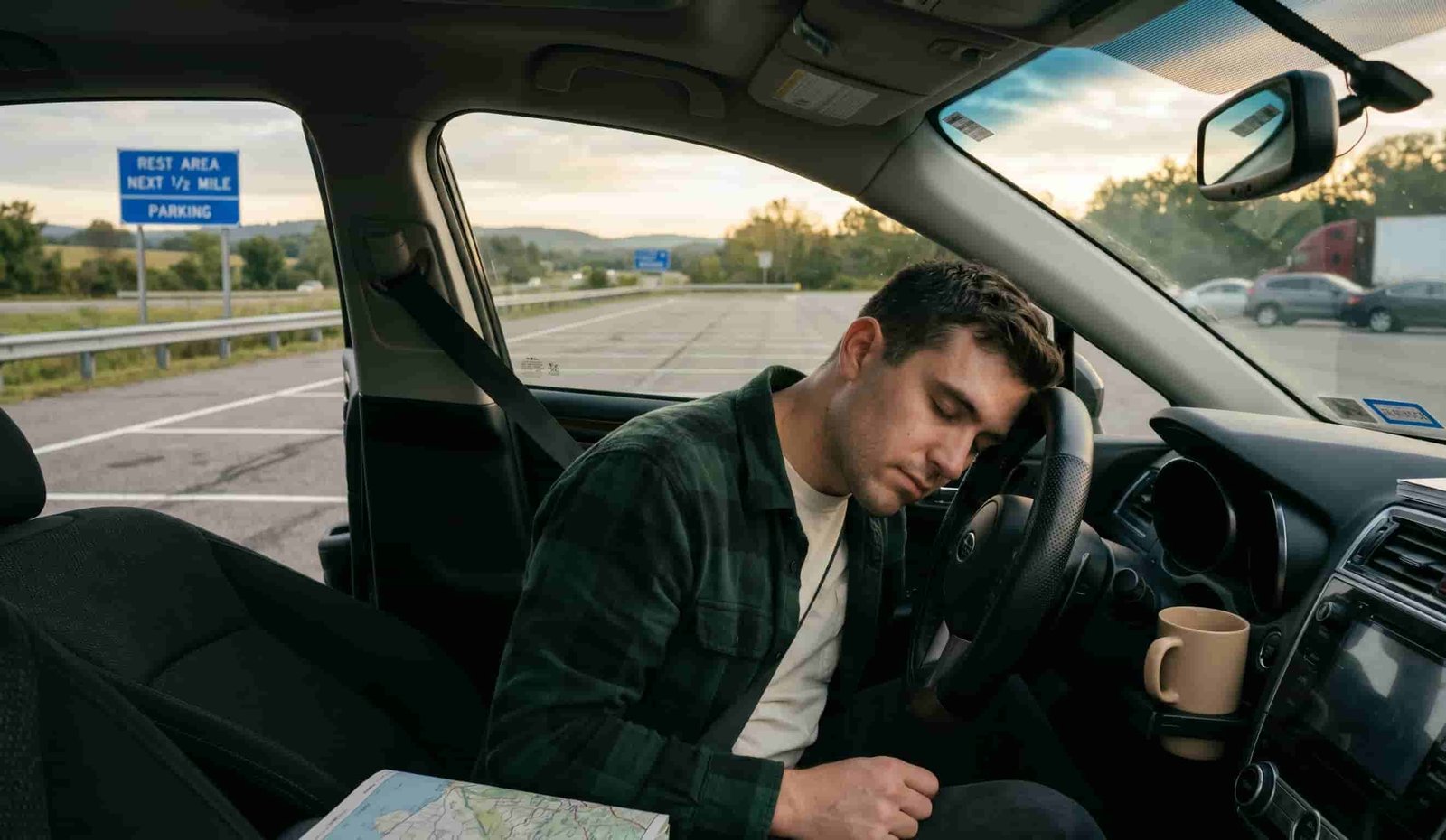
Why Are Professional Drivers and Night Shift Workers at the Highest Risk?
Direct Answer: Because chronic partial sleep restriction — the defining feature of night shift and commercial driving — produces cumulative cognitive impairment that is invisible to the affected individual and accumulates faster than most people realize.
Mechanism: S1-1/S1-2 and circadian rhythm science: night shift workers experience a permanent conflict between their biological circadian drive for sleep (which peaks at 2–4 AM and 1–3 PM) and their work schedule requiring wakefulness during these windows. This produces chronic partial sleep deprivation that compounds across shifts. The critical finding from S1-1 is that after 7 nights of partial sleep restriction (5–6 hours per night), cognitive performance impairment reaches a plateau equivalent to 24 hours of total sleep deprivation — and the individual subjectively reports feeling “almost fine.” This illusion of adaptation is the most dangerous feature of shift work: the subjective feeling of adjustment does not match the objective cognitive impairment, meaning the driver believes they have adapted when their reaction time is equivalent to being legally drunk. Commercial truck drivers face additional risk factors: mandatory early start times conflict with circadian nadir, federal hours-of-service regulations create pressure to drive while fatigued, and the sedentary nature of the job produces physiological sleepiness that compounds circadian effects.
Actionable Advice: If you are a shift worker or commercial driver, your fatigue is not a motivation problem — it is a biological conflict between your circadian biology and your work schedule. Prioritize sleep before the commute home, use blackout curtains and white noise to protect daytime sleep, and never accept a “just push through it” attitude toward the drive home from a night shift.
How to Build a Pre-Road-Trip Sleep Routine That Actually Prevents Drowsy Driving
Direct Answer: The prevention of drowsy driving begins the night before the trip — not in the car. A road trip is not the time to “catch up” on sleep. It requires arriving fully rested.
Mechanism: S4-4 of the whitepaper and Stanley (2018) describe the pre-travel sleep preparation protocol: (1) 7–9 hours of undisturbed sleep the night before departure — not the night of departure; (2) avoid alcohol for 24 hours before the drive, as even legally sober alcohol consumption the night before significantly disrupts sleep architecture; (3) if crossing time zones, begin shifting sleep schedule 2–3 days before departure; (4) the morning of the trip, avoid heavy carbohydrate-rich meals which increase postprandial somnolence; (5) during the trip, schedule a 20-minute nap every 2–3 hours if driving longer than 8 hours. The critical insight is that drowsiness is a biological drive, not a motivational state — willpower cannot override it any more than willpower can override thirst. The only prevention is adequate sleep before the drive, and the only cure during the drive is pulling over and sleeping.
Actionable Advice: Before your next long road trip: go to bed an hour earlier for 2 nights before departure. Set an alarm to protect 8 hours of sleep. No exceptions. If you would not drink three beers before driving, do not start a road trip with 6 hours of sleep debt. Sleep debt is a quantifiable impairment, and it should be treated with the same seriousness we treat alcohol impairment.
Frequently Asked Questions
What is drowsy driving and why is it so dangerous?
Direct Conclusion: Drowsy driving is operating a vehicle while too fatigued to maintain safe reaction times and attention. It is dangerous because microsleeps — brief losses of consciousness — can occur without warning, and unlike drunk driving there are no obvious external signs of impairment. At highway speeds, a 3-second microsleep means traveling the length of a football field blind.
How does drowsy driving compare to drunk driving in terms of risk?
Direct Conclusion: 17–18 hours awake produces impairment equivalent to 0.05% BAC (approaching legal limit). 24 hours awake equals 0.10% BAC (legally drunk in all states). Unlike drunk drivers who typically slow down or make errors before a crash, drowsy drivers can have sudden complete unconsciousness — making them more dangerous per event.
What is a microsleep and how long does it last while driving?
Direct Conclusion: A microsleep is a brief, involuntary episode where the cortex goes partially or fully offline. They last 2–30 seconds and can occur even with eyes open. At 60 mph, a 3-second microsleep means traveling 270 feet with no driver input.
What are the early warning signs of falling asleep at the wheel?
Direct Conclusion: Yawning, heavy eyelids, drifting from lane, missing an exit, not remembering the last few miles, and hitting the rumble strip. Importantly, these are not early warnings — they indicate microsleep has already begun or is imminent. Pull over immediately at any sign of drowsiness.
Does rolling down the window or playing loud music help counteract drowsiness?
Direct Conclusion: No. These interventions activate the sympathetic nervous system briefly (cold air, startle response) but do not reverse the underlying sleep pressure. They may briefly mask the feeling of drowsiness while leaving the microsleep risk completely intact. The only effective countermeasures are sleep and caffeine.
Does caffeine actually help you stay awake while driving?
Direct Conclusion: Caffeine improves subjective alertness for 30–45 minutes but does not eliminate microsleeps or reverse cognitive impairment from sleep deprivation. It can also mask the drowsiness warning signal, making drivers more likely to take risks. Caffeine is effective as part of the Nappuccino method — not as a standalone fix.
What is the Nappuccino method and how does it work?
Direct Conclusion: Drink a coffee, then immediately take a 20-minute nap. Caffeine takes ~25 minutes to peak in the bloodstream, so it activates as you wake. Together, the nap reduces accumulated sleep pressure and caffeine restores alertness for 2–3 hours. This is the only evidence-based caffeine strategy for drowsy driving.
Why do so many crashes happen within 5 miles of home?
Direct Conclusion: On familiar routes near home, the brain’s default mode network activates procedural automation, reducing prefrontal vigilance. For sleep-deprived drivers, this means the system responsible for catching errors is offline precisely when microsleeps begin. The subjective ‘almost there’ feeling masks the actual cognitive impairment.
Who is at highest risk for drowsy driving accidents?
Direct Conclusion: Night shift workers, commercial truck drivers, young male drivers, and anyone who has accumulated sleep debt. Shift workers are at particular risk because chronic partial sleep restriction produces cumulative impairment equivalent to 24 hours awake after just 7 nights — while the driver feels ‘almost normal.’
What is the single most effective thing you can do before a long road trip?
Direct Conclusion: Get 7–9 hours of fully undisturbed sleep the night before departure — not the night of. Sleep debt is a quantifiable impairment, equivalent to alcohol. If you would not drink three beers before driving, do not start a road trip with 6 hours of sleep debt. The only cure for sleepiness is sleep.
Pull Over. Sleep. Arrive Alive.
Drowsy driving is not a character flaw. It is a biological fact. Treat it with the same seriousness you treat drunk driving.
Optimise Your Sleep Environment Take the Sleep AssessmentThe Slumbelry Commitment
Sleep is the most vulnerable state of human existence. It is where we heal, reset, and grow.
At Slumbelry, we do not just sell sleep products; we advocate for your physiological right to rest. From ergonomic support to light management, every solution we offer is designed with one obsession: Respecting your Biology.
Science is our language, but your recovery is our purpose. You take care of everything else in your life — let us take care of your nights.
Rest Deeply,
The Slumbelry Team