
What Is Insomnia? The Sleep Disorder That Tricks You Into Thinking You’re Fine
⚡ Core Takeaway: Insomnia vs. Sleeplessness
- Normal sleeplessness: Occasional difficulty sleeping due to stress, travel, or a specific event. Resolves naturally.
- Insomnia disorder: Persistent (3+ nights/week for 3+ months) sleep difficulty causing significant daytime impairment, despite adequate sleep opportunity.
- The key question: Is your sleep difficulty affecting your daytime functioning — mood, energy, concentration, performance? If yes, it may be insomnia.

What is insomnia — and how do you know if your sleep difficulties qualify? Most people who say they have insomnia are describing a rough night. Actual insomnia disorder is a clinical condition affecting 10-15% of the adult population, with a precise diagnostic definition that separates it from normal sleep variation. Understanding that definition is the first step toward knowing whether your sleep difficulties require self-management, professional intervention, or investigation for another underlying condition. This guide covers the clinical definition, types, risk factors, physiological impacts, and when insomnia is actually a symptom of something else.
What Is Insomnia — And How Is It Different From Normal Sleeplessness?
Insomnia is one of the most commonly misunderstood conditions. Most people who say “I’m insomnia” are describing a rough night. Actual insomnia disorder is a clinical condition characterized by persistent difficulty falling asleep, staying asleep, or achieving restorative sleep — occurring at least 3 nights per week for at least 3 months, despite having adequate time and opportunity for rest.
Understanding what insomnia truly is — versus normal variation in sleep — is the first step toward recognizing when sleep difficulties require attention and intervention. The clinical definition exists because occasional sleeplessness and a genuine sleep disorder have fundamentally different causes, prognoses, and treatments.
What Insomnia Is NOT
It’s important to distinguish insomnia from normal sleep variations. These are NOT insomnia: occasional sleeplessness due to stress, excitement, or environmental factors; short sleep duration by choice (staying up late for work or entertainment); sleep disruption due to external factors like noise, light, or temperature; temporary sleep changes during illness, travel, or major life events; natural age-related changes in sleep patterns that don’t cause distress; sleep restriction due to work schedules or caregiving responsibilities. The key difference: persistence, impact on daily life, and the presence of adequate sleep opportunity.
The Clinical Definition: What Actually Qualifies as Insomnia
According to diagnostic standards (DSM-5 and ICSD-3), insomnia disorder is diagnosed when sleep difficulties meet ALL of the following criteria:
Diagnostic Criteria for Insomnia Disorder
Frequency: Occur at least 3 nights per week for a minimum of 3 months. Impact: Cause significant distress or impairment in social, occupational, or other important areas of functioning. Opportunity: Happen despite adequate opportunity for sleep (sufficient time in bed, appropriate sleep environment). Exclusion: Are not better explained by another sleep disorder, medical condition, or substance use.
The key distinction is that insomnia is not about the amount of sleep you get — it is about the quality of sleep and how it affects your daytime functioning. Some people function well on 6 hours of sleep; others need 9 hours. The number is not the diagnosis. The impact is.
Core Symptoms of Insomnia
Nighttime Symptoms: Sleep onset difficulty — taking more than 30 minutes to fall asleep regularly. Sleep maintenance problems — frequent awakenings during the night with difficulty returning to sleep. Early morning awakening — waking up much earlier than desired and being unable to fall back asleep. Non-restorative sleep — feeling unrefreshed despite spending adequate time in bed.
Daytime Consequences: Fatigue, tiredness, or low energy. Difficulty concentrating or remembering. Mood disturbances (irritability, anxiety, depression). Reduced performance at work or school. Increased errors or accidents. Concerns or worries about sleep.
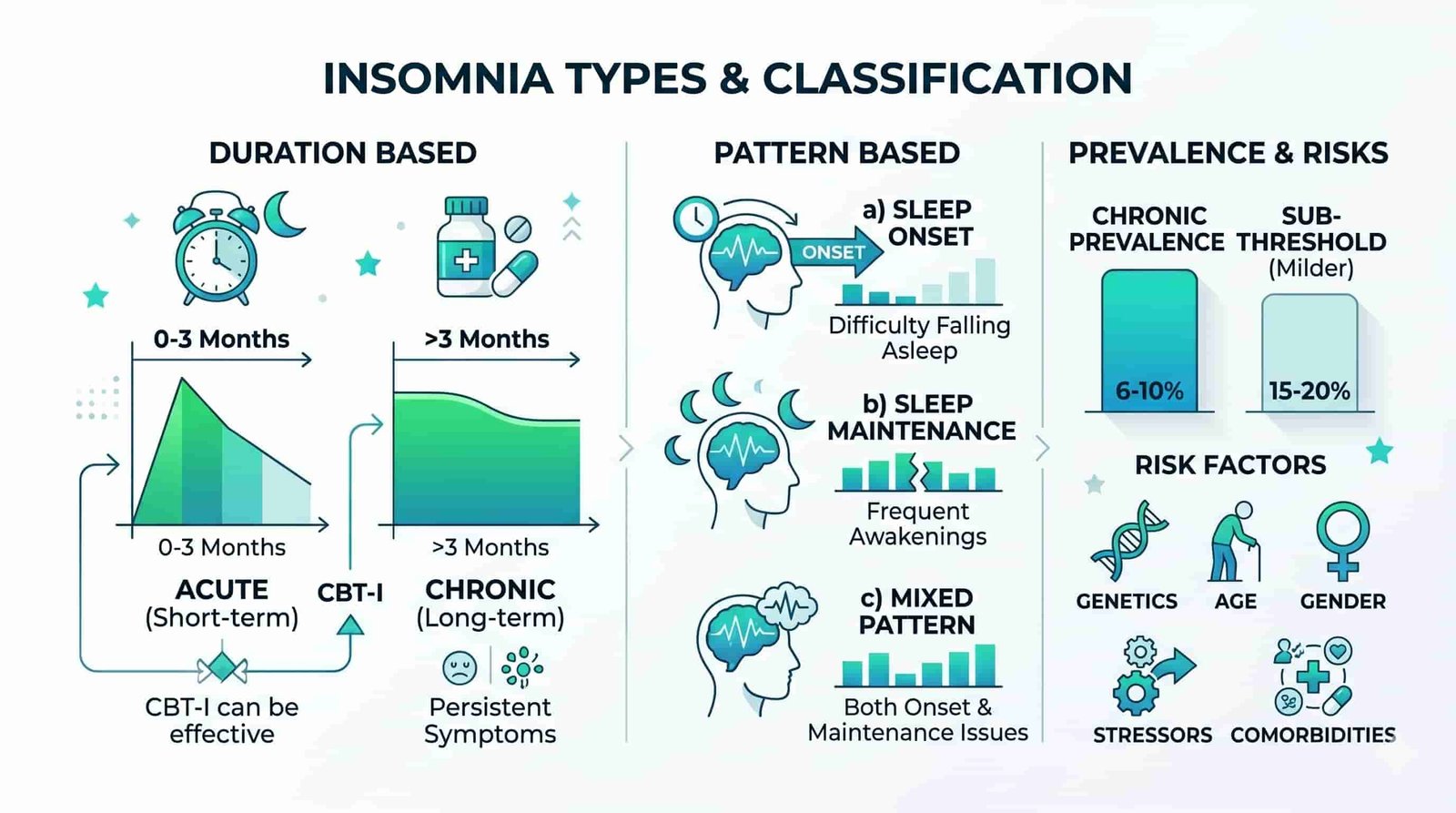
Types of Insomnia: Acute, Chronic, Sleep Onset, Sleep Maintenance, and Mixed
Insomnia is not a single condition. It presents in distinct patterns — and understanding which type you have determines the right intervention.
Duration-Based Classification
Acute (Short-term) Insomnia: Duration less than 3 months, often lasting days to weeks. Usually linked to identifiable stressors or life events — job loss, relationship problems, illness, travel, major life changes. Often resolves on its own once the trigger is addressed. Can develop into chronic insomnia if not properly managed.
Chronic (Long-term) Insomnia: Duration 3 months or longer, occurring at least 3 nights per week. Often involves multiple contributing factors — behavioral, psychological, and physiological. Significant effects on health, mood, and quality of life. Usually requires professional intervention. May have periods of improvement and worsening.
Pattern-Based Classification
Sleep Onset Insomnia (Initial Insomnia): Difficulty falling asleep at bedtime. Often associated with anxiety, racing thoughts, or hyperarousal. May involve lying awake for hours before sleep. Common in younger adults and those with anxiety disorders.
Sleep Maintenance Insomnia (Middle Insomnia): Difficulty staying asleep — frequent awakenings with difficulty returning to sleep. Associated with medical conditions, aging, or deep sleep fragmentation. Common in older adults and those with chronic pain or anxiety.
Mixed Insomnia: Combination of sleep onset and maintenance difficulties. Most common presentation in chronic insomnia. Reflects multiple underlying mechanisms simultaneously.
The 3P Model: Predisposing, Precipitating, and Perpetuating Factors
Insomnia never has a single cause. The 3P model — developed by Dr. Arthur Spielman — explains why insomnia develops and why it persists: three categories of factors combine to produce the full disorder.
The Three Factors
Predisposing factors (who you are): Biological vulnerability to sleep disruption — anxiety sensitivity, high baseline arousal, genetic predisposition, female sex (women are 40% more likely to develop insomnia), older age. These make some people constitutionally more vulnerable to insomnia than others.
Precipitating factors (what happened): Acute stressors that trigger the initial insomnia episode — a stressful life event, illness, grief, job change, relationship crisis, major transition. Almost any significant disruption can trigger acute insomnia in a predisposed individual.
Perpetuating factors (what you do that keeps it going): Behaviors and thoughts that prevent recovery — spending excessive time in bed trying to catch up on sleep, napping to compensate, worrying about sleep causing hyperarousal, using alcohol to self-medicate, inconsistent sleep schedules. These are the factors that turn a normal acute insomnia response into a chronic disorder.
Who Is Most at Risk? The Demographics and Triggers of Insomnia
Insomnia affects approximately 10-15% of the adult population globally, making it one of the most common health conditions. Certain populations are at significantly higher risk.
High-Risk Populations
Women: 40% more likely to develop insomnia than men. Hormonal changes during menstruation, pregnancy, perimenopause, and menopause directly disrupt sleep architecture. Estrogen and progesterone fluctuations affect both sleep onset and maintenance.
Adults over 65: Sleep architecture changes with aging — more fragmented sleep, earlier wake times, reduced deep sleep. These changes interact with medical conditions and medications common in older adults.
People with mental health conditions: 50% of insomnia cases are comorbid with psychiatric conditions — depression, anxiety, PTSD, OCD. The relationship is bidirectional: insomnia causes and worsens psychiatric conditions, and psychiatric conditions cause and worsen insomnia.
Shift workers and travelers: Circadian disruption from shift work affects 20-25% of the workforce. Jet lag and social jet lag (weekend sleep schedule shifts) fragment sleep architecture.

How Insomnia Affects the Brain and Body: The Cumulative Damage of Poor Sleep
Chronic insomnia is not just about feeling tired. It is about accumulated physiological damage across every organ system — and most people with insomnia dramatically underestimate how much it is costing them.
Neurological Impact
Matthew Walker’s research documents that sleep deprivation impairs the prefrontal cortex (executive function, decision-making, emotional regulation) first and most severely. After one night of 6 hours vs. 8 hours, reaction time degrades by 25%. After 7 nights of restriction, cognitive performance is equivalent to 48 hours of total sleep deprivation. The brain also loses its ability to form and retain memories — the hippocampus, which handles memory consolidation, requires deep sleep (N3) to transfer experiences from short-term to long-term storage. Chronic insomnia degrades this capacity permanently over time.
Cardiovascular and Metabolic Impact
Sleep deprivation raises cortisol and adrenaline levels, increasing heart rate and blood pressure. Chronic insomnia is associated with a 45% increased risk of coronary heart disease and a 25% increased risk of stroke. Insulin sensitivity drops with sleep restriction — even one night of 4 hours of sleep produces measurable pre-diabetic changes in blood glucose regulation. Leptin (satiety hormone) drops; ghrelin (hunger hormone) rises. People who sleep less than 6 hours per night are 30% more likely to develop obesity.
Comorbidities: When Insomnia Is a Symptom of Something Else
Insomnia rarely occurs alone. In most chronic cases, it is both a symptom and a cause — maintaining a bidirectional relationship with other conditions.
Common Comorbid Conditions
Anxiety and depression: Present in 50-60% of chronic insomnia cases. The hyperarousal state that maintains insomnia is the same physiological state that drives anxiety. The emotional dysregulation caused by poor sleep worsens depressive symptoms. Treating insomnia improves mental health outcomes; treating mental health conditions improves insomnia.
Chronic pain: Creates a feedback loop — pain disrupts sleep, poor sleep lowers pain threshold, lower pain threshold makes pain feel worse. Addressing both simultaneously is more effective than treating either in isolation.
Sleep apnea: Frequently co-occurs with insomnia, particularly in older adults. Breathing interruptions fragment deep sleep, producing both sleep maintenance insomnia and daytime sleepiness. Undiagnosed sleep apnea is one of the most common reasons insomnia treatment fails.
The Hourglass Effect: Why Acute Insomnia Can Become Chronic If Ignored
The most important thing to understand about acute insomnia is that it has a narrow intervention window. If ignored or mishandled during the acute phase, it can transition into chronic insomnia — which is substantially harder to treat.
The Transition Process
Acute insomnia triggered by a stressor typically resolves when the stressor resolves — if no perpetuating behaviors are introduced. The failure point is behavioral: spending more time in bed to compensate (reducing sleep efficiency), worrying about sleep (activating hyperarousal), and napping (fragmenting homeostatic sleep drive). These behaviors turn acute, self-limiting insomnia into chronic, self-perpetuating insomnia. Research shows that early intervention during the acute phase — before maladaptive behaviors become habitual — prevents the transition to chronicity in 70-80% of cases.
⚡ The Action Window
If you are experiencing acute insomnia triggered by a specific event, take action NOW, while the problem is still acute: maintain consistent bedtimes and wake times. Do not spend more time in bed than usual. Avoid daytime napping. Do not use alcohol as a sleep aid. If the acute insomnia persists beyond 2 weeks, seek professional help before it crosses the 3-month threshold.
When Sleep Trouble Is Actually a Different Sleep Disorder
Not all sleep problems are insomnia. Several other sleep disorders present with similar symptoms and require different treatment approaches. Knowing when to suspect a different disorder is critical.
Conditions Commonly Confused With Insomnia
Sleep apnea: Breathing interruptions during sleep (5-30+ per hour) causing micro-arousals. Usually accompanied by loud snoring, gasping, morning headaches. Diagnosed via polysomnography. Treatment (CPAP) resolves the sleep fragmentation.
Restless leg syndrome (RLS): Uncomfortable sensations in the legs with an irresistible urge to move them, worsening at rest and at night. Disrupts sleep onset. Responds to specific medications (dopamine agonists, gabapentinoids) not used for primary insomnia.
Circadian rhythm disorders: Delayed Sleep Phase Syndrome (night owls who cannot fall asleep until 2-3 AM), Advanced Sleep Phase Syndrome (early risers who fall asleep at 7-8 PM). Misdiagnosed as insomnia because the complaint is difficulty sleeping at conventional times. Treated with chronotherapy and light therapy, not CBT-I.
Parasomnias: Sleepwalking, night terrors, REM behavior disorder — activities during sleep that the sleeper is unaware of. Often misreported as “not sleeping.”
The Slumbelry Framework: Understanding Insomnia Is the First Step to Solving It
Slumbelry’s approach to insomnia begins with a simple inversion: the goal is not to sleep more hours. The goal is to wake up restored. Insomnia exists on a spectrum — from one rough night to a chronic neurological condition. Knowing where you are on that spectrum determines what action is appropriate.
Slumbelry’s Sleep Education Philosophy
We believe that understanding what insomnia is — and is not — is the first step toward solving it. A single night of poor sleep is not insomnia; it is a normal variation. Chronic insomnia disorder is a medical condition that requires professional treatment. Between those two extremes lies a large gray area where self-management, sleep hygiene optimization, and environmental design can prevent the problem from worsening. Slumbelry’s content exists to help you understand which category your sleep difficulties fall into — and when to escalate to professional care.
Action step: Use the diagnostic criteria above to assess where your sleep difficulties fall. If you meet the criteria for insomnia disorder, book a GP appointment within the next two weeks. If you do not, use our sleep hygiene resources to prevent acute insomnia from transitioning to chronic.
Frequently Asked Questions About Insomnia
What is the difference between insomnia and just not sleeping well?
The key distinction is persistence and impact. Occasional sleeplessness due to stress, travel, or excitement is normal — it resolves naturally and causes no significant daytime impairment. Insomnia disorder is clinically defined as: sleep difficulty occurring at least 3 nights per week, for at least 3 months, causing significant daytime impairment, despite adequate sleep opportunity. The diagnostic question is not ‘how many hours did I sleep’ but ‘is my sleep affecting my daytime functioning.’ If you have poor sleep for 2 nights and feel fine the next day, that is not insomnia. If you have poor sleep for 3+ nights per week consistently and feel fatigued, irritable, or cognitively impaired the next day — that may be insomnia.
What are the three main types of insomnia?
Insomnia is classified by both duration and pattern. Duration: Acute (short-term) insomnia — less than 3 months, usually triggered by a specific stressor, often resolves when the stressor is resolved. Chronic insomnia — 3+ months, 3+ nights per week, usually requires professional treatment. Pattern: Sleep onset insomnia — difficulty falling asleep at bedtime, common in anxious individuals. Sleep maintenance insomnia — difficulty staying asleep (frequent awakenings), common in older adults and those with medical conditions. Mixed insomnia — both onset and maintenance difficulties, the most common presentation in chronic insomnia.
What is the 3P model of insomnia?
The 3P model (Predisposing, Precipitating, Perpetuating) explains why insomnia develops and persists. Predisposing factors: your constitutional vulnerability — anxiety sensitivity, high baseline arousal, female sex, older age, genetic predisposition. These make some people more likely to develop insomnia than others. Precipitating factors: the acute trigger — a stressful life event, illness, job loss, grief, relationship crisis. Almost any significant disruption can trigger acute insomnia in a predisposed person. Perpetuating factors: the behaviors that keep insomnia going — spending excessive time in bed, napping to compensate, alcohol use, caffeine dependence, inconsistent schedules, and most importantly: the anxiety about sleep itself which creates the hyperarousal that prevents sleep. Breaking the perpetuating cycle is the primary target of CBT-I.
Who is most at risk for developing insomnia?
Insomnia affects 10-15% of the adult population. Highest-risk groups: Women — 40% more likely than men due to hormonal fluctuations across menstrual cycle, pregnancy, perimenopause, and menopause. Adults over 65 — sleep architecture changes with aging (more fragmented, earlier wake times, reduced deep sleep). People with mental health conditions — 50% of chronic insomnia cases are comorbid with depression, anxiety, PTSD, or OCD. The relationship is bidirectional: each worsens the other. Shift workers and frequent travelers — circadian disruption from irregular schedules affects 20-25% of the workforce. People with chronic medical conditions — chronic pain, thyroid disorders, and respiratory conditions all disrupt sleep.
What damage does chronic insomnia do to the brain and body?
Chronic insomnia causes measurable damage across every organ system. Neurologically: sleep deprivation impairs the prefrontal cortex first — reaction time degrades by 25% after one night of 6 vs 8 hours; after 7 nights, cognitive performance is equivalent to 48 hours of total sleep deprivation. Memory consolidation in the hippocampus requires deep sleep — chronic insomnia degrades this capacity. Cardiovascularly: chronic insomnia increases coronary heart disease risk by 45% and stroke risk by 25%. Metabolically: insulin sensitivity drops after one night of 4 hours sleep (pre-diabetic changes); leptin drops and ghrelin rises, increasing obesity risk by 30%. Immunologically: natural killer cell activity drops by 70% after one night of 4-6 hours of sleep.
Can insomnia be a symptom of another condition?
Yes — and this is one of the most underdiagnosed presentations. Insomnia is both a cause and a consequence of many conditions. Bidirectional relationships exist with: depression and anxiety (50-60% of chronic insomnia cases are comorbid) — treating insomnia improves mental health outcomes; chronic pain (creates a feedback loop: pain disrupts sleep, poor sleep lowers pain threshold) — requires simultaneous treatment; sleep apnea (breathing interruptions fragment deep sleep, causing both maintenance insomnia and daytime sleepiness) — often missed as the underlying cause of ‘treatment-resistant’ insomnia; thyroid disorders (hyperthyroidism causes hyperarousal and maintenance insomnia) — standard blood tests can rule this out; GERD (acid reflux worsens when lying down, disrupting sleep maintenance). Any insomnia that does not respond to standard CBT-I warrants medical evaluation for comorbid conditions.
When does acute insomnia become chronic insomnia?
The transition from acute to chronic insomnia occurs at the 3-month threshold — which is also the clinical diagnostic threshold. The mechanism of transition: acute insomnia triggered by a stressor typically resolves when the stressor resolves — if no maladaptive behaviors are introduced. The failure point is behavioral: spending more time in bed to catch up, napping to compensate, using alcohol, and most importantly, worrying about sleep (which causes hyperarousal, preventing sleep). Research shows that early intervention during the acute phase prevents the transition to chronicity in 70-80% of cases. The critical intervention window is the first 2-4 weeks of acute insomnia, before perpetuating behaviors become habitual. After 3 months, the disorder is neurologically entrenched and significantly harder to treat.
What other sleep disorders are commonly confused with insomnia?
Several conditions are frequently misdiagnosed as primary insomnia: Sleep apnea — breathing interruptions causing micro-arousals. Usually accompanied by snoring, gasping, morning headaches. Diagnosed via polysomnography. Restless leg syndrome — uncomfortable leg sensations with urge to move, worsening at rest and at night. Disrupts sleep onset, responds to different medications than insomnia. Circadian rhythm disorders — Delayed Sleep Phase Syndrome (night owls unable to fall asleep until 2-3 AM) or Advanced Sleep Phase Syndrome (early risers falling asleep at 7-8 PM). Misdiagnosed as onset insomnia because the complaint is difficulty sleeping at conventional times. Parasomnias — sleepwalking, night terrors, REM behavior disorder — activities during sleep the person is unaware of, often reported as ‘not sleeping.’ Narcolepsy — sudden sleep attacks during the day, excessive daytime sleepiness that feels like insomnia but is a separate disorder.
How do doctors diagnose insomnia disorder?
Diagnosis is clinical — no imaging or laboratory test is required for straightforward cases. The diagnostic process: detailed sleep history covering onset, duration, frequency, pattern, triggers, and impact. Sleep diary for 1-2 weeks to confirm the pattern. Medical history review — medications, substances, other conditions. Mental health screening — depression, anxiety, trauma history. Physical examination if indicated (airway assessment, thyroid, neurological). The key diagnostic tools are the clinical interview and sleep diary, not laboratory testing. Polysomnography (sleep study) is reserved for cases where another primary sleep disorder (sleep apnea, periodic limb movement disorder) is suspected — not for straightforward insomnia.
What should I do if I think I have insomnia?
Assess using the clinical criteria: Are you experiencing sleep difficulties 3+ nights per week? For 3+ months? Causing significant daytime impairment (fatigue, mood changes, cognitive impairment)? If NO to all three — you have normal sleep variation. Use sleep hygiene optimization to prevent the problem from worsening: consistent bedtimes and wake times, no caffeine after 2 PM, no alcohol before bed, regular exercise, cool dark quiet bedroom. If YES to all three — you likely meet criteria for insomnia disorder. Book a GP appointment within 2 weeks. Do not wait for it to resolve on its own — the longer chronic insomnia persists, the more neurologically entrenched it becomes. CBT-I (Cognitive Behavioral Therapy for Insomnia) is the first-line treatment and works for 70-80% of patients.
Is Your Sleep Difficulty Actually Insomnia?
Use the diagnostic criteria in this guide to assess where your sleep difficulties fall — and know when professional treatment is the right next step.
Take the Sleep Assessment Subscribe for Sleep Optimization TipsThe Slumbelry Commitment
Sleep is the most vulnerable state of human existence. It is where we heal, reset, and grow.
At Slumbelry, we do not just sell sleep products; we advocate for your physiological right to rest. From ergonomic support to light management, every solution we offer is designed with one obsession: Respecting your Biology.
Science is our language, but your recovery is our purpose. You take care of everything else in your life — let us take care of your sleep.
Rest Deeply,
The Slumbelry Team
Medical References:
1. Morin, C. M., et al. (2006). Psychological and Behavioral Treatment of Insomnia. Sleep, 28(9), 1137-1148.
2. Walker, M. (2017). Why We Sleep. Scribner.
3. Spielman, A. J., et al. (1987). A Behavioral Perspective on Insomnia Treatment. Psychiatry Clinics of North America.