
Chronic Insomnia Won’t Fix Itself: The Professional Treatment Path That Actually Works
⚡ Core Takeaway: Three Reasons to See a Professional
- CBT-I is the gold standard: Cognitive Behavioral Therapy for Insomnia works for 70-80% of patients and the benefits last years — unlike medication, which only masks symptoms.
- Insomnia for 3+ months with 3+ nights/week is your threshold: Below this, self-help may work. Above it, professional intervention prevents chronicity from becoming permanent.
- Your GP is the right first call: They rule out medical causes (thyroid, sleep apnea, depression) before referring to a sleep specialist or CBT-I therapist.

Insomnia treatment has evolved significantly from the prescription-pad approach of previous decades. Today, evidence-based approaches like Cognitive Behavioral Therapy for Insomnia (CBT-I) lead the treatment toolkit — with clinical evidence showing it works for 70-80% of patients and produces lasting results without medication dependency. This guide covers when to seek professional help, what CBT-I actually involves, medication options and their real risks, and how to navigate the journey toward better sleep with expert guidance.
How Do You Know When Insomnia Requires Professional Help?
While many sleep issues resolve with lifestyle changes and self-help strategies, chronic insomnia often requires professional intervention to break the cycle. Recognizing when to seek expert help is crucial for preventing the condition from becoming entrenched and impacting your overall health.
Signs You Need Professional Treatment
Duration and Frequency: Sleep difficulties persisting for more than 3 months despite self-help efforts. Insomnia occurring 3 or more nights per week consistently. Sleep problems getting worse rather than improving. Multiple self-help strategies attempted without success.
Impact on Daily Life: Significant daytime fatigue affecting work or school performance. Mood changes including irritability, anxiety, or depression. Difficulty concentrating or making decisions. Increased accidents or near-misses due to sleepiness. Physical symptoms like headaches or digestive issues from sleep deprivation.
Red Flags Requiring Immediate Attention
Sleep Apnea Signs: Loud snoring, gasping during sleep, morning headaches. Restless Leg Syndrome: Uncomfortable sensations in legs with urge to move. Parasomnias: Sleepwalking, night terrors, or violent movements during sleep. Narcolepsy Symptoms: Sudden sleep attacks during the day. Mental Health Concerns: Thoughts of self-harm or severe depression. Substance Use: Relying on alcohol or drugs to sleep.
Action step: If you meet 3+ of the duration/frequency criteria AND 2+ daily impact criteria, schedule a GP appointment this week. You do not need to wait for the problem to get worse.
What Is CBT-I and Why Is It the Gold Standard Treatment?
Cognitive Behavioral Therapy for Insomnia (CBT-I) is a structured program that helps identify and replace thoughts and behaviors that cause or worsen sleep problems with habits that promote sound sleep. It is considered the gold standard treatment for chronic insomnia — research shows it is as effective as medication in the short term and significantly more effective in the long term.
The Evidence: CBT-I by the Numbers
70-80% of people with chronic insomnia experience significant improvement with CBT-I. Average reduction in sleep onset latency: 30-50%. Sleep efficiency improves substantially, with decreased nighttime awakenings and improved daytime functioning. Most importantly, benefits are typically maintained long-term — without medication’s dependency risk or side effect profile. The American College of Physicians recommends CBT-I as the first-line treatment for all adult patients with chronic insomnia, ahead of medication.
CBT-I Core Components
Sleep Education: Learning about normal sleep patterns and sleep hygiene. Cognitive Therapy: Identifying and changing negative thoughts about sleep. Behavioral Interventions: Changing behaviors that interfere with sleep. Sleep Restriction: Limiting time in bed to improve sleep efficiency. Stimulus Control: Strengthening the association between bed and sleep. Relaxation Training: Learning techniques to reduce physical and mental arousal.
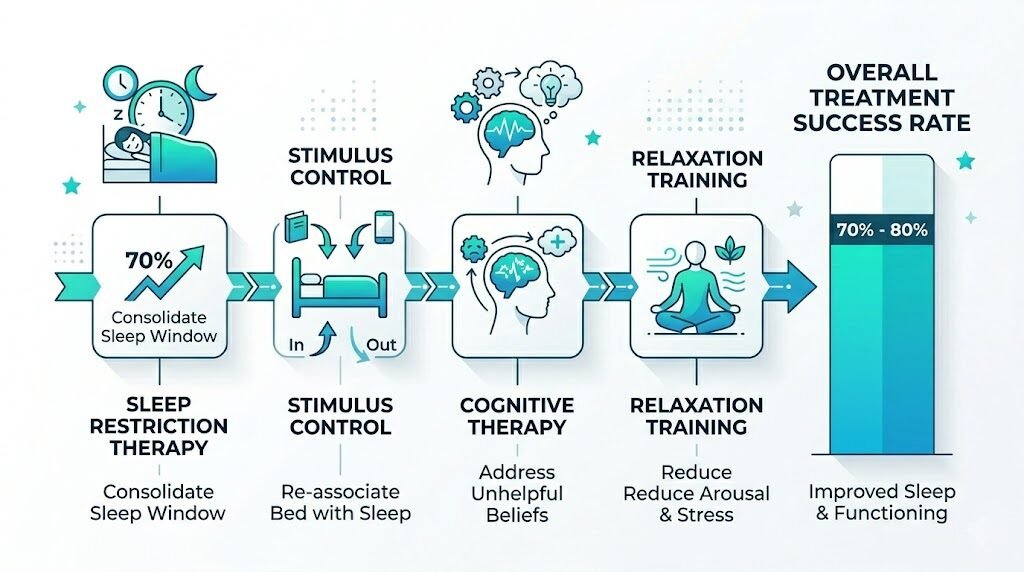
CBT-I Techniques Explained: Sleep Restriction, Stimulus Control, and Cognitive Restructuring
CBT-I is not a single technique — it is a combination of behavioral and cognitive interventions applied in a structured sequence. Understanding each component helps you recognize what a treatment program will actually ask you to do.
Sleep Restriction Therapy
Sleep restriction limits time in bed to match actual sleep time, creating enough sleep pressure to consolidate sleep and reduce time spent awake in bed. The process: if you sleep 5 hours out of 8 in bed, your initial time-in-bed window is set to 5 hours. As sleep efficiency improves (>85%), the window is extended in 15-30 minute increments every few days. This sounds counterintuitive — restricting sleep sounds like it makes things worse. But it works by building sleep pressure, eliminating the anxiety of lying awake for hours, and retraining the brain’s association between bed and sleep. Typically shows measurable results within 2-4 weeks.
Stimulus Control Instructions
The principle: the bed must become a pure sleep signal, not a wakefulness association. Go to bed only when sleepy. Use the bed only for sleep and intimacy — no reading, no screens, no work. Get out of bed if unable to sleep within 15-20 minutes. Return to bed only when genuinely sleepy again. Maintain a consistent wake time regardless of sleep quality the night before. The goal is to break the conditioned response where the bed triggers anxiety and wakefulness instead of sleep.
Cognitive Restructuring
Identifies catastrophic thoughts about sleep loss — “if I don’t sleep tonight, I’ll fail my presentation tomorrow” — and challenges their logic. Develops more balanced, realistic thoughts about sleep: “A bad night will make tomorrow harder, but I will survive it and my body will compensate.” Reduces the anxiety about insomnia that perpetuates the insomnia — which is why cognitive therapy is as important as the behavioral components.
When Is Medication Appropriate for Insomnia — and When to Avoid It
While CBT-I is the preferred first-line treatment, medications may be appropriate in specific situations — either as short-term relief while implementing behavioral changes, or when CBT-I is unavailable. Understanding when medication makes sense — and when it makes things worse — is essential.
When Medication May Be Considered
Severe insomnia causing significant impairment and requiring immediate relief. Crisis situations where the acute cycle must be broken. CBT-I is unavailable or inaccessible in your area. Patient preference after full discussion of risks and benefits. Combination therapy with CBT-I for severe cases. Underlying medical conditions contributing to insomnia that must be simultaneously managed.
Prescription Sleep Medications: What You Need to Know
Z-drugs (Zolpidem, Eszopiclone, Zaleplon): Shorter half-life than traditional benzodiazepines, less risk of next-day drowsiness. Still carry dependency and tolerance risks. May cause complex sleep behaviors (sleep-driving, sleep-eating) in susceptible individuals. Benzodiazepines (Temazepam, Lorazepam): Effective for sleep initiation and maintenance. Higher dependency risk and tolerance development. Can cause daytime sedation and cognitive impairment. Generally reserved for short-term use only. Orexin Receptor Antagonists (Suvorexant, Lemborexant): Newer class targeting wake-promoting systems. May have lower dependency risk. Can cause next-day drowsiness. Expensive and may not be covered by insurance.
⚡ The Medication Rule
Use the lowest effective dose for the shortest duration. Avoid alcohol — it compounds sedation and disrupts sleep architecture. Plan for gradual discontinuation with your doctor — rebound insomnia is common with abrupt stopping. Combine with CBT-I when possible — medication alone never addresses underlying causes. Do not use OTC antihistamines (Benadryl/Diphenhydramine) for long-term insomnia — tolerance develops within days and cognitive impairment accumulates.
What Happens During a Comprehensive Sleep Evaluation
A thorough professional evaluation is essential for identifying the underlying causes of insomnia and developing an effective treatment plan. Understanding what to expect reduces the anxiety of the first appointment and helps you prepare.
The Initial Assessment
Medical History: Detailed sleep history including onset, duration, and patterns. Current medications and supplements. Medical conditions that may affect sleep. Family history of sleep disorders. Substance use history including alcohol, caffeine, and recreational drugs.
Sleep Diary Analysis: Bedtime and wake time patterns. Sleep latency (time to fall asleep). Number and duration of nighttime awakenings. Total sleep time and sleep efficiency. Daytime napping and caffeine intake. Mood and energy levels.
Physical Examination: Assessment of airway and breathing. Neurological examination. Evaluation for signs of other medical conditions. BMI and neck circumference measurement (sleep apnea indicators).
Diagnostic Tools
Polysomnography (Sleep Study): Comprehensive overnight monitoring in a sleep lab. Measures brain waves, eye movements, muscle activity, breathing, heart rate, and oxygen levels. Can diagnose sleep apnea, periodic limb movements, and other disorders. Usually not needed for straightforward insomnia cases — reserved for complex presentations.
Home Sleep Testing: Simplified monitoring for suspected sleep apnea. More convenient and cost-effective than lab studies. Limited to breathing and oxygen monitoring. May miss some sleep disorders.
Actigraphy: Wrist-worn device monitoring movement and light exposure. Provides objective data on sleep-wake patterns. Useful for assessing circadian rhythm disorders. Can be worn for weeks to capture patterns.

Specialized Treatments: Light Therapy, Mindfulness, and Biofeedback
Beyond CBT-I and medication, several specialized treatments may be recommended for specific types of insomnia or when standard approaches are not sufficient.
Light Therapy
Particularly effective for circadian rhythm disorders. Uses bright light to reset the body’s internal clock and suppress melatonin at appropriate times. Treatment typically uses 10,000 lux light boxes for 30 minutes to 2 hours daily. Morning light advances sleep phase (earlier bedtime); evening light delays it (later bedtime). Effective for Delayed Sleep Phase Syndrome, Advanced Sleep Phase Syndrome, Shift Work Sleep Disorder, and Jet Lag.
Mindfulness-Based Therapy for Insomnia (MBTI)
Combines meditation and mindfulness practices with sleep-specific techniques. Focuses on accepting and observing sleep difficulties rather than fighting them. Reduces sleep-related anxiety and the effort of trying to sleep. Particularly effective for insomnia driven by rumination and pre-sleep anxiety. Can be combined with CBT-I for enhanced effect.
Biofeedback and Relaxation Training
Teaches conscious control over physiological processes that affect sleep. EMG Biofeedback: Monitors muscle tension — useful for physical tension-related insomnia. HRV Biofeedback: Monitors autonomic nervous system — trains parasympathetic dominance. Progressive Muscle Relaxation: Systematic tensing and relaxing of muscle groups. Reduces physical tension and anxiety. Can be learned and practiced independently after initial training.
Insomnia and Comorbid Conditions: Why the Whole Person Must Be Treated
Insomnia rarely occurs in isolation. Most chronic insomnia cases are comorbid with other conditions — and treating insomnia without addressing the co-occurring disorder typically produces incomplete results.
Mental Health and Insomnia
Depression and Insomnia: Bidirectional relationship — each condition worsens the other. May require simultaneous treatment of both. Some antidepressants improve sleep; others worsen it. CBT-I can be effective even with comorbid depression — addressing sleep improves mood outcomes. Anxiety Disorders: Racing thoughts and worry interfere with sleep onset. Benefits from anxiety-specific CBT techniques alongside sleep-focused intervention. Relaxation training particularly helpful. PTSD and Trauma: Nightmares and hypervigilance disrupt sleep architecture. May require trauma-specific therapy (EMDR, Image Rehearsal Therapy) alongside sleep treatment.
Medical Conditions and Sleep
Chronic Pain: Pain interferes with sleep initiation and maintenance; poor sleep increases pain sensitivity. May require coordinated pain and sleep management. Hormonal Changes: Menopause-related sleep disruption, thyroid disorders, age-related changes in sleep architecture. Neurological Conditions: Parkinson’s disease, Alzheimer’s disease, Multiple sclerosis — each affects sleep architecture uniquely and requires specialized treatment approaches.
How to Find the Right Sleep Specialist and Prepare for Your First Appointment
Choosing the right healthcare provider is crucial for successful insomnia treatment. Knowing what questions to ask — and how to prepare — dramatically improves the quality of your first appointment.
⚡ Questions to Ask Before Booking
About Experience: How many patients with insomnia do you treat? What is your training in sleep medicine? Are you board-certified in sleep medicine? Do you offer CBT-I or can you refer to someone who does?
About Treatment Approach: What is your typical approach to treating insomnia? Do you prefer behavioral or medication treatments? How do you handle treatment-resistant cases? What role do you see for sleep medications?
About the Process: What can I expect during the evaluation? How long does treatment typically take? How often will we meet? What homework or assignments will be involved?
Preparing for Your First Appointment
Information to Gather: Complete sleep diary for 1-2 weeks (use our free template). List of all medications and supplements. Medical history and previous sleep treatments tried. Questions and concerns about your sleep.
What to Expect: Detailed discussion of your sleep history. Physical examination if indicated. Discussion of treatment options. Development of an initial treatment plan. Scheduling of follow-up appointments.
The Slumbelry Framework: Professional Treatment Is Respecting Your Biology’s Limits
Slumbelry’s approach to insomnia is consistent with its approach to sleep generally: respect the biology, design the environment, and know when self-management has reached its limits. Professional treatment for insomnia is not a last resort — it is a biological necessity when chronic insomnia has passed the threshold where self-help can reverse it.
Slumbelry’s Commitment to Professional Sleep Care
The goal of Slumbelry’s sleep content is to help you understand when the problem is solvable with better sleep habits — and when it requires clinical intervention. Chronic insomnia that has persisted for more than 3 months, that occurs 3 or more nights per week, and that is producing measurable daytime impairment — this is a medical condition that deserves medical treatment. CBT-I, delivered by a trained therapist, is the most evidence-based intervention available. Medication, when used appropriately under medical supervision, can provide the acute relief needed to begin the behavioral work. Neither is a sign of failure. Both are acts of respecting your biology’s limits.
Action step: If you recognize your situation in the “when to seek help” criteria above, book a GP appointment this week. You are not failing — you are accessing the intervention that can actually work.
Frequently Asked Questions About Insomnia Treatment
When exactly should someone seek professional treatment for insomnia?
The clinical threshold for professional intervention is: insomnia lasting more than 3 months (chronic) occurring 3 or more nights per week, despite attempted self-help strategies, AND producing measurable daytime impairment (fatigue, mood changes, cognitive impairment, relationship problems). If you meet these criteria, professional treatment is medically indicated — not optional. The longer chronic insomnia remains untreated, the more it becomes neurologically entrenched as a conditioned response. Early intervention prevents the problem from becoming permanent.
What is CBT-I and why is it the gold standard for insomnia treatment?
Cognitive Behavioral Therapy for Insomnia (CBT-I) is a structured, evidence-based treatment program that addresses the thoughts and behaviors maintaining insomnia. Unlike medication, which masks symptoms, CBT-I resolves underlying causes. Research shows 70-80% of patients experience significant improvement, with benefits lasting years after treatment ends. The American College of Physicians recommends CBT-I as the first-line treatment for all adult chronic insomnia — ahead of medication. It is delivered by trained psychologists, therapists, or sleep specialists over 6-8 sessions typically. It includes sleep education, cognitive restructuring, sleep restriction, and stimulus control techniques.
How does sleep restriction therapy actually work?
Sleep restriction therapy limits time in bed to match actual sleep time, creating sufficient homeostatic sleep pressure to consolidate sleep and eliminate the anxiety of lying awake for hours. The process: if you sleep 5 hours out of 8 in bed, your initial time-in-bed window is set to 5 hours. As sleep efficiency improves above 85%, the window is extended in 15-30 minute increments. This sounds counterintuitive — restricting sleep sounds like it worsens things. But it works by building stronger sleep pressure, eliminating the wakefulness-anxiety association, and retraining the brain’s conditioned response between bed and sleep. Most people see measurable improvement within 2-4 weeks.
What medications are commonly prescribed for insomnia and what are the risks?
Prescription medications for insomnia fall into several categories: Z-drugs (Zolpidem, Eszopiclone) — shorter-acting and less likely to cause next-day drowsiness, but still carry dependency and complex sleep behavior risks. Benzodiazepines (Temazepam, Lorazepam) — effective but higher dependency risk and cognitive impairment; generally for short-term use only. Orexin receptor antagonists (Suvorexant, Lemborexant) — newer class targeting wake-promoting systems, potentially lower dependency risk but expensive. Off-label antidepressants (Trazodone, Mirtazapine) — commonly prescribed, may be appropriate when comorbid depression or anxiety is present. All carry risks of dependency, tolerance, rebound insomnia on discontinuation, and potential cognitive effects with long-term use. Medication should always be combined with behavioral intervention when possible.
What happens during a comprehensive sleep evaluation?
A comprehensive sleep evaluation typically includes: detailed sleep history covering onset, duration, patterns, and triggers. Review of current medications and supplements. Physical examination assessing airway, breathing, BMI, and neurological function. Sleep diary analysis across 1-2 weeks tracking bedtime, wake time, sleep latency, awakenings, and daytime function. Standardized questionnaires (Insomnia Severity Index, Pittsburgh Sleep Quality Index, Epworth Sleepiness Scale). Mental health screening for depression, anxiety, and trauma history. Polysomnography (overnight sleep study) is reserved for cases where sleep apnea, periodic limb movement disorder, or other primary sleep disorders are suspected — not for straightforward insomnia cases.
What is the difference between CBT-I and mindfulness-based therapy for insomnia?
CBT-I is a structured behavioral and cognitive program with defined techniques (sleep restriction, stimulus control, cognitive restructuring) applied in a specific sequence. MBTI (Mindfulness-Based Therapy for Insomnia) focuses on accepting sleep difficulties rather than fighting them — reducing the effort and anxiety around sleep that perpetuates insomnia. The key distinction: CBT-I is active intervention (changing behaviors and thoughts); MBTI is acceptance-based (changing the relationship with sleep difficulties). They can be combined effectively. For insomnia driven primarily by anxiety and rumination about sleep, MBTI may be more tolerable; for insomnia driven by behavioral dysfunction, CBT-I’s structure is more directly effective.
Can insomnia be treated if it is caused by another medical condition?
Yes — but the approach must be integrated. Comorbid insomnia (insomnia occurring alongside another condition) requires simultaneous treatment of both the primary condition and the insomnia. Depression and insomnia have a bidirectional relationship — treating only the depression while leaving insomnia unmanaged produces suboptimal outcomes for both. Similarly, anxiety disorders, chronic pain, hormonal disruptions (thyroid, menopause), and neurological conditions (Parkinson’s, Alzheimer’s) all affect sleep architecture in specific ways that require coordinated treatment. A multidisciplinary approach — coordination between sleep specialists, psychiatrists or psychologists, and primary care physicians — typically produces the best outcomes for comorbid insomnia.
How do I find a qualified CBT-I therapist or sleep specialist?
Start with your GP — they can rule out medical causes, provide initial treatment, and refer to specialists. For CBT-I specifically: the Society of Behavioral Sleep Medicine (SBSM) maintains a directory of certified CBT-I providers. The American Board of Sleep Medicine certifies sleep medicine physicians. For online options: validated digital CBT-I programs (Sleepio, Somryst, SHUTi) are FDA-authorized and clinically proven — and significantly more affordable than in-person therapy when insurance coverage is lacking. Before booking, ask: how many insomnia patients do you treat? Are you board-certified? Do you offer CBT-I specifically? What is your treatment approach?
What should I bring to my first sleep appointment?
Prepare before your first appointment: a completed sleep diary for 1-2 weeks (record bedtime, wake time, sleep latency, nighttime awakenings, caffeine/alcohol intake, mood and energy levels). A complete list of all medications and supplements currently taking. Your medical history including any previous sleep treatments and their outcomes. A list of questions: about their experience with insomnia cases, their treatment approach, typical treatment duration, what homework is involved. The more specific your information, the faster the clinician can identify patterns and develop an appropriate treatment plan.
Is insomnia treatment covered by insurance?
CBT-I sessions are typically covered by health insurance when delivered by an in-network provider (psychologist, licensed therapist, or sleep medicine physician). Sleep medicine consultations are usually covered. Check your specific plan for: copay amounts for specialist visits, deductible status, prior authorization requirements for sleep studies. If CBT-I is not accessible in your area or is cost-prohibitive, validated digital CBT-I programs (some FDA-authorized) are available without prescription at lower cost and have demonstrated clinical efficacy comparable to in-person therapy.
Ready to Take the Professional Treatment Path?
If your insomnia has passed the clinical threshold, the most important thing you can do this week is book an appointment. Professional help exists for a reason — and it works.
Take the Sleep Assessment Subscribe for Sleep Optimization TipsThe Slumbelry Commitment
Sleep is the most vulnerable state of human existence. It is where we heal, reset, and grow.
At Slumbelry, we do not just sell sleep products; we advocate for your physiological right to rest. From ergonomic support to light management, every solution we offer is designed with one obsession: Respecting your Biology.
Science is our language, but your recovery is our purpose. You take care of everything else in your life — let us take care of your sleep.
Rest Deeply,
The Slumbelry Team
Medical References:
1. Morin, C. M., et al. (2006). Psychological and Behavioral Treatment of Insomnia. Sleep, 28(9), 1137-1148.
2. Qaseem, A., et al. (2016). Management of Chronic Insomnia Disorder in Adults. Annals of Internal Medicine.
3. Walker, M. (2017). Why We Sleep. Scribner.