
Your Sleep Tracker Is Probably Lying to You — Here’s What the Science Actually Says
⚡ Core Takeaway: Use the Data, Don’t Worship It
- Accuracy is 60-70%: Consumer sleep trackers detect deep sleep with only moderate accuracy — the “sleep stages” you see are mathematical guesses, not brainwave readings.
- The most reliable metric is time-in-bed consistency: This is what trackers measure accurately. Sleep scores, readiness scores, and stage-by-stage breakdowns are not clinically validated.
- Orthosomnia is real: The anxiety generated by checking a tracker every morning often worsens the sleep it claims to measure. If you feel rested but your score is bad, trust your body.
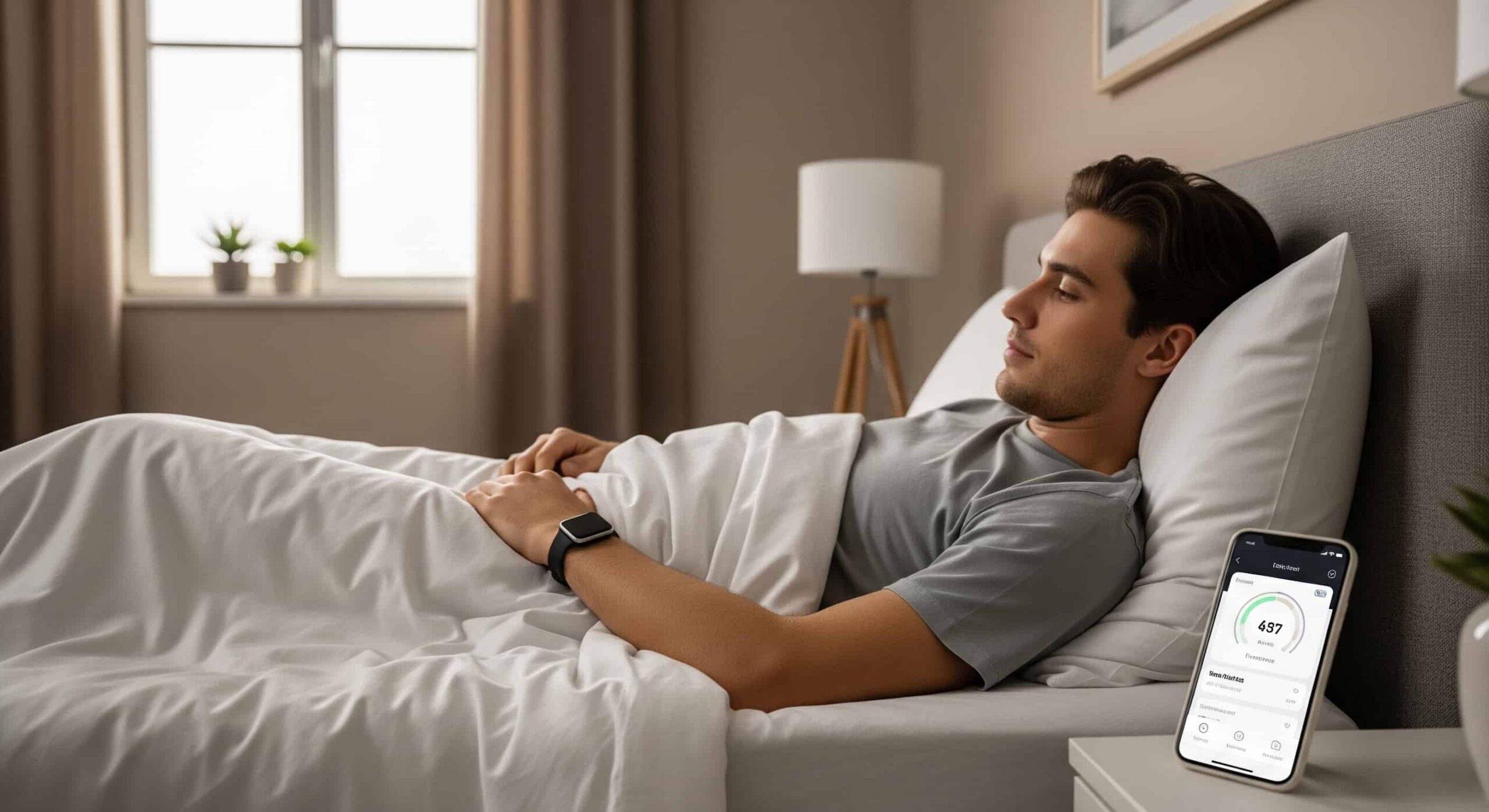
Smart sleep trackers are now in one in four households. They promise to reveal what’s happening while you sleep — nightly sleep scores, readiness indexes, detailed breakdowns of your deep sleep and REM stages. The technology has advanced dramatically. But the gap between what these devices claim to measure and what they can actually detect remains wide. This is the science-backed review of smart sleep trackers: what the research says about accuracy, which devices are worth your money, and how to use the data without letting it destroy the sleep it was designed to improve.
How Accurate Are Consumer Sleep Trackers? What the Research Actually Shows
Sleep tracking technology has advanced dramatically in the past decade — but the gap between what the devices claim to measure and what they can actually detect remains wide. Multiple peer-reviewed studies comparing consumer sleep trackers against clinical polysomnography (the gold standard: EEG, EMG, and EOG brainwave measurement) reveal consistent accuracy patterns.
The Clinical Validation Evidence
A comprehensive review published in Sleep Medicine Reviews found that consumer sleep trackers detect sleep versus wake with approximately 78-96% accuracy — but accuracy drops significantly when distinguishing between specific sleep stages. Deep sleep (N3) detection accuracy is only 60-70% compared to EEG-based polysomnography. The most common error: the tracker classifies wakefulness as light sleep, inflating total sleep time estimates by 15-30 minutes on average. The fundamental limitation: consumer devices use movement (accelerometer) and heart rate (optical sensor) to estimate what is happening in the brain. They cannot read brainwaves. All “sleep stage” data from consumer trackers is a mathematical interpolation, not a direct measurement.
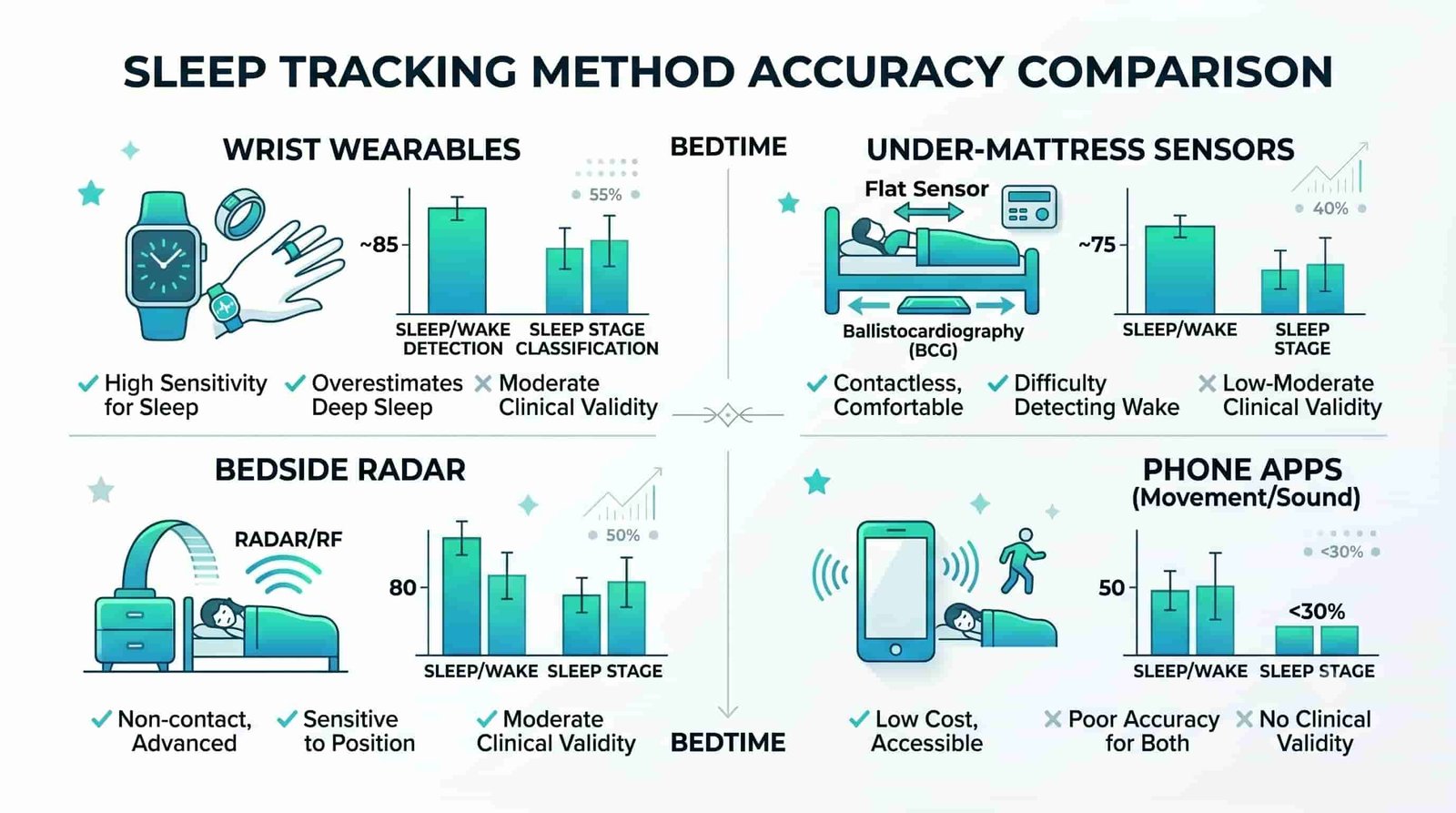
Wearable vs. Non-Wearable vs. App-Based Trackers: The Accuracy Comparison
Sleep tracking technology comes in three main form factors, each with distinct accuracy profiles and use case trade-offs.
Wearable Trackers (Smartwatches, Rings, Bands)
How they work: Optical heart rate sensor (LED-based photoplethysmography) + 3-axis accelerometer. Some premium devices add galvanic skin response, skin temperature, or ambient light sensors.
Accuracy: Best of the three categories for sleep stage estimation. Accuracy for detecting sleep vs. wake: 85-96%. Accuracy for sleep staging: 60-70% for N3 deep sleep, 70-80% for REM. The proximity to the skin improves signal quality — rings (Oura, Ultrahuman) can be more consistent than wrist-worn devices because they maintain consistent contact pressure.
Best for: People who want longitudinal tracking across many nights and are primarily interested in time-in-bed consistency, not clinical sleep staging.
Non-Wearable Trackers (Under-Mattress Sensors, Bedside Devices)
How they work: Ballistocardiography (under-mattress) or radar/sound (bedside) — detecting movement and heart rate through the mattress or air.
Accuracy: Similar to wearables for sleep vs. wake detection (80-90%) but less accurate for sleep staging. Under-mattress sensors work better for detecting breathing patterns and snoring (which they detect well) than for sleep stages. Bedside radar devices (Google Nest Hub) can be accurate for detecting presence/absence of sleep but produce unreliable stage data.
Best for: People who cannot wear a device while sleeping, or couples who want to track separately without two wearables.
App-Based Trackers (Phone Accelerometer, Microphone)
How they work: Smartphone accelerometer (movement) or microphone (sound/snoring) — no dedicated sensor.
Accuracy: Lowest of the three categories. Sleep vs. wake accuracy: 65-80%. Sleep staging: not reliably accurate for any stage. Phone-based trackers work best for people who consistently place their phone on the mattress and leave it undisturbed.
Best for: Casual tracking with no specific accuracy requirements. Not suitable for anyone with suspected sleep disorders.
Why Your Sleep Score Has a 40% Error Margin — And Why That Still Matters
Every morning, your tracker delivers a verdict: a number between 0 and 100. A score of 72 means something important — except that the error margin on most consumer sleep scores makes the difference between 72 and 92 statistically meaningless on any given night.
The Math Behind the Score
Sleep scores aggregate multiple metrics — time asleep, time awake, sleep efficiency, time in each stage, HRV, respiratory rate — each with its own measurement error. When these errors compound, a single-night score can vary by ±15-20 points from the true value purely due to measurement noise, not actual sleep quality changes. The clinical implication: if your score changes by less than 10 points from one night to the next, it is statistically indistinguishable from noise. The score is most useful as a weekly or monthly trend indicator, not a nightly judgment.
Why the Number Still Matters — For Behavior, Not Biology
Despite the error margin, sleep tracker data is not useless. Longitudinal tracking (over weeks and months) reveals patterns that single-night accuracy cannot: the effect of alcohol on your sleep quality, the impact of a late workout, the difference between 6 hours and 7 hours for YOUR specific biology. This behavioral feedback loop — observing how your choices affect your data over time — is the genuine value of a sleep tracker. The failure mode is interpreting nightly scores as biological verdicts rather than noisy behavioral data points.
The Orthosomnia Problem: When Monitoring Becomes the Disease
The term orthosomnia, coined by Dr. Kenneth Baron in 2017, describes a recently identified phenomenon: the anxiety generated by sleep tracking that paradoxically worsens the very sleep being measured. It is one of the most ironic unintended consequences in consumer health technology.
The Mechanism of Orthosomnia
Orthosomnia develops through a three-step loop: first, the tracker delivers an anxiety-provoking score or verdict (“low readiness,” “poor sleep”). Second, this triggers a real cortisol and adrenaline response — the same physiological state that prevents sleep onset. Third, the anxiety about poor sleep produces the poor sleep, confirming the tracker’s prediction. The tracker’s prediction becomes the cause of its own accuracy. Research shows 18% of sleep app users report increased anxiety about sleep after tracking began, and 14% developed sleep concerns that may not have existed before tracking.
⚡ How to Use a Tracker Without Developing Orthosomnia
- Check your tracker data ONCE per week — not every morning. Weekly trend data is meaningful; daily data is noise.
- If a nightly score causes anxiety, check it only after you have assessed your subjective state: do you feel rested? If yes, discard the number.
- Use the tracker to identify behavioral patterns (what you ate, how late you exercised, how much you drank) — not to judge your biological performance.
- Never let a score predict your day’s mood. If you feel good and scored badly, trust your subjective experience.
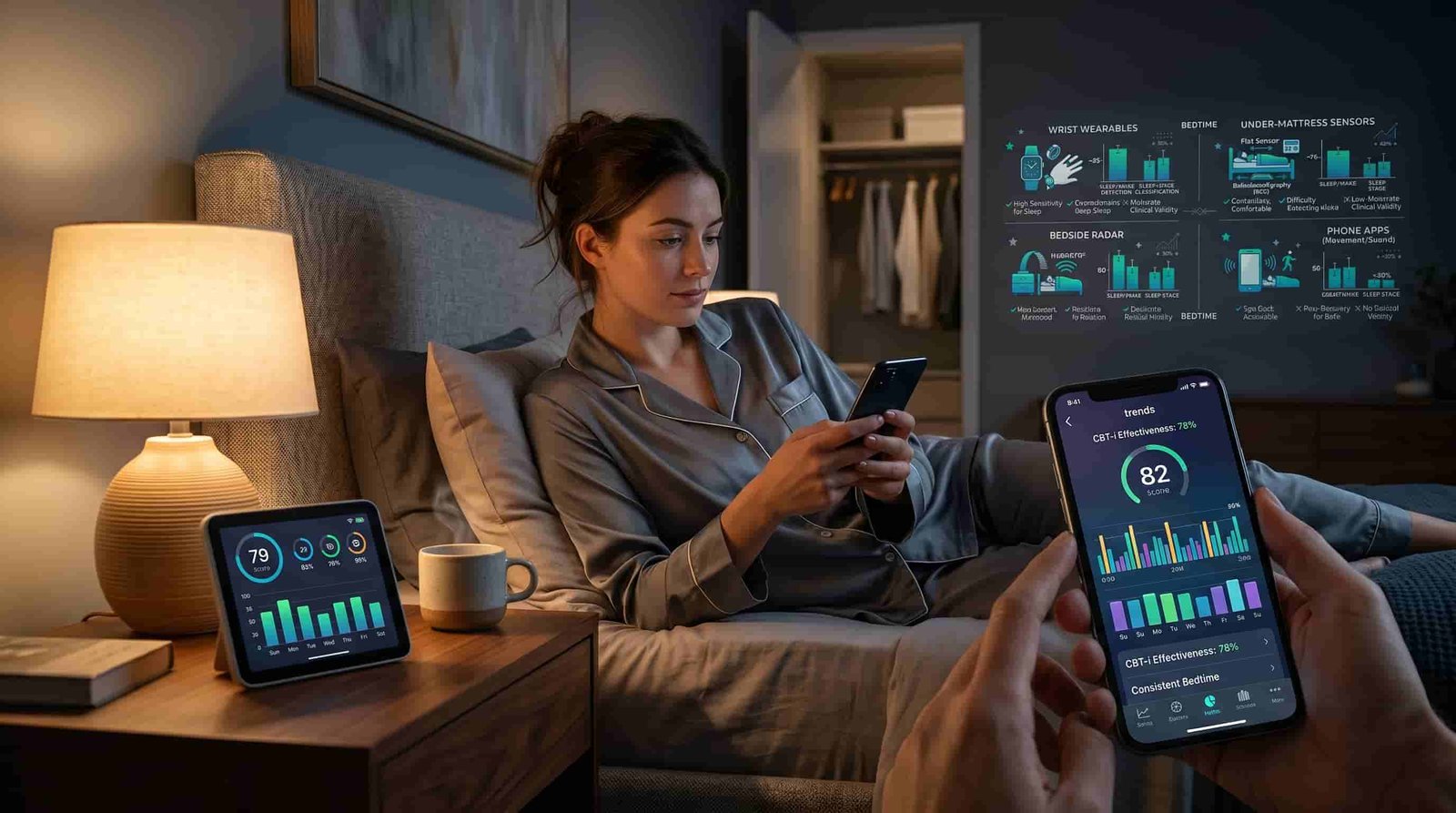
The Best Sleep Trackers for 2025: A Science-Based Comparison
Based on clinical accuracy data, feature sets, and behavioral design philosophy, these are the trackers most worth considering in 2025.
Best Premium: Oura Ring Gen 3
Accuracy: Best-in-class for consumer devices — 70-75% accuracy for sleep staging. The ring form factor maintains consistent sensor contact without pressure variation from wrist rotation. Temperature and HRV data are clinically validated and longitudinal tracking is excellent.
Watch Out For: $299+ plus monthly subscription ($5.99/mo). No display means no real-time feedback — which can actually reduce orthosomnia risk. Sizing kit required.
Best for: Users who want the most accurate consumer device available and are comfortable with a subscription model.
Best Value: Withings Sleep Analyzer
Accuracy: 80-85% for sleep vs. wake, reasonable staging accuracy for a non-wearable. Particularly strong on snoring and respiratory pattern detection — useful for screening sleep apnea risk.
Watch Out For: No individual wearable means no HRV data from the sensor itself. Sleep apnea screening feature is suggestive, not diagnostic — a clinical sleep study is still required for diagnosis.
Best for: Couples who want comprehensive tracking without wearables, or people who find wearing devices while sleeping uncomfortable.
Best Ecosystem Integration: Apple Watch
Accuracy: 65-72% for sleep staging — below the Oura ring due to wrist rotation and pressure variation. But Apple Health’s ecosystem integration is unmatched, and sleep latency detection (time to fall asleep) is reasonably accurate.
Watch Out For: Requires nightly charging (often during the day, which disrupts tracking). Battery does not support both always-on display and full sleep tracking simultaneously.
Best for: iPhone users already invested in the Apple ecosystem who want unified health data across multiple metrics.
What Sleep Trackers Can and Cannot Measure: The Clinical vs. Consumer Gap
Understanding what your tracker can and cannot measure is essential for interpreting the data without anxiety or false confidence.
What Trackers CAN Measure Reliably
Time in bed: Highly accurate — movement and heart rate clearly differentiate awake from asleep states. Time asleep: Accurate within ±15-30 minutes for most devices. Sleep schedule consistency: The most reliable longitudinal metric — consistency in bedtimes and wake times across weeks. Heart rate during sleep: Accurate within ±3-5 bpm for most optical sensors. HRV (Heart Rate Variability): Reasonably accurate on premium devices; useful for tracking recovery and stress trends over time.
What Trackers CANNOT Measure Reliably
Sleep stages (N1/N2/N3/REM): All consumer devices estimate these using HRV and movement proxies. Clinical accuracy requires EEG. Deep sleep estimates are particularly unreliable — error margins of ±30-40% are common. Sleep quality (subjective): No device can measure how restored you feel. This is between your ears, not in your bloodstream. Sleep apnea: Consumer trackers can suggest risk (via respiratory rate patterns and oxygen saturation estimates) but cannot diagnose. A clinical polysomnography is required for diagnosis. Cortisol levels: Some devices claim to measure stress; no consumer device can detect cortisol without a blood sample.
How to Use Sleep Tracker Data Without Developing Anxiety About Your Sleep
The goal of sleep tracking is behavioral insight, not nightly biological judgment. Applied correctly, a sleep tracker reveals which behaviors support or undermine your rest — allowing you to make informed changes over time.
⚡ The Slumbelry Tracking Protocol
- Check once per week: Sunday morning, review the week’s data. Look for patterns — not individual nights.
- Track one variable at a time: Want to know if late exercise affects your sleep? Use 3 weeks of consistent tracking to compare exercise timing vs. sleep score. Change one variable at a time.
- Use the data for behavioral decisions: “I drank 3 glasses of wine on Friday and Saturday — and my sleep scores were 15 points lower both days.” That’s actionable.
- Discard the daily verdict: “I scored 68” is not actionable. “My weekly average improved after I started meditating” is.
When to See a Doctor Instead of Trusting Your Tracker
Sleep trackers are wellness tools. They are not medical devices. There are clear situations where a tracker’s reassurance is dangerous — and clinical evaluation is necessary.
Red Flags That Require Professional Evaluation
Your tracker shows normal sleep but you feel terrible: The tracker’s score may be falsely reassuring. Persistent daytime impairment with “normal” tracker data warrants investigation for: sleep apnea, thyroid disorders, depression, or chronic fatigue syndrome.
Your tracker shows poor sleep but you feel fine: This is orthosomnia. The tracking anxiety itself may be the problem. A clinical evaluation can rule out actual sleep pathology — and may be the only way to stop the tracking-anxiety loop.
Your tracker suggests sleep apnea: Respiratory events, low SpO2 drops, and irregular breathing patterns that your tracker flags as “possible apnea” require a clinical polysomnography for diagnosis. No consumer device can diagnose sleep apnea — and undiagnosed sleep apnea significantly increases cardiovascular risk.
You’re relying on medication or alcohol to sleep: A tracker cannot tell you why you need these. Dependency and tolerance patterns require clinical management.
The Slumbelry Approach: Tracking Your Biology Without Losing Your Mind
Slumbelry’s position on sleep trackers is consistent with its approach to sleep generally: the goal is not more data. The goal is better rest. A sleep tracker is a mirror — it reflects what your behavior and biology are already doing. The tracker does not make you sleep. It shows you what you are doing to your sleep. Use it as a behavioral feedback tool. Do not worship it as an authority over your nightly rest. Your subjective experience — how you feel when you wake — is still the most reliable measure of whether you slept well. The tracker is a supplement to that self-knowledge, not a replacement for it.
The Slumberly Tracking Philosophy
Use your tracker for one purpose: identifying which of your behaviors correlate with better rest over time. When the tracker’s data conflicts with your subjective experience, default to your subjective experience. When the data reveals patterns you didn’t know existed, investigate them. When the data generates anxiety, stop checking it. The tracker serves you — not the other way around.
Action step: If you have been checking your tracker every morning, switch to once per week. Notice whether your relationship with sleep changes. If anxiety about sleep scores is persistent, consult a doctor — and consider a clinical sleep evaluation to rule out actual pathology.
Frequently Asked Questions About Smart Sleep Trackers
How accurate are consumer sleep trackers compared to clinical sleep studies?
Consumer sleep trackers are significantly less accurate than clinical polysomnography (PSG). Research published in Sleep Medicine Reviews found consumer devices detect sleep vs. wake with 78-96% accuracy, but sleep staging accuracy drops to 60-70% for deep sleep and 70-80% for REM — compared to EEG-based clinical measurement which is the gold standard. The fundamental limitation: consumer devices use movement (accelerometer) and heart rate (optical sensor) to estimate what is happening in the brain. They cannot read brainwaves. All sleep stage data from consumer trackers is a mathematical interpolation, not a direct measurement. For clinical sleep disorder diagnosis (sleep apnea, narcolepsy, periodic limb movement disorder), a formal polysomnography is required.
What is the most accurate consumer sleep tracker available?
As of 2025, the Oura Ring Generation 3 ranks highest among consumer devices for sleep tracking accuracy — approximately 70-75% accuracy for sleep staging compared to polysomnography. Its ring form factor maintains more consistent sensor contact than wrist-worn devices, which suffer from rotation and pressure variation during sleep. Apple Watch Series 9/Ultra 2 runs second at 65-72% for staging accuracy, but benefits from a richer ecosystem. Withings Sleep Analyzer (under-mattress) is competitive for non-wearable tracking, particularly for respiratory pattern detection and snoring screening. All consumer devices fall below clinical accuracy thresholds — the most reliable metric across all platforms is time-in-bed consistency, which has 85-95% accuracy.
What is orthosomnia and how does sleep tracking cause it?
Orthosomnia is the anxiety-driven worsening of sleep caused by obsessive tracking behavior. Coined by Dr. Kenneth Baron in 2017, it develops through a three-step loop: (1) the tracker delivers an anxiety-provoking score or ‘poor sleep’ verdict; (2) this triggers a real cortisol and adrenaline response — the physiological state that prevents sleep onset; (3) the anxiety produces poor sleep, confirming the tracker’s prediction. Research shows 18% of sleep app users report increased anxiety after tracking began, and 14% developed sleep concerns that may not have existed before tracking. The paradox: the tool designed to improve sleep can degrade it when used anxiously. The solution: weekly (not daily) data review, and trusting subjective experience over tracker’s verdict.
Can a sleep tracker detect sleep apnea?
No — a sleep tracker can suggest the possibility of sleep apnea but cannot diagnose it. Consumer trackers detect potential apnea through proxy indicators: oxygen saturation estimates (SpO2), respiratory rate patterns, and heart rate variability anomalies during sleep. When these cross certain thresholds, trackers may flag ‘possible sleep apnea’ or ‘irregular breathing patterns.’ However, these are screening indicators, not diagnostic criteria. A clinical polysomnography — which measures airflow, respiratory effort, oxygen saturation via finger probe, and EEG arousals — is required for formal diagnosis. Undiagnosed sleep apnea significantly increases cardiovascular risk. If your tracker flags potential apnea, book a clinical evaluation — not reassurance from the tracker’s ‘normal’ readings on other nights.
What’s the difference between wearable and non-wearable sleep trackers?
Wearable trackers (smartwatches, rings, bands) use optical heart rate sensors and accelerometers pressed against the skin. They detect sleep vs. wake with 85-96% accuracy and sleep staging with 60-75% accuracy — the best available in consumer devices. Non-wearable trackers (under-mattress sensors, bedside radar devices) use ballistocardiography or radar to detect movement and heart rate without skin contact. They offer 80-90% accuracy for sleep vs. wake but weaker sleep staging. Their advantage: no discomfort from wearing a device, and better for couples who want separate tracking without two wearables. Their disadvantage: cannot measure HRV directly and are less reliable for detecting specific sleep stages. For anyone with suspected sleep disorders, a wearable provides more useful longitudinal data.
Why does my sleep score change so much from night to night?
Nightly sleep score variation of 10-20 points is primarily noise, not biological signal. Sleep scores aggregate multiple metrics — each with its own measurement error from the device’s sensors. When errors compound, a single-night score can vary by ±15-20 points from the true value purely due to measurement noise. A 10-point drop from Tuesday to Wednesday is statistically indistinguishable from a measurement error. The score is most useful as a weekly or monthly trend indicator, not a nightly judgment. Use tracking data to compare patterns over weeks — not to interpret individual nights as good or bad. If your weekly average trends upward over 4 weeks, that’s meaningful. If Tuesday’s score was 15 points lower than Monday’s, that’s noise.
Should I check my sleep tracker every morning?
No — checking every morning is the fastest path to orthosomnia. The daily review habit turns a behavioral feedback tool into an anxiety trigger. Research suggests checking tracker data once per week is sufficient for identifying meaningful patterns while avoiding the anxiety loop. If you must check daily, do so only after you have assessed your subjective state: do I feel rested? If yes, discard the number and move on. If no, consider what might have caused it — and look at the weekly pattern, not a single night. The best tracker data is behavioral: ‘I averaged 15 points higher in sleep quality after I stopped drinking’ — not ‘I scored 68 today.’
Can sleep trackers replace a clinical sleep study?
No — consumer sleep trackers are wellness devices, not clinical diagnostic tools. They cannot diagnose sleep disorders, distinguish between different types of insomnia, detect narcolepsy or hypersomnia, or identify specific sleep architecture abnormalities. Clinical polysomnography (PSG) measures brain waves (EEG), eye movements (EOG), muscle activity (EMG), heart rhythm (ECG), breathing patterns, and blood oxygen — none of which any consumer device replicates. If you have persistent sleep complaints despite normal tracker data, or if your tracker flags possible apnea, a clinical evaluation is required. If you have excessive daytime sleepiness that doesn’t match your tracker’s ‘good’ scores, a PSG is warranted. Consumer trackers are screening tools — useful for identifying patterns worth discussing with a doctor, not for replacing that conversation.
What metrics from a sleep tracker are actually reliable and useful?
The most reliable tracker metrics: Time in bed (TIB) — 85-95% accurate across all device types. Sleep schedule consistency — comparing bedtimes and wake times across weeks reveals behavioral patterns reliably. Heart rate during sleep — accurate within ±3-5 bpm for most premium devices. HRV (when available on premium devices) — useful for tracking recovery and stress trends over time, especially if measured consistently each morning. Least reliable: Sleep stage estimates (N1/N2/N3/REM) — 60-70% accuracy at best for deep sleep. Sleep latency estimates — moderate accuracy but affected by whether you use the device as an alarm. SpO2 estimates — useful for gross screening but not diagnostic quality. Readiness and sleep scores — composite indices with compounding error margins that make individual-night scores statistically unreliable.
How do I use sleep tracker data to actually improve my sleep?
Use the data for behavioral pattern analysis, not nightly performance review. The most actionable approach: fix ONE variable at a time and track for 2-3 weeks. Example questions to answer with data: Does late exercise (after 7 PM) correlate with lower sleep efficiency? Does alcohol consumption within 3 hours of bedtime reduce my deep sleep percentage? Do I sleep better when I maintain a consistent weekday wake time on weekends? Does my sleep quality improve when I keep the bedroom below 19°C vs. 22°C? Each of these questions can be answered with 3-4 weeks of consistent tracking data. Look at weekly averages, not daily scores. When you identify a behavioral correlation that matches your subjective experience, change that behavior. When the data generates anxiety rather than insight, stop checking it.
Ready to Use Your Tracker as a Tool, Not a Verdict?
Check weekly. Trust the patterns. Ignore the nightly numbers. Your biology is smarter than any algorithm.
Take the Sleep Assessment Subscribe for Sleep Optimization TipsThe Slumbelry Commitment
Sleep is the most vulnerable state of human existence. It is where we heal, reset, and grow.
At Slumbelry, we do not just sell sleep products; we advocate for your physiological right to rest. From ergonomic support to light management, every solution we offer is designed with one obsession: Respecting your Biology.
Science is our language, but your recovery is our purpose. You take care of everything else in your life — let us take care of your sleep.
Rest Deeply,
The Slumbelry Team
Medical References:
1. Baron, K. G., et al. (2017). Orthosomnia: Are Some Patients Taking the Quantified Self Too Far? Journal of Clinical Sleep Medicine, 13(2), 351–354.
2. Kelly, J. M., et al. (2012). Wrist-Based Accelerometry for Measuring Sleep. Sleep Medicine Reviews.
3. Walker, M. (2017). Why We Sleep. Scribner.