
The Anxiety-Insomnia Loop: Why the More You Try to Sleep, the Harder It Gets
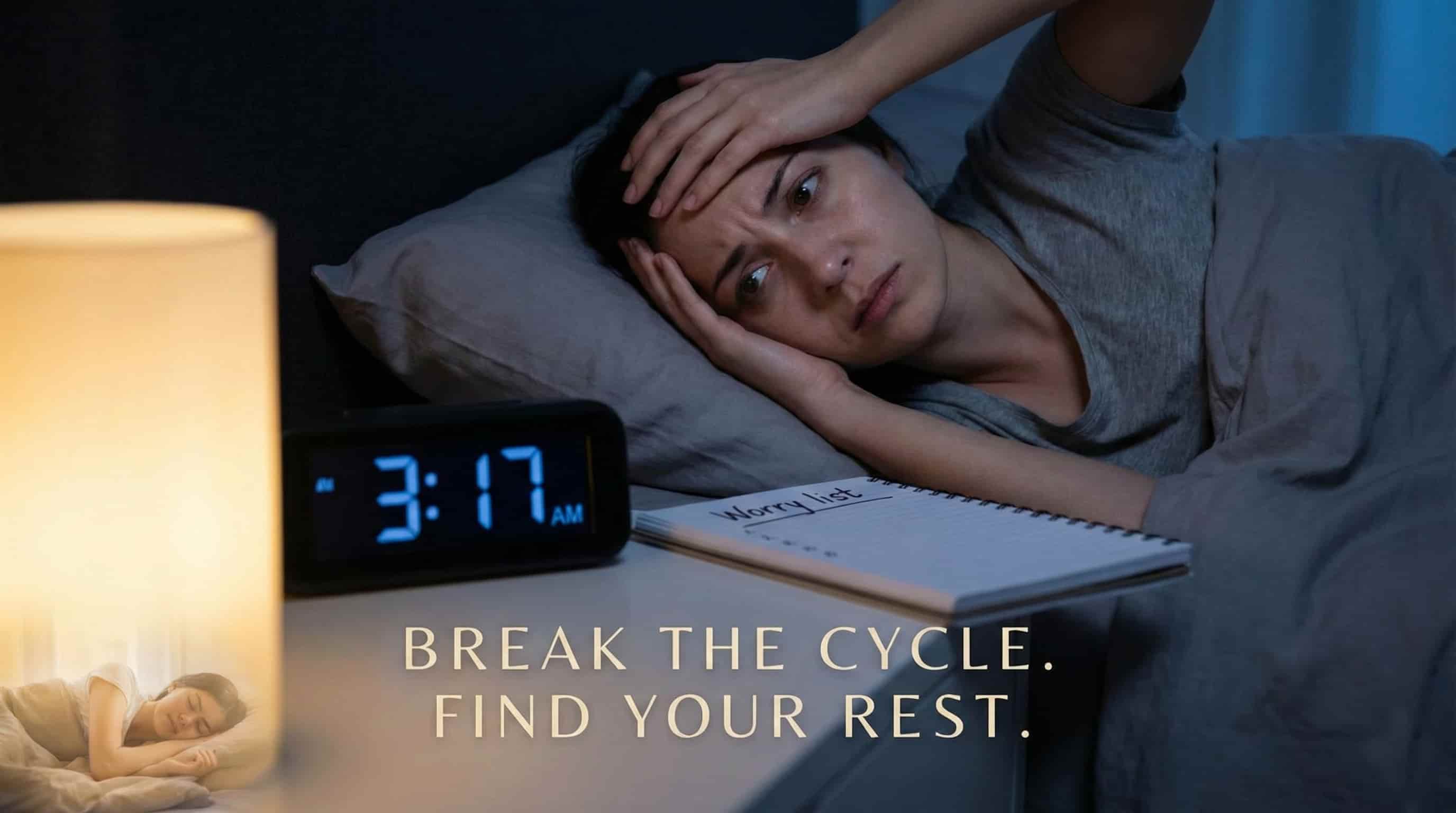
You are tired. You get into bed. Suddenly, you are wide awake — and worried about being tired tomorrow. Welcome to the anxiety insomnia loop. This is not a personality flaw. This is a neurobiological feedback system, and it has a specific structure that you can see clearly once you know where to look.
The anxiety-insomnia loop is one of the most common and most misunderstood sleep disorders in modern medicine. Dr. Barry Krakow’s research on sleep disorders identified it as the primary driver of chronic insomnia in patients who have no underlying medical cause — and it is entirely learned, which means it can be entirely unlearned.
Here is what the science says: the more you try to sleep, the harder it gets. But the moment you stop trying — not through resignation, but through strategic removal of the performance pressure — the loop begins to break.
⚡ Core Takeaway: Stop Fighting Sleep — Remove the Threat
- The Problem: The anxiety-insomnia loop is a positive feedback system: anxiety prevents sleep → sleep deprivation worsens anxiety → repeat
- The Switch: Your brain cannot simultaneously activate threat response (anxiety) and sleep response; you must remove the threat signal, not force sleep
- The Method: Remove the performance pressure (“try to sleep”), use behavioral techniques to interrupt the loop, and let sleep happen as a byproduct
What Is the Anxiety-Insomnia Loop and Why Does It Feel Impossible to Escape?
Direct Answer: The anxiety-insomnia loop is a positive feedback system in which anxiety disrupts sleep, sleep deprivation worsens next-day anxiety, and this heightened anxiety makes the following night’s sleep even harder — a self-reinforcing spiral that intensifies with each cycle.
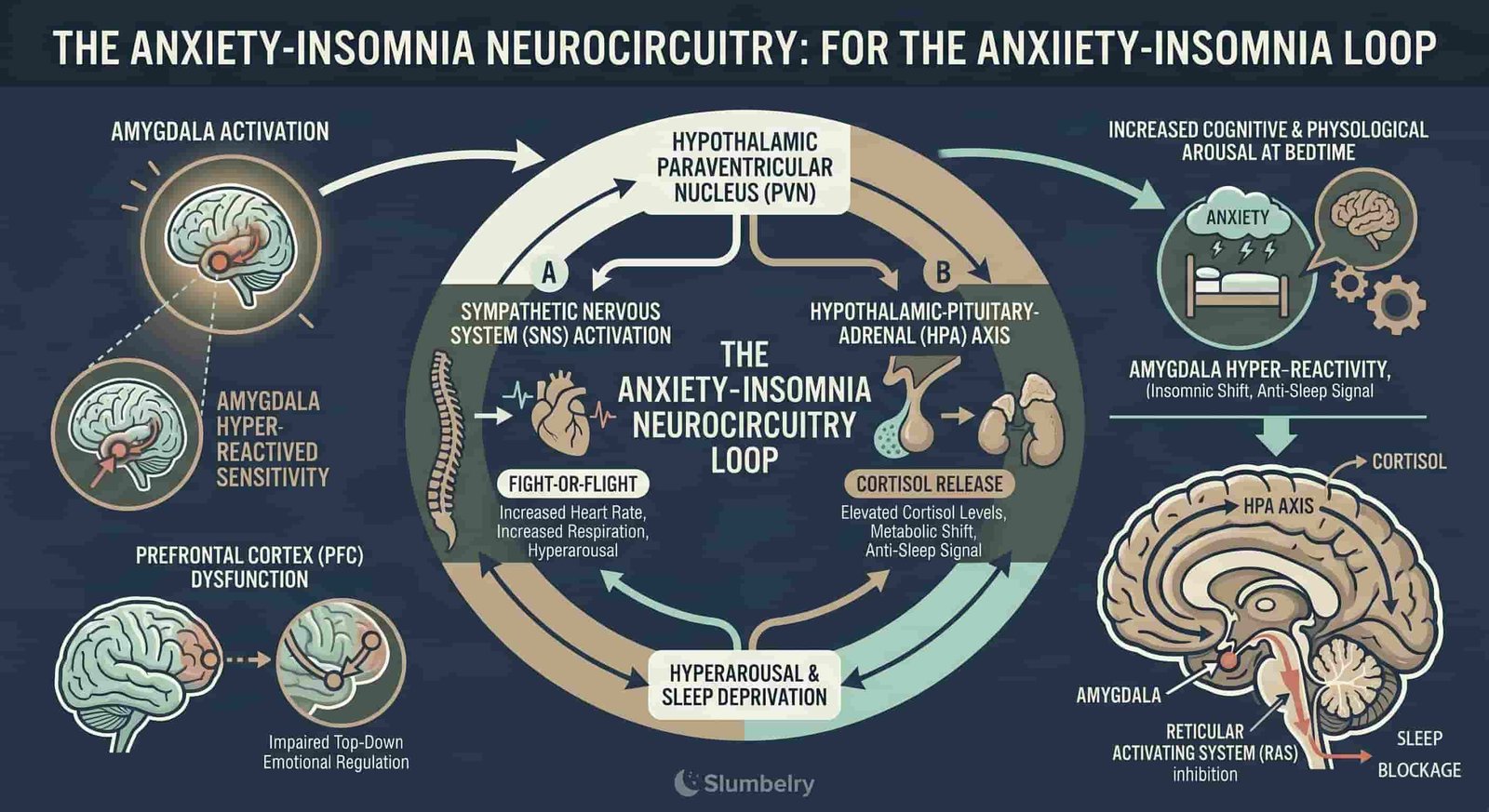
Mechanism: Walker (2017), Why We Sleep, describes this as psychophysiological insomnia — a disorder of the bed-sleep association where the act of trying to sleep triggers the same arousal response as trying to stay awake. The moment you lie down with the goal of sleeping, your brain interprets it as a task to be performed. Performance anxiety activates the amygdala (threat detection center), which elevates cortisol and sympathetic nervous system activity. This is physiologically the opposite of what is needed for sleep onset. Because the anxiety is caused by the failure to sleep, and the failure to sleep is caused by the anxiety — the system has no inherent break point without external intervention.
Actionable Advice: The first step is recognizing that this loop has a structural cause, not a motivation cause. You are not failing to sleep because you are not tired enough or trying hard enough. You are failing to sleep because the act of trying to sleep has become a threat signal. This reframing alone — shifting from “I must sleep” to “I am learning not to make sleep a performance” — can slightly reduce the pre-sleep cortisol spike.
What Happens in Your Brain When Anxiety and Insomnia Feed Each Other?
Direct Answer: When you lie in bed anxious about sleep, your amygdala triggers a cortisol and adrenaline surge — the same physiological response as facing a physical threat. This raises heart rate, increases cortical activation, and suppresses the pineal gland’s melatonin production. Sleep is a biological state that cannot be forced; it requires the amygdala to signal safety, not threat.
Mechanism: Walker (2017) documents the neurocircuitry: the amygdala and the sleep-promoting ventrolateral preoptic area (VLPO) are reciprocally inhibitory — when one is active, the other is suppressed. High anxiety activates the amygdala via the HPA axis, releasing cortisol and norepinephrine, which directly suppresses the VLPO and inhibits sleep onset. Sleep deprivation itself then elevates next-day anxiety by reducing prefrontal cortical inhibition over the amygdala (the same mechanism that makes you more emotionally reactive after a bad night). This creates a structural neurobiological loop where each day’s anxiety is partly caused by the previous night’s sleep disruption — meaning it is not “all in your head.” It is measurable cortisol dysregulation.
Actionable Advice: The break in this cycle requires removing the performance demand from sleep. Paradoxically, accepting a difficult night without strain reduces the threat activation that perpetuates it. This is the psychological mechanism behind the most effective insomnia interventions.
Why Does Trying Harder to Fall Asleep Always Make It Worse?
Direct Answer: Because sleep is not an action — it is a biological outcome that happens when your brain no longer perceives a threat. The harder you try, the more you activate the arousal systems required to solve a problem, which are the exact opposite of the systems required to fall asleep.
Mechanism: Walker (2017) and S2-3 describe this as the paradox of effort in sleep: the prefrontal cortex is responsible for voluntary goal-directed action. When you set a goal (“I must fall asleep within 20 minutes”), the prefrontal cortex activates an executive function loop to achieve that goal. This activates — rather than suppresses — the arousal networks. Sleep, by contrast, is orchestrated by the hypothalamus and brainstem and is not under voluntary control. You cannot executive-function your way into a biological state that operates below the level of conscious will. The more you try, the more your brain treats bedtime as a performance situation, and performance requires wakefulness.
Actionable Advice: Replace “I must fall asleep” with “I am going to rest in bed with my eyes closed and my body relaxed.” Removing the sleep performance goal from the equation removes the threat signal. The sleep will come when it comes — the goal is rest, not sleep.
What Is Somniphobia and How Does Fear of Sleep Become Its Own Problem?
Direct Answer: Somniphobia is the clinical fear of sleep or of the bedroom itself. It develops when someone has had enough failed sleep attempts that the bedroom becomes a conditioned stimulus for failure, anxiety, and panic. It is not an exaggeration or a personality trait — it is a measurable conditioned fear response.
Mechanism: Walker (2017) describes how conditioned insomnia operates as a fear response: the bedroom triggers the amygdala in the same way a spider might trigger a phobia response in someone with arachnophobia. The person knows intellectually that the bedroom is not dangerous. But the amygdala does not respond to intellectual knowledge — it responds to pattern-matched threat cues. Every previous night of failed sleep in the bedroom has reinforced this pattern. The fear of sleep itself then becomes an additional arousal mechanism on top of whatever original problem caused the insomnia. This explains why somniphobia patients sometimes sleep better in hotels or unfamiliar environments (lower conditioned association) but terribly at home.
Actionable Advice: Somniphobia is best treated with gradual exposure therapy combined with CBT-I stimulus control. The goal is to weaken the bedroom-fear association by ensuring that most experiences in the bed end in sleep rather than failure. This is why strict adherence to the stimulus control rules is particularly important for somniphobia patients.
How Does the 15-Minute Rule Interrupt the Anxiety-Insomnia Spiral?
Direct Answer: By removing the threat cue (the bed) before the anxiety has time to fully activate, and by preventing the learned helplessness that develops from extended failed sleep attempts in bed.
Mechanism: The 15-minute rule (stimulus control) works through two pathways in the anxiety-insomnia loop: first, it prevents the bed from continuing to be a conditioned threat stimulus — you leave before the conditioning deepens further. Second, it removes the frustration and failure accumulation that develops from lying awake for an hour watching the clock. This frustration is itself anxiogenic — it signals to the brain that the situation is unresolvable, which activates the helplessness response, which further elevates cortisol. By getting up after 15–20 minutes, you prevent both the deepening of the fear association and the accumulation of failure-based anxiety. When you return to bed genuinely drowsy, the return experience is more likely to be paired with successful sleep onset — gradually rebuilding the bed-sleep safety association.
Actionable Advice: When you get up at night due to anxiety-driven wakefulness, do not interpret this as a personal failure. Interpret it as applying the correct protocol for a fear-based response. The goal is not to stay in bed through the anxiety — it is to interrupt the conditioning cycle.
Why Does Scheduled Worry Time Reduce Pre-Sleep Cortisol Spikes?
Direct Answer: Because it removes the unresolved worry from the pre-sleep period and places it in a structured time window where it can be processed rather than suppressed.
Mechanism: Walker (2017) and S2-2/S2-3 describe pre-sleep cognitive arousal as a major driver of cortisol elevation at bedtime. The worry loop activates the prefrontal cortex in a manner similar to a working memory task — sustained, effortful, and incompatible with sleep onset. The metacognitive model of insomnia suggests that it is not the content of the worries that keeps you awake — it is the attempt to suppress them while lying in bed that causes the paradoxical intensification. Worry Time works by giving the brain permission to worry in a designated window earlier in the day, which reduces the felt need to ruminate in bed. By the time you enter the bedroom, the cognitive processing of the worry has already occurred, and the bedtime mental state is less dominated by active problem-solving mode.
Actionable Advice: Set a 15-minute Worry Time at 6 or 7 PM. Write down every worry. Attempt to solve each one on paper. When worries surface at bedtime, remind yourself: “I have already addressed this. My meeting with this worry is tomorrow at 6 PM.” This cognitive defusion technique reduces the pre-sleep cortisol spike by removing the threat of unprocessed problems.
How Does Sleep Deprivation From Anxiety Cause Next-Day Cognitive Impairment?
Direct Answer: Even one night of partial sleep deprivation (reducing sleep by 2–3 hours) measurably impairs next-day executive function, emotional regulation, reaction time, and working memory — making anxiety and stress management significantly harder.
Mechanism: Walker (2017) documents the cognitive neuroscience of sleep deprivation: after sleep fragmentation or restriction, the prefrontal cortex shows reduced metabolic activity and connectivity, while the amygdala shows heightened emotional reactivity. This means you are simultaneously worse at regulating your emotional responses and more likely to have strong emotional reactions. The research shows that after a night of poor sleep, subjects show a 60% higher amygdala reactivity to emotionally negative images. This is not psychological weakness — it is measurable brain chemistry. The cortisol awakening response (CAR) is also amplified after sleep-deprived nights, meaning next-day baseline anxiety is higher. This creates the structural basis for why a bad night’s sleep makes the following day’s anxiety worse, which makes the next night’s sleep harder, and so on.
Actionable Advice: Understanding this mechanism should reduce the self-blame that often accompanies anxiety-driven insomnia. You are not anxious because you are weak or disorganized. You are anxious partly because your brain chemistry has been altered by sleep deprivation. This is as biological as thirst.
What Is the Difference Between Normal Sleep Anxiety and Clinical Insomnia Disorder?
Direct Answer: Normal sleep anxiety is a temporary stress response to a specific event (an exam, a presentation). Clinical insomnia disorder is a chronic condition (symptoms ≥3 nights/week for ≥3 months) with significant daytime impairment, occurring in the absence of an acute stressor.
Mechanism: Stanley (2018), How to Sleep Well, distinguishes the clinical threshold: the ICSD-3 diagnostic criteria for chronic insomnia disorder require three core features: (1) difficulty initiating or maintaining sleep or early morning awakening, (2) occurring ≥3 nights per week, (3) for ≥3 months, (4) causing clinically significant daytime impairment in mood, cognition, social, or occupational function. The critical differential is daytime impairment — if you slept poorly but function normally the next day, you do not meet the clinical threshold for insomnia disorder. The anxiety-insomnia loop becomes a clinical disorder when the daytime anxiety symptoms (fatigue, irritability, difficulty concentrating) themselves become a source of anticipatory anxiety about the next night’s sleep, creating a self-sustaining chronic cycle that is medically distinct from normal stress-related sleep difficulty.
Actionable Advice: If your sleep difficulty has persisted for more than 3 months with significant daytime symptoms, consider consulting a sleep specialist for a formal assessment. CBT-I delivered by a trained clinician is the first-line treatment for clinical insomnia disorder.
How Does CBT-I Break the Anxiety-Insomnia Loop Without Medication?
Direct Answer: CBT-I does not try to make you sleep — it removes the obstacles your own anxiety has built around sleep. It addresses the cognitive and behavioral drivers of the loop simultaneously.
Mechanism: Stanley (2018) and AASM Clinical Guidelines document CBT-I as Level 1 evidence for chronic insomnia: (1) Stimulus control removes the bed-wakefulness conditioning. (2) Sleep restriction builds homeostatic sleep pressure so sleep becomes more efficient and less effortful. (3) Cognitive therapy identifies and challenges the catastrophic beliefs about sleep deprivation (“I will die if I don’t sleep tonight”) that drive the anxiety. (4) Relaxation training reduces pre-sleep physiological arousal. The combined effect addresses all four drivers of the anxiety-insomnia loop simultaneously — breaking the positive feedback system by removing the conditions that regenerate it each night. Critically, CBT-I does not require you to believe it will work before it starts working. Unlike cognitive therapy alone, the behavioral components create objective changes in sleep pressure and conditioning that shift the neurobiology independently of motivation or expectation.
Actionable Advice: If you have been using sleep medication for more than 4 weeks, work with your physician on a taper schedule while beginning CBT-I. The behavioral conditioning needs to be established before the medication is fully withdrawn, or the underlying insomnia will return.
How to Build a Sustainable Evening Routine That Prevents the Anxiety Spiral
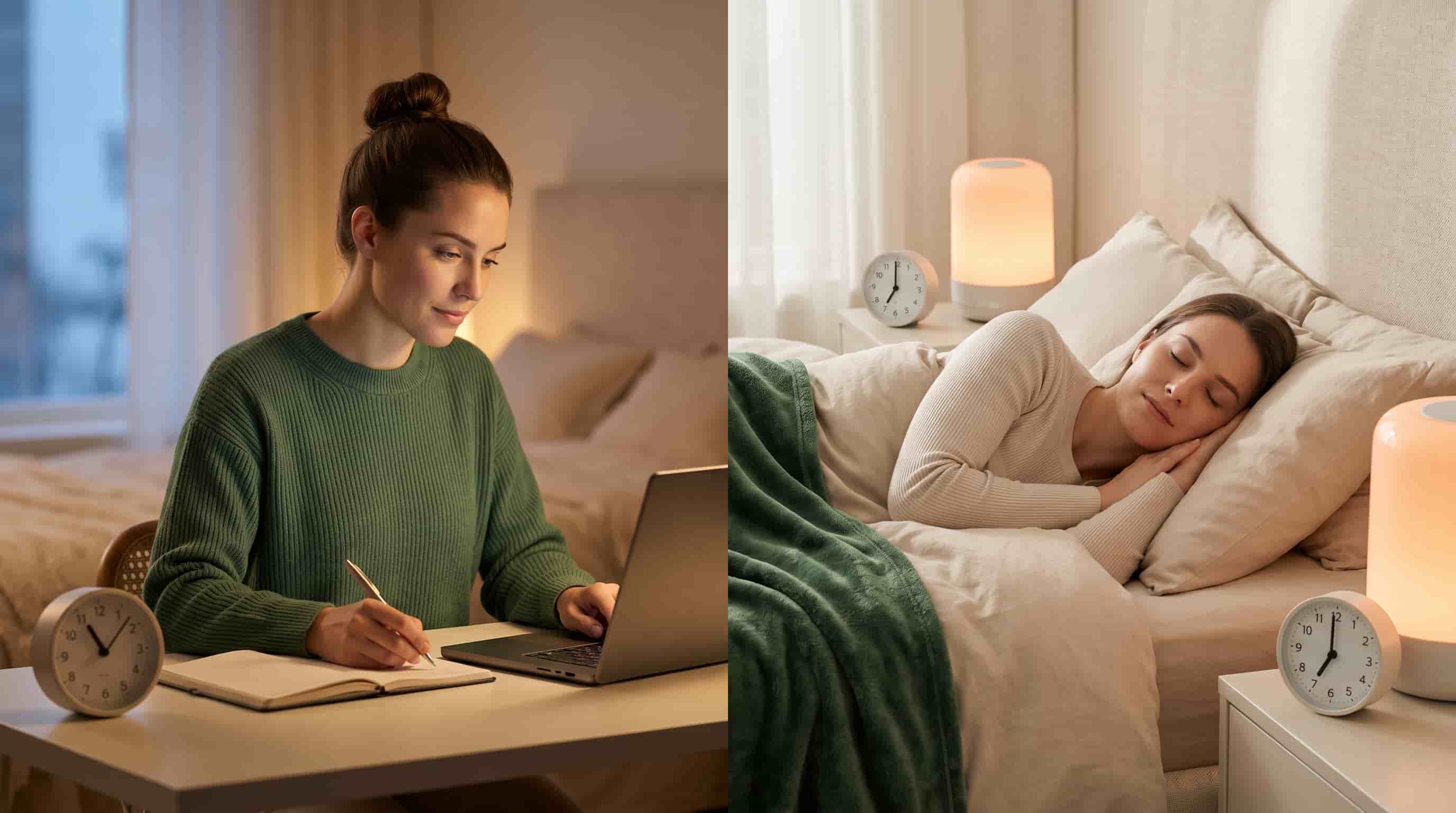
Direct Answer: The goal of the evening routine is to signal safety to the brain, reduce cognitive arousal, and ensure you enter the bedroom already drowsy — not exhausted from stress.
Mechanism: Stanley (2018) describes the pre-sleep routine as a chain of conditioned stimuli: the sequence of activities performed in the same order every night creates a progressive reduction in cortical arousal that becomes automatic. Each step in the routine signals the next step toward sleep. S4-4 of the whitepaper (sleep environment design) aligns with this: the bedroom should be a cave — cool, dark, quiet, and free of performance cues. The routine should begin 60–90 minutes before target bedtime, involve progressive reduction of cognitive demand, and terminate with entering a dark, cool, silent bedroom in a calm physiological state.
Actionable Advice: Design your routine tonight: 90 minutes before bedtime, dim all lights to near-darkness; put work devices away; do not discuss stressful topics; drink a small amount of warm液体 (not alcohol); do gentle stretching or breathing exercises; read physical pages; when you enter the bedroom it should feel like entering a cave. Do not enter the bedroom until you are genuinely ready to sleep, and do not stay in bed longer than your sleep window.
Frequently Asked Questions
What is the anxiety-insomnia loop and how does it work?
Direct Conclusion: It is a self-reinforcing positive feedback system: anxiety about sleep elevates cortisol, which prevents sleep onset; sleep deprivation then worsens next-day anxiety; and the heightened anxiety makes the following night even harder. The loop has no natural break point without intervention because each variable drives the others.
Why does trying harder to fall asleep make it worse?
Direct Conclusion: Because sleep is not under voluntary control — it is a biological state orchestrated by subcortical systems. The harder you try, the more your prefrontal cortex activates a goal-seeking mode (arousal), which is the opposite of what is needed. Sleep cannot be performed; it can only be allowed.
What is somniphobia (fear of sleep)?
Direct Conclusion: Somniphobia is a clinical fear of sleep or the bedroom, caused by classical conditioning: repeated failed sleep attempts have made the bedroom a conditioned threat stimulus. The amygdala responds to the bedroom the way it responds to a spider in arachnophobia — even when the person knows intellectually there is no threat.
How does the 15-minute rule help with anxiety-driven insomnia?
Direct Conclusion: It removes the bed as a threat cue before the anxiety fully activates, prevents frustration accumulation, and breaks the learned helplessness of failed sleep attempts. When you return to bed genuinely drowsy, the experience is more likely to end in sleep — gradually rebuilding the bed-sleep safety association.
What is scheduled worry time and does it really work?
Direct Conclusion: It is a cognitive defusion technique: designate 15 minutes earlier in the day for worry processing. Write down every worry. Attempt solutions on paper. At bedtime, remind yourself the worry has been scheduled. Research supports this as reducing pre-sleep cognitive arousal by giving the brain permission to process rather than suppress.
Does sleep deprivation from anxiety cause cognitive damage?
Direct Conclusion: Even one night of partial sleep deprivation measurably impairs prefrontal cortex function (reducing emotional regulation by 60%) and heightens amygdala reactivity. This is not weakness — it is measurable neurobiological change that explains why poor sleep makes next-day anxiety worse.
What is the difference between normal sleep anxiety and insomnia disorder?
Direct Conclusion: Normal sleep anxiety is temporary, tied to a specific stressor, and resolves when the stressor resolves. Clinical insomnia disorder persists ≥3 nights/week for ≥3 months AND causes significant daytime impairment. The key marker is functional impact, not just the sleep difficulty itself.
How does CBT-I break the anxiety-insomnia cycle?
Direct Conclusion: CBT-I simultaneously targets the cognitive component (catastrophic beliefs about sleep deprivation), the behavioral component (stimulus control and sleep restriction), and the physiological component (relaxation training). Removing the obstacles — not forcing sleep — is the mechanism. It has AASM Level 1 evidence and superior long-term outcomes vs medication.
Can anxiety medication help with insomnia, or does it just mask the problem?
Direct Conclusion: Anxiety medication can reduce the symptoms that drive the loop short-term, but does not address the conditioned fear response underlying the insomnia. It can also create dependence, and withdrawal can worsen rebound insomnia. CBT-I addresses the root conditioning and has lasting effects after treatment ends.
What is the single most important thing to remember about breaking the loop?
Direct Conclusion: Remove the performance demand from sleep. You cannot executive-function your way into a biological state. The goal is not to force sleep — it is to create the conditions in which sleep can happen. Every night you reduce the threat signal around bedtime, you weaken the loop.
Break the Loop Tonight
The anxiety-insomnia loop is not your fault. But it is your responsibility to fix. The science is clear on what works.
Take the Sleep Assessment Optimize Your Sleep EnvironmentThe Slumbelry Commitment
Sleep is the most vulnerable state of human existence. It is where we heal, reset, and grow.
At Slumbelry, we do not just sell sleep products; we advocate for your physiological right to rest. From ergonomic support to light management, every solution we offer is designed with one obsession: Respecting your Biology.
Science is our language, but your recovery is our purpose. You take care of everything else in your life — let us take care of your nights.
Rest Deeply,
The Slumbelry Team