
The Sleep Restriction Method: Why Sleeping Less Can Fix Your Insomnia
You have probably heard the advice: spend more time in bed, and you will sleep more.
It is wrong — and for the 10–15% of adults with chronic insomnia, it is actively harmful.
The more hours you spend in bed awake, the more your brain learns that the bed is a place of frustration, not rest. Every night of tossing and turning in bed deepens the same neural association. After months or years, going to bed feels like a threat signal, not a sleep cue.
Sleep restriction therapy for insomnia inverts this logic. By spending less time in bed, not more, you build the biological pressure that forces deep, efficient sleep — and within weeks, most people experience the consolidated, restorative sleep they have not had in months or years.
⚡ Core Takeaway: Use Sleep Pressure — Do Not Fight It
- The Problem: Spending 9 hours in bed when you only sleep 6 trains your brain to be awake in bed — the bed becomes a cue for wakefulness
- The Mechanism: Sleep restriction builds sleep pressure by limiting time in bed to actual sleep time; higher pressure = deeper, more efficient sleep
- The Rule: Never go below 5 hours or above 9 hours time in bed during SRT; always pair with a fixed wake time and CBT-I stimulus control
Why Does Spending More Time in Bed Often Make Insomnia Worse?
Direct Answer: Because lying awake in bed for long periods trains your brain to associate the bed with wakefulness — not sleep. Each night you spend tossing and turning in bed, you deepen the neural association between your mattress and the inability to sleep.
Mechanism: Walker (2017), Why We Sleep, documents conditioned or learned insomnia: the bed becomes a cue for arousal through repeated pairing with the experience of being awake. The more nights you spend in bed trying to sleep and failing, the stronger the association becomes. This is the opposite of classical conditioning in a harmful direction — the bed, which should trigger sleep onset, now triggers vigilance and frustration. The result: you do not just have insomnia. You have a trained reflex that keeps you awake specifically in your bedroom.
Actionable Advice: If you are spending more than 20–30 minutes awake in bed at any point, get out of bed and go to another room. Do not read, watch TV, or scroll your phone in bed — these all deepen the wakefulness association. Only return to bed when you are genuinely drowsy. This is stimulus control therapy — the first and most immediate behavioral intervention for insomnia.
What Is Sleep Restriction Therapy and Where Does This CBT-I Technique Come From?
Direct Answer: Sleep Restriction Therapy (SRT) is a core component of Cognitive Behavioral Therapy for Insomnia (CBT-I). It was developed in the 1980s by Arthur Spielman and colleagues and is now the first-line non-pharmacological treatment for chronic insomnia according to AASM clinical guidelines.
Mechanism: Stanley (2018), How to Sleep Well, documents the origin of SRT: the observation that insomniacs who restricted their time in bed paradoxically slept better, not worse. By limiting time in bed to approximately the same duration as actual sleep time, SRT increases sleep pressure (homeostatic sleep drive), reduces nocturnal awakenings, and improves sleep efficiency. Over time, as sleep becomes consolidated and the bed-sleep association is rebuilt, the sleep window is gradually expanded. The AASM classifies CBT-I (which includes SRT) as a Level 1 recommendation for chronic insomnia — higher evidence than any pharmacological intervention, and with durable effects that medication cannot match.
Actionable Advice: The starting point for SRT is calculating your actual sleep time: use a sleep diary for 7–14 days, or use your best estimate from a tracker. This number becomes your initial time in bed allowance. Do not go below 5 hours and do not go above 9 hours time in bed, regardless of how much you think you sleep.
How Does Sleep Restriction Actually Work: The Science of Sleep Pressure and Cortisol?
Direct Answer: SRT works by increasing homeostatic sleep pressure — the biological need for sleep that accumulates from the moment you wake up. The longer you stay awake, the more adenosine builds up in your brain, and the stronger your drive to sleep becomes.
Mechanism: Walker (2017) describes the two-process model of sleep regulation: Process S (homeostatic sleep drive, measured by adenosine levels) builds during wakefulness and is discharged during deep NREM sleep. Process C (circadian rhythm, governed by the suprachiasmatic nucleus) provides a secondary wake-promoting signal that counteracts sleep pressure during the day, then withdraws in the evening to allow sleep onset. SRT exploits the homeostatic component: by restricting time in bed, you allow adenosine to accumulate to higher levels than usual, creating a more powerful sleep pressure than the fragmented sleep of chronic insomnia. This results in faster sleep onset, fewer nighttime awakenings, and a higher proportion of deep N3 and REM sleep. Critically, it also prevents the evening cortisol spike that chronic insomniacs experience when they go to bed too early — their brains anticipate wakefulness in bed, triggering a cortisol release that directly opposes sleep onset.
Actionable Advice: The best time to go to bed is when you are so drowsy you could fall asleep in minutes — not when you decide it is “bedtime.” For most people, this means a later bedtime than they currently use. Pair this with a fixed wake time and your sleep pressure will build correctly within 3–5 days.
What Is the Sleep Efficiency Formula and Why Does It Determine Your Treatment?
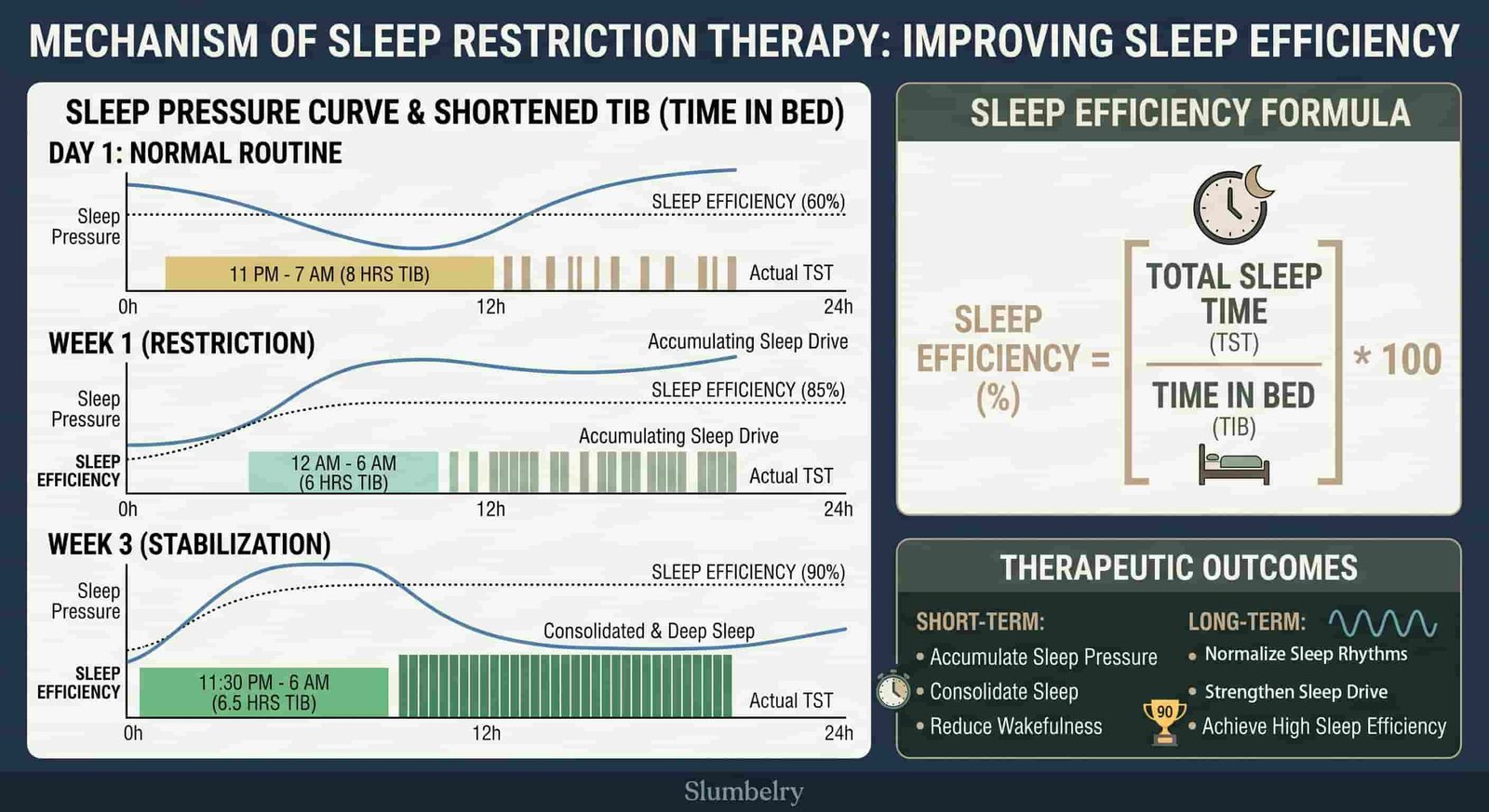
Direct Answer: Sleep Efficiency = (Total Sleep Time / Time in Bed) x 100. It is the percentage of time in bed that you actually spend asleep. SRT adjusts your time in bed to bring this number above 85%.
Mechanism: AASM sleep assessment guidelines use 85% as the threshold for clinically healthy sleep efficiency. Below 85% indicates a sleep disorder or significant fragmentation issue. SRT uses this metric directly: you begin with time in bed approximately equal to your estimated total sleep time. Every 5–7 days, you review your sleep efficiency from your sleep diary. If it is above 85%, you can expand your time in bed by 15–30 minutes (moving your bedtime earlier, not your wake time later). If it is below 80%, you compress your time in bed by 15–30 minutes. This titration process continues until you reach a sustainable sleep schedule with efficiency above 85% and adequate total sleep duration (minimum 5.5 hours).
Actionable Advice: Start a sleep diary tonight: record the time you got into bed, the time you fell asleep, the time you woke up for good, and the time you got out of bed. From this, calculate your sleep efficiency. If it is below 85%, SRT is likely to help you.
How to Calculate Your Sleep Window: A Step-by-Step Guide to SRT
Direct Answer: Step 1: Calculate average actual sleep time over 7 days. Step 2: Set a fixed wake time you can maintain 7 days a week. Step 3: Set initial bedtime by counting back from wake time by your average sleep duration (minimum 5 hours, maximum 9 hours). Step 4: Maintain strict adherence for 2 weeks before adjusting.
Mechanism: Example: If your average sleep is 5.5 hours and your fixed wake time is 7:00 AM, your initial bedtime = 1:30 AM. You do not go to bed before 1:30 AM under any circumstances for the first 2 weeks. You wake up at 7:00 AM every day including weekends. After 2 weeks, if your sleep efficiency is above 85%, you move your bedtime 15–30 minutes earlier. If it is below 80%, you move your bedtime later (or reduce time in bed further). The AASM recommends minimum 2-week intervals between adjustments to allow the sleep system to stabilize.
Actionable Advice: Do not try to compensate for lost sleep by napping during SRT. Napping reduces homeostatic sleep pressure and directly undermines the mechanism. If you must nap (extreme fatigue, safety concerns), limit it to 20–30 minutes before 1 PM only.
What Happens in Your Brain When You Restrict Time in Bed?
Direct Answer: Your adenosine levels build to a higher peak than usual, creating a more powerful homeostatic sleep drive. This forces the brain into deeper, more efficient sleep — specifically increasing N3 (slow-wave deep sleep) and REM proportions.
Mechanism: Walker (2017) documents that N3 sleep is the stage most sensitive to sleep pressure: the more adenosine accumulated, the higher the proportion of N3 in the sleep period. SRT exploits this: by building high adenosine through a compressed time in bed window, the brain prioritizes the most restorative stages of sleep, reducing the lighter N2 proportion and the frequency of micro-awakenings. Additionally, the cortisol response that typically accompanies chronic insomniacs going to bed early is reduced — the brain no longer anticipates hours of struggle in bed, so the pre-sleep cortisol spike diminishes. After 3–4 weeks of SRT, neuroimaging studies show normalization of prefrontal cortex activity during sleep — the hyperarousal pattern characteristic of chronic insomnia resolves as sleep efficiency improves.
Actionable Advice: Expect the first 3–5 nights of SRT to feel difficult. You may feel more tired than usual. This is normal — it is the sleep deprivation phase working as intended. The improvement typically comes in week 2 as sleep consolidates and deepens. Track your symptoms, not just your sleep, to stay motivated.
Why Is the Fixed Wake Time the Most Important Part of Sleep Restriction?
Direct Answer: Because it anchors your circadian rhythm and sets the starting point for calculating your entire sleep window. Without a consistent wake time, you cannot calculate a meaningful bedtime, and your circadian clock cannot stabilize.
Mechanism: Walker (2017) describes the suprachiasmatic nucleus (SCN) as your body’s master clock, most strongly reset by light exposure in the morning. A fixed wake time — even on weekends — provides a consistent daily anchor for the circadian rhythm. When you change your wake time, you shift your entire circadian timing, fragmenting the subsequent night’s sleep. Research shows that wake time consistency is the single most powerful circadian stabilizer: it is more impactful than bedtime consistency for people with insomnia. SRT leverages this by locking the wake time first and deriving the bedtime from it, rather than the reverse. The goal is to build a reliable sleep pressure curve that peaks at the same time every evening.
Actionable Advice: Set your wake time first, ideally at or shortly after your usual natural wake time (between 6–8 AM for most adults). Keep this exact — same minute, 7 days a week. Use bright light (open blinds, outdoor exposure, or a 10,000 lux light box) within 30 minutes of waking to reinforce the circadian anchor.
How to Progressively Expand Your Sleep Window Without Relapsing
Direct Answer: Only expand your time in bed when your sleep efficiency has been above 85% for at least 5–7 consecutive nights. When you do expand, move your bedtime earlier by 15–30 minutes (never move your wake time later).
Mechanism: The goal of progressive expansion is to find the minimum effective time in bed that produces optimal sleep quality, then gradually restore the additional time if it does not compromise efficiency. AASM guidelines recommend: when TST increases enough that efficiency drops below 80%, compress time in bed again. Expansion is done only in the evening direction (earlier bedtime) because moving the wake time later risks destabilizing the circadian anchor. The expansion phase typically takes 4–8 weeks for mild to moderate insomnia; more severe cases may require 12–16 weeks. The key principle: efficiency above 85% must be maintained before each expansion. If efficiency drops after expansion, revert immediately to the previous time in bed window.
Actionable Advice: Patience is the most important skill in the expansion phase. The temptation to expand based on how well you feel (not on the data) is the most common reason for relapse. Trust the sleep diary data, not your subjective feeling of being recovered. Once you are consistently above 85% efficiency with an acceptable total sleep time, you have found your maintenance window.
What Are the Main Contraindications and Who Should Not Try Sleep Restriction?
Direct Answer: Sleep restriction is contraindicated in: bipolar disorder (risk of mania trigger), epilepsy (sleep deprivation lowers seizure threshold), severe depression with suicidal ideation, untreated sleep apnea (SRT increases sleepiness and could worsen apneas), and shift workers with highly variable schedules. Use with caution in older adults (over 65) and those with significant medical conditions.
Mechanism: Stanley (2018), How to Sleep Well, and AASM Clinical Guidelines specify contraindications for SRT. The primary concern is that deliberate sleep deprivation in vulnerable populations can precipitate serious adverse events: in bipolar disorder, sleep loss is a well-documented trigger for manic episodes; in epilepsy, sleep deprivation lowers the seizure threshold and is a known seizure trigger. For depression, SRT can initially worsen symptoms (though paradoxically may help in specific protocols under clinical supervision). In all of these cases, a sleep physician should be involved before initiating SRT. For uncomplicated chronic insomnia without comorbid conditions, SRT is safe and highly effective when the 5-hour minimum time in bed floor is maintained.
Actionable Advice: Before starting SRT, screen yourself using the STOP-BANG questionnaire for sleep apnea. If you score 3 or above, or if you have a history of mood disorders, epilepsy, or regular nightmares, consult a sleep physician before beginning. The risk of SRT is minimal for healthy adults with uncomplicated chronic insomnia.
How Does Sleep Restriction Compare to Sleep Hygiene Therapy Alone?
Direct Answer: Sleep hygiene alone is mildly effective. SRT combined with stimulus control (CBT-I) is the gold standard. The difference in outcomes is substantial — sleep hygiene alone rarely cures chronic insomnia, while CBT-I including SRT achieves remission rates of 50–70% in clinical trials.
Mechanism: Comparative studies consistently show that sleep hygiene education as a standalone intervention produces small to moderate improvements in insomnia severity (effect size approximately 0.3–0.5), while CBT-I (which includes sleep restriction and stimulus control) produces large improvements with durable results (effect size approximately 0.8–1.2). The reason is structural: sleep hygiene addresses the environmental conditions of sleep but not the conditioned association between bed and wakefulness. SRT and stimulus control directly target this conditioned association, breaking the reinforcing cycle of insomnia. Importantly, CBT-I effects are sustained long after treatment ends, while pharmacological effects dissipate when medication is discontinued. Stanley (2018) notes that the AASM now recommends CBT-I as the first-line treatment for chronic insomnia, ahead of medication, specifically because of its superior efficacy and durability.
Actionable Advice: If you have tried sleep hygiene changes (temperature, screens, alcohol, exercise) without significant improvement, you are not a sleep hygiene failure — you have a conditioned insomnia problem that requires CBT-I including SRT. This is the clinical distinction that changes the treatment approach.
Frequently Asked Questions
What is sleep restriction therapy and how does it work?
Direct Conclusion: Sleep restriction therapy (SRT) is a core component of Cognitive Behavioral Therapy for Insomnia (CBT-I). It works by limiting the amount of time you spend in bed to approximately the amount of time you actually sleep, which increases homeostatic sleep pressure and forces the brain into deeper, more consolidated sleep. As sleep efficiency improves, the time in bed is gradually expanded. SRT is the single most effective non-pharmacological intervention for chronic insomnia.
Why does spending more time in bed make insomnia worse?
Direct Conclusion: Because it creates conditioned or learned insomnia. When you spend 8–9 hours in bed but only sleep 5–6 hours, your brain learns to associate the bed with being awake — not with sleeping. Every night you toss and turn in bed, you deepen this neural association. The solution is not to spend more time in bed but to reduce time in bed until sleep becomes consolidated and efficient, then gradually restore it.
How do I calculate my sleep window for sleep restriction therapy?
Direct Conclusion: Step 1: Track your actual sleep time for 7–14 days (use a sleep diary or tracker). Step 2: Set a fixed wake time you can maintain 7 days a week. Step 3: Count backward from your wake time by your average sleep duration — this is your initial bedtime. Example: 6 hours average sleep + 7:00 AM wake time = 1:00 AM initial bedtime. Never go below 5 hours or above 9 hours time in bed.
What is the minimum and maximum time in bed during sleep restriction?
Direct Conclusion: AASM guidelines specify a minimum of 5 hours time in bed (to prevent excessive sleep deprivation and adverse effects on mood, cognition, and immune function) and a maximum of 9 hours (beyond which most adults do not need to sleep even in recovery from sleep debt). These boundaries exist for safety and efficacy: going below 5 hours risks worsening hyperarousal; going above 9 hours usually reflects sleep that the body does not need.
How long does it take for sleep restriction therapy to work?
Direct Conclusion: Sleep consolidation typically improves within 5–10 days as homeostatic sleep pressure builds. Significant clinical improvement in insomnia severity scores is usually seen within 3–4 weeks. Full protocol completion (including progressive expansion) takes 6–16 weeks depending on severity. The key is maintaining strict adherence to the scheduled bedtime and wake time during the initial 2-week stabilization period.
Why is the fixed wake time more important than the bedtime in SRT?
Direct Conclusion: Because the wake time anchors your entire circadian rhythm. Your suprachiasmatic nucleus (body clock) is most strongly reset by light exposure in the morning. A consistent wake time creates a reliable circadian signal that makes falling asleep at your designated bedtime easier. If you have a different wake time each day, your circadian rhythm destabilizes, fragmenting sleep regardless of when you go to bed. The wake time is the anchor; the bedtime is derived from it.
Can sleep restriction therapy be dangerous or cause sleep deprivation?
Direct Conclusion: In healthy adults with uncomplicated insomnia, SRT is safe when the 5-hour minimum time in bed is maintained. The temporary sleep deprivation in the first few days is intentional and part of the mechanism. However, it is contraindicated in bipolar disorder (risk of triggering mania), epilepsy (sleep deprivation lowers seizure threshold), and severe depression. Consult a sleep physician if you have these conditions before starting SRT.
What happens in the brain during sleep restriction therapy?
Direct Conclusion: Adenosine levels build to higher peaks than usual, increasing homeostatic sleep pressure and the proportion of deep N3 slow-wave sleep and REM. The pre-sleep cortisol spike that characterizes chronic insomnia diminishes as the brain no longer anticipates prolonged wakefulness in bed. Neuroimaging studies show normalization of prefrontal cortex hyperarousal patterns after 3–4 weeks of SRT.
Can I use sleep restriction therapy if I have depression or anxiety?
Direct Conclusion: With caution and ideally under clinical supervision. SRT can initially increase fatigue and mood symptoms in depression (because of the intentional sleep deprivation phase). However, if insomnia and depression are comorbid, resolving insomnia with CBT-I often improves depression scores. For anxiety alone, SRT is generally well-tolerated and often reduces anxiety about sleep specifically. If you have a diagnosed mood disorder, discuss SRT with your physician or a sleep specialist before beginning.
When should sleep restriction therapy be stopped or modified?
Direct Conclusion: Stop or modify SRT if: you develop symptoms of mania (euphoria, racing thoughts, reduced need for sleep in bipolar), your depression worsens significantly, you experience seizures (in epilepsy patients), or you develop extreme daytime sleepiness that impairs safety (driving, operating machinery). If your sleep efficiency drops below 75% after initial improvements, compress your time in bed by 15–30 minutes. If it remains below 70% after compression, consult a sleep specialist before continuing.
Ready to Reclaim Your Sleep?
If chronic insomnia has been stealing your rest, take action today with science-backed strategies designed to rebuild your sleep architecture — starting tonight.
Take the Sleep Assessment Explore Our Sleep Optimization CollectionThe Slumbelry Commitment
Sleep is the most vulnerable state of human existence. It is where we heal, reset, and grow.
At Slumbelry, we do not just sell sleep products; we advocate for your physiological right to rest. From ergonomic support to light management, every solution we offer is designed with one obsession: Respecting your Biology.
Science is our language, but your recovery is our purpose. You take care of everything else in your life — let us take care of your nights.
Rest Deeply,
The Slumbelry Team