
Why Your Brain Can’t Fall Asleep in Your Own Bed (And How to Fix It)
Every night, you do the same ritual. Pillow fluffed, phone charged, lights off.
And every night, the same result: 45 minutes of staring at the ceiling, replaying tomorrow’s problems, refreshing the same three apps. This is what stimulus control therapy for insomnia looks like in practice — and the solution starts with understanding why your brain learned this pattern in the first place.
Here is what nobody has told you: the problem is not that you cannot sleep. The problem is that your brain has learned that the bed is a place of wakefulness, not rest. And every night you spend awake in bed — regardless of why — is a training session that confirms it.
The good news: Pavlov spent months training his dogs. You can retrain your brain in weeks. The tool is called stimulus control therapy for insomnia — and it is one of the most powerful, evidence-based interventions in sleep medicine.
⚡ Core Takeaway: Bed = Sleep. Nothing Else.
- The Problem: Every night you spend awake in bed (scrolling, worrying, working) deepens the neural association between the bed and wakefulness
- The Fix: The bed is for two things only: sleep and intimacy. Everything else trains your brain to be alert in bed
- The Rule: If you are awake for more than 15–20 minutes, get out of bed and do something boring until drowsy — then return

Why Does Your Brain Associate the Bed With Wakefulness Instead of Sleep?
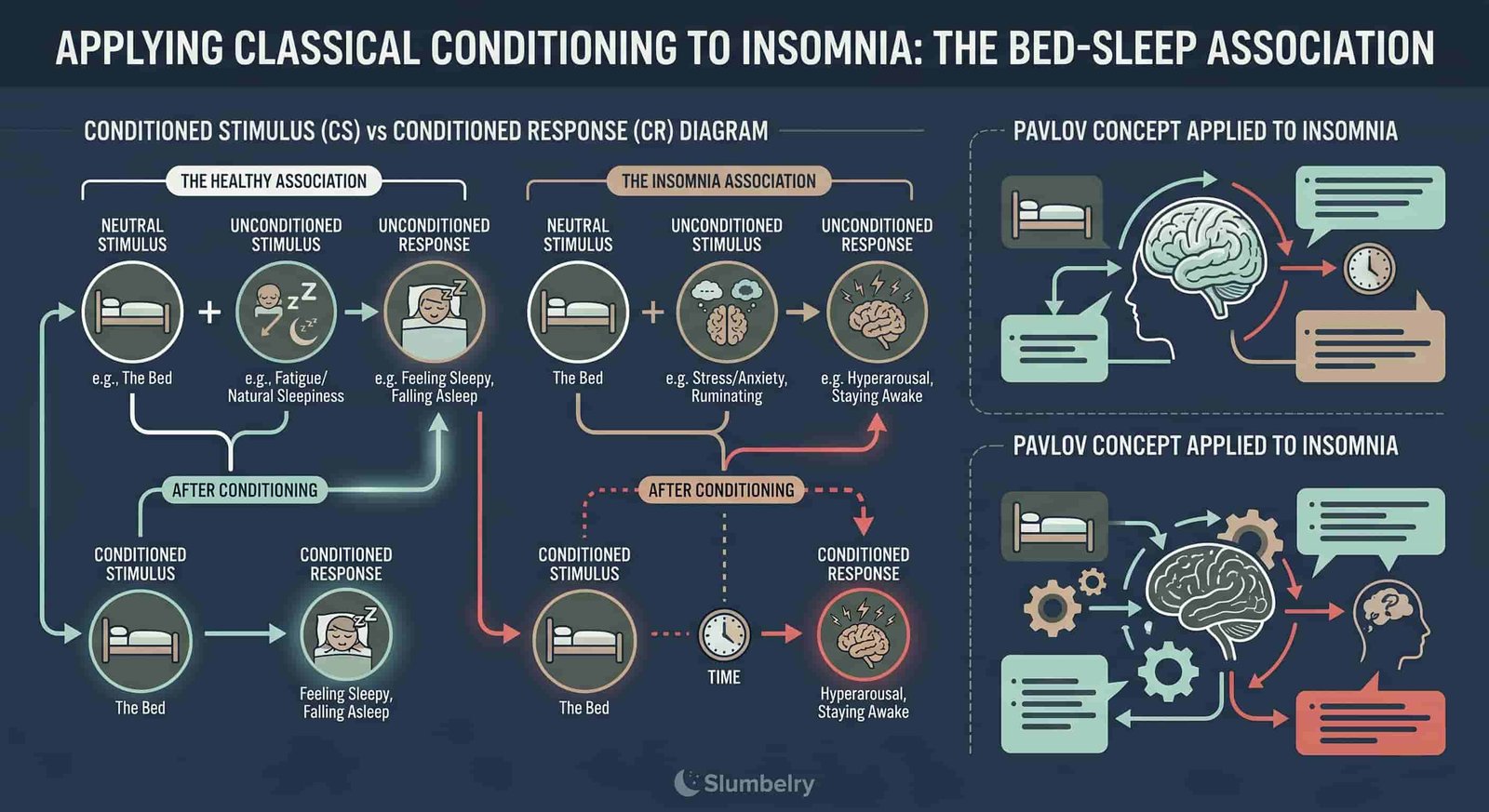
Direct Answer: Because every night you have spent awake in bed — working, scrolling, worrying, watching Netflix — has trained it to be alert there. The bed was supposed to trigger sleep onset. Instead, it now triggers vigilance. This is not a personality flaw. It is classical conditioning.
Mechanism: Walker (2017), Why We Sleep, describes how conditioned or learned insomnia develops: the bed becomes a conditioned stimulus (CS) for wakefulness through repeated pairing with the unconditioned response of arousal. Initially, lying in bed with worry or stress triggers the normal wakefulness response. Over time, the bed alone — without any worry — triggers the same arousal response. This is the same mechanism Pavlov used with his dogs: the bell (the bed) becomes associated with food (arousal) and eventually triggers salivation (wakefulness) even without food. The insomniac’s bed has become a Pavlovian bell for alertness — and every night of lying awake in bed rings it again, deepening the association.
Actionable Advice: The first step is awareness: if you cannot immediately fall asleep upon lying down, and you spend more than 15 minutes awake in bed, your brain is training itself to be awake in bed. Stop the training session by getting out.
What Is Stimulus Control Therapy and Where Does This CBT-I Technique Come From?
Direct Answer: Stimulus Control Therapy (SCT) is a structured behavioral program designed to re-associate the bed with sleep by eliminating all sleep-incompatible activities in bed and breaking the cycle of wakefulness. It was developed by Richard Bootzin in 1972 and is now a cornerstone of Cognitive Behavioral Therapy for Insomnia (CBT-I).
Mechanism: Stanley (2018), How to Sleep Well, documents the original Bootzin SCT protocol: six instructions that target the conditioned arousal response directly. The AASM Clinical Guidelines classify CBT-I including SCT as a Level 1 treatment for chronic insomnia — the highest evidence grade available. The goal of SCT is to restore the bed as a reliable sleep cue: when you lie down, your brain should immediately begin the sleep onset process without resistance or vigilance. This is achieved by preventing the bed from being paired with wakefulness, so the brain can relearn the original association.
Actionable Advice: The six rules of Stimulus Control are: (1) Use the bed only for sleep and intimacy. (2) If you are awake for 15–20 minutes, get out of bed. (3) Use the bed only when drowsy. (4) Return to bed only when sleepy. (5) Get up at the same time every day regardless of how you slept. (6) Do not nap during the day. These six rules are the clinical protocol — follow all six, not just the ones you find convenient.
How Does Classical Conditioning Explain Why You Cannot Sleep in Your Own Bed?
Direct Answer: Classical conditioning explains that the bed was once a neutral stimulus — but repeated pairing with wakefulness turned it into a conditioned stimulus for arousal. Your brain now expects to be awake in bed before you even lie down.
Mechanism: Walker (2017) describes the neuroscience of conditioned insomnia: the bed triggers the amygdala (the threat-detection center) to activate the sympathetic nervous system, releasing cortisol and adrenaline — the same physiological state as being in physical danger. The hippocampus and prefrontal cortex (responsible for logical assessment) are suppressed during sleep onset, so there is no cognitive override of this conditioned response: your body responds to the bed as a threat before your thinking brain can intervene. This explains why insomniacs experience immediate physiological arousal upon lying in bed — not because they are thinking about something stressful, but because the bed itself has become the threat cue. This is why cognitive techniques alone (trying to relax, counting sheep) often fail: the conditioning is happening at a subcortical, pre-conscious level that willpower cannot directly influence.
Actionable Advice: The only way to break a conditioned response is to stop reinforcing it. Every night you lie awake in bed, you reinforce the conditioning. The rule is absolute: no more than 20 minutes awake in bed. If you are not asleep, you are out.
What Is the 15-Minute Rule and How Does It Work to Reset the Bed-Sleep Association?
Direct Answer: The 15-minute rule (also called the 20-minute rule depending on the protocol version) states: if you do not fall asleep within 15–20 minutes of lying down, get out of bed and do something boring until you are genuinely drowsy, then return. Each return to bed should be an immediate sleep onset attempt.
Mechanism: The 15-minute rule works by preventing the conditioned arousal from being reinforced by extended wakefulness in bed. When you lie in bed and cannot sleep for 30–60 minutes, the brain has a long exposure to the bed-while-awake scenario, strengthening the association. By leaving after 15–20 minutes, you interrupt the reinforcement cycle and create a new pattern: bed = sleep (because you return only when drowsy and fall asleep quickly). The rule also serves a secondary function: it removes the anxiety of “trying to sleep” by replacing it with the simple instruction “get up and do something boring.” This removes performance pressure, which itself reduces the pre-sleep cortisol spike that prevents sleep onset.
Actionable Advice: The moment you realize you have been awake for 15–20 minutes: get up, turn on low light (not bright light — bright light suppresses melatonin and signals wakefulness), go to another room, and do something mildly boring. Airing on the couch, reading a book (not a page-turner), folding laundry, or listening to a podcast at low volume all work. Do not clean the kitchen (too activating). Do not watch TV or use your phone (blue light + engaging content will wake you up further).
Why Does Getting Out of Bed When Awake Actually Help You Fall Asleep Faster?
Direct Answer: Because staying in bed awake while struggling to sleep does two things: it reinforces the bed-wakefulness association and generates anxiety about not sleeping, which further elevates cortisol and locks you in a feedback loop.
Mechanism: Walker (2017) documents the anxiety-sleep paradox: worrying about sleep (metacognitive worry) elevates cortisol and sympathetic nervous system activity, which is physiologically incompatible with sleep onset. The more you lie in bed trying to sleep, the more frustrated you become, and the more your body activates for wakefulness. This is psychophysiological insomnia — not a sleep disorder, but a conditioning disorder driven by anxiety. Getting out of bed breaks this loop in two ways: first, by removing the conditioned stimulus (the bed) before it can trigger more arousal; second, by preventing the frustration and anxiety from building. When you get up and do something boring, your brain eventually associates the experience with the low-arousal state of drowsiness — and when you return to the bed in this state, the return is associated with sleep onset rather than struggle.
Actionable Advice: The goal of getting out of bed is not to achieve sleep away from the mattress. It is to return to bed in the correct neurological state: drowsy, low arousal, and free of frustration. If you get up and do something that increases your alertness (phone, exciting book, cleaning), you are defeating the purpose. Choose genuinely boring activities that lower your arousal state.
How Does Stimulus Control Differ From Sleep Restriction Therapy?
Direct Answer: Stimulus control targets the bed-sleep association problem. Sleep restriction targets the sleep pressure problem. They are different mechanisms and different interventions — but they are most effective when used together as part of full CBT-I.
Mechanism: Stanley (2018) distinguishes the mechanisms: Stimulus control (SCT) addresses the conditioned arousal response — it prevents the bed from triggering wakefulness by eliminating all non-sleep activities from the bed. Sleep restriction (SRT) addresses the homeostatic sleep drive — it increases sleep pressure by limiting time in bed to actual sleep time, forcing deeper and more efficient sleep. SCT alone does not address inadequate sleep pressure; SRT alone does not address the conditioned bed-wakefulness association. When combined, they are additive: SRT builds the biological pressure to sleep, and SCT ensures the bed delivers on that pressure without triggering arousal. The AASM recommends using both as part of CBT-I rather than in isolation for moderate to severe chronic insomnia.
Actionable Advice: If you are doing only one of these and not seeing results, you are probably missing the other component. SCT without SRT is slower; SRT without SCT leaves the bed-association problem unresolved.
Why Does Using Your Phone in Bed Destroy the Bed-Sleep Association Faster Than Anything Else?
Direct Answer: Because your phone does three things simultaneously: it delivers blue light that suppresses melatonin, it triggers cognitive engagement that elevates arousal, and it does all of this in the specific location where you are trying to fall asleep.
Mechanism: Walker (2017) documents that blue light wavelengths (460–480 nm) directly suppress melatonin onset by activating ipRGC (intrinsically photosensitive retinal ganglion cells) which project to the suprachiasmatic nucleus (SCN), signaling “it is daytime.” This delays sleep onset by an average of 22 minutes per hour of screen use before bed. Beyond the light effect, engaging content (social media, news, work email) activates the prefrontal cortex and amygdala, elevating cortisol and norepinephrine — the same arousal cascade triggered by a physical threat. The combined effect of light plus cognitive engagement in the sleep location creates an exceptionally powerful conditioning: bed = blue light + cognitive arousal + alertness. After months of this, the brain does not need your phone to be active in bed — the bed alone triggers the arousal state that the phone initially created.
Actionable Advice: Remove the phone from the bedroom entirely. Not from the bedside table — from the room. Charge it in another room. If you use it as an alarm, buy a separate alarm clock. This one change alone is the single most impactful sleep hygiene improvement for phone-addicted insomniacs.

How to Rebuild the Bed-Sleep Association: A Practical Nightly Routine
Direct Answer: Create a pre-sleep routine that signals to the brain: “the next 30 minutes are a transition from wakefulness to sleep.” This routine must be consistent, boring, and conducted in low light.
Mechanism: AASM sleep assessment guidelines and Stanley (2018) describe the pre-sleep routine as a classical conditioning ritual: the sequence of activities before bed becomes a chain of conditioned stimuli, each signaling the next step toward sleep. By conducting the same activities in the same order every night 30–60 minutes before bed, the brain learns to interpret each step as a sleep cue: dimming lights signals “melatonin release,” putting on pajamas signals “the day is ending,” reading a physical book signals “cognitive engagement is winding down.” The routine creates a progressive reduction in cortical arousal that makes the transition to sleep automatic rather than requiring deliberate effort.
Actionable Advice: Design your pre-sleep routine tonight: (1) Start 45 minutes before target bedtime. (2) Dim all lights to near-darkness. (3) Do not discuss work, money, or relationships. (4) Read physical pages (not a screen). (5) Do something meditative: gentle stretching, breathing exercises, journaling. (6) When you enter the bedroom, it should feel like walking into a cave — cool, dark, quiet. Your body should begin to feel drowsy within 5 minutes of entering the bedroom.
What Mistakes Undermine Stimulus Control Therapy Before It Has a Chance to Work?
Direct Answer: The most common reasons SCT fails are: not getting out of bed soon enough, not staying out long enough, doing stimulating activities when out of bed, and breaking the routine on weekends.
Mechanism: Stanley (2018), How to Sleep Well, identifies the most frequent compliance failures in SCT: (1) Staying in bed 30–60 minutes before getting up — by then, the brain has spent a full hour in the conditioning scenario, counteracting the therapy. The 15–20 minute rule must be strict. (2) Getting up and using a phone, watching TV, or doing engaging work — this replaces bed-wakefulness conditioning with screen-wakefulness conditioning, and the blue light damage prevents any benefit from the break. (3) Going back to bed when not yet drowsy — if you return after 20 minutes and still cannot sleep, the problem is not the bed; it is that you are not yet drowsy enough. Stay up longer. (4) Allowing weekend lie-ins — a 2-hour weekend wake time shift is enough to destabilize the circadian rhythm enough that Monday night’s sleep is fragmented regardless of SCT compliance.
Actionable Advice: Set a rule for yourself: if I am not asleep in 20 minutes, I am out of bed, phone stays in another room, and I am back only when I am struggling to keep my eyes open. The first 2 weeks will feel unnatural and difficult. This is normal. The third week is where most people start noticing the difference.
How Does Stimulus Control Therapy Compare to Medication for Insomnia?
Direct Answer: CBT-I (including SCT) and medication both reduce insomnia symptoms. CBT-I has better long-term outcomes, no side effects, and addresses the root cause. Medication works faster but does not cure insomnia and carries dependence risk.
Mechanism: Comparative studies show: Z-drugs (zolpidem, eszopiclone) and benzodiazepines reduce insomnia severity in the short term (2–4 weeks) with effect sizes of approximately 0.6–0.8. CBT-I including stimulus control shows effect sizes of 0.8–1.2 and is effective in both the short and long term. Critically, medication effects dissipate within 1–2 weeks of discontinuation; CBT-I effects are sustained for 12–24 months after treatment ends. The AASM’s 2021 update to its Clinical Practice Guidelines explicitly recommends CBT-I over medication as the first-line treatment for chronic insomnia in adults, specifically citing superior durability and absence of adverse effects. The dependence liability of Z-drugs and benzodiazepines also creates a secondary problem: patients who have been on long-term sleep medication often struggle to discontinue it, which itself becomes a source of anxiety-driven insomnia.
Actionable Advice: If you are currently taking sleep medication, do not stop suddenly — this can precipitate rebound insomnia. Work with your physician on a gradual taper while beginning CBT-I. The goal is to have the behavioral conditioning in place before the medication is fully tapered, so the underlying insomnia does not return.
Frequently Asked Questions
What is stimulus control therapy for insomnia?
Direct Conclusion: Stimulus control therapy (SCT) is a structured behavioral program that re-associates the bed with sleep by eliminating all non-sleep activities from the bedroom and enforcing the rule: if you are awake for more than 15–20 minutes, get out of bed and only return when genuinely drowsy. It was developed by Richard Bootzin in 1972 and is now a cornerstone of CBT-I. SCT targets the conditioned arousal response that makes the bed trigger wakefulness instead of sleep — it is not about relaxation, but about conditioning.
Why does my brain associate the bed with being awake?
Direct Conclusion: Because of classical conditioning. Every night you have spent awake in bed (scrolling, working, worrying, watching TV) has reinforced the association between the bed and the wakefulness state. The bed, which should be a conditioned stimulus for sleep onset, has become a conditioned stimulus for alertness. This happens at a subcortical level — your amygdala activates before your thinking brain can intervene, which is why willpower alone cannot override it.
What is the 15-minute rule for insomnia?
Direct Conclusion: The 15-minute rule states: if you are not asleep within 15–20 minutes of lying down, get out of bed and go to another room. Stay there until you are genuinely drowsy, then return and attempt to sleep immediately. The goal is to prevent the brain from spending extended time in the bed-while-awake state, which reinforces the wrong association.
Does getting out of bed when awake really help you fall asleep?
Direct Conclusion: Yes — when done correctly. Staying in bed awake for long periods reinforces the association between the bed and wakefulness. Getting out breaks the loop, removes the frustration, and allows you to return to the bed only when you are drowsy enough to fall asleep immediately. The key is what you do when you are up: it must be boring, low-light, low-arousal activity (not phone use or exciting TV).
Why does using my phone in bed make it harder to sleep?
Direct Conclusion: Your phone does three things that suppress sleep: blue light suppresses melatonin by signaling daytime to your suprachiasmatic nucleus; engaging content elevates cortisol and norepinephrine through cognitive and emotional activation; and doing both of these in bed creates a triple conditioning effect where bed = blue light + cognitive arousal + alertness. This is the single most damaging sleep habit for modern insomniacs.
What is the difference between stimulus control and sleep restriction?
Direct Conclusion: Stimulus control targets the bed-sleep association problem (conditioned arousal). Sleep restriction targets inadequate sleep pressure (homeostatic deficit). They are different mechanisms: SCT says ‘stop reinforcing wakefulness in bed,’ SRT says ‘build more sleep pressure by limiting time in bed.’ Full CBT-I uses both together because they are additive and address different root causes of insomnia.
How long does stimulus control therapy take to work?
Direct Conclusion: Initial improvements in sleep onset latency are typically seen within 1–2 weeks. Significant clinical improvement (reduced insomnia severity scores, increased sleep efficiency above 85%) is typically achieved within 4–6 weeks of consistent adherence. Full remission may take 8–12 weeks. The most important factor is strict adherence — people who modify the rules often fail to see improvement.
Can I do stimulus control therapy if I live in a small apartment?
Direct Conclusion: Yes — you do not need a separate room, just a different surface from your bed. You can sit in a chair, on the couch, or even at a desk in another part of the apartment. The key is that when you return to the bed, it is with the intention of immediate sleep onset. Even sitting at a kitchen table doing something boring for 20 minutes can be effective.
What should I do when I get out of bed at night?
Direct Conclusion: Choose a boring, low-light, low-arousal activity: sitting quietly with a physical book in dim light, folding laundry, listening to a calming podcast or audio book, gentle breathing exercises, or coloring. Avoid: phones, tablets, laptops, TV, work, exciting reading, bright lights, caffeine, and exercise. The goal is to lower your arousal state, not to fill the time with entertainment.
Is stimulus control therapy better than medication for insomnia?
Direct Conclusion: For long-term outcomes, yes. Medication (Z-drugs, benzodiazepines) reduces insomnia symptoms but does not address the root cause, loses effectiveness on discontinuation, and carries dependence risk. CBT-I including stimulus control has larger effect sizes and the benefits are sustained for 12–24 months after treatment. The AASM recommends CBT-I over medication as the first-line treatment for chronic insomnia in adults. If you are on sleep medication, consult your physician before tapering — do not stop suddenly.
Ready to Reclaim Your Bedroom?
If your bed has become a place of struggle instead of rest, take action tonight. Discover the science-backed approach to retraining your brain for effortless sleep.
Take the Sleep Assessment Optimize Your Sleep EnvironmentThe Slumbelry Commitment
Sleep is the most vulnerable state of human existence. It is where we heal, reset, and grow.
At Slumbelry, we do not just sell sleep products; we advocate for your physiological right to rest. From ergonomic support to light management, every solution we offer is designed with one obsession: Respecting your Biology.
Science is our language, but your recovery is our purpose. You take care of everything else in your life — let us take care of your nights.
Rest Deeply,
The Slumbelry Team