
The Snooze Button Is the Most Destructive 9 Minutes of Your Day
⚡ Core Takeaway: Snooze = Sleep Inertia Tax
- Sleep inertia is real: Waking mid-cycle triggers a 15-30 minute cognitive fog that worsens to 4 hours when you fragment sleep with repeated snoozes.
- The 9-minute interval is a mechanical relic: 1950s clockmakers chose 9 minutes because of gear teeth alignment — it has zero biological basis.
- One rule replaces the snooze: If you need more sleep, set your alarm 30 minutes later and sleep straight through. One unbroken 30-minute block outperforms 3 hours of fragmented snooze cycles.
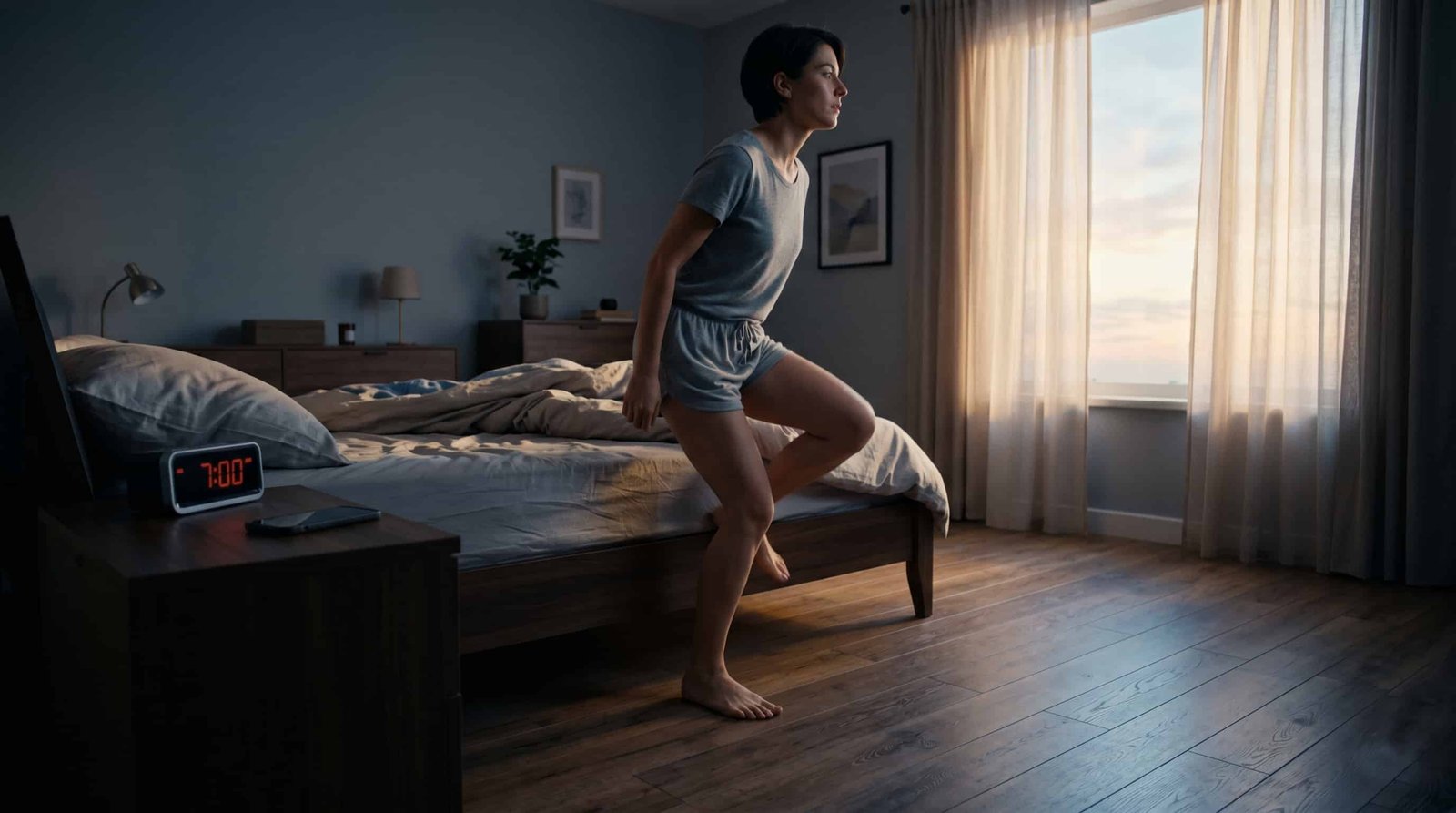
The snooze button is the most seductive mechanism in modern sleep — and the most physiologically destructive. Every morning, hundreds of millions of people make the same calculation: 9 more minutes of sleep, and then I will be ready. They are not just wrong. They are actively choosing to add a 4-hour cognitive handicap to the first quarter of their day. This is the science of why the snooze button destroys mornings — and the exact system for replacing it permanently.
Why Does the Snooze Button Make You Feel Worse Instead of Better?
It is the most seductive button in the world. The alarm goes off at 7:00 AM, pulling you from a warm dream into a cold room. The day ahead looks exhausting. You see the option: snooze — 9 minutes. You tell yourself you just need a few more minutes to finish this sleep. Then you will be ready. The lie is seductive because it sounds logical. The truth is biological: the snooze button does not give you more rest. It gives you sleep inertia — a morning cognitive handicap that makes the first four hours of your day substantially worse than they need to be.
The R90 Context: Where You Are in the Sleep Cycle When the Alarm Fires
When your first alarm fires, there are three possible scenarios. You are in light sleep (N1/N2) near the end of a cycle — ideal. You are in deep sleep (N3) — your brain is still in its most restoration-dependent state and will resist waking hard. Or you are in REM — where emotional processing is interrupted and your emotional regulation for the day is degraded before it starts. In all three scenarios, hitting snooze and drifting back to sleep does not extend the same sleep stage. Because most adults are chronically sleep-deprived, your brain does not gently extend light sleep — it crashes back into the most physiologically demanding sleep it can reach, typically deep sleep (N3) or early REM. Nine minutes is long enough to re-enter a new cycle but nowhere near long enough to complete one.
Sleep Inertia: The 4-Hour Cognitive Handicap You’re Starting Every Morning
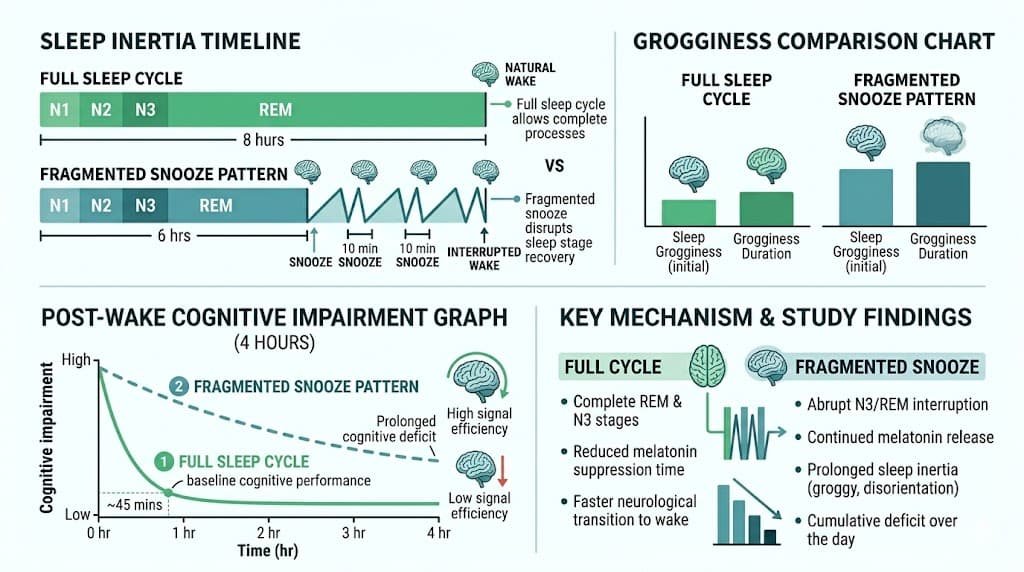
Sleep inertia is the transitional state between sleep and wakefulness — the groggy, fog-like cognitive impairment you feel in the first minutes after waking. Under normal circumstances (waking at the end of a cycle without interruption), sleep inertia clears in 15-30 minutes. This is why you should not make major decisions, drive, or have difficult conversations in the first half hour after waking.
The Math of Repeatedly Fragmented Sleep
When you hit snooze, you restart a sleep cycle — and then your alarm fires again mid-cycle. Sleep inertia, which normally clears in 30 minutes, resets every time you do this. Research shows that each snooze cycle extends sleep inertia by approximately 30 minutes. Three snooze cycles — the average for chronic snoozers — produces up to 4 hours of cumulative cognitive impairment before you feel normal. This is not a feeling that wears off by 9 AM. It is a measurable degradation in decision-making, reaction time, and emotional regulation that persists until early afternoon. You are not just “not a morning person.” You are actively choosing, every morning, to be cognitively impaired for a quarter of your workday.
The 9-Minute Myth: Why the Snooze Interval Is a 1950s Engineering Glitch
Here is a piece of sleep trivia that reveals how arbitrary the standard snooze interval is: the 9-minute snooze was not chosen by sleep scientists. It was chosen by mechanical engineers in the 1950s. Early alarm clocks used a snooze gear mechanism. A 10-minute interval was physically impossible due to the gear teeth alignment in standard clock housings, so the engineers compromised on 9 minutes. That arbitrary mechanical constraint has been carried forward into every smartphone alarm app in existence — and has been accepted as a biological norm by hundreds of millions of people who have never questioned why their snooze window is exactly 9 minutes long.
Cortisol Awakening Response: How Your Body Prepares to Wake Before Your Alarm
Your body begins waking up before your alarm fires. This process — the cortisol awakening response (CAR) — begins approximately 30-45 minutes before scheduled wake time and involves a peak in cortisol, adrenaline, and heart rate. CAR is part of the suprachiasmatic nucleus’s (SCN) pre-wake signaling: it raises your core body temperature, suppresses melatonin, and elevates alertness in preparation for the day’s first challenge. When you hit snooze, you are disrupting this carefully orchestrated process. The alarm’s sound triggers a fight-or-flight cortisol spike. The snooze sends you back into sleep, suppressing the cortisol that was building. The next alarm fires and triggers another spike. By the third or fourth snooze cycle, your cortisol pattern is completely incoherent — neither asleep nor genuinely awake, stuck in a sympathetic-nervous-system loop that produces neither rest nor readiness.
The 90-Minute Rule: Why Full Sleep Cycles Are the Morning Anchor
Nick Littlehales’ R90 framework applies to waking as directly as it applies to bedtime. If you need to wake at 6:30 AM and your last cycle ended at 5:00 AM, you have already completed 5 full cycles. There is no biological penalty for waking at the natural end of a cycle — even if it means accepting 6.5 hours of sleep rather than forcing a full 7.5 hours by hitting snooze. The goal is not to maximize hours in bed. The goal is to wake at a cycle boundary, feeling coherent rather than fragmented.
⚡ The 90-Minute Wake Alignment
Use a sleep tracker (once per week, not daily) to understand where your natural wake point falls relative to your alarm. If your alarm consistently fires mid-cycle, shift your target wake time by 15-30 minutes until you consistently wake at or near a cycle boundary. Alternatively: set your alarm 30 minutes later than your target and sleep straight through. One uninterrupted 30-minute extension from a cycle boundary outperforms three snooze cycles.
Light Before Sound: Why Sunlight Is Your Most Powerful Wake-Up Tool
Humans did not evolve to wake to alarm sounds. The body’s primary wake signal is light — specifically, the 460-480nm blue-wavelength light that triggers SCN suppression of melatonin and activates the cortisol awakening response. Sunlight at dawn is the strongest natural version of this signal. A sunrise simulation alarm clock (which gradually increases light from near-darkness to warm orange over 20-30 minutes) replicates this process indoors.
Light as Circadian Anchor
Research shows that exposure to bright light within 30 minutes of waking advances your circadian phase — meaning you will naturally feel sleepy earlier the following night, making it easier to wake without the snooze the next morning. The mechanism: morning light exposure calibrates the SCN’s internal clock, strengthening the wake-time signal that builds overnight through adenosine clearance. Morning light is not just about feeling alert today. It is about making tomorrow morning easier. The most effective habit change for chronic snoozers is not a behavioral hack — it is 10 minutes of sunlight exposure immediately after waking, before coffee, before your phone.
The “Across the Room” Method: Engineering Discomfort Into the Habit Loop
The most effective behavioral intervention for snooze addiction is spatial: move your alarm device (phone or clock) to the other side of the bedroom. You must physically stand, cross the floor, and reach to turn it off. Once your feet are on the cold floor, the sympathetic nervous system is partially activated — body temperature rises, cortisol begins its awakening response, and the hardest part of breaking the snooze loop is over. The key constraint: once you stand up, you cannot return to bed. This requires environmental design, not willpower. Do not negotiate with yourself standing next to the alarm. Once you are vertical, leave the bedroom immediately.
The “No Negotiation” Rule: How to Make Your Morning Commitment Unbreakable
The night before, establish your wake time as a non-negotiable contract. Not a hope, not a plan — a contract. “I wake at 7:00 AM.” When the alarm fires the next morning, you do not deliberate. You count 3-2-1, the way an athlete counts down before a race start, and you stand up. The deliberation is the trap. Any moment spent negotiating with yourself in the morning is a moment the sleep inertia compounds. The R90 principle applied here: your wake time is the anchor. Everything else — your energy, your mood, your cognitive performance — flows from honoring that anchor. If you need more sleep, adjust the wake time tomorrow. Tonight, honor the contract.
Why Willpower Fails and Systems Succeed
Neuroscience research on habit formation shows that willpower-based morning decisions consistently fail because the prefrontal cortex — responsible for executive decision-making — is the last brain region to fully come online after sleep. You cannot make good decisions about whether to snooze at 7:00 AM because your prefrontal cortex is still groggy from sleep inertia. The solution is to remove the decision from the morning entirely. Set your alarm, set your environment (phone across the room, curtains open), and treat the outcome as predetermined. You are not deciding to wake at 7:00 AM in the morning. You decided at 11:00 PM the night before.
If You Need More Sleep, Earn It: The 30-Minute Rule vs. the 9-Minute Trap
If you are consistently hitting snooze because you genuinely need more sleep, the problem is not your morning habit — it is your sleep schedule. The snooze is a band-aid on insufficient sleep, not a solution. Here is the rule that replaces the snooze: if you need more sleep, set your alarm 30 minutes later and sleep straight through until it fires. One uninterrupted 30-minute extension from a cycle boundary provides genuine restorative sleep. Three 9-minute fragmented snooze cycles provide none of the recovery of the 30 minutes they nominally offer.
⚡ The Only Exception to the No-Snooze Rule
If you are traveling across time zones or recovering from significant sleep debt (3+ cycles below your weekly target), a single 20-30 minute power nap in the early afternoon (1-3 PM) is more effective and less disruptive than any morning snooze. This is the only legitimate use of the snooze logic: a brief, controlled rest that supplements your weekly cycle total without fragmenting your morning cortisol pattern.
The Slumbelry Framework: Your Morning Is a Performance Asset, Not a Battleground
Slumbelry’s approach to mornings is the same as its approach to sleep generally: design the environment so the desired behavior is inevitable and the undesired behavior is inconvenient. The snooze button is not a personal failing. It is a failure of environmental design. Move the phone. Set the light. Lock the contract the night before. Your morning is the first 30 minutes of your cognitive performance for the entire day — and possibly the most important 30 minutes of your health. It is not a battleground between your alarm and your willpower. It is a performance asset that deserves the same engineering discipline you apply to the rest of your sleep environment.
Morning Light Is Slumbelry’s Primary Wake Intervention
Among all the sleep products and protocols Slumbelry engineers, morning light exposure is the single highest-ROI intervention for improving wake quality. A sunrise simulation alarm, combined with a commitment to 10 minutes of outdoor light exposure before coffee, produces measurable improvements in sleep inertia clearance, circadian consistency, and next-night sleep onset within 3-4 days. The snooze button is an expensive substitute for a problem that light solves permanently.
Action step: Tonight, put your phone charger on the other side of your bedroom. Set your alarm for your target wake time. Tomorrow, when it fires, stand up, walk to your phone, and go outside. No snooze. No negotiation. Your morning starts the night before.
Frequently Asked Questions About the Snooze Button
Why does hitting snooze make you feel more tired instead of more rested?
Because sleep inertia resets every time you wake and then fall back asleep. Sleep inertia is the cognitive fog you feel immediately after waking — it normally clears in 15-30 minutes as your prefrontal cortex comes fully online. When you hit snooze and re-enter sleep, your brain crashes back into deep sleep (N3) or early REM. When the alarm fires 9 minutes later, sleep inertia resets and begins accumulating again. Each snooze cycle adds approximately 30 minutes of extended sleep inertia. Three snooze cycles produces up to 4 hours of cumulative cognitive impairment before you feel normal. You are not banking rest — you are paying a compound interest tax on sleep fragmentation.
What is sleep inertia and how long does it last?
Sleep inertia is the transitional physiological state between sleep and full wakefulness — characterized by grogginess, impaired decision-making, slow reaction time, and general cognitive fog. Under normal circumstances (waking at a natural cycle boundary without interruption), sleep inertia clears in 15-30 minutes as the prefrontal cortex fully activates and cortisol levels rise to daytime baseline. With one snooze cycle, sleep inertia extends to 60-90 minutes. With repeated snoozing (3+ cycles), sleep inertia can persist for up to 4 hours. This is why chronic snoozers report feeling ‘not fully awake’ until mid-morning — they are experiencing extended sleep inertia from deliberate sleep fragmentation.
Why is the snooze button set to 9 minutes?
The 9-minute snooze interval is a mechanical engineering artifact from the 1950s, not a biological recommendation. Early alarm clocks used a snooze gear mechanism that physically could not accommodate a 10-minute interval due to gear teeth alignment constraints in standard clock housings. Engineers chose 9 minutes as the closest practical interval. When digital alarm clocks were developed, the 9-minute convention was carried forward without biological justification — and when smartphone alarm apps were built, they inherited the convention from digital alarm clocks without any sleep science basis. There is nothing special about 9 minutes. It is an arbitrary mechanical decision from 70 years ago.
What is the cortisol awakening response (CAR) and how does snoozing disrupt it?
The cortisol awakening response (CAR) is the body’s pre-wake signal — a natural peak in cortisol and adrenaline that begins 30-45 minutes before your scheduled wake time. This is the SCN’s way of preparing the body for the day ahead: raising core temperature, suppressing melatonin, and elevating heart rate and alertness. This process is carefully sequenced. When you hit snooze, the alarm sound triggers an adrenaline spike. The snooze sends you back into sleep, suppressing the rising cortisol. The next alarm fires and triggers another adrenaline spike. By the third snooze, your cortisol pattern is incoherent — neither asleep nor awake, caught in a sympathetic nervous system loop that produces neither rest nor readiness. Every snooze cycle disrupts the CAR, making genuine wakefulness progressively harder to achieve.
How many sleep cycles should I complete before waking?
Most adults need 5-6 complete sleep cycles per night (each 90 minutes), equating to 7.5-9 hours of total sleep time. If you are sleep-deprived, you may need more. The critical principle is not how many hours you complete but whether you wake at a cycle boundary. Waking mid-cycle (which is what the snooze button causes) interrupts N3 deep sleep or REM — the two most physiologically valuable stages. Use a sleep tracker to identify where your natural wake point falls relative to your alarm. If your alarm consistently fires mid-cycle, shift your target wake time by 15-30 minutes. You are looking for the wake window where you naturally surface near the end of a cycle, not the window where the alarm yanks you out of deep sleep.
Does the R90 sleep method apply to morning wake times?
Yes — directly. Nick Littlehales’ R90 framework treats the fixed wake time as the non-negotiable anchor of the entire sleep system. The principle: if you need to wake at 6:30 AM and your last cycle ended at 5:00 AM, you have already completed 5 full cycles. There is no biological penalty for waking at a cycle boundary even if it means accepting fewer total hours. The goal is waking coherent, not waking with maximum hours. The corollary: if you are consistently hitting snooze because you are not completing enough cycles, the problem is your bedtime schedule — not your morning willpower. Fix the schedule: go to bed earlier or accept a wake time that aligns with your natural cycle boundaries.
Is morning sunlight exposure really more effective than an alarm for waking up?
Yes — and not just subjectively. Sunlight at dawn (specifically 460-480nm blue-wavelength light) is the SCN’s primary wake signal. Exposure to bright light within 30 minutes of waking produces measurable improvements in sleep inertia clearance, same-day alertness, and next-night sleep onset timing. Research shows morning light exposure advances your circadian phase, meaning you will naturally feel sleepy earlier the following night. A sunrise simulation alarm clock (which gradually increases indoor light from darkness to warm orange over 20-30 minutes) is an effective substitute when natural sunlight is not available. The combination of morning light and a consistent wake time compounds over 3-4 days into a measurably stronger circadian rhythm — which makes waking without snooze progressively easier each morning.
What is the ‘Across the Room’ method for breaking the snooze habit?
Move your alarm device (phone or clock) to the far side of your bedroom — somewhere that requires you to physically stand up and walk across the floor to turn it off. Once your feet are cold on the floor, the sympathetic nervous system is partially activated: body temperature rises, cortisol begins its awakening response, and the hardest part of breaking the snooze loop is over. The constraint: once you are vertical, do not return to bed. Leave the bedroom immediately. This requires environmental design, not willpower — because your prefrontal cortex is not fully online at waking and cannot be relied upon to make good decisions. The physical act of standing up is the only intervention that actually works, because it eliminates the option of unconscious negotiation.
What should I do if I genuinely need more sleep in the morning?
If you are hitting snooze because you genuinely need more sleep, the problem is your bedtime schedule — not your morning habit. The fix is not the snooze button; it is a schedule adjustment. The rule: if you need more sleep, set your alarm 30 minutes later than your target and sleep straight through until it fires. One uninterrupted 30-minute extension from a cycle boundary provides genuine restorative sleep. Three 9-minute fragmented snooze cycles do not. Alternatively, if you are significantly sleep-deprived (3+ cycles below your weekly target), a single 20-30 minute early-afternoon power nap (1-3 PM) is more effective and less disruptive than any morning snooze — because early afternoon is when the circadian rhythm naturally dips and a nap at this time does not disrupt nighttime sleep onset.
How does the snooze button affect morning productivity and decision-making?
The productivity cost of snoozing is substantial and measurable. Research on sleep inertia shows that cognitive performance — including decision-making, reaction time, and working memory — is degraded by 15-40% during sleep inertia states. For a person who snoozes through 3 cycles, this impairment can persist until late morning. The prefrontal cortex (responsible for executive function, planning, and self-control) is the last region to recover from sleep inertia, meaning the cognitive skills most needed for morning productivity work are also the most suppressed. A morning meeting attended in a snooze-induced sleep inertia state produces worse decisions than the same meeting attended after a coherent wake. The snooze button is not a neutral 9-minute delay — it is a deliberate choice to start the workday with impaired cognitive capacity.
Ready to Take Your Mornings Back?
Stop fragmenting your mornings. Design the environment so your wake is inevitable, coherent, and powerful.
Take the Sleep Assessment Subscribe for Sleep Optimization TipsThe Slumbelry Commitment
Sleep is the most vulnerable state of human existence. It is where we heal, reset, and grow.
At Slumbelry, we do not just sell sleep products; we advocate for your physiological right to rest. From ergonomic support to light management, every solution we offer is designed with one obsession: Respecting your Biology.
Science is our language, but your recovery is our purpose. You take care of everything else in your life — let us take care of your sleep.
Rest Deeply,
The Slumbelry Team
Medical References:
1. Winsky-Sommerer, R., et al. (2007). Sleep Inertia: Current Insights. Nature and Science of Sleep.
2. Hilditch, C. J., et al. (2016). A Review of Short and Long Sleep Duration and Associated Sleep Patterns. Sleep Medicine Reviews.
3. Littlehales, N. (2016). Sleep: The Myth of 8 Hours. Da Capo Lifelong Books.