
Stop Trying to Sleep. Stop Checking Your Sleep Score.
⚡ Core Takeaway: Sleep Score Anxiety Is a Real Condition
- The Nocebo Effect: A low sleep score doesn’t just disappoint you — it triggers real cortisol release that actively fragments your sleep architecture.
- The Accuracy Truth: Consumer trackers guess sleep stages using movement and HRV. They cannot read brainwaves. Deep sleep percentages from wrist-worn devices are within a ±40% margin of error.
- The Protocol: The 14-day Blind Tracking Detox — wear your tracker, never check the app — reconnects your brain to its own signals instead of outsourcing rest quality to an algorithm.

What Is Sleep Score Anxiety—and Is Your Tracker Manufacturing It?
You wake up feeling rested. You stretch, you feel genuinely energized. Then you check your smartwatch. It shows a red sleep score of 45 and reports 12 minutes of deep sleep. Instantly, your energy evaporates. You feel sluggish before your feet hit the floor.
Your brain has been hacked—not by biology, but by a nocebo effect. Sleep score anxiety is the obsessive preoccupation with quantified sleep data that paradoxically destroys the very rest being measured. According to Dr. Kenneth Baron, who coined the term orthosomnia in 2017, the anxiety generated by tracking devices can be severe enough to meet clinical insomnia thresholds.
The Science: Why the Nocebo Effect Is Real Neuroscience
Paul McKenna and Guy Meadows both document a consistent finding: effort-based sleep pursuit activates the sympathetic nervous system. When you lie in bed calculating whether you can still hit a 90 on your Oura score, adrenaline and cortisol flood your system. Sleep is a parasympathetic process — it cannot be forced. The moment sleep becomes a performance metric, the brain reclassifies the bedroom as a workplace, not a recovery zone.
What to do instead: When you wake up, notice how you feel before touching your phone. If your body feels rested, your tracker is wrong — not you.
Why Your Sleep Tracker Cannot Actually Read Your Brainwaves
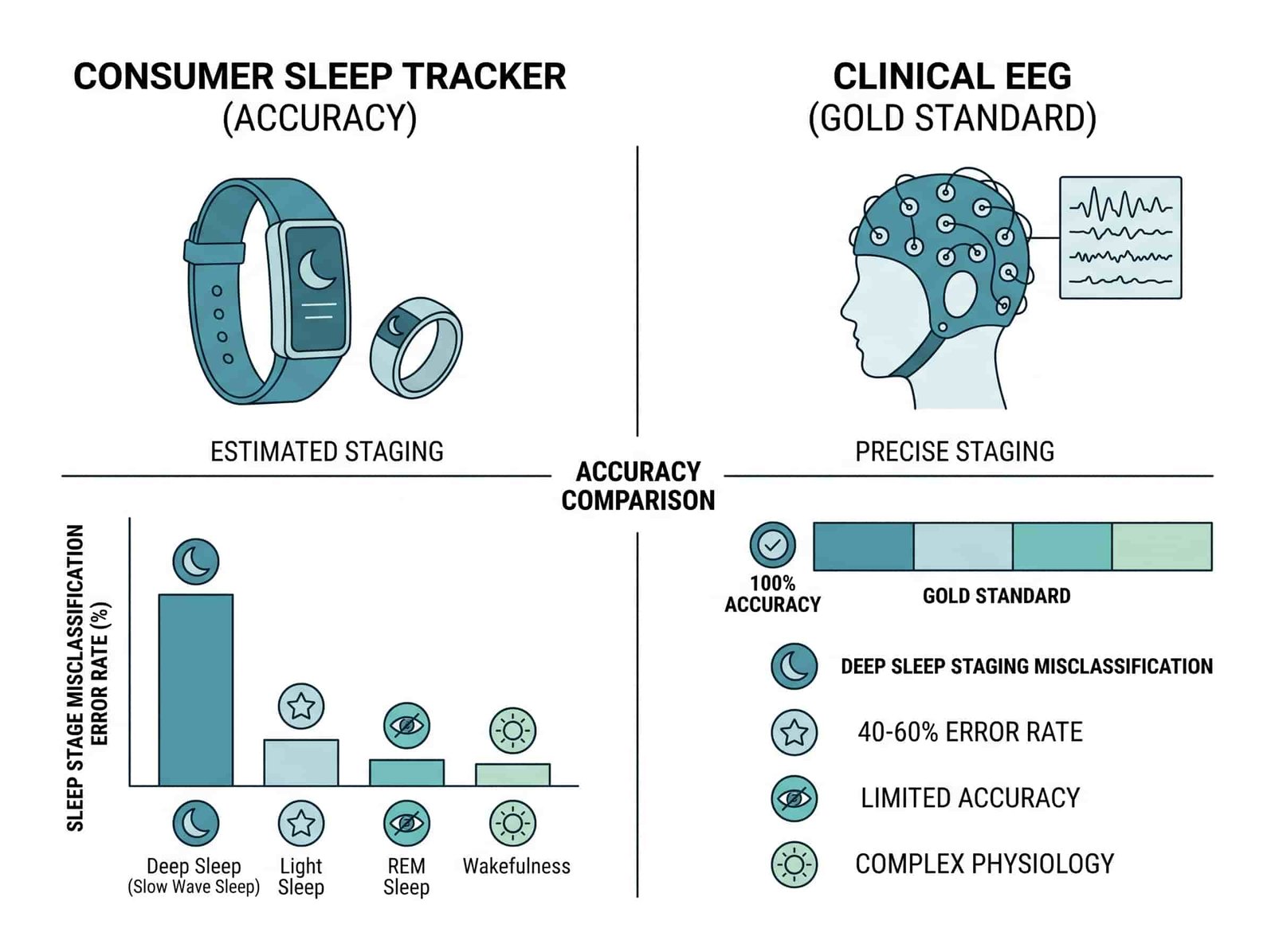
Here is the hard truth that wearable tech companies do not advertise: your wrist cannot accurately read brainwaves. True sleep staging requires a clinical EEG with electrodes attached to your scalp. Your $300 ring relies entirely on heart rate variability (HRV) and movement accelerometers to guess your sleep architecture.
Studies consistently show that consumer trackers are only 60–70% accurate for deep sleep detection compared to clinical polysomnography. They are highly accurate for total time-in-bed — but the moment a device tells you that you got “12 minutes of deep sleep,” that number is a mathematical guess with a ±40% error margin.
The Accuracy Reality: What Consumer Devices Actually Measure
Your watch uses an optical sensor to estimate HRV and an accelerometer to detect movement. These signals go into a proprietary algorithm that classifies sleep stages. Each brand — Oura, Whoop, Fitbit, Apple Watch — uses a different algorithm, which is why the same person wearing two devices on the same night can receive dramatically different sleep stage reports. According to Matthew Walker’s research, only EEG-based polysomnography can reliably distinguish between N1, N2, N3 (deep sleep), and REM stages.
What to do instead: Stop treating tracker-derived sleep stages as medical fact. Use the device only for what it is actually good at: time-in-bed consistency, not sleep quality judgment.
The Cortisol Loop: Why Checking Your Score Immediately Wakes You Up
Looking at your sleep score in the morning does not just change your mood — it physiologically elevates cortisol, suppressing the alertness and recovery激素 that good sleep should provide. The anxiety triggered by a red score is itself a cause of your next bad night.
Shawn Stevenson notes in Sleep Smarter that psychological stress follows the same cortisol pathway as physical temperature dysregulation. The nocebo effect — where a perceived threat (a bad sleep score) triggers real physiological stress responses — activates your sympathetic nervous system. The result: fragmented sleep, reduced glymphatic clearance, and diminished next-day cognitive performance.
⚡ The Blind Rating Protocol
Put your tracker on the nightstand, screen-down. Within 30 minutes of waking, rate your subjective energy from 1 to 10 based purely on how your body feels. Never look at the app data before doing this. After 14 days, compare your subjective ratings with the tracker’s data. Most people find the correlation is surprisingly weak — meaning the data was never the real problem.
The Paradox of Sleep Effort: Why Trying Harder Makes It Worse
Sleep is a parasympathetic process. It cannot be forced. The harder you try, the more awake you become. This is called the Paradox of Sleep Effort, and it is the core mechanism of sleep score anxiety.
Guy Meadows, author of The Sleep Book, confirms: normal sleepers never “try” to sleep — they simply sleep. The insomniac’s paradox is effort = wakefulness. Your tracker adds a new performance dimension: now sleep itself is something to optimize and score. This makes the parasympathetic process structurally impossible. Dr. Neil Stanley emphasizes that many cases of chronic insomnia are fundamentally “scared into existence” — and a sleep score is one of the most effective fear triggers ever invented.
The 3P Model: How Sleep Score Anxiety Becomes Self-Perpetuating
According to the Spielman 3P Model of insomnia, predisposing factors (sensitive personality), precipitating factors (a bad night), and perpetuating factors (wrong behavioral responses) combine to manufacture chronic insomnia. Sleep score checking is a textbook perpetuating factor: it keeps the sympathetic nervous system activated long after the original trigger has passed. This is why CBT-I (Cognitive Behavioral Therapy for Insomnia) explicitly requires removing sleep tracking as a first step.
What to do instead: When you get into bed tonight, your only goal is to be horizontal. No score to hit. No sleep stages to optimize. Just rest.
Tired vs. Sleepy: The 90% Trap Your Tracker Cannot Solve
You can be physically exhausted but neurologically wide awake. Going to bed when you are “tired” is the fastest way to manufacture sleep score anxiety. Your tracker measures your exhaustion — it cannot tell you if you are actually sleepy.
Dr. W. Chris Winter, author of The Sleep Solution, defines the critical distinction: “sleepy” means your eyelids are heavy and your brain cannot maintain wakefulness. “Tired” is energy depletion without the neurological drive to sleep. Slumbelry’s Golden Rule (whitepaper S2-4): only go to bed when you feel sleepy, not just tired. A tracker helps you log when you were in bed — it does not tell you whether you should have been there.
⚡ The Second Wave Protocol
Next time you feel exhausted at 9 PM, do not go to bed. Wait for the second wave — the one that comes with heavy eyelids and involuntary head-nodding. That is your sleep window. Going to bed during the first wave of tiredness, before sleepiness actually arrives, keeps you lying awake staring at the ceiling while your tracker records every minute of it.
What Sleep Science Actually Says About Deep Sleep Percentages
Deep sleep typically comprises 10–20% of total sleep in adults. The “gold standard” 20% number your tracker shows is an estimate, not a measurement. A reading of “12 minutes of deep sleep” is likely within the margin of error of your device.
Nick Littlehales’ R90 strategy reframes this obsession completely: think in 90-minute cycles, not percentages. Missing one cycle does not matter when you look at the weekly total (35 cycles as the target). The glymphatic system’s brain-cleansing function — flushing metabolic waste including beta-amyloid — occurs across all sleep stages, not exclusively in deep sleep. Obsessing over deep sleep percentages ignores the fact that total time asleep, and sleep consistency, drive glymphatic clearance more reliably than stage-specific optimization.
R90 and the Weekly Cycle: Reframing Sleep From Performance to Process
The R90 method, pioneered by Nick Littlehales with elite athletes, treats sleep as a weekly resource rather than a nightly judgment. Five cycles per night (7.5 hours) is the baseline target. If you miss one night, look at the weekly total before panicking. This shifts the psychological relationship with sleep from a pass-fail exam to a long-term biological process — exactly the mindset shift needed to break sleep score anxiety.
The 14-Day Blind Tracking Detox: A Clinical Protocol
The Blind Tracking Detox separates subjective sleep quality from tracker data. It trains you to reconnect with your body’s internal gauge rather than outsourcing rest quality to an algorithm.
James Maas’ Power Nap research and Neil Stanley’s consistency studies both confirm: subjective energy ratings correlate better with next-day cognitive performance than tracker-generated sleep scores. After 14 days, most people discover their subjective ratings match their objective data poorly — proving the tracker was the problem, not the solution.
⚡ The 14-Day Protocol in Full
- Wear your tracker to bed every night for 14 consecutive nights.
- Within 30 minutes of waking, rate your subjective energy from 1 to 10 based purely on how you feel. Write it down.
- Never check the app data during the 14 days.
- At the end of 14 days, compare your subjective scores with the tracker’s data.
- Note how often your subjective score contradicts the app’s number.
The goal is not to prove trackers are useless — it is to prove that your internal sense of recovery is a more reliable metric than any app score. Once that clicks psychologically, the anxiety loses its grip.
Sleep Tracking Meets Sleep Hygiene: The Sanctuary Rule
Even if you trust your tracker, checking it in bed violates the most fundamental principle of sleep hygiene: your bedroom is for sleep and intimacy only. The bedroom should signal “rest” to your brain — not “performance review.”
Arianna Huffington’s Sanctuary Rule and Dr. Neil Stanley’s First Night Effect both confirm: the brain learns contextual cues from the bedroom environment. When you bring performance metrics into bed, the brain reclassifies the bedroom as a workplace. According to Matthew Walker’s research, the sanctuary principle extends to all screen use: the bedroom should be a screen-free zone, and devices should be charged outside it to prevent the temptation of late-night data review.
⚡ The Sanctuary Protocol
- Charge your tracker across the room, not on your nightstand.
- Keep your phone out of arm’s reach — ideally out of the bedroom entirely.
- Establish a 30-minute wind-down routine with no screens: reading a physical book, light stretching, or a warm bath.
- The bed is for sleep and intimacy only — not data review, not problem-solving, not planning.
When Tracking Is Actually Useful — And When to Stop Completely
Tracking is useful for circadian rhythm consistency (fixed wake time, bedtime regularity) and for identifying patterns over weeks. It is not useful for nightly judgment of sleep stages or sleep quality.
James Maas and Nick Littlehales both cite fixed wake time as the most powerful circadian anchor. Consumer trackers are highly accurate (±10 minutes) for time-in-bed logging — making them excellent consistency enforcement tools, nothing more. The two-process model of sleepiness (Process S: adenosine sleep pressure; Process C: circadian rhythm) is invisible to your tracker, yet these are the actual biological drivers of sleep quality that you cannot measure with a wrist sensor.
What Your Tracker Cannot See: The Two-Process Model
Matthew Walker’s two-process model describes two independent systems governing sleepiness: the circadian rhythm (Process C, your body clock deciding when you want to sleep) and sleep pressure (Process S, adenosine accumulation deciding how sleep deprived you are). Your tracker cannot measure either of these directly. The sleep score is an algorithm’s best guess, not a measurement of your actual biological state. This is why two people with identical sleep stage data can have completely different next-day cognitive performance — and why the score is not the signal.
What to do instead: Use your tracker for one thing only: confirming your wake time is consistent within ±30 minutes every day. Discard everything else.
The Slumbelry Framework: Reclaiming Sleep as Rest, Not Data
Sleep score anxiety is a symptom of the “Quantified Self” ideology applied to the one domain where data cannot replace experience. Sleep is a subjective, neurological process that defies algorithmic measurement. The goal is not a better score — it is a better night’s rest.
Slumbelry’s Sleep System integrates the 3P Model (Spielman), CBT-I stimulus control, and the R90 cycle strategy to address the root mechanism of sleep score anxiety. The core insight from whitepaper S2-3 is that effort-based sleep pursuit — treating sleep as a performance metric — activates the sympathetic nervous system, which is precisely the opposite of what initiates sleep. Slumbelry’s philosophy of Conscious Rest rejects optimization ideology in favor of trusting your body’s own signals.
Conscious Rest: Slumbelry’s Answer to Sleep Score Anxiety
Conscious Rest means approaching sleep without an agenda. It means noticing when you are sleepy, honoring that signal with a calm bedroom environment, and trusting the outcome. It means accepting that one bad night does not define your sleep architecture, and that the brain is capable of remarkable recovery when given the right conditions. Comfortable bedding — a zero-motion mattress, an ergonomic pillow that maintains spinal alignment — contributes to restful sleep because it removes physical disruption, not because it generates a better data score.
Action step: Tonight, put the tracker on silent. Tomorrow morning, before you look at any score, ask yourself one question: Do I feel rested? If the answer is yes, the data is irrelevant. If the answer is no, the solution is behavioral — not algorithmic.
Frequently Asked Questions About Sleep Score Anxiety
What is sleep score anxiety?
Sleep score anxiety — clinically referred to as orthosomnia — is the obsessive preoccupation with achieving perfect quantified sleep data from wearable trackers. It describes a condition where the anxiety generated by checking sleep scores paradoxically worsens the very sleep being measured. The nocebo effect is the core mechanism: a perceived threat (a bad score) triggers real cortisol release, activating the sympathetic nervous system and fragmenting sleep architecture. Coined by Dr. Kenneth Baron in 2017, the term reflects a growing clinical pattern observed in sleep clinics worldwide.
Can sleep trackers actually measure deep sleep accurately?
No. Consumer sleep trackers estimate sleep stages using heart rate variability (HRV) and wrist movement acceleration. They cannot read brainwaves. Clinical studies show these devices have only 60–70% accuracy for deep sleep detection compared to polysomnography (EEG). When your Oura ring or Whoop shows ’12 minutes of deep sleep,’ that number is a mathematical guess with a margin of error up to ±40%. Only clinical EEG can accurately classify N1, N2, N3 (deep sleep), and REM stages.
How does checking my sleep score affect my next night’s sleep?
Immediately and physiologically. Seeing a low sleep score triggers cortisol release — the same stress hormone that fights sleep. This creates a self-fulfilling cycle: a bad score causes anxiety, anxiety fragments your sleep, and fragmented sleep produces another bad score. According to Shawn Stevenson’s research in Sleep Smarter, psychological stress follows the same cortisol pathway as physical temperature dysregulation, activating the sympathetic nervous system and suppressing the parasympathetic state required for sleep onset.
What’s the difference between being tired and being sleepy?
‘Tired’ means your body is physically or mentally exhausted. ‘Sleepy’ means your brain cannot maintain wakefulness — you have heavy eyelids and involuntary microsleeps. Going to bed when you are merely tired (but not sleepy) is the fastest way to manufacture sleep score anxiety. Dr. W. Chris Winter calls this the most common trap for insomniacs in The Sleep Solution. Slumbelry’s Golden Rule: only go to bed when you feel genuinely sleepy, not just fatigued. A tracker logs when you were in bed — it cannot tell you whether you should have been.
What is the 14-day blind tracking detox?
For 14 consecutive nights, wear your sleep tracker to bed but never check the app data in the morning. Instead, within 30 minutes of waking, rate your subjective energy from 1 to 10 based purely on how you feel — write it down before looking at any data. After two weeks, compare your subjective ratings with the tracker’s data. Most people discover their actual energy correlates poorly with the app’s score. The purpose is not to prove trackers are useless — it is to prove that your internal sense of recovery is a more reliable metric than any algorithm, and to break the psychological dependency on external validation of sleep quality.
Should people with insomnia stop using sleep trackers?
Yes. Clinical sleep psychologists almost universally recommend that insomnia patients remove all wearable sleep trackers. The data amplifies hyper-arousal and fixation on the problem. CBT-I (Cognitive Behavioral Therapy for Insomnia) protocol explicitly requires stopping sleep tracking as a first step. Your singular goal should be cognitive de-escalation — learning to trust your body’s own signals rather than outsourcing rest quality judgment to a proprietary algorithm with a known ±40% error margin.
Is there any data from sleep trackers that is actually useful?
Yes — one thing only: time-in-bed consistency. Consumer trackers are highly accurate (±10 minutes) for recording when you get into bed and when you wake up. This makes them excellent tools for enforcing circadian rhythm regularity. The fixed wake time anchor is the most powerful circadian biohack available. Everything else — sleep stages, sleep scores, recovery ratings, deep sleep percentages — is statistically unreliable and psychologically harmful if scrutinized. Use your tracker as a consistency tool, not a quality judge.
How does the 3P model explain why sleep tracking becomes chronic?
The Spielman 3P Model of insomnia explains the progression from acute insomnia to chronic sleep score anxiety. Predisposing factors (a sensitive, perfectionist personality) combine with precipitating factors (one bad night of sleep, or an unexpected red score) to trigger acute insomnia. But perpetuating factors — continuing to track, continuing to go to bed early in pursuit of a better score, continuing to analyze the data — keep the cycle alive long after the original trigger has passed. Breaking the cycle requires removing the perpetuating factors: stop tracking, stop early bedtimes, and stop analyzing data. This is the CBT-I stimulus control protocol.
Does the glymphatic system only work during deep sleep?
No. This is a common misconception driven by sleep tracker marketing. The glymphatic system’s brain-cleansing function — flushing metabolic waste including beta-amyloid, the compound associated with Alzheimer’s disease — occurs across all sleep stages, though it is most active during deep sleep. However, even light sleep and restful waking states contribute to neurological maintenance. Matthew Walker’s research confirms that total time asleep, not stage-specific optimization, drives glymphatic clearance. The obsession with maximizing deep sleep percentages ignores this and creates anxiety that actually worsens sleep quality.
What does Slumbelry recommend for sleep score anxiety?
Slumbelry’s Sleep System addresses sleep score anxiety through three integrated frameworks. First, the 3P Model — removing perpetuating behaviors (tracking, early bedtimes, data analysis) that keep the anxiety cycle alive. Second, CBT-I stimulus control — using the bed only for sleep and intimacy, leaving if you do not sleep within approximately 20 minutes. Third, the R90 cycle strategy — reframing sleep from a quality score to a weekly cycle target. Slumbelry’s philosophy of Conscious Rest holds that sleep cannot be optimized as a performance metric; it can only be supported by removing barriers (discomfort, anxiety, light, noise) and trusting the body’s own signals.
Ready to Reclaim Your Sleep From the Algorithm?
If your tracker has become a source of anxiety rather than insight, it is time to audit the relationship. Discover the sleep science that puts your biology back in charge — not an app.
Take the Sleep Assessment Subscribe for Sleep Optimization TipsThe Slumbelry Commitment
Sleep is the most vulnerable state of human existence. It is where we heal, reset, and grow.
At Slumbelry, we do not just sell sleep products; we advocate for your physiological right to rest. From ergonomic support to light management, every solution we offer is designed with one obsession: Respecting your Biology.
Science is our language, but your recovery is our purpose. You take care of everything else in your life — let us take care of your sleep.
Rest Deeply,
The Slumbelry Team
Medical References:
1. Baron, K. G., et al. (2017). Orthosomnia: Are Some Patients Taking the Quantified Self Too Far? Journal of Clinical Sleep Medicine, 13(2), 351–354.
2. Zambotti, M. D., et al. (2019). Performance of commercial sleep-tracking devices. Sleep Medicine Reviews, 47, 108–118.
3. Walker, M. (2017). Why We Sleep. Scribner.
4. Winter, W. C. (2017). The Sleep Solution. Berkley.