The Gender Sleep Gap
why women sleep different — And Why Standard Sleep Advice Fails Them
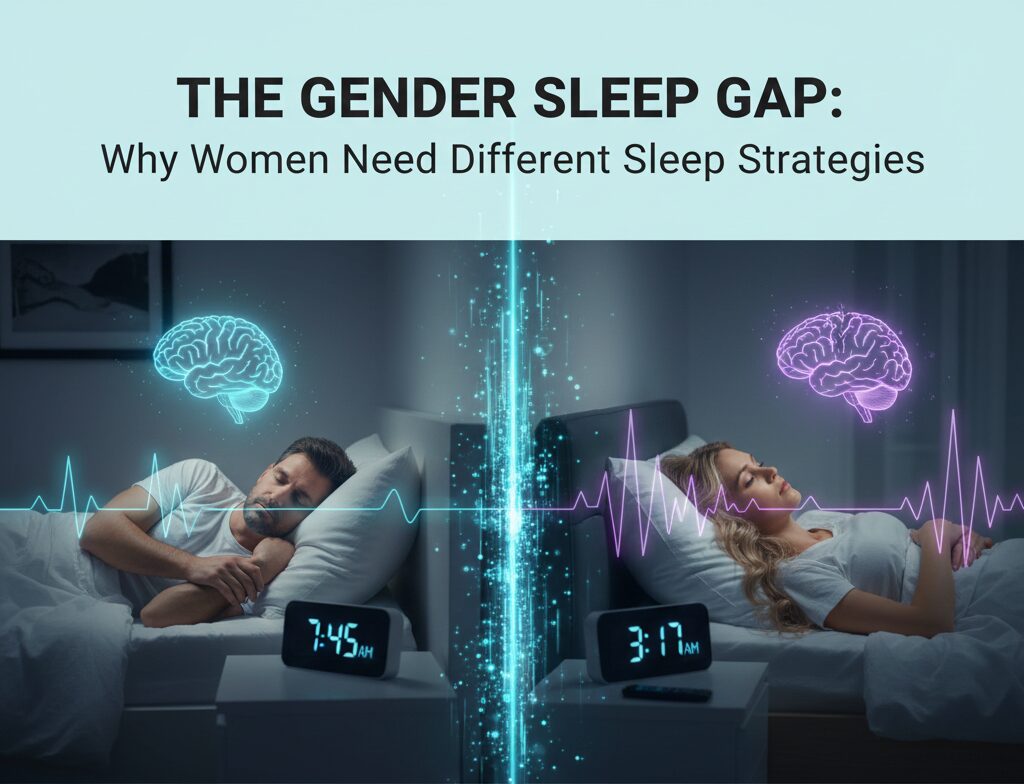
In my years consulting with clients across every demographic, one finding has become undeniable: sleep guidelines are predominantly written for the “average male,” and this systematic bias has left half the population without evidence-based answers.
This is why why women sleep different is not a lifestyle observation — it is a clinical reality that requires a fundamentally different approach to sleep optimization for women.
The Gender Sleep Gap is not about women “worrying more” or being more stressed. It is about the fact that the female hormonal system creates a moving target for sleep architecture that shifts not just over a lifetime, but every single month.
⚡ Core Takeaway: Biology, Not Weakness
- The biology gap: Women are 40% more likely to report insomnia than men. The driver is not stress or worry — it is hormonal fluctuation inherent to the menstrual cycle, pregnancy, and menopause. Standard sleep advice was developed from male-centric studies and fails women by default.
- The phase problem: A woman’s sleep “normal” changes every 28 days (menstrual cycle), every 9 months (pregnancy), and over 5-15 years (menopause). There is no single strategy that works across all phases.
- The protocol: Cycle-aware sleep — tracking your phase to match strategy, prioritizing temperature control for menopause, ergonomic support for pregnancy, and progesterone-aware scheduling for menstrual insomnia.
Why Women Report More Sleep Problems Than Men — The Data Is Clear
Direct Answer: Women are 40% more likely to report insomnia than men, according to a 2020 meta-analysis published in Sleep Medicine Reviews. This gap is not explained by differences in stress levels, workload, or “worry tendency” — it persists after controlling for all these variables. The primary driver is biological: sex hormones directly modulate every component of sleep architecture.
Mechanism: Estrogen and progesterone both cross the blood-brain barrier and have receptors in the hypothalamic suprachiasmatic nucleus (the master clock), the prefrontal cortex, and the limbic system. This means hormonal fluctuation is not just a background influence — it is a direct regulator of sleep timing, sleep depth, and sleep continuity. When these hormones shift monthly, the sleep they produce shifts with them (Shaver and Woods, 2015).
Actionable Advice: Stop interpreting your sleep variability as a personal failure. It is programmed biology. The goal is not to achieve a male sleep pattern — it is to engineer a female sleep pattern that accommodates your hormonal reality.
The Menstrual Cycle and Sleep: Why the “Standard Rules” Fail Every 28 Days
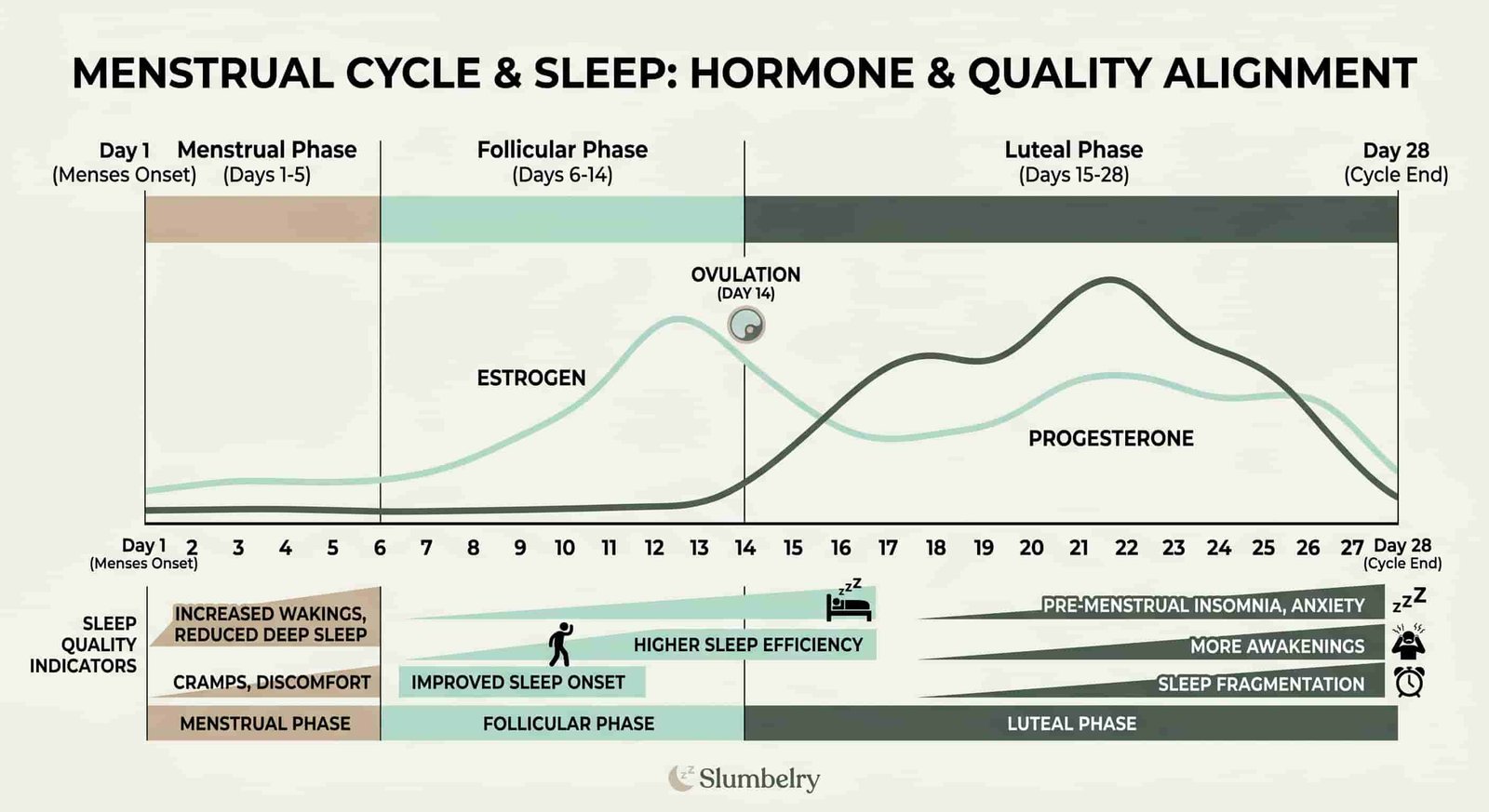
Direct Answer: The menstrual cycle creates a predictable oscillating hormonal environment that produces two distinct sleep profiles per cycle — one in the follicular phase (days 1-14) and one in the luteal phase (days 15-28). Standard sleep hygiene advice assumes a stable hormonal baseline and fails women specifically during the luteal phase.
Mechanism: During the luteal phase, progesterone rises to its monthly peak — and progesterone is a potent hypnotic (sleep-inducing agent) with GABA-enhancing properties. This creates the “hypersomnia” pattern where women feel an overwhelming daytime sleepiness from days 15-22. Then, just before menstruation, progesterone drops sharply, removing its sedating effect and triggering the “insomnia window” days 25-28, when many women report being unable to fall asleep despite exhaustion. This is not a psychological phenomenon — it is a neurochemical one (Driver et al., 1996).
Actionable Advice: Track your cycle with a simple app. When you know your luteal phase insomnia window is days 25-28, schedule lighter workdays and implement strict sleep hygiene during those four days — earlier bedtime, zero caffeine after noon, no alcohol.
Progesterone as a Natural Sedative: The Hypersomnia-Insomnia Paradox
Direct Answer: Progesterone acts on GABA-A receptors in the brain — the same receptors targeted by benzodiazepines and sleep medications — making it one of the most powerful natural sleep-inducing compounds in the human body. The paradox is that this same hormone, when it drops, produces the most acute insomnia.
Mechanism: During the mid-luteal phase, progesterone levels reach 10-20 times their baseline, creating a sedating effect that many women describe as “I could sleep standing up.” Then, 48-72 hours before menstruation begins, progesterone drops to its lowest point. This withdrawal is paradoxically activating — the GABA-enhancing effect disappears, leaving the nervous system in a relatively hyperactive state. The result: the same hormone that made you need 10 hours of sleep now makes it impossible to fall asleep (Manber and Armitage, 1999).
Actionable Advice: During the progesterone drop days (days 25-28), support your nervous system with magnesium glycinate (300-400mg in the evening), a warm bath before bed (which restores peripheral vasodilation and helps the post-shower temperature drop), and a consistent pre-sleep routine. Do not try to push through — this is a neurochemical window, not a willpower problem.
Why Sleep Fragmentation Is Not the Same as Insomnia in Women
Direct Answer: Insomnia is defined as difficulty initiating or maintaining sleep, resulting in daytime impairment. Sleep fragmentation — repeated micro-awakenings that disrupt sleep continuity — is a separate phenomenon that women frequently experience but do not always identify as a sleep problem, especially during pregnancy and perimenopause.
Mechanism: The 3P Model (Perlis et al., 2016) distinguishes between precipitating factors (the trigger) and perpetuating factors (the behaviors that maintain the problem). For women, hormonal shifts are precipitating factors that cause sleep fragmentation. If the woman interprets these awakenings as “just part of life” and does not modify her sleep behavior, the fragmentation becomes a perpetuating factor — the bed becomes associated with wakefulness. Over time, this behavioral non-response turns fragmentation into chronic insomnia.
Actionable Advice: Even if the hormonal trigger (pregnancy, perimenopause) is temporary, treat fragmented sleep as a sleep problem. Use stimulus control: if awake for more than 20 minutes, leave the bed and return when genuinely sleepy. Do not “wait it out” in bed — this trains the brain to associate the bed with wakefulness.
Pregnancy and Sleep: The Mechanical and Hormonal Double Assault
Direct Answer: Pregnancy produces the most dramatic and compressed changes in sleep architecture of any non-pathological life phase. Insomnia prevalence during pregnancy ranges from 15% in the first trimester to 75-80% in the third trimester. The challenge is not one thing — it is simultaneously hormonal, mechanical, and behavioral.
Mechanism: First trimester: rising progesterone causes daytime hypersomnia (the body is selecting for more sleep to protect the pregnancy), but also triggers nocturia (frequent urination from increased blood volume and kidney filtration). Second trimester: relative stability, but anxiety about the upcoming birth can trigger anticipatory insomnia. Third trimester: a combination of mechanical pressure (fetal position compressing the diaphragm and vena cava), restless legs syndrome (from iron deficiency and circulation changes), and gastroesophageal reflux. No single intervention works — the problem is multifactorial (Mindell et al., 2015).
Actionable Advice: For third-trimester sleep, the hierarchy is: side-sleep position with a pregnancy pillow (offloading hip and spine pressure), iron supplementation if RLS is present, head-of-bed elevation for reflux, and a strict no-food-after-7PM rule. Ergonomic support is not a luxury during pregnancy — it is a sleep necessity.
Menopause and Sleep: The Thermoregulatory Collapse at 2 AM
Direct Answer: Menopause is the single largest sleep-disrupting life event for women, and the mechanism is fundamentally thermoregulatory — not psychological. Hot flushes (vasomotor symptoms) are not just uncomfortable; they are neurological events that directly fragment sleep architecture.
Mechanism: Estrogen withdrawal during menopause disrupts the hypothalamic temperature regulation set point. The thermoregulatory system, which normally maintains a stable body temperature through the night, becomes unstable — triggering episodic cutaneous vasodilation (hot flushes) that increase skin temperature by 0.5-2.0C. Each hot flush is accompanied by an arousal response (measured as a 2-3 second EEG shift from deep sleep to light sleep, even if the woman does not fully wake). A woman experiencing 5-6 hot flushes per night is losing 30-50% of her deep sleep to these micro-arousals. This is not the same as waking up from a dream — it is a temperature regulatory failure that she may not consciously remember (Freedman, 2014).
Actionable Advice: Temperature control is non-negotiable. Keep the bedroom at 17-19C. Use a cooling mattress pad (Slumbelry’s thermoregulation layer). Wear moisture-wicking sleepwear. Take a cool shower before bed to pre-cool the peripheral skin. These interventions directly reduce the amplitude of hot flushes by maintaining a lower baseline body temperature.
Why Hot Flushes Destroy Sleep Architecture Beyond Simple Wakefulness
Direct Answer: The clinical significance of hot flushes is not measured by how many times a woman wakes up — it is measured by how much deep (slow-wave) sleep she loses. Slow-wave sleep is critical for immune function, memory consolidation, and growth hormone release. The micro-arousals triggered by hot flushes specifically eliminate NREM3 (deep sleep), leaving women with disproportionately light, fragmented sleep that feels unrefreshing even after 8 hours in bed.
Mechanism: Each hot flush produces a 2-5 second EEG arousal, typically not remembered but registered by the sleep architecture as a transition from deep to light sleep. The cumulative effect of 4-8 hot flushes per night is a reduction in slow-wave sleep percentage from a normal 15-20% to under 5%. This means women in menopause often spend 7+ hours in bed but get only 4-5 hours of physiologically meaningful sleep (Shechter et al., 2013). This explains why hormone replacement therapy (HRT), when it eliminates hot flushes, often restores sleep architecture within days — even before any subjective improvement in sleep quality is noticed.
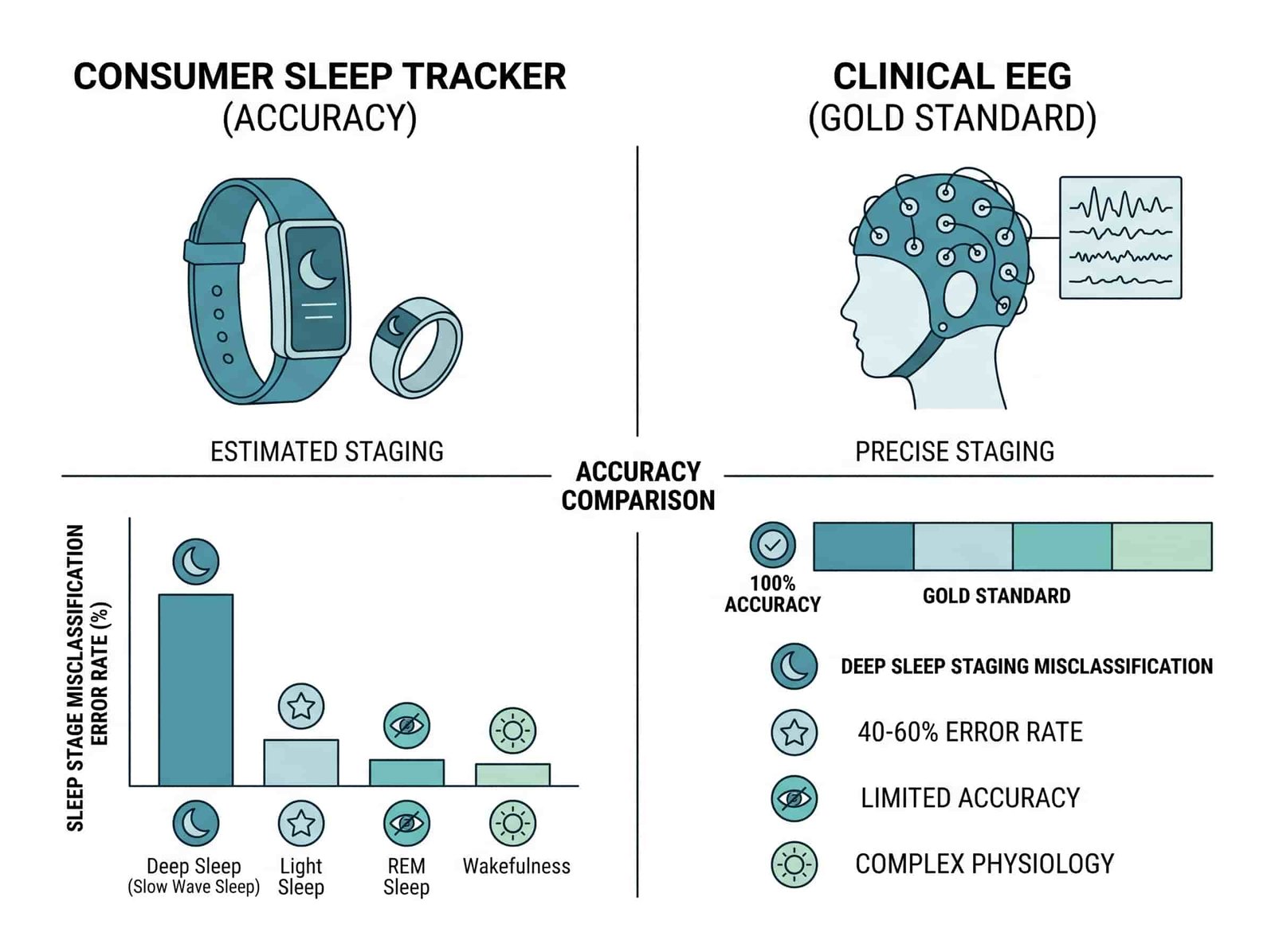
Actionable Advice: If you are in perimenopause or menopause and experiencing unrefreshing sleep despite 7-8 hours in bed, assume hot flushes are your primary culprit — even if you do not remember waking. Track your sleep with a wearable or a sleep study. If hot flushes are confirmed, prioritize temperature interventions before considering medication.
The Circadian Timing Shift: Why Women Have Earlier Sleep Timing Than Men
Direct Answer: Women have a measurably earlier circadian phase than men — an average of 20-30 minutes earlier. This is not a cultural artifact; it is a biological finding replicated across multiple chronotype studies. This phase advance means women are biologically oriented toward earlier bedtimes and earlier wake times, not toward “waking up later and sleeping in.”
Mechanism: The suprachiasmatic nucleus (SCN) in women shows a shorter intrinsic circadian period than in men, resulting in a phase advance of the melatonin rhythm, the cortisol rhythm, and the core body temperature rhythm. This means women’s circadian system is biologically timed to wind down and wake up earlier, independent of social schedules, work demands, or caregiving responsibilities. Additionally, estrogen has a direct phase-advancing effect on the SCN — meaning that higher estrogen (premenopausal women) produces an even stronger phase advance (Baker and Lee, 2018).
Actionable Advice: Work with your biological timing, not against it. If you are a woman who naturally falls asleep at 10 PM and wakes at 6 AM, that is not laziness — it is your circadian biology. Fighting this by forcing yourself to stay up until midnight to match social or work schedules produces cumulative sleep debt. Honor your phase: aim for the sleep window your biology selects, even if it means declining evening commitments.
Women-Specific Sleep Hygiene: The Protocol for Each Life Phase
Direct Answer: There is no universal sleep hygiene recommendation for women — there are phase-specific recommendations. The sleep strategy that works for a 25-year-old in her follicular phase will fail a 50-year-old in perimenopause. Effective sleep hygiene for women is cycling-aware and phase-matched.
Mechanism: Phase 1 (Menstruation to Ovulation / Follicular): Estrogen rises, mood and energy typically improve, and sleep is most stable. This is the optimal phase for high-performance work and late evenings. Phase 2 (Post-Ovulation to Menstruation / Luteal): Progesterone rises and falls. Days 18-24: prioritize recovery sleep, reduce intensity. Days 25-28: strict sleep hygiene, no caffeine after noon, early bedtime. Phase 3 (Pregnancy): Sleep is mechanically challenged. Prioritize ergonomic setup over willpower. Phase 4 (Perimenopause/Menopause): Temperature is the primary lever. Every degree of ambient cooling equals measurable sleep architecture improvement. Phase 5 (Post-Menopause): Hormonal stabilization, but sleep architecture that was damaged during the transition may take 2-3 years to normalize.

Why Comparing Your Sleep to Your Partner’s Is a Category Error
Direct Answer: The male and female sleep systems are not equivalent baselines with minor variations — they are fundamentally different architectures shaped by different hormonal inputs. Comparing your sleep to your male partner’s is a category error, not just a difference of degree.
Mechanism: Men’s circadian period is approximately 6 minutes longer than women’s, producing a systematic tendency for men to fall asleep later and wake up later. Men’s sleep is more sensitive to acute sleep deprivation (rebound more slowly from one night of short sleep). Women’s sleep is more sensitive to chronic partial sleep restriction (accumulates more sleep debt from consistent 6-hour nights). The sleep architecture itself differs: women have 5-8% more slow-wave sleep than men at baseline, and lose a larger percentage of this during menopause. These are not advantages or disadvantages — they are different architectures for different biological functions (Baker and Lee, 2018).
Actionable Advice: Stop benchmarking your sleep against someone whose biology runs on a different operating system. Track YOUR sleep quality, YOUR cycle phase, and YOUR recovery patterns over time. What matters is whether your sleep is optimally supporting YOUR biological needs — not whether it matches the average male standard.
Frequently Asked Questions
Why are women more likely to develop insomnia than men?
Direct Conclusion: Insomnia in women is primarily driven by sex hormone fluctuations that directly modulate sleep architecture. Unlike men’s relatively stable testosterone levels (which decline gradually over decades), women’s estrogen and progesterone levels shift dramatically every 28 days, then again during pregnancy and menopause. Each shift creates a new sleep architecture that requires a different set of conditions for optimal function. This moving target makes women inherently more vulnerable to insomnia triggers that would not significantly affect a stable male hormonal baseline (Shaver and Woods, 2015).
Does the menstrual cycle really affect sleep quality every month?
Direct Conclusion: Yes — measurably and predictably. Most women experience their worst sleep in the 3-5 days before menstruation (days 23-28 of the cycle), when progesterone is declining from its luteal peak. Polysomnographic studies confirm objective reductions in total sleep time, sleep efficiency, and slow-wave sleep during this window, even in women who do not subjectively report insomnia. If you feel more tired during these days, your sleep data confirms it — it is not perception.
What is the link between progesterone and sleep?
Direct Conclusion: Progesterone acts as a natural hypnotic through its interaction with GABA-A receptors in the brain — the same receptor system targeted by benzodiazepines like Valium and sleep aids like Ambien. High progesterone promotes sleepiness and deep sleep; the rapid drop in progesterone before menstruation removes this sedating effect and triggers the characteristic luteal phase insomnia. This is also why progesterone-based contraceptives can affect sleep quality — they suppress the natural oscillation.
Is it normal to sleep differently during pregnancy?
Direct Conclusion: Yes — dramatic changes in sleep during pregnancy are the physiological norm, not a sign of something wrong. First trimester: hypersomnia from progesterone is normal. Second trimester: sleep typically improves as the body adapts. Third trimester: fragmentation, frequent waking, RLS, and reflux are the rule, not the exception. A meta-analysis found 75-80% of third-trimester pregnant women report clinically significant sleep disruption. The goal is not to sleep normally during pregnancy — it is to optimize what sleep is possible within the physiological constraints.
How do hot flushes during menopause actually disrupt sleep architecture?
Direct Conclusion: Each hot flush triggers a 2-5 second micro-arousal (an EEG transition from deep to light sleep), typically not consciously remembered. A woman experiencing 4-6 hot flushes per night loses 30-50% of her slow-wave (restorative) sleep to these arousals. This is why many postmenopausal women report 7-8 hours in bed but still feel unrefreshed — their sleep architecture is dominated by light sleep with minimal deep sleep. The sleep is being disrupted at the neurophysiological level, not just at the level of conscious waking.
Should women track their menstrual cycle for sleep optimization?
Direct Conclusion: Absolutely yes — and not just for fertility tracking. Knowing your cycle phase allows you to match your sleep strategy to your biology. During the luteal phase (days 15-28), expect decreased sleep efficiency and plan earlier bedtimes and reduced evening stimulation. During menstruation, prioritize iron-rich foods if you have heavy flow (iron deficiency worsens sleep quality). During perimenopause, cycle tracking helps distinguish menopause-related insomnia from other triggers. A simple temperature-tracking app or a cycle diary gives you the data to stop being surprised by your own biology.
What is perimenopause, and how does it affect sleep before full menopause?
Direct Conclusion: Perimenopause is the 5-15 year transition period before full menopause (defined as 12 consecutive months without menstruation), during which estrogen and progesterone fluctuate erratically rather than following their regular cyclical pattern. During perimenopause, sleep disruption often begins 2-3 years before the final period, driven by unpredictable hot flushes triggered by estrogen withdrawal rather than stable low estrogen. Many women describe perimenopausal insomnia as the worst sleep of their lives — worse than new parenthood, worse than menopause itself — precisely because the triggers are unpredictable rather than cyclic.
Why do women wake up earlier than men even when sleeping the same amount?
Direct Conclusion: Women have a shorter intrinsic circadian period than men — approximately 6 minutes shorter. This produces a systematic circadian phase advance of 20-30 minutes, meaning women’s master clock runs faster and reaches its sleep-onset and wake-time signals earlier each day. This is not a social or behavioral difference — it is measurable at the level of melatonin secretion timing and core body temperature minimum. The sleep phase difference is biologically driven, not culturally learned, and is one reason women are more likely to be “morning types” and men more likely to be “evening types.”
Are sleep medications less effective or more risky for women?
Direct Conclusion: Yes to both. Women metabolize many sedative-hypnotic drugs more slowly than men due to differences in body composition (higher fat-to-water ratio affecting drug distribution) and slower gastric emptying. This means women experience higher blood concentrations and longer elimination times for the same dose. Z-drugs (Ambien, Lunesta) in particular show significantly higher next-day residual sedation in women at standard doses. Additionally, OTC sleep aids containing diphenhydramine (Benadryl, Unisom) have been associated with increased dementia risk in women with long-term use, per a 2015 Johns Hopkins study. The safest approach for women with chronic insomnia is CBT-I — which is equally effective for both sexes but without the pharmacokinetic risks unique to women.
What is the single most important sleep change for women in midlife?
Direct Conclusion: Temperature control. If you are in perimenopause or menopause and doing one thing for your sleep, lower your bedroom temperature to 17-19C. This single intervention reduces the amplitude of hot flushes, improves sleep onset latency, and increases slow-wave sleep percentage more reliably than any supplement or medication. Every degree you lower your bedroom temperature is measurable sleep architecture improvement. Before supplements, before sleep hygiene apps, before meditation — turn down the thermostat.
Ready to Transform Your Recovery?
Stop comparing your sleep to your partner’s. Women are not men with a messaging problem — they are a different biological system that requires phase-aware sleep engineering. Let us build yours.
Take the Sleep Assessment Explore Our Cooling MattressThe Slumbelry Commitment
Sleep is the most vulnerable state of human existence. It is where we heal, reset, and grow.
At Slumbelry, we do not just sell sleep products; we advocate for your physiological right to rest. From ergonomic support to light management, every solution we offer is designed with one obsession: Respecting your Biology.
Science is our language, but your recovery is our purpose. You take care of everything else in your life — let us take care of your sleep.
Rest Deeply,
The Slumbelry Team