Self test insomnia: comprehensive assessment tools and when to seek help
July 28, 2025
Do I Have Insomnia? Self-Assessment Quiz for Better Sleep
Your Sleep Tracker Cannot Diagnose Insomnia — But This Can
Written by Dr. Lycan Dizon, Slumbelry Chief Sleep Consultant · Updated 2025
⚡ Core Takeaway: How to Self-Test for Insomnia
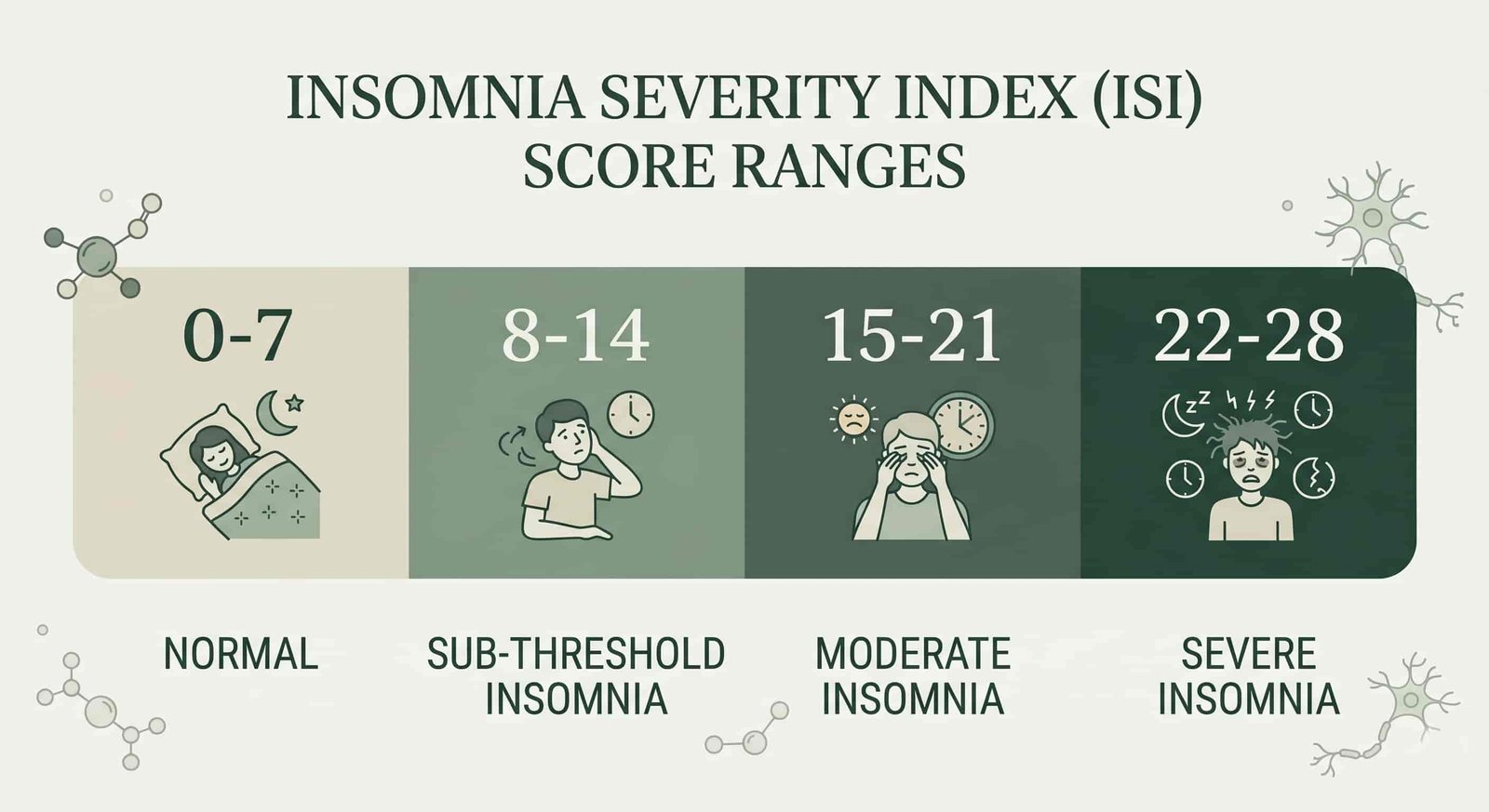
The Standard: ISI scores 0-7 = no insomnia | 8-14 = sub-threshold | 15-21 = moderate | 22-28 = severe. The ISI is the clinical gold standard for self-reporting.
The Daytime Test: Epworth Scale scores above 10 indicate pathological sleepiness — not just tiredness. High ISI + low Epworth = hyperarousal-driven insomnia.
The Reality Check: Smartwatch data does not equal clinical diagnosis. Questionnaires like the ISI are often more accurate than any wearable algorithm.
Clinical self-assessment tools like the ISI provide objective data that subjective exhaustion cannot.
Insomnia Self-Test: Comprehensive Assessment Tools to Grade Your Sleep
Prompt: A sleek clipboard with a medical assessment form lying next to a cup of herbal tea and a modern smartwatch…
Are you just going through a stressful week, or have you crossed the threshold into clinical insomnia? Subjective feelings of exhaustion can be deceiving. To determine whether you need simple sleep hygiene adjustments or heavy-duty Cognitive Behavioral Therapy (CBT-I), you need objective data.
Quick Answer: How do you clinically test for insomnia at home?
The most effective way to grade your sleep without a lab is by using clinical questionnaires like the Insomnia Severity Index (ISI) and the Epworth Sleepiness Scale (ESS). These tools measure the behavioral impact of sleep loss, distinguishing between acute sleeplessness and chronic neurological hyperarousal.
What Is the Insomnia Severity Index (ISI)?
The ISI is a brief, 7-item questionnaire used by sleep clinics worldwide to assess the nature, severity, and impact of insomnia over the past two weeks.
The Science: Scoring the ISI
The test asks you to rate factors from 0 to 4, including:
Difficulty falling asleep.
Difficulty staying asleep.
Problems waking up too early.
How noticeable your sleep problems are to others.
How worried/distressed you are about your current sleep pattern.
The Breakdown: A score of 0-7 indicates no clinically significant insomnia. 8-14 is sub-threshold insomnia. 15-21 is moderate clinical insomnia. 22-28 represents severe clinical insomnia, requiring immediate professional intervention.
How Do You Measure Daytime Fatigue?
Insomnia isn’t just about what happens at 3 AM; it’s about how you function at 3 PM.
Actionable Advice: The Epworth Sleepiness Scale
The Epworth Sleepiness Scale asks you to rate your likelihood of dozing off (0-3) in eight different situations, such as sitting and reading, watching TV, or sitting in traffic.
The Hack: If you score high on the ISI (indicating you can’t sleep at night) but low on the Epworth Scale (indicating you aren’t actually falling asleep during the day), you are likely dealing with a hyperactive nervous system (hyperarousal) rather than pure sleep deprivation.
What About Sleep Trackers and Smartwatches?
Wearables are excellent for tracking gross motor movement and heart rate variability (HRV), but they have a dark side.
Protocol: Avoiding Orthosomnia
The Goal: Use data without letting the data use you.
The Hack: If checking your sleep score in the morning dictates your mood for the rest of the day, you must take off the watch. “Orthosomnia” is a modern psychological condition where the obsession with achieving perfect sleep metrics actively causes anxiety that destroys sleep. Clinical questionnaires (like the ISI) are often more indicative of your actual well-being than a smartwatch algorithm.
The Insomnia Severity Index (ISI) is the clinical gold standard for self-reporting. It is a brief, 7-item questionnaire that measures the nature, severity, and impact of insomnia over the past two weeks, providing a clear numerical score.
Is tracking my sleep with a smartwatch enough to diagnose insomnia?
No. While smartwatches provide helpful data on movement and heart rate, they cannot measure brain waves (EEG) to definitively map sleep stages. Furthermore, fixating on tracker data can cause “orthosomnia”—anxiety driven by the pursuit of perfect sleep metrics.
Medical References:
1. Bastien, C. H., et al. (2001). Validation of the Insomnia Severity Index as a clinical and research tool. Sleep Medicine, 2(4), 297-307.
2. Johns, M. W. (1991). A new method for measuring daytime sleepiness: the Epworth sleepiness scale. Sleep, 14(6), 540-545.
The Insomnia Severity Index (ISI) is a validated 7-item questionnaire. Scores above 14 indicate clinical insomnia warranting professional intervention. Use it weekly to track progress.Smartwatch sleep data is a useful trending tool — not a clinical diagnosis. If checking your tracker causes anxiety, stop wearing it at night.
Frequently Asked Questions About Insomnia Self-Testing
What is the Insomnia Severity Index (ISI)?
The ISI is a 7-item clinical questionnaire used worldwide to assess the nature, severity, and impact of insomnia over the past two weeks. It covers difficulty falling asleep, staying asleep, early awakening, sleep dissatisfaction, and daytime impairment. Scores: 0-7 normal, 8-14 sub-threshold, 15-21 moderate, 22-28 severe.
How is the Epworth Sleepiness Scale different from the ISI?
The ISI measures nighttime sleep quality — what happens when you try to sleep. The Epworth Scale measures daytime sleepiness — whether you actually fall asleep unintentionally during ordinary activities like reading or driving. A high ISI + low Epworth score suggests hyperarousal rather than simple sleep deprivation.
Is a smartwatch enough to diagnose insomnia?
No. Consumer wearables use actigraphy (movement sensors) and heart rate as sleep proxies. They cannot measure brain waves (EEG) to confirm sleep stages. Smartwatch REM estimates are approximations at best. Obsessive tracking can trigger orthosomnia — anxiety driven by the pursuit of perfect metrics that actively worsens insomnia.
What is orthosomnia?
Orthosomnia is a modern condition where the pursuit of perfect sleep tracker scores creates so much anxiety that it undermines sleep itself. If you check your sleep score before your feet hit the floor and it dictates your entire day’s mood, the tracker has become the problem. Remove it or stop checking.
What does it mean if my ISI is high but Epworth is low?
This combination — cannot sleep at night but not falling asleep during the day — is the hallmark of hyperarousal-driven insomnia. The nervous system is stuck in a chronic low-grade fight-or-flight state. CBT-I and nervous system downregulation (not sleep medication) are the correct interventions.
Should I see a doctor if my ISI is above 15?
Yes. An ISI score above 15 indicates moderate to severe clinical insomnia. A score above 21 requires immediate professional intervention. Persistent insomnia (lasting more than 3 months) significantly increases risk of cardiovascular disease, depression, and cognitive decline.
What is CBT-I and how does it compare to medication?
Cognitive Behavioral Therapy for Insomnia (CBT-I) is the first-line clinical treatment recommended by the American College of Physicians. It addresses root causes — dysfunctional beliefs about sleep, hyperarousal, irregular sleep schedules — rather than masking symptoms. It outperforms medication long-term and has no side effects.
How often should I retake the ISI?
Weekly. The ISI is brief enough (7 items) to track progress without fatigue. If your score changes by 5+ points in a week, something meaningful changed — either an intervention is working or a new stressor has emerged. Track the trend, not the daily number.
Do sleep trackers have any clinical value?
Yes — for trending over weeks and months, not for daily diagnosis. Weekly sleep efficiency data and HRV trends can reveal patterns that questionnaires miss, such as recovery from exercise or the impact of alcohol. Use them as a dashboard, not a judge.
What is the relationship between insomnia and anxiety?
Insomnia and anxiety have a bidirectional relationship. Anxiety makes it harder to sleep; sleep deprivation amplifies anxiety through prefrontal cortex impairment. The hyperarousal model explains why insomniacs often feel ‘tired but wired.’ Addressing one directly improves the other.
Ready to Take Back Your Nights?
Stop guessing. Use clinical self-assessment tools to get objective data on your sleep — then build a protocol that actually works for your biology.
Sleep is the most vulnerable state of human existence. It is where we heal, reset, and grow.
At Slumbelry, we do not just sell sleep products; we advocate for your physiological right to rest. From ergonomic support to light management, every solution we offer is designed with one obsession: Respecting your Biology.
Science is our language, but your recovery is our purpose. You take care of everything else in your life — let us take care of your sleep.
Rest Deeply, The Slumbelry Team
Medical References:
1. Bastien, C. H., et al. (2001). Validation of the Insomnia Severity Index as a clinical and research tool. Sleep Medicine, 2(4), 297-307.
2. Johns, M. W. (1991). A new method for measuring daytime sleepiness: the Epworth sleepiness scale. Sleep, 14(6), 540-545.