
Calculate Your Perfect Bedtime Using the 90-Minute Sleep Cycle Rule
We have all experienced this infuriating scenario: You are responsible. You get into bed at 10:30 PM. You sleep a solid 8 hours, and your alarm goes off at 6:30 AM. Yet, when you open your eyes, you feel like you were hit by a bus. You do not know what year it is, your limbs feel like lead, and you spend the next two hours in a severe brain fog.
Contrast that with the nights you stayed up too late, only slept 6 hours, but somehow woke up feeling crisp, energized, and ready to attack the day before your alarm even went off.
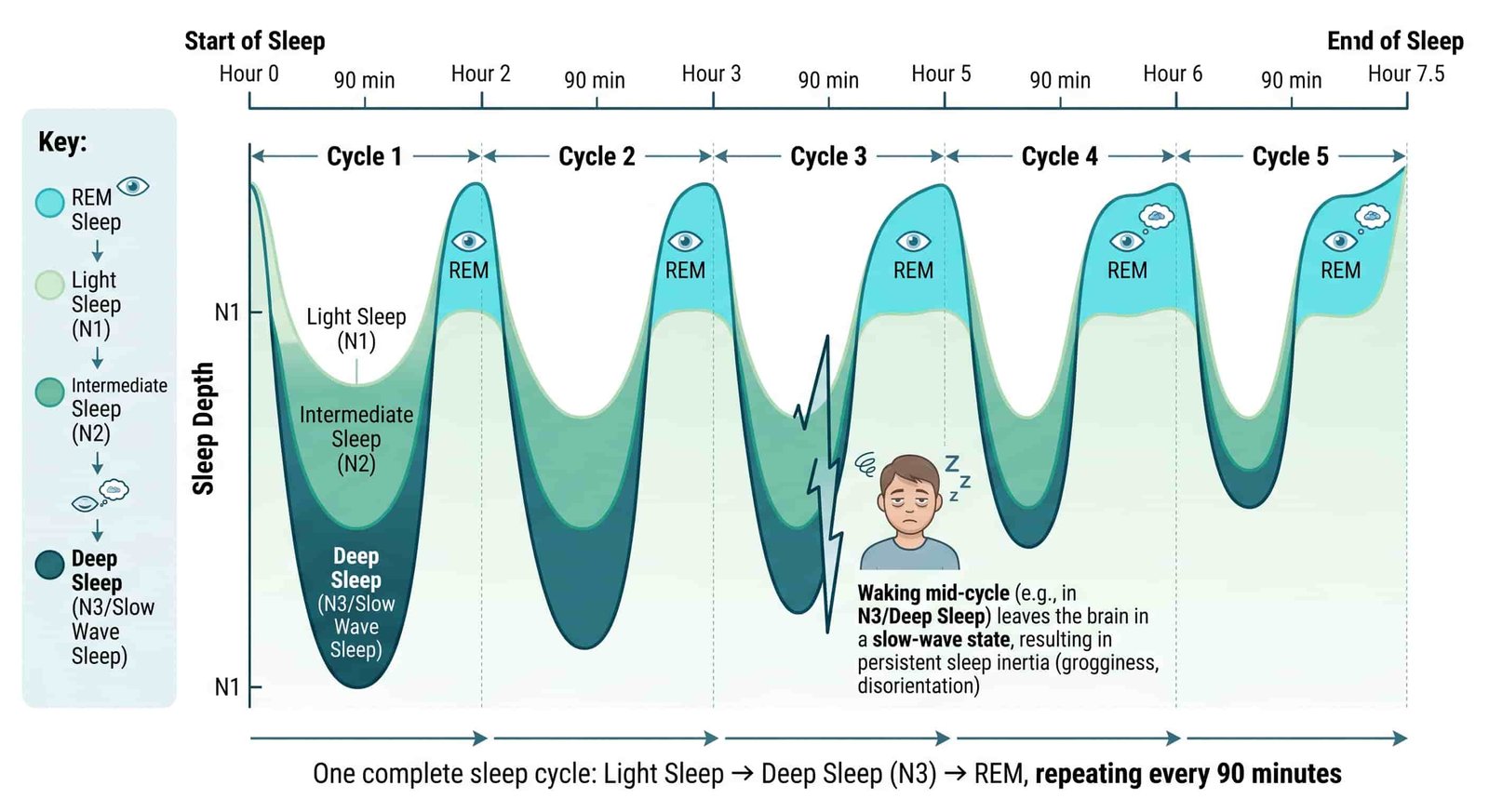
This is not a coincidence. It is basic biology. The pervasive myth that you must get exactly “8 hours of sleep” is fundamentally flawed. Sleep is not a solid block of time; it is a series of precise 90-minute cycles. If your alarm clock rudely interrupts the wrong stage of that cycle, it does not matter if you slept for 10 hours—you will wake up feeling miserable.
⚡ Core Takeaway: The Mathematical Law to End Sleep Inertia
- The 90-Minute Rule: Your brain cycles through Light, Deep, and REM sleep every 90 minutes. You must wake up at the end of a cycle, not in the middle.
- The Fixed Anchor: Stop trying to control your bedtime. Set a non-negotiable wake-up time and calculate backward in 90-minute blocks.
- The 8-Hour Myth: 8 hours is biologically awkward. 7.5 hours (5 cycles) or 6 hours (4 cycles) will leave you significantly more refreshed than 8 hours.

Why do I wake up exhausted after 8 hours of sleep?
Direct Answer: You wake up exhausted because your alarm went off while your brain was submerged in Deep Sleep (Stage N3).
Mechanism: A standard sleep cycle lasts exactly 90 minutes. If you sleep for exactly 8 hours (480 minutes), your alarm will go off right in the middle of your sixth sleep cycle, likely during Deep Sleep. During Deep Sleep, your brainwaves are slow (Delta waves), and your body is essentially paralyzed for repair. Being abruptly ripped from this stage causes a neurological phenomenon called “Sleep Inertia”—a severe cognitive impairment and disorientation that can last for hours.
Actionable Advice: Adjust your alarm to wake you up at the 7.5-hour mark (exactly five 90-minute cycles). You will wake up during the light REM transition and feel instantly alert.
How do I calculate my perfect bedtime?
Direct Answer: You establish a fixed wake-up time and count backward in 90-minute increments.
Mechanism: Elite sports sleep coaches (like Nick Littlehales, creator of the R90 method) teach that you cannot force your brain to fall asleep on command, but you can strictly control when you wake up. By anchoring your wake-up time (e.g., 7:00 AM) every single day, you stabilize your circadian rhythm. From 7:00 AM, you count backward: 5 cycles (7.5 hours) is 11:30 PM. 4 cycles (6 hours) is 1:00 AM.
Actionable Advice: If your anchor wake time is 7:00 AM, your ideal bedtime is 11:30 PM. Factor in 15 minutes to fall asleep, meaning you should be in bed with the lights off at 11:15 PM.
What should I do if I miss my calculated bedtime window?
Direct Answer: Do not go to bed immediately; wait for the next 90-minute “bus” to arrive.
Mechanism: Think of your sleep cycles like a train schedule. If your target train leaves at 11:30 PM and you get distracted until 12:15 AM, getting into bed then means you are jumping onto a moving train. Your alarm at 7:00 AM will now shatter your Deep Sleep. It is biologically superior to stay awake, do some light reading or stretching, and catch the next cycle at 1:00 AM.
Actionable Advice: If you miss your 11:30 PM window, stay out of bed until 12:45 AM. You will only get 6 hours of sleep (4 cycles), but you will wake up vastly more refreshed than if you slept for 6 hours and 45 minutes.
How does mattress quality affect the 90-minute cycle?
Direct Answer: A poor mattress forces you to shift positions, causing “micro-arousals” that reset your sleep cycle before you ever reach Deep Sleep.
Mechanism: For the 90-minute cycle to complete successfully, your body must remain undisturbed. If your mattress creates pressure points on your hips or traps excess body heat, your nervous system triggers a micro-arousal. You toss and turn, and your brain is pulled out of the cycle. You spend the whole night hovering in Light Sleep, never getting the physiological repair of Deep Sleep.
Actionable Advice: Your sleep surface must eliminate physical friction. An adaptive, pressure-relieving Slumbelry mattress ensures your nervous system feels safe enough to complete all 5 sleep cycles seamlessly without interruption.

Sleep Cycle FAQ: Mastering the Math of Rest
Why do I wake up tired after 8 hours of sleep?
Direct Conclusion: You wake up tired because your alarm interrupted a Deep Sleep stage.
Why: Waking up during Deep Sleep (N3) causes ‘sleep inertia,’ a severe cognitive fog because your brainwaves are forced to shift too rapidly from Delta to Beta.
Action: Stop aiming for 8 hours. Aim for exactly 7.5 hours (five 90-minute cycles) to wake up during a natural light sleep transition.
How long is a normal sleep cycle?
Direct Conclusion: A standard human sleep cycle lasts approximately 90 minutes.
Why: During this 90-minute period, your brain moves sequentially from Light Sleep (N1/N2) into physical repair (Deep Sleep N3), and finally into cognitive repair (REM sleep).
Action: Plan your entire night in 90-minute blocks rather than single hours.
How do I calculate the best time to go to sleep?
Direct Conclusion: Set a non-negotiable wake-up time, then count backward in 90-minute blocks.
Why: You can control your wake time, but not your sleep onset. Counting backward aligns your alarm with the end of a cycle.
Action: For a 6:30 AM wake-up, counting back 5 cycles (7.5 hours) gives you a perfect bedtime window of 11:00 PM.
What should I do if I miss my calculated bedtime?
Direct Conclusion: Do not go to sleep immediately; wait for the next 90-minute window.
Why: Going to sleep at random times guarantees you will wake up mid-cycle, causing severe grogginess.
Action: If you miss your 11:00 PM window, stay up doing a relaxing activity and go to sleep exactly at 12:30 AM.
Is 6 hours of sleep better than 7 hours?
Direct Conclusion: Yes, 6 hours of sleep will generally leave you feeling more refreshed than 7 hours.
Why: 6 hours is exactly four complete 90-minute cycles. Seven hours interrupts the middle of your fifth cycle, triggering sleep inertia.
Action: If you have to stay up late, intentionally set your alarm to get exactly 6 hours or 4.5 hours of sleep, never an in-between number.
What is the R90 sleep recovery program?
Direct Conclusion: The R90 method is a clinical approach that abandons the ‘8-hour myth’ in favor of 90-minute cycles.
Why: Developed by elite sports sleep coach Nick Littlehales, it focuses on achieving 35 full sleep cycles per week rather than worrying about nightly hours.
Action: If you get a bad night of sleep (only 3 cycles), don’t panic. Just ensure you hit your 35-cycle weekly goal by adding a 90-minute nap later in the week.
Why is a fixed wake-up time more important than bedtime?
Direct Conclusion: A fixed wake-up time anchors your entire circadian rhythm.
Why: Your biological clock relies on consistent morning light exposure to trigger the 14-hour countdown to evening melatonin release.
Action: Wake up at the exact same time 7 days a week. Never sleep in on weekends, as it causes “social jetlag.”
How long does sleep inertia last?
Direct Conclusion: Severe sleep inertia can last anywhere from 30 minutes to 2 hours.
Why: It takes the brain significant time to clear out adenosine and shift from slow-wave Delta patterns to active Beta waves.
Action: If you wake up groggy, immediately expose your eyes to bright sunlight and drink a large glass of cold water to accelerate the wake-up process.
Does the time it takes to fall asleep affect the calculation?
Direct Conclusion: Yes, you must factor in “sleep latency” (the time it takes to fall asleep).
Why: The average healthy adult takes 15 to 20 minutes to fall asleep once the lights are out.
Action: If your calculated sleep window is 11:30 PM, you must be in bed, relaxed, with the lights off by 11:15 PM.
Can a bad mattress disrupt my 90-minute cycles?
Direct Conclusion: Absolutely. Physical discomfort is the number one cause of broken sleep cycles.
Why: If a mattress causes pressure points, your brain forces a “micro-arousal” to make you roll over, resetting your cycle before you reach Deep Sleep.
Action: Invest in an adaptive, pressure-relieving mattress like Slumbelry to ensure you glide through all 5 cycles without physical interruption.
Ready to Transform Your Recovery?
The right math only works on the right mattress. Discover the sleep system engineered to keep your cycles uninterrupted.
Take the Sleep Assessment Master Your Sleep CyclesThe Slumbelry Commitment
Sleep is the most vulnerable state of human existence. It is where we heal, reset, and grow.
At Slumbelry, we don’t just sell sleep products; we advocate for your physiological right to rest. From ergonomic support to light management, every solution we offer is designed with one obsession: Respecting your Biology.
Science is our language, but your recovery is our purpose. You take care of everything else in your life—let us take care of your sleep.
Rest Deeply,
The Slumbelry Team