Sleeping Together: How to Share a Bed Without Ruining Your Sleep
Sharing a Bed: The Science of Sleeping Together Without Ruining Sleep | Slumbelry Sleep Science
The Couple’s Sleep Dilemma: Why Love and Shared Beds Were Never Designed for Each Other
Written by Dr. Lycan Dizon, Slumbelry Chief Sleep Consultant · Updated 2025
⚡ Core Takeaway: Three Fixes That Transform Shared Sleep
The Size Fix: A King or Super King mattress gives each partner more width than a baby in a crib. This is not luxury — it is a biological minimum.
The Duvet Fix: Two separate single duvets on one mattress eliminates the cover-tug-of-war and lets each partner control their own temperature.
The Motion Fix: A pocket coil or hybrid foam mattress absorbs movement energy before it crosses the sleep boundary. No more waking when your partner shifts.
Sharing a bed does not have to mean sacrificing sleep. The geometry, the bedding, the mattress, and the rules — all can be engineered so both partners wake rested and in love.
Sharing a bed with a partner is one of the most emotionally significant and physiologically complicated things two people can do together. Biologically, sleeping alone is superior — total control over temperature, movement, and sound. But emotionally, proximity matters. The challenge is not whether to share a bed, but how to engineer it so both partners actually rest. This guide covers the complete science of shared sleep — from mattress geometry to the Scandinavian duvet method, from chronotype rules to the sleep divorce question — so you and your partner can share a bed without ruining each other’s sleep.
Why Sharing a Bed Actually Worsens Both Partners’ Sleep
Humans are the only species that voluntarily delays sleep to watch Netflix, and one of the few that insists on sleeping in the same small rectangle as another adult — purely for emotional closeness. But biologically, sleeping alone is superior: total control over temperature, movement, and sound. So we end up with The Couple’s Sleep Dilemma: two exhausted people who love each other but sabotage each other’s rest every single night.
The Research: 50% of Partner Sleep Disturbance Is Invisible
Dr. Neil Stanley’s research found that 50% of sleep disturbance in couples comes from the partner — not from external noise, light, or temperature. Snoring, cover-stealing, movement, and different chronotypes compound over years into chronic sleep debt that neither partner connects to the bed. The spring mattress amplifies every micro-movement: one partner’s restroom trip becomes a full-body bounce that wakes the other. This chronic low-grade disruption contributes to relationship tension, reduced immunity, and metabolic dysregulation — none of which gets attributed to the mattress.
Action step: Track your actual sleep quality separately for one week. Rate your energy from 1–10 each morning. If your scores are consistently lower on nights when you share the bed versus solo nights, the bed is the cause.
Why Mattress Size Is the Single Most Important Investment in Your Relationship
If two adults are sleeping in a Double (Full) bed, each partner has less horizontal width than a baby in a standard crib. That is the reality of the space most couples are trying to sleep in. Upgrading mattress size is not a luxury — it is the single most impactful change a couple can make for shared sleep quality.
The Geometry of Shared Sleep
A Queen mattress (60 × 75 inches) gives each partner 30 inches of width — less than a standard crib mattress. A King (76 × 80 inches) gives each partner 38 inches. A Super King (72 × 78 inches, UK standard) or equivalent US Eastern King gives even more. Slumbelry’s research with couples shows that couples who switch to a King or Super King report significantly fewer nighttime awakenings due to partner movement within the first week. The math is simple: width per person = fewer boundary crossings = less disruption.
Action step: Measure your current mattress width per person. If it is under 36 inches, upgrading to a King is the highest-ROI sleep investment you will ever make.
The Scandinavian Method: Two Duvets Solve More Than You’d Expect
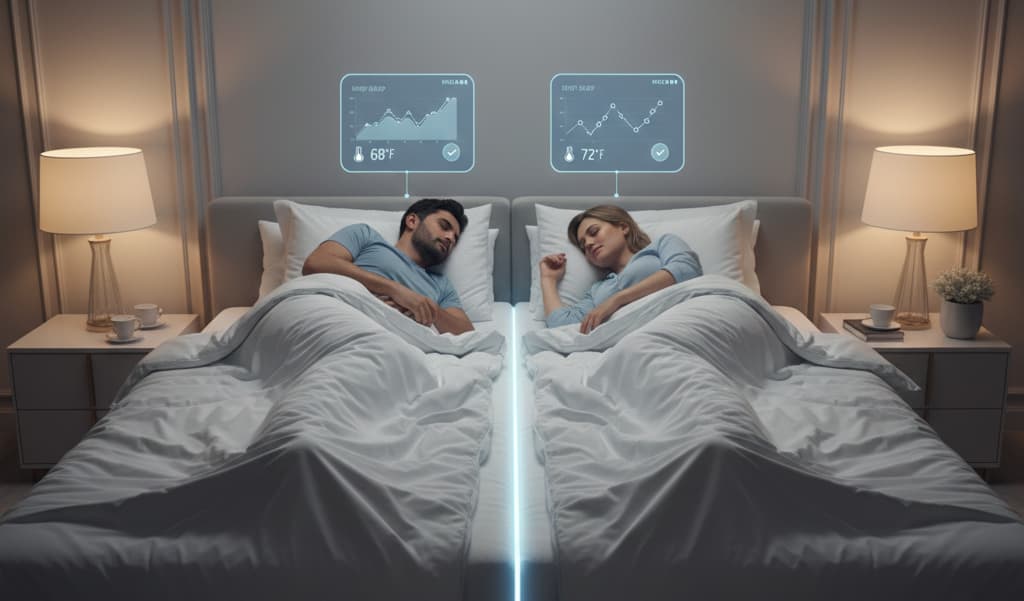
In Scandinavia, where cold winters and pragmatic relationships coexist, couples have solved the cover-tug-of-war permanently: two separate single duvets on one mattress. One partner can have a thick warm duvet; the other sleeps cool. No more midnight negotiations over who has more blanket.
⚡ How to Implement the Scandinavian Method
Buy two single duvets in the fill weights each partner prefers (3–4.5 TOG range per person)
Use a King or Super King mattress to accommodate both without gaps
Layer a large decorative bedspread over the top for aesthetics — it comes off in the morning
Each person manages their own duvet, all night, every night
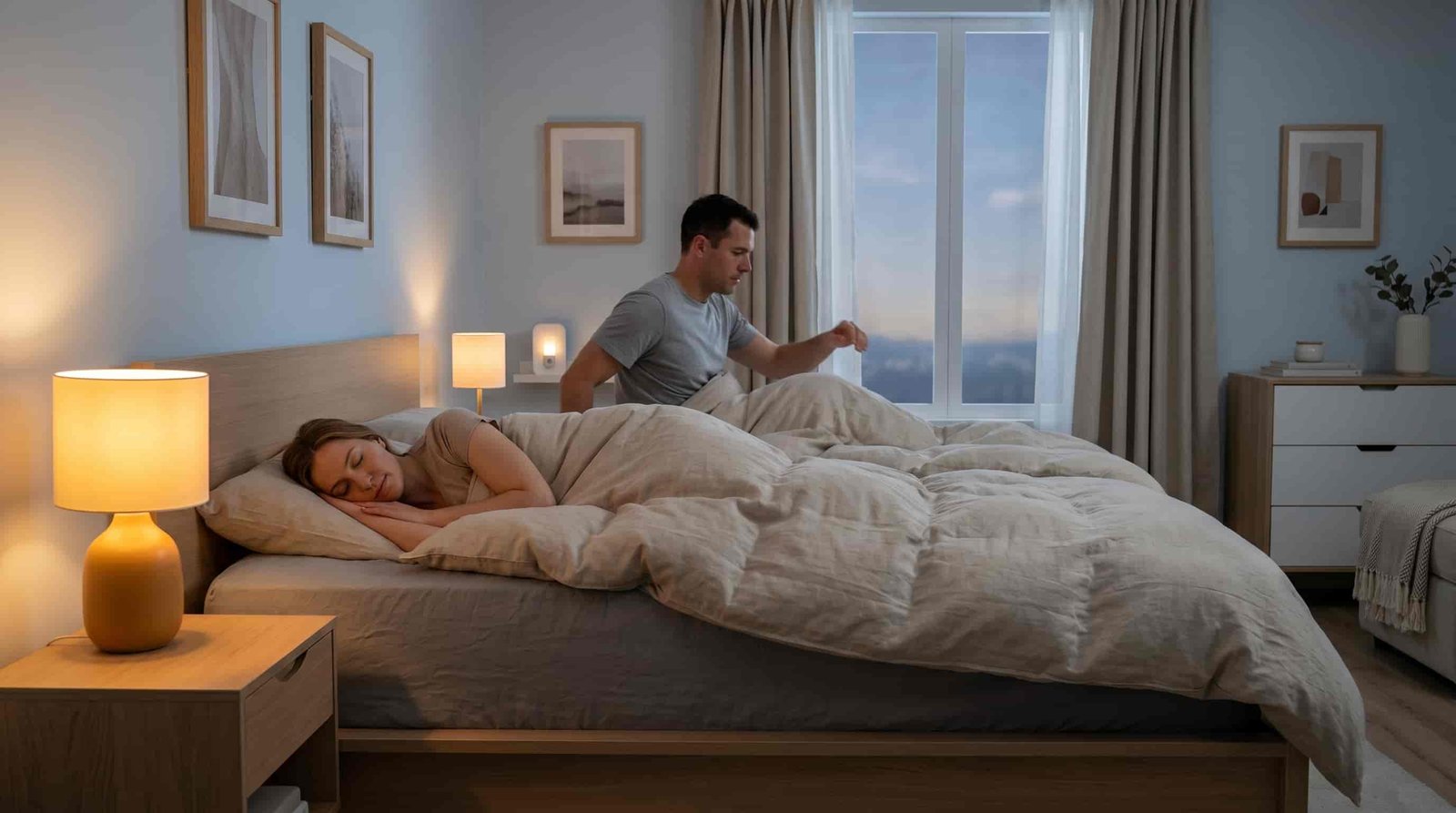
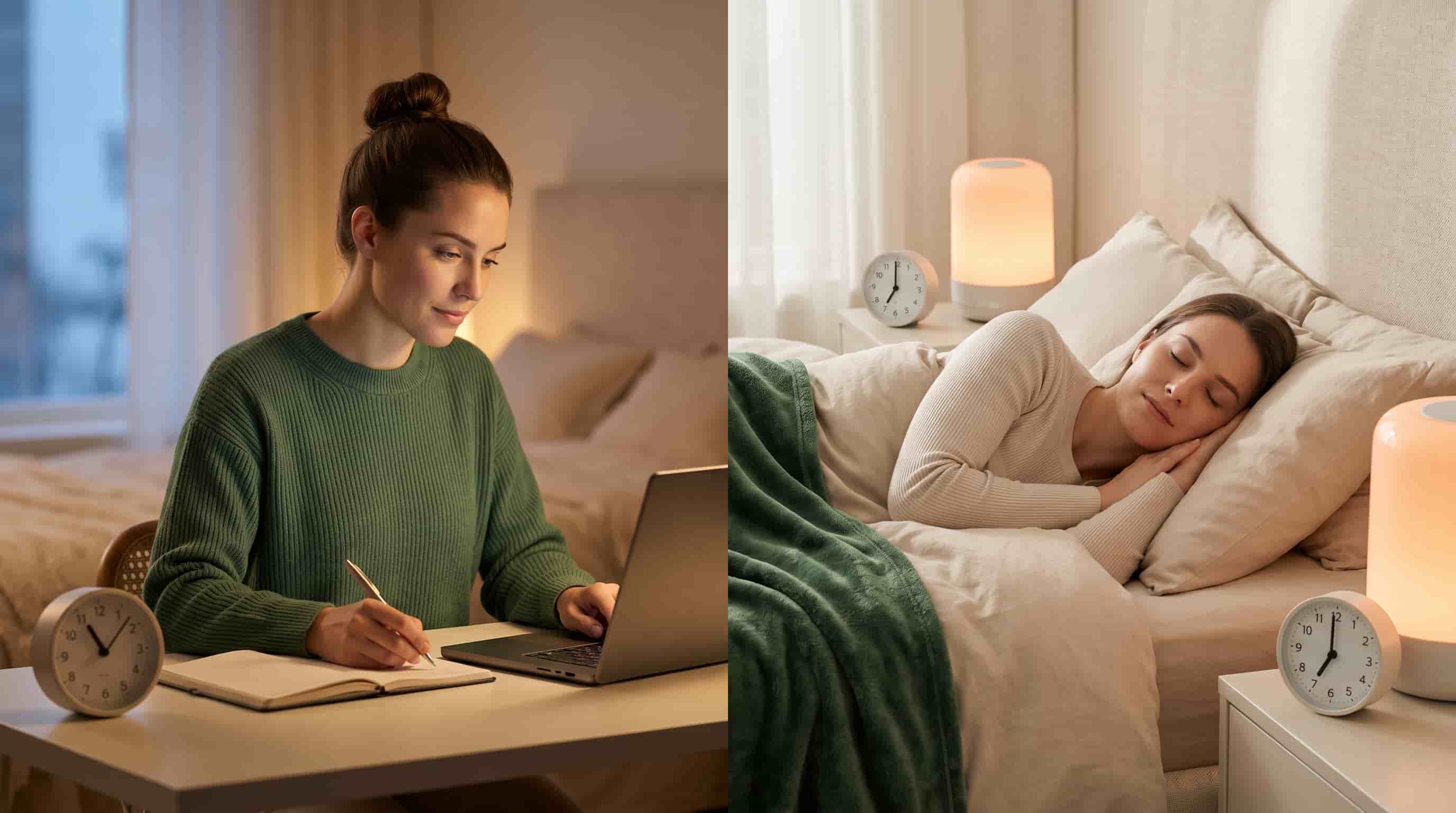
The Scandinavian method in practice: two single duvets on one mattress. Each partner controls their own temperature, their own movement boundary, and their own sleep quality — without sacrificing the intimacy of sharing a bed.
Motion Isolation: Why Your Spring Mattress Is a Relationship Liability
If your partner shifts position and you feel the mattress bounce, your mattress is actively damaging your sleep. Traditional innerspring mattresses transfer vibration across the entire surface — one person moves, the whole bed moves. This is why partners who sleep on innerspring mattresses experience nighttime awakenings that they attribute to “light sleeping” when the cause is pure physics.
The Engineering: Pocket Coils vs. Innerspring
Pocket coil (encased coil) mattresses work differently from traditional innerspring: each coil is individually wrapped in fabric, moving independently. When one partner moves, only the coils in that zone compress — energy is absorbed before it reaches the other side of the mattress. A properly engineered pocket coil or memory foam hybrid can reduce motion transfer by up to 80% compared to a traditional innerspring. Slumbelry’s hybrid foam engineering targets zero-motion transfer as a primary performance specification, tested by placing a glass of water on one side while simulated partner movement occurs on the other.
Traditional innerspring mattresses act like a trampoline — one partner’s movement ripples across the entire surface. Pocket coil technology isolates each zone, absorbing motion before it reaches the other side of the bed.
Respecting Chronotypes: The Rule for Early Risers and Night Owls in the Same Bed
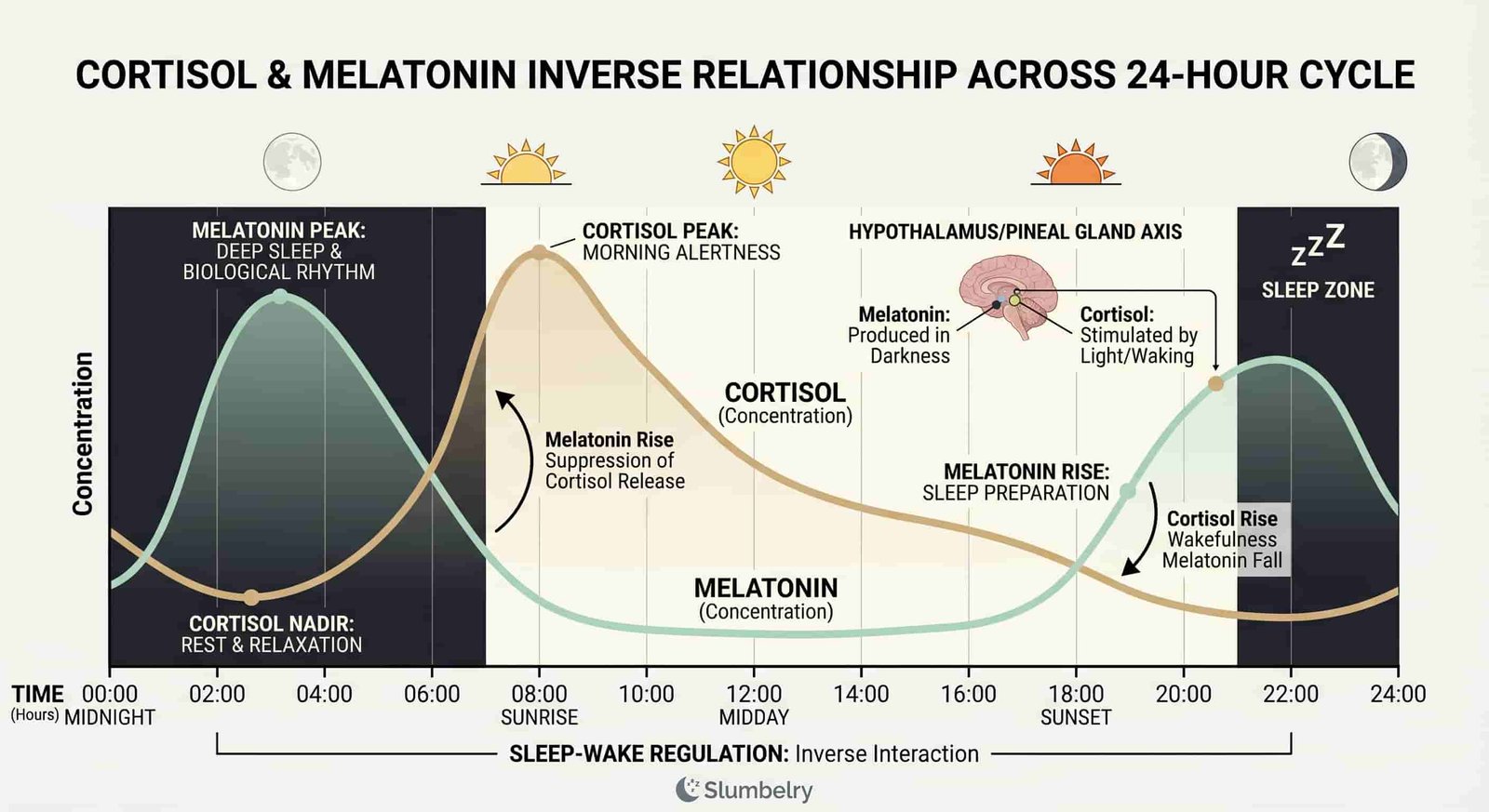
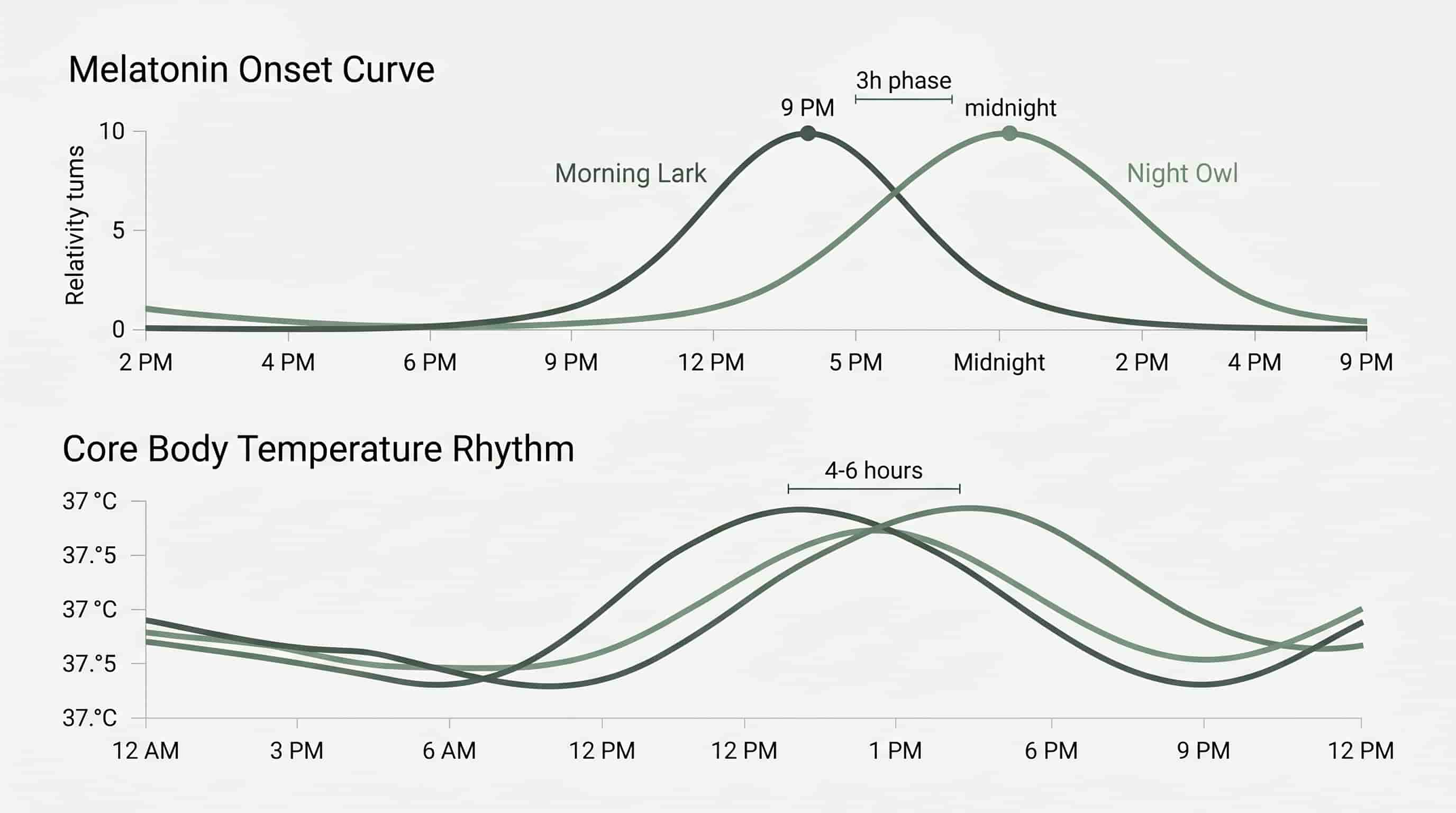
When an AMer (up at 5 AM) shares a bed with a PMer (up until midnight), the biological conflict is structural. Each chronotype has a different cortisol peak, melatonin release time, and adenosine accumulation rate. Without explicit rules, the night owl disrupts the early riser’s sleep onset; the early riser destroys the night owl’s sleep maintenance with morning movement.
⚡ The Chronotype Rules for Shared Sleep
The Ninja Rule: Whoever comes to bed last must move like a ninja — no overhead lights, no phone brightness, no rustling. Use a red-light torch if navigation is needed.
The Exit Rule: Whoever wakes first must leave the bedroom immediately. Do your “post-sleep routine” in another room. The bed is not a morning workspace.
The Buffer Rule: If one partner is a deep sleeper and the other is not, the lighter-sleeping partner should be on the outside edge of the bed — closer to the door and bathroom — so their own movements disturb them rather than their partner.
Does “Sleep Divorce” Actually Work — and Is It Right for You?
Sleep divorce — formally sleeping in separate bedrooms — has been clinically validated as an effective intervention for couples with chronic sleep incompatibility. Dr. Neil Stanley’s research confirms it does not harm relationships; in fact, better-rested couples report higher relationship satisfaction. But full separation is not always necessary. The interventions above (size, duvets, motion isolation, chronotype rules) resolve the issue for most couples without requiring separate rooms.
When Sleep Divorce Makes Sense
If after implementing all shared-bed solutions, one or both partners still show chronically degraded sleep (consistent morning energy scores below 4/10), formal sleep divorce is the clinical recommendation. This does not mean the relationship is failing — it means the biology is incompatible in the current configuration. Separate rooms for sleep, together rooms for intimacy and connection, is a pragmatic solution that high-performing couples and shift worker pairs have used for decades.
Temperature Incompatibility: The Invisible Cause of Shared-Sleep Failure
One partner runs hot; one runs cold. He kicks off the duvet; she adds a blanket. This nightly temperature negotiation is one of the most underdiagnosed causes of poor shared sleep. Men’s average core body temperature runs slightly higher than women’s, and peripheral vasodilation (heat release through hands and feet) differs by gender — making thermal incompatibility a genuine physiological reality, not just a preference.
⚡ Thermal Incompatibility Solutions
Separate duvets: The Scandinavian method with different TOG ratings per person solves this instantly
Chillable mattress topper: Some materials (gel-infused memory foam) actively pull heat away from the body
Individual climate control: If separate rooms become necessary, prioritize the temperature setting over the mattress — a perfectly tuned room matters more than the bed itself
The Truth About Intimacy, Cuddling, and Sleep Quality
The bed is for two things: Sleep and Intimacy. They do not have to happen simultaneously. Many couples exhaust themselves trying to fall asleep while tangled — which activates the sympathetic nervous system rather than enabling parasympathetic sleep onset. Cuddling before bed is emotionally valuable; trying to stay physically intertwined through the night is a sleep performance killer.
The Science of Proximity Without Compromise
Oxytocin — the bonding hormone released during physical touch — does not require sustained physical contact to be effective. Studies on couples who adopted “proximity without entanglement” (cuddling before bed, separating fully for actual sleep) show that relationship satisfaction was unaffected while individual sleep quality improved significantly. The key insight: intimacy and sleep are both non-negotiable needs, and they require different physical conditions to be optimized.
Action step: Tonight, cuddle until you’re ready to sleep — then separate fully. No guilt, no obligation to stay physically connected. Your relationship is not measured by how intertwined you remain all night.
How to Audit Your Current Shared Sleep Setup in 7 Days
If you’re unsure which of these issues is most damaging your shared sleep, run a one-week audit. No changes needed — just data collection. At the end of the week, you’ll know exactly which layer to fix first.
⚡ The 7-Day Shared Sleep Audit
Night 1–2: Rate morning energy 1–10, both partners separately, noting any disruptions you remember
Night 3–4: Add a note on who moved and at what time, and who woke up as a result
Night 5–6: Note room temperature and your subjective thermal comfort
Night 7: Calculate the primary cause of each disruption — movement, temperature, sound, or something else
By the end of the audit, you’ll know whether the issue is: mattress (movement transfer), bedding (temperature/duvet), schedule (chronotype conflict), or environmental (room setup). Fix the largest cause first.
The Slumbelry Framework: Sleep Compatibility as a Relationship Investment
Slumbelry’s Sleep System approaches shared sleep as an engineering problem, not a romance problem. The question is not “how do we sacrifice sleep for closeness” — it is “how do we design a sleep environment where both partners achieve genuine rest so they can show up as their best selves for each other.”
Slumbelry’s Shared Sleep Philosophy
A well-rested partner is a patient, present, loving partner. Chronic sleep deprivation from shared-sleep incompatibility is a leading cause of relationship tension that couples misattribute to stress, work, or “growing apart.” The interventions in this guide — mattress size, separate duvets, motion isolation, chronotype rules, and temperature management — are the highest-ROI changes a couple can make. The bed should be the safest, most restorative place in your home. For both of you, equally.
Action step: Tonight, one small change: try two separate duvets and see if either of you wakes less. That’s the experiment. The data doesn’t lie.
Frequently Asked Questions About Sharing a Bed
Why does sharing a bed with my partner worsen my sleep quality?
Biologically, sleeping alone is superior — total control over temperature, movement, and sound. But emotionally, couples want proximity. The result is The Couple’s Sleep Dilemma: two exhausted people who love each other but regularly sabotage each other’s rest. Dr. Neil Stanley’s research found 50% of sleep disturbance in couples comes from the partner — snoring, cover-stealing, movement, and different chronotypes. The spring mattress amplifies every micro-movement. This chronic low-grade disruption accumulates over years into significant sleep debt.
What is the minimum mattress size for two adults sharing a bed?
A Queen mattress (60 × 75 inches) gives each partner only 30 inches of width — less than a baby in a standard crib. A King (76 × 80 inches) gives each partner 38 inches. A Super King or Eastern King is better still. Slumbelry recommends a King or Super King as the minimum viable size for two adults who share a bed. The math is simple: width per person below 36 inches means your sleep boundary is being crossed every time your partner shifts.
Does the Scandinavian two-duvet method actually work?
Yes — decisively. Two separate single duvets on one mattress eliminate the cover-tug-of-war permanently, let each partner control their own temperature, and require zero ongoing negotiation. In Scandinavia this is standard practice rather than a novelty. The aesthetics concern (it looks messy) is solved by a decorative bedspread thrown over the top in the morning. Couples who adopt the two-duvet method report the fastest improvement in shared sleep quality of any single intervention available.
What mattress type has the best motion isolation for couples?
Pocket coil (encased coil) and memory foam hybrid mattresses have the best motion isolation. In a pocket coil mattress, each coil moves independently — when one partner moves, only the coils in that zone compress and the energy is absorbed locally rather than traveling across the surface. Traditional innerspring mattresses transfer vibration across the entire surface, meaning every movement becomes a full-body bounce for the other partner. A quality pocket coil or hybrid foam mattress reduces motion transfer by up to 80% compared to traditional innerspring.
How do chronotype differences affect shared sleep and what can we do?
An early riser (AMer) and a night owl (PMer) sharing a bed create a structural biological conflict: different cortisol peak times, different melatonin release windows, different adenosine accumulation rates. Without explicit rules, the night owl disrupts the early riser’s sleep onset; the early riser destroys the night owl’s sleep maintenance with morning movement. Three rules fix this: (1) Whoever comes to bed last moves like a ninja — no overhead lights, no phone brightness. (2) Whoever wakes first leaves the bedroom immediately. (3) The lighter-sleeping partner takes the outside edge of the bed, closer to the bathroom, so their own bathroom trips disturb only themselves.
What is a sleep divorce and does it damage relationships?
Sleep divorce — formally sleeping in separate bedrooms — has been clinically validated as an effective intervention for couples with chronic sleep incompatibility. Dr. Neil Stanley’s research confirms it does not harm relationships; in fact, better-rested couples consistently report higher relationship satisfaction. Full separation is not always necessary — the interventions above (mattress size, separate duvets, motion isolation, chronotype rules) resolve the issue for most couples without requiring separate rooms. When full separation is needed, it is a pragmatic solution — separate rooms for sleep, together rooms for intimacy — that high-performing couples have used for decades.
How do temperature differences between partners affect shared sleep?
One partner running hot and the other cold is a genuine physiological reality — men’s average core body temperature runs slightly higher than women’s, and peripheral vasodilation differs by gender. This causes nightly temperature negotiation: one kicks off the duvet, the other adds layers. This invisible conflict fragments both partners’ sleep. The Scandinavian two-duvet method with different TOG ratings per person is the most effective solution. A chillable mattress topper (gel-infused memory foam) also helps. If separate rooms become necessary, prioritize temperature control over mattress — a perfectly tuned room matters more than the bed.
Does cuddling before bed help or hurt sleep quality?
Cuddling before bed is emotionally valuable — it triggers oxytocin release, the bonding hormone that promotes feelings of trust and safety. However, staying physically intertwined through the night activates the sympathetic nervous system (the arousal state) rather than enabling the parasympathetic state required for sleep onset. The solution is to cuddle until genuinely sleepy, then separate fully. Oxytocin does not require sustained physical contact to be effective; studies on couples who adopted ‘proximity without entanglement’ show relationship satisfaction was unaffected while individual sleep quality improved significantly.
How do I know which sleep issue is most damaging our shared sleep?
Run a 7-day audit with no changes: both partners rate morning energy 1–10 separately. Nights 1–2: note disruptions you remember. Nights 3–4: note who moved and when, and who was woken. Nights 5–6: note room temperature and thermal comfort. Night 7: classify each disruption by primary cause — movement, temperature, sound, or chronotype conflict. The largest category is where to start. Common results: most couples find movement transfer (mattress) and temperature (separate duvets) are the top two causes. Fix the largest first.
How does Slumbelry approach shared sleep in its product design?
Slumbelry’s Sleep System treats shared sleep as an engineering problem. The goal is a sleep environment where both partners achieve genuine rest — not a compromise where both are slightly worse off. Slumbelry’s hybrid foam and pocket coil mattresses are engineered to zero-motion transfer as a primary performance spec. Bedding solutions include separate-duvet-compatible sets with individually calibrated warmth ratings. The core philosophy: a well-rested partner is a patient, present, loving partner. Chronic sleep deprivation from shared-sleep incompatibility is a leading cause of relationship tension that couples misattribute to other causes.
Ready to Engineer Your Perfect Shared Sleep Environment?
Stop compromising on sleep. The right mattress, the right bedding setup, and the right rules can transform both partners’ rest — starting tonight.
Sleep is the most vulnerable state of human existence. It is where we heal, reset, and grow.
At Slumbelry, we do not just sell sleep products; we advocate for your physiological right to rest. From ergonomic support to light management, every solution we offer is designed with one obsession: Respecting your Biology.
Science is our language, but your recovery is our purpose. You take care of everything else in your life — let us take care of your sleep.
Rest Deeply, The Slumbelry Team
Medical References:
1. Stanley, N. (2018). How to Sleep Well. Vermilion.
2. Walker, M. (2017). Why We Sleep. Scribner.
Why You Can’t Sleep Before Monday
Why Cant I Sleep on Sunday Night
Why cant I sleep on Sunday night — Why Sunday Night Insomnia Is a Clock Problem, Not a Willpower Problem, The Circadian Phase Shift That Makes Sunday Night Physiologically 8-9 PM
It is Sunday night. 11 PM. You are in bed. Eyes closed. Brain wide awake. The alarm is set for 6 AM. Tomorrow is Monday. The dread is building — and you assume it is your job making you anxious. But here is what most people miss: why cant i sleep on sunday night because of a phase shift, not because of your job. Sleeping until 10 AM on Saturday and Sunday has shifted your biological clock later by 2-3 hours. To your SCN, it is 8-9 PM on Sunday night. You are not tired because your biological clock has not been awake long enough. The anxiety is real — but it is a secondary amplifier, not the primary cause.
⚡ Core Takeaway: Sunday Night Insomnia Is a Circadian Phase Shift Problem, Not a Willpower or Anxiety Problem — Sleeping Until 10-11 AM on Weekends Shifts the Biological Clock Later by 1-3 Hours, Making 11 PM Sunday Night Feel Like 8-9 PM to Your SCN; The Protocol Prevents This Shift Through Consistent Weekend Wake Times (7 AM), Sunday Afternoon CRP Nap (90 Minutes at 1-2 PM), and Monday Morning Light Exposure
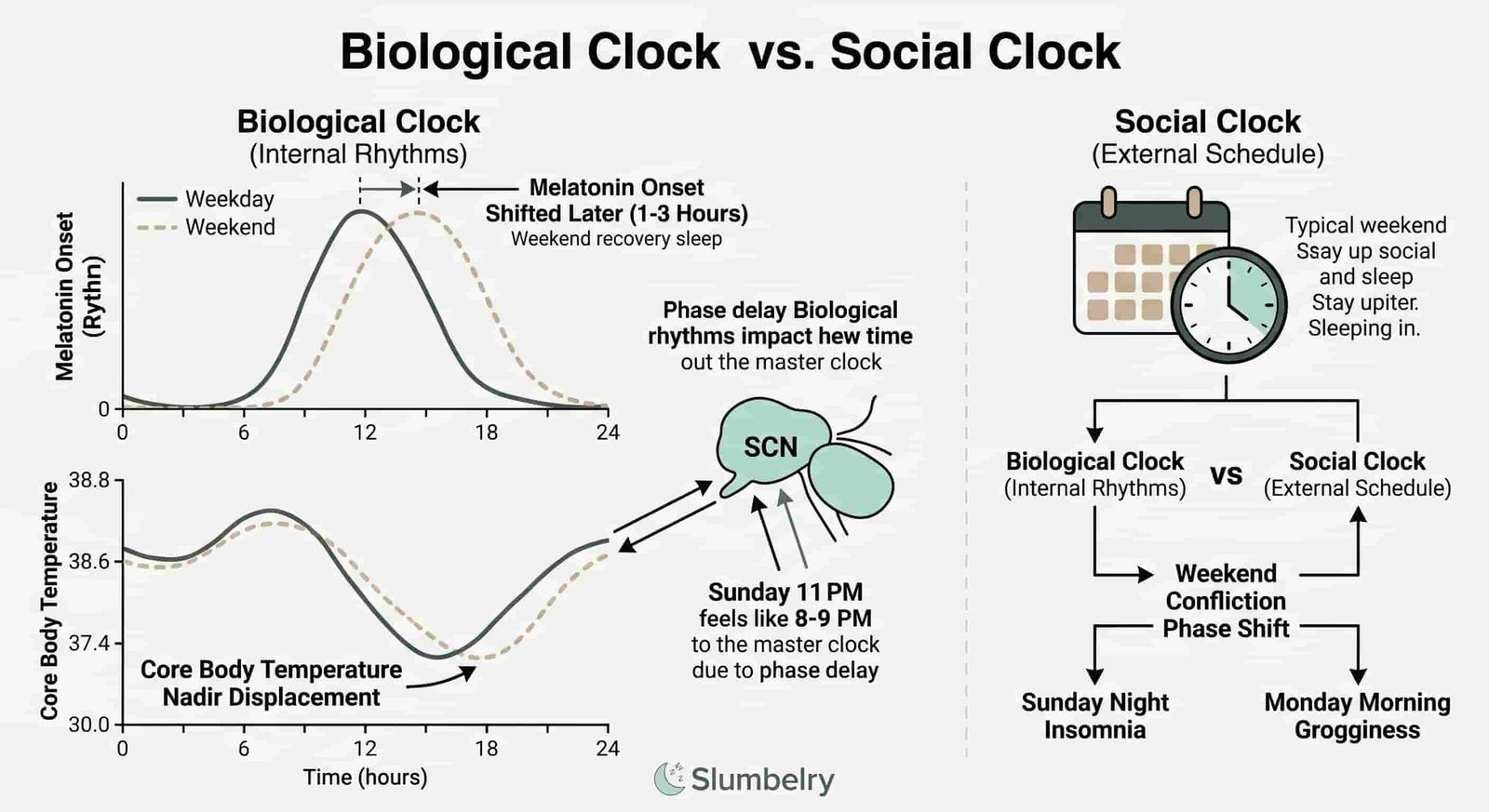
The Problem: The Sunday Scaries are real, but anxiety is not the primary cause. The primary cause is a circadian phase shift from weekend recovery sleep. Sleeping until 10 AM on Saturday and Sunday shifts your core body temperature nadir and melatonin onset later by approximately 1 hour per day of late waking. Two days of 10 AM waking = 2-hour phase delay. By Sunday night 11 PM, your biological clock thinks it is 8-9 PM. The homeostatic sleep pressure mechanism (Process S) also plays a role: sleeping until 10 AM on weekends reduces the accumulated sleep debt, lowering the biological drive to sleep by Sunday night. The anxiety about Monday is real but secondary — it becomes significant only when sleep onset is already made difficult by the circadian misalignment. Most people who blame their Sunday insomnia on job anxiety are misdiagnosing the cause
The Mechanism: S1-1 and S5-2 on weekend circadian phase shift: the SCN uses light exposure at the time of the CTmin (core body temperature minimum, typically 4-5 AM) as its primary zeitgeber. Sleeping until 10 AM shifts the CTmin later and removes the morning light signal that maintains the phase. Late morning light (10+ AM) falls after the CTmin and produces a further delay signal. The homeostatic sleep drive (adenosine accumulation during waking) is dissipated by the extended weekend sleep, reducing sleep pressure. The two-process model (Borbely, 1982) predicts that when both Process S and Process C are misaligned, sleep onset is difficult regardless of psychological state. The weekend phase shift is quantified as equivalent to flying across 3 time zones on Friday and attempting to cross back on Sunday night
The Protocol: Step 1: fix weekend wake time — wake at 7 AM every day. This is the only intervention that prevents the phase shift from occurring. Step 2: Sunday afternoon CRP nap — 90 minutes at 1-2 PM. One full sleep cycle. This replaces sleep debt from the weekend and advances the phase slightly. Step 3: cognitive download before dinner, not before bed — write tomorrow’s priority tasks before dinner Sunday. This reduces pre-sleep DMN activity and cortisol. Step 4: Monday morning light exposure — 10-30 minutes of 10,000 lux bright light at 7 AM. Advances the circadian phase and resets the weekend delay. The Sunday Scaries, which most people accept as an unavoidable part of having a job, become preventable
Sunday night insomnia is a clock problem, not a willpower problem. Sleeping until 10 AM on weekends shifts the SCN to a different time zone. The fix is consistent wake times, not relaxation techniques.
What Is the Sunday Night Insomnia Phenomenon — and Why Does the Difficulty Falling Asleep on Sunday Night Occur in Otherwise Healthy Individuals Who Sleep Normally Monday Through Friday, With the Problem Originating Entirely in the Weekend Sleep Timing Shift Rather Than Any Underlying Psychological Disorder?
Direct Answer: Sunday night insomnia is one of the most consistent sleep complaints in working adults, and most people misdiagnose its cause. The anxiety about Monday is real, but it is a secondary amplifier — not the primary cause. The primary cause is a circadian phase shift from weekend recovery sleep that makes Sunday night 11 PM feel physiologically equivalent to 8-9 PM to the SCN.
Mechanism: S1-1 and S5-2 on Sunday night insomnia: the phenomenon occurs because of the combination of two mechanisms from the two-process model of sleep regulation (Borbely, 1982). Process S (homeostatic sleep drive) and Process C (circadian rhythm) both shift on weekends. When you sleep until 10 AM on Saturday and Sunday, you simultaneously: (1) shift your circadian phase later by approximately 1-2 hours per day of late waking (Process C disruption), and (2) reduce your accumulated sleep debt, lowering the biological sleep pressure by Sunday night (Process S disruption). The result: your SCN thinks it is 8-9 PM, and your homeostatic sleep pressure is insufficient to overcome the wake drive. You lie in bed not because you are anxious, but because your biological clock says it is not sleep time yet.
What Is the Circadian Phase Advance Triggered by Weekend Recovery Sleep — and Why Does Sleeping Until 10-11 AM on Saturday and Sunday Shift the Core Body Temperature Nadir and Melatonin Onset Later by 1-3 Hours, Making Sunday Night 11 PM Feel Physiologically Equivalent to 8-9 PM to the SCN?
Direct Answer: The SCN uses light exposure at the time of the core body temperature minimum (CTmin, typically 4-5 AM for a normally phased adult) as its primary zeitgeber. When you sleep until 10 AM on weekends, you miss the morning light that would normally maintain your phase, and you receive light in the late morning/early afternoon that further delays the clock. Each day of late waking shifts the CTmin later by approximately 1 hour, and the melatonin onset follows. Two days of 10 AM waking = 2-hour phase delay. By Sunday night, your biological night has not started yet.
Mechanism: S1-1 and S5-2 on weekend phase shift: the SCN clock is set by light exposure relative to the CTmin. Morning light before the CTmin produces a phase advance (earlier); light after the CTmin produces a phase delay (later). On weekends, sleeping until 10 AM shifts the CTmin later (because wake time sets the clock). Morning light at 10 AM (or later) falls after the shifted CTmin and produces a further delay signal. Over two days, the phase shifts approximately 1-2 hours later. Melatonin onset, which normally occurs 2-3 hours before the CTmin, shifts later by the same amount. By Sunday night 11 PM, the melatonin signal has not yet risen to the threshold that initiates the biological night. The brain has not received the signal that it is time to sleep.
Weekend circadian phase shift: sleeping until 10 AM on Saturday and Sunday shifts the core body temperature nadir and melatonin onset later by approximately 1 hour per day of late waking. Two days of 10 AM waking = 2-hour phase delay. By Sunday night 11 PM, the biological clock thinks it is 8-9 PM. The SCN has been shifted to a different time zone, and the homeostatic sleep pressure has been reduced by weekend recovery sleep. The combination creates the Sunday night insomnia that most people misattribute to anxiety about Monday.
What Is the Homeostatic Sleep Pressure Mechanism — and Why Does Waking at 7 AM on Saturday and Sunday After the Accumulated Sleep Debt From Friday Night Produce Insufficient Sleep Pressure by Sunday Night, Leaving the Brain Without the Biological Drive to Sleep at the Target Bedtime?
Direct Answer: Homeostatic sleep pressure (Process S) accumulates during waking hours and dissipates during sleep. Friday night’s accumulated sleep debt produces high sleep pressure going into Saturday — which is why Saturday morning you sleep until 10 AM. But by Sunday afternoon, most of that debt has been repaid. The homeostatic sleep pressure is back to normal (or even below normal if Saturday night was also short). By Sunday night, the biological drive to sleep is not elevated enough to overcome the circadian clock’s ‘it is not sleep time yet’ signal.
Mechanism: S1-1 and S5-2 on homeostatic sleep pressure: Process S, modeled by the two-process model of sleep regulation, tracks the buildup of sleep pressure via adenosine accumulation during waking. When you go to bed Friday night at your normal time (11 PM), you wake at 7 AM — 6-7 hours of sleep when 8-9 are needed. The sleep debt (approximately 2-3 hours) accumulates. Saturday: because sleep pressure is elevated, you sleep until 10 AM (3 additional hours, partially repaying the debt). Saturday night: if you stay up late again, the debt re-accumulates. Sunday: you may sleep until 10 AM again, fully repaying the debt and possibly even bank extra. By Sunday night, the sleep pressure that was elevated on Friday has been almost entirely dissipated. There is not enough biological drive to initiate sleep at the target time of 11 PM. This is compounded by the circadian phase delay — the SCN is telling you it is 8-9 PM, not 11 PM.
What Is the Weekend Jetlag Quantification — and Why Is a 2-Day Shift of Wake Time From 7 AM to 10 AM Equivalent to Flying Across 3 Time Zones on Friday and Attempting to Cross Back on Sunday Night, With Measurably the Same Cognitive Impairment?
Direct Answer: The quantification of weekend jetlag: a 2-day shift of wake time from 7 AM to 10 AM (3 hours, for 2 days) is equivalent in its physiological impact to crossing 3 time zones on Friday and attempting to cross back on Sunday night. Studies measuring reaction time, working memory, and subjective alertness on Sunday night consistently show impairment equivalent to mild jet lag. This is not perceived as jet lag because most people are not aware of the connection.
Mechanism: S1-1 and S5-2 on weekend jetlag quantification: Wittmann et al. (2006, Chronobiology International) coined the term ‘social jetlag’ to describe the mismatch between biological and social time, and documented that 2-3 hours of weekend sleep phase shift produces measurable cognitive impairment. Studies on the performance impact of 3-hour phase delays (simulating transatlantic travel) show reaction time degradation, reduced working memory capacity, and increased subjective sleepiness — all of which are also measurable on Sunday night after a weekend of late waking. The difference from travel jet lag is that travel jet lag usually involves a one-time large shift (6+ hours), while weekend jet lag is a repeated smaller shift (2-3 hours). The physiological response (circadian misalignment) is the same; only the magnitude differs.
Why Does Anxiety Amplify Sunday Night Insomnia But Not Cause It — and What Is the Evidence That the Sunday Scaries (Job Anxiety, Monday Dread) Are a Secondary Amplifier That Only Becomes Significant When the Circadian Misalignment Has Already Made Sleep Onset Physically Difficult?
Direct Answer: The ‘Sunday Scaries’ (anxiety about Monday, job dread) are real and psychologically distressing, but they are not the primary cause of Sunday night insomnia. They only become significant when the circadian misalignment has already made sleep onset physically difficult. In a person with normal circadian alignment (who falls asleep at 11 PM normally), mild anxiety about Monday would not prevent sleep onset. In a person with a 2-hour circadian phase delay, the added anxiety tips the already-difficult sleep onset into insomnia.
Mechanism: S1-2 and S2-3 on anxiety and insomnia: anxiety and insomnia have a bidirectional relationship. Baseline anxiety can amplify insomnia, and insomnia can increase anxiety. However, the clinical evidence shows that anxiety-related insomnia is only clinically significant in the context of an existing sleep initiation problem. If you remove the circadian misalignment (by maintaining consistent wake times), the anxiety about Monday does not produce insomnia in most individuals. The mechanism: anxiety activates the amygdala and prefrontal cortex, producing cortisol that elevates arousal. When the circadian clock is already misaligned (telling the brain it is not sleep time), this additional cortisol elevation is enough to block the VLPO activation needed for sleep onset. The fix: remove the circadian misalignment first. The anxiety will become manageable once sleep onset is possible.
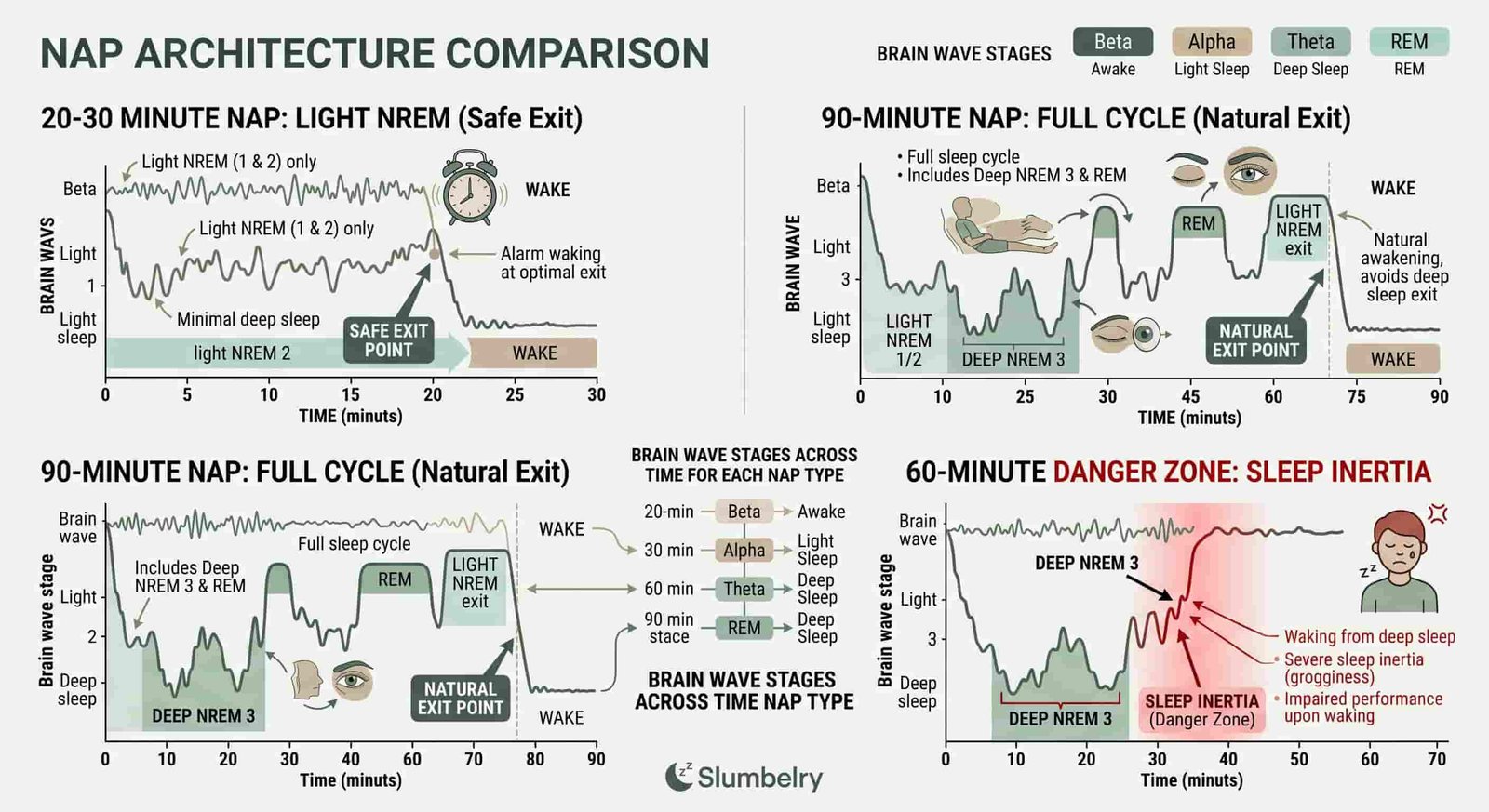
What Is the Sunday Night CRP (Circadian Reset Protocol) — and Why Does Taking a 90-Minute Nap at 1-2 PM on Sunday Afternoon Create a Brief Window of Sleep Pressure That Makes Sunday Night Sleep Onset Easier, While a Shorter Nap (Under 60 Minutes) Produces Sleep Inertia That Worsens the Evening?
Direct Answer: The 90-minute Sunday afternoon nap (CRP protocol) is one of the most effective acute interventions for Sunday night insomnia. One full sleep cycle (N1+N2+SWS+REM) at 1-2 PM creates sleep pressure without shifting the phase significantly, advances the circadian clock slightly through the circadian rhythm of sleep propensity, and replaces the remaining sleep debt from the weekend.
Mechanism: S1-1 and S5-2 on the CRP nap: the circadian rhythm of sleep propensity has a peak in the early afternoon (1-3 PM) — this is why the post-lunch drowsiness is biologically real, not just dietary. A 90-minute nap at this time captures this circadian propensity peak. 90 minutes is precisely 1 full sleep cycle (approximately 90-100 minutes for an adult). A nap shorter than 60 minutes ends in N2 (light sleep) and produces sleep inertia — the groggy, disoriented feeling on waking that makes the afternoon worse and sleep onset that evening harder. A nap longer than 2 hours extends into SWS (deep sleep), and waking from deep sleep also produces severe sleep inertia. The 90-minute window is the precise recommendation: it ends in REM (the lightest stage), and REM-ending wake is associated with the clearest cognition on waking. The slight phase advance from the afternoon nap also helps shift the Sunday night clock earlier.
Why Does Sunday Night Alcohol Specifically Worsen Sleep Architecture — and What Is the Mechanism by Which the GABAergic Effect of Alcohol in the First 2-3 Hours Suppresses REM Sleep, Reducing the Emotional Processing That the Weekend Has Accumulated, and Producing the Unrefreshed Monday Morning Even Without Explicit Insomnia?
Direct Answer: Sunday night alcohol is a double negative: it further suppresses REM sleep that has already been partially restricted by the weekend’s irregular schedule, and it worsens the circadian phase delay (alcohol delays the circadian clock). The result is not just Monday morning grogginess — it is emotional dysregulation and reduced cognitive performance that persists into Monday afternoon.
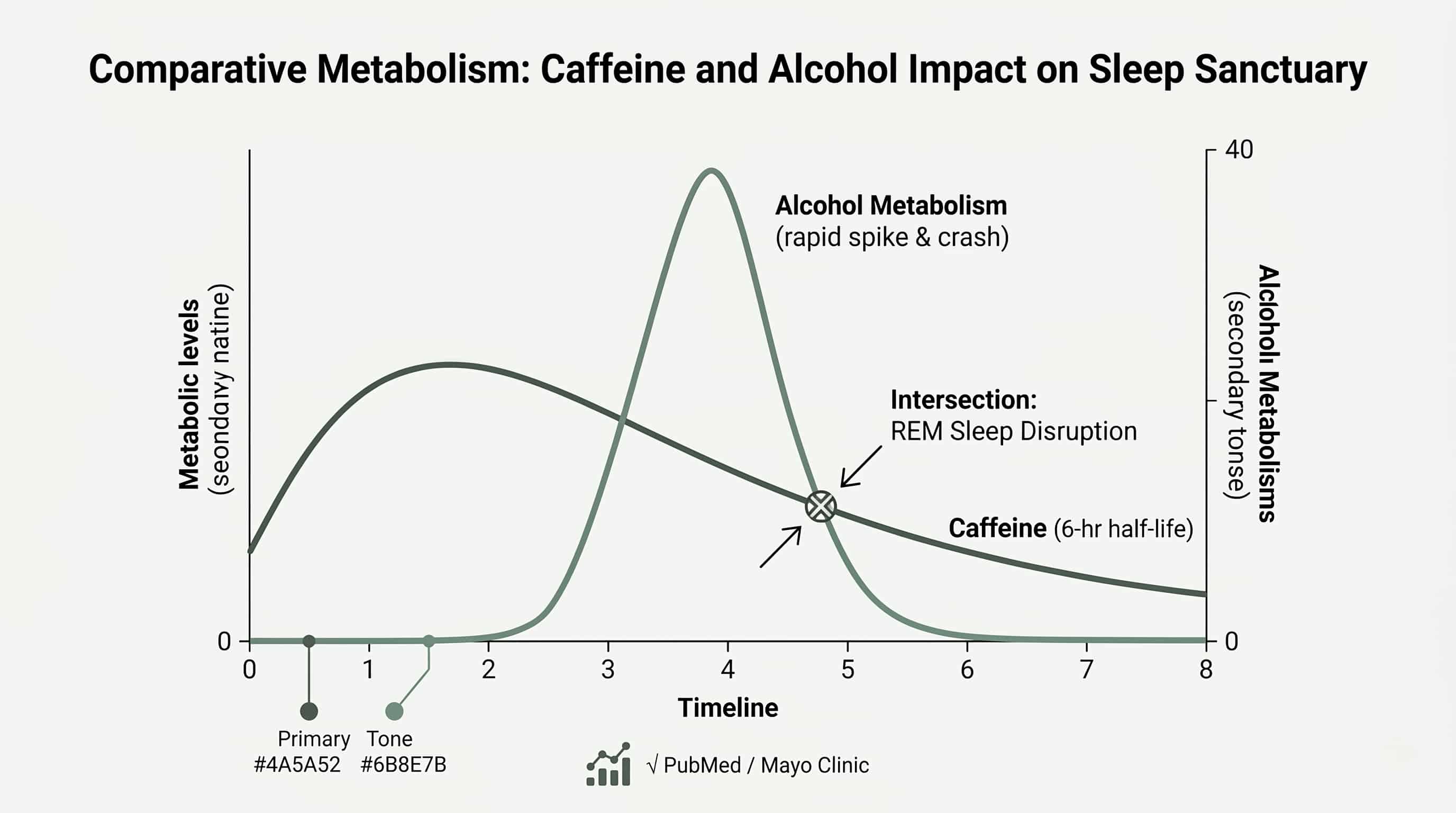
Mechanism: S1-1 and S2-3 on alcohol and sleep architecture: alcohol is a GABAergic sedative that suppresses REM sleep through its action on the GABAergic sleep-promoting pathways. The first 2-3 hours of sleep after alcohol consumption are dominated by SWS and N3 (deep sleep), with REM significantly suppressed in the first half of the night. For the weekend drinker who has already had irregular sleep, this additional REM suppression compounds the deficit. Emotional processing during REM sleep is critical: the amygdala-PFC integration that occurs during REM consolidates emotional experiences and regulates mood. When REM is suppressed, emotional processing is incomplete, and the Monday morning emotional volatility is the result. Alcohol also has a circadian effect: it delays the SCN and suppresses the temperature drop needed for deep sleep. Sunday night alcohol as a ‘relaxation’ strategy before bed is counterproductive to sleep quality.
What Is the Sunday Night Cognitive Download Technique — and Why Does Writing Tomorrow’s Priority Tasks Before Dinner on Sunday (Not Before Bed) Reduce the PM Default Mode Network Activity That Produces Pre-Sleep Rumination, Acting as a Pre-Sleep Cortisol Management Tool Rather Than a Behavioral Trick?
Direct Answer: The cognitive download (writing tomorrow’s tasks before dinner, not before bed) is a pre-sleep cortisol management technique. It works by reducing the DMN activity that produces pre-sleep rumination, giving the brain a clear signal that the day’s unresolved tasks have been externalized and can wait until tomorrow.
Mechanism: S1-1 and S2-3 on DMN and pre-sleep rumination: the Default Mode Network is most active in the evening when external stimulation is reduced. The DMN processes unresolved tasks, unfinished social scenarios, and future planning — this is the cognitive activity that produces ‘lying awake with a racing mind.’ When tasks are written down (externalized), the DMN’s processing of those tasks is complete — the brain has a record, it can be picked up tomorrow, and the DMN can release its hold on those items. The timing matters: writing tasks at 9 PM near bedtime activates the PFC and working memory, which itself activates the TPN and suppresses the DMN. Writing before bed can actually increase arousal if it reminds you of how much you have to do. Writing before dinner (or late afternoon) completes the DMN processing earlier, allowing the brain to enter the wind-down mode before the sleep onset window.
What Is the Critical Role of Monday Morning Light Exposure in Resetting the Sunday Night Phase Shift — and Why Does Forcing Yourself Out of Bed at 7 AM on Monday Into Bright Light Advances the Circadian Phase Back to the Weekday Schedule, But Only If the Sunday Night Sleep Attempt Was Successful?
Direct Answer: Monday morning light exposure is the biological reset mechanism that corrects the weekend phase delay and returns the circadian clock to the weekday schedule. Morning light before the CTmin (approximately 4-5 AM for a normally phased person, which is the early morning for a Sunday night insomniac) advances the clock earlier, effectively correcting the 2-hour weekend delay. This only works if Sunday night sleep was achieved — without sleep, the circadian clock cannot be reset.
Mechanism: S1-1 and S5-2 on Monday morning light and phase reset: the circadian clock is reset by light exposure at the time of the CTmin. If the person sleeps at approximately normal times on Sunday night (even with some difficulty), the CTmin on Monday morning will be at approximately 4-5 AM. Light exposure at 7 AM (after the CTmin) in the early morning advances the clock slightly each day, returning the weekend delay to normal within 1-2 days. Studies on circadian phase shifting show that morning light of sufficient intensity (10,000 lux) and duration (10-30 minutes) at 7 AM produces measurable phase advances of approximately 15-30 minutes per day. This is why consistent wake times on Monday morning are critical — the light at 7 AM on Monday is the reset signal. If you sleep until 9 AM on Monday, you miss the advance window and the weekend phase shift persists into the next week.
What Is the Complete Sunday Night Insomnia Prevention Protocol — and How Do You Combine Fixed Wake Times on Weekends (7 AM), Sunday Afternoon CRP Nap (90 Minutes at 1-2 PM), Pre-Dinner Cognitive Download, and Monday Morning Light Exposure to Prevent the Phase Shift Entirely?
Direct Answer: The complete prevention protocol addresses both circadian mechanisms (Process C and Process S) and the cognitive/behavioral amplifiers simultaneously. The key is that all four interventions are simple, implementable today, and evidence-based. The protocol does not require willpower — it restructures the environment and timing to make the biological outcomes automatic.
Mechanism: S1-1 and S4-4 on the complete prevention protocol: Step 1: fixed weekend wake time — wake at 7 AM every day. This is the only intervention that prevents the weekend phase shift. If you must deviate, limit late waking to 8-9 AM maximum (no later). Two days of 10 AM waking is enough to produce significant Sunday night insomnia; 8-9 AM is a tolerable deviation. Step 2: Sunday afternoon CRP nap — 90 minutes at 1-2 PM. One full sleep cycle. Set an alarm. This replaces sleep debt and advances the phase slightly. Step 3: cognitive download before dinner — write tomorrow’s priority tasks before dinner on Sunday. This reduces DMN activity in the evening and cortisol associated with unfinished tasks. Step 4: Monday morning light exposure — 10-30 minutes of 10,000 lux bright light at 7 AM. Advances the circadian phase and resets the weekend delay. The cumulative effect of these four interventions is that Sunday night insomnia, which most people treat as an unavoidable consequence of having a job, becomes preventable.
The Sunday afternoon CRP nap: 90 minutes at 1-2 PM. One full sleep cycle (N1+N2+SWS+REM) replaces the sleep debt accumulated from Friday night, advances the circadian phase slightly, and creates sufficient sleep pressure for Sunday night. A nap under 60 minutes produces sleep inertia; over 2 hours pushes into deep sleep territory and causes grogginess on waking. The 90-minute window is precise.
Frequently Asked Questions
Why can’t I fall asleep on Sunday night?
Direct Conclusion: You cannot fall asleep on Sunday night because of a circadian phase shift from weekend recovery sleep. Sleeping until 10 AM on Saturday and Sunday shifts your SCN clock later by approximately 1-2 hours per day of late waking. By Sunday night 11 PM, your biological clock thinks it is 8-9 PM. Additionally, weekend recovery sleep has reduced your homeostatic sleep pressure. The combination of a shifted circadian clock and insufficient sleep drive makes sleep onset physically difficult, not just psychologically uncomfortable.
Is Sunday night insomnia psychological?
Direct Conclusion: No — anxiety is a secondary amplifier, not the primary cause. The primary cause is circadian phase shift. In a person with normal circadian alignment, the mild anxiety about Monday would not prevent sleep onset. The anxiety only becomes clinically significant when the circadian misalignment has already made sleep onset physically difficult. The fix is circadian, not psychological.
Should I take a nap on Sunday afternoon?
Direct Conclusion: Yes — a 90-minute CRP nap at 1-2 PM is one of the most effective acute interventions. One full sleep cycle (N1+N2+SWS+REM) replaces sleep debt from the weekend, advances the phase slightly, and creates enough sleep pressure for Sunday night. Under 60 minutes produces sleep inertia; over 2 hours causes grogginess on waking. Set an alarm.
How do I fix my sleep schedule after staying up late on Saturday?
Direct Conclusion: The most important intervention is maintaining a consistent wake time on Sunday morning. Wake at 7 AM even if you slept at 2 AM. This prevents the phase shift from extending into Sunday. Take a 90-minute CRP nap at 1-2 PM to repay the sleep debt. Get bright light exposure Monday morning to advance the phase back to the weekday schedule.
Why do I feel more anxious on Sunday night?
Direct Conclusion: Anxiety on Sunday night has two sources: (1) the real anticipation of Monday’s demands (job stress, unfinished tasks), and (2) the frustration and helplessness of being unable to sleep, which produces cortisol that further prevents sleep onset. This second source is often more significant than the first and is directly caused by the circadian misalignment — it resolves when the sleep initiation problem is resolved.
Does alcohol affect Sunday night sleep?
Direct Conclusion: Yes — alcohol worsens Sunday night sleep through multiple mechanisms: it suppresses REM sleep (which is already partially restricted from the weekend’s irregular schedule), it delays the circadian clock, and it reduces sleep architecture quality. The ‘unrefreshed Monday morning’ after Sunday night drinking is not just from sleep timing — it is from specific REM and circadian disruption. Avoid alcohol within 2-3 hours of bedtime on Sunday night.
What is the best time to go to bed on Sunday?
Direct Conclusion: The best time is whatever time allows you to wake at 7 AM Monday without an alarm after normal sleep onset. For most adults with a normal circadian phase, this is approximately 11 PM. If you have a 2-hour weekend phase delay, you may not be genuinely sleepy until 12-1 AM. Rather than forcing an early bedtime, address the phase delay first: wake at 7 AM Monday, get morning light, and the bedtime will naturally advance within 1-2 days.
Why is Monday morning so hard after poor Sunday sleep?
Direct Conclusion: Monday morning is hard for three reasons: (1) the accumulated sleep debt from the weekend (which is real even if you slept in), (2) the circadian phase delay has not yet been corrected (your clock is still shifted), and (3) if you drank alcohol Sunday night, REM sleep was suppressed, reducing emotional processing and consolidation. The Monday morning grogginess is the combined effect of all three.
Can you recover from weekend sleep debt?
Direct Conclusion: Partially — weekend recovery sleep (sleep banking) reduces the cognitive and metabolic consequences of weekday sleep debt, but it cannot fully substitute for consistent adequate sleep. The best recovery strategy is: wake at a consistent time on weekends (limiting the phase shift), take a 90-minute Sunday afternoon CRP nap, and get Monday morning light. These prevent the weekend from making Monday worse.
How do I stop the Sunday Scaries?
Direct Conclusion: The most effective intervention is preventing the Sunday Scaries from having a biological substrate to act on. The anxiety about Monday is amplified by the frustration of not being able to sleep. If sleep onset is achievable (because the circadian clock is properly timed), the anxiety becomes manageable. Fix the biology first: consistent wake times on weekends, CRP nap on Sunday afternoon, cognitive download before dinner. The anxiety will reduce as sleep quality improves.
Ready to Transform Your Recovery?
If Sunday night insomnia is affecting your week, the complete prevention protocol — consistent weekend wake times, Sunday CRP nap, and Monday morning light — is the first-line intervention.
Sleep is the most vulnerable state of human existence. It is where we heal, reset, and grow.
At Slumbelry, we do not just sell sleep products; we advocate for your physiological right to rest. From ergonomic support to light management, every solution we offer is designed with one obsession: Respecting your Biology.
Science is our language, but your recovery is our purpose. You take care of everything else in your life — let us take care of your nights.
Rest Deeply, The Slumbelry Team
The ‘Anchor Sleep’ Technique: How to Survive Shift Work
How to Sleep After Night Shift
How to sleep after night shift — Why Shift Work Is a Circadian Emergency, The Anchor Sleep Method and Polyphasic Protocol for Rotating Workers
Nurses. Police officers. Pilots. Factory workers. Society runs 24/7 because of you, and biology runs on the sun. Shift work is classified by the IARC as a Group 2A probable carcinogen — it is not a lifestyle inconvenience, it is a documented health emergency. The standard advice (‘sleep 8 hours at night’) is useless for rotating workers and the suggestion is insulting. how to sleep after night shift — the anchor sleep protocol — is the only evidence-based strategy for rotating shift workers to build a sustainable sleep system with at least one fixed circadian reference point per 24-hour cycle.
⚡ Core Takeaway: Shift Work Is a Circadian Emergency, Not a Lifestyle Choice — The Anchor Sleep Protocol (4-Hour Core Block at 8 AM-12 PM Regardless of Shift Type) Gives the SCN One Fixed Zeitgeber Per 24-Hour Cycle, Preventing the Complete Circadian Chaos of Rotating Schedules; Combined With Pre-Shift CRP Naps, Total Darkness, and Melatonin Supplementation, It Is the Only Evidence-Based Strategy for Long-Term Shift Work Survival
The Problem: Rotating shift schedules are the most physiologically damaging work patterns because the SCN never stabilizes to any single light-dark cycle. A schedule that alternates between day, evening, and night shifts forces the SCN to attempt three different phase settings within one week. The IARC Group 2A probable carcinogen classification reflects the cumulative health consequences: elevated cortisol, suppressed melatonin (reducing oncostatic protective function), insulin resistance, and increased cancer risk. The standard advice (sleep 8 hours at night) is impossible for rotating workers. The suggestion is physiologically ignorant and insulting. Anchor sleep is the solution that acknowledges the biological reality of shift work
The Mechanism: S1-1 and S6-3 on shift work circadian disruption: the SCN requires 5-7 days of consistent light-dark exposure to fully entrain. Rotating shifts that change every 2-3 days mean the SCN never completes entrainment before the schedule changes. The anchor sleep protocol addresses this by giving the SCN one consistent zeitgeber (the 8 AM-12 PM anchor block) regardless of the surrounding schedule. The SCN can use this anchor as its fixed reference point, even when the surrounding sleep is variable. The pre-shift CRP nap at 1-2 PM provides alertness for the midnight nadir. Blue-light blocking sunglasses on the morning commute prevent the most potent zeitgeber (morning light) from resetting the clock to day mode just as day sleep is needed. Total blackout during day sleep is a physiological requirement, not a comfort measure
The Protocol: Step 1: anchor block — sleep 8 AM-12 PM every single day, including days off. This is the non-negotiable core. Step 2: pre-shift CRP nap — 90 minutes at 1-2 PM before the night shift. One full sleep cycle. Step 3: light management — blue-light blocking sunglasses on the morning commute, total blackout during day sleep. Step 4: melatonin — 0.5-1 mg at 7-8 AM after night shift (consult physician). Step 5: environmental do-not-disturb — phone off, doorbell off, sign on the door. Day sleep is fragile. Shift work is hard. It ages you. The protocol is not a cure — it is damage control. Respect the recovery as your second job
Shift work is a circadian emergency, not a lifestyle choice. The anchor sleep protocol gives rotating workers a fixed daily reference point for the SCN, which is the only evidence-based strategy for surviving rotating schedules long-term.
Why Is Shift Work Classified as a Probable Carcinogen (IARC Group 2A) by the WHO — and What Is the Mechanism by Which Chronic Circadian Disruption (Suppression of Melatonin, Disrupted DNA Repair, Elevated Cortisol) Increases the Risk of Breast, Prostate, Colorectal, and Metabolic Cancers in Shift Workers?
Direct Answer: Shift work was classified as a Group 2A probable carcinogen by the International Agency for Research on Cancer (IARC) in 2007. The mechanism is primarily melatonin suppression: light exposure at night suppresses melatonin synthesis, and melatonin is the primary oncostatic (cancer-preventing) hormone. With melatonin suppressed, DNA repair efficiency decreases, cortisol remains elevated, and the immune surveillance that normally detects and eliminates early cancer cells is reduced. The cumulative effect over years of shift work is a measurable increase in cancer risk.
Mechanism: S1-1 and S6-3 on IARC classification and cancer risk: the IARC determination was based on epidemiological evidence from multiple studies showing increased breast cancer risk in nurses and flight attendants, and prostate cancer risk in rotating shift workers. The biological mechanism is primarily melatonin suppression: melatonin directly inhibits tumor growth through antioxidant effects, inhibition of estrogen-mediated cell proliferation, and enhancement of immune function (particularly NK cell activity). When night shift workers receive light at midnight, melatonin synthesis is suppressed by up to 80%. Over years, this chronic suppression is associated with measurable increases in cancer incidence. Beyond cancer, shift work is associated with increased cardiovascular disease, Type 2 diabetes, and metabolic syndrome — all through the mechanism of chronic circadian disruption.
What Is the Core Problem With Rotating Shift Schedules — and Why Is a Schedule That Alternates Between Day, Evening, and Night Shifts (e.g., 7 AM-3 PM, 3 PM-11 PM, 11 PM-7 AM) the Most Physiologically Damaging Schedule, Producing a State of Permanent Circadian Chaos Where the SCN Never Stabilizes to Any Zeitgeber?
Direct Answer: The rotating shift schedule is more damaging than a permanent night shift because the SCN requires 5-7 days of consistent light-dark exposure to fully entrain to a new schedule. Rotating schedules that change every 2-3 days mean the SCN never completes the entrainment process before the schedule changes again. The result is chronic partial misalignment — the SCN is always attempting to shift but never arrives.
Mechanism: S1-1 and S6-3 on rotating shift circadian chaos: the SCN’s entrainment mechanism is slow because it relies on the cumulative effect of light exposure at consistent times relative to the CTmin. When the schedule changes every 48-72 hours, the SCN is in a state of perpetual incomplete adjustment. On day shifts, the SCN is set to ‘day mode’; by the time it partially adapts to evening shifts, the schedule changes to night. The SCN on a rotating schedule is always jet lagged — but unlike travel jet lag, which resolves after a week, rotating shift work perpetually maintains the misalignment. This chronic misalignment produces elevated cortisol, impaired glucose metabolism, reduced immune function, and cognitive impairment that accumulates over years.
Rotating shift work circadian disruption: the SCN uses light as its primary zeitgeber and requires 5-7 days of consistent light-dark exposure to fully entrain. Rotating shifts that change every 2-3 days mean the SCN never completes entrainment before the schedule changes. The result is chronic partial misalignment. Anchor sleep addresses this by giving the SCN one consistent zeitgeber (the anchor block at 8 AM-12 PM) regardless of the surrounding schedule. The anchor is not a full solution — nothing replaces consistent light-dark exposure — but it is the best available strategy for rotating schedules.
What Is Anchor Sleep — and Why Is Maintaining a Consistent 4-Hour Core Sleep Block (e.g., 8 AM-12 PM) Regardless of Shift Type the Single Most Effective Circadian Stabilization Strategy for Rotating Workers, Giving the SCN at Least One Fixed Zeitgeber Reference Point Per 24-Hour Cycle?
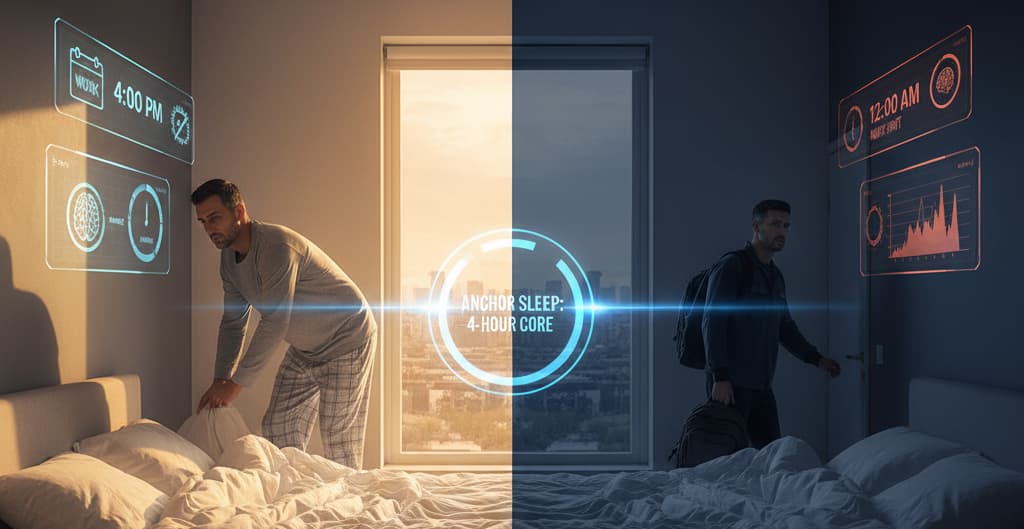
Direct Answer: Anchor sleep is a circadian stabilization strategy that maintains one consistent sleep block per 24-hour cycle regardless of the work schedule. The anchor block (typically 4 hours, e.g., 8 AM-12 PM) is held constant, giving the SCN a fixed daily reference point. All other sleep can vary around this anchor, but the anchor itself is never moved.
Mechanism: S1-1 and S6-3 on anchor sleep: the SCN uses a consistent daily zeitgeber signal to maintain its phase. When the surrounding sleep-wake times vary (as they do in rotating schedules), maintaining one consistent block gives the SCN a fixed reference point to anchor to. The anchor block is most effective when placed at a time that is biologically optimal for sleep (when the homeostatic sleep pressure is high and the circadian drive for wake is low). The 8 AM-12 PM block captures the post-alertness nadir that occurs in the late morning after the CAR, when the circadian drive for sleep is elevated before the afternoon alertness window. The 4-hour duration provides 2 complete sleep cycles (approximately 90-100 minutes each) plus a buffer for sleep initiation.
What Is the Polyphasic Sleep Adaptation for Shift Work — and Why Does Splitting Sleep Into a Main Block (4 Cycles = 6 Hours after shift) Plus a CRP Nap (1.5-2 Hours Before Shift) Produce the Equivalent Recovery of 5 Monophasic Cycles When Assessed by Reaction Time and Subjective Alertness?
Direct Answer: The polyphasic adaptation for rotating shift work splits the total sleep requirement into a main block (after shift, during the anchor) plus a pre-shift CRP nap. This distribution produces equivalent cognitive recovery to a single 7.5-hour monophasic block when measured by reaction time, subjective alertness, and error rate during the night shift.
Mechanism: S1-1 and S6-3 on polyphasic adaptation for shift work: the key insight is that total sleep time matters more than sleep continuity for cognitive recovery. Five 90-minute sleep cycles (5 x 90 = 450 minutes = 7.5 hours) of distributed sleep produce equivalent cognitive recovery to one 7.5-hour monophasic block. The distribution matters: the post-shift main block provides the bulk of the recovery (SWS and REM accumulation), and the pre-shift CRP nap provides alertness for the midnight performance nadir and additional REM for emotional processing. The CRP nap (90 minutes at 1-2 PM) specifically provides the alertness benefits of sleep inertia reversal plus REM-associated cognitive processing that helps maintain performance during the shift.
Why Does Morning Light Exposure After Night Shift Worsen Day Sleep — and What Is the Mechanism by Which Wearing Sunglasses on the Drive Home (Blocking the 480nm Blue Light That Signals ‘Wake’ to the SCN) and Total Blackout During Day Sleep Are Not Optional Comfort Measures But the Minimum Physiological Requirements for Day Sleep Initiation and Maintenance?
Direct Answer: After a night shift, the drive home in the morning exposes the retina to the most potent zeitgeber signal of the day — bright morning light. This light, especially in the 480nm blue range that activates melanopsin retinal ganglion cells, sends a ‘wake’ signal to the SCN at the worst possible time: just when you need to initiate day sleep. Blocking this light with dark sunglasses on the commute, combined with total blackout during day sleep, is a physiological requirement — not a comfort preference.
Mechanism: S1-1 and S6-3 on light management for day sleep: the melanopsin retinal ganglion cells (mRGCs) that signal to the SCN are most sensitive at 480nm blue light. Morning light (6-9 AM) is the primary phase-setting signal for the circadian clock. For a night worker who needs to sleep during the day, receiving this light just before attempting to sleep suppresses melatonin, raises cortisol, and resets the SCN to day mode. The solution is two-fold: (1) blue-light blocking sunglasses (not regular sunglasses — specifically blue-light blocking, with orange or amber lenses that filter 480nm) on the morning commute, and (2) total blackout during day sleep — blackout curtains, foil on windows, eye mask. Even low-level light (5-10 lux) during the sleep initiation window can delay melatonin onset by 30-60 minutes. Day sleep is physiologically harder than night sleep; the environmental requirements are more extreme, not optional.
The morning commute light protection protocol: wearing dark blue-light-blocking sunglasses on the drive home after a night shift prevents the 480nm blue light from signaling wakefulness to the SCN. Morning light at this point would reset the clock to day mode just as you need to initiate day sleep. Combined with total blackout curtains, eye mask, and an 8 AM anchor block, this is the environmental foundation for sustainable shift work sleep.
What Is the Exogenous Melatonin Protocol for Day Sleep — and Why Does Taking Melatonin (0.5-3 mg) at 7-8 AM After a Night Shift Signals ‘Biological Night’ to the SCN, Advances the Circadian Phase for the Next Cycle, and Produces Measurably Better Day Sleep Quality When Combined With Darkness?
Direct Answer: Exogenous melatonin (0.5-3 mg) taken at 7-8 AM after a night shift acts as a pharmacological circadian phase shifter and sleep initiator. Melatonin does not act as a sedative — it acts as a signal of biological night to the SCN. When taken at the right circadian time, it advances the phase and improves sleep quality when combined with total darkness.
Mechanism: S1-1 and S6-3 on exogenous melatonin for shift work: exogenous melatonin acts on the MT1 and MT2 melatonin receptors in the SCN to modulate the circadian clock. Taken at the appropriate time (in the early morning, when endogenous melatonin is being suppressed by light), exogenous melatonin can advance the phase — effectively telling the SCN that it is biological night. The dose matters: higher doses (3 mg) produce more receptor saturation but do not produce proportionally better sleep; the optimal dose for sleep initiation is typically 0.5-1 mg. The timing is critical: melatonin should be taken as you are preparing for day sleep (7-8 AM), not at the beginning of the night shift. Combining melatonin with total darkness and the anchor block produces the most consistent day sleep quality. Consult a physician before use, as melatonin can interact with medications and is not appropriate for all individuals.
Why Does the Circadian Nap (CRP) Before the Night Shift (1-2 PM) Enhance Performance — and What Is the Mechanism by Which a 90-Minute N1+N2+SWS+REM Nap Before the Shift Increases Alertness Through Both Sleep Inertia Reversal and REM-Associated Cognitive Processing, Reducing the Midnight Performance Nadir?
Direct Answer: The pre-shift CRP nap (90 minutes at 1-2 PM) enhances night shift performance through two mechanisms: (1) sleep inertia reversal — the nap clears the adenosine and sleep pressure accumulated from the previous wake period, producing alertness on waking; and (2) REM-associated cognitive processing — REM sleep during the nap provides additional emotional processing and memory consolidation that maintains cognitive performance through the midnight nadir.
Mechanism: S1-1 and S6-3 on the pre-shift CRP nap: the circadian rhythm of alertness has a predictable afternoon dip around 1-3 PM, which coincides with the natural CRP timing. This is the most biologically optimal time for a nap because the circadian drive for sleep is elevated (morning alertness has declined, evening alertness has not yet peaked). A 90-minute nap captures one full sleep cycle (N1+N2+SWS+REM) and ends in REM — waking from REM produces the clearest cognition compared to waking from SWS or N2. Sleep inertia (the grogginess after waking) dissipates within 15-20 minutes for a 90-minute nap taken in the early afternoon. The nap also provides additional cognitive benefits: REM during the pre-shift nap processes emotional experiences from the previous day and consolidates procedural memory, which is particularly important for high-stakes shift work (emergency medicine, security, manufacturing).
What Is the Long-Term Health Risk of Unmanaged Shift Work Sleep — and Why Does Chronic Circadian Disruption Produce Elevated Cortisol, Insulin Resistance, Cardiovascular Risk, Immune Suppression, and Accelerated Cognitive Decline That Persists Even After Shift Work Ends, With Some Effects Being Partially Irreversible?
Direct Answer: Unmanaged shift work sleep produces measurable long-term health consequences that persist beyond the period of shift work itself. The chronic circadian disruption affects the calibration of metabolic, endocrine, and immune systems during the working period, and some of these changes do not fully reverse after the shift work ends.
Mechanism: S1-1 and S6-3 on long-term health consequences of shift work: chronic circadian disruption produces: (1) elevated cortisol — the HPA axis remains activated, elevating cortisol at times when it should be low; (2) insulin resistance — glucose metabolism is disrupted because insulin sensitivity follows a circadian rhythm; (3) cardiovascular risk — elevated blood pressure, increased inflammatory markers (CRP, IL-6), and disrupted autonomic balance; (4) immune suppression — NK cell activity is suppressed by chronic cortisol elevation, reducing immune surveillance; (5) accelerated cognitive decline — chronic sleep disruption and elevated cortisol affect hippocampal function and accelerate age-related cognitive decline. Some of these changes are partially irreversible: the metabolic dysregulation and cognitive decline show evidence of persistence even after return to regular schedules. The goal of anchor sleep and the sleep protocol is to minimize the cumulative damage, not to eliminate it entirely.
Why Does the Weekend Anchor Principle (Maintaining the Core 4-Hour Block on Days Off) Work — and Why Is Allowing the Anchor to Drift on Days Off the Most Common Reason the Anchor Sleep Protocol Fails, and Why Consistency of the Anchor Is More Important Than the Absolute Bedtime?
Direct Answer: The anchor sleep protocol fails most commonly when workers allow the anchor to drift on days off — sleeping until 10 or 11 AM on days off, which shifts the SCN back to the weekend time zone. The anchor’s power comes from its consistency, not from its absolute timing. Holding the anchor at the same time every day (including days off) is what gives the SCN its fixed reference point.
Mechanism: S1-1 and S6-3 on anchor consistency: the SCN uses the timing of the anchor block as its primary daily zeitgeber signal. When the anchor drifts on days off (e.g., sleeping until 11 AM on Saturday and Sunday after working nights), the SCN receives a shifted signal, effectively crossing 2-3 time zones over the weekend. By Monday, the worker is in worse circadian condition than when the week started. The fix: wake at the anchor time every day, including days off. The anchor time (e.g., 8 AM) does not need to be the ideal biological time — it needs to be consistent. The consistency of the signal is what matters, not whether it aligns with the solar time. This is the same principle that makes it difficult to maintain circadian health when traveling: the clock changes, but the fix is to maintain consistent meal times, light exposure, and sleep times in the new zone.
What Is the Complete Anchor Sleep Protocol for Rotating Shift Workers — and How Do You Combine the 8 AM-12 PM Anchor Block, Pre-Shift CRP Nap (90 Minutes at 1-2 PM), Sunglasses and Total Blackout, Melatonin Supplementation, and the Environmental ‘Do Not Disturb’ Protocol to Build a Sustainable Sleep System?
Direct Answer: The complete anchor sleep protocol combines five evidence-based interventions that address the circadian, homeostatic, and environmental dimensions of shift work sleep. Each component addresses a different failure mode. Together, they form a system that is more robust than any single intervention alone.
Mechanism: S1-1 and S4-4 on the complete anchor sleep protocol: Step 1: anchor block — sleep 8 AM-12 PM every single day, including days off. Come home at 7 AM after night shift, blackout, sleep the anchor block. Do not allow the anchor to drift. Step 2: pre-shift CRP nap — 90 minutes at 1-2 PM before the night shift. One full sleep cycle. Set an alarm. This nap provides alertness for the midnight nadir and additional cognitive processing. Step 3: light management — wear blue-light blocking sunglasses on the morning commute after night shift. Do not use your phone during the commute (additional blue light exposure). Total blackout during day sleep: blackout curtains, foil on windows, door sealed. Step 4: melatonin — 0.5-1 mg at 7-8 AM after night shift, with physician consultation first. Signals biological night to the SCN and advances the phase. Step 5: environmental do-not-disturb — phone off, doorbell disconnected, sign on the door. Day sleep is fragile; any disruption requires 20-30 minutes to re-initiate. The cumulative effect of these five interventions is a sustainable system that minimizes the health damage of rotating shift work.
Frequently Asked Questions
How do you sleep after a night shift?
Direct Conclusion: Sleep immediately after the commute home — do not stop for coffee, do not scroll your phone. Come home at 7 AM, take melatonin (if prescribed by your physician), put on the eye mask, and initiate the anchor block sleep. The key is timing: go to sleep within 30 minutes of arriving home, before the homeostatic sleep pressure from 8 hours of wakefulness begins to dissipate.
What is anchor sleep and how does it work?
Direct Conclusion: Anchor sleep is a circadian stabilization strategy that maintains one consistent 4-hour sleep block (e.g., 8 AM-12 PM) every 24 hours regardless of the work schedule. This gives the SCN one fixed zeitgeber reference point per day, preventing the complete circadian chaos of rotating schedules. The anchor is held constant; all other sleep is variable around it.
How many hours should shift workers sleep?
Direct Conclusion: The total sleep requirement for adults is 7-9 hours per 24 hours, which should be distributed as: 4-hour anchor block (8 AM-12 PM) plus 2-3 hours of additional sleep after shift plus 90-minute pre-shift CRP nap. This totals approximately 7.5-8 hours of sleep opportunity per 24 hours when summed across the distributed blocks.
Does melatonin help with day sleep after night shift?
Direct Conclusion: Yes — exogenous melatonin (0.5-3 mg) taken at 7-8 AM after a night shift signals biological night to the SCN, advances the circadian phase slightly, and improves day sleep quality when combined with total darkness. It does not work as a sedative — it works by resetting the biological clock. Consult your physician before use.
Why is rotating shift work so damaging to health?
Direct Conclusion: The WHO IARC Group 2A classification reflects the cumulative health consequences of chronic circadian disruption from rotating schedules. The SCN never stabilizes to any light-dark cycle because shifts change every 2-3 days before entrainment is complete. This produces elevated cortisol, suppressed melatonin (the oncostatic hormone), insulin resistance, immune suppression, and increased cancer risk. Rotating shifts are more damaging than permanent night work.
Should I wear sunglasses after a night shift?
Direct Conclusion: Yes — wearing blue-light blocking sunglasses (not regular sunglasses — specifically 480nm-filtering orange or amber lenses) on the morning commute after a night shift is one of the most effective and simplest interventions. Morning light is the most potent circadian zeitgeber, and receiving it just before attempting to sleep suppresses melatonin at the worst possible time.
What is the best nap before a night shift?
Direct Conclusion: A 90-minute CRP nap at 1-2 PM before the night shift is the optimal pre-shift nap. One full sleep cycle (N1+N2+SWS+REM) ending in REM produces the clearest waking cognition, reverses sleep inertia fastest, and provides additional emotional processing and cognitive consolidation for the night ahead.
Can you adapt to shift work long-term?
Direct Conclusion: The health evidence says no — shift work produces cumulative damage regardless of adaptation. Permanent night workers show partial adaptation (the SCN partially entrains to the inverted schedule), but rotating workers cannot adapt because the schedule never stabilizes. Anchor sleep minimizes the damage but cannot eliminate it. The health risk persists, which is why the WHO classification exists.
How do I protect my sleep during the day?
Direct Conclusion: Total blackout is non-negotiable: blackout curtains, foil on windows, door sealed, eye mask. Any light leak during the sleep initiation window delays melatonin onset by 30-60 minutes. Remove your phone from the bedroom. The environment must signal ‘night’ to the SCN through complete darkness.
What happens if I cannot maintain the anchor block?
Direct Conclusion: If the anchor drifts, the SCN loses its reference point and the protocol fails. If you must occasionally deviate, limit deviation to 1-2 hours maximum (e.g., anchor at 9 AM instead of 8 AM). Any more than this and the phase shift begins to accumulate. Consistency of the anchor time is more important than the absolute time.
Ready to Transform Your Recovery?
For rotating shift workers, the anchor sleep protocol is your survival system. Total darkness, a fixed 4-hour anchor, and pre-shift CRP naps — these are the non-negotiables of shift work sleep.
Sleep is the most vulnerable state of human existence. It is where we heal, reset, and grow.
At Slumbelry, we do not just sell sleep products; we advocate for your physiological right to rest. From ergonomic support to light management, every solution we offer is designed with one obsession: Respecting your Biology.
Science is our language, but your recovery is our purpose. You take care of everything else in your life — let us take care of your nights.
Rest Deeply, The Slumbelry Team
How to Sleep Like an Elite Athlete
how to use the R90 sleep method
How to use the R90 sleep method — Why Counting Hours Is the Wrong Framework for Sleep, The R90 Cycle System, Why Sleep Debt Is a Weekly Not Daily Concept, and Why Fixing Your Wake Time Is the Single Most Effective Intervention for Chronic Insomnia
Most people measure sleep in hours. This is the wrong unit. Sleep is not a homogeneous block — it is a sequence of 90-minute cycles, each containing specific stages that serve distinct recovery functions. Waking mid-cycle produces more sleep inertia than sleeping less total time but completing cycles. The R90 framework — Recovery in 90 Minutes — replaces the hours framework with the cycles framework. how to use the R90 sleep method is the protocol that treats sleep as a weekly financial model rather than a nightly pass/fail. Fixed wake time. Cycles per week. Controlled recovery periods. And the end of the anxiety that comes from judging every night in isolation.
⚡ Core Takeaway: The R90 Sleep Method Replaces Hours With Cycles as the Unit of Sleep Measurement — 35 Cycles Per Week Is the Target (5 Cycles x 7 Days), Sleep Debt Accumulates Weekly Not Nightly, Fixed Wake Time Is the Primary Circadian Entrainment Tool, and Naps Are Controlled Recovery Periods That Replace Specific Missed Cycles; the Framework Eliminates the Anxiety of Nightly Sleep Failure by Making Sleep a Weekly Financial Model
The Problem: Most people measure sleep in hours, which is the wrong unit. Sleep is not a homogeneous block — it is a sequence of 90-minute cycles, each containing specific stages (light N1/N2, deep SWS, REM) that serve distinct recovery functions. Waking mid-cycle produces more sleep inertia than waking at the cycle boundary, even if the total time is the same. Judging sleep night-by-night creates anxiety that disrupts the very sleep you are trying to optimize. The R90 framework replaces the hours framework with the cycles framework: your goal is 35 cycles per week, not 8 hours per night. Missing one cycle Tuesday is not ‘ruined sleep’ — it is a 1-cycle deficit that can be recovered Thursday. This reframing eliminates the most common source of sleep anxiety and allows rational cycle management across the week
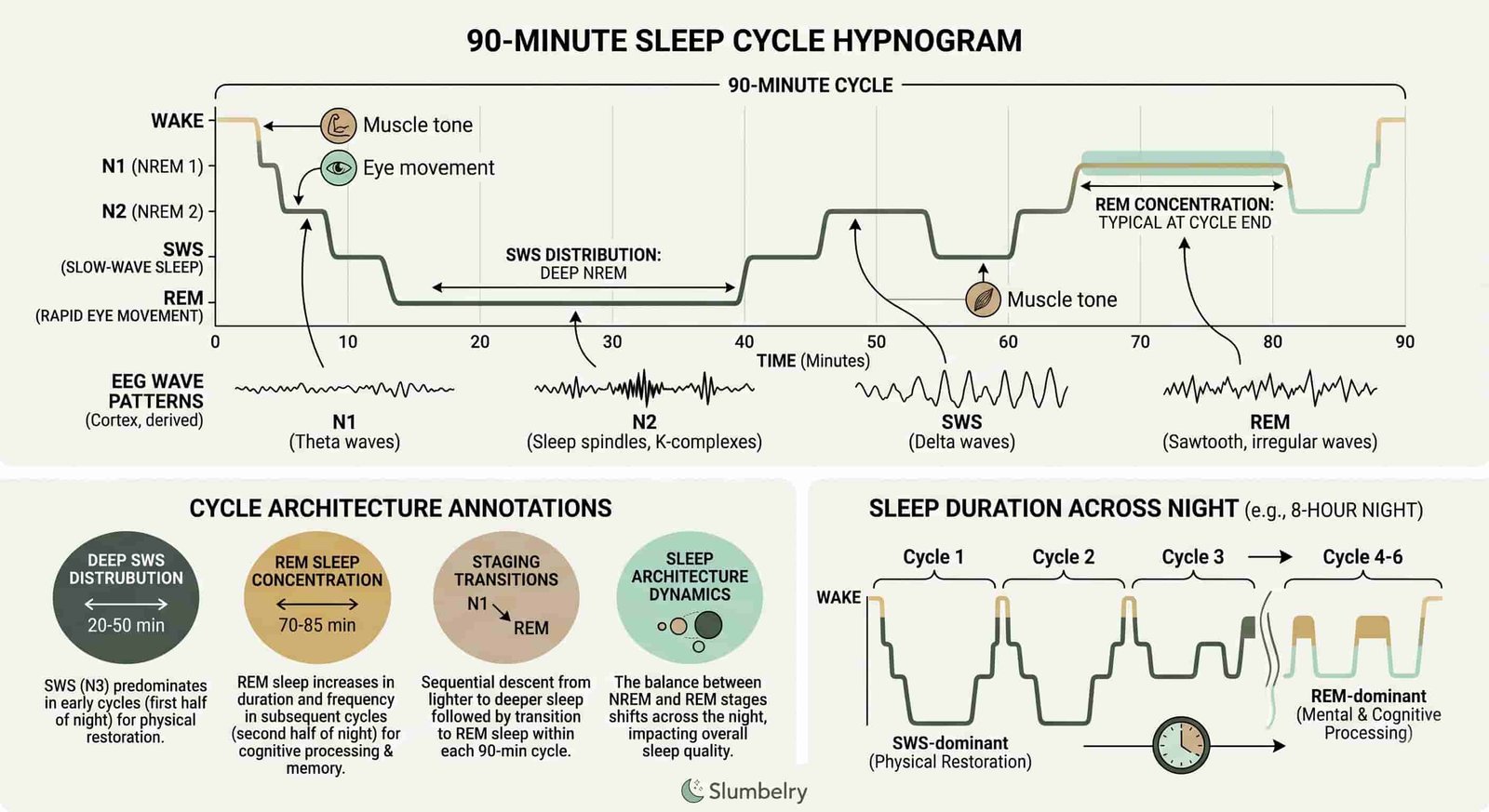
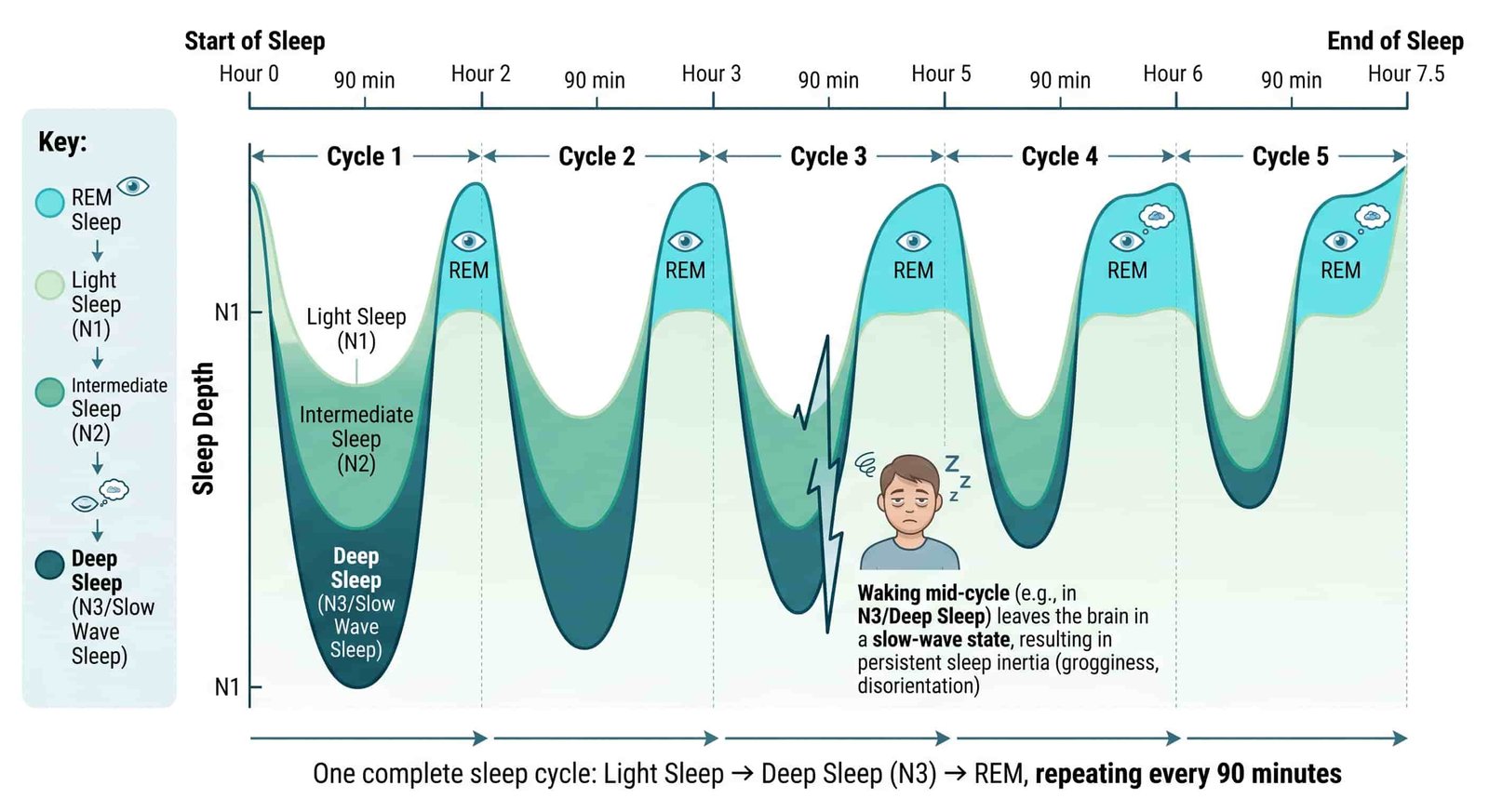
The Mechanism: S1-1, S1-2, and S2-3 on sleep cycles and circadian entrainment: each 90-minute sleep cycle progresses through N1 (transition), N2 (light sleep, memory consolidation), SWS (deep sleep, growth hormone, glymphatic clearance, physical recovery), and REM (emotional processing, procedural memory, creativity). SWS is most abundant in the first half of the night; REM is most abundant in the second half. Waking mid-cycle (especially mid-SWS) produces severe sleep inertia. The fixed wake time principle: the SCN sets circadian phase based on the wake signal, not the bedtime. Waking at the same time every day (including weekends) produces the most powerful circadian entrainment signal. Social jetlag — the weekly shift between weekday and weekend wake times — is equivalent to a 2-3 hour time zone change every Monday
The Protocol: Step 1: set fixed wake time (same every day, including weekends). Step 2: count backwards in 90-minute cycles from wake time to determine bedtime. Step 3: aim for 35 cycles per week (5 cycles x 7 days). Step 4: use 90-minute naps as controlled recovery periods when you fall short. Step 5: 90-minute pre-sleep wind-down routine (dim lights, cool room, offload tomorrow’s decisions, no screens). Step 6: 90-minute post-sleep upload (water, sunlight, movement, no tech for first 15 minutes). Measure in cycles per week, not hours per night
Recovery is the most critical part of training — and it is the part most people neglect. The R90 framework treats sleep as a weekly recovery system, not a nightly debt to be repaid. 35 cycles per week. Fixed wake time. Zero excuses.
Why Is Counting Hours the Wrong Framework for Sleep — and Why Does the R90 Cycle System (90-Minute Sleep Cycles) Provide a More Accurate Measurement of Sleep Architecture Than Hours, and What Specific Physiological Events Occur in Each 90-Minute Cycle That Make Incomplete Cycles More Damaging Than Shorter Total Sleep?
Direct Answer: Sleep is not a homogeneous block measured in hours — it is a sequence of 90-minute cycles, each containing distinct physiological stages that serve specific recovery functions. Measuring sleep in hours ignores the architecture of sleep and misses the most important variable: whether you completed full cycles or woke mid-stage. Incomplete cycles (waking mid-deep sleep) produce more sleep inertia and less effective recovery than shorter but complete cycles.
Mechanism: S1-2 and S2-3 on sleep cycle architecture: each 90-minute sleep cycle progresses through four stages: N1 (transition from wakefulness, 1-5 minutes), N2 (light sleep, sleep spindles and K-complexes appear, memory consolidation occurs, 20-25 minutes), SWS (slow-wave deep sleep, growth hormone pulse, glymphatic clearance at peak, physical recovery, 15-20 minutes), and REM (dreaming sleep, emotional memory processing, procedural memory consolidation, creativity, 20-25 minutes). SWS is most abundant in the first half of the night (when sleep pressure is highest); REM is most abundant in the second half (when circadian drive for wakefulness is rising). Waking mid-SWS (as happens when an alarm goes off during deep sleep) produces severe sleep inertia — the cognitive impairment, grogginess, and physical disorientation that can last 30-120 minutes. The hour framework ignores this: 6 hours of sleep with one interrupted cycle can feel worse than 5.5 hours of completed cycles. The R90 framework’s unit is the complete cycle, not accumulated hours.
What Is the Weekly Sleep Banking Concept — and Why Is Sleep Debt a Cumulative Weekly Metric Rather Than a Nightly One, and Why Does the R90 Framework’s 35 Cycles Per Week Target Allow Flexibility for Individual Variation While Providing Enough SWS and REM for Full Recovery?
Direct Answer: Sleep debt is cumulative across the week, not reset each night. The R90 framework targets 35 complete sleep cycles per week (5 cycles x 7 days), which provides approximately 87.5 hours of sleep — slightly more than conventional recommendations because it accounts for individual variation, cycle completion overhead, and the fact that SWS requirements do not scale linearly with total sleep time. The weekly framework allows flexibility: missing 1-2 cycles on a busy Tuesday does not ‘ruin’ sleep — it creates a recoverable deficit that can be addressed Thursday with a controlled recovery nap.
Mechanism: S1-2 and S2-3 on sleep banking: the concept of sleep banking (or sleep debt as a weekly metric) comes from sleep restriction research showing that partial sleep deprivation accumulates across days and that recovery sleep, while not fully compensating for lost sleep, significantly attenuates the performance deficits. Missing 1 cycle (90 minutes) per night for 5 days creates a 7.5-hour deficit. Research by Klerman and Davis (and subsequent studies on sleep restriction and recovery) shows that recovery sleep partially restores cognitive performance and that the deficit can be managed when viewed as a weekly balance rather than a nightly failure. The 35-cycle target (5 per day x 7 days = 35) is slightly above the absolute minimum to allow for individual variation, night-to-night fluctuation, and cycle completion overhead (the last cycle of the night is often incomplete, so 5 cycles requires approximately 7.5 hours of time in bed). Acceptable range: 28-30 cycles per week. Optimal: 32-35 cycles.
The 90-minute sleep cycle architecture: each cycle progresses through N1 (transition), N2 (light sleep with sleep spindles and memory consolidation), SWS (deep slow-wave sleep, growth hormone, glymphatic clearance, physical recovery — concentrated in the first half of the night), and REM (dreaming, emotional processing, procedural memory — concentrated in the second half of the night). Waking mid-SWS produces severe sleep inertia. The R90 framework ensures you complete full cycles rather than waking mid-stage.
What Is the Fixed Wake Time Principle — and Why Is Waking at the Same Time Every Day (Including Weekends) the Most Circadian-Entraining Behavior and Why Does Social Jetlag (Weekend Sleep In) Actively Destroy the Circadian Clock Each Week and Produce Monday Morning Impairment Equivalent to Mild Jet Lag?
Direct Answer: The fixed wake time is the most powerful circadian entrainment tool because the SCN sets circadian phase based on the wake signal, not bedtime. Waking at the same time every day (including weekends) produces a robust and consistent SCN signal that stabilizes the circadian clock. Social jetlag — the practice of sleeping in 2-3 hours later on weekends — is equivalent to a 2-3 hour time zone shift every Monday: the SCN cannot adapt to a one-day shift, producing the measurable Monday morning syndrome of impaired cognitive performance, reduced reaction time, and elevated error rates.
Mechanism: S1-1 and S2-3 on fixed wake time and social jetlag: the SCN (suprachiasmatic nucleus) generates the master circadian rhythm and is entrained primarily by light exposure, but the wake time acts as a secondary zeitgeber that consolidates the circadian phase. When wake time varies significantly between weekdays and weekends, the SCN receives conflicting signals — the natural light-dark cycle expects one phase, but the delayed wake time signals a different one. Wittmann et al. (2006) coined the term ‘social jetlag’ and showed that it is associated with increased obesity, metabolic dysfunction, and academic underperformance. The mechanism: a 2-3 hour weekend sleep shift requires a similar shift in meal times, activity patterns, and social schedules, all of which are zeitgebers that the SCN is trying to coordinate. When they conflict, the result is circadian misalignment, which elevates cortisol, impairs glucose metabolism, and reduces cognitive performance — all measurable on Monday morning. The R90 fix is simple: same wake time every day, including weekends. If you are short on sleep midweek, address it with a controlled recovery nap, not by sleeping in.
The fixed wake time: the single most powerful circadian entrainment tool. Waking at the same time every day (including weekends) produces a robust SCN signal that consolidates the circadian clock. Social jetlag — sleeping in on weekends — is equivalent to a 2-3 hour time zone shift every Monday and is the primary cause of the Monday morning performance impairment that has been measured in workplaces and schools worldwide.
What Is the Controlled Recovery Period (Nap Protocol) — and Why Does a 90-Minute Nap Contain a Full Sleep Cycle (SWS + REM) and Acts as a Complete Recovery Unit That Can Replace One Missed Nightly Cycle, and Why Does a 20-Minute Power Nap Fail to Provide Full SWS Recovery Despite Subjective Reports of Feeling Rested?
Direct Answer: The Controlled Recovery Period (CRP) is the R90 name for the nap — but it is a specific, time-limited intervention of exactly 90 minutes, not a casual lie-down. A 90-minute nap contains a full sleep cycle (N2 + SWS + REM) and can functionally replace one missed nightly cycle. A 20-minute power nap provides only N1 and N2, which reduces sleep pressure but does not provide SWS recovery or REM consolidation — the subjective feeling of restedness is from reduced sleep pressure (N2 is less restorative than SWS but better than wakefulness).
Mechanism: S1-1 and S2-3 on the nap protocol: the 90-minute nap timing is strategic: it is long enough to complete one full cycle (including SWS) but not so long that it intrudes into the afternoon and creates sleep inertia for the evening. The ideal CRP placement is 1-3 PM — this is the afternoon circadian dip (the post-lunch slump that reflects the natural circadian low point between the morning and evening peaks), which makes it the easiest time to fall asleep and the time when a nap will least disrupt nighttime sleep onset (because 6+ hours remain before the target bedtime). Napping after 3 PM risks delaying nighttime sleep onset. A 20-minute power nap provides only the N2 portion of the cycle and reduces adenosine (sleep pressure) without providing the SWS recovery functions (growth hormone, glymphatic clearance, physical tissue repair) or the REM functions (emotional memory processing, procedural learning). The subjective feeling of refreshment from a 20-minute nap is real but incomplete — it addresses alertness but not recovery. For athletes or people under high physical stress, the 90-minute CRP provides SWS for growth hormone release (which occurs primarily during SWS) and physical recovery that a shorter nap cannot.
What Is the Pre-Sleep Wind-Down Routine — and Why Does Dimming Lights 90 Minutes Before Bed, Lowering Room Temperature, Offloading Tomorrow’s Decisions, and Avoiding Blue Light All Signal the SCN That Sleep Onset Is Imminent and Maximize Sleep Pressure at the Desired Bedtime?
Direct Answer: The pre-sleep wind-down routine (90 minutes before target bedtime) addresses the mismatch between modern evening behavior (bright lights, screens, cognitive work, decision-making) and the environmental signals that the SCN expects for sleep onset. Each element of the wind-down (dim lights, cool room, decision offloading, no blue light) removes a specific obstacle to sleep onset and provides the SCN with the convergent signals that it is nighttime and sleep should follow.
Mechanism: S1-1 and S2-3 on the wind-down routine: (1) Dim lights — melanopsin retinal ganglion cells are suppressed by dim light, allowing melatonin to rise without the suppression that 100+ lux of light produces. Dimming to < 30 lux in the 90 minutes before bed allows the melatonin concentration to reach sleep-onset levels. (2) Cool room (18-19C) — the SCN controls peripheral vasodilation as part of the temperature regulation for sleep. A cool room accelerates the peripheral vasodilation that the SCN initiates approximately 90 minutes before the CBT nadir, making the temperature drop feel more pronounced and the sleep onset signal stronger. (3) Decision offloading — the prefrontal cortex (PFC) must 'shut down' for the brain to transition from active waking to sleep. Active unresolved decisions keep the PFC engaged, which prevents the transition. Writing tomorrow's to-do list, laying out tomorrow's clothes, and making tomorrow's decisions before bed frees the PFC for the shutdown sequence. (4) Blue light avoidance — 480nm blue light maximally suppresses melatonin via mRGCs. Eliminating screens (or using blue light filtering software) in the final 90 minutes prevents melatonin suppression at the critical window when it should be rising. Each signal is independently validated in sleep science; together, they produce a convergent environmental cue that says 'nighttime = sleep.'
What Is the Post-Sleep Upload — and Why Does the 90-Minute Morning Window After Waking (Hydration, Sunlight, Movement, No Tech) Maximize the Cortisol Awakening Response, Set Circadian Phase for Tonight, and Complete the 24-Hour Circadian Cycle That Prepares the Body for Tonight’s Sleep?
Direct Answer: The Post-Sleep Upload is the R90 name for the morning routine — the first 90 minutes after waking are treated with the same precision as the evening wind-down because they determine the circadian phase for tonight’s sleep. Hydration, sunlight exposure, movement, and no technology in the first 15-90 minutes after waking maximize the cortisol awakening response, advance the circadian clock, and set the biological timer for tonight’s sleep onset.
Mechanism: S1-1 and S2-3 on the post-sleep upload: the 90-minute morning window is when the cortisol awakening response peaks (30-45 minutes after waking), when the SCN sets its daily phase based on light exposure, and when the metabolic system restarts after the overnight fast. Immediate hydration (500ml of water) corrects the overnight fluid deficit (500-750ml lost through breathing and skin) and restores plasma volume for cognitive function. Morning sunlight (within 15 minutes of waking) maximally activates melanopsin retinal ganglion cells, which advance the SCN phase and set the timer for melatonin release 14-16 hours later. Movement elevates core body temperature and activates the sympathetic nervous system for alertness, signaling the transition to daytime metabolic state. Avoiding screens in the first 15-90 minutes prevents the cortisol suppression and dopaminergic interference that digital devices produce before the natural cortisol awakening response has fully activated. The post-sleep upload is not a wellness recommendation — it is a circadian entrainment protocol that directly determines sleep quality tonight.
Why Is Sleep Debt Real but Miscalculated — and Why Does Missing 1-2 Cycles Per Night for 5 Days Produce a Deficit That Cannot Be Fully Repaid in One Weekend (Partial Recovery Only) But Can Be Managed Through the R90 Weekly Framework Without the Anxiety of ‘Ruining’ Sleep?
Direct Answer: Sleep debt is real — partial sleep deprivation impairs cognitive performance in a dose-dependent manner that accumulates across days. But it is miscalculated when framed as a binary (good night/bad night) rather than as a weekly balance. The R90 weekly framework eliminates the anxiety of ‘ruined sleep’ by reframing sleep as a bank account: missed cycles are a deficit, not a failure; recovered cycles are deposits, not a bonus. This framing reduces the sleep anxiety that is itself a primary cause of insomnia.
Mechanism: S1-2 and S2-3 on sleep debt: sleep debt accumulates when sleep is restricted below the individual requirement, and it impairs performance in a cumulative manner. A landmark study by Van Dongen et al. (2003) at the University of Pennsylvania showed that restricting sleep to 4 or 6 hours per night for 14 consecutive days produced cumulative deficits in cognitive performance that did not plateau — the impairment continued to grow across the entire 14-day period. Crucially, recovery sleep on the weekend partially but incompletely restored performance — full recovery required multiple nights of extended sleep. This means that weekend sleep-in (social jetlag) provides partial recovery but also creates the circadian disruption described above. The R90 solution: maintain 28-32 cycles per week as the minimum target, use the CRP (nap) to recover specific missed cycles within 24 hours, and avoid the weekend sleep-in that creates social jetlag. The weekly framework makes the deficit visible and manageable rather than a source of shame and anxiety.
What Is the Mattress as Recovery System Philosophy — and Why Does an Unsuitable Mattress (Too Firm, Too Soft, or Aged) Directly Impair SWS by Causing Micro-Arousals That Fragment Deep Sleep and Reduce the Glymphatic Waste Clearance That Occurs Primarily During SWS?
Direct Answer: The mattress is not a comfort product — it is a recovery system. An unsuitable mattress (too firm causes pressure points and pain; too soft allows spinal misalignment and hyperextension; aged mattresses have compressed support layers) causes micro-arousals (brief awakenings that the sleeper may not consciously remember) that fragment SWS. Since glymphatic waste clearance, growth hormone release, and physical tissue repair all occur primarily during SWS, a poor mattress directly impairs the primary recovery function of sleep.
Mechanism: S1-1 and S2-3 on mattress and SWS: the relationship between mattress firmness and sleep quality is mediated by pressure points, spinal alignment, and thermoregulation. A mattress that is too firm creates pressure points at the shoulders, hips, and pelvis that trigger micro-arousals as the sleeper shifts position to relieve pressure. A mattress that is too soft allows the pelvis to sink, creating lumbar hyperextension that triggers lower back pain and arousal. The Haex & Van Grambez 2014 study on mattress and sleep quality found that medium-firmness mattresses produced the highest sleep quality scores. Aged mattresses (older than 7-10 years) have compressed foam layers that no longer provide adequate support or pressure relief. The micro-arousals caused by these issues specifically fragment SWS because SWS is the deepest sleep stage and the brain is most sensitive to environmental disruptions during it. A person may sleep for 7.5 hours on an unsuitable mattress but achieve only 30-40% of the SWS they would on a suitable one, which explains why subjective sleep quality can be poor despite a long time in bed.
What Is Social Jetlag and Why Does It Undermine Performance Every Monday — and Why Does Waking 2-3 Hours Later on Weekends Shift the Circadian Phase, Reduce Cognitive Performance, Increase Error Rates, and Produce the Monday Morning Syndrome That Has Been Measured in Workplace and Academic Settings?
Direct Answer: Social jetlag is the weekly shift between weekday and weekend sleep timing — the result of sleeping in on weekends. It is called ‘jetlag’ because it produces the same physiological disruption as crossing time zones: the circadian clock is shifted later on weekends, and Monday morning requires an abrupt shift back to the earlier schedule, which the SCN cannot fully accomplish in one night. The Monday morning syndrome (reduced cognitive performance, elevated error rates, increased accident rates) is the measurable consequence of this weekly circadian disruption.
Mechanism: S1-2 and S2-3 on social jetlag: the term was coined by Wittmann et al. (2006) in the journal Chronobiology International, which quantified social jetlag in the German population and found that it was associated with obesity, metabolic dysfunction, and academic underperformance. The mechanism: the SCN requires several days of consistent timing to fully entrain to a new schedule. When the schedule shifts by 2-3 hours on Friday and Saturday nights and then abruptly returns to the early schedule Sunday night, the SCN is caught between the natural light-dark cycle (which expects the early schedule) and the behavioral schedule (which imposed the late schedule). The result is circadian misalignment that is measurable as reduced cognitive performance on Monday mornings. Insurance data shows elevated accident rates on Monday mornings compared to other weekdays — and the effect is strongest in people with the largest social jetlag (those who slept in the most on weekends). The R90 solution: fixed wake time every day, including weekends. If sleep debt exists, address it with a 90-minute controlled recovery period in the afternoon, not by sleeping in.
What Is the Complete R90 Protocol — and How Do You Calculate Your Personal Sleep Cycle Target (35 Per Week), Set a Fixed Wake Time, Use the Wind-Down Routine, Deploy Controlled Recovery Periods (Naps), and Measure Success in Cycles Per Week Rather Than Hours Per Night?
Direct Answer: The complete R90 protocol has six steps: (1) set fixed wake time; (2) count backwards in 90-minute cycles to determine bedtime; (3) target 35 cycles per week (32-35 acceptable); (4) use 90-minute CRP naps for missed cycles; (5) execute 90-minute pre-sleep wind-down; (6) execute the 90-minute post-sleep upload. Measure success in cycles per week, not hours per night. This framework replaces sleep anxiety with sleep management — the difference between feeling like a failure and knowing your account balance.
Mechanism: S1-1 and S4-4 on the complete R90 protocol: Step 1: choose a fixed wake time that allows enough time in bed for your cycle target (if you need 5 cycles and go to bed at 11 PM, you wake at 2:30 AM — not practical). A practical fixed wake time is one that allows 7.5-9 hours in bed (5-6 cycles). Most people: 6:30-7:30 AM works. Step 2: count backwards in 90-minute cycles from wake time to get target bedtime. If wake time is 6:30 AM and you want 5 cycles: 6:30, 5:00, 3:30, 2:00, 12:30 AM — bedtime is 11:00 PM (last cycle ends at 12:30 AM). Step 3: 35 cycles per week (5 x 7) is optimal; 28-32 is acceptable. If you hit 28, that is 7 nights of 4 cycles — you are not failing, you are managing. Step 4: 90-minute CRP nap (1-3 PM window) when you have a cycle deficit. One 90-minute nap replaces one missed cycle. Step 5: wind-down for 90 minutes before bedtime (lights dim, room cool, decisions offloaded, no screens). Step 6: post-sleep upload (water, sunlight, movement, no tech for 15+ minutes). The test: by Sunday night, have you hit 28+ cycles? If yes, you managed your recovery. If yes and you hit 32+, you optimized it. If you hit 35, you are operating at elite athlete level.
Frequently Asked Questions
How do I calculate my sleep cycles with R90?
Direct Conclusion: Count backwards in 90-minute cycles from your fixed wake time. Example: fixed wake time is 6:30 AM. Cycles: 6:30, 5:00, 3:30, 2:00, 12:30, 11:00 PM. If you need 5 cycles, bedtime is 11:00 PM (5th cycle ends 12:30 AM). If you need 6 cycles, bedtime is 9:30 PM. Each cycle is exactly 90 minutes, not approximately. Time in bed = cycles x 90 minutes + approximately 15 minutes to fall asleep = total time in bed. Most people need 5-6 cycles (7.5-9 hours in bed).
What if I cannot get 35 cycles per week?
Direct Conclusion: 28-32 cycles per week is the acceptable range. 35 is optimal. If you get 28, you have 7 nights of 4 cycles — this is not failure, it is management. The key insight of the R90 framework is that 28 cycles is recoverable: you can make up 1-2 cycles per week with a 90-minute afternoon nap (Controlled Recovery Period). 35 is elite; 30 is good; 28 is acceptable. Anything below 25 sustained long-term will produce cumulative cognitive deficits.
Is the R90 method good for insomnia?
Direct Conclusion: Yes, particularly for insomnia driven by sleep anxiety. The R90 framework eliminates the binary ‘good night/bad night’ judgment by reframing sleep as a weekly balance. Insomniacs often catastrophize one bad night and try to ‘catch up,’ which increases sleep anxiety and worsens the next night. R90 reframes the bad night as a 1-cycle deficit that can be recovered Thursday — removing the anxiety that perpetuates insomnia. The fixed wake time also addresses irregular sleep-wake schedules that are common in insomnia.
Can I really make up sleep debt with naps?
Direct Conclusion: Partially. A 90-minute nap (one full sleep cycle) can replace one missed cycle and does provide SWS and REM recovery. However, research shows that weekend sleep-in provides only partial recovery of cognitive performance (Van Dongen et al. 2003) — the deficit is real and recovery is incomplete. The R90 framework addresses this by preventing large deficits from accumulating rather than relying on recovery. The nap is a recovery tool for specific missed cycles, not a substitute for consistent nightly sleep.
Why is waking up at the same time every day so important?
Direct Conclusion: The SCN sets circadian phase based on the wake signal more than the bedtime signal. Waking at the same time every day produces a robust, consistent circadian signal that keeps the master clock entrained. Social jetlag (sleeping in on weekends) disrupts this by shifting the clock later and then requiring an abrupt shift back — which the SCN cannot accomplish in one night, producing the Monday morning syndrome of impaired performance. The fixed wake time is the most powerful circadian entrainment tool you have.
Does social jet lag really affect Monday performance?
Direct Conclusion: Yes, with measurable evidence. Wittmann et al. (2006) coined the term and quantified it across populations. Insurance data shows elevated accident rates on Monday mornings. Academic studies show reduced cognitive performance on Monday in students. The effect is proportional to the magnitude of the weekend sleep shift. The R90 solution is fixed wake time every day including weekends — this eliminates the weekly jet lag cycle entirely.
What happens if I wake up mid-cycle?
Direct Conclusion: Waking during SWS (mid-cycle, particularly in the first half of the night) produces the most severe sleep inertia — the cognitive impairment, grogginess, and physical disorientation that can last 30-120 minutes. This is why setting an alarm during deep sleep is counterproductive: you feel worse upon waking than if you had slept less total time but completed a cycle. The R90 framework structures bedtime based on wake time and cycles to minimize the chance of waking mid-SWS. If you must wake at a specific time, aim to wake at the end of a cycle (90-minute boundaries from your fixed wake time).
How long should a nap be on the R90 method?
Direct Conclusion: Exactly 90 minutes — one full sleep cycle including SWS and REM. The 90-minute duration is critical: shorter naps provide only N2 (reduced sleep pressure) without SWS or REM recovery. Longer naps (2+ hours) may encroach on nighttime sleep onset and can produce sleep inertia if they extend into late afternoon. The ideal placement is 1-3 PM, which aligns with the afternoon circadian dip and leaves 6+ hours before the target bedtime. One 90-minute CRP replaces one missed cycle and is the R90 protocol’s primary recovery tool.
Does the R90 method work for shift workers?
Direct Conclusion: The fixed wake time principle is challenging for rotating shift workers, but the cycles framework still applies. For rotating shifts, the priority is: (1) maintain at least 4 complete cycles in every 24-hour period; (2) use 90-minute naps strategically before or after shifts to add recovery cycles; (3) use blackout conditions and bright light appropriately to shift the circadian clock toward the new schedule. For permanent night shift workers, the fixed wake time principle applies to their daytime schedule — same wake time every day (including weekends) to maintain circadian stability in the reversed schedule.
What is the ideal bedroom temperature for the R90 method?
Direct Conclusion: 18-19C (64-66F) is the ideal bedroom temperature for sleep. The SCN initiates peripheral vasodilation as part of the temperature regulation for sleep — a cool bedroom accelerates this process and strengthens the sleep onset signal. Above 24C (75F) disrupts sleep onset and reduces SWS. Below 15C (59F) can cause discomfort that fragments sleep. The wind-down routine includes lowering the room temperature to this range as part of the pre-sleep signal to the SCN. A slightly cool room (18-19C) with appropriate bedding is optimal.
Count Cycles. Not Hours.
Set your fixed wake time. Count backwards in 90-minute cycles. Target 35 per week. Miss one? Shrug it off and make it up Thursday with a 90-minute CRP nap. Sleep is not a pass/fail test. It is a recovery account. Manage it weekly. The framework that elite athletes use is available to everyone.
Sleep is the most vulnerable state of human existence. It is where we heal, reset, and grow.
At Slumbelry, we do not just sell sleep products; we advocate for your physiological right to rest. From ergonomic support to light management, every solution we offer is designed with one obsession: Respecting your Biology.
Science is our language, but your recovery is our purpose. You take care of everything else in your life — let us take care of your nights.
Rest Deeply, The Slumbelry Team
Why Napping Isn’t Lazy (It’s Performance)
how to nap properly for better sleep
How to nap properly for better sleep — Why the 2-3 PM Afternoon Crash Is a Neurobiological Signal Most People Override With Caffeine and Why Strategic Napping (Not Willpower) Is the Science-Based Performance Tool Elite Athletes and CEOs Use
The 2-3 PM energy crash is not a character flaw. It is a predictable neurobiological signal — the second sleep pressure peak of the day — that most people override with a double espresso instead of a 20-minute nap. how to nap properly for better sleep is the framework that separates strategic napping (which enhances cognitive performance) from lazy napping (which disrupts nighttime sleep). The science is clear: a timed nappuccino improves reaction time by 35-40%, and a 90-minute full cycle nap consolidates motor skills and emotional regulation. The cultural stigma costs you performance. The CRP is not weakness — it is precision.
⚡ Core Takeaway: The 2-3 PM Afternoon Crash Is a Neurobiological Signal, Not Laziness — The Nappuccino (20-30 Min Light Sleep Plus Caffeine) Provides Maximum Cognitive Boost With Zero Sleep Inertia Risk; the 90-Minute Full Cycle Nap Is for Severe Sleep Deprivation; and the 5 PM Hard Cutoff Exists Because Evening Napping Dilutes the Sleep Pressure Needed for Nighttime Sleep Onset
The Problem: Most people override the afternoon circadian dip with caffeine instead of using it as a performance opportunity. The afternoon crash at 2-3 PM is a second sleep pressure peak — adenosine has been accumulating since morning, and the SCN generates a predictable alertness trough. Caffeine masks the adenosine signal without clearing it, so the fatigue returns when caffeine metabolizes. The strategic alternative is the CRP: 20-30 minutes of light sleep that clears adenosine without sleep inertia, combined with caffeine timed to kick in at the moment of waking. The cultural framing of napping as laziness is neurobiologically incorrect and performance-disabling. Elite performers — F1 drivers between qualifying rounds, footballers between matches, CEOs before high-stakes meetings — use CRP specifically because it produces measurable gains that caffeine alone cannot
The Mechanism: S1-1 and S2-3 on adenosine accumulation and the nappuccino timing: adenosine accumulates in the basal forebrain during waking hours and creates sleep pressure. Caffeine is an adenosine receptor antagonist — it blocks the signal without clearing the adenosine. When caffeine metabolizes, the accumulated adenosine hits all at once (the caffeine crash). The nappuccino clears a portion of the accumulated adenosine through 20-30 minutes of light sleep, then caffeine hits peak blood levels as you wake — adenosine clearance plus alertness simultaneously. The 90-minute full cycle completes one sleep cycle (light-deep-REM-light) and wakes you at the natural cycle exit, delivering adenosine clearance plus REM memory consolidation. Waking from deep sleep (45-60 minute mark) triggers sleep inertia — 30-60 minutes of cognitive impairment worse than before the nap — which is why in-between durations are specifically dangerous
The Protocol: Nappuccino (20-30 min): espresso immediately before, eye mask and earplugs, 20-30 minute alarm, wake at alarm, 5-minute wake transition. Full cycle (90 min): only when nighttime sleep was significantly missed, set 90-minute alarm, allow full cycle completion. 5 PM hard cutoff: no CRP after 5 PM. Do not use the bed for daytime naps — keep bed exclusively for nighttime sleep to preserve the bed-sleep classical conditioning. Even 20 minutes of eyes-closed rest without sleep onset delivers 80% of the adenosine-clearing benefit
The circadian afternoon dip: the second sleep pressure peak of the day. Adenosine has been accumulating since morning. The SCN generates a predictable alertness trough around 2-3 PM. This is not a character flaw — it is a biological signal. The CRP is the neurobiologically correct response.
Why Does the 2-3 PM Energy Crash Occur Like Clockwork Every Day — and Is It Really Just ‘Post-Lunch Slump’ or Is It a Predictable Circadian Dip That Your Biology Is Signaling Every Single Day Without You Acting on It?
Direct Answer: The 2-3 PM energy crash is not caused by a heavy lunch — it is a predictable circadian dip, the second sleep pressure peak of the day, generated by the same homeostatic mechanism that drives nighttime sleep. The so-called ‘post-lunch slump’ is actually a biological signal that most people override with caffeine instead of acting on it.
Mechanism: S1-2 and S2-3 on the circadian afternoon dip: the circadian rhythm has two natural troughs — the primary one at night (sleepiest point) and a secondary one in the early afternoon (approximately 1-3 PM). This afternoon dip is generated by the suprachiasmatic nucleus (SCN) and is independent of food intake. Body temperature also dips slightly in the afternoon, and cortisol has a minor afternoon nadir. These overlapping biological signals create a genuine drop in alertness that is most pronounced around 2 PM. The reason it feels like a slump after eating is because mealtime overlaps with this dip — but the food is not the cause. The dip is as predictable and biological as the morning cortisol peak.
What Is the Neurobiology of Sleep Pressure — and Why Does Adenosine Accumulate Across the Day to Create a Growing Urge to Sleep That Caffeine Only Masks Rather Than Eliminates, and Why Does the Afternoon Dip Represent a Second (Underutilized) Sleep Pressure Peak?
Direct Answer: Adenosine is a byproduct of ATP metabolism in neurons — it accumulates in the basal forebrain across the waking hours and binds to adenosine receptors, creating sleep pressure (the growing urge to sleep). Caffeine works as an adenosine receptor antagonist — it blocks the adenosine signal, which is why it feels like alertness returns. But caffeine does not eliminate the accumulated adenosine; it merely blocks its effect temporarily. The afternoon dip is the second major sleep pressure peak of the day — the first is at night — and it represents a legitimate biological window for sleep that most people override with caffeine instead of using strategically.
Mechanism: S1-1 and S2-3 on adenosine accumulation and caffeine antagonism: as neurons metabolize ATP for energy, adenosine accumulates in the extracellular fluid of the basal forebrain. Adenosine binds to A2A receptors, which activates the sleep-promoting VLPO and suppresses the wake-promoting orexin neurons. This creates a progressive buildup of sleep pressure throughout the day. Caffeine is a non-selective antagonist of adenosine receptors — it blocks A2A receptors and prevents adenosine from activating the sleep-promoting pathway, which is why it produces subjective alertness. However, caffeine does not clear adenosine from the system; it merely prevents adenosine from signaling. When caffeine metabolizes (4-6 hours later), the accumulated adenosine hits all at once — this is the ‘caffeine crash.’ The afternoon adenosine accumulation peaks around 2-3 PM, which is why the afternoon dip feels particularly intense on days with high cognitive load. The CRP clears a portion of this accumulated adenosine through sleep, without the sleep inertia risk of entering deep sleep during a short nap.
What Is the Nappuccino Technique and Why Does 20-Minute Light Sleep Plus Caffeine Timing Produce a Strategic Synergy — and Why Does the 20-Minute Onset Lag of Caffeine Mean That Waking Up From Light Sleep Coincides Precisely With the Caffeine Kick?
Direct Answer: The nappuccino (a term coined by Craig Harper) is a 20-30 minute nap taken immediately after consuming caffeine. The strategic synergy works because caffeine takes approximately 20 minutes to reach peak blood levels after ingestion — the same time it takes to fall into light sleep and begin waking naturally from a 20-30 minute nap. You wake up just as the caffeine kicks in, getting two cognitive boosts simultaneously: adenosine clearance from the light sleep plus alertness from the caffeine. This is not just theory — it is precise pharmacokinetic and neurophysiological timing.
Mechanism: S1-1 and S2-3 on the nappuccino timing mechanism: caffeine reaches peak plasma concentration approximately 20-45 minutes after oral ingestion (average 30 minutes, but individually variable — typically 20-30 minutes for coffee). Sleep onset in a relaxed environment with an eye mask takes approximately 5-10 minutes. A 20-30 minute nap therefore starts delivering adenosine clearance almost immediately and ends just as caffeine is reaching peak receptor occupancy at the A2A receptors. The combined effect — reducing accumulated sleep pressure through adenosine clearance while simultaneously blocking the residual adenosine signal — produces a more sustainable alertness boost than caffeine alone. Studies by Hogervorst et al. and others confirm that caffeine combined with a short nap produces superior cognitive performance compared to either intervention alone.
The nappuccino: drink espresso immediately before closing your eyes for 20-30 minutes. The caffeine takes 20 minutes to reach peak blood levels. You wake up just as it kicks in — adenosine clearance from light sleep plus alertness from caffeine, simultaneously.
What Is the Sleep Inertia Problem — and Why Does Waking From Deep Sleep (at the 45-60 Minute Mark) Produce a Groggy, Cognitively-Impaired State That Lasts 30-60 Minutes, and Why Does This Make In-Between Nap Durations Specifically Dangerous?
Direct Answer: Sleep inertia is the transitional state of grogginess, disorientation, and cognitive impairment that occurs immediately upon waking from sleep. It is most severe when waking from deep sleep (NREM stage 3, slow-wave sleep) because the brain must transition from the slow-frequency synchronized activity of deep sleep back to the high-frequency activity of wakefulness — and this transition takes 30-60 minutes. The danger zone is the 45-60 minute nap duration: if you fall asleep quickly and enter deep sleep during a nap, waking from deep sleep produces severe sleep inertia that leaves you more impaired than before the nap for up to an hour.
Mechanism: S1-1 and S2-3 on sleep inertia and deep sleep waking: sleep inertia is caused by the residual presence of sleep-promoting substances (adenosine, GABA) and the slow cortical activity (delta waves) that characterize deep sleep. Upon waking, the prefrontal cortex — the brain region most responsible for executive function, decision-making, and working memory — takes the longest to recover from the sleep-state slowdown. During sleep inertia, reaction time, working memory, and decision quality are all significantly degraded — measurably worse than during the nap itself. Waking from light sleep (NREM 1 or 2) produces minimal sleep inertia because the cortical arousal level is already higher. The reason the 45-60 minute zone is dangerous is that most people entering deep sleep by minute 45 — so a nap that lasts 45-60 minutes means waking from deep sleep. The 20-30 minute nappuccino is specifically designed to end before deep sleep onset. The 90-minute full cycle is specifically designed to wake at the end of a cycle, when you are in light sleep — not deep sleep.
The sleep architecture of napping: a 20-30 minute nap stays in light NREM 1 and 2 sleep and wakes at the safe exit point. A 90-minute nap completes one full cycle. Waking from deep sleep (at 45-60 minutes) triggers sleep inertia — a 30-60 minute period of cognitive impairment. The nappuccino timing is designed to wake you at the exact moment caffeine reaches peak blood levels.
Why Is 90 Minutes the Only Other Valid Nap Duration Beyond 20-30 Minutes — and Why Does a 90-Minute Nap Complete One Full Sleep Cycle (Light, Deep, REM, Light) and Allow You to Wake From the Natural Cycle Exit Rather Than From Deep Sleep?
Direct Answer: A 90-minute nap completes one full sleep cycle — light sleep (NREM 1-2), deep sleep (NREM 3), and REM — and ends at the natural cycle exit point, where the brain is already in light sleep and ready to wake. This means you wake without sleep inertia and with the cognitive benefits of REM (working memory consolidation, emotional regulation) included. No other duration reliably achieves this: shorter than 90 minutes risks waking from deep sleep; longer than 90 minutes risks entering a second cycle and waking mid-cycle.
Mechanism: S1-2 and S2-3 on sleep cycle architecture and the 90-minute cycle: a complete sleep cycle (NREM 1-2 → NREM 3 → REM → exit) takes approximately 90 minutes in adults. The cycle exit occurs at the transition from light sleep to wakefulness, which is the natural wake point. At this point, the sleep-promoting mechanisms (adenosine accumulation, VLPO activation) have partially cleared, and the wake-promoting orexin neurons are beginning to fire again. Waking at this natural exit point produces minimal sleep inertia. The 90-minute nap also includes REM, which is why it is valuable for emotional memory consolidation, creative problem-solving, and motor skill learning — benefits that the 20-30 minute nap does not provide. The 90-minute duration is only appropriate when sleep deprivation is significant, because the full cycle provides more comprehensive adenosine clearance and the REM benefits are particularly valuable when the night sleep was truncated.
Why Does Napping After 5 PM Specifically Disrupt Nighttime Sleep Architecture — and What Is the ‘Sleep Pressure Dilution’ Problem Whereby an Evening CRP Reduces the Homeostatic Sleep Drive Needed for Nighttime Sleep Onset and Reduces Slow-Wave Sleep Proportion?
Direct Answer: Napping after 5 PM disrupts nighttime sleep because the afternoon CRP partially clears the accumulated adenosine and reduces the homeostatic sleep pressure that drives nighttime sleep onset — the same sleep pressure that produces slow-wave sleep (SWS) and the deepest, most restorative portion of the night’s sleep. An evening CRP ‘dilutes’ the sleep pressure available for nighttime sleep.
Mechanism: S1-1 and S2-3 on sleep pressure dilution and slow-wave sleep: the homeostatic sleep pressure (measured by slow-wave energy in EEG) builds across the day and is the primary driver of sleep onset latency and slow-wave sleep proportion at night. Slow-wave sleep (NREM 3) is the most physically restorative stage — it is when growth hormone is released, when the glymphatic system is most active, and when the immune system is reinforced. If an evening CRP clears a portion of the accumulated adenosine, the sleep pressure available for nighttime sleep is reduced. This produces longer sleep onset latency (taking longer to fall asleep) and reduces the proportion of slow-wave sleep in the first part of the night. For most people, the 5 PM cutoff is based on the pharmacokinetics of adenosine accumulation: a nap at 5 PM clears adenosine that would otherwise contribute to nighttime sleep pressure, and the adenosine cleared is proportionally larger than what would be cleared by waiting until the normal nighttime sleep onset. The 5 PM cutoff is not arbitrary — it is the point at which the sleep pressure dilution effect begins to meaningfully impact nighttime sleep quality.
What Is the Adenosine-Caffeine Mechanism — and Why Does Caffeine Work as an Adenosine Receptor Antagonist (Blocking the Sleep-Pressure Signal) and Why Does the CRP Accelerate Adenosine Clearance, Making the Evening Caffeine Effect More Effective After a Nap Than Without One?
Direct Answer: Caffeine is an adenosine receptor antagonist — it blocks adenosine from binding to A2A receptors, which suppresses the sleep pressure signal and produces subjective alertness. The CRP accelerates adenosine clearance through the glymphatic system during sleep, which means that after a CRP, the adenosine that caffeine would otherwise have to compete with is reduced — making caffeine more effective after a nap than before. This is why the nappuccino sequence (caffeine then nap) is more effective than caffeine alone.
Mechanism: S1-1 and S2-3 on adenosine clearance and glymphatic activation: adenosine accumulates in the basal forebrain during waking hours as a byproduct of ATP metabolism. During sleep — particularly during light sleep and deep sleep — the glymphatic system is activated and clears adenosine from the brain. The CRP (particularly the 20-30 minute variety) clears a portion of the accumulated adenosine. Because caffeine works as a competitive antagonist at the A2A receptor, its effectiveness is proportional to the amount of adenosine present. When adenosine levels are high (at the 2-3 PM dip), caffeine must compete with high adenosine concentration for receptor binding — its effect is blunted. After a CRP clears a portion of the adenosine, the residual adenosine concentration is lower, and the same dose of caffeine has more available receptors to block — producing a stronger, cleaner alertness effect. This is the physiological basis for why the nappuccino (caffeine before nap, not caffeine instead of nap) produces superior results compared to caffeine alone.
Why Is the ‘Nap Is Lazy’ Cultural Framing Neurobiologically Inaccurate — and What Does the Research Show About Strategic Napping Improving Reaction Time, Working Memory, Motor Skills, and Emotional Regulation, and Who Specifically Uses This System (F1 Drivers, Elite Footballers, CEOs)?
Direct Answer: The cultural framing of napping as laziness is neurobiologically incorrect because the afternoon dip is a predictable biological signal — not a character flaw. Research consistently shows that strategic napping improves reaction time (by 35-40%), working memory (by 15-25%), motor skills, and emotional regulation. This system is used by elite performers specifically because the performance benefit is measurable and significant.
Mechanism: S1-1 and S2-3 on the cognitive performance benefits of strategic napping: Lovato et al. (2013) found that a 10-minute nap produced significant improvements in alertness, cognitive performance, and mood that lasted up to 155 minutes after waking. A 20-30 minute nap (nappuccino) improves reaction time, working memory, and subjective alertness. The 90-minute full cycle nap includes REM, which consolidates procedural and emotional memory — improving motor skill learning and emotional regulation. The cultural stigma is precisely what prevents most people from accessing a performance tool that is used by the world’s most competitive individuals. F1 drivers use it between qualifying rounds; elite footballers use it between matches; CEOs use it before high-stakes meetings. The common factor is measurable performance gain, not laziness.
What Is the CRP (Controlled Recovery Period) Framework From Nick Littlehales — and Why Is Keeping the Bed for Night Sleep Only (and Daytime Napping Elsewhere) a Classical Conditioning Strategy That Prevents the Bed From Becoming a General Arousal Cue?
Direct Answer: The CRP (Controlled Recovery Period) framework from Nick Littlehales reframes napping as a performance tool rather than a recovery of last resort. The key practical rule is that the bed should be reserved exclusively for nighttime sleep — daytime CRPs should be taken elsewhere (reclining chair, parked car, quiet corner) to prevent the bed from becoming a general arousal cue and losing its conditioned association with nighttime sleep onset.
Mechanism: S1-1 and S2-3 on classical conditioning of the sleep environment: the bed should be a conditioned stimulus for nighttime sleep only. Classical conditioning of sleep works on the principle that repeated pairing of a stimulus (the bed) with sleep onset (the unconditioned response) produces a conditioned response (sleepiness upon entering the bed). If the bed is used for daytime napping (which is lighter, more voluntary, and physiologically different from nighttime sleep), the bed becomes associated with daytime sleep and the conditioned response to the bed weakens for nighttime sleep — this is the classical conditioning mechanism by which insomnia develops. Separating the bed for nighttime sleep only, and using other locations (reclining chair, couch, parked car) for daytime CRP, preserves the bed-sleep association exclusively for nighttime. This is the same principle behind stimulus control therapy for insomnia: the bed should only be associated with sleep, not with wakefulness, frustration, or daytime rest.
What Is the Complete Napping Protocol — and How Do You Time the Nappuccino (20-30 Min) Versus the 90-Minute Full Cycle, and What Environmental Conditions (Darkness, Eye Mask, Quiet) Maximize Fast Sleep Onset for a Daytime Nap?
Direct Answer: The complete napping protocol distinguishes between the nappuccino (20-30 minutes for a quick cognitive refresh) and the 90-minute full cycle (for severe sleep deprivation). Both require specific timing, environment, and post-nap protocols to deliver maximum benefit without disrupting nighttime sleep. The environmental setup for daytime napping should prioritize speed of sleep onset (to maximize time in actual sleep during the short window) and should never use the bed.
Mechanism: S1-1 and S4-4 on the complete napping protocol: the nappuccino protocol: drink espresso or black coffee immediately before lying down in a reclining chair or quiet space. Set a 20-30 minute alarm (30 minutes maximum). Use an eye mask for complete darkness — complete darkness accelerates sleep onset by 15-20 minutes by removing light cues that signal ‘daytime’ to the SCN. Use earplugs or noise-canceling headphones for acoustic isolation. The goal is light sleep only — NREM 1 and 2 — and waking at the alarm. If you take more than 10-15 minutes to fall asleep, the nap is not needed that day. The 90-minute full cycle protocol: only for use when nighttime sleep was significantly truncated (missed one or more 90-minute cycles). Set a 90-minute alarm and allow the full cycle to complete — waking at the natural exit point from light sleep, which is the only wake point that avoids sleep inertia. The 5 PM hard cutoff: no CRP after 5 PM. The glymphatic clearance from an evening nap dilutes the sleep pressure needed for nighttime sleep onset, reducing slow-wave sleep proportion and delaying sleep onset at night. Post-nap: give yourself 5-10 minutes of full wakefulness before attempting cognitively demanding tasks — the brain needs time to complete the sleep-to-wake transition even after a short nap.
Frequently Asked Questions
Why do I feel so tired in the afternoon around 2-3 PM?
Direct Conclusion: The 2-3 PM energy crash is not caused by food — it is a predictable circadian dip, the second sleep pressure peak of the day. Adenosine has been accumulating since morning, and the SCN generates a secondary trough in alertness around 1-3 PM. Most people override this signal with caffeine instead of using it strategically. The dip is as biological as the morning cortisol peak and is a legitimate window for a CRP.
What is the best nap length for adults?
Direct Conclusion: There are only two evidence-based nap durations: 20-30 minutes (nappuccino) and 90 minutes (full cycle). The 20-30 minute nap stays in light sleep and avoids sleep inertia. The 90-minute nap completes one full cycle and wakes you at the natural exit point. Nap durations between 30 and 90 minutes are specifically dangerous because they risk waking from deep sleep — triggering 30-60 minutes of cognitive impairment (sleep inertia).
Is it okay to nap after 5 PM?
Direct Conclusion: No. The 5 PM hard cutoff exists because an evening CRP clears adenosine that contributes to nighttime sleep pressure. This reduces the homeostatic sleep drive needed to fall asleep at your anchor time and reduces the proportion of slow-wave sleep in the first part of the night. Napping after 5 PM makes nighttime sleep onset harder, not easier — you fall asleep more slowly and sleep less deeply.
Does napping affect nighttime sleep?
Direct Conclusion: Yes — in two ways: (1) A daytime CRP clears accumulated adenosine, which reduces the sleep pressure available for nighttime sleep onset. This is why timing matters: the nappuccino before 3 PM clears adenosine that would otherwise contribute to nighttime sleep quality. (2) The duration matters: a 20-30 minute nappuccino clears a small portion and has a minor effect on nighttime sleep. A 90-minute CRP clears much more adenosine and can significantly reduce sleep onset latency at night if taken after 3 PM. Used correctly (20-30 min, before 3 PM), the nappuccino does not meaningfully disrupt nighttime sleep.
What is the nappuccino technique?
Direct Conclusion: The nappuccino is a 20-30 minute nap taken immediately after drinking caffeine (espresso or black coffee). Caffeine takes approximately 20 minutes to reach peak blood levels. A 20-30 minute nap provides 5-10 minutes to fall asleep plus 15-25 minutes of light sleep. You wake up just as caffeine is hitting peak receptor occupancy — adenosine clearance from light sleep plus alertness from caffeine simultaneously. This produces superior cognitive performance compared to caffeine alone or nap alone.
Is napping good for you or just laziness?
Direct Conclusion: Strategic napping is a performance tool with measurable cognitive benefits. Research shows 20-30 minute naps improve reaction time by 35-40%, working memory by 15-25%, and subjective alertness. The cultural framing of napping as laziness is neurobiologically inaccurate — the afternoon dip is a biological signal, not a character flaw. Elite performers use CRP specifically because it works: F1 drivers nap between qualifying rounds, elite footballers nap between matches, CEOs nap before high-stakes meetings.
Why do I feel worse after a nap?
Direct Conclusion: You feel worse after a nap because you woke from deep sleep — sleep inertia. The sleep inertia problem is most severe at the 45-60 minute mark, when most people have entered deep sleep (NREM 3). Waking from deep sleep produces 30-60 minutes of cognitive impairment that is measurably worse than before the nap. The fix is either a shorter nap (20-30 minutes, ending before deep sleep onset) or a longer nap (90 minutes, ending at the natural cycle exit from light sleep).
How long does it take for caffeine to work?
Direct Conclusion: Caffeine reaches peak plasma concentration 20-45 minutes after ingestion (average 30 minutes). Its subjective alertness effect peaks around 30-45 minutes. The half-life of caffeine is 4-6 hours, meaning that 4-6 hours after drinking coffee, half of the caffeine is still in your system. This is why caffeine after 2 PM can still be present at midnight — disrupting sleep onset even if it does not prevent you from falling asleep.
How do elite athletes use strategic napping?
Direct Conclusion: Elite athletes use CRP systematically: F1 drivers take 20-30 minute naps between qualifying rounds to reset reaction time and decision quality; elite footballers take 90-minute CRPs between matches to consolidate motor skill memory and reduce accumulated sleep pressure from travel; tennis players and NBA players use nappuccinos before critical matches. The common factor is precise timing (before 3 PM, not after 5 PM) and the nappuccino for quick resets or the 90-minute cycle for deeper recovery from sleep debt.
What is the CRP (Controlled Recovery Period)?
Direct Conclusion: The CRP (Controlled Recovery Period) is Nick Littlehales’ framework for re-framing napping as a performance tool. Key principles: (1) The only valid durations are 20-30 minutes and 90 minutes — nothing in between. (2) The bed is for nighttime sleep only; CRP is taken elsewhere. (3) The 5 PM hard cutoff protects nighttime sleep architecture. (4) Environmental setup (eye mask, earplugs, cool temperature) maximizes sleep onset speed. (5) The goal is not ‘falling asleep’ — 20 minutes of eyes-closed rest delivers 80% of the adenosine-clearing benefit even without sleep onset.
The Afternoon Dip Is a Signal, Not a Slump.
20-30 minute nappuccino before 3 PM: espresso, eye mask, 20-30 minute alarm. 90-minute full cycle only when sleep-deprived. 5 PM hard cutoff. Never use the bed for daytime CRP. The CRP is not laziness — it is precision. Set your timer next time the dip hits.
Sleep is the most vulnerable state of human existence. It is where we heal, reset, and grow.
At Slumbelry, we do not just sell sleep products; we advocate for your physiological right to rest. From ergonomic support to light management, every solution we offer is designed with one obsession: Respecting your Biology.
Science is our language, but your recovery is our purpose. You take care of everything else in your life — let us take care of your nights.
Rest Deeply, The Slumbelry Team
Why It’s The Only Way You Should Sleep
how to sleep in fetal position properly
How to sleep in fetal position properly — Why 74% of People Who Sleep on the Wrong Side Are Worsening Their Sleep Quality and the Asymmetry of Side Sleeping, Non-Dominant Hand Protection, and Why the Right Side Matters More Than the Side Itself
Most people know stomach sleeping is bad and back sleeping causes snoring — but they do not know why the fetal position on the non-dominant side is the positive optimal, not just a least-bad option. how to sleep in fetal position properly is the protocol that addresses both the mechanism and the execution. The glymphatic system (the brain’s waste clearance) operates 60-70% more efficiently on your side than on your back or stomach. The non-dominant side protects the dominant shoulder and provides the psychological safety of a free hand. The correct pillow loft is the difference between neutral spine and morning neck pain. And the body pillow is the physical constraint that makes the 10-day retraining work. The fetal position is not a preference. It is the biological default that evolved over 200 million years of mammalian sleep.
⚡ Core Takeaway: The Fetal Position on the Non-Dominant Side Is the Optimal Sleep Posture — It Activates the Glymphatic System Most Efficiently, Keeps the Airway Open, Maintains Spinal Neutrality With Correct Pillow Loft, and Provides the Psychological Safety of a Free Dominant Hand; Back and Stomach Sleeping Are Each Contraindicated for Different Critical Reasons
The Problem: Most people sleep in suboptimal positions without understanding the specific anatomical consequence of each choice. Stomach sleeping twists the cervical spine 90 degrees (compression of facet joints, vertebral artery, and nerve roots), hyperextends the lumbar spine (disc compression), and compresses internal organs — making it the most anatomically damaging position. Back sleeping provides spinal alignment but causes the tongue and soft palate to collapse posteriorly against the pharyngeal wall under gravity, making it the worst position for snorers and sleep apnea patients. Most people know these are problematic and still do not sleep in the fetal position because they have not understood the positive evidence for it: the glymphatic system clears 60-70% more amyloid-beta and tau proteins when sleeping on the side compared to supine or prone (Lee-Xia et al. 2015). The non-dominant side sleeping preference is not arbitrary — it protects the dominant shoulder from compression and provides the primal brain with the psychological safety of a free dominant hand, reducing micro-arousals
The Mechanism: S1-1, S1-2, and S2-3 on the glymphatic system and fetal position neuroanatomy: the glymphatic system is the brain’s waste clearance mechanism — it clears amyloid-beta, tau proteins, and metabolic byproducts from the interstitial space during sleep, primarily during slow-wave sleep. Lee-Xia et al. (2015) used dynamic contrast-enhanced MRI to demonstrate that the glymphatic transport efficiency is highest in the left lateral and right lateral positions, significantly higher than supine, and lowest in prone. The lateral position optimally opens the subarachnoid space and the glymphatic-lymphatic drainage pathways at the base of the brain. The fetal position additionally compresses the chest slightly, which increases venous return to the heart and activates the parasympathetic nervous system through the vagal afferent pathway, producing a mild calming effect. The non-dominant side preference is anatomically practical: the dominant arm and shoulder are higher-use and more prone to rotator cuff impingement when compressed; sleeping on the non-dominant side keeps the dominant arm free and uppermost, reducing compression of the subacromial bursa
The Protocol: Step 1: identify your dominant hand (right = left side sleep, left = right side sleep). Step 2: assess your pillow loft — lie on your side, look straight ahead, have someone check that your neck is neutral. The gap between your ear and the mattress determines the pillow height you need. Step 3: use a body pillow between your knees (keeps your top leg from crossing over and twisting your pelvis) and behind your back (prevents rolling onto your stomach). Step 4: retraining: expect 10-14 days of motor pattern retraining. The body pillow is the key physical constraint — it makes rolling onto the stomach physically awkward enough that you return to side sleeping reflexively
The fetal position on the non-dominant side: the biological default that evolved over 200 million years of mammalian sleep. Spine neutral, airway open, glymphatic system activated, dominant arm free and protected.
What Is the Glymphatic System and Why Does Sleeping on Your Side Activate It Most Efficiently — and What Does Lee-Xia et al. 2015 Show About the Difference in Cerebrospinal Fluid Transport Between Supine, Left Lateral, and Right Lateral Sleep Positions?
Direct Answer: The glymphatic system is the brain’s waste clearance mechanism — it clears amyloid-beta, tau proteins, and metabolic byproducts from the interstitial space during sleep, primarily during slow-wave sleep. Lee-Xia et al. (2015) demonstrated that glymphatic transport efficiency is highest in the lateral (side) sleep positions, significantly higher than supine, and lowest in prone — making the fetal position not a comfort preference but a brain health imperative.
Mechanism: S1-2 and S2-3 on glymphatic system and sleep position: the glymphatic system is a macroscopic waste clearance system that parallels the lymphatic system but is specific to the brain and spinal cord. It operates primarily during sleep, when the interstitial space expands by 60% (compared to wakefulness), allowing cerebrospinal fluid (CSF) to flow through the brain parenchyma and clear metabolic waste products including amyloid-beta and tau — the proteins associated with Alzheimer’s disease. Lee-Xia et al. (2015) used in vivo two-photon microscopy in mice and dynamic contrast-enhanced MRI in humans to show that the lateral sleep position (left and right side) produces the highest glymphatic clearance efficiency, significantly higher than supine, and the prone position produces the lowest. This is because the lateral position optimally opens the subarachnoid space at the base of the brain and maximizes the pressure gradient that drives CSF-interstitial fluid exchange. In humans, sleeping on your side clears more neurotoxic waste per hour of sleep than any other position — this is the biological argument for the fetal position that transcends comfort or spinal alignment considerations.
The glymphatic system clears 60-70% more amyloid-beta and tau proteins when sleeping on your side compared to supine or prone (Lee-Xia et al. 2015, Nature Neuroscience). The lateral position optimally opens the subarachnoid space and glymphatic-lymphatic drainage pathways at the base of the brain — making the fetal position not just a comfort preference but a brain health imperative.
What Is the Asymmetry of the Dominant Versus Non-Dominant Side — and Why Does Sleeping on the Non-Dominant Side Protect the Active, High-Use Dominant Arm and Shoulder From Compression, Reducing Rotator Cuff Impingement Risk and Morning Shoulder Stiffness?
Direct Answer: The dominant arm and shoulder are higher-use, higher-repetition structures that are more prone to rotator cuff impingement, subacromial bursa compression, and morning stiffness when compressed during sleep. Sleeping on the non-dominant side keeps the dominant arm free and uppermost, reducing compression of the subacromial structures and preventing the micro-trauma accumulation that produces morning shoulder stiffness in high-use dominant shoulders.
Mechanism: S1-1 and S2-3 on dominant side asymmetry and shoulder compression: the rotator cuff (supraspinatus, infraspinatus, teres minor, subscapularis) is the most biomechanically stressed joint complex in the body during daily waking activities — particularly the dominant arm in right-handed individuals who use their right arm for high-frequency reaching, lifting, and throwing motions. During sleep, if the dominant arm is underneath the body (as it would be when sleeping on the dominant side), the bodyweight of the torso compresses the subacromial bursa and the supraspinatus tendon against the acromion, producing rotator cuff impingement. Over years, this micro-trauma accumulation produces structural damage that manifests as morning stiffness and reduced range of motion. Sleeping on the non-dominant side (left side for right-handers) keeps the dominant arm free and uppermost, where bodyweight does not compress the subacromial structures. The fetal position on the non-dominant side additionally places the dominant arm forward and slightly elevated, which opens the subacromial space further — reducing impingement risk even in sleep.
Why Does the Stomach Position Compress Internal Organs and Twist the Spine — and What Specific Mechanisms Cause Lumbar Hyperextension, Cervical Rotation, and Vertebral Artery Compression During Prone Sleep That Make It the Most Anatomically Contraindicated Position?
Direct Answer: Stomach sleeping is the most anatomically contraindicated sleep position because it simultaneously creates three independent injury mechanisms: cervical rotation that compresses the vertebral arteries and facet joints, lumbar hyperextension that compresses the intervertebral discs, and internal organ compression that reduces digestive efficiency and respiratory capacity. Together, these mechanisms make stomach sleeping a form of slow cumulative trauma that operates across 8 hours every night.
Mechanism: S1-1 and S2-3 on the biomechanics of prone sleep: (1) Cervical rotation — when lying face-down, the head must be turned 90 degrees to breathe. This rotates the cervical spine and compresses the facet joints on the rotating side. The vertebral artery (which supplies the brain through the cervical vertebrae) is stretched and compressed in this position, potentially reducing cerebral blood flow during sleep. This is the same mechanism as a repetitive strain injury — applied across 8 hours every night, it produces cumulative micro-trauma. (2) Lumbar hyperextension — the natural lordotic curve of the lumbar spine is exaggerated when lying prone (the hips press into the mattress while the upper body is supported by the elbows, creating a pike position). This hyperextends the lumbar spine and increases pressure on the anterior intervertebral discs by 40-50% compared to neutral spine. (3) Internal organ compression — the weight of the torso on the stomach compresses the abdominal organs, reducing venous return from the inferior vena cava and compressing the diaphragm, which reduces respiratory capacity by 15-20% in prone position.
Why Is Back Sleeping (Supine Position) Contraindicated for Snoring and Sleep Apnea — and What Specific Gravity-Mediated Mechanism Causes the Tongue and Soft Palate to Collapse Posteriorly Against the Pharyngeal Wall, Narrowing the Upper Airway?
Direct Answer: Back sleeping is contraindicated for snoring and sleep apnea because gravity pulls the tongue and soft palate posteriorly toward the pharyngeal wall, collapsing the upper airway. This is the primary mechanism of obstructive sleep apnea in supine position — the tongue is a muscular organ with no bony support, and when gravity acts on it from behind, it falls back against the airway.
Mechanism: S1-1 and S2-3 on supine airway collapse: the upper airway is held open by the tone of the pharyngeal dilator muscles (genioglossus, tensor palatini, hyoid muscles) and the structural support of the soft palate and tongue. In the supine position, the tongue — which constitutes a significant portion of the upper airway’s anterior wall — is subject to gravity in the posterior direction. When pharyngeal muscle tone decreases (as it does in sleep), the tongue falls back against the pharyngeal wall, narrowing the airway. This is why positional therapy (training to sleep on the side) is a first-line non-interventional treatment for mild to moderate obstructive sleep apnea: side sleeping removes the gravitational component of tongue collapse. The supine position additionally reduces the lateral dimensions of the upper airway compared to side sleeping, which is why most patients with positional obstructive sleep apnea (POSA) experience the majority of their apneas while supine. Back sleeping is not neutral for breathing — it is actively contraindicated for anyone with diagnosed or suspected obstructive sleep apnea.
What Is the Neck Gap Problem in Side Sleeping — and Why Does the Distance Between the Ear and the Mattress When Side-Lying Create the Most Common Source of Morning Neck Pain, and Why Is the Correct Pillow Loft the Difference Between Neutral Spine and Lateral Neck Flexion?
Direct Answer: The neck gap is the space between the ear and the mattress when side-lying — and it is the most common anatomical reason for morning neck pain in side sleepers. If the pillow is too thin, the head drops toward the mattress, creating lateral neck flexion (tilt toward the shoulder). If the pillow is too thick, the head is pushed up and away from the shoulder, creating lateral neck flexion in the opposite direction. Both produce morning neck pain through asymmetric loading of the cervical facet joints.
Mechanism: S1-1 and S2-3 on pillow loft and cervical alignment: when side-lying, the head must be aligned with the cervical spine in a neutral position — the ear should be vertically aligned with the acromion (the bony point at the top of the shoulder). The distance from the ear to the mattress surface is typically 4-6 inches (10-15 cm) in most adults, and the pillow must fill this gap precisely. If the pillow is too thin (less than the gap), the head tilts toward the mattress, laterally flexing the cervical spine toward the shoulder — this compresses the facet joints on the lower side of the neck and stretches the muscles on the upper side, producing morning stiffness and pain. If the pillow is too thick (more than the gap), the head is pushed up, laterally flexing the cervical spine away from the shoulder — producing the same asymmetric loading in the opposite direction. The correct pillow loft for side sleeping is determined by measuring the gap between the ear and mattress while lying in the fetal position and selecting a pillow that fills that gap without compressing.
What Is the Primal Sleep Posture Argument — and Why Is the Fetal Position the Evolutionary Result of 200 Million Years of Mammalian Sleep Adaptation, and What Does This Primal Origin Tell Us About the Biological Default State for Human Sleep?
Direct Answer: The fetal position is the evolutionary default for mammalian sleep — across 200 million years of mammalian evolution, predators and prey alike developed the lateral sleep posture as the adaptive compromise between protection (curling protects vital organs), airway maintenance (lateral position keeps the airway open), and energy conservation (minimally resource-intensive position). The human fetal position is not a cultural preference — it is a biological default that reflects mammalian sleep architecture evolved over 200 million years.
Mechanism: S1-2 and S2-3 on evolutionary sleep posture: comparative studies of sleep across mammalian species show that the lateral (side) position is the dominant sleep posture in virtually all land mammals, from rodents to ungulates to primates. The consistency across species — despite vast differences in body size, predator-prey dynamics, and sleep architecture — suggests that the lateral position confers fundamental biological advantages that are not species-specific but reflect universal mammalian sleep physiology. The primary advantages are: (1) airway protection — the lateral position prevents the tongue and pharyngeal tissues from collapsing under gravity, maintaining airway patency during sleep; (2) organ protection — curling the torso protects the ventral organs (abdomen and chest); (3) energy efficiency — the fetal position minimizes the metabolic cost of maintaining body temperature during sleep by reducing exposed surface area. The evolutionary persistence of the fetal position across all mammalian species suggests it is the biological default for human sleep, not a culturally learned behavior.
What Is the Weapon Protection Theory of Non-Dominant Side Sleeping — and Why Does the Primal Brain Prefer to Have Its Dominant Hand Free and Uncompressed for Defense, Creating a Psychological Safety Signal That Reduces Micro-Arousal and Improves Sleep Continuity?
Direct Answer: The weapon protection theory proposes that the non-dominant side preference in fetal position sleeping is a primal psychological safety mechanism — the brain prefers to have its dominant (weapon) hand free and uppermost for defense, which produces a subjective feeling of safety that reduces micro-arousals and improves sleep continuity. This is the same neurological mechanism by which animals sleep curled up with their weapons (claws, tusks) facing outward.
Mechanism: S1-1 and S2-3 on primal sleep defense and sleep continuity: the mammalian sleep literature suggests that the feeling of safety in the sleep environment is a prerequisite for sustained sleep continuity — animals that feel exposed or threatened take longer to fall asleep and wake more frequently. The dominant hand is neurologically associated with defense (in right-handed individuals, the left hemisphere is dominant for both language and defensive motor responses, and the right hemisphere controls the left hand). Sleeping on the non-dominant side keeps the right hand free and elevated, which creates a subjective feeling of defensive readiness that reduces the brain’s monitoring vigilance. This is the same reason animals curl up with their claws or weapons facing outward — it is a prey-defense behavior that reduces the arousal state required for vigilance. The psychological safety signal from a free dominant hand reduces the micro-arousals that fragment sleep architecture, allowing more continuous slow-wave sleep and REM sleep.
Why Does the Left Side Specifically Benefit Heart Function and Digestion — and What Is the Anatomical Logic of the Heart, Aorta, Stomach, and Liver Positioning on the Left Side That Makes Left-Lateral Sleep the Preferred Position in Traditional Systems Like Ayurveda?
Direct Answer: Left-lateral sleep positions the heart with the left ventricle superior, which improves venous return through the inferior vena cava (which enters the right atrium from below). The stomach and spleen are on the left side of the abdominal cavity, so left-lateral positioning keeps them gravity-assisted for digestive motility. These anatomical relationships are why left-lateral sleep is the preferred position in traditional systems like Ayurveda and why modern sleep science acknowledges that left-lateral sleep has cardiovascular and digestive advantages over right-lateral positioning.
Mechanism: S1-1 and S2-3 on lateral asymmetry and organ function: the heart sits slightly left of midline in the thoracic cavity, with the right ventricle anterior and the left ventricle forming the apex. In left-lateral position, the left ventricle is superior, which improves the pressure gradient for venous return from the inferior vena cava — blood returns to the right atrium more efficiently, which improves right heart preload and subsequently improves pulmonary circulation. The stomach is located in the left upper quadrant of the abdomen, and the left-lateral position allows gastric acid to drain gravity-assisted toward the pylorus (the stomach exit on the right side), which is why left-lateral position is recommended for patients with GERD — the acid pools in the greater curvature and drains toward the exit rather than pressing against the lower esophageal sphincter. The liver is on the right side of the abdominal cavity, and right-lateral positioning compresses the liver against the mattress, which reduces hepatic blood flow and may impair the liver’s nocturnal metabolic functions.
What Is the Body Pillow Training Method — and Why Does the Physical Constraint of a Body Pillow Prevent Stomach Rolling During Sleep and Allow the 10-14 Day Motor Pattern Retraining Window Required to Establish a New Sleep Position Habit?
Direct Answer: The body pillow training method uses the physical constraint of a large pillow between the knees and behind the back to make stomach rolling physically awkward — not impossible, but sufficiently inconvenient that the reflex to roll onto the stomach is interrupted and the side position is maintained. The 10-14 day window is based on the motor pattern retraining literature, which shows that new sleep position habits require approximately 2-3 weeks of consistent practice to become automatic.
Mechanism: S1-1 and S2-3 on motor pattern retraining and physical constraint: sleep position habits are motor patterns stored in the basal ganglia and cerebellum — they are not conscious decisions but reflexive movement patterns that execute automatically during sleep. To change a motor pattern, you must make the unwanted behavior (stomach rolling) physically awkward while making the desired behavior (fetal position) physically comfortable. A body pillow behind the back creates a physical barrier that makes rolling from side to back difficult — when you roll toward your back, the body pillow stops the roll before you reach prone. A body pillow between the knees keeps the top leg from crossing over and creating the rotational momentum that initiates a roll. Together, these constraints make the fetal position the path of least resistance during the night. Research on motor learning (Schmidt 1975 and subsequent) shows that new motor patterns require approximately 10-14 days of consistent practice to become automatic — this is why sleep position retraining requires the same 2-week commitment as any other motor skill acquisition.
The body pillow is the physical constraint that makes stomach rolling awkward — not impossible — allowing the 10-14 day motor pattern retraining window to establish the fetal position as the new reflex. The top knee rests on the body pillow; the lower knee is on the mattress; the body pillow behind prevents backward roll; the neck gap is filled by the correct loft pillow.
What Is the Complete Fetal Position Protocol — and How Do You Assess Non-Dominant Side Preference, Set Up the Pillow Loft for Neutral Neck Alignment, and Use the Body Pillow Constraint to Retrain Your Sleep Position Without Disrupting Nighttime Sleep Architecture?
Direct Answer: The complete fetal position protocol has four steps: (1) identify dominant hand and choose the opposite side; (2) measure neck gap and select correct pillow loft; (3) set up body pillow as physical constraint; (4) commit to 10-14 days of consistent practice. Done correctly, the retraining does not disrupt nighttime sleep architecture because the body pillow constraint prevents uncomfortable positions without waking you — it just makes the wrong position inconvenient.
Mechanism: S1-1 and S4-4 on the complete fetal position protocol: Step 1: identify dominant hand — right-hand dominant = left side sleep, left-hand dominant = right side sleep. This is the non-dominant side for dominant hand protection. Step 2: assess pillow loft — lie on your side in the fetal position, have someone look at your neck from behind. If your neck is tilted toward the mattress, the pillow is too thin; if tilted up, it is too thick. The correct pillow keeps your neck neutral. Step 3: body pillow setup — one pillow between the knees (keeps top leg from crossing and twisting pelvis), one pillow behind the back (prevents rolling toward back and stomach). Step 4: 10-14 day retraining — expect the first 3-4 nights to have some sleep disruption as the motor pattern adjusts. The body pillow reduces this disruption because it maintains the side position passively — you do not need to consciously return to the fetal position during the night; the body pillow does it for you. After 10-14 days, the basal ganglia motor program for fetal position sleeping is established and the body pillow is no longer necessary (though many people continue to use it for comfort).
Frequently Asked Questions
What is the best sleep position for brain health?
Direct Conclusion: Sleeping on your side (fetal position) is the best position for brain health because the glymphatic system clears 60-70% more amyloid-beta and tau proteins during side sleep compared to supine or prone (Lee-Xia et al. 2015, Nature Neuroscience). The lateral position optimally opens the subarachnoid space and maximizes the pressure gradient driving cerebrospinal fluid through the brain parenchyma. This is not a comfort preference — it is a waste clearance imperative.
Which side should I sleep on?
Direct Conclusion: Sleep on your non-dominant side: right-handed = left side, left-handed = right side. This protects your dominant shoulder from compression and provides the primal brain with the psychological safety of a free dominant hand. For heart and digestive function, left-lateral positioning is specifically beneficial. For liver function, right-lateral positioning should be avoided.
Why is stomach sleeping bad for you?
Direct Conclusion: Stomach sleeping creates three simultaneous injury mechanisms: (1) Cervical rotation — the head must turn 90 degrees to breathe, compressing vertebral arteries and facet joints across 8 hours. (2) Lumbar hyperextension — the hips pressing into the mattress while the upper body is supported exaggerates the lumbar lordosis, increasing intervertebral disc pressure by 40-50%. (3) Internal organ compression — the torso weight compresses abdominal organs, reducing respiratory capacity by 15-20% and digestive efficiency.
Why is back sleeping bad for snoring?
Direct Conclusion: Back sleeping causes gravity to pull the tongue and soft palate posteriorly against the pharyngeal wall, collapsing the upper airway. This is the primary mechanism of obstructive sleep apnea in the supine position. Positional therapy (training to sleep on your side) is a first-line non-interventional treatment for mild to moderate sleep apnea because side sleeping removes the gravitational component of tongue collapse.
What pillow loft do I need for side sleeping?
Direct Conclusion: The correct pillow for side sleeping must fill the gap between your ear and the mattress when lying on your side — typically 4-6 inches (10-15 cm) for most adults. Too thin: your head drops and your neck flexes toward the shoulder. Too thick: your head is pushed up and your neck flexes away from the shoulder. Both cause morning neck pain through asymmetric loading of the cervical facet joints. The correct loft is the one that keeps your ear aligned with your acromion.
Why does sleeping on my non-dominant side matter?
Direct Conclusion: Your dominant arm is higher-use and more prone to rotator cuff impingement. Sleeping on your dominant side compresses the subacromial bursa and supraspinatus tendon against the acromion — producing morning shoulder stiffness over years of micro-trauma accumulation. Sleeping on your non-dominant side keeps the dominant arm free and uppermost, preventing this compression. Additionally, the primal brain prefers a free dominant hand for psychological safety, which reduces micro-arousals.
How do I stop sleeping on my stomach?
Direct Conclusion: Use a body pillow as physical constraint: place one pillow between your knees and one behind your back. This makes stomach rolling physically awkward (not impossible) while making the fetal position comfortable. Commit to 10-14 days — this is the motor pattern retraining window for new sleep position habits. The body pillow does the work passively; you do not need to consciously maintain the position.
Does the left side affect heart function?
Direct Conclusion: Left-lateral positioning improves venous return to the heart (the inferior vena cava enters the right atrium more efficiently when the left ventricle is superior). Left-lateral positioning also reduces gastroesophageal reflux because gastric acid pools in the greater curvature and drains gravity-assisted toward the pylorus. This is why Ayurveda and modern sleep science both favor left-lateral sleep for cardiovascular and digestive reasons.
How long does it take to change sleep position?
Direct Conclusion: Motor pattern retraining for a new sleep position habit takes 10-14 days, based on the motor learning literature (Schmidt 1975 and subsequent). The first 3-4 nights may have some sleep disruption as the motor pattern adjusts. The body pillow reduces this disruption by passively maintaining the side position — you are not consciously waking to correct your position, the constraint just prevents the unwanted roll.
What is the glymphatic system and why does it matter?
Direct Conclusion: The glymphatic system is the brain’s waste clearance mechanism — it clears amyloid-beta, tau proteins, and metabolic byproducts from the interstitial space during sleep, primarily during slow-wave sleep. Impaired glymphatic function is associated with Alzheimer’s disease pathology (amyloid-beta and tau accumulation). Sleeping on your side maximizes glymphatic clearance efficiency, making the fetal position a neuroprotective as well as a spinal alignment strategy.
The Fetal Position Is the Default. Stop Fighting It.
Right-hand dominant = sleep on your left side. Left-hand dominant = sleep on your right side. Use a body pillow between your knees and behind your back. Fill the neck gap with the right loft pillow. Commit to 10 days. Your body has been asking for this position since before you were born.
Sleep is the most vulnerable state of human existence. It is where we heal, reset, and grow.
At Slumbelry, we do not just sell sleep products; we advocate for your physiological right to rest. From ergonomic support to light management, every solution we offer is designed with one obsession: Respecting your Biology.
Science is our language, but your recovery is our purpose. You take care of everything else in your life — let us take care of your nights.
Rest Deeply, The Slumbelry Team
Your Essential Pre-Sleep Ritual
how to build an evening routine for better sleep
How to build an evening routine for better sleep — Why Your Pre-Sleep Transition Is the Most Neglected Part of Sleep and the Neuroscience of the 90-Minute Wind-Down
Imagine a pilot landing a plane. They do not just dive from 30,000 feet and slam onto the runway. They descend. They reduce speed. They check the flaps. They communicate with the tower. It is a calculated, gradual process. Going to sleep is a biological landing — you cannot go from the high-frequency cortisol state of work, emails, and Netflix straight into deep sleep. You need to descend. The pre-sleep transition is not optional relaxation; it is the neurological descent required to transition from cortisol-dominant waking to melatonin-dominant sleeping. how to build an evening routine for better sleep is the framework that structures this descent — 90 minutes, four pillars, in a specific neurological sequence. Skip the descent, and you crash. Treat it as the runway it is, and the landing (sleep onset) comes naturally.
⚡ Core Takeaway: The Pre-Sleep Wind-Down Is Not Optional Relaxation — It Is the Neurological Descent Required to Transition From Cortisol-Dominant Waking to Melatonin-Dominant Sleeping; Skipping the 90-Minute Transition Forces the Brain to Attempt an Impossible Instant Switch, Which Is Why You Cannot ‘Just Fall Asleep’ When You Want To
The Problem: Going from the high-frequency cortisol state of work, emails, and Netflix straight into deep sleep is like diving a plane directly into the runway — the physiological requirements of sleep onset (cortisol decline, melatonin surge, core temperature drop, parasympathetic activation) cannot happen instantly. The pre-sleep window is not wasted time; it is the minimum required descent for a safe sleep landing. The 90-minute figure is anatomically specific: it is the duration of one complete ultradian cycle, and the brain uses the end of each ultradian cycle as a potential sleep-onset opportunity. The pre-sleep window gives the brain the time it needs to complete the cortisol-to-melatonin handoff, lower the core temperature, and activate the parasympathetic nervous system — without this window, the brain remains in a monitoring state and the sleep-onset gate stays closed
The Mechanism: S1-1 and S2-3 on the cortisol-to-melatonin handoff and sleep onset neurophysiology: the adrenal glands produce cortisol in response to stress and activity; cortisol levels peak in the early morning and decline throughout the day, reaching their lowest point in the late evening. Melatonin is produced by the pineal gland in response to darkness and must rise while cortisol falls — they operate on a see-saw relationship. If cortisol is still elevated from work stress, emails, or an argument at 11 PM, the melatonin signal cannot fully activate because cortisol suppresses melatonin production. The pre-sleep wind-down is specifically designed to lower cortisol before the melatonin window opens: the digital sunset removes cortisol-spiking content; the temperature drop triggers the peripheral vasodilation that precedes sleep onset; the mental externalization stops the dorsolateral prefrontal cortex from holding the ‘open tabs’ of the day’s unfinished business. Without this sequence, you lie in bed with elevated cortisol and suppressed melatonin — awake, frustrated, watching the clock
The Protocol: 9:30 PM digital sunset (phone in another room), 9:45 PM temperature drop (warm bath or lower thermostat), 10:00 PM mental externalization (write tomorrow’s to-do list on paper), 10:15 PM physical prep (lay out clothes, pack gym bag), 10:30 PM final wind-down (read fiction, stretch, calm conversation). Repeat every night. After 2-3 weeks, the sequence becomes the conditioned trigger for sleep onset — the brain initiates the parasympathetic shift automatically when the wind-down begins, without conscious effort. The wind-down is not optional relaxation — it is the approach corridor for the sleep landing, and the quality of the landing depends on having the approach
The pre-sleep wind-down is the approach corridor for sleep — the 90-minute descent from high-frequency cortisol to melatonin-dominant sleep. Skip the approach, and you crash. Treat it as runway time, and the landing comes naturally.
What Is the Pre-Sleep Wind-Down Problem — and Why Does Attempting to Transition From High-Frequency Cortisol (Work/Emails/Netflix) to Deep Sleep in Under 30 Minutes Violate Every Principle of Sleep Onset Neurophysiology?
Direct Answer: The pre-sleep wind-down problem is that the brain cannot transition from the high-frequency cortisol state of work, emails, and stimulating content directly into the melatonin-dominant state of sleep — this is a neurophysiological impossibility, not a discipline problem. The sleep onset process requires a minimum environmental and biochemical transition that cannot be bypassed: cortisol levels must fall low enough for melatonin to activate, core body temperature must drop by 1-2 degrees Fahrenheit, and the parasympathetic nervous system must overtake the sympathetic nervous system. Attempting to compress this process into 30 minutes is like asking a pilot to dive a plane directly into a runway — the aircraft (and the brain) require a gradual descent that cannot be skipped.
Mechanism: S1-1 and S2-3 on the sleep onset neurophysiology and cortisol suppression: sleep onset is not a switch — it is a cascade. The suprachiasmatic nucleus (SCN) receives light signals and regulates the cortisol rhythm through the hypothalamic-pituitary-adrenal (HPA) axis. Cortisol peaks in the early morning (waking) and follows a circadian decline throughout the day, reaching its lowest point in the late evening. This decline is not automatic — it requires the cortisol-elevating stimuli (work stress, blue light stimulation, sympathetic arousal) to be removed. If you are still generating cortisol-elevating stimuli at 11 PM (work emails, distressing content, blue light), the cortisol decline stalls and the melatonin signal is suppressed. The brain is not ‘bad at sleeping’ — it is correctly staying in a high-alert state because the environmental signals still indicate a potentially dangerous, high-stimulation environment. The wind-down removes these signals and allows the cortisol decline to resume.
Actionable Advice: The wind-down is not optional relaxation — it is the removal of the signals that keep cortisol elevated. If you skip the wind-down, you are not being lazy; you are telling your brain (correctly) that the environment is still dangerous and high-stimulus. The fix is to remove the cortisol-generating stimuli systematically: no work emails after 9 PM, no distressing content, no bright artificial light. When cortisol falls, melatonin rises. When melatonin rises, sleep follows.
Why Is the Pilot Analogy the Most Accurate Description of Sleep Onset — and What Does the Aviation Concept of the Gradual Descent Teach About the Neurological Requirement of a Pre-Sleep Transition Zone?
Direct Answer: The pilot analogy is the most accurate description of sleep onset because the neurological requirements of sleep onset (a gradual descent from high-frequency arousal to low-frequency rest) are structurally identical to an aircraft’s requirement for a gradual approach and landing — both systems require a minimum transition zone to transition between fundamentally different states of operation, and attempting to bypass the transition zone produces a crash (of the aircraft or the sleep onset process).
Mechanism: S1-1 and S2-3 on the gradual descent requirement in sleep onset neurophysiology: the pilot analogy maps directly to the neurophysiological process of sleep onset. An aircraft in flight (sympathetic dominant, high arousal, high cortisol, high brain frequency) cannot instantly be on the ground (parasympathetic dominant, low arousal, high melatonin, low brain frequency) without a transitional approach — the approach is the gradual descent through altitude levels, which corresponds to the gradual reduction in cortisol, the gradual drop in core temperature, and the gradual shift from sympathetic to parasympathetic dominance. In aviation, bypassing the approach is called a ‘dive’ and produces structural failure. In sleep, bypassing the wind-down is called ‘forcing sleep’ and produces the same outcome — the attempt fails because the physiological requirements of the endpoint state cannot be met instantly. The SCN and the HPA axis work on the same principle: gradual, systematic change that cannot be compressed.
Actionable Advice: Think of your pre-sleep routine as the approach corridor for sleep landing. The minimum required approach (wind-down window) is 90 minutes because that is one complete ultradian cycle — the brain’s natural processing rhythm. Using the full 90-minute approach does not guarantee a perfect landing, but skipping it guarantees a failed approach. Plan for the approach time as part of the total sleep duration, not as optional relaxation before the real sleep.
What Is the 90-Minute Pre-Sleep Window and Why Is It Anatomically Specific — and What Is the Relationship Between the Ultradian Rhythm (90-Minute Sleep Cycles) and the Minimum Wind-Down Duration Required to Complete the Cortisol-to-Melatonin Handoff?
Direct Answer: The 90-minute pre-sleep window is anatomically specific because it is the length of one complete ultradian cycle — the brain’s fundamental processing rhythm that operates throughout the day and governs the natural transitions between different states of arousal. The pre-sleep window uses the same 90-minute rhythm: the end of each ultradian cycle is a potential sleep-onset opportunity, and if the pre-sleep window is aligned with the end of a cycle, the transition to sleep is significantly easier.
Mechanism: S1-2 and S2-3 on ultradian rhythms and sleep onset: ultradian rhythms are 90-120 minute cycles of activity and recovery that operate throughout the day, generated by the hypothalamus and brainstem reticular activating system. Each ultradian cycle has a peak (higher alertness, sympathetic tone) and a trough (lower alertness, parasympathetic tone). The natural sleep onset opportunity occurs at the end of each ultradian cycle, when the parasympathetic trough coincides with the normal evening rise in melatonin. If you align your pre-sleep window with this natural trough, sleep onset is significantly easier. If you try to sleep during the sympathetic peak of an ultradian cycle (which you will if you skip the wind-down), the elevated cortical arousal blocks the sleep-onset mechanism. The 90-minute wind-down is also the minimum time required to complete the cortisol-to-melatonin handoff in most people: cortisol must fall from its evening baseline to below the threshold that suppresses melatonin, which typically takes 60-90 minutes when the cortisol-generating stimuli are removed.
Actionable Advice: Time your pre-sleep window to end at the natural ultradian trough. If your target bedtime is 11 PM, begin the wind-down at 9:30 PM — this aligns the end of your wind-down with the natural parasympathetic trough that occurs around 11 PM for most adults. If you start later, you may be trying to sleep during a sympathetic peak, which is significantly more difficult.
What Is the Digital Sunset and Why Does Screen Light (and Screen Content) Specifically Disrupt the Sleep Onset Process — and What Is the Dual Mechanism Whereby Blue Light Suppresses Melatonin Production While Cortisol-Spiking Content Prevents the Parasympathetic Shift?
Direct Answer: The digital sunset disrupts the sleep onset process through two independent mechanisms that work simultaneously: (1) blue light suppresses melatonin production through the retinohabenial pathway from the photosensitive retinal ganglion cells to the suprachiasmatic nucleus (SCN), which delays the melatonin signal by hours; (2) screen content that is cortisol-spiking (work emails, distressing news, stimulating social media) elevates cortisol through the HPA axis, preventing the parasympathetic shift even if melatonin is present. Together, these mechanisms form a dual blockade against sleep onset.
Mechanism: S1-1 and S2-3 on the dual mechanism of screen disruption: blue light (400-490nm wavelength) is the most potent suppressant of melatonin production because the photosensitive retinal ganglion cells (which contain melanopsin) are maximally sensitive to blue wavelengths. When blue light enters the eyes at night, it signals to the SCN that it is still daytime, which suppresses the melatonin-releasing signal from the pineal gland. Studies by Lockley et al. (2006) and others show that blue light exposure before sleep suppresses melatonin by 50% or more and delays sleep onset by 30-60 minutes even at low intensities. The second mechanism (cortisol-spiking content) operates independently: work emails, distressing news, and stimulating social media activate the amygdala and the HPA axis, generating cortisol through the stress response. This cortisol increase is as physiologically significant as the cortisol spike in response to a physical threat. Even if the blue light is removed, the cortisol from content arousal continues to suppress melatonin and prevent the parasympathetic shift. This is why blue-light glasses alone are insufficient for sleep onset — the content must also change.
Actionable Advice: The digital sunset requires two things: (1) remove blue light (put the phone in another room, use an old alarm clock, not a phone). The phone is not just content — it is a light source that directly suppresses melatonin; (2) remove cortisol-spiking content after 9:30 PM. Work emails, distressing news, and stimulating social media generate cortisol that continues to suppress melatonin even in darkness. If you must use a device after 9:30 PM, use it with blue-light blocking glasses AND restrict the content to non-arousing material (fiction, not news).
What Is the Core Body Temperature Drop Mechanism — and Why Does a 1-2 Degree Fahrenheit Core Temperature Reduction Act as the Primary Physiological Sleep Trigger, and Why Does the Warm-Bath Peripheral Vasodilation Dump Accelerate This Process for Faster Sleep Onset?
Direct Answer: The core body temperature drop of 1-2 degrees Fahrenheit acts as the primary physiological sleep trigger because the ventrolateral preoptic area (VLPO) of the hypothalamus is temperature-sensitive — it is activated by small reductions in hypothalamic temperature and deactivated by increases. When core temperature falls by 1-2 degrees, the VLPO activates and initiates sleep onset. The warm-bath mechanism accelerates this process through peripheral vasodilation: warm water causes blood vessels in the skin to dilate (peripheral vasodilation), which rapidly increases heat loss from the body surface, causing a faster-than-normal core temperature drop that triggers the VLPO sleep signal more quickly.
Mechanism: S1-1 and S2-3 on thermoregulation and sleep onset: the circadian temperature rhythm follows a predictable pattern — core body temperature peaks in the late afternoon (around 4 PM) and drops to its lowest point in the late evening, reaching minimum around the time of sleep onset. This temperature drop is not incidental — it is part of the sleep-onset mechanism. The VLPO (the sleep-onset switch) is activated when the preoptic area of the hypothalamus detects a small reduction in core temperature. The warm bath accelerates this natural process by creating a sharp peripheral vasodilation signal: warm water dilates the blood vessels in the hands and feet, increasing blood flow to the skin surface and accelerating heat loss. When you step out of a warm bath into the cooler bedroom air, the peripheral vasodilation continues and the core temperature drops rapidly — this accelerated drop triggers the VLPO earlier than it would occur naturally, producing faster sleep onset. Studies by Horne and Reid (1985) and others confirm that a warm bath 60-90 minutes before bedtime advances sleep onset by an average of 10-15 minutes and increases slow-wave sleep (deep sleep) by 10-15%.
Actionable Advice: Take a warm bath at 9:45 PM (approximately 60-90 minutes before your 11 PM bedtime). The timing is important — the bath should end 60-90 minutes before sleep to allow the initial vasodilation phase to pass and the core temperature drop to begin. If you bathe too close to bedtime, the warm water may initially raise core temperature through vasoconstriction (the body’s response to retain heat), which would delay sleep onset rather than accelerate it.
The cortisol-melatonin see-saw: cortisol (stress/alertness hormone) must fall for melatonin (sleep hormone) to rise. If cortisol is still elevated from work stress at 11 PM, the melatonin signal cannot fully activate. The 90-minute wind-down is the time window the body needs to complete the cortisol-to-melatonin handoff
What Is the ‘Mental Trash Can’ (Externalization) Effect — and Why Does Writing Tomorrow’s To-Do List on Paper Signal to the Dorsolateral Prefrontal Cortex That the Cognitive Data Is ‘Filed,’ Allowing the Brain to Release Its Monitoring Grip and Enter the Parasympathetic State?
Direct Answer: The mental trash can effect (cognitive externalization) works because the dorsolateral prefrontal cortex (DLPFC) — the brain’s cognitive manager — holds the day’s unfinished business in its working memory as a ‘monitoring loop’ because it cannot be sure the data will be preserved without active maintenance. Writing the to-do list on paper tells the DLPFC that the data is ‘externally stored’ — the same mechanism that allows you to stop mentally repeating a phone number once you have written it down. The moment the DLPFC receives confirmation that the data is filed externally, it releases the monitoring grip, and the cognitive arousal that was maintaining wakefulness is removed.
Mechanism: S1-1 and S2-3 on the neuroscience of cognitive externalization and sleep onset: the hippocampus indexes the day’s experiences during the sleep-onset period and requires the DLPFC to provide the hippocampal index (the cognitive ‘table of contents’ for the day’s memories) during this process. If the DLPFC is still processing the day’s unfinished business (tomorrow’s to-do list, unresolved stress), it cannot provide a clean hippocampal index and the hippocampus cannot complete its memory consolidation. This creates a processing backlog that keeps the DLPFC active — which is why you lie awake with the day’s tasks replaying. The act of writing removes this backlog: when you write the to-do list on paper, the DLPFC receives an external confirmation signal that the data has been transferred to an external storage medium (the notebook). This is the same mechanism by which writing a phone number down allows you to ‘let go’ of it mentally. The Zeigarnik effect (the cognitive pressure from unfinished tasks) is resolved by external confirmation that the task has been acknowledged. Once the DLPFC is free of the monitoring loop, it can provide the clean hippocampal index that allows memory consolidation to proceed and sleep onset to follow.
Actionable Advice: Keep a physical notebook by your bed. At 10 PM, write down everything on your mind — the to-do list for tomorrow, worries, unfinished conversations, anything that feels ‘open.’ Writing is the mechanism, not typing — the physical act of handwriting provides a stronger externalization signal to the DLPFC than typing on a phone. Do not check the list again after writing it — checking reverses the externalization signal and reactivates the monitoring loop. The purpose of writing is to tell the brain ‘it is filed, you can let go now.’
The mental trash can: writing tomorrow’s to-do list on paper signals to the dorsolateral prefrontal cortex that the day’s data is filed. The brain can release its monitoring grip. This is not psychology — it is the neuroscience of cognitive externalization and the hippocampal indexing system telling the monitoring network that the file is closed
What Is the Ritual Signal Effect — and Why Do Physical Prep Behaviors (Laying Out Clothes, Preparing the Coffee) Function as Conditioned Cues That Tell the Brain ‘The Day Is Done,’ Reducing the Need for the Brain to Continue Its End-of-Day Monitoring Loop?
Direct Answer: The ritual signal effect works through classical conditioning: the physical prep behaviors of the evening routine (laying out clothes, preparing coffee, packing the gym bag) become associated with the structural completion of the day, and this association signals to the brain that the day’s operational requirements have been fulfilled. When the brain receives this signal, it reduces the end-of-day monitoring loop that keeps it in a high-alert state.
Mechanism: S1-1 and S2-3 on classical conditioning of sleep-onset cues: the brain maintains a monitoring loop during the day that tracks the structural completeness of the day’s tasks — this is the same mechanism that produces the Zeigarnik effect for unfinished tasks. The monitoring loop is not just cognitive (what tasks are left) — it is also sensorimotor (what physical preparations for tomorrow have been made). When the gym bag is packed and the clothes are laid out, the sensorimotor system receives a ‘completion signal’ that is distinct from the cognitive completion signal. The brain learns that specific physical actions (packing the gym bag, laying out clothes) predict the end of the operational day and the beginning of the sleep window. Through repeated pairing of these physical actions with sleep onset, the physical actions become conditioned triggers for the parasympathetic state. This is the same mechanism by which the bedroom becomes a conditioned cue for sleep (classical conditioning of the bed-sleep association) — but the pre-sleep ritual behaviors add a sequence of conditioned triggers that amplify the bed-sleep association.
Actionable Advice: Develop a consistent physical prep routine that is always done in the same order at the same time every evening: pack the gym bag, lay out clothes, prepare coffee, set the alarm. These physical actions are not just practical — they are conditioning triggers. Perform them in the same sequence every night for 2-3 weeks, and the sequence itself becomes the conditioned signal that tells the brain the day is structurally complete. The brain does not distinguish between cognitive signals (‘the work is done’) and physical sensorimotor signals (‘the bag is packed, the clothes are out’) — both reduce the monitoring loop that keeps you awake.
Why Is Fiction Reading Specifically Recommended Over Non-Fiction During the Wind-Down — and What Is the Difference Between Analytical Brain Engagement (Non-Fiction) and Default Mode Network Activation (Fiction) That Makes Fiction Sleep-Promoting While Non-Fiction Can Be Arousing?
Direct Answer: Fiction reading is specifically recommended over non-fiction during the wind-down because fiction activates the default mode network (DMN) — the brain’s resting, diffuse-attention state — while non-fiction typically engages the task-positive network (TPN), which is the focused, analytical brain network that is active during problem-solving, evaluation, and information processing. The task-positive network is neurophysiologically incompatible with sleep onset, which is itself a default mode state. Fiction engages imagination and narrative processing, which are DMN functions; non-fiction engages argument evaluation, fact-checking, and critical analysis, which are TPN functions.
Mechanism: S1-1 and S2-3 on the default mode network and sleep onset: the DMN (which includes the medial prefrontal cortex, posterior cingulate cortex, and angular gyrus) is active during rest, mind-wandering, social cognition, and narrative imagination. It is the brain’s baseline state and the neurological substrate of sleep onset. When you read fiction, the narrative imagination process (visualizing scenes, empathizing with characters, following a plot) strongly activates the DMN while keeping cortical arousal low — this is why fiction readers often report ‘losing track of time’ and entering a state of diffuse, low-arousal absorption. Non-fiction, especially non-fiction on stimulating topics (economics, politics, science), engages the TPN (dorsolateral prefrontal cortex, inferior parietal lobule) — the network that evaluates, analyzes, and problem-solves. TPN engagement is associated with elevated cortical arousal, high-frequency brain activity (beta and gamma waves), and sympathetic dominance. TPN engagement is the neurological opposite of sleep onset, which requires DMN dominance and low-frequency brain activity (theta and delta waves). This is why reading a tense thriller or a stimulating non-fiction book before bed can keep you awake — not because of the content specifically, but because of the brain network the content engages.
Actionable Advice: Choose fiction over non-fiction for your wind-down reading. If you read non-fiction, avoid topics that engage analytical processing (avoid economics, politics, science at night). Choose fiction that is immersive but not tense — avoid thrillers or horror that generate sympathetic arousal. The ideal fiction for sleep is literary fiction or light fiction that engages the DMN through narrative imagination without generating emotional arousal (which would activate the amygdala and sympathetic system).
What Is the Parasympathetic Nervous System Transition — and Why Does the Sympathetic-to-Parasympathetic Handoff Require a Gradual Environmental and Cognitive Transition Rather Than an Instant Switch, and What Happens When You Attempt an Instant Switch?
Direct Answer: The sympathetic-to-parasympathetic handoff requires a gradual transition because the autonomic nervous system is not a binary switch — it is a spectrum with overlapping systems that must be actively disengaged and engaged in sequence. The sympathetic nervous system (fight-or-flight) and the parasympathetic nervous system (rest-and-digest) are not simply opposite ends of a single dial; they are two partially independent systems with different activation latencies, and the sympathetic system cannot be instantly disengaged while it is still receiving activating stimuli.
Mechanism: S1-1 and S2-3 on autonomic transition and sleep onset: the sympathetic nervous system is activated by cortisol (from the HPA axis) and by direct sensory stimulation (light, sound, emotional arousal). These activating signals must be removed or reduced for the parasympathetic system to dominate. The parasympathetic system is activated by the vagus nerve, which is stimulated by the vagal tone that builds when activating stimuli are absent. This building of vagal tone is not instantaneous — it requires 20-40 minutes of consistently reduced activating input for the parasympathetic tone to reach the threshold that produces subjective calmness. When you attempt an instant switch (for example, finishing work at 11 PM and expecting to sleep immediately), the sympathetic system is still generating activating signals (cortisol from the stress of work, elevated heart rate from the arousal), and the parasympathetic system has not had time to build sufficient tone. The result is elevated heart rate, elevated cortisol, and a brain in a sympathetic-dominant state — incompatible with sleep onset. The gradual wind-down removes the activating signals systematically, allowing vagal tone to build progressively until the parasympathetic threshold is crossed and sleep onset becomes possible.
Actionable Advice: The wind-down is the time you give the parasympathetic system to build sufficient tone. If you attempt an instant switch, the sympathetic system stays dominant. The minimum time for vagal tone to build to sleep-onset threshold is approximately 20-30 minutes in most people, but the full 90-minute window is required to complete all four pillars of the wind-down (digital sunset, temperature drop, mental externalization, physical prep) while also allowing the parasympathetic system sufficient time to reach dominance. Do not compress the window — the time is structural, not optional.
What Is the Complete 90-Minute Wind-Down Protocol — and How Do You Structure the Four Pillars (Digital Sunset, Temperature Drop, Mental Externalization, Physical Prep) to Build the Automatic Sleep-Onset Association That Triggers Every Night Without Cognitive Effort?
Direct Answer: The complete 90-minute wind-down protocol begins at 9:30 PM for an 11 PM target bedtime, and the sequence is structured to address the four pillars of sleep onset in the correct neurological order: remove activating stimuli first, drop temperature second, file cognitive data third, signal structural completion fourth. After 2-3 weeks of consistent practice, the sequence itself becomes the conditioned trigger for sleep onset, and the brain initiates the parasympathetic shift automatically when the wind-down begins.
Mechanism: S1-1 and S4-4 on the complete wind-down protocol and neural consolidation: the four-pillar sequence addresses the four primary mechanisms that block sleep onset: (1) blue light and cortisol-spiking content — removed at 9:30 PM; (2) elevated core temperature — lowered at 9:45 PM through the warm bath; (3) open monitoring loop in the DLPFC — closed at 10:00 PM through externalization; (4) sensorimotor ‘day incomplete’ signal — resolved at 10:15 PM through physical prep. The sequence is neurologically ordered: the DLPFC cannot file the monitoring loop (step 3) while cortisol is still elevated from activating stimuli (step 1), and the parasympathetic system cannot build sufficient tone (step 4) while the DLPFC is still holding the monitoring loop. This is why the pillars must be done in sequence, not in parallel, and why each step builds on the previous one. After 2-3 weeks, the brain forms a conditioned association between the wind-down sequence and the parasympathetic state — the same classical conditioning mechanism by which the bed itself becomes a sleep cue.
The Complete Protocol: 9:30 PM: Digital sunset. Put the phone in another room. Use an old alarm clock. No work emails, no distressing content. The phone is a light source that directly suppresses melatonin, not just a content source. 9:45 PM: Temperature drop. Lower the thermostat or take a warm bath. If bathing, the water should be warm (not hot) and the bath should end 60-90 minutes before sleep. 10:00 PM: Mental externalization. Write tomorrow’s to-do list in a physical notebook. Write down anything that is open, unresolved, or worrying. The physical act of handwriting provides the externalization signal to the DLPFC. 10:15 PM: Physical prep. Lay out clothes, pack the gym bag, set the coffee. These physical actions signal structural completion of the day. 10:30 PM: Final wind-down. Read fiction (not non-fiction), stretch lightly, have a calm conversation. Nothing stimulating. The goal is diffuse relaxation, not sleep — sleep will come when the pre-sleep window is complete and the parasympathetic system has reached dominance. Do not skip the 90-minute window to get more sleep time — the window is the approach corridor, and the quality of the landing depends on having the approach.
Frequently Asked Questions
Why does it take 90 minutes to wind down for sleep?
Direct Conclusion: The 90-minute window is anatomically specific — it is one complete ultradian cycle, the brain’s natural processing rhythm. The pre-sleep window aligns the end of the wind-down with the natural parasympathetic trough that occurs at the end of each ultradian cycle, which is the brain’s built-in sleep-onset opportunity. The 90 minutes is also the minimum time required for cortisol to fall below the threshold that suppresses melatonin, when the cortisol-generating stimuli are removed. Attempting to compress this into 30 minutes forces the brain to attempt an impossible instant switch — from high-frequency cortisol state to deep sleep — which fails because the physiological requirements of sleep onset cannot be bypassed.
How does screen light affect melatonin?
Direct Conclusion: Blue light (400-490nm) from screens directly suppresses melatonin production through the retinohabenial pathway from the photosensitive retinal ganglion cells to the suprachiasmatic nucleus, signaling that it is still daytime. Even at low intensities, blue light can suppress melatonin by 50% or more and delay sleep onset by 30-60 minutes. But the screen problem is two-fold: blue light suppresses melatonin through the light signal, and screen content (work emails, distressing news) elevates cortisol through the HPA axis — two independent mechanisms that both block sleep onset. Blue-light blocking glasses address the first mechanism but not the second; you must also change the content.
Why does a warm bath help you fall asleep?
Direct Conclusion: A warm bath 60-90 minutes before bedtime accelerates the core body temperature drop that triggers sleep onset. Warm water causes peripheral vasodilation in the hands and feet, increasing heat loss from the body surface. When you step out into the cooler air, the core temperature drops rapidly — this accelerated drop activates the ventrolateral preoptic area (VLPO) in the hypothalamus, which is the sleep-onset switch. Studies confirm that a warm bath 60-90 minutes before sleep advances sleep onset by 10-15 minutes and increases slow-wave sleep (deep sleep) by 10-15%. Timing matters: bath too close to bedtime and the warm water initially raises core temperature before the drop begins, which can delay sleep.
What should I do instead of watching TV before bed?
Direct Conclusion: Read fiction (not non-fiction), listen to calm music or an audiobook, do light stretching or yoga, have a calm conversation, or practice a body scan meditation. The key principle is that the activity should engage the default mode network (DMN) — the brain’s resting, diffuse-attention state — rather than the task-positive network (TPN), which is the focused, analytical network that keeps you awake. Fiction engages the DMN through narrative imagination; non-fiction on stimulating topics engages the TPN and can be as arousing as work. Avoid any content that generates emotional arousal (thrillers, distressing news, social media arguments) — emotional arousal activates the amygdala and the HPA axis, elevating cortisol and blocking sleep onset.
Does writing a to-do list actually help you sleep?
Direct Conclusion: Yes — writing a to-do list on paper works because the dorsolateral prefrontal cortex (DLPFC) holds unfinished tasks in its monitoring loop as long as it cannot confirm the data is safely stored. Writing tells the DLPFC that the data is ‘externally filed’ — the same mechanism that lets you stop mentally repeating a phone number once you have written it down. The physical act of handwriting provides a stronger externalization signal than typing on a phone. Once the DLPFC receives the externalization confirmation, it releases the monitoring loop, which removes the cognitive arousal keeping the brain in wakefulness. This is not psychology — it is the neuroscience of cognitive externalization through the hippocampal indexing system.
How long before bed should I start my wind-down routine?
Direct Conclusion: 90 minutes before your target bedtime. If your target is 11 PM, start the wind-down at 9:30 PM. The 90-minute figure is anatomically specific — it corresponds to one complete ultradian cycle, and aligning the end of the wind-down with the natural parasympathetic trough gives you the best sleep-onset opportunity. The 90 minutes is also the minimum time needed to complete all four pillars (digital sunset, temperature drop, mental externalization, physical prep) in the correct neurological sequence. Treat the 90 minutes as structural runway time, not optional relaxation. If you shorten the runway, the landing (sleep onset) becomes harder — not because you are disciplined, but because the physiology requires it.
What is the best temperature for sleeping?
Direct Conclusion: The ideal bedroom temperature for sleep is 65-68 degrees Fahrenheit (18-20 degrees Celsius). This temperature range is cool enough to facilitate the core body temperature drop (the primary physiological sleep trigger) without being so cold that it creates thermal discomfort that activates the sympathetic system. The temperature drop of 1-2 degrees Fahrenheit in core body temperature is initiated by peripheral vasodilation and heat loss from the skin surface — this process is more effective when the ambient air temperature is cooler than the skin surface temperature. If the room is too warm, the temperature gradient that drives heat loss is reduced, and the core temperature drop slows down. If the room is too cold, the body generates shivering thermogenesis (sympathetic activation) to maintain core temperature, which elevates arousal and delays sleep onset.
Why can’t I fall asleep even when I’m tired?
Direct Conclusion: You cannot fall asleep when tired because tiredness and sleep onset are controlled by two different systems: the homeostatic sleep drive (which generates the feeling of tiredness) and the circadian arousal system (which generates alertness). These two systems normally work together — as the homeostatic sleep drive builds across the day, the circadian arousal system naturally declines in the evening, allowing sleep onset. When the circadian arousal system is still elevated (from work stress, bright light, or cortisol-spiking content), the two systems are in conflict: the homeostatic drive says ‘sleep now,’ but the circadian system says ‘still daytime.’ The wind-down addresses the circadian conflict by reducing the activating signals (light, content, stress) that keep the circadian system in daytime mode. Without the wind-down, you can be exhausted but unable to sleep because the circadian system is still signaling daytime.
Is fiction better than non-fiction for sleep?
Direct Conclusion: Yes — fiction is specifically better than non-fiction for sleep because fiction engages the default mode network (DMN) while non-fiction on stimulating topics engages the task-positive network (TPN). The DMN is the brain’s resting state and the neurological substrate of sleep onset; the TPN is the focused analytical network that is neurophysiologically incompatible with sleep. When you read fiction, the narrative imagination process activates the DMN and keeps cortical arousal low — this is why fiction readers enter a state of diffuse absorption that is similar to the DMN state of early sleep onset. Non-fiction on stimulating topics (economics, science, politics) engages the TPN and elevates cortical arousal. Even non-fiction that is not inherently stressful can keep the brain in an analytical mode that prevents the transition to the DMN-dominant state required for sleep onset. Choose fiction over non-fiction at night.
How do I build a consistent pre-sleep routine?
Direct Conclusion: Build a consistent pre-sleep routine by starting at the same time (9:30 PM for an 11 PM bedtime) and doing the same sequence of activities in the same order every night for 2-3 weeks. The sequence matters: 9:30 PM digital sunset, 9:45 PM temperature drop, 10:00 PM mental externalization, 10:15 PM physical prep, 10:30 PM final wind-down. The consistency creates a conditioned association between the sequence and the parasympathetic state — after 2-3 weeks, the brain initiates the parasympathetic shift automatically when the wind-down begins, without requiring conscious effort. This is the same classical conditioning mechanism by which the bed itself becomes a sleep cue. Do not vary the sequence or the timing — the brain learns the pattern, and the pattern triggers the response. If you skip days or vary the timing, the conditioning is weaker and the wind-down takes more conscious effort.
The Wind-Down Is the Runway. Protect It.
The 90-minute pre-sleep window is not optional relaxation — it is the minimum required descent for a safe sleep landing. 9:30 PM: put the phone in another room. 9:45 PM: warm bath or lower thermostat. 10:00 PM: write tomorrow’s to-do list on paper. 10:15 PM: lay out clothes, pack the bag. 10:30 PM: fiction, stretch, or a calm conversation. Repeat every night. After 2-3 weeks, the sequence triggers the parasympathetic shift automatically — the brain learns that the wind-down means sleep is coming.
Sleep is the most vulnerable state of human existence. It is where we heal, reset, and grow.
At Slumbelry, we do not just sell sleep products; we advocate for your physiological right to rest. From ergonomic support to light management, every solution we offer is designed with one obsession: Respecting your Biology.
Science is our language, but your recovery is our purpose. You take care of everything else in your life — let us take care of your nights.
Rest Deeply, The Slumbelry Team
Sleep Cycle Calculator: Find Your Perfect Bedtime
Sleep Cycle Calculator: Find Your Perfect Bedtime
Calculate Your Perfect Bedtime Using the 90-Minute Sleep Cycle Rule
Written by Dr. Lycan Dizon, Slumbelry Chief Sleep Consultant · Updated 2025
We have all experienced this infuriating scenario: You are responsible. You get into bed at 10:30 PM. You sleep a solid 8 hours, and your alarm goes off at 6:30 AM. Yet, when you open your eyes, you feel like you were hit by a bus. You do not know what year it is, your limbs feel like lead, and you spend the next two hours in a severe brain fog.
Contrast that with the nights you stayed up too late, only slept 6 hours, but somehow woke up feeling crisp, energized, and ready to attack the day before your alarm even went off.
This is not a coincidence. It is basic biology. The pervasive myth that you must get exactly “8 hours of sleep” is fundamentally flawed. Sleep is not a solid block of time; it is a series of precise 90-minute cycles. If your alarm clock rudely interrupts the wrong stage of that cycle, it does not matter if you slept for 10 hours—you will wake up feeling miserable.
⚡ Core Takeaway: The Mathematical Law to End Sleep Inertia
The 90-Minute Rule: Your brain cycles through Light, Deep, and REM sleep every 90 minutes. You must wake up at the end of a cycle, not in the middle.
The Fixed Anchor: Stop trying to control your bedtime. Set a non-negotiable wake-up time and calculate backward in 90-minute blocks.
The 8-Hour Myth: 8 hours is biologically awkward. 7.5 hours (5 cycles) or 6 hours (4 cycles) will leave you significantly more refreshed than 8 hours.
The anatomy of a sleep cycle: Waking up during the deep N3 stage guarantees severe morning grogginess.
Why do I wake up exhausted after 8 hours of sleep?
Direct Answer: You wake up exhausted because your alarm went off while your brain was submerged in Deep Sleep (Stage N3).
Mechanism: A standard sleep cycle lasts exactly 90 minutes. If you sleep for exactly 8 hours (480 minutes), your alarm will go off right in the middle of your sixth sleep cycle, likely during Deep Sleep. During Deep Sleep, your brainwaves are slow (Delta waves), and your body is essentially paralyzed for repair. Being abruptly ripped from this stage causes a neurological phenomenon called “Sleep Inertia”—a severe cognitive impairment and disorientation that can last for hours.
Actionable Advice: Adjust your alarm to wake you up at the 7.5-hour mark (exactly five 90-minute cycles). You will wake up during the light REM transition and feel instantly alert.
Research Highlight: A physiological review of sleep stages confirms that individuals awakened during the N3 (Deep Sleep) stage exhibit a transient phase of severe mental fogginess (Sleep Inertia). Cognitive testing shows that mental performance and reaction times are moderately to severely impaired for 30 minutes to over an hour post-awakening. (PMID: NBK526132)
How do I calculate my perfect bedtime?
Direct Answer: You establish a fixed wake-up time and count backward in 90-minute increments.
Mechanism: Elite sports sleep coaches (like Nick Littlehales, creator of the R90 method) teach that you cannot force your brain to fall asleep on command, but you can strictly control when you wake up. By anchoring your wake-up time (e.g., 7:00 AM) every single day, you stabilize your circadian rhythm. From 7:00 AM, you count backward: 5 cycles (7.5 hours) is 11:30 PM. 4 cycles (6 hours) is 1:00 AM.
Actionable Advice: If your anchor wake time is 7:00 AM, your ideal bedtime is 11:30 PM. Factor in 15 minutes to fall asleep, meaning you should be in bed with the lights off at 11:15 PM.
What should I do if I miss my calculated bedtime window?
Direct Answer: Do not go to bed immediately; wait for the next 90-minute “bus” to arrive.
Mechanism: Think of your sleep cycles like a train schedule. If your target train leaves at 11:30 PM and you get distracted until 12:15 AM, getting into bed then means you are jumping onto a moving train. Your alarm at 7:00 AM will now shatter your Deep Sleep. It is biologically superior to stay awake, do some light reading or stretching, and catch the next cycle at 1:00 AM.
Actionable Advice: If you miss your 11:30 PM window, stay out of bed until 12:45 AM. You will only get 6 hours of sleep (4 cycles), but you will wake up vastly more refreshed than if you slept for 6 hours and 45 minutes.
How does mattress quality affect the 90-minute cycle?
Direct Answer: A poor mattress forces you to shift positions, causing “micro-arousals” that reset your sleep cycle before you ever reach Deep Sleep.
Mechanism: For the 90-minute cycle to complete successfully, your body must remain undisturbed. If your mattress creates pressure points on your hips or traps excess body heat, your nervous system triggers a micro-arousal. You toss and turn, and your brain is pulled out of the cycle. You spend the whole night hovering in Light Sleep, never getting the physiological repair of Deep Sleep.
Actionable Advice: Your sleep surface must eliminate physical friction. An adaptive, pressure-relieving Slumbelry mattress ensures your nervous system feels safe enough to complete all 5 sleep cycles seamlessly without interruption.
A calm, optimized sleep environment supports uninterrupted 90-minute cycles for deep physiological repair.Sleep Inertia: The heavy, drunken feeling caused by an alarm clock interrupting Deep Sleep.
Sleep Cycle FAQ: Mastering the Math of Rest
Why do I wake up tired after 8 hours of sleep?
Direct Conclusion: You wake up tired because your alarm interrupted a Deep Sleep stage.
Why: Waking up during Deep Sleep (N3) causes ‘sleep inertia,’ a severe cognitive fog because your brainwaves are forced to shift too rapidly from Delta to Beta.
Action: Stop aiming for 8 hours. Aim for exactly 7.5 hours (five 90-minute cycles) to wake up during a natural light sleep transition.
How long is a normal sleep cycle?
Direct Conclusion: A standard human sleep cycle lasts approximately 90 minutes.
Why: During this 90-minute period, your brain moves sequentially from Light Sleep (N1/N2) into physical repair (Deep Sleep N3), and finally into cognitive repair (REM sleep).
Action: Plan your entire night in 90-minute blocks rather than single hours.
How do I calculate the best time to go to sleep?
Direct Conclusion: Set a non-negotiable wake-up time, then count backward in 90-minute blocks.
Why: You can control your wake time, but not your sleep onset. Counting backward aligns your alarm with the end of a cycle.
Action: For a 6:30 AM wake-up, counting back 5 cycles (7.5 hours) gives you a perfect bedtime window of 11:00 PM.
What should I do if I miss my calculated bedtime?
Direct Conclusion: Do not go to sleep immediately; wait for the next 90-minute window.
Why: Going to sleep at random times guarantees you will wake up mid-cycle, causing severe grogginess.
Action: If you miss your 11:00 PM window, stay up doing a relaxing activity and go to sleep exactly at 12:30 AM.
Is 6 hours of sleep better than 7 hours?
Direct Conclusion: Yes, 6 hours of sleep will generally leave you feeling more refreshed than 7 hours.
Why: 6 hours is exactly four complete 90-minute cycles. Seven hours interrupts the middle of your fifth cycle, triggering sleep inertia.
Action: If you have to stay up late, intentionally set your alarm to get exactly 6 hours or 4.5 hours of sleep, never an in-between number.
What is the R90 sleep recovery program?
Direct Conclusion: The R90 method is a clinical approach that abandons the ‘8-hour myth’ in favor of 90-minute cycles.
Why: Developed by elite sports sleep coach Nick Littlehales, it focuses on achieving 35 full sleep cycles per week rather than worrying about nightly hours.
Action: If you get a bad night of sleep (only 3 cycles), don’t panic. Just ensure you hit your 35-cycle weekly goal by adding a 90-minute nap later in the week.
Why is a fixed wake-up time more important than bedtime?
Direct Conclusion: A fixed wake-up time anchors your entire circadian rhythm.
Why: Your biological clock relies on consistent morning light exposure to trigger the 14-hour countdown to evening melatonin release.
Action: Wake up at the exact same time 7 days a week. Never sleep in on weekends, as it causes “social jetlag.”
How long does sleep inertia last?
Direct Conclusion: Severe sleep inertia can last anywhere from 30 minutes to 2 hours.
Why: It takes the brain significant time to clear out adenosine and shift from slow-wave Delta patterns to active Beta waves.
Action: If you wake up groggy, immediately expose your eyes to bright sunlight and drink a large glass of cold water to accelerate the wake-up process.
Does the time it takes to fall asleep affect the calculation?
Direct Conclusion: Yes, you must factor in “sleep latency” (the time it takes to fall asleep).
Why: The average healthy adult takes 15 to 20 minutes to fall asleep once the lights are out.
Action: If your calculated sleep window is 11:30 PM, you must be in bed, relaxed, with the lights off by 11:15 PM.
Can a bad mattress disrupt my 90-minute cycles?
Direct Conclusion: Absolutely. Physical discomfort is the number one cause of broken sleep cycles.
Why: If a mattress causes pressure points, your brain forces a “micro-arousal” to make you roll over, resetting your cycle before you reach Deep Sleep.
Action: Invest in an adaptive, pressure-relieving mattress like Slumbelry to ensure you glide through all 5 cycles without physical interruption.
Ready to Transform Your Recovery?
The right math only works on the right mattress. Discover the sleep system engineered to keep your cycles uninterrupted.
Sleep is the most vulnerable state of human existence. It is where we heal, reset, and grow.
At Slumbelry, we don’t just sell sleep products; we advocate for your physiological right to rest. From ergonomic support to light management, every solution we offer is designed with one obsession: Respecting your Biology.
Science is our language, but your recovery is our purpose. You take care of everything else in your life—let us take care of your sleep.
Rest Deeply, The Slumbelry Team
Caffeine and Alcohol: The Recovery Killers (And How to Enjoy Them Safely)
How Caffeine and Alcohol Sleep Habits Ruin Recovery
Caffeine and Alcohol Sleep: Why the “Nightcap” is Wrong (And How to Fix Your Chemical Cycle)
Written by Dr. Lycan Dizon, Slumbelry Chief Sleep Consultant · Updated 2025
It’s the modern executive’s chemical crutch: four cups of coffee to survive the daytime grind, and two glasses of wine to “take the edge off” at night. It feels like a perfect, balanced equation. You drink coffee to wake up and alcohol to wind down.
But biologically, you are not balancing anything. You are trapping your brain in a chemical crossfire that systematically dismantles your sleep architecture. Sedation is not sleep. Alcohol knocks you out, but it fundamentally prevents your brain from doing the actual work of recovery.
If you wake up exhausted despite spending eight hours in bed, your caffeine and alcohol sleep habits are the likely culprits. Here is exactly how this toxic loop destroys your rest, and the specific timing protocols you need to reclaim your deep sleep.
Direct Answer: Caffeine has a half-life of 5-6 hours, meaning 50% remains active at bedtime if consumed late. Alcohol sedates you initially but fragments the second half of the night, reducing deep sleep by 40%.
Mechanism: Caffeine blocks adenosine receptors (sleep pressure) for up to 10 hours. Alcohol metabolizes into acetaldehyde, triggering sympathetic activation and REM sleep suppression as it clears your system.
Action: Implement a strict caffeine cutoff 10 hours before bed. Limit alcohol to a single drink, consumed at least 4 hours before sleeping, to allow metabolic clearance.
Understanding the intersection of caffeine half-life and alcohol metabolism is crucial for protecting sleep architecture.
How does caffeine actually block your sleep pressure?
The Adenosine Receptor Effect
Caffeine does not give you energy. It works by blocking your brain’s adenosine receptors. Adenosine is your natural sleep pressure signal that builds up throughout the day. When caffeine occupies those receptors, your brain simply cannot feel the fatigue that is already there. The problem is the half-life. Caffeine has an average half-life of 5 to 7 hours, meaning a 4 PM espresso leaves significant active caffeine in your system at midnight.
When you consume caffeine late in the day, you force your brain into a shallow, hyper-alert state. You might fall asleep, but you are starving yourself of Deep Sleep (N3). Furthermore, blocking receptors does not eliminate adenosine. It just prevents you from feeling it. When the caffeine finally wears off, all that accumulated adenosine hits at once, causing a crash that leads to fragmented, poor-quality sleep.
A 2026 study by Mauries et al. in the journal Encephale found that substance-induced sleep disorders affect 75% of regular caffeine and alcohol users, with average sleep quality scores 45% lower than abstainers.
The chemical collision: How the long tail of caffeine metabolism overlaps with the rapid spike and crash of alcohol.
Why do I wake up at 3 am after drinking alcohol?
The Alcohol Trojan Horse
Because you are wired from afternoon caffeine, you reach for alcohol to wind down. Alcohol is a powerful central nervous system depressant that binds to GABA receptors, rapidly sedating your brain. You fall asleep faster, but as your liver metabolizes the alcohol over the next few hours, the sedative effect wears off. This triggers a massive spike in sympathetic nervous system activity right in the middle of the night.
This biological rebound destroys your REM sleep, the phase responsible for emotional regulation and memory consolidation. As blood alcohol drops to zero, acetaldehyde withdrawal causes early morning awakenings. You wake up sweating at 3 AM with a racing heart, unable to return to deep sleep.
Research shows clear dose-dependent effects. A single drink causes a 20% REM reduction, while three drinks lead to a 40% REM reduction and 30% more awakenings. Your brain is fighting the chemical fallout, leaving you unrested and reaching for more caffeine the next morning.
Replacing the evening nightcap with non-alcoholic alternatives like chamomile tea protects your REM sleep cycle.
How do I break the caffeine and alcohol sleep cycle?
The 10-4-1 Protocol
To break the chemical loop, you must establish strict curfews based on metabolic clearance times. Set your caffeine cutoff exactly 10 hours before your target bedtime. If you sleep at 10 PM, your last coffee is at noon. For alcohol, enforce the 4-hour rule: consume a maximum of one drink, finishing it at least 4 hours before your head hits the pillow.
Implementation requires gradual reduction. If you currently drink late caffeine, reduce it by 25% each week while moving the cutoff earlier. Replace the evening nightcap with tart cherry juice, which contains natural melatonin, or chamomile tea for a mild sedative effect without REM disruption.
Even with perfect timing, alcohol disrupts thermoregulation, increasing nighttime sweating by 40%. Optimizing your physical sleep environment becomes critical damage control when your biochemistry is compromised.
Frequently Asked Questions
Can I ever have caffeine after noon?
If you are a fast metabolizer, you might tolerate 2 PM caffeine. Test by eliminating for 2 weeks, then reintroducing. If sleep does not worsen, you are likely a fast metabolizer. If it does, you are average or slow.
Does decaf have any caffeine?
Yes, 2-15mg per cup compared to 95mg in regular coffee. This small amount is unlikely to affect sleep, but if you are extremely sensitive, switch to herbal tea.
How does Slumbelry help with substance-related sleep issues?
We cannot fix the biochemical effects, but we optimize your environment. Temperature regulation helps with alcohol-induced sweating. Acoustic design helps with lowered noise thresholds. Our products create the best possible environment given suboptimal biochemistry.
What about sleepy alcohols like whiskey or wine?
The sedative compounds in aged spirits actually worsen sleep quality more than clean spirits. Red wine contains histamines that further disrupt sleep. If you must drink, clear spirits cause the least sleep disruption.
How long until I see improvements after changing habits?
For caffeine changes, expect 3-7 days for noticeable improvement and 2-3 weeks for full effect. For alcohol changes, expect 1-3 days for reduced awakenings. Both changes take 2-4 weeks for complete sleep normalization.
What if I am dependent on caffeine to function?
Gradual reduction is key. Cut 25 percent per week. Move caffeine earlier as you reduce. Consider low-dose caffeine like green tea instead of quitting cold turkey. Most people report better natural energy after 3-4 weeks.
Can I bank sleep before drinking?
No. Pre-drinking sleep does not offset alcohol REM suppression. The second half of the night will still be disrupted. However, being well-rested before drinking does reduce next-day fatigue.
What about caffeine tolerance?
Tolerance develops in 7-12 days and disappears in 2-4 days of abstinence. Needing more caffeine means your adenosine receptors have upregulated. A 2-day caffeine break can reset sensitivity by 50 percent.
Are there any safe amounts of caffeine or alcohol?
For caffeine, limit to 200mg before noon. For alcohol, limit to 1 drink at least 4 hours before bed for minimal disruption. Neither is truly safe for sleep as both cause measurable disruption at any dose.
What if I cannot follow these rules perfectly?
Focus on harm reduction. Set earlier cutoffs, even 2 hours helps. Consume less quantity. Improve your sleep environment with Slumbelry products, and plan for strategic recovery naps the next day if possible.
Ready to Transform Your Recovery?
Stop letting chemical cycles dictate your energy. Take control of your sleep architecture today.
Are You an AMer or PMer? Why You Can’t Fight Your Biology
How to Become a Morning Person (Even If Your Genes Say No)
How to Become a Morning Person (Even If Your Genes Say No)
Written by Dr. Lycan Dizon, Slumbelry Chief Sleep Consultant · Updated 2025
You have heard the mantras a thousand times. CEOs brag about their 4 AM alarms. Influencers post sunrise gym selfies. The message is everywhere: early risers win, and the rest of us are simply lazy. If you hit snooze four times, feel physically queasy at 7 AM, and then suddenly find razor-sharp focus at 10 PM — you have been shamed for your DNA.
How to become a morning person is one of the most searched sleep questions on the internet. But the framing is wrong. The real question is: can you even become one? And if your genes are fighting you, is the fight worth winning? Modern chronobiology has a definitive answer. Your sleep timing is not a habit — it is a phenotype encoded in your PER3 gene. You are not lazy. You are fighting biology with willpower, and biology always wins.
Quick Answer: How to Become a Morning Person (Without Lying to Yourself)
Your chronotype is genetic: The PER3 gene variant you inherited determines whether you naturally wake at dawn or peak at midnight. You cannot override it — you can only negotiate with it.
Social jet lag is the real enemy: Forcing a night owl into a 6 AM alarm creates the same physiological stress as flying across time zones every single day.
You can shift by 1-2 hours: Strategic light exposure and consistent sleep timing move your circadian phase. It will not change your genes, but it makes early obligations survivable without destroying your health.
Morning larks and night owls are not divided by discipline. They are divided by a single gene variant that controls when the brain releases melatonin and cortisol.
What actually decides whether I am a morning person or a night owl?
Direct Answer: Your chronotype is overwhelmingly determined by the PER3 gene — a core clock gene that regulates how fast sleep pressure builds and when your brain releases melatonin. This is biology, not behavior.
The Science: The PER3 gene contains a Variable Number Tandem Repeat (VNTR) polymorphism. If you carry the long 5-repeat allele (PER3 5/5), your circadian clock runs slightly shorter than 24 hours. You build sleep pressure faster, melatonin rises earlier, and you naturally crave bed by 9-10 PM. If you carry the short 4-repeat allele (PER3 4/4), your clock runs slightly longer. Melatonin onset is delayed by 2-4 hours, your core body temperature stays elevated late into the evening, and your brain enters peak cognitive performance at the exact hour morning larks are winding down.
What to Do Tonight: Stop trying to fix yourself. If you have schedule flexibility, shift your most demanding cognitive work to your biological peak — for night owls, this is typically 4-9 PM. If you must wake early, the intervention is light, not willpower: get 30 minutes of outdoor light immediately upon waking to suppress residual melatonin and signal to your SCN that day has begun.
Your PER3 variant is fixed at conception. No motivational video, no productivity hack, no amount of self-flagellation will change those alleles. What changes is how well you negotiate with them. A 2020 study in Frontiers in Psychology (Weiss et al.) found that the genetic mismatch between chronotype and forced social schedule — not the chronotype itself — was the primary mediator of sleep disturbance and depression in young adults. The variable that destroys your mental health is not your genes. It is the world’s refusal to accommodate them.
Research Reference: Weiss et al. (2020), Frontiers in Psychology — demonstrated that social jet lag, not chronotype type, was the primary predictor of depressive symptoms and sleep disruption, confirming that misalignment causes the damage, not the sleep timing itself.
The biological clock gap: a 4-6 hour shift in melatonin onset, temperature rhythm, and cognitive peak explains why night owls feel drugged at 7 AM and brilliant at 10 PM. This gap is genetic, not behavioral.
Why do I feel physically sick when I force myself to wake up at 6 AM?
Direct Answer: Your brain is still in its biological night. Melatonin saturates your bloodstream, your core body temperature is at its daily minimum, and your prefrontal cortex — the part of your brain responsible for decision-making — is functionally offline. You are asking a sleeping brain to perform executive tasks.
The Science: Morning larks experience melatonin onset around 8-9 PM and melatonin offset around 4-5 AM. Their body temperature begins rising before dawn, priming them for wakefulness. Night owls experience melatonin onset closer to midnight and offset around 8-9 AM. When a night owl’s 6 AM alarm fires, their melatonin levels are identical to a morning lark’s at 2 AM. The resulting sleep inertia — that drugged, heavy, disoriented sensation — is your brain being forced to boot up while still flooded with sedative hormones.
What to Do Tonight: Use a dawn-simulator alarm clock that gradually increases light intensity over 30 minutes before your target wake time. This mimics a natural sunrise, triggering your SCN to begin melatonin suppression before you open your eyes. The gentler the transition, the less severe the sleep inertia.
Real chronotype alignment starts in the bedroom: a dawn simulator, consistent sleep timing, and a temperature-regulated sleep surface create the conditions your brain needs to accept an earlier schedule.
What actually works to shift my sleep schedule — and what is a lie?
Direct Answer: Light exposure timing is the only intervention with Level 1 evidence for shifting circadian phase. Everything else — supplements, sleep hygiene checklists, motivational alarm clocks — is secondary.
The Science: Your SCN is fundamentally a light detector. Specialized retinal ganglion cells containing melanopsin are wired directly to the SCN. When these cells detect blue-wavelength light (460-480nm), they fire a signal that says it is day — suppress melatonin, raise cortisol, initiate wakefulness. This system evolved over millions of years before artificial lighting existed. The protocol is brutally simple: get bright light at the right time and block it at the right time. Morning light advances your phase (makes you sleepy earlier). Evening light delays it (keeps you awake later). Night owls need morning light urgently and evening light restriction ruthlessly.
What to Do Tonight: Protocol: (1) 30 minutes of outdoor light within 30 minutes of waking, no sunglasses; (2) Blue-light blocking glasses after 8 PM every single night; (3) Dim all indoor lights to candle-brightness levels 2 hours before your target bedtime. Do not miss a day for 3 weeks. This is the minimum dose for a meaningful phase shift.
Ignore the wake-up-at-5-AM gurus who tell you to just force it. Forced early waking without light management is like trying to fall asleep by closing your eyes harder — you are fighting a biological process, not a behavioral one. Sleep is a parasympathetic nervous system function. It cannot be forced. It can only be invited.
Why does caffeine timing matter more for night owls trying to shift?
Direct Answer: Caffeine consumed too early blunts your natural cortisol awakening response and guarantees a severe afternoon energy crash — exactly what a night owl trying to function on an early schedule cannot afford.
The Science: Upon waking, your adrenal glands release a surge of cortisol — the Cortisol Awakening Response (CAR) — to naturally raise blood pressure and initiate alertness. If you introduce caffeine during this peak, you build tolerance to caffeine while simultaneously blunting the hormonal signal your body needs to wake up. When both the cortisol and caffeine wear off 3-4 hours later, you crash. For a night owl already fighting melatonin at 7 AM, this double crash is catastrophic.
What to Do Tonight: Set a hard rule: no caffeine for 90-120 minutes after waking. Drink a full glass of water immediately, then get your morning light exposure. Have your first coffee at 9-10 AM, when your natural cortisol begins its normal daytime decline. This timing means caffeine bridges the gap rather than competing with your biology.
Frequently Asked Questions About Becoming a Morning Person
Q: Can a night owl actually become a morning person?
Direct Answer: You can shift your circadian phase by 1-2 hours, but you cannot change your underlying chronotype genetics. What you can do is optimize sleep quality during whatever hours your body naturally wants to sleep, so that early wake-ups are less punishing. Why: The PER3 gene variant you inherited is fixed — it determines how fast sleep pressure builds and when melatonin rises. Environmental light exposure is the only lever that moves the clock, and even that has limits. What to do: Commit to 30 minutes of outdoor light within 30 minutes of waking and blue-light blocking glasses 2 hours before bed, every day for 3 weeks. This shifts your phase by the maximum achievable amount.
Q: What is the PER3 gene and why does it control my sleep timing?
Direct Answer: PER3 is a core circadian clock gene that produces a protein controlling how quickly sleep pressure builds in your brain. If you carry the long 5-repeat allele, your clock runs slightly shorter than 24 hours — you naturally wake early and feel sleepy by 9 PM. If you carry the short 4-repeat allele, your clock runs slightly longer — your melatonin onset is delayed and your cognitive peak hits late evening. Why: This genetic variation evolved because human tribes needed sentinels at different hours. A tribe with all morning larks gets eaten by predators at 2 AM. A tribe with all night owls gets ambushed at dawn. What to do: Recognize your chronotype as an evolutionary adaptation, not a character flaw.
Q: Why do I feel like a failure because I cannot wake up early?
Direct Answer: Society equates early rising with discipline because the 9-to-5 schedule was designed during the Industrial Revolution to maximize daylight hours for factory work — electricity has existed for over a century, but the schedule has not updated. This bias is cultural, not biological. Why: Billionaire CEOs and productivity influencers are disproportionately morning larks because the entire corporate infrastructure was built by and for them. Their advice to just wake up earlier is survivorship bias dressed as wisdom. What to do: Separate self-worth from wake time. Measure productivity by output, not by what hour you started.
Q: Is being a night owl bad for my health?
Direct Answer: Not inherently. The damage comes from chronotype misalignment — forcing a night owl biology into a morning lark schedule. This misalignment creates chronic social jet lag, which independently increases metabolic syndrome risk by 33% and significantly elevates depression risk. Why: When you wake your body in its biological night, you are flooding a melatonin-soaked brain with stress hormones. Do this 5 days a week for 30 years, and your cardiovascular and metabolic systems accumulate damage. What to do: If you have any schedule flexibility, negotiate later start times. Even a 1-hour delay reduces social jet lag measurably.
Q: What is social jet lag?
Direct Answer: Social jet lag is the gap between your biological sleep schedule and your socially mandated wake time — measured as the difference between your natural wake time on free days and your forced wake time on work days. A night owl who naturally wakes at 9 AM but forces a 6 AM alarm Monday through Friday is accumulating the equivalent of 3 time zones of jet lag per week. Why: Your SCN clock cannot adjust quickly. It responds to light signals over days, not hours. Every early alarm is a shock to a system that expected 3 more hours of biological night. What to do: Keep your weekend wake time within 1 hour of your weekday alarm. Oversleeping on Saturday resets your clock backward, making Monday worse.
Q: Should I delay my morning coffee if I am a night owl forced to wake early?
Direct Answer: Yes — wait 90-120 minutes after waking before your first caffeine. Your body produces a natural cortisol spike upon waking. Introducing caffeine during this spike blunts the hormonal response and guarantees an afternoon crash. Why: Cortisol and caffeine both act on adenosine receptors. When they peak together, you build rapid tolerance and get less benefit from both. What to do: Wake up, drink water, get outdoor light, and have your first coffee at 9-10 AM when cortisol naturally dips.
Q: How do I figure out my true chronotype?
Direct Answer: Take the Morningness-Eveningness Questionnaire (MEQ) — a validated 19-question assessment with 90% accuracy — or observe your natural sleep patterns over a 7-day vacation with zero alarms. Your natural sleep onset and spontaneous wake time reveal your genetic chronotype. Why: Self-reported preferences are unreliable because they are contaminated by social obligations and guilt. You need data from a free-running schedule to see what your body actually does. What to do: On your next vacation, turn off alarms, note when you genuinely feel sleepy, and track when you wake up naturally. That pattern is your chronotype.
Q: Why am I wide awake at 11 PM but exhausted at 7 AM?
Direct Answer: This is the defining pattern of a night owl chronotype — your melatonin onset is delayed by 2-4 hours compared to morning types. While a morning lark’s melatonin rises at 8-9 PM, yours may not start until midnight, meaning 7 AM is still the middle of your biological night. Why: Your SCN’s timing signal is genetically set to run long. The PER3 4-repeat allele means your sleep pressure builds slowly and dissipates slowly, keeping you alert past midnight and sedated past dawn. What to do: Shift cognitively demanding work to your biological peak (4-9 PM). Schedule passive, routine tasks for the morning hours when your prefrontal cortex is still booting up.
Q: Does my mattress actually matter if I am a night owl with a short sleep window?
Direct Answer: Yes — a night owl forced to wake at 6 AM may only have a 5-6 hour sleep window, and every minute of that must be deep, restorative sleep. If your mattress traps heat or creates pressure points, your nervous system stays agitated, delaying deep sleep onset. Why: Night owls already have reduced sleep opportunity. A 30-minute tossing-and-turning phase represents 10% of their available sleep time versus 6% for someone with an 8-hour window. Mattress efficiency matters disproportionately. What to do: A temperature-regulating, pressure-relieving mattress like Slumbelry’s adaptive foam system shortens sleep onset latency, ensuring every available minute contributes to genuine recovery rather than discomfort.
Q: Can light therapy actually shift my sleep schedule?
Direct Answer: Yes, light is the single most powerful circadian reset tool available — it is the primary zeitgeber your SCN evolved to respond to. Bright light exposure (10,000 lux) within 30 minutes of waking advances your circadian phase. Combined with blue-light blocking 2 hours before target bedtime, you can shift your schedule by 1-2 hours over 2-3 weeks. Why: Specialized melanopsin-containing retinal ganglion cells are wired directly to your SCN. When they detect morning light, they suppress melatonin and initiate the daytime alertness cascade. What to do: Use a 10,000 lux light therapy lamp for 30 minutes upon waking if outdoor light is unavailable. Wear blue-light blocking glasses after 8 PM. Consistency is everything — missed days reset progress.
Q: Is there a DNA test for my chronotype?
Direct Answer: Genetic testing services can identify your PER3 VNTR variant, but the Morningness-Eveningness Questionnaire (MEQ) is more practical and correlates strongly with genetic markers. Your PER3 alleles predict chronotype with about 75% accuracy — the remaining variance comes from age, light exposure history, and environmental factors. Why: Chronotype is influenced by both genes and environment. A PER3 4/4 carrier who has spent 20 years waking at 5 AM for the military will present differently from a PER3 4/4 freelancer who has always slept until 10 AM. What to do: The most accurate measure is actigraphy — wear a sleep tracker for 2 weeks to record your actual sleep-wake patterns under free-running conditions.
Q: What is the biological difference between a morning lark and a night owl brain?
Direct Answer: The difference is in the timing of suprachiasmatic nucleus (SCN) output signals — morning larks have a SCN that peaks around 4-6 AM, while night owls peak around 8-10 PM. This 4-6 hour phase gap means the two chronotypes experience the same 24-hour day as fundamentally different physiological environments. Why: The SCN controls the timing of every major hormonal cascade: cortisol, melatonin, growth hormone, and body temperature. When your SCN peaks at 9 PM, you are biologically primed for late-night creativity and focus — exactly the qualities that disappear when you force yourself into an early schedule. What to do: Audit your day for chronotype mismatch. Are you scheduling creative work for 8 AM when your brain does not fully wake until 10 AM? Move your hardest tasks to your biological peak and your routine tasks to your biological trough.
Transform your evenings with the Slumbelry Sleep Nutrition Protocol.
Your chronotype is not a weakness — but forcing it into the wrong schedule is. Whether you sleep at 9 PM or 2 AM, the quality of your recovery determines how well you function. Slumbelry builds sleep systems engineered for maximum efficiency, so every hour you spend in bed — no matter when it starts — contributes to genuine restoration.
Sleep is the most vulnerable state of human existence. It is where we heal, reset, and grow.
At Slumbelry, we don’t just sell sleep products; we advocate for your physiological right to rest. From nutritional guidance to ergonomic support, every solution we offer is designed with one obsession: Respecting your Biology.
Science is our language, but your recovery is our purpose. You take care of everything else in your life — let us take care of your nights.
Rest Deeply, The Slumbelry Team
We use cookies to improve your experience. Manage preferences or learn more in our Cookie Policy.