
Jet Lag Protocols: Beating the Time Zone Hangover
How to Reset Your Body Clock After Flying: The Evidence-Based Jet Lag Protocol That Actually Works
You land in Paris. It’s 10 AM. Your body thinks it’s 4 AM. You feel nauseous, foggy, and exhausted — and someone hands you a café crème.
This is jet lag. And it is not just tiredness.
It is your circadian system — your master biological clock — completely out of sync with the local light-dark cycle at your destination. The old rule of “one day per timezone” is the passive waiting version. The jet lag recovery version uses three evidence-based levers — light, food, and melatonin — to actively jump your clock to the correct timezone in the shortest possible time.
⚡ Core Takeaway: Override the Clock, Don’t Just Wait for It
- The Problem: Jet lag is not tiredness — it is a temporary circadian misalignment where your internal clock (SCN) is desynchronized from the destination light-dark cycle; symptoms persist until re-entrainment, typically 1 day per timezone eastbound, 0.8 days westbound
- The Three Levers: Light (strongest zeitgeber — use it at destination morning/evening to push your clock in the right direction), Food (12-16h fast ending at destination breakfast resets the metabolic clock), Melatonin (0.5mg 30min before target bedtime — not for sleep, for phase shifting)
- The Mistake: Napping, eating at home times, and avoiding light at the wrong times all deepen the misalignment; arrive with a plan for destination day 1, not day 2

What Is Jet Lag and Why Does Crossing Time Zones Feel Physically Terrible?
Direct Answer: Jet lag is not ordinary tiredness — it is a temporary misalignment between your internal circadian clock and the local light-dark cycle at your destination. The symptoms (fatigue, insomnia, GI disturbance, cognitive fog, mood instability) persist until your circadian system fully re-entrains to the new timezone.
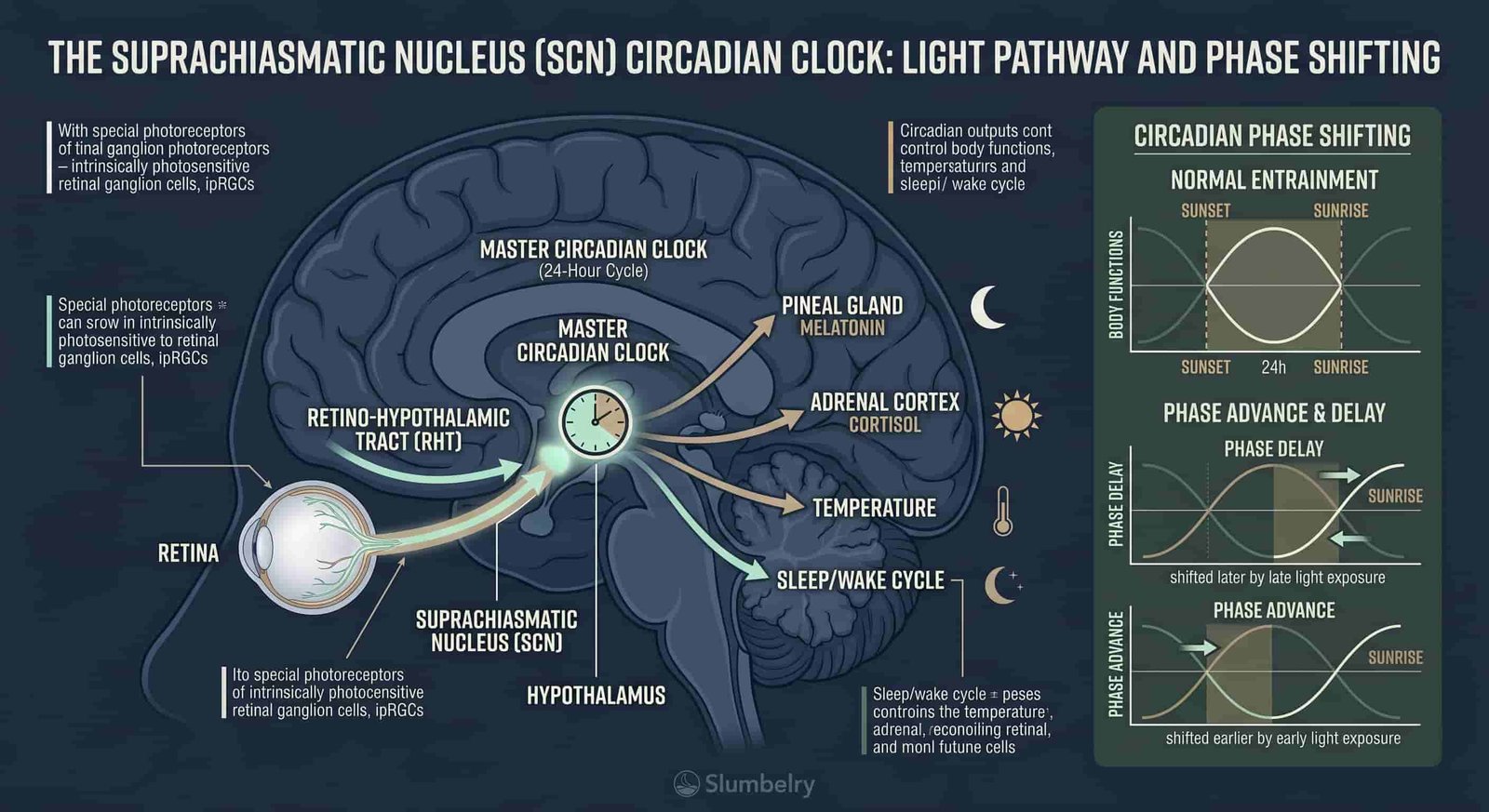
Mechanism: S2-3 of the whitepaper and Waterhouse & Reilly (1997), Jet-lag, Trends in Endocrinology & Metabolism, establish the physiology: your central circadian pacemaker — the suprachiasmatic nucleus (SCN) in the hypothalamus — coordinates all peripheral clocks in organs including the liver, gut, and heart. When you cross time zones rapidly, the SCN is still emitting signals timed to your origin timezone while the destination light-dark cycle sends contradictory signals through the retino-hypothalamic tract. This produces the characteristic desynchronization: the central clock and peripheral clocks are out of phase with each other, manifesting as multi-system symptoms. Recovery time is approximately 1 day per timezone crossed when flying eastbound and 0.8 days per timezone westbound — meaning a 7-hour eastbound shift (e.g., New York to Paris) requires 7+ days for full re-entrainment without intervention.
Actionable Advice: The symptoms you feel on arrival are not from the flight itself — they are from your circadian system being in the wrong timezone. Understanding this shifts the goal from “pushing through tiredness” to “actively resetting the clock.”
Why Does Flying East Feel Harder Than Flying West? The Asymmetry of Circadian Recovery
Direct Answer: The circadian clock is easier to delay (shift later) than advance (shift earlier), because the body’s natural circadian period is slightly longer than 24 hours (~24.2 hours on average), making it structurally easier to stay up later than to fall asleep earlier.
Mechanism: S2-3 and S1-1 of the whitepaper document the向东/向西 asymmetry: flying west (e.g., London to New York, -5 hours) requires phase delay — your clock runs later than destination time, and it’s easier to stay up until your natural rhythm catches up. Flying east (e.g., New York to Paris, +6 hours) requires phase advance — your clock must shift earlier, which is harder because the circadian system resists moving to an earlier schedule. Czeisler et al. (1999) in Science confirmed that the human circadian system can shift in either direction but does so at different rates: westward shift averages 0.8 days per timezone; eastward shift averages 1.0–1.5 days per timezone. This is why a transatlantic crossing eastward feels systematically worse than the same distance westward — and why eastbound travelers should start pre-flight interventions earlier.
Actionable Advice: When flying east, begin the pre-flight protocol 1–2 days earlier than westbound. The harder adjustment direction requires more lead time to achieve the same result.
What Is the Fasting-Feeding Reset and Why Does the Biological Clock Respond to Food Timing?
Direct Answer: The fasting-feeding reset exploits the fact that while the SCN is the master clock, peripheral organs — particularly the liver and pancreas — have their own circadian clocks that can be reset independently by food timing. A 12–16 hour fast ending at your destination’s normal breakfast time effectively “jumps” your metabolic clock to the new timezone.
Mechanism: S2-3 and Hauri (1998), The Sleep Disorders, document the metabolic peripheral clock: every organ in the body has its own clock running on approximately 24-hour cycles, synchronized by both the SCN and by feeding cycles. Critically, food timing can reset peripheral clocks independently of light — a finding established by Damiola et al. (2000) in Genes & Development showing that food restriction during the normal rest period shifts peripheral organ clocks without affecting the SCN. The practical application: stop eating 12–16 hours before your destination’s breakfast time (e.g., if you’re landing in Paris at 8 AM local, finish your last meal by 4–6 PM the previous day). When you break your fast at the destination’s breakfast time, you present the metabolic system with a strong “daytime” signal — resetting the liver, gut, and pancreatic clocks in the correct timezone. This does not replace light-based SCN resetting but provides a complementary mechanism that accelerates the overall re-entrainment process.
Actionable Advice: Plan your pre-flight meals to time your fast so that breaking the fast coincides with your destination’s breakfast or early lunch time. This is the single most underused jet lag intervention.
How Does Light Exposure Manipulate the Suprachiasmatic Nucleus to Reset Your Clock?
Direct Answer: Light is the primary zeitgeber (time-giver) for the SCN. Specific wavelengths of light (particularly blue light, ~480nm) detected by melanopsin-containing retinal ganglion cells signal “daytime” to the SCN, which then shifts the circadian phase forward or backward depending on when the light is received.
Mechanism: S1-1 of the whitepaper and Czeisler et al. (1989), Science, established the precise mechanism of light-induced circadian phase shifting: light applied during the biological night causes a phase advance (shifts the clock earlier); light applied during late biological day causes a phase delay (shifts the clock later). The critical window for light sensitivity is approximately 6 hours before the minimum of your core body temperature rhythm (typically 2–4 AM for someone on a normal schedule). Applying bright light during this window produces maximum phase-shifting effect. For jet lag recovery, this means calculating your “destination” circadian position and seeking or avoiding light at the destination’s corresponding times. Outdoor sunlight is approximately 10–20 times more effective at phase shifting than indoor light — which is why outdoor light exposure at the correct times is the most powerful jet lag intervention available.
Actionable Advice: Upon arrival at your destination, get outdoor sunlight at the correct time for your direction of travel. Flying east: seek bright light in the destination morning (this pushes your clock earlier). Flying west: seek bright light in the destination late afternoon/evening (this pushes your clock later). If outdoor light is unavailable, use a 10,000 lux bright light box.
What Is the Correct Melatonin Dose and Timing for Jet Lag and Does It Actually Work?
Direct Answer: Melatonin for jet lag works as a chronobiotic (phase-shifting agent), not as a sleep aid. The correct approach is 0.3–0.5mg taken 30–60 minutes before the destination target bedtime — not a large dose at midnight after you can’t sleep.
Mechanism: S2-3 and Herxheimer & Petrie (2002), Cochrane Review of Melatonin for jet lag, examined 10 RCTs with 418 participants and found that melatonin taken at the destination bedtime significantly reduced jet lag symptoms across multiple studies. The Cochrane meta-analysis found: (1) melatonin is highly effective for eastbound travel (>5 timezone shifts), (2) dose is not linear — 0.3–0.5mg is as effective as 5mg for phase shifting, (3) higher doses (>1mg) can produce next-day drowsiness from residual melatonin levels. Timing is critical: taken during the biological evening, melatonin signals “night is coming” and advances the circadian phase; taken at the wrong time, it can worsen jet lag by shifting the clock in the wrong direction. The mechanism is indirect — melatonin binds to MT2 receptors in the SCN, which activates the phase-shifting pathway — rather than directly sedating the brain.
Actionable Advice: Take 0.3–0.5mg melatonin 30–60 minutes before your target destination bedtime. Start the night after arrival (not the flight night, where it may disrupt sleep if you need to stay awake). Do not exceed 1mg — higher doses do not produce better phase shifting and increase residual drowsiness risk.
Why Is Dehydration Actually One of the Worst Offenders in Post-Flight Recovery?
Direct Answer: The aircraft cabin has humidity levels of 10–20% (compared to 30–60% in most indoor environments), causing fluid loss of approximately 1.5–2 liters over a 6-hour flight — and this dehydration directly worsens every symptom of jet lag while also impairing the cognitive function you need to execute the protocol correctly.
Mechanism: S1-2 of the whitepaper documents the cognitive effects of dehydration: even mild dehydration (1–2% body weight loss) impairs attention, reaction time, and short-term memory — the same functions already impaired by circadian misalignment. The compounding effect means that arriving dehydrated amplifies the cognitive fog of jet lag significantly. Additionally, dehydration disrupts GI function, which interferes with the fasting-feeding reset — if your gut is not operating normally because it is in conservation mode from fluid loss, the food-timing signal is less effective. Alcohol consumption during flights compounds this: alcohol is a diuretic, worsens dehydration, disrupts sleep architecture (reducing slow-wave sleep even when you do sleep), and interferes with the circadian system through multiple mechanisms including suppression of melatonin secretion.
Actionable Advice: Drink 250ml of water per hour of flight (more than you feel you need). Avoid alcohol entirely during flights, or limit to one drink maximum with substantial food. Continue aggressive hydration for the first 24 hours post-arrival.
Why Does Napping Upon Arrival Anchor You to Your Old Time Zone?
Direct Answer: Sleep at the “wrong” circadian time anchors your clock to the old timezone — because the timing of sleep itself is a powerful zeitgeber. Sleeping when your body thinks it’s 3 AM deepens the misalignment rather than reducing it.
Mechanism: S2-3 and S4-4 of the whitepaper describe sleep as an active zeitgeber: the timing, duration, and regularity of sleep feed back to the SCN and peripheral clocks, either reinforcing or undermining the light-based signals. A strategic nap at destination midday can be useful (see H2-9), but napping immediately upon arrival at what your body thinks is 3 AM — because you flew east and your clock hasn’t shifted yet — creates a new, wrong-phase anchor point. The result is that you now have two misalignments to correct instead of one: the original travel-induced misalignment plus the nap-induced phase delay. The worst pattern is the “arrive exhausted, nap 2–3 PM local, sleep 11 PM local, wake 3 AM local” cycle — each nap pushes the clock further from the target. The only nap that does not anchor you to the wrong time is a strategically timed 20–30 minute nap at the destination’s early afternoon circadian低谷 — and only if absolutely necessary for safety (e.g., severe sleep deprivation).
Actionable Advice: Do not nap on arrival day unless you are a safety risk (e.g., must drive). Power through to the destination’s normal bedtime, even if you feel terrible. The discomfort of one difficult evening is significantly less than the cost of 3–4 days of compounded misalignment.
How Does the One-Day-Per-Time-Zone Rule Break Down for Frequent Travelers?
Direct Answer: Frequent travelers who cross time zones regularly without full recovery between trips accumulate a “circadian debt” that never fully resolves — producing chronic jet lag symptoms that become a baseline state rather than a temporary condition.
Mechanism: S1-1 of the whitepaper and Stanley (2018), How to Sleep Well, document the cumulative effect of repeated circadian disruption: each incomplete re-entrainment leaves a residual phase offset. After 3–4 repeated incomplete crossings, the circadian system can settle into a stable but wrong phase — a chronic jet lag state characterized by consistent poor sleep quality, impaired daytime function, and GI disturbances that are misattributed to other causes. This is particularly common in business travelers who cross 5+ time zones weekly. The solution for frequent travelers is a partial adjustment strategy: rather than trying to fully re-entrain between every trip, shift the sleep schedule by 50–75% of the timezone difference, which maintains a smaller, more manageable gap to close on each subsequent trip. This “anchor sleep” approach — protecting one consistent sleep time across all time zones — provides a stable reference point that limits the accumulation of circadian debt.
Actionable Advice: If you travel frequently across time zones, designate one sleep anchor time (e.g., 11 PM home base time) that you maintain regardless of timezone. This creates a stable circadian reference point that limits misalignment accumulation.
What Are the Specific Protocols for Flying East vs Flying West?
Direct Answer: Eastbound travel requires phase advance (earlier schedule) — seek morning light, avoid evening light, take melatonin at destination bedtime. Westbound travel requires phase delay (later schedule) — seek evening light, avoid early morning light, no melatonin needed in most cases.
Mechanism: S2-3 and Waterhouse et al. (2000), Jet lag: trends and coping strategies, Lancet, give the specific protocols: Eastbound (phase advance): Start 1–2 days pre-flight: go to bed 30–60 minutes earlier each night, get bright outdoor light in the early morning. Flight day: wear sunglasses in the early morning destination time to avoid light, use sunglasses or block light in the late afternoon destination time. Arrival day: get outdoor sunlight first thing in the destination morning. Take 0.3–0.5mg melatonin 30–60 minutes before destination bedtime. Westbound (phase delay): Pre-flight: stay up 1–2 hours later each night for 1–2 days. Flight day: wear sunglasses to avoid morning destination light, seek late afternoon/evening destination light. Arrival day: seek outdoor light in the late afternoon. No melatonin typically needed unless crossing more than 8 time zones. Short-haul (1–3 zones): Usually re-entrains without intervention; prioritize sleep hygiene and meal timing at destination local times.
Actionable Advice: Write out your specific protocol before the flight, including the exact sunglasses-on/sunglasses-off times for arrival day. The protocol only works if executed correctly — improvisation at the destination is where most people fail.

How to Prepare Before Your Flight to Minimize Jet Lag on Arrival
Direct Answer: Pre-flight preparation is where most of the recovery is won or lost. The 2–3 days before departure are more important than anything you do after landing.
Mechanism: S4-4 and S4-3 of the whitepaper establish the pre-flight protocol: 2–3 days pre-flight (eastbound): Begin shifting bedtime 30–60 minutes earlier each night toward the destination’s schedule. Get bright outdoor light in the morning. Avoid evening light. This begins the phase advance before you board the plane. 1–2 days pre-flight (westbound): Stay up 1–2 hours later each night. Get evening light to push the clock later. Flight day: Set your watch to the destination timezone immediately — this begins the psychological shift. Hydrate aggressively; avoid alcohol. Wear sunglasses at the correct times to block or receive light according to the destination protocol. Use the flight time to sleep if it aligns with the destination nighttime (earplugs/eye mask for daytime flight sleep; no sleep aids unless you have a prescription). Do not eat at your origin timezone meal times — eat according to destination meal times. Key supplements: Melatonin 0.3–0.5mg at destination bedtime starting the night after arrival; continue for 2–3 nights. Light exposure at correct times on arrival day.
Actionable Advice: Write your protocol on a card and keep it accessible. The pre-flight phase shift for eastbound travel cannot be replaced by anything you do after landing — it is the most effective intervention and the most commonly skipped.
Arrive Ready, Not Wrecked
The world is big. Don’t waste the first two days of your trip recovering from the flight.
Travel Sleep Masks Flight EarplugsFrequently Asked Questions
What causes jet lag and how long does it last?
Direct Conclusion: Jet lag is circadian misalignment — your internal body clock (SCN) is desynchronized from the destination light-dark cycle after rapid transmeridian travel. Recovery takes approximately 1 day per timezone crossed eastbound, 0.8 days per timezone westbound. A 6-hour eastbound shift (e.g., NY to Paris) takes 6+ days without intervention.
Why does flying east feel worse than flying west?
Direct Conclusion: The human circadian period averages 24.2 hours — slightly longer than 24 hours. This makes it structurally easier to delay the clock (stay up later, flying west) than to advance it (sleep earlier, flying east). Flying east requires phase advance, which is harder and slower. This is why a transatlantic crossing eastward always feels worse than westward.
What is the best jet lag recovery protocol?
Direct Conclusion: The three most effective interventions: (1) Light at the correct destination times — the primary SCN zeitgeber. (2) Fasting-feeding reset — a 12-16 hour fast ending at destination breakfast resets the peripheral metabolic clock. (3) Melatonin 0.3-0.5mg at destination bedtime — works as a chronobiotic (phase-shifter), not a sleep aid. No single intervention is sufficient; all three working together produce the fastest re-entrainment.
Does fasting help reset the body clock after flying?
Direct Conclusion: Yes. While the SCN is reset by light, peripheral organ clocks (liver, gut, pancreas) can be independently reset by food timing. A 12-16 hour fast ending at your destination’s breakfast time gives these peripheral clocks a strong ‘new day’ signal that accelerates overall re-entrainment. This is scientifically established from studies showing food restriction shifts peripheral clocks without affecting the SCN.
How does light exposure actually reset circadian rhythm?
Direct Conclusion: Light enters the eyes and hits melanopsin-containing retinal ganglion cells, which send signals via the retino-hypothalamic tract to the SCN. Light during biological night causes phase advance (earlier clock); light during late biological day causes phase delay (later clock). Outdoor sunlight is 10-20x more powerful than indoor light for phase shifting. Timing is critical — wrong-time light can worsen jet lag instead of fixing it.
What is the correct melatonin dose and timing for jet lag?
Direct Conclusion: 0.3-0.5mg taken 30-60 minutes before your destination target bedtime. This is the chronobiotic dose — not a sleep aid dose. Higher doses (5mg+) do not produce better phase shifting and can cause next-day drowsiness. Melatonin works by binding to MT2 receptors in the SCN, activating the phase-shifting pathway — it shifts the clock rather than sedating you.
Should I nap when I arrive if I’m exhausted from flying?
Direct Conclusion: Generally no — napping at the wrong circadian time anchors you to your old timezone, worsening the misalignment you are trying to correct. The one exception is a strategic 20-30 minute nap at the destination’s early afternoon (around 1-2 PM local) if you are too impaired to function safely. But the best strategy is to power through to destination bedtime, even if you feel terrible.
Why does dehydration make jet lag symptoms worse?
Direct Conclusion: The aircraft cabin has 10-20% humidity vs 30-60% indoors — you lose 1.5-2 liters of fluid on a 6-hour flight. Even mild dehydration (1-2% body weight) impairs attention, reaction time, and memory — compounding the cognitive effects of circadian misalignment. Additionally, dehydration disrupts GI function, which weakens the fasting-feeding reset mechanism. Alcohol worsens this by further dehydrating and disrupting sleep architecture.
What’s the difference in protocol for flying east vs west?
Direct Conclusion: Eastbound: requires phase advance (earlier schedule) — seek morning light at destination, avoid evening light, take 0.3-0.5mg melatonin at destination bedtime. Start pre-flight protocol 1-2 days earlier. Westbound: requires phase delay (later schedule) — seek evening light at destination, avoid morning light, no melatonin typically needed. Start pre-flight by staying up 1-2 hours later each night.
How can I prepare before a long-haul flight to minimize jet lag?
Direct Conclusion: Pre-flight preparation for eastbound: 2-3 days before departure, go to bed 30-60 min earlier each night and get bright morning light. Westbound: stay up 1-2 hours later each night and get evening light. Flight day: set watch to destination timezone immediately, hydrate aggressively, avoid alcohol, wear sunglasses at correct times, eat at destination meal times. Start melatonin the first night after arrival. The pre-flight phase shift is the most important step and the most commonly skipped.
The Slumbelry Commitment
Sleep is the most vulnerable state of human existence. It is where we heal, reset, and grow.
At Slumbelry, we do not just sell sleep products; we advocate for your physiological right to rest. From ergonomic support to light management, every solution we offer is designed with one obsession: Respecting your Biology.
Science is our language, but your recovery is our purpose. You take care of everything else in your life — let us take care of your nights.
Rest Deeply,
The Slumbelry Team