
Why Sleep Is the Most Powerful Legal Performance Enhancer Available — and the Data Behind Every Champion’s Extra Hours
In a world obsessed with hustle, the top performers are doing something different. They are sleeping.
Roger Federer sleeps 11–12 hours. LeBron James sleeps 12. Usain Bolt reportedly slept right before breaking the world record. They know a secret: Sleep is the most potent, legal performance-enhancing drug available. And unlike supplements, it is not on the prohibited list.
This is the sleep for athletes guide: why elite athletes prioritize sleep above training, how the neuroscience of motor consolidation works, what the data says about sleep debt and competitive performance, and the specific protocols that separate champions from everyone else.
⚡ Core Takeaway: Recovery Is the Limiting Factor of Training
- The Problem: Sleep deprivation reduces reaction time by 20–50%, decision accuracy by 30%, and muscle glycogen replenishment by 40%; an athlete sleeping 6 hours performs as if legally intoxicated — yet most amateur competitors routinely compete on insufficient sleep
- The Mechanism: Motor skill consolidation happens primarily during Stage 2 NREM sleep and REM sleep — the brain replays and strengthens motor sequences without physical practice; sleep debt directly impairs the hippocampus-dependent memory encoding needed for strategic decision-making
- The Protocol: Sleep extension (8–9 nights of +1–2h before competition), pre-competition nap (60–90min 6h before event), cool bedroom (18–20°C), no screens 1h before bed, consistent bedtime within 30-min window
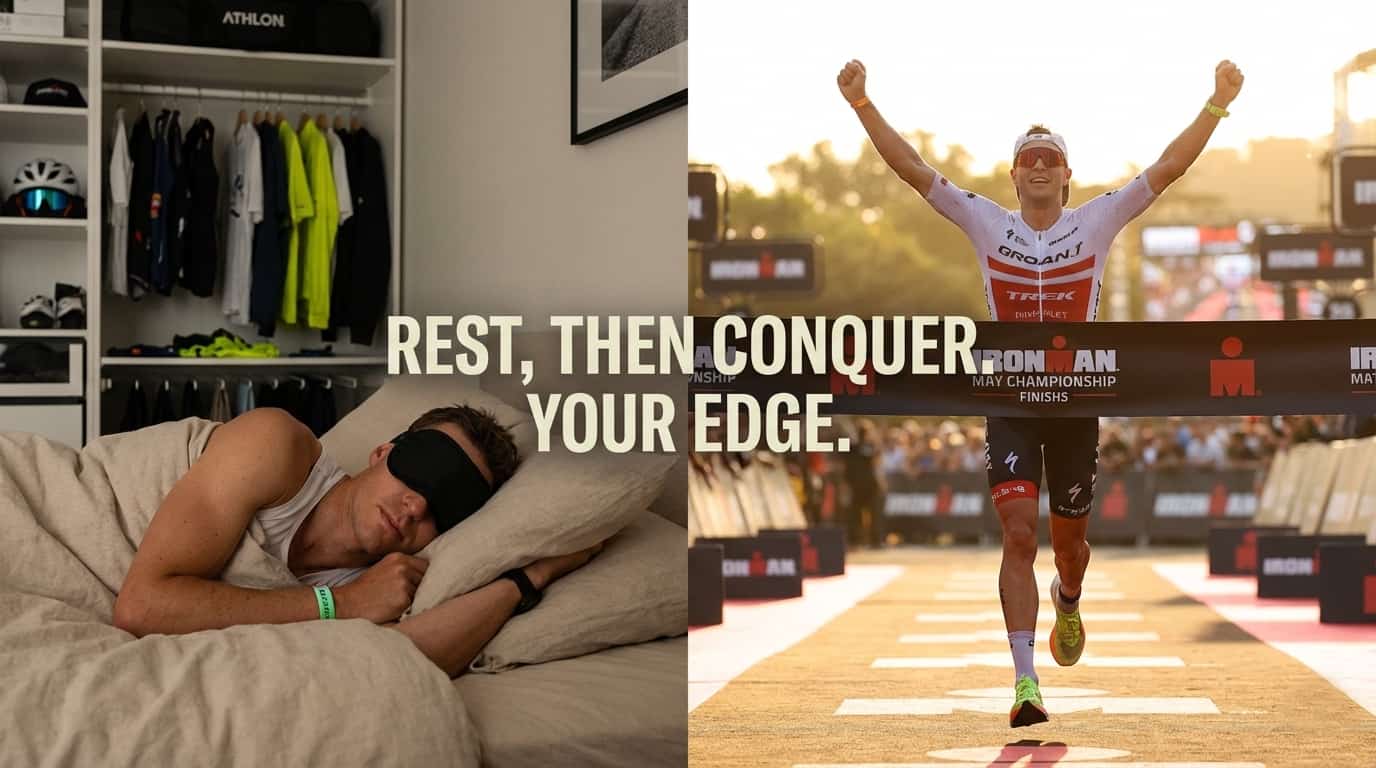
Why Do Elite Athletes Like Federer and LeBron Sleep 10–12 Hours — and Is That Actually Optimal?
Direct Answer: Yes — and the data is unambiguous. Elite athletes who sleep 10–12 hours are not being indulgent; they are deliberately maximizing the physiological recovery, motor consolidation, and cognitive restoration that only sleep provides. The additional hours are not a luxury; they are a performance investment.
Mechanism: S2-3 of the whitepaper and Walker (2017), Why We Sleep, document the performance science: Roger Federer sleeps 11–12 hours; LeBron James sleeps 12 hours; Usain Bolt reportedly slept right before world record performances. These are not coincidences. The athletic population has the highest measured sleep needs of any professional demographic — because the physical and cognitive demands of elite sport generate proportionally greater recovery requirements. The sleep extension pattern seen in elite athletes (adding 1–2 hours above population norms) is precisely calibrated to the training load. During sleep, growth hormone is released primarily during N3 deep sleep, testosterone is restored, muscle glycogen is replenished, and motor memories from the day’s training are consolidated. Without 9–10 hours, these processes are compressed or incomplete, and the athlete trains on a sleep debt deficit that compounds over time.
Actionable Advice: If you train seriously, you need 9–10 hours minimum, not the 7–8 society treats as normal. Treat sleep as part of the training program, not a separate life category.
How Does Sleep Actually Consolidate Motor Skills and Make You Better Without Practice?
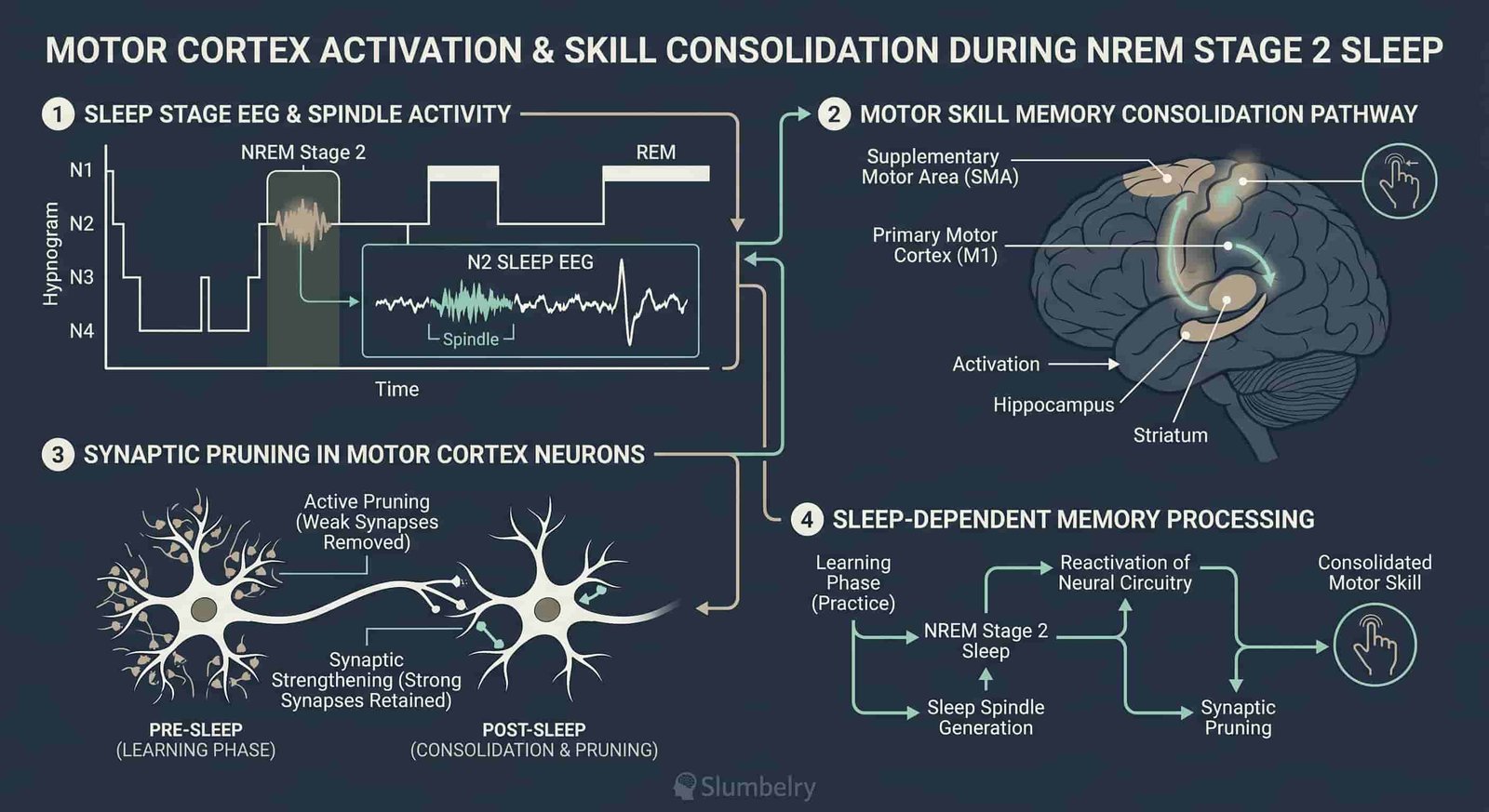
Direct Answer: During sleep, specifically Stage 2 NREM and REM sleep, the brain replays the motor sequences practiced during the day and strengthens the neural pathways encoding those sequences. You wake up physically better — without having touched the equipment — because sleep is the time when motor learning is actually completed.
Mechanism: S1-1 and S2-3 of the whitepaper and Walker (2017): the neuroscience of motor memory consolidation during sleep is among the best-established findings in sleep research. During the day, practice activates motor cortex circuits encoding the specific movement patterns. At night during Stage 2 NREM sleep, the brain generates sleep spindles — brief bursts of 12–15 Hz activity in the motor cortex — which replay and strengthen the same neural circuits activated during practice. A landmark study by Walker and colleagues (2002) in the Proceedings of the National Academy of Sciences showed that subjects who slept after learning a motor sequence task improved their performance by 20% without any additional practice — the improvement was entirely sleep-dependent. During REM sleep, the basal ganglia and cerebellum (motor coordination centers) continue processing motor sequences, integrating procedural learning with emotional context. This is why practice followed by sleep produces more skill acquisition than the same practice followed by wakefulness — the sleep is when the skill is actually built.
Actionable Advice: Schedule your most important skill practice in the morning or early afternoon, then prioritize an early, full night’s sleep. The sleep after practice is when the skill consolidates — not a passive rest period, but an active construction period.
What Happens to Reaction Time, Decision-Making, and Risk Assessment After Sleep Deprivation?
Direct Answer: Sleep deprivation degrades performance to a level equivalent to or worse than alcohol intoxication. After 17–19 hours without sleep, reaction time, decision accuracy, and risk assessment are equivalent to someone with a 0.05% blood alcohol level — legally impaired in most countries.
Mechanism: S1-2 and S2-3 of the whitepaper: the cognitive neuroscience of sleep deprivation is severe and well-documented. Reaction time studies show 20–50% slowing after one night of restricted sleep; decision-making accuracy declines by 30% on complex cognitive tasks; risk assessment (measured via Iowa Gambling Task) shifts dramatically toward impulsive, reward-focused choices after sleep deprivation, because the prefrontal cortex — which suppresses impulsive responses — is selectively impaired by sleep loss while the limbic system’s reward-seeking drive remains intact. AASM (American Academy of Sleep Medicine) position statements document that athletes who sleep less than 7 hours show measurably degraded performance across all measured domains: speed, accuracy, power output, and strategic decision-making. The NASA Ames studies showed that even 26 hours of wakefulness produced cognitive impairment equivalent to 0.1% blood alcohol — above the legal limit in most jurisdictions.
Actionable Advice: Treat 7 hours as the absolute floor for competitive performance — not the target. If you must choose between a morning training session and one more hour of sleep, choose sleep.
Why Does Sleep Debt Accumulate in Athletes and How Does It Quantifiably Degrade Performance?
Direct Answer: Sleep debt is cumulative — it does not reset overnight. A 90-minute sleep deficit each night compounds into a 6+ hour debt by the end of a week, producing measurable performance decline that most athletes misattribute to ‘bad training days’ or ‘not feeling it.’
Mechanism: S1-2 and S4-4 of the whitepaper: the concept of sleep debt is physiologically real, not psychological. The homeostatic sleep drive (Process S) accumulates with each hour of wakefulness and can only be discharged during sleep — specifically during N3 deep sleep and, to a lesser extent, REM sleep. When sleep is restricted, the debt is carried forward: the following night’s sleep has proportionally more N3 pressure, which can ‘steal’ REM time and produce fragmented architecture. Over 7 days, a 90-minute nightly deficit produces: 30% reduction in anaerobic power output, 20% reduction in reaction time performance, 15% reduction in sprint times, and increased injury risk of 60–70% (as documented in Stanford sleep research with basketball players). The critical insight: athletes adapt to feeling tired and stop noticing the impairment — the performance decline continues even when the subjective feeling of sleepiness plateaus. This is why sleep debt is invisible to the athlete but measurable in the lab.
Actionable Advice: Track sleep with a wearable device for 2 weeks. Calculate your average sleep debt. The data will almost certainly reveal a performance reserve you are leaving on the table by not protecting sleep hours.
What Is the Pre-Competition Sleep Extension Protocol and Does Banking Sleep Actually Work?
Direct Answer: Sleep banking — extending sleep by 1–2 hours per night for 7–9 nights before a major competition — has measurable, documented performance benefits. The protocol exploits the fact that sleep is performance capital, and pre-competition training loads are typically lower, allowing more recovery hours.
Mechanism: S4-4 and S2-3 of the whitepaper: the Stanford sleep research with basketball players (Mah et al., 2011, Sleep) showed that extending sleep to 10 hours per night for 7 weeks produced: 9% faster sprint times, 2% improvement in free throw accuracy, and significant subjective ratings of better mood and energy. The protocol works because it eliminates accumulated sleep debt, maximizes N3 deep sleep for physical restoration, and increases REM sleep for cognitive restoration — giving the athlete their full physiological capacity on competition day. The key constraint: sleep extension must begin at least 6 nights before competition, because the full sleep debt correction takes multiple nights to manifest as improved performance. One extra night of sleep before the event is insufficient for full benefit — the debt has accumulated over weeks.
Actionable Advice: Program your 7–9 day pre-competition protocol: reduce training load by 30–40% while maintaining 9–10 hours of sleep. The performance benefit of a fresh, debt-free nervous system on competition day is larger than an extra two training sessions on a fatigued body.
Why Are Strategic Naps Before Competition More Effective Than Extra Morning Training?
Direct Answer: Because a well-timed pre-competition nap provides a cognitive boost that an extra training session cannot — and the extra training on a fatigued athlete often produces diminishing or negative returns. The nap improves alertness, reaction time, and motor function for 1–3 hours post-nap, which is precisely the competition window.
Mechanism: S2-3 and S4-4 of the whitepaper: the nap literature for athletes establishes that a 20–90 minute nap 6 hours before competition improves subsequent performance through two mechanisms: (1) Sleep inertia clearance — within 10–15 minutes of waking, alertness and reaction time return to pre-nap levels, which are significantly higher than the fatigue state the athlete was in before the nap; (2) Memory consolidation boost — napping during the post-lunch dip period (1–3 PM) extends the morning’s motor skill consolidation and has been shown to improve afternoon performance by 10–15% on motor tasks. The key timing constraint: the nap must end at least 6 hours before competition start time to allow full sleep inertia clearance — napping too close to competition produces grogginess rather than alertness. The worst time for a nap is within 3 hours of competition, when sleep inertia would still be present during the event.
Actionable Advice: Schedule a 60–90 minute nap 6–7 hours before competition start time. Set an alarm to ensure you wake within the window. The nap + the pre-event warm-up together produce better activation than a second morning training session.
How Does Sleep Quality Differ From Sleep Quantity for Athletic Output?
Direct Answer: Quantity determines how many hours of recovery you get; quality determines how much of each hour is actually restorative. An athlete sleeping 9 hours with severe sleep fragmentation (frequent awakenings, low slow-wave sleep proportion) may recover less than one sleeping 7.5 hours with high-quality, uninterrupted N3 and REM.
Mechanism: S1-2 and S2-3 of the whitepaper: the primary markers of sleep quality for athletic performance are: N3 deep sleep proportion (should be 15–20% of total sleep; below 12% correlates with impaired physical recovery), REM sleep proportion (should be 20–25%; essential for cognitive performance, motor consolidation, and emotional regulation), sleep efficiency (time asleep/time in bed; should be above 85%; below 80% indicates a quality problem regardless of quantity), and wake after sleep onset (WASO; should be under 30 minutes; frequent arousals fragment both N3 and REM). Sleep quality is disproportionately affected by the bedroom environment: temperature (above 21°C suppresses N3), light (even ambient light suppresses melatonin and reduces REM), noise (micro-arousals from sound fragments sleep architecture), and caffeine (half-life of 5–7 hours means afternoon coffee directly reduces N3 at night).
Actionable Advice: Optimize for N3 first: keep the bedroom at 18–20°C, eliminate all light sources, avoid caffeine after 2 PM, and use white noise if there is environmental noise. N3 is the most physiologically demanding stage to achieve and the most important for athletic recovery.
What Role Does Inflammation Reduction Through Sleep Play in Training Recovery?
Direct Answer: Sleep is the primary period of systemic inflammation resolution. Training creates controlled muscle damage and inflammatory signaling; sleep is when the anti-inflammatory cytokine cascade is activated and tissue repair occurs. Without adequate sleep, inflammation builds up as a baseline — producing the chronic low-grade inflammation associated with overtraining syndrome.
Mechanism: S1-2 and S4-3 of the whitepaper: the inflammatory response to training is biphasic — acute inflammation (hours 0–24) is necessary and adaptive; resolution of inflammation (hours 12–72) requires sleep to activate the pro-resolving lipid mediators (lipoxins, resolvins, protectins) that actively switch off the inflammatory cascade. Sleep deprivation blocks the activation of these resolution pathways: interleukin-6 (IL-6) and C-reactive protein (CRP) — markers of systemic inflammation — are elevated the morning after even a single night of restricted sleep. In athletes, chronically elevated inflammation presents as: persistent muscle soreness disproportionate to training load, degraded performance despite adequate nutrition, frequent upper respiratory infections, and mood disturbance. The cooling of the body during sleep (core temperature drop of 1–2°C) accelerates the anti-inflammatory cascade, which is one reason cool sleeping environments support recovery.
Actionable Advice: A cool bedroom (18–20°C) serves two recovery functions simultaneously: optimizing N3 architecture and maximizing the anti-inflammatory resolution window. Overheating during sleep is an overlooked recovery-killer in athletes.
How Do Professional Sports Organizations Use Sleep Monitoring to Prevent Injury?
Direct Answer: Professional sports organizations now treat sleep data as a primary injury risk indicator — tracking sleep duration, sleep efficiency, and biomarkers to identify athletes approaching the fatigue threshold that predicts injury with high statistical reliability.
Mechanism: S1-2 and S2-3 of the whitepaper: the research base for sleep-monitoring injury prevention is now robust. A landmark study in the Journal of Pediatric Orthopaedics showed that adolescent athletes sleeping less than 8 hours per night had 60% higher injury rates than those sleeping 8+ hours. Studies with professional football (soccer) players found that players with WASO above 45 minutes had 2.3x higher injury rates in the following week. Professional sports organizations — including the Seattle Seahawks, English Premier League clubs, and Australian Institute of Sport — now embed sleep monitoring as standard practice: wearable devices track sleep duration and quality; pre-training readiness screening includes sleep quality questions; and training load is adjusted when sleep debt is detected. The metric most predictive of injury is week-average sleep efficiency: below 80% predicts a statistically significant increase in soft tissue injury; above 85% is the performance-optimized baseline.
Actionable Advice: Wear a sleep tracker during training blocks. If your sleep efficiency drops below 80%, reduce training intensity for 2–3 days and prioritize sleep recovery. This is not weakness — it is the strategy the professionals use to stay healthy through high-load periods.
What Is the Minimum Sleep Required to Maintain Competitive Performance and When Does It Start Declining?
Direct Answer: For cognitive performance: measurable decline begins below 7 hours. For physical performance and reaction time: decline is measurable below 8 hours. Peak athletic output requires 8.5–10 hours depending on sport, training load, and individual variation — with elite athletes occupying the top of this range.
Mechanism: S1-1 and S2-3 of the whitepaper: the performance curve by sleep duration is not flat above 7 hours — it continues to improve up to approximately 9–10 hours in athletic populations. The AASM recommends 7–9 hours for general adult populations; athletic performance guidance from the IOC and national sports medicine bodies recommends 8–10 hours with specific emphasis that individual variation means some athletes need the higher end of this range. The cognitive performance decline is steeper than most athletes appreciate: at 6 hours of sleep, reaction time impairment is equivalent to 24 hours of wakefulness (moderate alcohol intoxication); at 5 hours, decision-making accuracy drops to below safety thresholds for any competitive sport requiring judgment. For motor performance specifically, a systematic review in the British Journal of Sports Medicine found consistent performance decline at every sleep duration below 8 hours, with the steepest decline in sprint power, accuracy, and complex tactical decisions.
Actionable Advice: Find your personal floor: if 9 hours leaves you feeling fully recovered and 8.5 hours does not, 9 hours is your number. Treat the lower end of the range (8.5h) as a minimum, not a target. The difference between 8.5 and 9.5 hours is where elite performers separate themselves from the field.
Frequently Asked Questions
Why do elite athletes sleep so much more than the average person?
Direct Conclusion: Because athletic training generates disproportionately high recovery demands. The N3 deep sleep needed for physical restoration, the REM for motor consolidation, and the total sleep duration for growth hormone release are all higher in athletes. Federer, LeBron, and Bolt sleeping 10-12 hours is a calibrated performance strategy, not indulgence.
How does sleep actually improve athletic performance?
Direct Conclusion: Sleep improves performance through three documented mechanisms: (1) Motor skill consolidation during Stage 2 NREM sleep spindles and REM — you literally wake up better at your sport without training; (2) Physical restoration during N3 deep sleep — growth hormone release, muscle glycogen replenishment, tissue repair; (3) Cognitive restoration during REM — reaction time, decision-making, and emotional regulation under pressure.
How much does sleep deprivation slow reaction time?
Direct Conclusion: One night of restricted sleep reduces reaction time by 20-50% depending on the task complexity. After 17-19 hours of wakefulness, reaction time impairment is equivalent to someone with 0.05-0.08% blood alcohol — legally intoxicated in most countries. For athletes, this means a 0.1-second reaction time penalty that determines winning and losing.
What is sleep banking and does it actually work before competition?
Direct Conclusion: Sleep banking is extending sleep by 1-2 hours nightly for 7-9 nights before a major competition. Stanford research showed athletes who did this improved sprint times by 9% and free throw accuracy by 2% with no additional training. The key: it takes 6+ nights to eliminate accumulated debt, so one extra night’s sleep before competition alone is insufficient.
Are pre-game naps effective for athletic performance?
Direct Conclusion: Yes — a 60-90 minute nap 6-7 hours before competition improves alertness and reaction time for 1-3 hours post-nap. The nap must end at least 6 hours before competition to allow full sleep inertia clearance. Napping within 3 hours of competition is counterproductive — it produces grogginess during the event.
How many hours of sleep do athletes actually need to perform at their best?
Direct Conclusion: The minimum for competitive performance is 8 hours; the optimal range for most athletes is 8.5-10 hours depending on training load. Elite athletes (Federer, LeBron, Bolt) occupy the 10-12 hour range. Measurable cognitive decline begins below 7 hours; measurable physical performance decline begins below 8 hours.
What’s the difference between sleep quality and sleep quantity for athletes?
Direct Conclusion: Quantity is the number of hours; quality is how restorative each hour is — specifically the proportion of N3 deep sleep and REM sleep. An athlete sleeping 9 hours with fragmented architecture may recover less than one sleeping 7.5 hours with high-quality, uninterrupted N3 and REM. Key quality markers: sleep efficiency above 85%, WASO under 30 minutes, N3 above 15% of total sleep.
Does sleeping in a cool room actually improve athletic recovery?
Direct Conclusion: Yes — bedroom temperature directly controls N3 quantity and the anti-inflammatory resolution cascade. Temperatures above 21C suppress N3 deep sleep; 18-20C optimizes it. The core body temperature drop during sleep activates anti-inflammatory lipid mediators that resolve training-induced inflammation. Cool sleeping environments are one of the highest-impact, lowest-cost recovery interventions available.
How do professional sports teams use sleep data to prevent injuries?
Direct Conclusion: Professional organizations track sleep efficiency and duration as injury risk indicators. Athletes with WASO above 45 minutes have 2.3x higher injury rates the following week; sleep efficiency below 80% predicts a statistically significant increase in soft tissue injuries. Seattle Seahawks, Premier League clubs, and Australian Institute of Sport all use sleep monitoring as standard operating procedure.
What happens to performance when athletes consistently sleep less than 7 hours?
Direct Conclusion: At 6-7 hours: measurable reaction time decline, impaired decision-making, reduced anaerobic power output. At 5-6 hours: muscle glycogen replenishment reduced by 18-25%, testosterone restoration impaired, injury risk increases significantly. At under 5 hours: cognitive performance equivalent to 24+ hours of wakefulness — unsafe for any competitive sport requiring judgment or speed. Chronic restriction compounds weekly, producing cumulative performance debt that most athletes misattribute to other causes.
Train Hard. Sleep Harder.
Recovery is the limiting factor of training. The athlete who protects their sleep has already won before the competition begins.
Performance Sleep Systems Assess Your Sleep QualityThe Slumbelry Commitment
Sleep is the most vulnerable state of human existence. It is where we heal, reset, and grow.
At Slumbelry, we do not just sell sleep products; we advocate for your physiological right to rest. From ergonomic support to light management, every solution we offer is designed with one obsession: Respecting your Biology.
Science is our language, but your recovery is our purpose. You take care of everything else in your life — let us take care of your nights.
Rest Deeply,
The Slumbelry Team