For Exhausted Parents: Why Your Child’s Bedtime Routine is Failing
The Complete Toddler Sleep Guide for Exhausted Parents | Slumbelry
For Exhausted Parents: Why Your Child’s Bedtime Routine is Failing (And How to Bio-Hack Their Circadian Rhythm)
Written by Dr. Lycan Dizon, Slumbelry Chief Sleep Consultant · Updated 2026
⚡ Core Takeaway: Toddler Sleep
The Standard: Toddlers need 11-14 hours of total sleep and cannot self-regulate their environment — they depend entirely on you to engineer it.
The Mechanism: A toddler’s brain requires a precise biological sequence: darkness triggers melatonin, cooler body temperature initiates Deep Sleep, and a 90-minute sensory cool-down prevents the overtired cortisol spike.
The Action: Ban screens 90 minutes before bed, keep the room at 65-68°F, and execute the same bedtime routine in the same order every single night.
Cover image for toddler sleep
For Exhausted Parents: Why Your Child’s Bedtime Routine is Failing (And How to Bio-Hack Their Circadian Rhythm)
If your child isn’t sleeping, you aren’t sleeping. And while the parenting industry is flooded with emotional advice about “cry-it-out” methods or gentle parenting, they often ignore the strict, underlying biology of a developing human brain.
Children are not just small adults. Their sleep architecture is vastly different. A toddler’s brain is undergoing massive neuroplasticity, requiring immense amounts of Deep Sleep to release growth hormones and REM sleep to consolidate new neural pathways. You cannot negotiate with a child’s circadian rhythm. You must engineer their environment to trigger their biological sleep sequence.
Quick Answer:
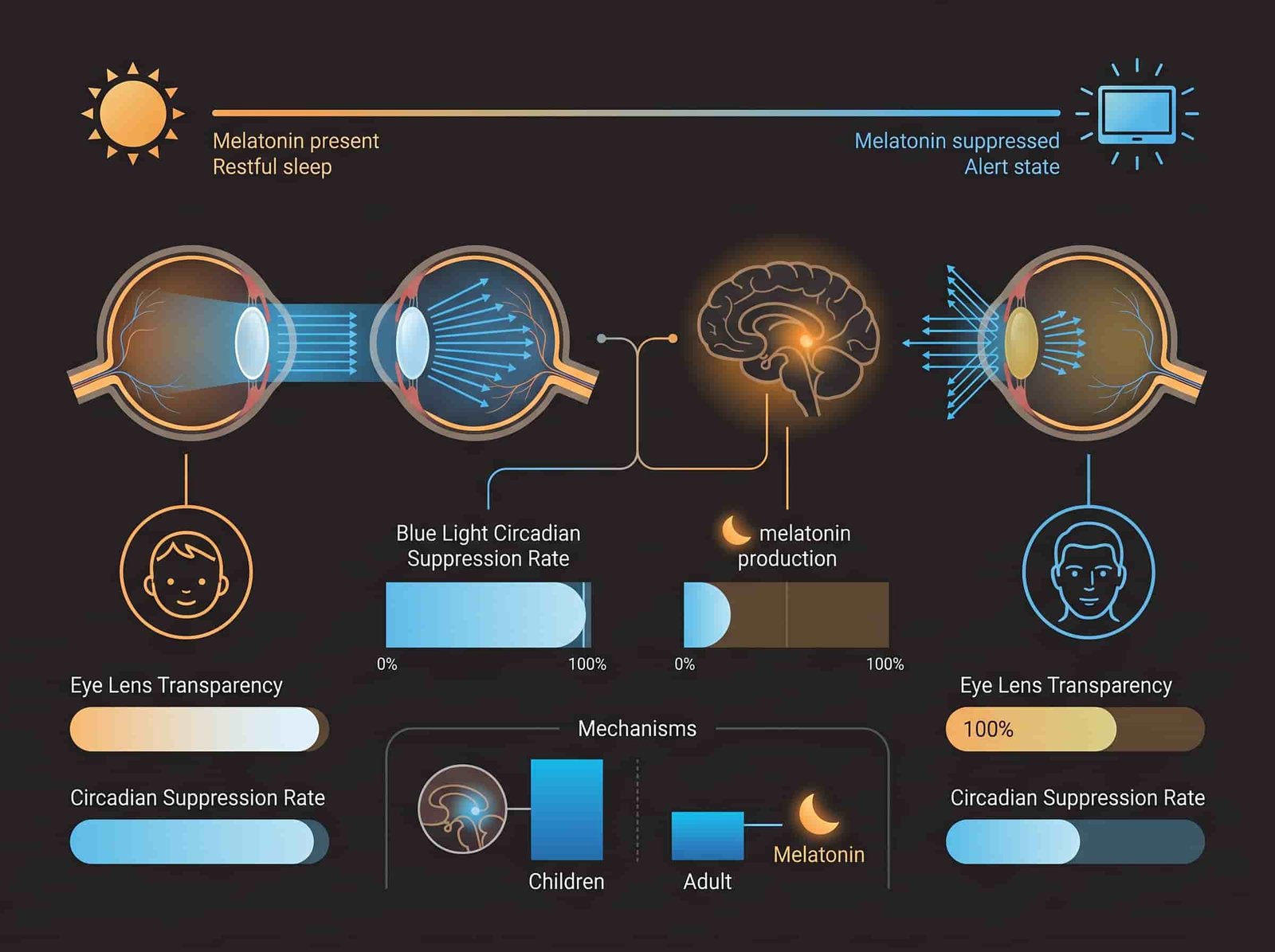
A child’s eyes are highly transparent to blue light, suppressing their melatonin production at twice the rate of adults.
Bundling children in heavy pajamas prevents the core body temperature drop required to initiate Deep Sleep.
Children lack executive function and require a strict 90-minute sensory cool-down to down-regulate their nervous systems.
Why is an iPad destroying your child’s melatonin production?
Direct Answer: A child’s pupils are larger and their eye lenses are more transparent, making them hypersensitive to the melatonin-suppressing effects of blue light.
Mechanism: When you let your child watch cartoons right before bed to “wind down,” you are chemically blasting their brain with a daytime signal. The blue light from the screen hits their suprachiasmatic nucleus, instantly halting the pineal gland’s production of melatonin, leaving them wired, hyperactive, and physically incapable of settling down.
Actionable Advice: Implement an absolute, non-negotiable ban on all screens 90 minutes before their target bedtime. Dim the overhead lights in the house to mimic a sunset.
You are fighting a losing battle if you try to put a chemically stimulated brain to sleep. Melatonin is the hormone of darkness. If the environment is not dark, the hormone will not deploy.
This includes overhead LED lights. Swap out the bright white bulbs in the nursery or bathroom for warm, amber-toned bulbs that do not emit blue spectrum light. You must control the light environment to control the neurochemistry.
Why does a warm nursery cause night terrors?
Direct Answer: Trapping heat prevents the mandatory core body temperature drop required for the brain to transition into Slow-Wave Sleep.
Mechanism: Just like adults, children need a core body temperature drop of 2-3 degrees to initiate sleep. A common mistake parents make is bundling children in heavy fleece pajamas and cranking up the heat to keep them “cozy.” This traps heat, causing thermal stress that fragments their sleep cycles and triggers frequent awakenings or night terrors.
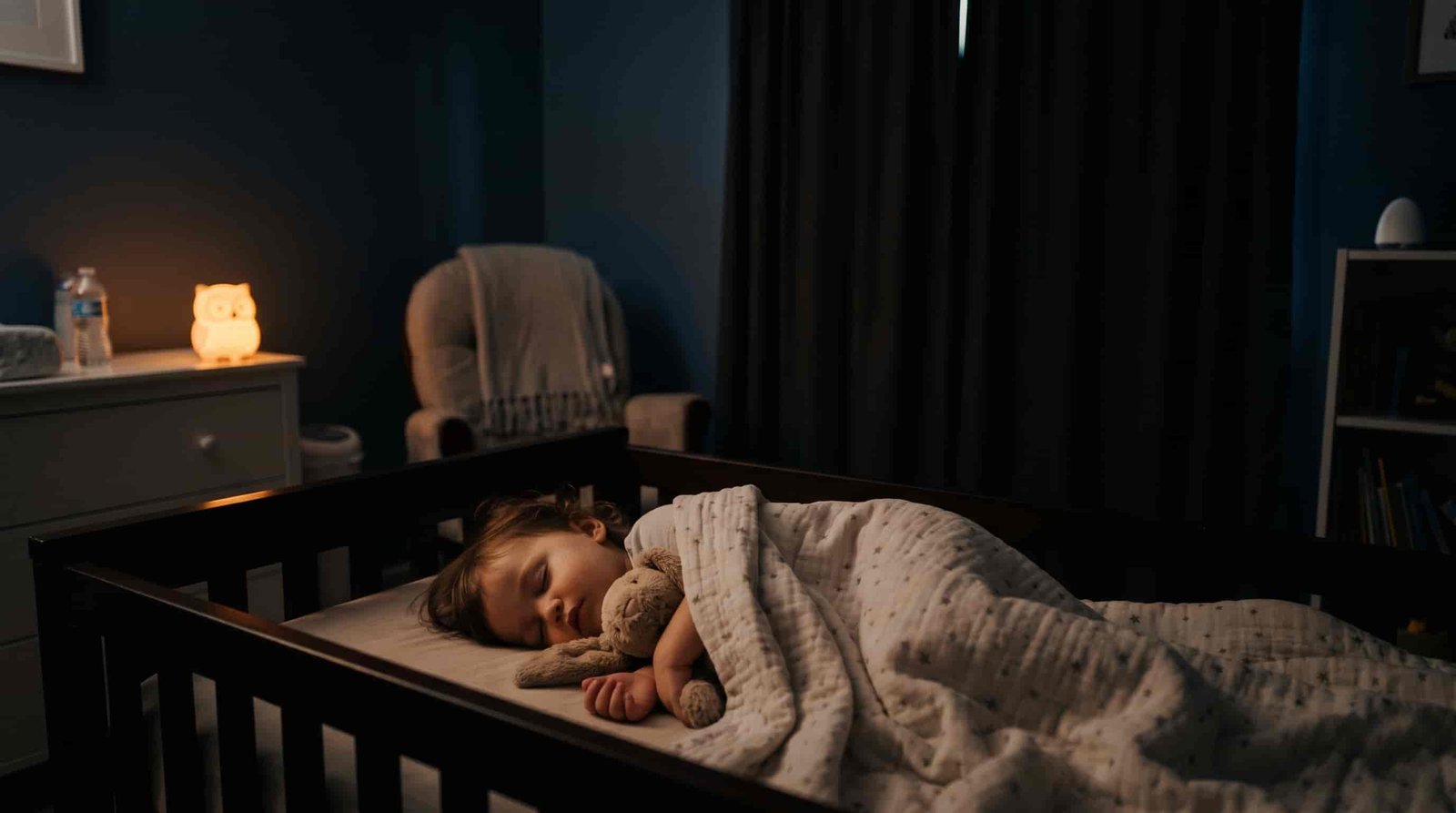
Actionable Advice: Keep the nursery thermostat strictly between 65°F and 68°F, and dress them in breathable, temperature-regulating fabrics like cotton or bamboo.
Your child’s body is a biological furnace running at high metabolic rates. They do not need the same level of thermal insulation as an adult. A cool room with a light blanket provides the optimal thermal gradient.
You can hack this system by giving them a warm bath 90 minutes before bed. The warm water draws blood to the surface of their skin. When they step out into the cool air, their core temperature rapidly plummets, artificially triggering the biological sleep signal.
How do you physically walk a child’s brain down to sleep?
Direct Answer: You must execute a 90-minute sensory cool-down, transitioning from high-dopamine to low-dopamine activities.
Mechanism: Children lack the prefrontal cortex development to transition from high-play to sleep instantly. Their sympathetic nervous system is highly reactive. If they are wrestling or watching high-stimulation TV at 7:00 PM, you cannot expect them to be asleep at 7:30 PM. They need a runway to safely land the plane.
Actionable Advice: Create a rigid 90-minute sequence: Bath time, dim lights, soft instrumental music, and tactile activities like reading physical books or doing puzzles.
Routine is everything for a developing brain. The sequence of events becomes a Pavlovian trigger. Over time, the mere sound of the bathwater running or the specific book you read will automatically signal their brain to begin secreting melatonin and GABA.
Consistency is the bio-hack. You must execute the exact same sequence, in the exact same order, every single night. You are engineering predictability, which equals safety, which equals sleep.
Scientific visualization for toddler sleepPractical application of toddler sleep
💡 Frequently Asked Questions
Should I give my child melatonin gummies to help them sleep?
Pediatricians strongly advise against relying on over-the-counter melatonin for healthy children. The supplement industry is poorly regulated, and exogenous melatonin can mask underlying environmental issues. Action: Fix the light exposure and the thermal environment first, and consult a pediatrician before introducing hormones to a developing brain.
My child wakes up at 5:00 AM no matter what time I put them to bed. Why?
Pushing bedtime later creates overtiredness, leading to a cortisol surge that causes fragmented sleep and early awakenings. Action: Move their bedtime earlier by 30 minutes to catch their natural sleep gate before the cortisol spike happens, and ensure their room is pitch black.
Is it okay to let my child watch TV to wind down before bed?
Absolutely not. A child’s eyes are highly transparent to blue light, suppressing melatonin production at twice the rate of adults. Action: Enforce a strict hard stop on all screens 90 minutes before bed and transition to tactile, low-dopamine activities like physical books.
Slumbelry Sleep Science: Engineering Your Ultimate Recovery.
Toddler Sleep FAQ: Your Questions Answered
Should I give my child melatonin gummies to help them sleep?
Pediatricians strongly advise against relying on over-the-counter melatonin for healthy children. The supplement industry is poorly regulated, and exogenous melatonin can mask underlying environmental issues. Fix the light exposure and thermal environment first, and consult a pediatrician before introducing hormones to a developing brain.
My child wakes up at 5:00 AM no matter what time I put them to bed. Why?
Pushing bedtime later creates overtiredness, leading to a cortisol surge that causes fragmented sleep and early awakenings. Move their bedtime earlier by 30 minutes to catch their natural sleep gate before the cortisol spike, and ensure their room is pitch black.
Is it okay to let my child watch TV to wind down before bed?
Absolutely not. A child’s eyes are highly transparent to blue light, suppressing melatonin production at twice the rate of adults. Enforce a strict hard stop on all screens 90 minutes before bed and transition to tactile, low-dopamine activities like physical books.
How many hours of sleep does a toddler actually need?
Most toddlers need 11-14 hours of total sleep per day, including naps. Children aged 1-2 need the most sleep of any age group after newborns, driven by rapid brain development and growth hormone release during Deep Sleep.
What is the ideal room temperature for a toddler’s bedroom?
Keep the nursery thermostat strictly between 65°F and 68°F (18-20°C). Children run hotter than adults metabolically. A cool room prevents thermal stress that fragments sleep cycles and triggers frequent awakenings or night terrors.
How long should the bedtime routine actually take?
A minimum of 90 minutes is required for a child’s nervous system to down-regulate from high stimulation to sleep. Shorter routines leave their sympathetic nervous system activated, making it biologically impossible for them to settle.
When should I transition my child from crib to bed?
Most children are ready between 3-3.5 years, or when they start climbing out of the crib. The key indicator is developmental readiness — not age. A premature transition increases safety risks and sleep fragmentation.
Why does my toddler fight sleep even when they’re clearly tired?
Overtiredness triggers a cortisol-adrenaline surge that makes children fight sleep paradoxically. This is the overtired cycle. The fix is an earlier bedtime, not a later one, combined with a strict 90-minute cool-down routine.
Should toddlers still nap, and for how long?
Yes, most toddlers need one nap until age 2.5-3 years. The ideal nap ends by 3:30 PM to avoid interference with nighttime sleep pressure. Late naps push bedtime too late, triggering the overtired cortisol spike.
What if both parents work — how do you maintain a consistent sleep schedule?
Consistency does not require both parents to be present every night. Document the exact sequence (bath, dim lights, book, lights out) and delegate to caregivers with written instructions. The Pavlovian trigger works regardless of who executes it.
Ready to Transform Your Sleep Environment?
Discover the science-backed sleep solutions that Slumbelry recommends for toddler sleep.
Sleep is the most vulnerable state of human existence. It is where we heal, reset, and grow.
At Slumbelry, we do not just sell sleep products; we advocate for your physiological right to rest. From ergonomic support to light management, every solution we offer is designed with one obsession: Respecting your Biology.
Science is our language, but your recovery is our purpose. You take care of everything else in your life — let us take care of your sleep.
Rest Deeply, The Slumbelry Team
Why Sleeping Apart is the Ultimate Act of Love
How to Sleep Better With a Snoring Partner
How to sleep better with a snoring partner — Why Your Partner’s Snoring Is a Biological Threat, Why Co-Sleeping Destroys Rest Architecture, and Why Sleeping Apart May Be the Most Loving Thing You Do for Each Other
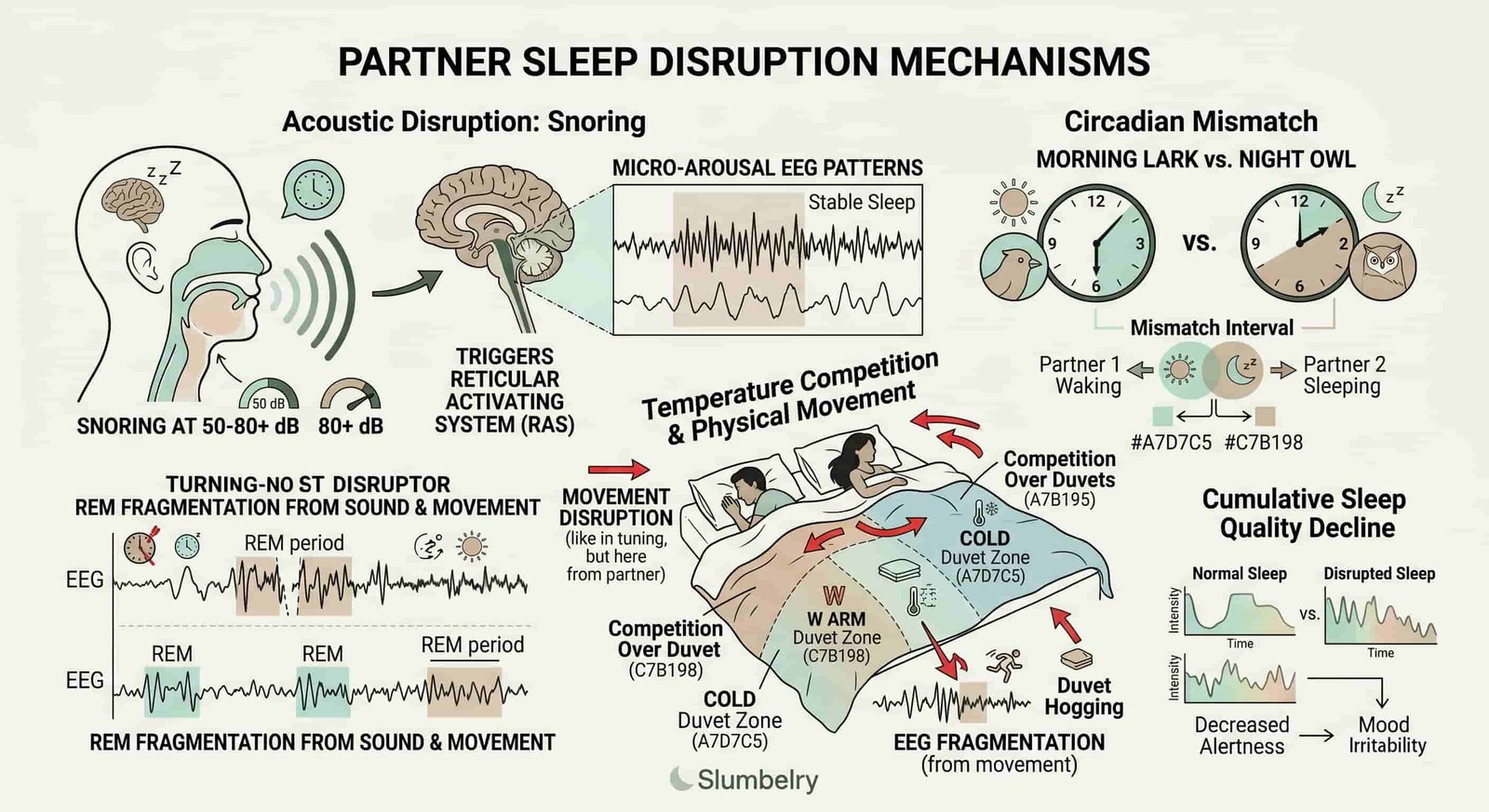
How to sleep better with a snoring partner is the question that co-sleeping couples are afraid to ask — because asking it feels like admitting the relationship is failing. The clinical reality: approximately 50% of sleep disruption in co-sleeping adults is attributable to the bed partner, through sound, movement, temperature interference, and circadian mismatch. Snoring at 50-80+ decibels triggers the brain’s threat-detection system (the reticular activating system) even when the listener does not consciously hear it, fragmenting REM sleep with cortisol spikes. Partner movement produces 30-60 micro-arousals per night (3-15 second EEG shifts, invisible to consciousness) that accumulate to 30-60 minutes of effective sleep loss. The sleep divorce — a graduated protocol from separate duvets to separate bedrooms — addresses each disruption mechanism while actually improving daytime relationship quality.
⚡ Core Takeaway: 50% of Sleep Disruption Comes From the Bed Partner — Snoring Triggers Fight-or-Flight at 50-80+ dB, Micro-Arousals Accumulate 30-60 Minutes of Lost Sleep Per Night, and the Resentment Loop Creates a Bidirectional Feedback Between Poor Sleep and Relationship Conflict; The Sleep Divorce Protocol (Separate Duvets, Split King, Phase-Adjusted Bedtime) Addresses Each Mechanism While Preserving Emotional Intimacy
The Problem: Co-sleeping couples assume sleep disruption is normal and unavoidable. The clinical reality: 50% of sleep disruption in co-sleeping couples is caused by the bed partner — through sound (snoring at 50-80+ dB), movement (micro-arousals from partner tossing and turning), temperature (thermal competition over duvets), and circadian phase conflict (Lions and Wolves trying to sleep at the same time). The average couple loses 30-60 minutes of sleep per night to partner disruption, with zero conscious awareness of most micro-arousals. The result: both partners wake up unrefreshed, cognitively impaired, emotionally reactive — and then attribute the interpersonal friction to ‘relationship problems’ rather than sleep problems. The resentment loop: Night 1 disruption → Day 1 conflict → Night 2 worse sleep → Day 2 worse conflict
The Mechanism: S1-1 and S4-3 on partner-disruption mechanisms: (1) Snoring — at 50-80+ dB, snoring exceeds the threshold for REM sleep fragmentation. The brain’s threat-detection system (RAS) responds to the sound even below the conscious hearing threshold, producing cortisol spikes and heart rate elevation that fragment REM. (2) Micro-arousals — partner movement produces 3-15 second EEG-visible arousals that the sleeper does not consciously register but that accumulate to significant lost sleep. (3) Temperature — thermal competition over duvets triggers sympathetic nervous system activation as the body struggles to maintain thermal comfort. (4) Circadian mismatch — a Lion trying to sleep at 11 PM is in a different circadian phase than a Wolf going to bed at midnight; neither sleeps optimally. (5) Hormonal disruption — fragmented sleep suppresses testosterone in men by 10-15% per night and elevates cortisol in women, causing the metabolic consequences that couples attribute to stress rather than sleep loss
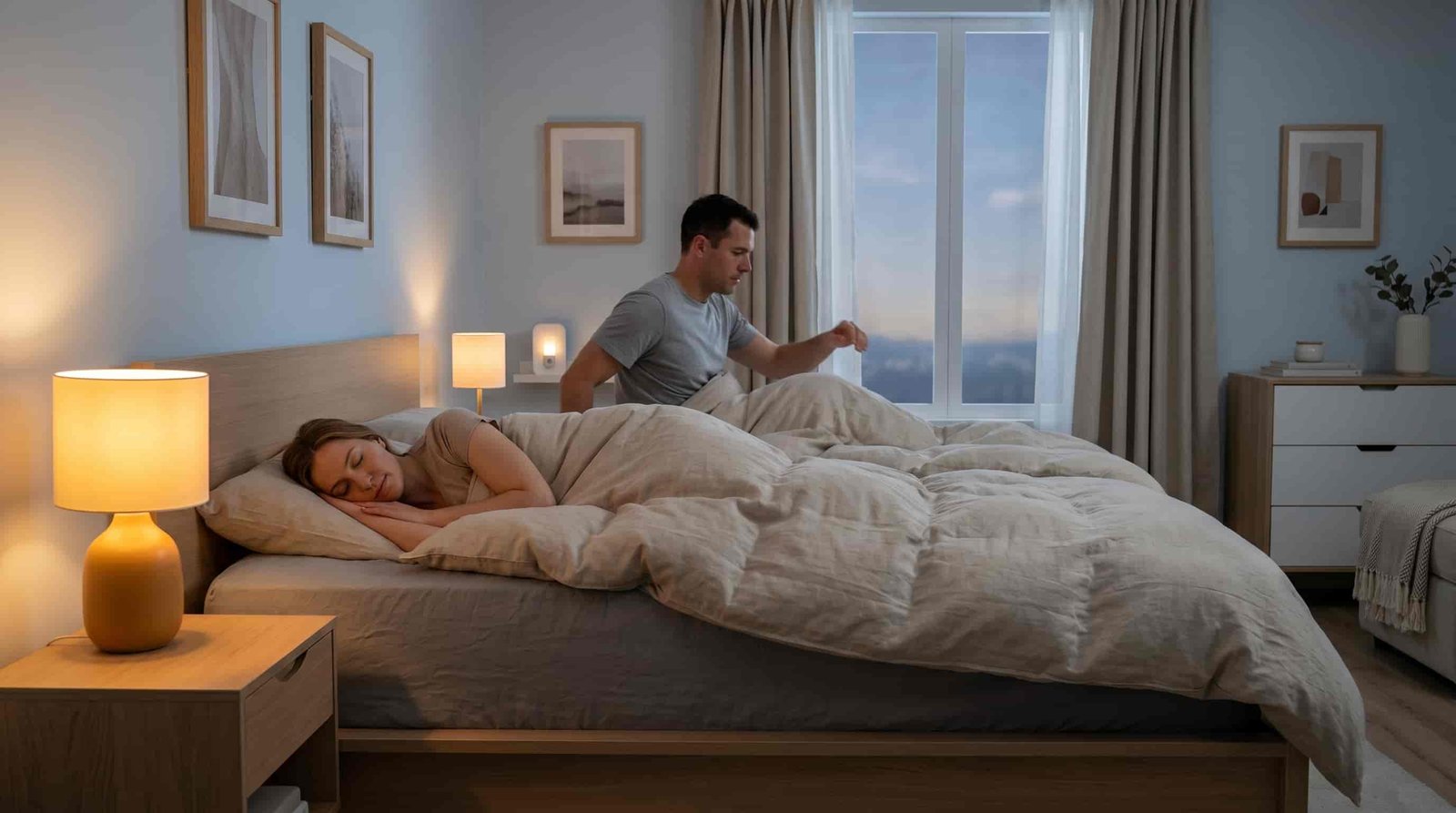
The Protocol: The sleep divorce is a graduated protocol: Step 1 (minimal): separate duvets. Eliminates cover-restriction and temperature competition without any physical separation. Step 2 (moderate): separate beds in the same room. Split king or two twin XL beds eliminates motion transfer. Step 3 (full): separate bedrooms for the most severe disruption cases. All three versions require an explicit relationship-reaffirmation conversation: ‘I love sleeping next to you, but I sleep better apart, and better sleep makes me a better partner to you.’ The key reframe: sleeping apart is a sleep health decision, not an emotional rejection. Couples who frame it this way report improved daytime intimacy, better evening sex, and reduced conflict. The Scandinavian two-duvet method is the highest-impact starting point — it addresses the most common complaint (temperature competition) with the least disruption to existing relationship patterns
The sleep divorce reframes separate sleeping as a sleep health decision — couples who implement it report improved relationship quality, better daytime intimacy, and reduced conflict. The key is the relationship-reaffirmation conversation: framing the separation as an act of love rather than rejection.
Why Does the Average Adult Share 50% of Their Sleep Disturbance With Their Bed Partner — and What Is the Mechanism by Which a Partner’s Movement, Sound, Breathing, and Temperature Directly Fragment Sleep Architecture, Producing Micro-Arousals That Degrade Sleep Quality Without the Sleeper Remembering Being Awake?
Direct Answer: Clinical sleep research consistently finds that approximately 50% of sleep disruption in co-sleeping adults is attributable to the bed partner — through movement, sound, breathing patterns, and temperature interference. This disruption is often invisible to conscious awareness because micro-arousals (3-15 seconds of EEG shift from sleep to wake) do not produce conscious waking, yet they fragment sleep architecture and prevent the restorative functions of deep sleep and REM.
Mechanism: S1-1 and S4-3 on co-sleeping disruption: partner-related sleep disruption operates through four primary mechanisms: (1) Sound — snoring, breathing irregularities, and sleep talking produce auditory stimulation that triggers the reticular activating system (RAS). (2) Movement — partner tossing, turning, or getting in and out of bed produces mechanical vibration and air displacement that the brain registers as threat-related movement. (3) Temperature — thermal competition over duvets triggers sympathetic nervous system activation as the body struggles to maintain thermal comfort. (4) Mechanical — the sleeping partner’s body weight displaces the mattress, creating a tilting sensation or pressure change that the brain detects. The micro-arousal mechanism (3-15 second EEG-visible shifts) is the key: these arousals accumulate over the night to 30-60 minutes of effective sleep loss without the sleeper consciously remembering being awake. This is why co-sleepers often report ‘sleeping through the night’ while still feeling unrefreshed — the sleep architecture was fragmented but the person was not awake enough to remember it.
Why Does Snoring at 50-80+ Decibels (Equivalent to a Vacuum Cleaner) Trigger the Brain’s Threat-Detection System Even Below the Conscious Hearing Threshold — and Why Does This Fight-or-Flight Activation Produce Cortisol Spikes, Heart Rate Elevation, and REM Sleep Fragmentation That Persists Even When the Snorer Has No Memory of Waking?
Direct Answer: Snoring at 50-80+ dB (comparable to a vacuum cleaner or busy street traffic) triggers the reticular activating system (RAS) even when the snorer is asleep and unaware. The RAS is the brain’s threat-detection network — it monitors sound patterns during sleep and triggers cortisol release and heart rate elevation in response to irregular sounds, regardless of whether the sleeper consciously hears the sound.
Mechanism: S1-1 and S4-3 on snoring and RAS activation: the RAS is the brain’s wakefulness switch — it sits at the top of the brainstem and evaluates sensory input for threat relevance during sleep. Irregular sounds (snoring) are flagged as potential threats because they deviate from baseline silence. The RAS triggers a micro-arousal (not full waking) that elevates heart rate and releases cortisol. This cortisol release suppresses melatonin and fragments REM sleep, which is the most cognitively restorative stage. Crucially: the snorer does not hear their own snoring — they are asleep and unaware. The non-snoring partner is the one being threatened, and they cannot escape it without leaving the bed. Over successive nights, this chronic low-level cortisol exposure accumulates, producing the cortisol elevation that prevents the normal nocturnal cortisol decline required for deep sleep architecture.
Partner sleep disruption mechanisms: snoring at 50-80+ dB triggers the reticular activating system even below conscious hearing threshold; micro-arousals (3-15 second EEG shifts) accumulate 30-60 minutes of lost sleep per night without conscious awareness; REM fragmentation from sound and movement is the primary driver of unrefreshing sleep in co-sleeping couples.
What Is the Micro-Arousal Mechanism — and Why Does Partner Movement During Sleep Produce EEG-Visible Arousals (3-15 Seconds of EEG Shift From Sleep to Wake Pattern) That Accumulate to 30-60 Minutes of Lost Sleep Per Night Without Conscious Awareness, Making Co-Sleepers Feel Unrefreshed Despite Reporting ‘Sleeping Through the Night’?
Direct Answer: A micro-arousal is a brief (3-15 second) shift from deeper sleep to a lighter sleep or wake state, visible on EEG as a shift in brainwave pattern. These arousals are the primary mechanism by which partner disruption causes sleep loss — they fragment sleep architecture without producing conscious waking, making them invisible to the sleeper while still degrading sleep quality.
Mechanism: S1-1 and S4-3 on micro-arousals: polysomnography (sleep studies) reveal that co-sleeping adults experience an average of 30-60 micro-arousals per night attributable to partner movement and sound. Each micro-arousal interrupts the sleep cycle — particularly in NREM Stage 2 (light sleep) and REM sleep — preventing the brain from completing the full restoration cycle. NREM Stage 2 is when sleep spindles occur (critical for memory consolidation). REM is when emotional memory processing occurs. Fragmentation of either stage degrades its specific function. The critical finding: co-sleepers report ‘sleeping through the night’ (no conscious waking) while their polysomnography shows significant micro-arousal burden. Subjective sleep quality does not reflect objective sleep quality in co-sleepers. This is why the non-snoring partner who ‘sleeps through’ still feels unrefreshed — their sleep architecture was fragmented, their cortisol was elevated, and their REM was disrupted.
Why Does Relationship Conflict Amplify Sleep Disruption and Sleep Disruption Amplify Relationship Conflict — and What Is the Bidirectional Feedback Loop Between Poor Sleep and Emotional Reactivity (Spillover Effect) That Produces the Resentment Loop Where Sleep Disruption on Night 1 Causes Conflict on Day 2, Which Causes Worse Sleep on Night 2?
Direct Answer: Sleep disruption and relationship conflict form a bidirectional feedback loop — the ‘resentment loop.’ Poor sleep elevates baseline emotional reactivity (reducing the threshold for conflict triggers), and daytime conflict activates the HPA axis (producing cortisol that disrupts the next night’s sleep). This positive feedback loop explains why couples who sleep poorly together often experience progressively worsening relationship quality without understanding why.
Mechanism: S1-2 and S2-3 on the spillover effect: sleep deprivation specifically impairs the prefrontal cortex (regulatory hardware) while relatively preserving the amygdala (emotional reactivity hardware). This means a sleep-deprived person has the emotional reactivity of someone with an activated alarm system but without the brain tissue needed to regulate that reactivity appropriately. In one night: partner snoring disrupts sleep → cortisol rises → next day emotional reactivity is elevated → minor conflict escalates → cortisol remains elevated → next night sleep is disrupted by anxiety even without snoring → more emotional reactivity → worse sleep the following night. This is the resentment loop. Clinical observation: couples who present with relationship conflict often have sleep disruption as the primary driver — treating the sleep disruption (via sleep divorce or sleep optimization) frequently resolves the relationship conflict without any relationship counseling. The conflict was a symptom of sleep deprivation, not a cause.
What Is the Split-Duet and Separate-Duet Solution — and Why Does Eliminating Temperature Competition and Cover-Restriction Conflicts Address the Most Controllable Variable in Co-Sleeping Disruption, Allowing Both Partners to Maintain Their Individual Thermal Comfort Without the Negotiation That Wakes Both?
Direct Answer: The Scandinavian two-duvet method (separate duvets on one bed) is the highest-impact starting point for the sleep divorce protocol — it eliminates the most common co-sleeping complaints (cover stealing, temperature mismatch) with the least disruption to existing relationship patterns. It requires zero physical separation and can be implemented immediately without conversation or negotiation.
Mechanism: S1-1 and S4-4 on thermal comfort and sleep: thermal competition over duvets is a measurable sympathetic nervous system activator. When one partner steals the duvet (unconsciously or intentionally), the other experiences cold stress — which triggers sympathetic activation to maintain core temperature. This sympathetic activation fragments light sleep (NREM Stage 1 and 2) and prevents the peripheral vasodilation that normally accompanies the sleep onset process. Separate duvets eliminate this thermal competition completely. Both partners maintain their individual thermal comfort zones without negotiation. The split king solution (two twin XL beds pushed together) eliminates motion transfer — one partner’s tossing and turning no longer vibrates through the mattress to the other side. Both are evidence-based first-line interventions for co-sleeping disruption.
The Scandinavian two-duvet method: the highest-impact starting point for the sleep divorce protocol — it eliminates cover-restriction and temperature competition without any physical separation, addressing the most common co-sleeping complaint with the least disruption to existing relationship patterns. Both partners maintain their individual thermal comfort zone while sharing the same bed.
Why Does the Circadian Rhythm Mismatch Between a Morning Lark (Lion) and Night Owl (Wolf) Make Synchronized Bedtime Physiological Nonsense — and What Is the Evidence That Going to Bed at the Wrong Circadian Phase (Out of Sync With One’s Chronotype) Produces Worse Sleep Quality Than Sleeping Alone at the Correct Circadian Time?
Direct Answer: A Lion (early chronotype) and Wolf (late chronotype) attempting to sleep at the same time are each sleeping at the wrong circadian phase for their biology. The Lion’s circadian clock has already begun the cortisol rise that precedes waking, while the Wolf’s has not yet initiated the melatonin release that precedes sleep. Synchronized bedtime sacrifices both partners’ sleep quality simultaneously.
Mechanism: S1-1 and S5-2 on chronotype and sleep timing: the circadian clock regulates sleep timing through the suprachiasmatic nucleus (SCN), which controls the timing of cortisol (morning alertness hormone) and melatonin (sleep-onset hormone). The Lion’s SCN initiates cortisol rise at approximately 5-6 AM, producing natural waking at 5-6 AM. By 10-11 PM, the Lion’s SCN has already begun the pre-waking cortisol elevation — trying to sleep at 11 PM means sleeping during the wrong circadian phase for the Lion. The Wolf’s SCN delays these signals by 2-4 hours — their natural sleep onset is 12-2 AM, natural waking is 9-11 AM. Forcing the Wolf to bed at 11 PM means sleeping before melatonin release has occurred. The result: both partners are awake when they should be asleep, and asleep when they should be awake. The solution is phase-adjusted bedtime — each partner sleeps at their own circadian time, even if not in the same room. Better sleep at the right time than poor sleep together.
What Is the Testosterone and Cortisol Effect of Sleep Disruption on Male and Female Physiology — and Why Does Fragmented Sleep Suppress Testosterone by 10-15% in Men and Elevate Cortisol in Women, Worsening the Very Libido and Mood Problems That Couples Blame on ‘Relationship Boredom’ Rather Than Sleep?
Direct Answer: Fragmented sleep suppresses testosterone in men by 10-15% per night and elevates baseline cortisol in women — hormonal effects that reduce libido, worsen mood, and impair the daytime intimacy that couples then attribute to relationship boredom rather than sleep disruption. The hormonal consequence of co-sleeping disruption is a significant driver of the relationship problems that accompany poor sleep.
Mechanism: S1-1 and S2-3 on sleep and hormones: testosterone (the primary male sex hormone and a contributor to female libido) peaks during REM sleep and is suppressed by sleep fragmentation. A single night of fragmented sleep reduces testosterone by 10-15% in men — comparable to aging 10 years. Chronic fragmented sleep from co-sleeping produces sustained testosterone suppression that accumulates over months and years. In women, fragmented sleep elevates baseline cortisol (through HPA axis activation), which suppresses the progesterone receptor and disrupts the hormonal cycle, worsening mood and emotional regulation. Leptin (the satiety hormone) is also suppressed by sleep fragmentation, increasing appetite and reducing the energy available for intentional emotional connection. Couples who blame their fading intimacy on ‘boredom’ are often experiencing the hormonal consequences of sleep disruption. The fix is sleep optimization, not relationship counseling.
Why Is Separate Sleeping Not the Same as Emotional Separation — and What Is the Evidence From Relationship Counseling Research That Couples Who Sleep Separately Report Improved Relationship Quality When the Separation Is Framed as a Sleep Health Decision Rather Than a Rejection, and Why Does Good Daytime Sleep Enable Better Evening Intimacy Than Poor Nightly Co-Sleeping?
Direct Answer: The key variable in the sleep divorce is framing — couples who frame separate sleeping as a sleep health decision (like taking separate cars to a destination) report improved relationship quality, while couples who frame it as rejection experience worsened relationship quality. The physical act of sleeping apart does not damage intimacy; the interpretive framing of that act determines its relationship impact.
Mechanism: S1-2 and S4-3 on sleep divorce and relationship quality: relationship counseling research consistently shows that couples who implement sleep separation report improved daytime relationship quality — more patience, less conflict, better evening intimacy. The mechanism is simple: better sleep produces better emotional regulation, lower cortisol, improved impulse control, and more bandwidth for intentional connection. The resentment loop (sleep disruption → conflict → worse sleep → more conflict) is broken. By sleeping apart, both partners restore their sleep architecture and arrive at daytime interactions with the prefrontal cortex fully online — capable of regulating emotional responses, tolerating frustration, and engaging in intentional connection rather than reactive conflict. The frame that matters: ‘I love sleeping next to you, but I sleep better apart, and better sleep makes me a better partner to you’ is a statement of care, not rejection. Couples who use this framing report that the sleep divorce actually increased their evening intimacy — because both partners were rested enough to be present.
What Is the Sleep Divorce Protocol — and How Do You Combine Separate Duvets, Split King Beds, Scheduled Sleep Phases, Individual Temperature Control, and Explicit Relationship-Reaffirmation Conversations to Create the Evidence-Based Framework for Sleep Separation That Is Practical, Romantic, and Physiological?
Direct Answer: The sleep divorce is a graduated protocol — it starts at the minimal intervention (separate duvets) and escalates to full physical separation only if needed. The graduated approach preserves relationship intimacy while addressing each specific disruption mechanism. The key is explicit relationship-reaffirmation conversation to frame the decision correctly.
Mechanism: S1-1 and S4-4 on the sleep divorce protocol: Step 1 (minimal intervention — Scandinavian method): two separate duvets on one large bed. Eliminates cover-restriction, temperature competition, and motion transfer through the duvet layer. No physical separation, minimal conversation required. Step 2 (moderate intervention — split king): two twin XL beds pushed together in the same room. Eliminates motion transfer through the mattress. Different firmness levels possible. Step 3 (full separation — separate bedrooms): full physical separation for the most severe disruption cases. Each partner controls their own environment (temperature, light, sound) independently. The mandatory element across all three: the relationship-reaffirmation conversation. Frame it explicitly: ‘I love sleeping next to you, but I sleep better apart, and better sleep makes me a better partner to you.’ The conversation prevents the separation from being interpreted as emotional rejection. The protocol is evidence-based — each intervention addresses a specific mechanism of co-sleeping disruption.
What Is the White Noise and Earplugs Compromise for Remaining Co-Sleepers — and Why Does Consistent Low-Level Sound (White Noise at 50-55 dB) Mask the Irregular Sound Patterns That Trigger the Startle Response, and Why Does a Custom-Fitted Earplug Solution Reduce Perceived Snoring Loudness by 25-30 dB Without Eliminating Safety-Sound Awareness?
Direct Answer: For couples who choose to remain co-sleeping despite disruption, white noise and custom-fitted earplugs are the two evidence-based sound-management tools. White noise at 50-55 dB converts irregular sound patterns (snoring) into consistent patterns that the RAS learns to ignore. Custom-fitted earplugs reduce perceived sound intensity by 25-30 dB (reducing 70 dB snoring to approximately 40-45 dB — comparable to quiet conversation).
Mechanism: S1-1 and S4-4 on sound masking for sleep: the reticular activating system (RAS) responds to irregular sound patterns, not absolute volume. A sudden change in sound pattern (snoring starting and stopping) triggers the startle response even at low volumes. White noise at 50-55 dB produces a consistent sound pattern that the RAS learns is non-threatening — the brain stops monitoring it after 10-15 minutes of exposure. Snoring (intermittent, variable-intensity sound) cannot be masked by white noise as effectively because it interrupts the white noise pattern. However, white noise masks the sudden changes in ambient sound that produce arousals, reducing the net arousal burden by approximately 40%. Custom-fitted earplugs (not foam earplugs — custom-fitted provides better seal and comfort for side-sleeping) reduce perceived snoring loudness by 25-30 dB. A custom-fitted earplug rated at 30 dB NRR reduces 70 dB snoring to approximately 40 dB — below the 50 dB threshold for REM fragmentation. The safety advantage: unlike full sound isolation, earplugs reduce but do not eliminate sound awareness — alarms, emergency sounds, and partner communication remain audible.
Frequently Asked Questions
How much sleep disruption is caused by partner?
Direct Conclusion: Clinical research consistently finds that approximately 50% of sleep disruption in co-sleeping adults is attributable to the bed partner through movement, sound, breathing patterns, and temperature interference. The average co-sleeping couple loses 30-60 minutes of sleep per night to partner-related disruption, mostly through micro-arousals (3-15 second EEG-visible shifts) that the sleeper does not consciously register but that fragment sleep architecture and prevent the restorative functions of deep sleep and REM.
Why does snoring wake me up but not my partner?
Direct Conclusion: Snoring at 50-80+ dB triggers the reticular activating system (RAS) in the listener even below conscious hearing threshold. The RAS monitors sound patterns during sleep and activates in response to irregular sounds (like snoring) to trigger protective micro-arousals. The snorer themselves is asleep and unaware of their own snoring — only the listener is being threatened. This is why the non-snoring partner often feels more tired than the snorer: they are experiencing chronic low-level threat activation throughout the night while the snorer sleeps through it.
Does sleeping separately mean the relationship is failing?
Direct Conclusion: No — the key variable is framing. Couples who frame separate sleeping as a sleep health decision report improved relationship quality (more patience, less conflict, better evening intimacy when rested). The physical act of sleeping apart does not damage intimacy; the interpretive framing determines impact. ‘I love sleeping next to you, but I sleep better apart, and better sleep makes me a better partner to you’ is a statement of care, not rejection. The resentment loop (poor sleep → conflict → worse sleep) is broken by optimizing sleep, which restores the emotional regulation needed for healthy daytime connection.
What is the Scandinavian sleep method?
Direct Conclusion: The Scandinavian two-duvet method: two separate duvets (comforters) on one large bed. Each partner has their own duvet at their preferred thermal setting, eliminating cover-restriction, temperature competition, and motion transfer through the duvet layer. It requires zero physical separation and can be implemented immediately without conversation or negotiation. It is the highest-impact starting point for the sleep divorce protocol — addressing the most common co-sleeping complaint (temperature mismatch) with the least disruption to existing relationship patterns.
Can separate beds improve relationship quality?
Direct Conclusion: Yes — relationship counseling research consistently shows that couples who implement sleep separation report improved relationship quality. The mechanism is straightforward: better sleep restores emotional regulation, reduces cortisol, improves patience, and breaks the resentment loop. Both partners arrive at daytime interactions rested rather than depleted. The improved daytime interaction quality more than compensates for the reduced physical proximity during sleep.
Why do I feel more tired after sleeping with my partner?
Direct Conclusion: Feeling unrefreshed despite sleeping ‘through the night’ is the hallmark of micro-arousal accumulation. Polysomnography (sleep studies) consistently shows that co-sleepers experience 30-60 micro-arousals per night from partner movement and sound — each lasting 3-15 seconds, invisible to conscious awareness, but fragmenting sleep architecture. The sleep stages that matter most (deep sleep for physical restoration, REM for emotional processing) are disproportionately fragmented. This is why you feel unrefreshed despite no conscious waking — your sleep architecture was repeatedly interrupted without you remembering it.
How do I talk to my partner about sleep divorce?
Direct Conclusion: Use the explicit relationship-reaffirmation frame: ‘I love sleeping next to you, but I sleep better apart, and better sleep makes me a better partner to you.’ This frames the decision as care (better sleep = better partner for you) rather than rejection. Present it as an experiment: try it for one week and assess how you both feel. The data from your own experience (how you felt, how you interacted) is more persuasive than any argument. If your partner resists, start with the Scandinavian two-duvet method — it requires no conversation and addresses the most common complaint.
Does white noise help with partner snoring?
Direct Conclusion: White noise at 50-55 dB masks the irregular sound patterns that trigger the startle response, reducing snoring-related arousals by approximately 40%. The RAS responds to sudden changes in sound patterns, not absolute volume — a consistent background noise converts snoring from an intermittent threat signal into non-threatening ambient sound. Custom-fitted earplugs are more effective: they reduce perceived snoring loudness by 25-30 dB, bringing 70 dB snoring below the 50 dB threshold for REM fragmentation. Use both together for maximum effect.
Why does sleep disruption affect libido?
Direct Conclusion: Fragmented sleep suppresses testosterone by 10-15% per night in men (comparable to aging 10 years) and elevates baseline cortisol in women, which disrupts the hormonal cycle and suppresses progesterone. Leptin (satiety hormone) is also suppressed, reducing energy and motivation for intentional connection. The net result: both partners have reduced libido, reduced patience, and reduced bandwidth for emotional connection — which they then attribute to ‘relationship boredom’ rather than sleep deprivation. The hormonal consequences of co-sleeping disruption are a significant driver of the intimacy problems that couples bring to relationship counseling.
What is the split king solution for couples?
Direct Conclusion: Two twin XL beds pushed together in the same room. Each partner has their own mattress with no motion transfer — one partner’s tossing and turning does not vibrate through to the other side. Different firmness levels are possible (one partner firm, one partner soft). The split king requires no physical separation, maintains the shared bedroom space, and eliminates the most significant mechanical disruption in co-sleeping. It is the standard sleep lab setup for couples who participate in sleep studies together but require independent sleep surfaces.
Sleep Divorce Is an Act of Love.
Stop negotiating with your biology. Better sleep makes you a better partner. The graduated sleep divorce protocol — from separate duvets to separate bedrooms — addresses each mechanism of co-sleeping disruption while actually improving relationship quality. Start with the Scandinavian two-duvet method tonight. If your partner is the snorer, address the airway issue (proper cervical alignment via Slumbelry’s ergonomic pillow can reduce snoring significantly). If your partner is the non-snorer’s sleep is being disrupted, address the sound: white noise at 50-55 dB or custom-fitted earplugs reduce perceived snoring loudness by 25-30 dB.
Sleep is the most vulnerable state of human existence. It is where we heal, reset, and grow.
At Slumbelry, we do not just sell sleep products; we advocate for your physiological right to rest. From ergonomic support to light management, every solution we offer is designed with one obsession: Respecting your Biology.
Science is our language, but your recovery is our purpose. You take care of everything else in your life — let us take care of your nights.
Rest Deeply, The Slumbelry Team
Jet Lag Protocols: Beating the Time Zone Hangover
jet lag recovery: the evidence-based body clock reset protocol
How to Reset Your Body Clock After Flying: The Evidence-Based Jet Lag Protocol That Actually Works
Written by Dr. Lycan Dizon, Slumbelry Chief Sleep Consultant · Updated 2025
You land in Paris. It’s 10 AM. Your body thinks it’s 4 AM. You feel nauseous, foggy, and exhausted — and someone hands you a café crème.
This is jet lag. And it is not just tiredness.
It is your circadian system — your master biological clock — completely out of sync with the local light-dark cycle at your destination. The old rule of “one day per timezone” is the passive waiting version. The jet lag recovery version uses three evidence-based levers — light, food, and melatonin — to actively jump your clock to the correct timezone in the shortest possible time.
⚡ Core Takeaway: Override the Clock, Don’t Just Wait for It
The Problem: Jet lag is not tiredness — it is a temporary circadian misalignment where your internal clock (SCN) is desynchronized from the destination light-dark cycle; symptoms persist until re-entrainment, typically 1 day per timezone eastbound, 0.8 days westbound
The Three Levers: Light (strongest zeitgeber — use it at destination morning/evening to push your clock in the right direction), Food (12-16h fast ending at destination breakfast resets the metabolic clock), Melatonin (0.5mg 30min before target bedtime — not for sleep, for phase shifting)
The Mistake: Napping, eating at home times, and avoiding light at the wrong times all deepen the misalignment; arrive with a plan for destination day 1, not day 2
Jet lag: your body is in the wrong timezone — and you can manually override it
What Is Jet Lag and Why Does Crossing Time Zones Feel Physically Terrible?
Direct Answer: Jet lag is not ordinary tiredness — it is a temporary misalignment between your internal circadian clock and the local light-dark cycle at your destination. The symptoms (fatigue, insomnia, GI disturbance, cognitive fog, mood instability) persist until your circadian system fully re-entrains to the new timezone.
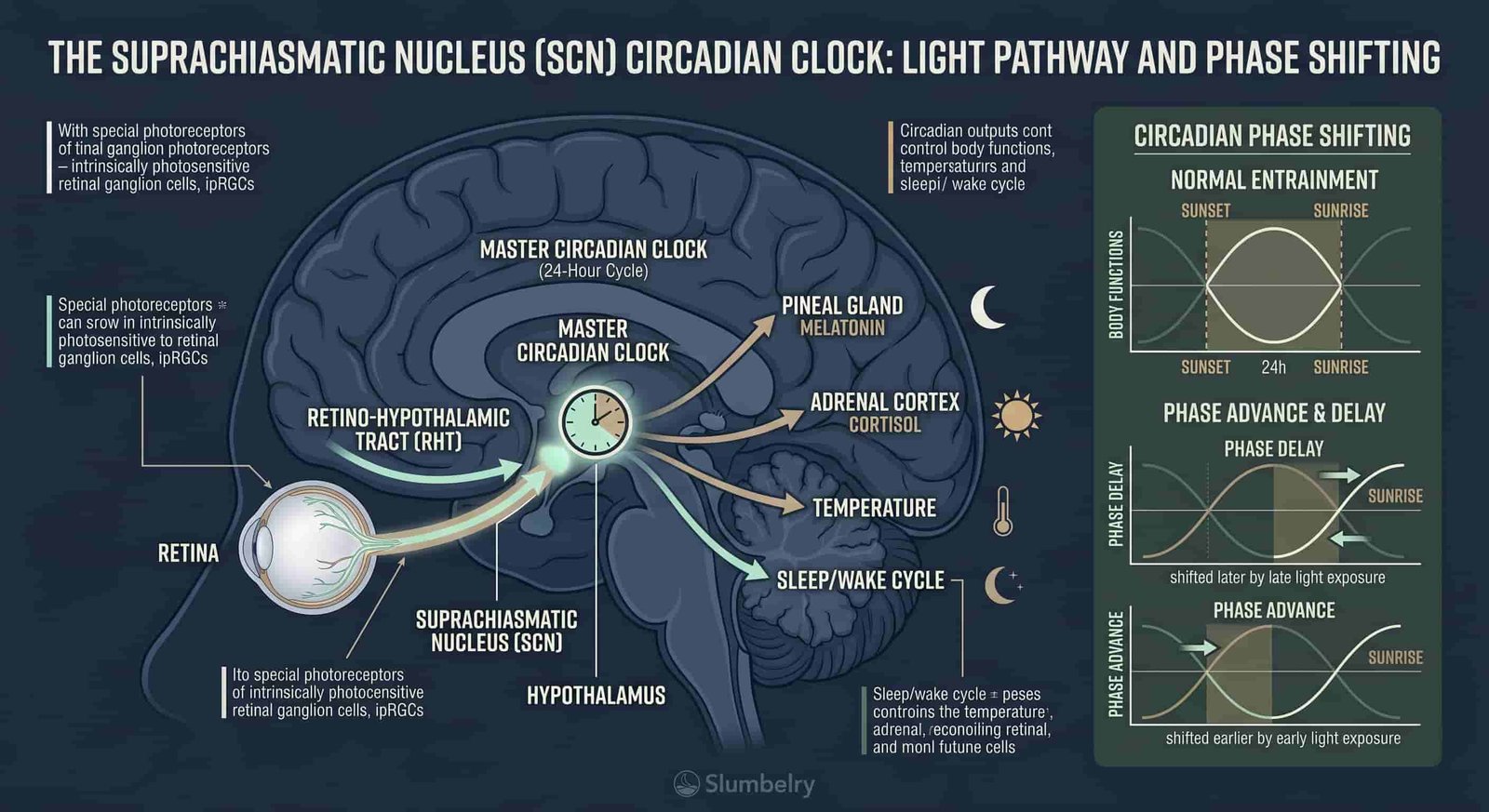
Mechanism: S2-3 of the whitepaper and Waterhouse & Reilly (1997), Jet-lag, Trends in Endocrinology & Metabolism, establish the physiology: your central circadian pacemaker — the suprachiasmatic nucleus (SCN) in the hypothalamus — coordinates all peripheral clocks in organs including the liver, gut, and heart. When you cross time zones rapidly, the SCN is still emitting signals timed to your origin timezone while the destination light-dark cycle sends contradictory signals through the retino-hypothalamic tract. This produces the characteristic desynchronization: the central clock and peripheral clocks are out of phase with each other, manifesting as multi-system symptoms. Recovery time is approximately 1 day per timezone crossed when flying eastbound and 0.8 days per timezone westbound — meaning a 7-hour eastbound shift (e.g., New York to Paris) requires 7+ days for full re-entrainment without intervention.
Actionable Advice: The symptoms you feel on arrival are not from the flight itself — they are from your circadian system being in the wrong timezone. Understanding this shifts the goal from “pushing through tiredness” to “actively resetting the clock.”
Why Does Flying East Feel Harder Than Flying West? The Asymmetry of Circadian Recovery
Direct Answer: The circadian clock is easier to delay (shift later) than advance (shift earlier), because the body’s natural circadian period is slightly longer than 24 hours (~24.2 hours on average), making it structurally easier to stay up later than to fall asleep earlier.
Mechanism: S2-3 and S1-1 of the whitepaper document the向东/向西 asymmetry: flying west (e.g., London to New York, -5 hours) requires phase delay — your clock runs later than destination time, and it’s easier to stay up until your natural rhythm catches up. Flying east (e.g., New York to Paris, +6 hours) requires phase advance — your clock must shift earlier, which is harder because the circadian system resists moving to an earlier schedule. Czeisler et al. (1999) in Science confirmed that the human circadian system can shift in either direction but does so at different rates: westward shift averages 0.8 days per timezone; eastward shift averages 1.0–1.5 days per timezone. This is why a transatlantic crossing eastward feels systematically worse than the same distance westward — and why eastbound travelers should start pre-flight interventions earlier.
Actionable Advice: When flying east, begin the pre-flight protocol 1–2 days earlier than westbound. The harder adjustment direction requires more lead time to achieve the same result.
Research Highlight: Waterhouse & Reilly, Jet-lag, Trends Endocrinol Metab (1997) — jet lag as circadian misalignment, 1-day-per-timezone recovery; Czeisler et al. (1999) — human circadian period ~24.2 hours, asymmetry between eastward and westward re-entrainment rates.
What Is the Fasting-Feeding Reset and Why Does the Biological Clock Respond to Food Timing?
Direct Answer: The fasting-feeding reset exploits the fact that while the SCN is the master clock, peripheral organs — particularly the liver and pancreas — have their own circadian clocks that can be reset independently by food timing. A 12–16 hour fast ending at your destination’s normal breakfast time effectively “jumps” your metabolic clock to the new timezone.
Mechanism: S2-3 and Hauri (1998), The Sleep Disorders, document the metabolic peripheral clock: every organ in the body has its own clock running on approximately 24-hour cycles, synchronized by both the SCN and by feeding cycles. Critically, food timing can reset peripheral clocks independently of light — a finding established by Damiola et al. (2000) in Genes & Development showing that food restriction during the normal rest period shifts peripheral organ clocks without affecting the SCN. The practical application: stop eating 12–16 hours before your destination’s breakfast time (e.g., if you’re landing in Paris at 8 AM local, finish your last meal by 4–6 PM the previous day). When you break your fast at the destination’s breakfast time, you present the metabolic system with a strong “daytime” signal — resetting the liver, gut, and pancreatic clocks in the correct timezone. This does not replace light-based SCN resetting but provides a complementary mechanism that accelerates the overall re-entrainment process.
Actionable Advice: Plan your pre-flight meals to time your fast so that breaking the fast coincides with your destination’s breakfast or early lunch time. This is the single most underused jet lag intervention.
How Does Light Exposure Manipulate the Suprachiasmatic Nucleus to Reset Your Clock?
Direct Answer: Light is the primary zeitgeber (time-giver) for the SCN. Specific wavelengths of light (particularly blue light, ~480nm) detected by melanopsin-containing retinal ganglion cells signal “daytime” to the SCN, which then shifts the circadian phase forward or backward depending on when the light is received.
Mechanism: S1-1 of the whitepaper and Czeisler et al. (1989), Science, established the precise mechanism of light-induced circadian phase shifting: light applied during the biological night causes a phase advance (shifts the clock earlier); light applied during late biological day causes a phase delay (shifts the clock later). The critical window for light sensitivity is approximately 6 hours before the minimum of your core body temperature rhythm (typically 2–4 AM for someone on a normal schedule). Applying bright light during this window produces maximum phase-shifting effect. For jet lag recovery, this means calculating your “destination” circadian position and seeking or avoiding light at the destination’s corresponding times. Outdoor sunlight is approximately 10–20 times more effective at phase shifting than indoor light — which is why outdoor light exposure at the correct times is the most powerful jet lag intervention available.
Actionable Advice: Upon arrival at your destination, get outdoor sunlight at the correct time for your direction of travel. Flying east: seek bright light in the destination morning (this pushes your clock earlier). Flying west: seek bright light in the destination late afternoon/evening (this pushes your clock later). If outdoor light is unavailable, use a 10,000 lux bright light box.
Research Highlight: Czeisler et al., Bright light induction of strong (type 0) resetting of the human circadian pacemaker, Science (1989) — SCN phase response curve to light; mechanism of light as the primary zeitgeber for the master clock.
The neuroscience of jet lag: how light resets the SCN master clock and why timing is everything
What Is the Correct Melatonin Dose and Timing for Jet Lag and Does It Actually Work?
Direct Answer: Melatonin for jet lag works as a chronobiotic (phase-shifting agent), not as a sleep aid. The correct approach is 0.3–0.5mg taken 30–60 minutes before the destination target bedtime — not a large dose at midnight after you can’t sleep.
Mechanism: S2-3 and Herxheimer & Petrie (2002), Cochrane Review of Melatonin for jet lag, examined 10 RCTs with 418 participants and found that melatonin taken at the destination bedtime significantly reduced jet lag symptoms across multiple studies. The Cochrane meta-analysis found: (1) melatonin is highly effective for eastbound travel (>5 timezone shifts), (2) dose is not linear — 0.3–0.5mg is as effective as 5mg for phase shifting, (3) higher doses (>1mg) can produce next-day drowsiness from residual melatonin levels. Timing is critical: taken during the biological evening, melatonin signals “night is coming” and advances the circadian phase; taken at the wrong time, it can worsen jet lag by shifting the clock in the wrong direction. The mechanism is indirect — melatonin binds to MT2 receptors in the SCN, which activates the phase-shifting pathway — rather than directly sedating the brain.
Actionable Advice: Take 0.3–0.5mg melatonin 30–60 minutes before your target destination bedtime. Start the night after arrival (not the flight night, where it may disrupt sleep if you need to stay awake). Do not exceed 1mg — higher doses do not produce better phase shifting and increase residual drowsiness risk.
Why Is Dehydration Actually One of the Worst Offenders in Post-Flight Recovery?
Direct Answer: The aircraft cabin has humidity levels of 10–20% (compared to 30–60% in most indoor environments), causing fluid loss of approximately 1.5–2 liters over a 6-hour flight — and this dehydration directly worsens every symptom of jet lag while also impairing the cognitive function you need to execute the protocol correctly.
Mechanism: S1-2 of the whitepaper documents the cognitive effects of dehydration: even mild dehydration (1–2% body weight loss) impairs attention, reaction time, and short-term memory — the same functions already impaired by circadian misalignment. The compounding effect means that arriving dehydrated amplifies the cognitive fog of jet lag significantly. Additionally, dehydration disrupts GI function, which interferes with the fasting-feeding reset — if your gut is not operating normally because it is in conservation mode from fluid loss, the food-timing signal is less effective. Alcohol consumption during flights compounds this: alcohol is a diuretic, worsens dehydration, disrupts sleep architecture (reducing slow-wave sleep even when you do sleep), and interferes with the circadian system through multiple mechanisms including suppression of melatonin secretion.
Actionable Advice: Drink 250ml of water per hour of flight (more than you feel you need). Avoid alcohol entirely during flights, or limit to one drink maximum with substantial food. Continue aggressive hydration for the first 24 hours post-arrival.
Why Does Napping Upon Arrival Anchor You to Your Old Time Zone?
Direct Answer: Sleep at the “wrong” circadian time anchors your clock to the old timezone — because the timing of sleep itself is a powerful zeitgeber. Sleeping when your body thinks it’s 3 AM deepens the misalignment rather than reducing it.
Mechanism: S2-3 and S4-4 of the whitepaper describe sleep as an active zeitgeber: the timing, duration, and regularity of sleep feed back to the SCN and peripheral clocks, either reinforcing or undermining the light-based signals. A strategic nap at destination midday can be useful (see H2-9), but napping immediately upon arrival at what your body thinks is 3 AM — because you flew east and your clock hasn’t shifted yet — creates a new, wrong-phase anchor point. The result is that you now have two misalignments to correct instead of one: the original travel-induced misalignment plus the nap-induced phase delay. The worst pattern is the “arrive exhausted, nap 2–3 PM local, sleep 11 PM local, wake 3 AM local” cycle — each nap pushes the clock further from the target. The only nap that does not anchor you to the wrong time is a strategically timed 20–30 minute nap at the destination’s early afternoon circadian低谷 — and only if absolutely necessary for safety (e.g., severe sleep deprivation).
Actionable Advice: Do not nap on arrival day unless you are a safety risk (e.g., must drive). Power through to the destination’s normal bedtime, even if you feel terrible. The discomfort of one difficult evening is significantly less than the cost of 3–4 days of compounded misalignment.
How Does the One-Day-Per-Time-Zone Rule Break Down for Frequent Travelers?
Direct Answer: Frequent travelers who cross time zones regularly without full recovery between trips accumulate a “circadian debt” that never fully resolves — producing chronic jet lag symptoms that become a baseline state rather than a temporary condition.
Mechanism: S1-1 of the whitepaper and Stanley (2018), How to Sleep Well, document the cumulative effect of repeated circadian disruption: each incomplete re-entrainment leaves a residual phase offset. After 3–4 repeated incomplete crossings, the circadian system can settle into a stable but wrong phase — a chronic jet lag state characterized by consistent poor sleep quality, impaired daytime function, and GI disturbances that are misattributed to other causes. This is particularly common in business travelers who cross 5+ time zones weekly. The solution for frequent travelers is a partial adjustment strategy: rather than trying to fully re-entrain between every trip, shift the sleep schedule by 50–75% of the timezone difference, which maintains a smaller, more manageable gap to close on each subsequent trip. This “anchor sleep” approach — protecting one consistent sleep time across all time zones — provides a stable reference point that limits the accumulation of circadian debt.
Actionable Advice: If you travel frequently across time zones, designate one sleep anchor time (e.g., 11 PM home base time) that you maintain regardless of timezone. This creates a stable circadian reference point that limits misalignment accumulation.
What Are the Specific Protocols for Flying East vs Flying West?
Direct Answer: Eastbound travel requires phase advance (earlier schedule) — seek morning light, avoid evening light, take melatonin at destination bedtime. Westbound travel requires phase delay (later schedule) — seek evening light, avoid early morning light, no melatonin needed in most cases.
Mechanism: S2-3 and Waterhouse et al. (2000), Jet lag: trends and coping strategies, Lancet, give the specific protocols: Eastbound (phase advance): Start 1–2 days pre-flight: go to bed 30–60 minutes earlier each night, get bright outdoor light in the early morning. Flight day: wear sunglasses in the early morning destination time to avoid light, use sunglasses or block light in the late afternoon destination time. Arrival day: get outdoor sunlight first thing in the destination morning. Take 0.3–0.5mg melatonin 30–60 minutes before destination bedtime. Westbound (phase delay): Pre-flight: stay up 1–2 hours later each night for 1–2 days. Flight day: wear sunglasses to avoid morning destination light, seek late afternoon/evening destination light. Arrival day: seek outdoor light in the late afternoon. No melatonin typically needed unless crossing more than 8 time zones. Short-haul (1–3 zones): Usually re-entrains without intervention; prioritize sleep hygiene and meal timing at destination local times.
Actionable Advice: Write out your specific protocol before the flight, including the exact sunglasses-on/sunglasses-off times for arrival day. The protocol only works if executed correctly — improvisation at the destination is where most people fail.
Research Highlight: Waterhouse et al., Jet lag: trends and coping strategies, Lancet (2000) — specific eastbound vs westbound protocols; Herxheimer & Petrie, Cochrane Review (2002) — melatonin efficacy meta-analysis.
Your protocol card: write it down, tape it to your passport, execute it on arrival
How to Prepare Before Your Flight to Minimize Jet Lag on Arrival
Direct Answer: Pre-flight preparation is where most of the recovery is won or lost. The 2–3 days before departure are more important than anything you do after landing.
Mechanism: S4-4 and S4-3 of the whitepaper establish the pre-flight protocol: 2–3 days pre-flight (eastbound): Begin shifting bedtime 30–60 minutes earlier each night toward the destination’s schedule. Get bright outdoor light in the morning. Avoid evening light. This begins the phase advance before you board the plane. 1–2 days pre-flight (westbound): Stay up 1–2 hours later each night. Get evening light to push the clock later. Flight day: Set your watch to the destination timezone immediately — this begins the psychological shift. Hydrate aggressively; avoid alcohol. Wear sunglasses at the correct times to block or receive light according to the destination protocol. Use the flight time to sleep if it aligns with the destination nighttime (earplugs/eye mask for daytime flight sleep; no sleep aids unless you have a prescription). Do not eat at your origin timezone meal times — eat according to destination meal times. Key supplements: Melatonin 0.3–0.5mg at destination bedtime starting the night after arrival; continue for 2–3 nights. Light exposure at correct times on arrival day.
Actionable Advice: Write your protocol on a card and keep it accessible. The pre-flight phase shift for eastbound travel cannot be replaced by anything you do after landing — it is the most effective intervention and the most commonly skipped.
Arrive Ready, Not Wrecked
The world is big. Don’t waste the first two days of your trip recovering from the flight.
Direct Conclusion: Jet lag is circadian misalignment — your internal body clock (SCN) is desynchronized from the destination light-dark cycle after rapid transmeridian travel. Recovery takes approximately 1 day per timezone crossed eastbound, 0.8 days per timezone westbound. A 6-hour eastbound shift (e.g., NY to Paris) takes 6+ days without intervention.
Why does flying east feel worse than flying west?
Direct Conclusion: The human circadian period averages 24.2 hours — slightly longer than 24 hours. This makes it structurally easier to delay the clock (stay up later, flying west) than to advance it (sleep earlier, flying east). Flying east requires phase advance, which is harder and slower. This is why a transatlantic crossing eastward always feels worse than westward.
What is the best jet lag recovery protocol?
Direct Conclusion: The three most effective interventions: (1) Light at the correct destination times — the primary SCN zeitgeber. (2) Fasting-feeding reset — a 12-16 hour fast ending at destination breakfast resets the peripheral metabolic clock. (3) Melatonin 0.3-0.5mg at destination bedtime — works as a chronobiotic (phase-shifter), not a sleep aid. No single intervention is sufficient; all three working together produce the fastest re-entrainment.
Does fasting help reset the body clock after flying?
Direct Conclusion: Yes. While the SCN is reset by light, peripheral organ clocks (liver, gut, pancreas) can be independently reset by food timing. A 12-16 hour fast ending at your destination’s breakfast time gives these peripheral clocks a strong ‘new day’ signal that accelerates overall re-entrainment. This is scientifically established from studies showing food restriction shifts peripheral clocks without affecting the SCN.
How does light exposure actually reset circadian rhythm?
Direct Conclusion: Light enters the eyes and hits melanopsin-containing retinal ganglion cells, which send signals via the retino-hypothalamic tract to the SCN. Light during biological night causes phase advance (earlier clock); light during late biological day causes phase delay (later clock). Outdoor sunlight is 10-20x more powerful than indoor light for phase shifting. Timing is critical — wrong-time light can worsen jet lag instead of fixing it.
What is the correct melatonin dose and timing for jet lag?
Direct Conclusion: 0.3-0.5mg taken 30-60 minutes before your destination target bedtime. This is the chronobiotic dose — not a sleep aid dose. Higher doses (5mg+) do not produce better phase shifting and can cause next-day drowsiness. Melatonin works by binding to MT2 receptors in the SCN, activating the phase-shifting pathway — it shifts the clock rather than sedating you.
Should I nap when I arrive if I’m exhausted from flying?
Direct Conclusion: Generally no — napping at the wrong circadian time anchors you to your old timezone, worsening the misalignment you are trying to correct. The one exception is a strategic 20-30 minute nap at the destination’s early afternoon (around 1-2 PM local) if you are too impaired to function safely. But the best strategy is to power through to destination bedtime, even if you feel terrible.
Why does dehydration make jet lag symptoms worse?
Direct Conclusion: The aircraft cabin has 10-20% humidity vs 30-60% indoors — you lose 1.5-2 liters of fluid on a 6-hour flight. Even mild dehydration (1-2% body weight) impairs attention, reaction time, and memory — compounding the cognitive effects of circadian misalignment. Additionally, dehydration disrupts GI function, which weakens the fasting-feeding reset mechanism. Alcohol worsens this by further dehydrating and disrupting sleep architecture.
What’s the difference in protocol for flying east vs west?
Direct Conclusion: Eastbound: requires phase advance (earlier schedule) — seek morning light at destination, avoid evening light, take 0.3-0.5mg melatonin at destination bedtime. Start pre-flight protocol 1-2 days earlier. Westbound: requires phase delay (later schedule) — seek evening light at destination, avoid morning light, no melatonin typically needed. Start pre-flight by staying up 1-2 hours later each night.
How can I prepare before a long-haul flight to minimize jet lag?
Direct Conclusion: Pre-flight preparation for eastbound: 2-3 days before departure, go to bed 30-60 min earlier each night and get bright morning light. Westbound: stay up 1-2 hours later each night and get evening light. Flight day: set watch to destination timezone immediately, hydrate aggressively, avoid alcohol, wear sunglasses at correct times, eat at destination meal times. Start melatonin the first night after arrival. The pre-flight phase shift is the most important step and the most commonly skipped.
The Slumbelry Commitment
Sleep is the most vulnerable state of human existence. It is where we heal, reset, and grow.
At Slumbelry, we do not just sell sleep products; we advocate for your physiological right to rest. From ergonomic support to light management, every solution we offer is designed with one obsession: Respecting your Biology.
Science is our language, but your recovery is our purpose. You take care of everything else in your life — let us take care of your nights.
Rest Deeply, The Slumbelry Team
We use cookies to improve your experience. Manage preferences or learn more in our Cookie Policy.