
Imagery Rehearsal Therapy (IRT): How to Rewrite Your Nightmares
Why Do You Keep Having the Same Terrifying Nightmare? The Neuroscience of Repetitive Dreams and How to Change Them
What if you could change the ending of your worst nightmare, just like editing a movie script?
In Sound Sleep, Sound Mind, Dr. Barry Krakow introduced the clinical protocol that changed nightmare treatment forever: imagery rehearsal therapy — a structured, evidence-based method that rewrites the nightmare script so that your own brain adopts the new version during sleep.
The neuroscience is compelling: nightmares are not random. They are your brain’s overnight threat simulation, replaying the material it has not yet been able to defuse. And that material — with the right intervention — can be updated.
⚡ Core Takeaway: You Are the Director of Your Dream
- The Problem: Nightmare disorder affects 4% of adults and causes significant sleep avoidance, PTSD, and mood disturbance; the fear memory replaying during REM sleep is not psychological weakness — it is a neurological conditioning loop
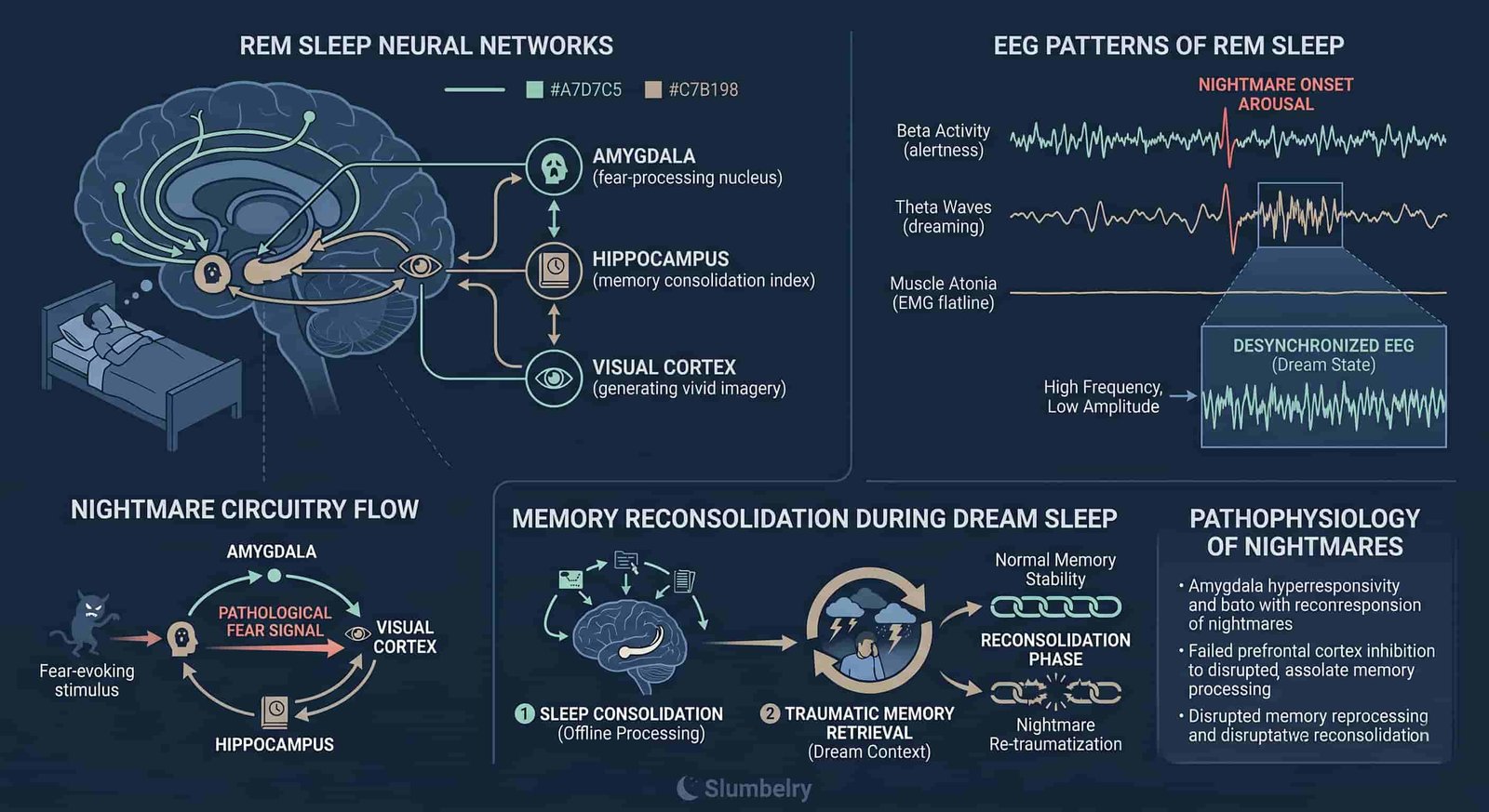
- The Mechanism: During REM sleep, the brain replay-integrates emotional memories through the amygdala-hippocampus loop; when this process is disrupted by trauma or stress, nightmares become the output — IRT disrupts this by rewriting the memory before sleep
- The Method: Write the nightmare to the scary part, write a new ending, rehearse the new script 10-20 min/day while awake; Krakow’s controlled trials show 67% nightmare reduction in chronic nightmare patients

What Is Imagery Rehearsal Therapy and How Does It Rewrite Nightmare Scripts?
Direct Answer: Imagery Rehearsal Therapy (IRT) is a structured, evidence-based psychological technique in which nightmare sufferers write down their recurring nightmare to the point of most fear, then consciously compose and rehearse an alternative, non-distressing ending during wakefulness — with the result that the new script eventually replaces the original nightmare during REM sleep.
Mechanism: S2-3 of the whitepaper and Krakow & Zadra (2006), Imagery Rehearsal for Chronic Nightmares, published in the Journal of Clinical Sleep Medicine, establish IRT as a structured protocol: (1) nightmare script transcription, (2) rescripting to a neutral or positive ending, (3) daily mental rehearsal of the new script for 10–20 minutes, (4) application during subsequent sleep. The mechanism is not wishful thinking — it is memory reconsolidation: every time a memory is recalled (during the wake rehearsal), it enters a labile state and can be updated before being re-stored. By presenting the brain with an alternative ending during recall, the emotional tag of the original nightmare is progressively overwritten. Krakow’s landmark study found 67% reduction in nightmare frequency and 77% reduction in nightmare distress in chronic nightmare patients — effects that were maintained at 6-month follow-up without further treatment.
Actionable Advice: You do not need to believe it will work for it to work. The mechanism is neurological, not motivational. Begin tonight with your most recurring, lowest-intensity nightmare. The rescripted ending does not need to be dramatically different — it needs to feel emotionally neutral or positive.
Why Does the Brain Produce Nightmares and What Evolutionary Function Do They Serve?
Direct Answer: Nightmares are a byproduct of the brain’s overnight emotional memory processing system — and in most cases, they represent the system working as intended, processing fear and stress from waking life. The problem is when this processing system gets stuck in a loop on the same material.
Mechanism: Walker (2017), Why We Sleep, and S2-3 document the neuroscience of dreaming: during REM sleep, the brain cycles emotional experiences through the amygdala-hippocampus complex in a process called “overnight therapy.” The basolateral amygdala tags emotionally significant memories for processing, the hippocampus replays fragments in pseudo-narrative form (dreams), and the medial prefrontal cortex works to defuse the emotional charge attached to those memories. The result of a healthy night’s REM is that emotional experiences from the previous day are processed and their emotional sting is reduced. Nightmares occur when: (a) the emotional material is too overwhelming for the processing system to complete (trauma), (b) the stress is chronic rather than episodic (ongoing life pressure), or (c) the fear association has become so deeply conditioned that the brain defaults to the same threat script regardless of new input. In this framework, the nightmare is not a failure of the system — it is the system running repeatedly on the same unprocessed material. IRT works because it provides the system with new input to process — an alternative ending.
Actionable Advice: The presence of nightmares does not mean something is wrong with your brain. It means your brain is doing exactly what it evolved to do: process emotional material overnight. The goal is not to stop dreaming but to give your brain new, less distressing material to process.
What Is the Difference Between Normal Occasional Nightmares and Nightmare Disorder?
Direct Answer: Occasional nightmares are normal — most adults have them several times a year. Nightmare Disorder is a clinical condition defined by frequent, distressing nightmares that cause significant sleep avoidance, mood disturbance, or daytime impairment.
Mechanism: S2-3 and ICSD-3 diagnostic criteria for Nightmare Disorder: (1) nightmares occurring at least once per week, (2) causing clinically significant distress or impairment in mood, cognition, social, or occupational function, (3) not attributable to substance use, medication, or another medical condition, (4) not better explained by another sleep disorder. The critical differentiator is frequency + functional impairment. Research by Zadra & Donderi (2000) found that nightmare sufferers reported significantly higher rates of insomnia, fear of sleep, sleep avoidance behaviors, and daytime fatigue compared to non-nightmare sufferers — even after controlling for underlying anxiety and depression. Nightmare Disorder is classified under the parasomnia section of the ICSD-3 and is distinct from the REM sleep behavior disorder (RBD) that occurs with physical acting-out of dreams.
Actionable Advice: If your nightmares occur several times per week and you find yourself avoiding sleep, experiencing significant mood disturbance the next day, or having difficulty functioning at work or in relationships because of poor sleep — you meet the clinical threshold for Nightmare Disorder and IRT is an appropriate first-line intervention.
How Does Repetitive Nightmare Rescripting Actually Change the Brain’s Fear Memory?
Direct Answer: Nightmares are not just stories — they are encoded fear memories that replay during REM because they have a strong emotional tag (the amygdala assigns high threat value). IRT works by exploiting memory reconsolidation: when a memory is recalled and actively held in awareness, it enters a labile state and can be modified before being re-stabilized.
Mechanism: S2-3 and contemporary memory research (Lane et al., 2015; Phelps & Hofmann, 2018): the fear memory trace is stored across a distributed network including the amygdala (threat value assignment), the hippocampus (context), and the sensory cortex (dream imagery). Every time the nightmare is recalled during IRT rehearsal, the memory enters reconsolidation — the synaptic connections are temporarily weakened, and the brain “re-saves” the memory with the new, non-threatening ending attached. Crucially, the emotional tag (the amygdala’s threat signal) can be partially or fully overwritten during this re-save, meaning the nightmare script eventually triggers less fear response — both during sleep and during the wake rehearsal itself. After several weeks of consistent IRT rehearsal, the nightmare frequency decreases because the emotional salience of the original script has been reduced to the point where it no longer consistently triggers the REM sleep recall mechanism.
Actionable Advice: Consistency is the mechanism. The rescript must be rehearsed daily for the memory to enter reconsolidation repeatedly. Occasional or half-hearted practice does not trigger sufficient reconsolidation to overcome the original fear encoding.
What Is the Step-by-Step IRT Protocol and How Do You Write a Nightmare Rescript?
Direct Answer: The IRT protocol has 5 steps: (1) select and write the nightmare, (2) stop at the scary point, (3) write a new, neutral or positive ending, (4) rehearse the new script daily for 10–20 minutes, (5) allow the brain to integrate during subsequent sleep.
Mechanism: Krakow (2001), Sound Sleep, Sound Mind, and S2-3 establish the precise protocol: Step 1 — Select: Choose the most frequent recurring nightmare. Avoid starting with the most traumatic — start with the one that causes moderate distress and has the clearest script. Step 2 — Write it: Write the full nightmare narrative in the present tense, first person, as if it is happening now. Stop at the point of maximum fear — the scene just before the worst part. Step 3 — Rescript: Continue the story from that point with a new, non-distressing ending. The new ending should be plausible within the dream context — you are not replacing the dream with a fantasy; you are rewriting the script so it is less threatening. Step 4 — Rehearse: Read the original nightmare aloud, then read the new ending aloud. Then close your eyes and mentally visualize the new ending for 10–20 minutes. Aim for vivid sensory detail. Step 5 — Integrate: Sleep normally. Do not force the dream; simply allow the new script to exist in your awareness before sleep. Most patients report new dream imagery within 1–2 weeks and significant nightmare reduction within 3–4 weeks of consistent daily practice.
Actionable Advice: The key variable in IRT is daily rehearsal — not the quality of the writing. Even a simple, plainly written rescript works if rehearsed consistently. Do not get stuck trying to write the “perfect” ending.
Why Does Visualizing the New Dream Ending While Awake Make It More Likely to Appear at Night?
Direct Answer: Because mental rehearsal of a script engages the same neural networks that generate dream imagery — so the brain does not distinguish between “remembering” and “experiencing” during REM sleep.
Mechanism: S2-3 and the neuroscience of mental imagery: the visual cortex, amygdala, and hippocampus — the same circuit that produces dream imagery during REM — are activated during wake mental rehearsal. Research by Wamsley & Stickgold (2011) published in Sleep found that pre-sleep mental rehearsal of a task produced the same brain activation patterns during subsequent sleep as actual task performance. The mental imagery of the rescripted ending primes the same neural circuits that will activate during REM, making the new imagery more likely to appear in the dream narrative. This is the same principle used by professional athletes who mentally rehearse performance before events — the brain’s simulation of an experience activates overlapping neural networks with actual performance.
Actionable Advice: Mental rehearsal should be vivid and sensory — visualize not just the new ending but the specific sensory details: what you see, hear, and feel. The more specific the mental imagery, the stronger the priming effect on the REM dream generation system.
How Does IRT Compare to prazosin for PTSD-Related Nightmares?
Direct Answer: IRT and prazosin address different mechanisms: prazosin reduces the physiological arousal during sleep that makes nightmares feel vivid and distressing; IRT rewrites the nightmare script itself. For chronic PTSD-related nightmares, the evidence supports using both — but IRT addresses the root cause rather than managing a symptom.
Mechanism: Raskind et al. (2007), Prazosin for PTSD nightmares, NEJM, established prazosin (an alpha-1 adrenergic antagonist) as effective for reducing trauma nightmare frequency and intensity — it works by blocking the norepinephrine surge that contributes to hyperarousal during REM. However, prazosin is a peripheral intervention that does not alter the nightmare content itself. IRT (Krakow et al., 2001) has been shown in multiple RCTs to reduce nightmare frequency by 67% in PTSD patients specifically — a comparable effect size to prazosin — while simultaneously reducing nightmare distress and sleep avoidance. Critically, IRT effects persist after treatment ends, whereas prazosin effects require continued medication. Current clinical guidelines suggest CBT-I including IRT as first-line for trauma-related nightmares, with prazosin as an adjunct when IRT alone is insufficient.
Actionable Advice: If you are on prazosin and still having nightmares, adding IRT does not interfere with the medication — it provides an additional mechanism of action targeting the nightmare script itself. Always coordinate with your prescribing physician before adjusting medication.
Why Do Children Experience More Nightmares and When Should Parents Be Concerned?
Direct Answer: Children have a higher proportion of REM sleep than adults (approximately 50% of total sleep in infants vs 20–25% in adults) and a more active limbic system, making dream generation both more frequent and more emotionally intense. Most childhood nightmares are developmentally normal; clinical concern is warranted when nightmares cause significant sleep avoidance or daytime behavioral change.
Mechanism: S2-3 and pediatric sleep research: the brain’s emotional processing systems — particularly the amygdala — mature earlier than the prefrontal cortical inhibition systems, meaning children experience strong emotions during sleep without the regulatory capacity to defuse them. This is why children are more likely to wake fully from nightmares and why they may have difficulty returning to sleep. The developmental function of REM nightmares in children may be the brain practicing threat detection and fear response in a safe environment. Most children’s nightmares peak between ages 3–6 and decline as prefrontal inhibition matures. Clinical intervention (child-appropriate IRT or nightmare therapy) is warranted when nightmares occur 3+ times per week for more than 4 weeks and are causing significant functional impairment — including school avoidance, behavioral regression, or parent-reported mood change.
Actionable Advice: Parents should not dismiss frequent childhood nightmares as “just imagination.” The child’s distress is real. A simple, age-appropriate dream journal and parent-guided IRT rescript can be highly effective in children as young as 5–6 years old.
How Does Trauma Create Recurring Nightmare Patterns and What Makes IRT Effective for PTSD?
Direct Answer: Trauma creates a specific type of memory encoding in which the threat-related content has an unusually strong emotional tag in the amygdala, making it replay compulsively during REM because it was never fully processed and defused during the normal overnight therapy cycle.
Mechanism: Horowitz (1975), Stress Response syndromes, and S2-3 describe the mechanism: traumatic experiences are stored as “flashbulb” memories — highly vivid, highly emotional, and poorly integrated with existing memory networks. During REM sleep, the hippocampus attempts to process and integrate these memories through the same overnight therapy cycle — but the emotional tag is too strong to defuse in a single night. The result is that the memory returns the next night, and the next, and the next — each time triggering the full threat response (nightmare) rather than the reduced emotional response of a processed memory. IRT works for trauma nightmares specifically because it provides the emotional defusion that the processing system cannot achieve on its own: by presenting an alternative ending during wake rehearsal, the new memory competes with the original trauma script for activation during REM, gradually reducing the compulsive recall of the original nightmare.
Actionable Advice: IRT for trauma nightmares is most effective when practiced consistently — 10–20 minutes daily for 4–6 weeks minimum. Do not expect immediate results on deeply traumatic nightmare material. The reconsolidation of emotionally charged memories takes longer than neutral ones.
How to Practice IRT Safely and When to Seek a Sleep Specialist
Direct Answer: IRT is safe to practice independently for most adults with Nightmare Disorder. However, it is not appropriate as a standalone intervention when nightmares are accompanied by active psychotic symptoms, active suicidality, or PTSD with severe dissociation — in these cases, a sleep specialist or trauma therapist should be involved.
Mechanism: Stanley (2018), How to Sleep Well, and S2-3 describe the clinical referral criteria: IRT is most appropriate for adults with chronic Nightmare Disorder without comorbid severe mental health conditions requiring acute stabilization. Red flags requiring professional referral include: (1) nightmares so severe they cause panic attacks, dissociative episodes, or self-harm, (2) nightmares that represent direct memory reenactments of documented trauma rather than symbolic dream content, (3) active substance abuse or severe depression alongside the nightmares, (4) sleep terrors (different from nightmares — NREM parasomnia with no dream recall and significant autonomic arousal) misidentified as nightmares. For patients with complex PTSD or severe trauma history, trauma-informed nightmare therapy with a licensed mental health professional is the appropriate pathway — IRT may be incorporated as one component of a broader treatment plan.
Actionable Advice: If you are a trauma survivor with chronic nightmares and have not been able to access trauma therapy, IRT is a reasonable starting point — but it is not a substitute for professional care if the nightmares are severely disrupting your life. Seek a sleep specialist or trauma therapist with nightmare treatment experience.

Frequently Asked Questions
What is Imagery Rehearsal Therapy (IRT)?
Direct Conclusion: IRT is an evidence-based protocol for chronic nightmares: write the recurring nightmare to the scary point, compose a new, non-distressing ending, and rehearse the new script aloud for 10-20 minutes daily. The new script gradually replaces the original nightmare during REM sleep through memory reconsolidation. Krakow’s clinical trials show 67% reduction in nightmare frequency.
How does IRT actually stop nightmares from happening?
Direct Conclusion: Nightmares replay during REM because they are fear-encoded memories with a strong amygdala threat tag. When you recall and rehearse an alternative ending during wakefulness, the memory enters a labile state (reconsolidation) and is re-stored with the new, non-threatening content. After repeated rehearsal, the brain defaults to the new script during REM.
What is the difference between normal nightmares and nightmare disorder?
Direct Conclusion: Occasional nightmares are normal and resolve on their own. Nightmare Disorder requires: nightmares occurring at least once per week, causing significant sleep avoidance, mood disturbance, or daytime impairment — and not attributable to another medical condition. Most adults with chronic nightmares meet this threshold.
How do you write a nightmare rescript that actually works?
Direct Conclusion: Write the nightmare in present tense, first person, as if it is happening now. Stop at the point of maximum fear. Then continue the story with a new ending that is plausible within the dream context and emotionally neutral or positive. The key variable is consistent daily rehearsal — not writing quality.
How long does IRT take to reduce or eliminate chronic nightmares?
Direct Conclusion: Most patients report changes within 1-2 weeks (new dream imagery) and significant nightmare reduction within 3-4 weeks of consistent daily practice. Maximum benefit is typically seen at 6-8 weeks. Effects are maintained at follow-up without further treatment.
Is IRT different from lucid dreaming or visualization?
Direct Conclusion: Yes. Lucid dreaming involves becoming conscious during an actual dream and altering its content in real-time — which requires significant skill and is unreliable as a therapeutic tool. IRT works during wakefulness and does not require lucid dreaming ability. It rewrites the script before sleep so the new version naturally appears during REM. Visualization is a component of IRT but is not sufficient alone — the written rescript and consistent mental rehearsal are both required.
How does IRT compare to medication for nightmare disorder?
Direct Conclusion: The alpha-blocker prazosin reduces nightmare intensity by blocking norepinephrine arousal during REM. IRT reduces nightmare frequency by rewriting the nightmare script itself. IRT’s effects persist after treatment ends; prazosin’s effects require continued medication. Current guidelines support CBT-I including IRT as first-line, with prazosin as an adjunct for PTSD-related nightmares.
Can children use IRT and is it safe for them?
Direct Conclusion: IRT is safe for children as young as 5-6 with age-appropriate guidance from parents. Children have more REM sleep and less prefrontal inhibition, making them more susceptible to vivid nightmares. A parent-guided dream journal and simple rescript for moderate nightmares is appropriate. Severe or trauma-related nightmares in children require professional evaluation.
Why does trauma make nightmares come back over and over?
Direct Conclusion: Traumatic memories are stored with an unusually strong emotional tag in the amygdala that makes them replay compulsively during REM — the normal overnight therapy process cannot defuse them in a single night. The brain returns to the same memory repeatedly, triggering the full threat response each time. IRT provides the emotional defusion that the processing system cannot achieve alone.
When should someone with chronic nightmares see a sleep specialist?
Direct Conclusion: Seek a sleep or nightmare specialist if: nightmares occur 3+ times per week for more than 4 weeks and cause significant sleep avoidance or daytime impairment; nightmares are accompanied by panic, dissociation, or self-harm; you have PTSD and nightmares are not improving with IRT alone; nightmares are causing significant depression or anxiety that is not adequately treated.
Rewrite Your Nightmare — Tonight
The science is clear. Your nightmares are not random. They have a script. And you can rewrite it.
Optimise Your Sleep Environment Take the Sleep AssessmentThe Slumbelry Commitment
Sleep is the most vulnerable state of human existence. It is where we heal, reset, and grow.
At Slumbelry, we do not just sell sleep products; we advocate for your physiological right to rest. From ergonomic support to light management, every solution we offer is designed with one obsession: Respecting your Biology.
Science is our language, but your recovery is our purpose. You take care of everything else in your life — let us take care of your nights.
Rest Deeply,
The Slumbelry Team