
Why Cannot I Sleep After Coffee? It Is Not the Caffeine Sensitivity — It Is Your Biology
You probably think you are immune to caffeine. “I can drink a shot of espresso after dinner and fall right asleep!” But you are not immune. You are confusing the ability to lose consciousness with the ability to achieve restorative sleep.
That late-afternoon coffee is not giving you an edge. It is acting as an invisible thief, quietly robbing your brain of the deep rest you need to perform at a high level tomorrow.
Here is what science says about caffeine and sleep — and the timing fix that actually works.
⚡ Core Takeaway: The Caffeine-Sleep Equation
- The Core Problem: Caffeine blocks adenosine receptors for 8-10 hours, stealing deep sleep even when you “sleep through the night.”
- The Timing Fix: Cut off caffeine 10+ hours before bed — not just “no afternoon coffee.”
- The Detox Truth: A 14-day caffeine reset can improve deep sleep by 30-40%.
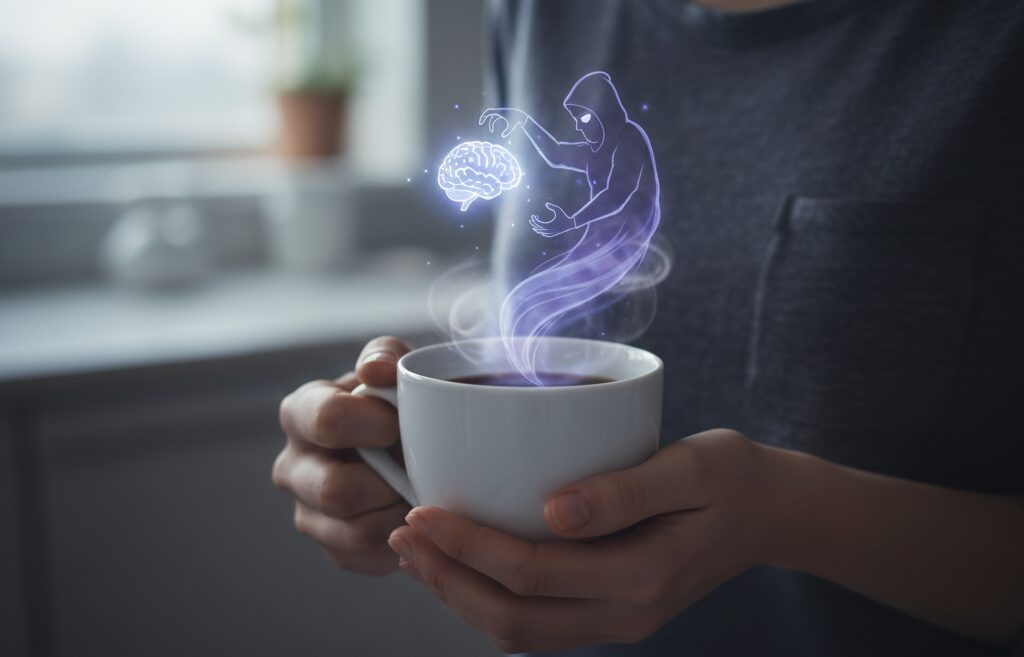
Why does afternoon caffeine destroy nighttime sleep?
Direct Answer: Caffeine half-life is 5-6 hours, meaning 50% remains in your system at midnight if you drink coffee at 2 PM.
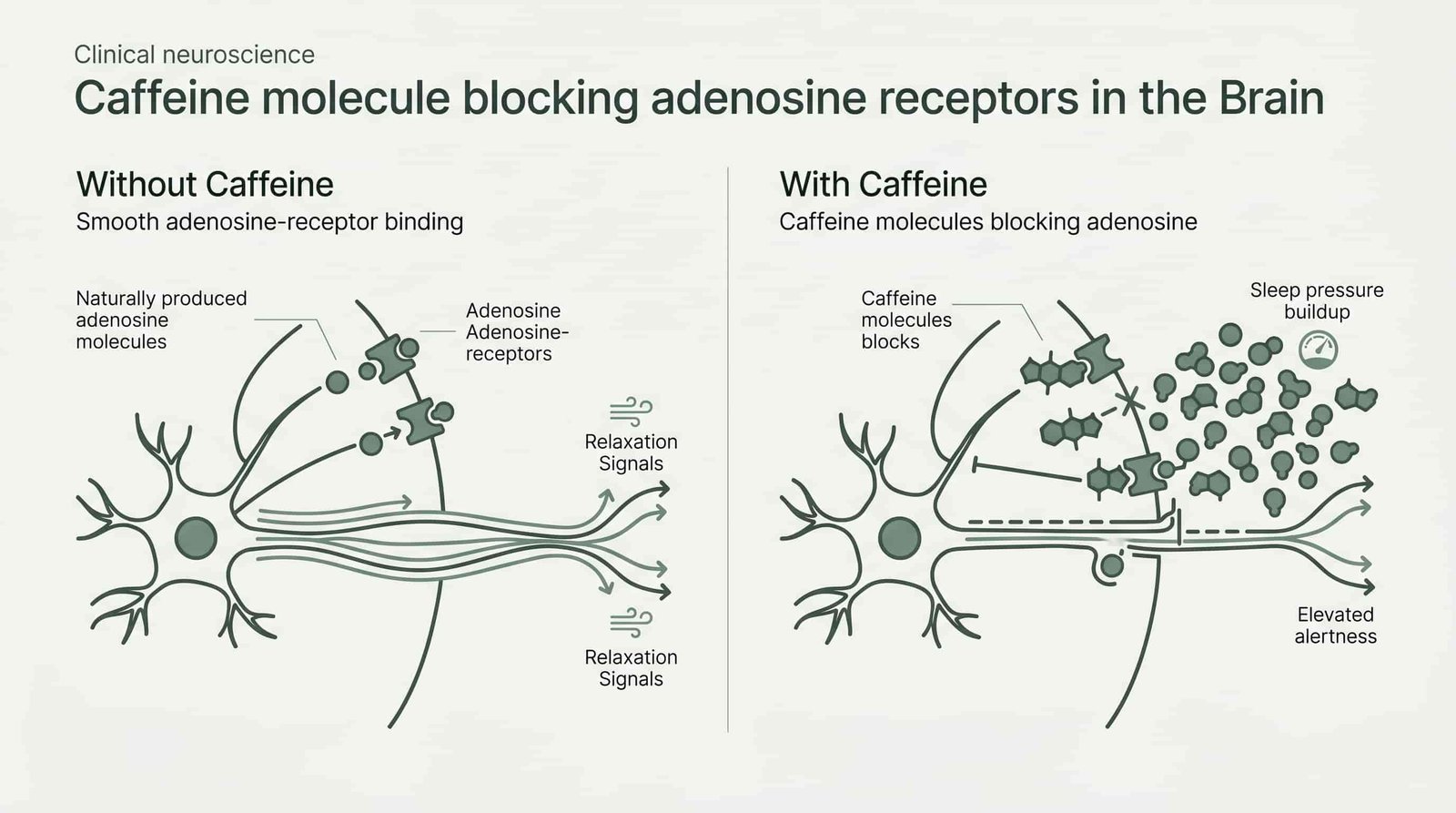
Mechanism: Your brain produces adenosine throughout the day as a byproduct of energy metabolism. Adenosine binds to receptors, creating “sleep pressure.” Caffeine molecules mimic adenosine, jamming these receptors without activating them. When caffeine wears off 5-6 hours later, accumulated adenosine floods your receptors — often at 2-3 AM, triggering sudden awakening.
Actionable Advice: Calculate your personal cutoff. If bedtime is 11 PM, your last caffeine must be no later than 1-2 PM. This is not “no afternoon coffee” — it is a strict 10-hour buffer.
How does caffeine steal deep sleep without you knowing?
Direct Answer: Caffeine reduces deep sleep (Stage N3) and REM sleep by 35-50% while preserving lighter sleep stages, so you believe you “slept fine.”
Mechanism: The sleep architecture thieves are: (1) Adenosine Blockade: Caffeine prevents adenosine binding, disrupting the brain sleep pressure calculation. (2) Cortisol Interference: Caffeine elevates cortisol, keeping your nervous system artificially alert during first sleep cycles. (3) Temperature Dysregulation: Caffeine raises core body temperature by 0.5-1°C, but entering deep sleep requires temperature drop.
Actionable Advice: Track your actual sleep quality — not just duration. Use a sleep tracker that shows deep sleep minutes. If you consume 200mg caffeine after noon and get under 60 minutes deep sleep, caffeine is your culprit.
The caffeine sensitivity spectrum — where do you fall?
Direct Answer: 95% of people are genetically slow caffeine metabolizers (CYP1A2), meaning caffeine significantly disrupts their sleep even at moderate doses.
Mechanism: The CYP1A2 enzyme determines caffeine metabolism speed. Fast metabolizers clear caffeine in 4-5 hours; slow metabolizers take 7-9 hours. Most people believe they are fast because they “do not feel caffeine effects” — but feeling nothing does not equal sleeping well.
Actionable Advice: Take the 14-day caffeine detox test. Stop all caffeine (coffee, tea, chocolate, energy drinks) for 14 days. Track deep sleep minutes. If deep sleep increases significantly, you are caffeine-sensitive. Resume with strict morning-only timing.
The caffeine cutoff protocol that actually works
Direct Answer: The only effective cutoff is 10+ hours before bed, not the commonly recommended “6 hours.”
Mechanism: The commonly quoted “6-hour rule” is based on caffeine dropping to 25% of peak levels — but 25% of a 200mg coffee is still 50mg, enough to fragment deep sleep. You need 90-95% clearance for clean sleep architecture.
Actionable Advice: (1) Set a non-negotiable caffeine cutoff (e.g., 1 PM for 11 PM bedtime). (2) Switch to caffeine-free alternatives after cutoff. (3) If you slip, do not “make up for lost sleep” with afternoon caffeine. (4) For special occasions, use 100mg fast-absorbing caffeine 12+ hours before bed.

Caffeine and Sleep FAQ: Your Questions Answered
How does caffeine affect sleep?
Direct Conclusion: Caffeine blocks adenosine receptors for 8-10 hours, reducing deep sleep by 35-50%.
Why: You sleep through the night but wake unrefreshed because the architecture is fragmented.
Action: Track deep sleep minutes with a sleep tracker. If under 60 minutes with afternoon caffeine, that is your culprit.
How many hours before bed should you stop caffeine?
Direct Conclusion: At least 10 hours, not the commonly recommended 6 hours.
Why: Caffeine half-life means 50% remains 5-6 hours after consumption. For an 11 PM bedtime, no caffeine after 1 PM.
Action: Calculate your personal cutoff: bedtime minus 10 hours = your last caffeine.
Does caffeine sensitivity increase with age?
Direct Conclusion: Yes. CYP1A2 enzyme activity decreases after 40.
Why: Slowed metabolism means caffeine stays active longer, affecting nighttime sleep more.
Action: If you are over 40 and suddenly sensitive to afternoon coffee, this is biology, not weakness.
Can I have decaf coffee if I am caffeine-sensitive?
Direct Conclusion: Decaf still contains 2-5mg caffeine per cup.
Why: If you are highly sensitive, even this triggers receptor activity.
Action: Switch to herbal tea or caffeine-free alternatives for true zero-caffeine evenings.
How long does it take to reset caffeine tolerance?
Direct Conclusion: 14 days for receptor sensitivity reset.
Why: Adenosine receptors need time to return to baseline sensitivity.
Action: Complete 14-day caffeine elimination. Deep sleep improvements begin within 3-5 days.
What is the connection between caffeine and anxiety?
Direct Conclusion: Caffeine increases anxiety behaviors by 35% even in healthy individuals.
Why: Caffeine stimulates cortisol and adrenaline production, mimicking anxiety symptoms.
Action: If you have anxiety, consider caffeine reduction as first-line treatment.
What about caffeine and exercise?
Direct Conclusion: Pre-workout caffeine improves performance but disrupts sleep if consumed afternoon.
Why: Caffeine elevation conflicts with the natural temperature drop needed for sleep onset.
Action: For evening exercisers, morning workout with morning caffeine is optimal for both performance and sleep.
Can I use caffeine strategically for shift work?
Direct Conclusion: Yes, but only during the circadian nadir (3-5 AM).
Why: Strategic timing maximizes alertness when biology naturally dips.
Action: Consume caffeine at start of night shift only. Strict cutoff 8-10 hours before daytime sleep.
Does caffeine cause insomnia?
Direct Conclusion: Indirectly, by fragmenting sleep architecture.
Why: Increased nighttime awakenings and delayed circadian temperature drop.
Action: Even if you fall asleep quickly, measure deep sleep quality, not just duration.
Is morning coffee better for sleep?
Direct Conclusion: Yes, if consumed before 9 AM for most people.
Why: Morning cortisol peaks make caffeine less disruptive to nighttime sleep.
Action: If you must have caffeine, restrict to pre-9 AM only. No exceptions after 1 PM.
Ready to Transform Your Recovery?
If caffeine is stealing your deep sleep, take action today. Discover science-backed solutions for better rest.
Take the Sleep Assessment Explore Our Cooling MattressThe Slumbelry Commitment
Sleep is the most vulnerable state of human existence. It is where we heal, reset, and grow.
At Slumbelry, we do not just sell sleep products; we advocate for your physiological right to rest. From ergonomic support to light management, every solution we offer is designed with one obsession: Respecting your Biology.
Science is our language, but your recovery is our purpose. You take care of everything else in your life — let us take care of your sleep.
Rest Deeply,
The Slumbelry Team