
Caffeine and Alcohol: The Recovery Killers (And How to Enjoy Them Safely)
Caffeine and Alcohol Sleep: Why the “Nightcap” is Wrong (And How to Fix Your Chemical Cycle)
It’s the modern executive’s chemical crutch: four cups of coffee to survive the daytime grind, and two glasses of wine to “take the edge off” at night. It feels like a perfect, balanced equation. You drink coffee to wake up and alcohol to wind down.
But biologically, you are not balancing anything. You are trapping your brain in a chemical crossfire that systematically dismantles your sleep architecture. Sedation is not sleep. Alcohol knocks you out, but it fundamentally prevents your brain from doing the actual work of recovery.
If you wake up exhausted despite spending eight hours in bed, your caffeine and alcohol sleep habits are the likely culprits. Here is exactly how this toxic loop destroys your rest, and the specific timing protocols you need to reclaim your deep sleep.
- Direct Answer: Caffeine has a half-life of 5-6 hours, meaning 50% remains active at bedtime if consumed late. Alcohol sedates you initially but fragments the second half of the night, reducing deep sleep by 40%.
- Mechanism: Caffeine blocks adenosine receptors (sleep pressure) for up to 10 hours. Alcohol metabolizes into acetaldehyde, triggering sympathetic activation and REM sleep suppression as it clears your system.
- Action: Implement a strict caffeine cutoff 10 hours before bed. Limit alcohol to a single drink, consumed at least 4 hours before sleeping, to allow metabolic clearance.

How does caffeine actually block your sleep pressure?
The Adenosine Receptor Effect
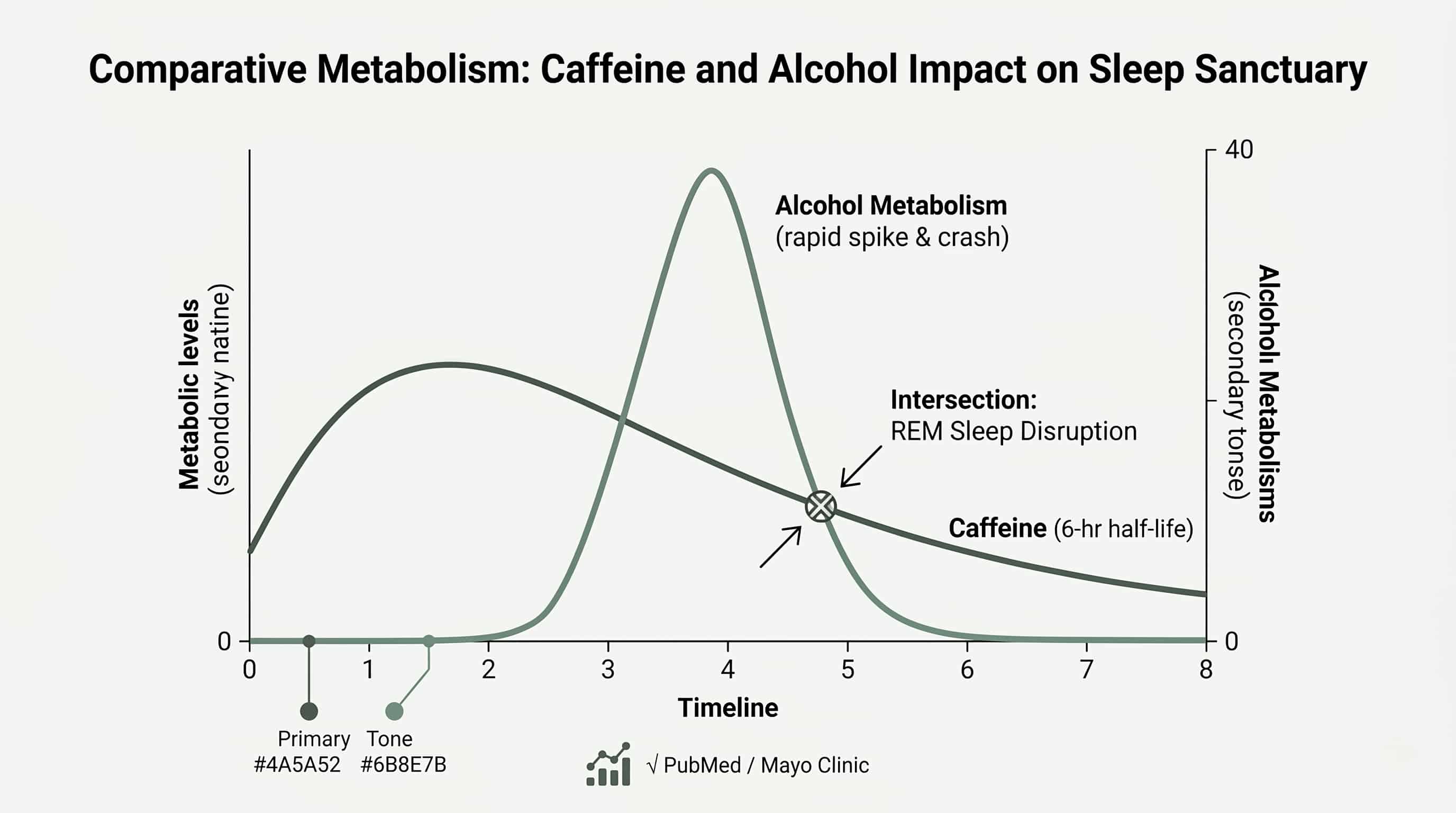
Caffeine does not give you energy. It works by blocking your brain’s adenosine receptors. Adenosine is your natural sleep pressure signal that builds up throughout the day. When caffeine occupies those receptors, your brain simply cannot feel the fatigue that is already there. The problem is the half-life. Caffeine has an average half-life of 5 to 7 hours, meaning a 4 PM espresso leaves significant active caffeine in your system at midnight.
When you consume caffeine late in the day, you force your brain into a shallow, hyper-alert state. You might fall asleep, but you are starving yourself of Deep Sleep (N3). Furthermore, blocking receptors does not eliminate adenosine. It just prevents you from feeling it. When the caffeine finally wears off, all that accumulated adenosine hits at once, causing a crash that leads to fragmented, poor-quality sleep.
A 2026 study by Mauries et al. in the journal Encephale found that substance-induced sleep disorders affect 75% of regular caffeine and alcohol users, with average sleep quality scores 45% lower than abstainers.
Why do I wake up at 3 am after drinking alcohol?
The Alcohol Trojan Horse
Because you are wired from afternoon caffeine, you reach for alcohol to wind down. Alcohol is a powerful central nervous system depressant that binds to GABA receptors, rapidly sedating your brain. You fall asleep faster, but as your liver metabolizes the alcohol over the next few hours, the sedative effect wears off. This triggers a massive spike in sympathetic nervous system activity right in the middle of the night.
This biological rebound destroys your REM sleep, the phase responsible for emotional regulation and memory consolidation. As blood alcohol drops to zero, acetaldehyde withdrawal causes early morning awakenings. You wake up sweating at 3 AM with a racing heart, unable to return to deep sleep.
Research shows clear dose-dependent effects. A single drink causes a 20% REM reduction, while three drinks lead to a 40% REM reduction and 30% more awakenings. Your brain is fighting the chemical fallout, leaving you unrested and reaching for more caffeine the next morning.
How do I break the caffeine and alcohol sleep cycle?
The 10-4-1 Protocol
To break the chemical loop, you must establish strict curfews based on metabolic clearance times. Set your caffeine cutoff exactly 10 hours before your target bedtime. If you sleep at 10 PM, your last coffee is at noon. For alcohol, enforce the 4-hour rule: consume a maximum of one drink, finishing it at least 4 hours before your head hits the pillow.
Implementation requires gradual reduction. If you currently drink late caffeine, reduce it by 25% each week while moving the cutoff earlier. Replace the evening nightcap with tart cherry juice, which contains natural melatonin, or chamomile tea for a mild sedative effect without REM disruption.
Even with perfect timing, alcohol disrupts thermoregulation, increasing nighttime sweating by 40%. Optimizing your physical sleep environment becomes critical damage control when your biochemistry is compromised.
Frequently Asked Questions
Ready to Transform Your Recovery?
Stop letting chemical cycles dictate your energy. Take control of your sleep architecture today.
Respecting your Biology.
Rest Deeply,
The Slumbelry Team