
The New Definition of ‘A Good Night’s Sleep’: Stop Stressing the Numbers
The Number That Destroyed Sleep: Why Checking Your Sleep Score Is Making You Sicker
⚡ Core Takeaway: Your Body Already Knows
- The nocebo effect is real: Telling yourself you slept badly produces the same cognitive impairment as actually sleeping poorly. Your belief about your sleep is nearly as powerful as sleep itself.
- The number is meaningless: Consumer sleep scores have a ±40% error margin and measure movement, not sleep stages. They cannot tell you if you slept well.
- One question replaces the app: “Do I feel rested?” — if yes, you slept well. If no, the answer is behavioral, not algorithmic.
What is a good night’s sleep — and who decided it had to be quantified? We live in an era where a $300 ring delivers a morning verdict: 74%, readiness low. And what do we do? We let that number shape our entire day’s emotional and cognitive trajectory. But the science tells a different story: the belief about your sleep is nearly as powerful as sleep itself, and the anxiety generated by checking that number may be the very thing destroying your rest.
What Is a Good Night’s Sleep? The Definition You’ve Been Getting Wrong
We live in the age of data. We count our steps, our calories, and now our sleep. We wear rings, watches, and bands that deliver a sleep score every morning. “You got 74%. Your readiness is Low.” And what happens? We panic. “Oh no, I slept badly. Today is going to be terrible.” This anxiety about sleep metrics has a clinical name: orthosomnia — the unhealthy obsession with perfect sleep data that paradoxically destroys the very rest being measured.
But the problem is deeper than obsession. The problem is the definition. We have been taught to measure sleep from the outside — via algorithms and accelerometers — rather than from the inside: how we actually feel. Nick Littlehales, whose R90 framework has been adopted by elite athletes worldwide, puts it simply: stop looking at the tracker and start listening to your body. A good night’s sleep is not an 8-hour unconsciousness target. It is whatever duration and quality produces genuine next-day restoration.
The Nocebo Effect: How Believing You Sleep Badly Makes It Come True
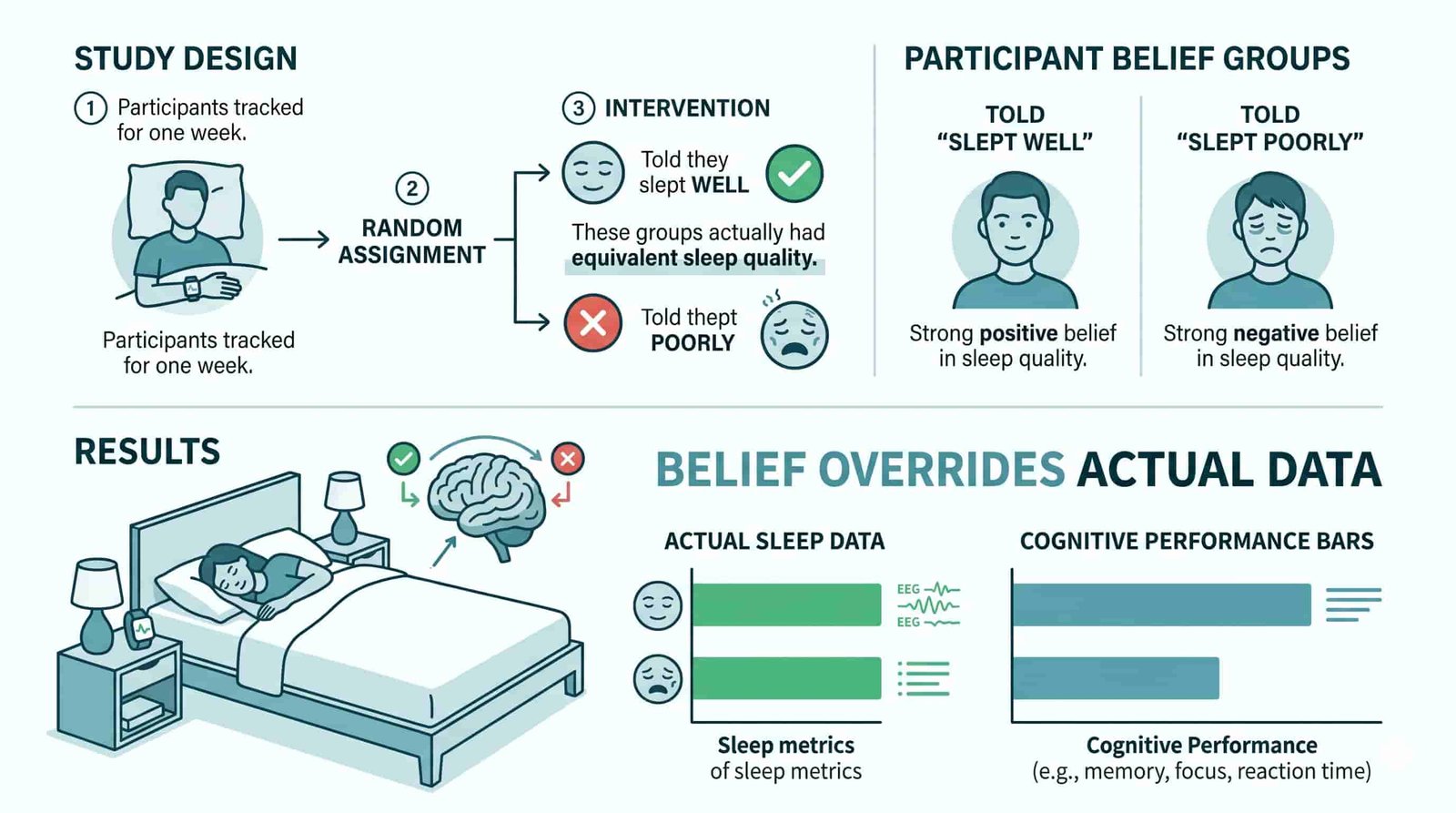
A clinical study exposed participants to the same sleep environment and gave half of them false feedback that their sleep quality was poor. That group showed measurable drops in next-day cognitive performance — even though their actual sleep was identical to the control group. A second group was told they slept well; their performance improved even when their actual sleep was equally disrupted.
The Placebo (and Nocebo) Effect in Sleep
The nocebo effect — where a belief about a condition produces real physiological symptoms — operates powerfully in sleep. When you wake up and your watch delivers a red sleep score, cortisol and adrenaline are released in response to the perceived threat (a “bad” outcome). This stress response activates the sympathetic nervous system — the fight-or-flight mode — which is precisely the opposite of what enables restorative sleep that night. You are not just feeling bad about your sleep. You are actively creating the conditions for the next bad night.
Why Sleep Scores and Readiness Metrics Are Medically Meaningless
Here is the hard truth wearable tech companies do not advertise: consumer sleep trackers cannot read your brainwaves. True sleep staging requires a clinical EEG. Your wrist uses heart rate variability (HRV) and movement data to guess sleep stages — and the accuracy of those guesses for deep sleep is only 60–70% compared to polysomnography, with a margin of error up to ±40%.
The Accuracy Problem: What Your Tracker Actually Measures
HRV and movement-based sleep staging was designed for populations where clinical EEG is not available. It was never intended to be a sleep quality arbiter. When you see “12 minutes of deep sleep” on your tracker, that number is a mathematical interpolation within a margin of error that makes the figure statistically unreliable. Sleep researchers who develop these algorithms themselves warn against over-interpreting nightly stage data. What the trackers are reliable for — time-in-bed consistency — has nothing to do with the score you receive.
The 200,000-Year Problem: Your Body Has Always Known How to Sleep
Your body has been sleeping for approximately 200,000 years without an Apple Watch, an Oura ring, or a sleep score. The physiological mechanisms of sleep — the glymphatic system’s nightly cleanse, the memory consolidation of the hippocampus, the parasympathetic nervous system’s dominance after sunset — have operated reliably across every era of human history. The idea that sleep must be measured to be managed is historically novel and biologically unnecessary.
Dr. Neil Stanley’s research on sleep across cultures confirms: in societies without sleep tracking technology, reports of “not getting enough sleep” are dramatically lower. The anxiety about sleep quality that characterizes modern insomnia populations correlates directly with the adoption of tracking behavior — not with any objective decline in sleep quality itself.
Sleep Is Not Unconsciousness — It’s Active Restoration You Can’t Measure
The definition of a good night’s sleep as “uninterrupted unconsciousness for a set number of hours” is physiologically inaccurate. Sleep is an active restoration process that includes: the glymphatic system’s 60% shrinkage of glial cells to flush metabolic waste including beta-amyloid; the hippocampus transferring memories from short-term to long-term storage; the complete shutdown of noradrenaline in REM sleep creating the only stress-free state in 24 hours. None of this is visible on a sleep score. None of it can be reduced to a number between 0 and 100.
What Sleep Science Actually Says About Nightly Variation
Matthew Walker’s research confirms significant nightly variation in sleep architecture is normal. One night may have more deep sleep (N3); another may have more REM. The brain allocates sleep stages based on what it needs most on any given day — more N3 after physical exertion, more REM after emotional processing. Chasing a consistent sleep stage profile across every night is not biology; it is algorithmic anxiety projected onto a process that evolved to be flexible.
The One Question You Should Ask Every Morning Instead of Checking Your Score
The single most powerful shift in your relationship with sleep data is this: before you check your tracker — ask yourself one question. Do I feel rested? Not “how many hours did I get” and not “what score did I receive.” Do I feel rested?
⚡ The Morning Ritual: Before You Touch Your Phone
- Step 1: As soon as you wake, notice how your body feels — without touching your phone or checking your tracker
- Step 2: Rate your energy from 1–10 based purely on subjective feeling, not data
- Step 3: Only then check your tracker — as a confirmation, not as the verdict
- Step 4: If subjective and objective data disagree, trust your subjective rating. Your internal state is the primary signal.
Rest as Recovery: Why Lying Still Is a Legitimate Sleep Strategy
If you cannot sleep, rest. Lying quietly in a dark room with your eyes closed for 30–40 minutes offers genuine neurological recovery even without achieving full sleep onset. This is not a compromise — it is a legitimate alternative with measurable benefits: reduced cortisol, activation of the parasympathetic nervous system, and partial recovery of glymphatic function.
Why Trying to Sleep Is the Problem
Paul McKenna and Guy Meadows both document the same finding in different frameworks: normal sleepers never “try” to sleep — they simply sleep. The insomniac’s paradox is effort equals wakefulness. The harder you try to fall asleep, the more the sympathetic nervous system activates, pushing you further from the parasympathetic state required for sleep onset. Acceptance — of wakefulness, of a “bad” score, of a restless night — is the paradox that breaks this cycle.
How to Stop Trying to Sleep — The Paradox That Actually Works
The most counterintuitive sleep advice that research consistently supports: stop trying. Not because sleep doesn’t matter, but because the attempt itself activates the sympathetic nervous system. When you lie in bed actively trying to fall asleep, you are in an active, alert state — the precise opposite of the parasympathetic dominance required for sleep onset.
⚡ The Permission Protocol
Tonight, give yourself permission not to sleep. Not as resignation — as strategy. When you accept that a bad night is survivable and not defining, the anxiety releases, cortisol drops, and the parasympathetic system takes over. The moment you genuinely stop trying is often the moment sleep arrives. This is not wishful thinking — it is the mechanism behind every successful CBT-I (Cognitive Behavioral Therapy for Insomnia) intervention.
The Weekly Audit vs. The Nightly Check: Changing Your Relationship With Data
If you want to use a tracker without developing orthosomnia, use it the way Nick Littlehales designed R90: weekly, not nightly. At the end of each week, review your cycle count (not your score) and look for patterns over time. One night of a low score means nothing. Three consecutive weeks of patterns — when you feel consistently unrefreshed — is actionable data worth investigating.
The R90 Framework Applied to Sleep Data
Littlehales designed R90 for athletes who travel internationally, play matches at odd hours, and experience unavoidable nightly variation. The framework was built to accept nightly fluctuation without psychological catastrophizing. Apply the same principle to your sleep data: the unit of measurement is the weekly cycle total and the subjective energy trend, not any individual nightly score.
The Slumbelry Framework: Sleep Quality Is a Feeling, Not a Number
Slumbelry’s approach to sleep is built on a simple inversion: the goal is not to optimize a score. The goal is to wake up rested, cognitively sharp, and emotionally regulated — and to show up fully for the life you are living. The tracker is a tool; it is not the authority. Your experience is the authority.
Slumbelry’s Sleep Measurement Philosophy
We build products to support your sleep, not to measure it. Every piece of Slumbelry engineering — from the mattress that maintains spinal alignment through the night to the cooling technology that supports the core temperature drop required for sleep onset — is designed to give you one thing: the physiological conditions for genuine rest. Whether you track that rest or not is your choice. Whether you feel it is the only metric that ultimately matters.
Action step: Tonight, take off the watch. Tomorrow morning, before you check any score, ask yourself: do I feel rested? That answer — yours alone — is the only sleep data you actually need.
Frequently Asked Questions About Good Sleep
What is orthosomnia and how is it caused by sleep trackers?
Orthosomnia is the unhealthy preoccupation with achieving perfect quantified sleep data from wearable trackers, a condition coined by Dr. Kenneth Baron in 2017. It develops when the anxiety generated by tracking sleep metrics paradoxically worsens the very sleep being measured. The nocebo effect — where a perceived threat (a bad sleep score) triggers real cortisol release and sympathetic nervous system activation — is the core mechanism. Studies show 18% of sleep app users report increased anxiety about their sleep after tracking, and 14% reported developing concerns about sleep quality that may not have existed before tracking.
Can a sleep tracker actually measure whether I slept well?
No. Consumer sleep trackers estimate sleep stages using heart rate variability (HRV) and movement data — they cannot read brainwaves. Clinical polysomnography (EEG) is the only accurate method. Research shows consumer devices have only 60–70% accuracy for deep sleep detection with a margin of error up to ±40%. When your tracker reports ’12 minutes of deep sleep,’ that number is a mathematical interpolation with substantial uncertainty. The only reliable data a consumer tracker provides is time-in-bed consistency — which is useful for circadian rhythm tracking but has nothing to do with the sleep score it generates.
What is the nocebo effect in sleep?
The nocebo effect is the inverse of the placebo effect — where a belief about a condition produces real negative physiological symptoms. In sleep, the nocebo effect works as follows: waking up and seeing a low sleep score triggers a real cortisol and adrenaline response (the body interprets a ‘bad’ outcome as a threat). This activates the sympathetic nervous system, fragmenting sleep architecture and making the next night worse. The belief about sleep quality becomes the physiological cause of the next poor night’s sleep. A clinical study confirmed participants told they slept poorly showed cognitive drops identical to those who actually slept poorly.
What did the study about sleep beliefs and performance actually find?
In a controlled study, participants were randomly told they slept either well or poorly — regardless of their actual sleep quality. The group told they slept well showed measurable improvement in next-day cognitive performance. The group told they slept poorly showed measurable cognitive decline, despite all participants having equivalent actual sleep. This confirms that the nocebo effect — the belief about sleep quality — produces equivalent cognitive impairment to actual poor sleep. Your perception of your sleep is nearly as powerful as your sleep itself.
Is it true that it’s normal to wake up during the night?
Yes — completely normal. Waking once or twice during the night is a standard feature of healthy sleep architecture, not a sign of broken sleep. Each 90-minute sleep cycle ends with a brief arousal state as the brain transitions between sleep stages. Most of these arousals are so brief (5–15 seconds) that you won’t remember them. What matters is not the number of brief arousals but the total time spent in genuine sleep stages and whether you can return to sleep easily. Obsessing over any nighttime awakening — and interpreting it as a failure — is the behavior that actually fragments sleep by triggering anxiety-driven sympathetic activation.
How does the R90 sleep method relate to not obsessively tracking sleep?
Nick Littlehales’ R90 framework was designed to eliminate nightly sleep anxiety by changing the unit of measurement. Instead of targeting a nightly 8 hours (which creates anxiety when missed), R90 targets 35 cycles per week — a forgiving weekly total that absorbs single-night variation without judgment. The fixed wake time anchor (not bedtime) is the primary commitment. This framework naturally eliminates the orthosomnia pattern because it replaces a pass-fail nightly judgment with a flexible long-term average. Sleep is treated as a weekly resource, not a nightly performance review — exactly the psychological shift needed to break the nocebo cycle.
Can resting quietly while awake be as beneficial as sleeping?
Yes — to a meaningful degree. Lying quietly in a dark room with eyes closed activates the parasympathetic nervous system, reduces cortisol, and allows partial glymphatic function even without achieving full sleep onset. Studies on insomnia patients show that ‘quiet wakefulness’ (maintaining a relaxed, eyes-closed state in bed without actively trying to sleep) produces measurable cognitive recovery compared to lying awake with anxiety. The key distinction: the recovery comes from the parasympathetic state, not from sleep itself. Anxiety-free rest, even without sleep, is substantially better than stressed wakefulness.
What should I do if I wake up in the middle of the night with anxiety about my sleep?
The immediate response: label the anxiety and let it pass. Cortisol spikes during nighttime awakenings are normal — the body interprets the dark, quiet state as potentially requiring alertness. Tell yourself: ‘This is a normal arousal. I am safe. Sleep will return or it won’t, and both are survivable.’ Do not reach for your phone to check the time or your score. If you have been awake for more than 20 minutes and feel anxious rather than sleepy, get out of bed, go to a different room, and do something boring (read something boring, not stimulating) until you feel genuinely sleepy. Return to bed only when sleep feels imminent. The goal is to break the association between bed and anxiety.
How does CBT-I address the sleep tracking anxiety problem?
Cognitive Behavioral Therapy for Insomnia (CBT-I), the first-line clinical treatment for chronic insomnia, explicitly addresses orthosomnia as part of its stimulus control protocol. CBT-I requires removing sleep tracking as a first step — not because data is harmful, but because the behavior of checking numerical scores activates the anxiety response that perpetuates insomnia. The three core CBT-I interventions for orthosomnia are: (1) removing sleep tracking and using only subjective morning ratings, (2) eliminating time-in-bed wakefulness (get up after 20 minutes of sleepless wakefulness), and (3) fixing the wake time anchor. These interventions break the nocebo cycle by eliminating the anxiety trigger.
How do I use my sleep tracker without developing orthosomnia?
Use your tracker for one purpose only: weekly cycle count and circadian consistency. Check the data once per week — not every morning. Never use a nightly score as a predictor of how your day will go. If you check in the morning and feel rested, discard the number. If you check and feel anxious, stop checking immediately. The boundary: the tracker informs long-term patterns (sleep debt accumulation, circadian drift, recovery after illness); it never delivers a nightly verdict. If you cannot maintain this relationship with your tracker, remove it from your bedroom entirely.
Ready to Reclaim Sleep From the Algorithm?
Stop letting a number define your rest. Discover the science of subjective sleep quality — and the environment that supports it.
Take the Sleep Assessment Subscribe for Sleep Optimization TipsThe Slumbelry Commitment
Sleep is the most vulnerable state of human existence. It is where we heal, reset, and grow.
At Slumbelry, we do not just sell sleep products; we advocate for your physiological right to rest. From ergonomic support to light management, every solution we offer is designed with one obsession: Respecting your Biology.
Science is our language, but your recovery is our purpose. You take care of everything else in your life — let us take care of your sleep.
Rest Deeply,
The Slumbelry Team
Medical References:
1. Walker, M. (2017). Why We Sleep. Scribner.
2. Baron, K. G., et al. (2017). Orthosomnia: Are Some Patients Taking the Quantified Self Too Far? Journal of Clinical Sleep Medicine, 13(2), 351–354.
3. Littlehales, N. (2016). Sleep. Da Capo Lifelong Books.