https://slumbelry.com/
×
Slumbelry
HOME SHOP WELLBEING BLOG LOGIN / REGISTER SEARCH CONTACT

The Melatonin Trap: Why More Is Not Better

Article Image

Written by Dr. Lycan Dizon, Slumbelry Chief Sleep Consultant

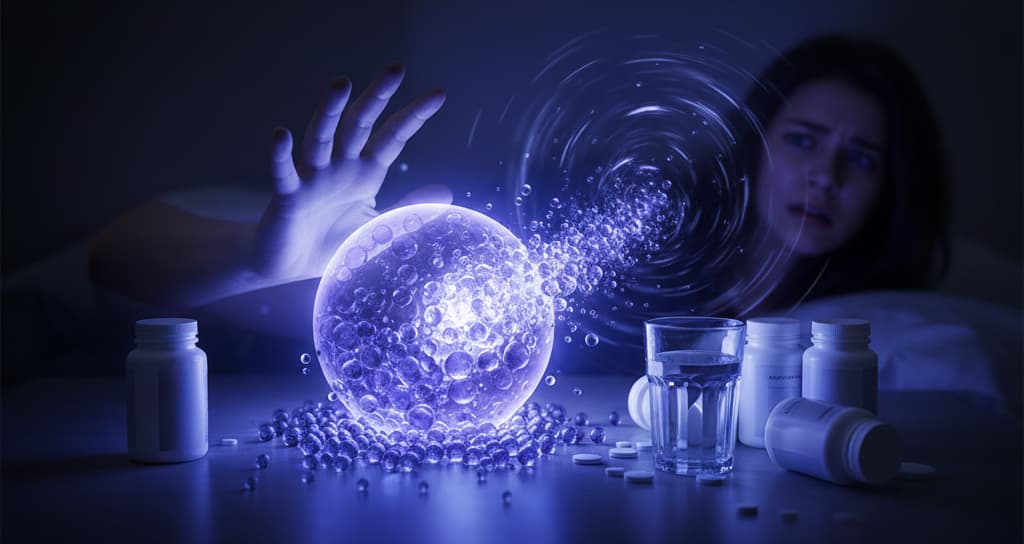
Walk into any pharmacy, and you’ll see them: shelves lined with purple bottles promising “Natural Sleep” in the form of gummies, chocolates, and pills. Melatonin has become the aspirin of the sleep world—the go-to quick fix for anyone tossing and turning.

But here is the uncomfortable truth: Melatonin is not a sedative. It is a hormone. And treating a hormone like a sleeping pill is a recipe for biological confusion.

The “Vampire Hormone”

Melatonin is naturally produced by your pineal gland in response to darkness. Its job is not to knock you out like a tranquilizer. Its job is to tell your body: “It is dark now. Prepare for rest.” It is the starter pistol for the race, not the finish line.

When you take a supplement, you are artificially signaling darkness. But unlike other vitamins, “more” is definitely not better.

The Overdose Epidemic

Your body naturally produces about 0.3 mg of melatonin per night.

Look at the bottle on your nightstand. Does it say 3mg? 5mg? 10mg?

If you are taking 5mg, you are ingesting nearly 16 times the amount your body naturally produces. At 10mg, you are flooding your system with 33 times the physiological dose.

This “supraphysiological” dosage leads to several issues: 1. Receptor Desensitization: Over time, your brain’s receptors may become less sensitive to the hormone, meaning you need more to feel the same effect. You are essentially training your body to ignore its own natural sleep signal. 2. The “Melatonin Hangover”: High doses often stay in your system well into the morning. This leads to that groggy, zombie-like feeling when you wake up—the exact opposite of the refreshed feeling you wanted. 3. Vivid Nightmares: Excess melatonin is linked to intense, often disturbing REM activity. If you’ve started taking gummies and suddenly have movie-quality nightmares, this is likely the culprit.

When Melatonin Actually Works

I am not saying melatonin is useless. It is a powerful chronobiotic tool (a time-shifter) when used correctly. It is effective for:

  • Jet Lag: Helping your body adjust to a new time zone.
  • Shift Work: resetting your clock when you must sleep during the day.
  • Delayed Sleep Phase Syndrome: For “night owls” trying to shift their schedule earlier.

But for general insomnia—waking up in the middle of the night or racing thoughts—it is often ineffective because it doesn’t address the root cause (stress, temperature, or caffeine).

The Natural Alternative: Darkness

The best way to boost your melatonin isn’t a pill; it’s darkness.

Blue light from your phone and harsh overhead LEDs suppress your natural melatonin production instantly. Instead of reaching for a gummy, try this: 1. Dim the lights by 50% one hour before bed. 2. Use blue-light blocking glasses if you must look at screens. 3. Sleep in total darkness. Even a small standby light from a TV can interfere with production. Use a high-quality blackout sleep mask.

Trust your body’s own chemistry. It knows how to sleep; you just need to stop blinding it with light and then confusing it with synthetic hormones. Let the darkness do the work.

The Slumbelry Commitment

Sleep is the most vulnerable state of human existence. It is where we heal, reset, and grow.

At Slumbelry, we don’t just sell sleep products; we advocate for your physiological right to rest. From ergonomic support to light management, every solution we offer is designed with one obsession: Respecting your Biology.

Science is our language, but your recovery is our purpose. You take care of everything else in your life—let us take care of your nights.

Rest Deeply,
The Slumbelry Team

The New Definition of ‘A Good Night’s Sleep’: Stop Stressing the Numbers

Article Image

Written by Dr. Lycan Dizon, Slumbelry Chief Sleep Consultant

We live in the age of data. We count our steps. We count our calories. And now, we count our sleep. We wear rings, watches, and bands that give us a “Sleep Score” every morning. “You got 74%.” “Your readiness is Low.” And what happens? We panic. “Oh no, I slept badly. Today is going to be terrible.” This phenomenon has a name: Orthosomnia. The unhealthy obsession with perfect sleep.

The Placebo Effect

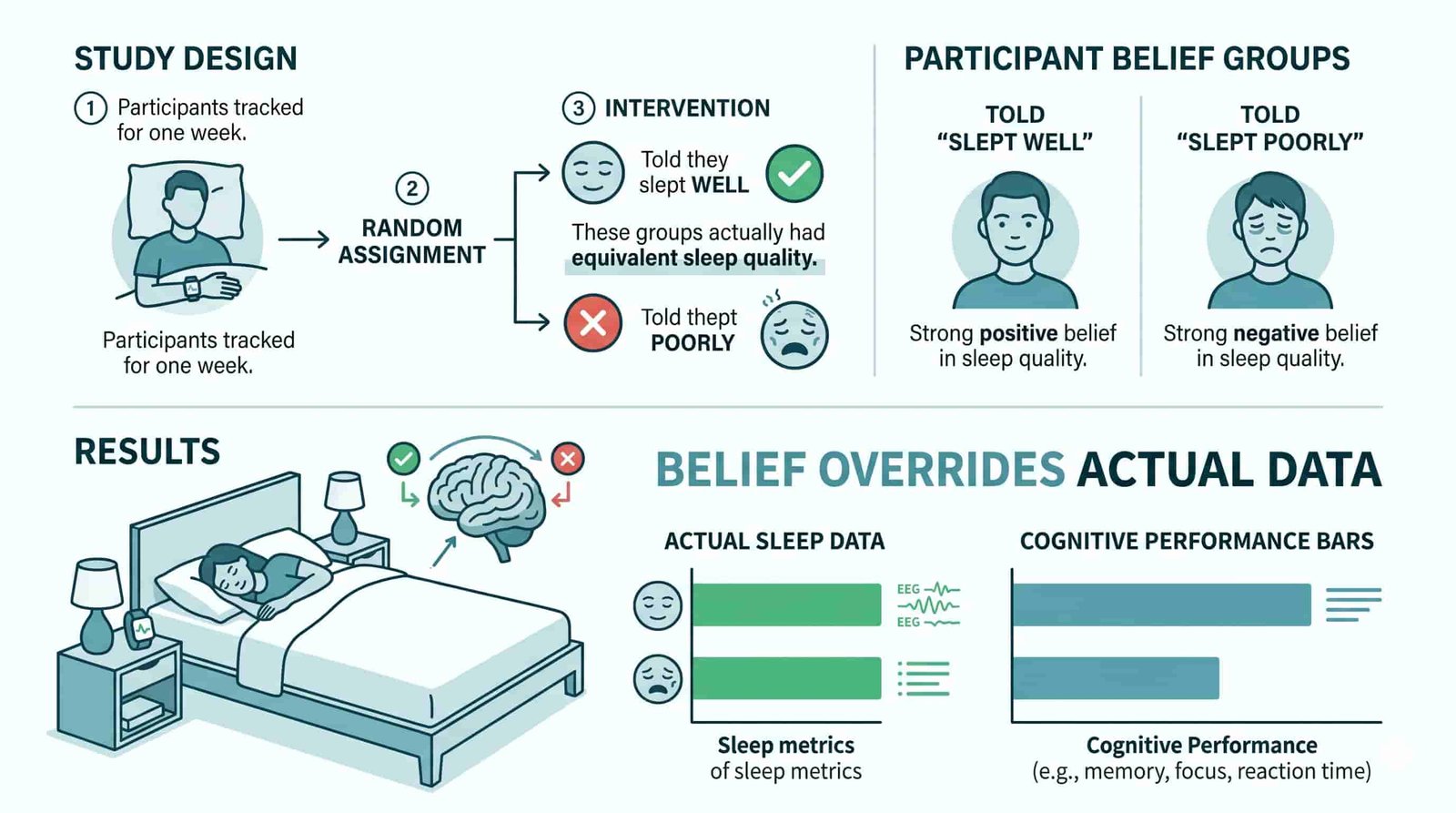
A study was done where participants were told they slept poorly (even if they slept well). Their cognitive performance dropped. Participants who were told they slept well (even if they slept poorly) performed better. Your belief about your sleep is almost as important as the sleep itself. If you wake up and your watch tells you that you failed, you will feel like a failure.

Redefining “Good”

Nick Littlehales wants you to stop looking at the tracker and start listening to your body. A “Good Night’s Sleep” isn’t a flat line of unconsciousness for 8 hours.

  • It’s okay to wake up. Everyone wakes up between cycles. It’s normal.
  • It’s okay to be restless. We move to regulate temperature.
  • It’s okay to have a bad night. It’s just one data point in a 35-cycle week.

Trust Your Body

Your body has been sleeping for 200,000 years without an Apple Watch. It knows what to do. If you are tired, sleep. If you can’t sleep, rest. Rest (lying quietly) offers many of the same benefits as sleep. The moment you stop trying to sleep is usually the moment you fall asleep.

The Slumbelry Philosophy

We build products to support your sleep, not to measure it. We want you to wake up and ask, “How do I feel?” not “What does the app say?” If you feel good, you slept good. Period. Take off the watch tonight. Trust your mattress. Trust your routine. And trust yourself. You’ve got this.

Unlocking Gentle Sleep: Tips, Aids, and Whispers for Restful Nights

In those quiet moments when the day fades and your mind wanders toward rest, remember: you’re not alone in seeking a softer path to sleep.

We’ve all been there—chasing that elusive calm amid the hum of life. Here, we simply hold space for your well-being, offering gentle insights into restorative sleep tips, thoughtful natural sleep aids for better rest, and a free whisper of white noise for sleep to cradle your evenings.

If it calls to you, take a breath… and step closer.

The Slumbelry Commitment

Sleep is the most vulnerable state of human existence. It is where we heal, reset, and grow.

At Slumbelry, we don’t just sell sleep products; we advocate for your physiological right to rest. From ergonomic support to light management, every solution we offer is designed with one obsession: Respecting your Biology.

Science is our language, but your recovery is our purpose. You take care of everything else in your life—let us take care of your nights.

Rest Deeply,
The Slumbelry Team

The Power of ‘Earthing’: Can Walking Barefoot Fix Your Sleep?

Article Image

Written by Dr. Lycan Dizon, Slumbelry Chief Sleep Consultant

Okay, stay with me on this one. This topic usually makes people roll their eyes. It sounds like “woo-woo” hippie nonsense. “You want me to walk barefoot on the grass to cure my insomnia? Should I hug a tree while I’m at it?”

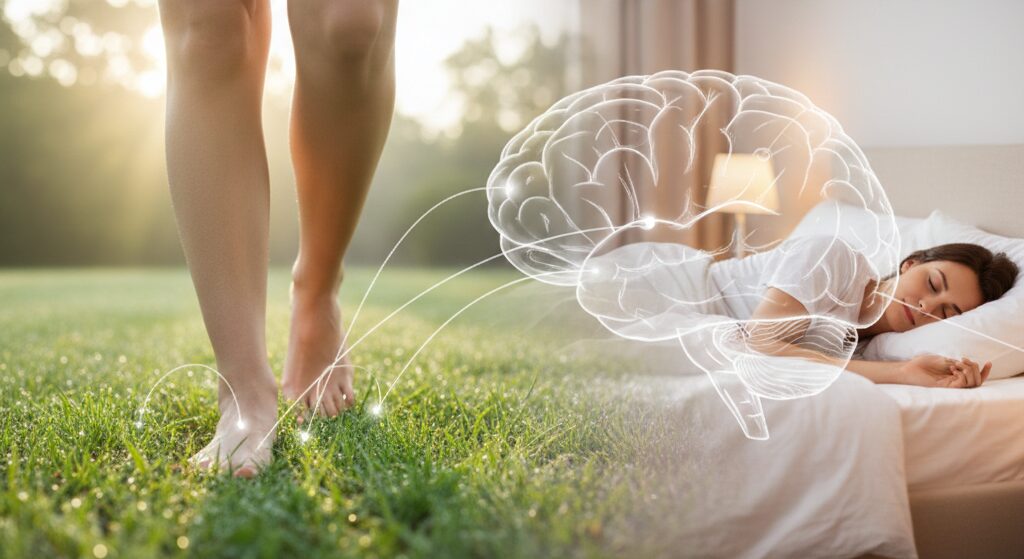
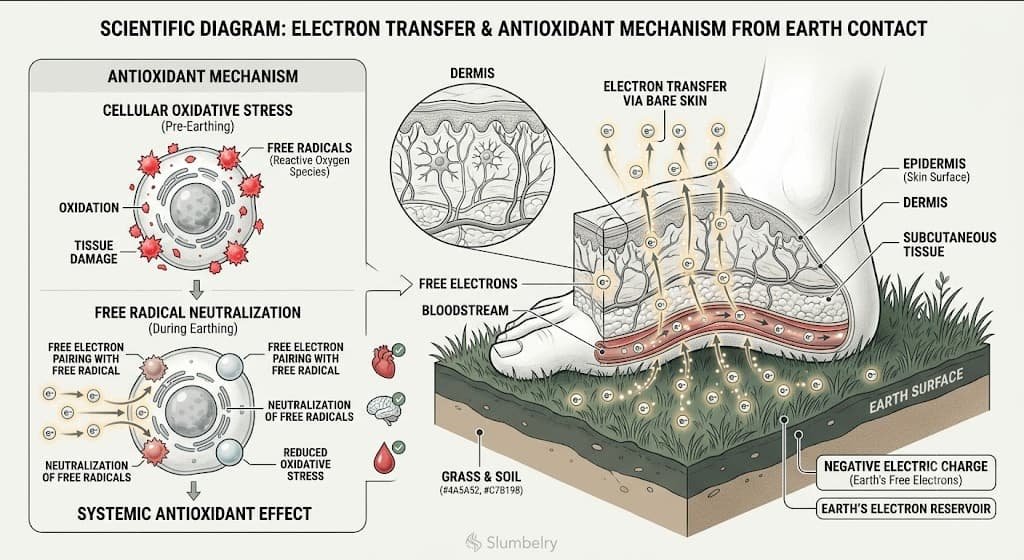
I get the skepticism. But what if I told you that the surface of the Earth is actually a giant battery, and plugging into it is one of the most potent antioxidants known to man? This is the science of Earthing (or Grounding). And it might be the missing link in your sleep hygiene.

The Science: The Electron Exchange

The human body is bio-electrical. Your heart, your brain, your muscles—they all run on electrical impulses. The Earth is also electrical. Its surface is teeming with an infinite supply of free electrons (negatively charged).

Here is the problem: In modern life, we are insulated. We wear rubber-soled shoes. We live in high-rise apartments. We sleep on elevated beds. We rarely, if ever, touch the actual ground. This disconnection causes a buildup of positive charge in the body (free radicals). This leads to chronic inflammation, which is the root cause of almost every modern disease, including sleep disorders.

Shawn Stevenson cites studies published in the Journal of Alternative and Complementary Medicine showing that when the human body connects to the Earth (grounding): 1. Cortisol Normalizes: The stress hormone rhythm syncs up with the natural day/night cycle. 2. Inflammation Drops: The influx of negative electrons neutralizes the positive free radicals. 3. Sleep Deepens: Participants reported falling asleep faster and waking up less frequently.

The Strategy: How to Get Grounded

You don’t need to move into a cave. You just need to touch the planet.

1. The Barefoot Walk

The simplest way is to take off your shoes and walk on a conductive surface.
  • Good Surfaces: Grass, sand, dirt, unpainted concrete/brick.
  • Bad Surfaces: Asphalt, wood, vinyl, rubber.
Aim for 10 minutes a day. Combine this with your “Sunlight Anchor” in the morning for a double-whammy of biological resetting.

2. The Beach Vacation Effect

Have you ever noticed that you sleep amazingly well after a day at the beach? Yes, the sun and swimming help. But you also spent all day walking barefoot on sand and swimming in conductive saltwater. You were grounded for hours. You discharged all your inflammation.

3. Earthing Technology

If you live in a city or a cold climate where barefoot walking isn’t an option, technology has caught up. There are Earthing mats and sheets available that plug into the ground port of your electrical outlet. They bring the Earth’s electrons right into your bed. While nothing beats nature, these can be a game-changer for chronic insomniacs.

Reconnect to Disconnect

We spend so much time connected to the “cloud” (internet) that we have forgotten to connect to the ground. We are biological organisms that evolved in contact with the Earth. When we sever that connection, things go wrong. So, kick off your shoes. Wiggle your toes in the grass. It’s not just good for your soul; it’s essential for your sleep.

The Slumbelry Commitment

Sleep is the most vulnerable state of human existence. It is where we heal, reset, and grow.

At Slumbelry, we don’t just sell sleep products; we advocate for your physiological right to rest. From ergonomic support to light management, every solution we offer is designed with one obsession: Respecting your Biology.

Science is our language, but your recovery is our purpose. You take care of everything else in your life—let us take care of your nights.

Rest Deeply,
The Slumbelry Team

Train Hard, Sleep Deep: Why Your Workout Timing Matters

Article Image

Written by Dr. Lycan Dizon, Slumbelry Chief Sleep Consultant

We all know exercise is good for us. It builds muscle, burns fat, and boosts mood. And generally, people who exercise sleep better than those who don’t. But have you ever crushed a high-intensity interval training (HIIT) class at 8:00 PM, only to find yourself staring at the ceiling at midnight, wide awake?

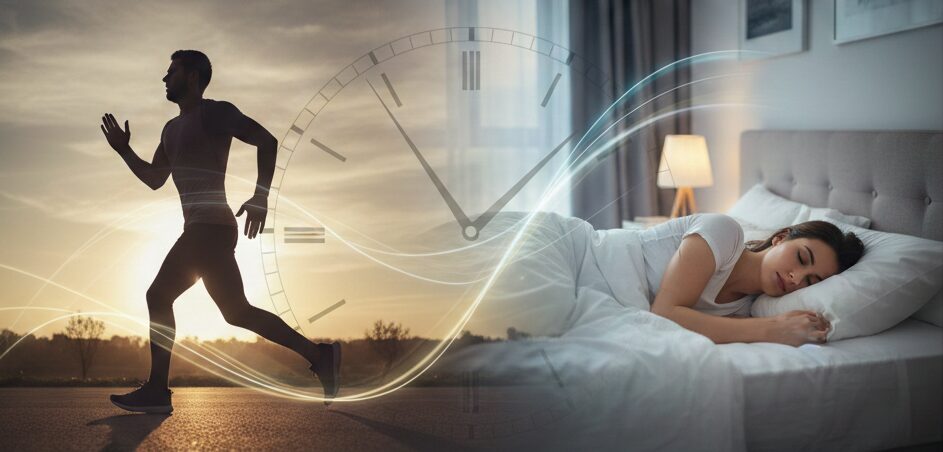
You are physically exhausted, but your brain is wired. This is the Exercise Paradox. Movement is medicine for sleep, but only if the timing is right.

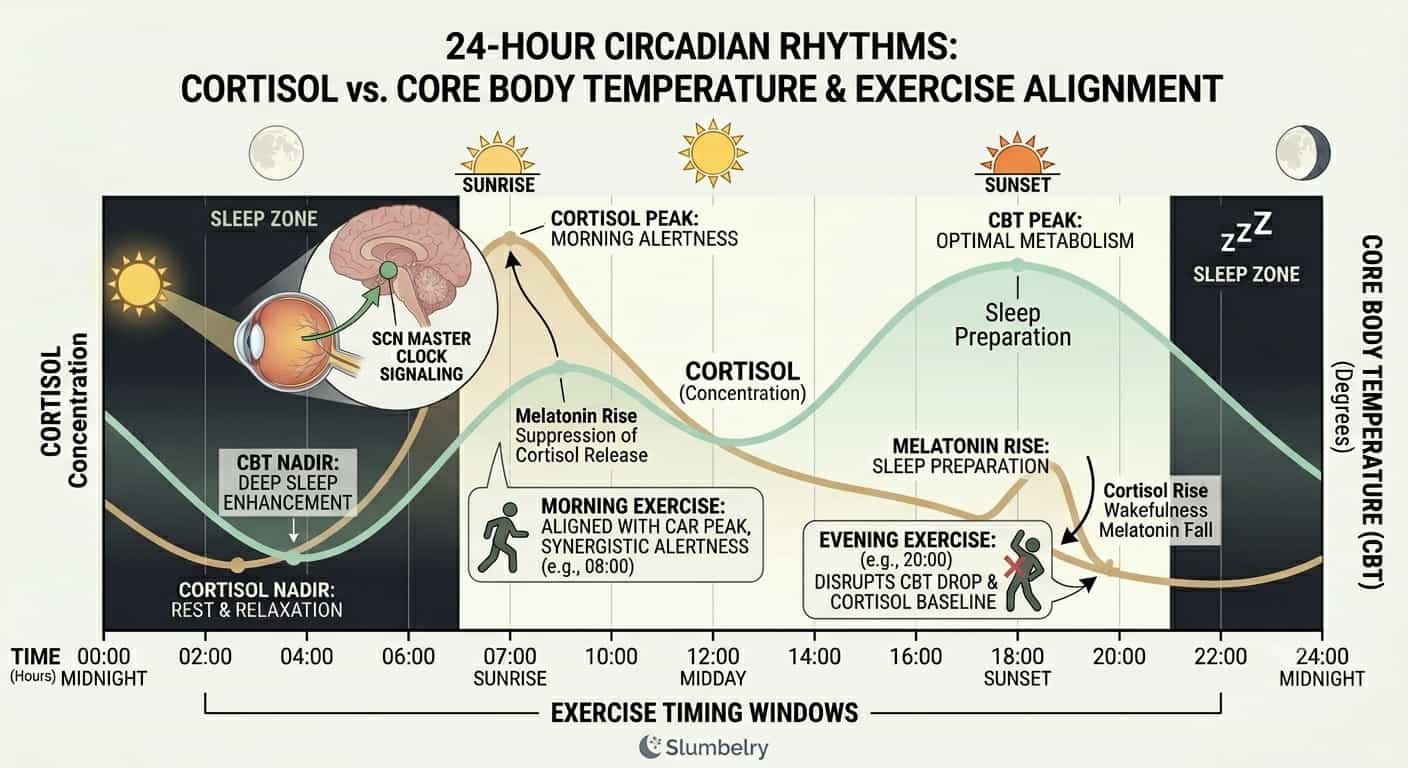
The Science: Cortisol and Temperature

When you exercise, you are essentially inducing a controlled stress response.

1. The Cortisol Spike

Intense exercise triggers the release of cortisol and adrenaline. These are “fight-or-flight” hormones. They are designed to keep you alert, focused, and ready to move. If you spike these hormones late at night, you are telling your body, “It’s survival time, not sleep time.” It can take hours for these levels to return to baseline, effectively pushing your sleep window back.

2. The Core Temperature Problem

As we discussed in our article on Thermal Regulation, your body needs to cool down to sleep. Exercise raises your core body temperature significantly. It’s like turning on a furnace inside your body. If you workout too close to bed, your body struggles to cool down enough to initiate deep sleep.

The Strategy: The Optimal Schedule

So, when should you train? Shawn Stevenson breaks it down based on hormonal rhythms.

1. Morning: The Cardio Zone (7:00 AM – 11:00 AM)

This is the golden hour.
  • Why: Your cortisol is naturally highest in the morning. Exercising now aligns with your biology. It “anchors” your rhythm, signaling to your body that the day has begun.
  • Bonus: A study from Appalachian State University showed that morning exercisers spent 75% more time in Deep Sleep than those who exercised later in the day.

2. Afternoon: The Strength Zone (2:00 PM – 6:00 PM)

This is when your body temperature is naturally highest, meaning your muscles are warm and flexible. It’s the best time for heavy lifting or peak performance.
  • The Cutoff: Try to finish intense workouts at least 4 hours before bed. This gives your body time to lower its temperature and stabilize cortisol.

3. Evening: The Recovery Zone (After 8:00 PM)

If you must move at night, keep it gentle.
  • Do: Yoga, stretching, light walking. These activities can actually help reduce cortisol and prepare the body for rest.
  • Don’t: CrossFit, sprints, heavy lifting, or competitive sports.

Listen to Your Body

If you are a night owl and find that evening workouts don’t disrupt your sleep, that’s fine. We are all unique. But if you are struggling with insomnia, your late-night gym session is the first suspect. Try shifting your workout to the morning for just one week. You might find that the weights feel heavier, but your eyelids feel heavier at night—and that’s the goal.

The Slumbelry Commitment

Sleep is the most vulnerable state of human existence. It is where we heal, reset, and grow.

At Slumbelry, we don’t just sell sleep products; we advocate for your physiological right to rest. From ergonomic support to light management, every solution we offer is designed with one obsession: Respecting your Biology.

Science is our language, but your recovery is our purpose. You take care of everything else in your life—let us take care of your nights.

Rest Deeply,
The Slumbelry Team

The Missing Mineral: Why Magnesium is Nature’s ‘Chill Pill’

Article Image

Written by Dr. Lycan Dizon, Slumbelry Chief Sleep Consultant

You lay in bed. Your mind is racing. Your legs feel twitchy. Your muscles are tight. You are tired, but your body feels… wired. It feels like anxiety, or stress, or just “bad luck.” But it might be a simple chemical deficiency.

You might be missing the “Master Mineral”: Magnesium.

Shawn Stevenson calls magnesium the “anti-stress mineral.” It is responsible for over 300 enzymatic processes in the human body. Yet, it is estimated that 80% of the population is deficient. Why? Because our soil is depleted, our water is filtered, and our stress levels burn through our magnesium stores like rocket fuel.

The Science: How Magnesium Induces Sleep

Magnesium is the brake pedal for your nervous system.

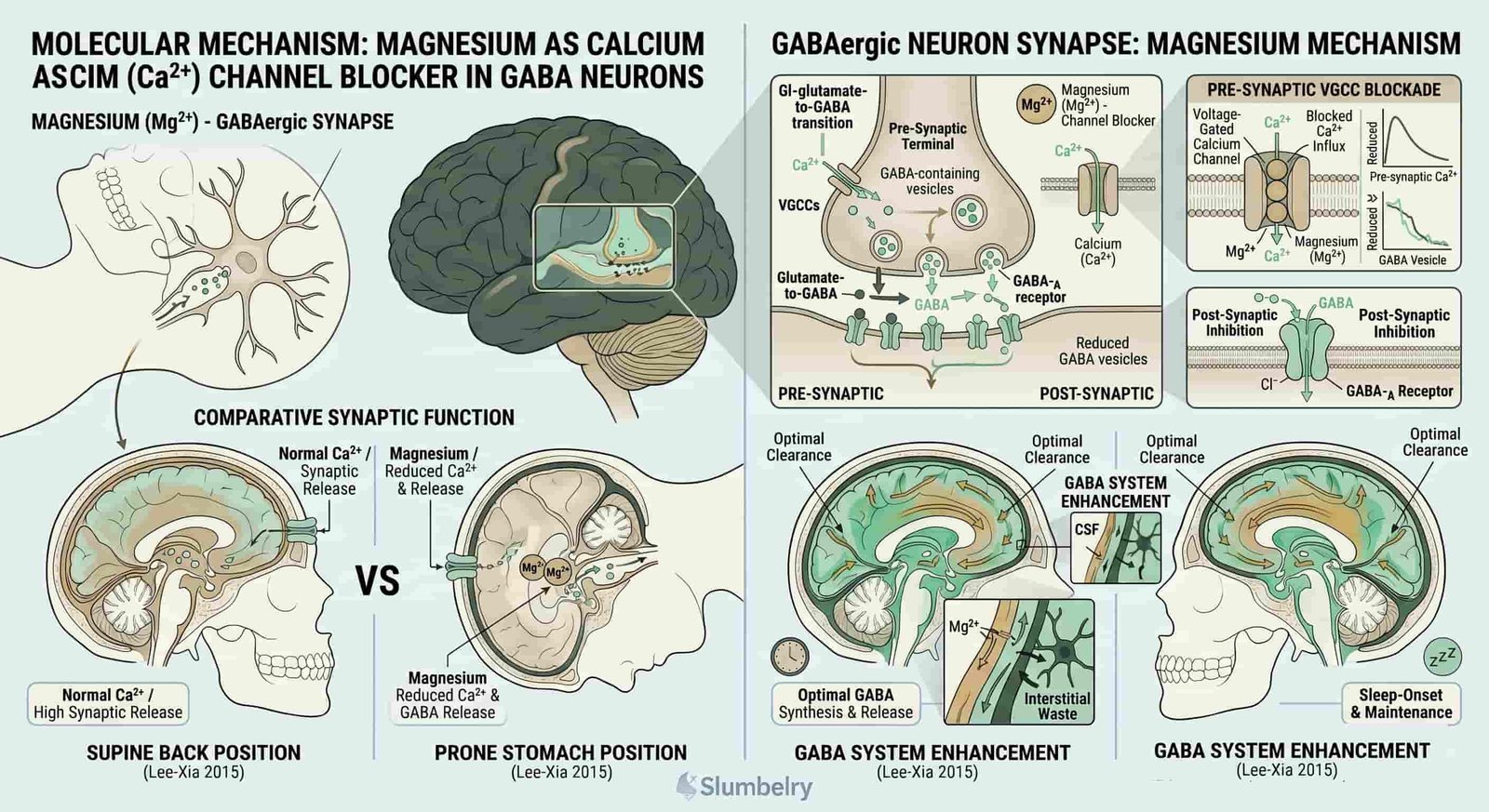
1. GABA Activation

Your brain has a neurotransmitter called GABA (gamma-aminobutyric acid). GABA is what calms you down. It turns off the “racing thoughts.” Magnesium is essential for GABA receptors to function. Without magnesium, your brain stays stuck in “ON” mode.

2. Muscle Relaxation

Calcium causes muscles to contract. Magnesium causes muscles to relax. If you have too much calcium and not enough magnesium, your muscles stay tense. This is a leading cause of Restless Leg Syndrome (RLS) and nighttime cramps.

3. Cortisol Regulation

Magnesium helps regulate the HPA axis (the body’s stress response system). Low magnesium leads to higher baseline cortisol, which suppresses melatonin.

The Solution: How to Get More

You can’t just eat a banana and call it a day (though bananas are good). To fix a deficiency, you need a strategy.

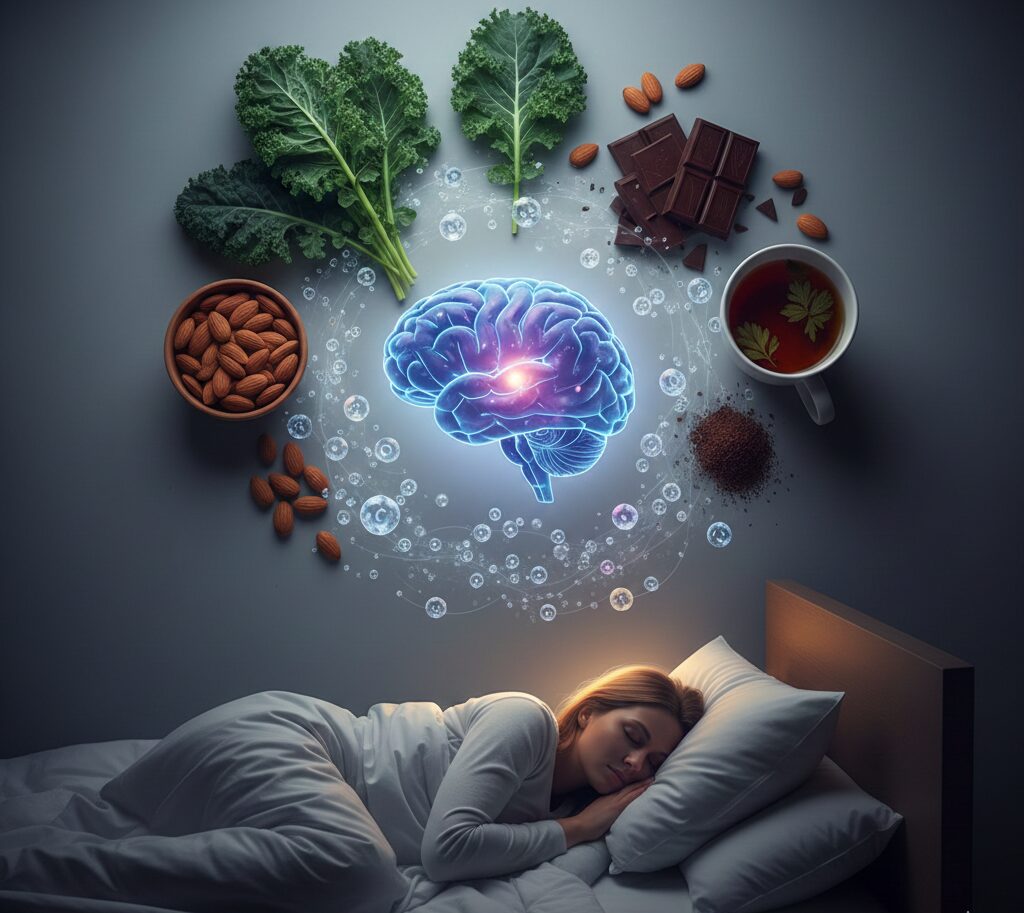
1. Eat Your Greens (and Seeds)

Dark leafy greens are the best source. Think spinach, swiss chard, and kale. Pumpkin seeds are also a powerhouse—just ¼ cup contains nearly 50% of your daily recommended intake.
  • Top Sources: Spinach, Pumpkin Seeds, Almonds, Dark Chocolate (yes!), Avocado.

2. Supplement Wisely (Oral)

Not all pills are created equal. Avoid Magnesium Oxide (it’s cheap and poorly absorbed). Look for:
  • Magnesium Bisglycinate: Bonded to glycine (a calming amino acid). Best for sleep.
  • Magnesium Threonate: Can cross the blood-brain barrier. Great for anxiety.
  • Magnesium Citrate: Good, but can have a laxative effect.

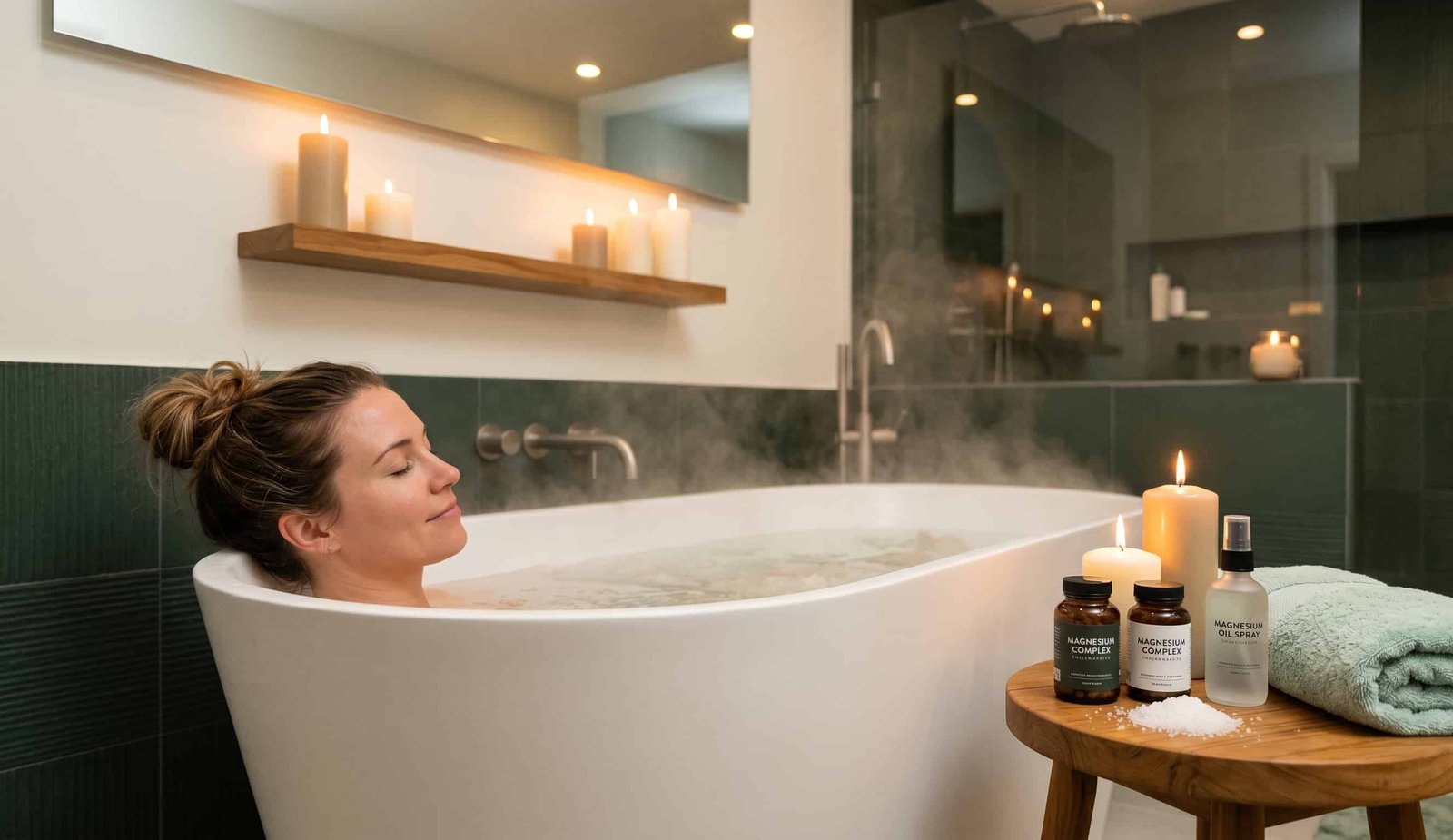
3. The Secret Weapon: Transdermal (Skin) Absorption

This is Shawn Stevenson’s favorite hack. Your skin can absorb magnesium directly, bypassing the digestive system.
  • Epsom Salt Bath: Epsom salts are Magnesium Sulfate. Taking a warm bath with 2 cups of salts hits you with a double whammy: thermal regulation (cooling effect after the bath) + magnesium absorption.
  • Magnesium Oil/Spray: Spray it on your chest or legs before bed. It can tingle at first (a sign of deficiency!), but it works fast to relax muscles.

The “Chill” Factor

If you feel constantly wound up, don’t immediately reach for a sleeping pill. Reach for the mineral that your body is begging for. Magnesium isn’t a drug; it’s a fundamental building block of relaxation. Give your body the tools it needs to turn off the lights.

The Slumbelry Commitment

Sleep is the most vulnerable state of human existence. It is where we heal, reset, and grow.

At Slumbelry, we don’t just sell sleep products; we advocate for your physiological right to rest. From ergonomic support to light management, every solution we offer is designed with one obsession: Respecting your Biology.

Science is our language, but your recovery is our purpose. You take care of everything else in your life—let us take care of your nights.

Rest Deeply,
The Slumbelry Team

Turn Your Bedroom Into a Recovery Cave

Sleep Sanctuary: Build a Bedroom That Forces Deep Rest

Sleep Sanctuary: Build a Bedroom That Forces Deep Rest

Look around your bedroom. If you see a television, a stack of unopened mail, a glowing router LED, and a phone charging on your nightstand, you do not have a bedroom. You have an entertainment and anxiety hub that happens to contain a mattress.

Sleep is the most vulnerable biological state a human enters. Your primitive brain will refuse to power down into deep sleep if it subconsciously registers your environment as stimulating, threatening, or chaotic. You cannot out-supplement a toxic sleep environment. Bio-hacking your sleep starts with engineering a flawless physical sanctuary — a room that signals only one thing: total recovery.

We are going to rebuild your bedroom across five non-negotiable pillars: air quality, temperature, light, sound, and psychological conditioning. Each pillar is backed by physiology. Each one is actionable tonight. And together, they transform your bedroom from a place where you simply lie down into a biological recovery chamber that forces deep rest.

Quick Answer

  • Your bedroom is a physiological trigger, not a living space. Light above 5 lux suppresses melatonin by 50%. CO₂ above 1,000 ppm fragments sleep architecture. Clutter elevates cortisol.
  • Temperature is the fastest lever. Lock your bedroom between 65°F and 68°F. Your core temperature must drop 2-3°F to initiate and sustain deep sleep.
  • Your brain learns what the bed means. If you work, scroll, and worry in bed, your brain prepares for stimulation, not sleep. Strict bed-only conditioning rewires this in two weeks.
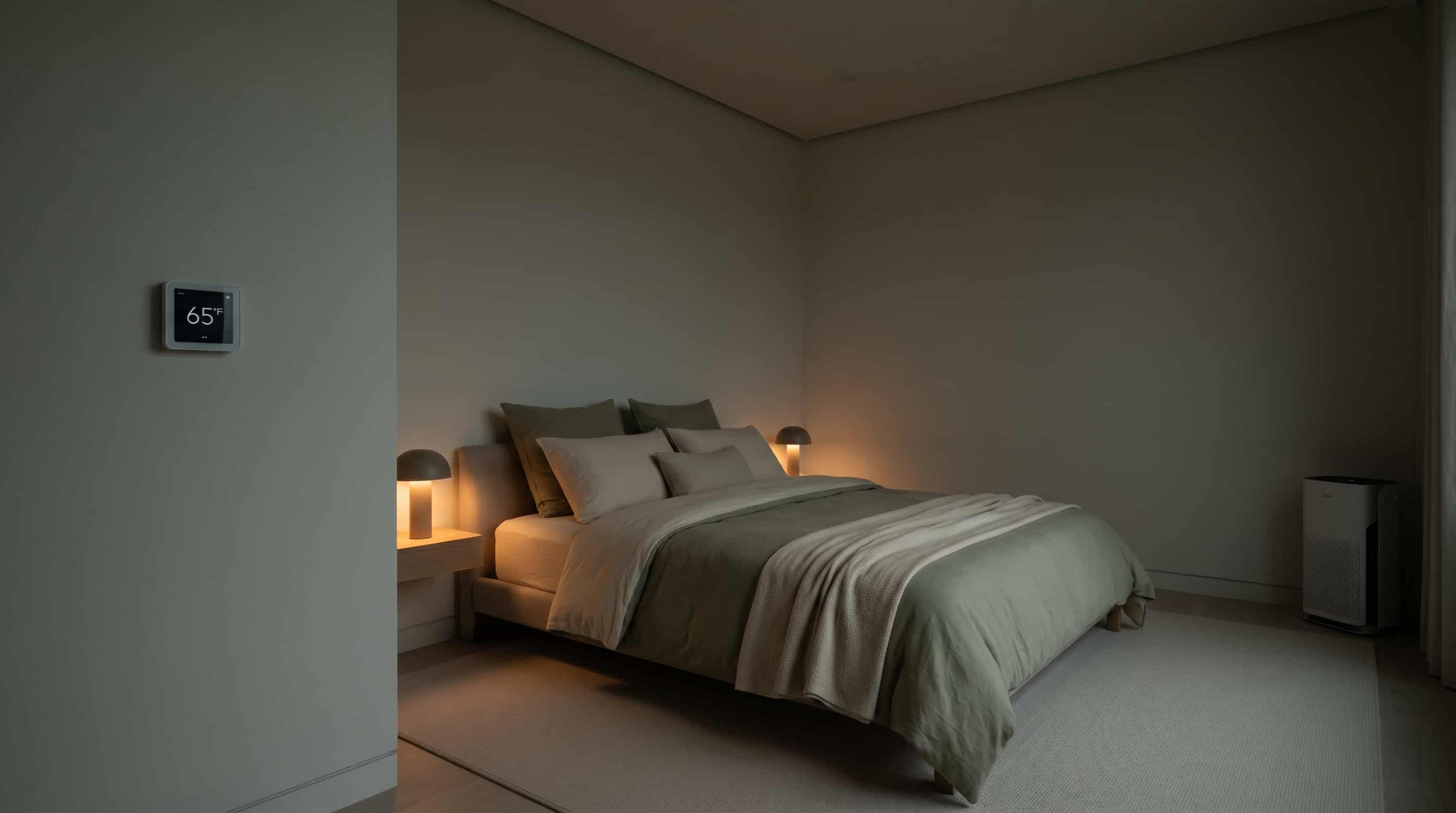
A minimalist bedroom optimized as a biological sleep sanctuary with complete blackout, premium cooling bedding, and zero electronics
A purpose-built sleep sanctuary: absolute darkness, thermal control at 65°F, and no electronic stimulation — the three foundations of biological recovery.

Why does your bedroom air secretly ruin your sleep?

Direct Answer: In a closed bedroom, CO₂ levels spike from 400 ppm to over 2,000 ppm by morning — triple the threshold that impairs cognitive restoration.

The Science: You breathe 7,000-9,000 liters of air every night. A typical sealed bedroom traps exhaled CO₂, causing it to accumulate rapidly. When CO₂ crosses 1,000 ppm, your respiratory rate increases by 20%, triggering micro-awakenings that fragment your sleep architecture without you ever becoming conscious of them. Particulate matter (PM2.5) above 12 μg/m³ — common even in “clean” urban bedrooms — increases inflammatory markers and reduces deep sleep by 30%.

What to Do Tonight: Open your bedroom window for 30 minutes before bed. This single action drops CO₂ by 80% inside 30 minutes. If external air quality is poor, run a HEPA air purifier rated for your room size.

Research Reference: Lin et al. (2026), Scientific Reports — Bedroom PM2.5 levels above 12 μg/m³ reduced sleep quality by 35% and impaired next-day physical performance by 25%, even in young, healthy adults.

Humidity matters more than most people realize. Below 30% relative humidity, your airways dry out, triggering nighttime coughing and throat irritation. Above 50%, you incubate dust mites and mold. Target 30-50% humidity — a simple hygrometer costs under ten dollars and tells you instantly whether your air is working for or against your sleep.

What is the exact temperature that forces deep sleep?

Direct Answer: Your bedroom must sit between 65°F and 68°F (18-20°C). Your core body temperature needs to drop by 2-3°F for sleep onset, and the ambient air temperature is the primary driver of that drop.

The Science: Sleep onset requires vasodilation — the widening of blood vessels in your hands, feet, and face to dump heat into the environment. If your room is above 70°F, your body fights a losing battle against thermodynamics. The heat stays trapped in your core, and your brain cannot transition into slow-wave sleep. Research shows bedrooms above 70°F reduce deep sleep by 40% and increase nighttime awakenings by 50%.

What to Do Tonight: Set your thermostat to 67°F one hour before bed. Wear minimal clothing to bed — your hands and feet are your body’s primary heat radiators, and insulating them traps heat in your core.

Research Reference: Lee et al. (2026), Frontiers in Public Health — Bedroom temperature-humidity combinations outside 65-68°F and 30-50% RH increased sleep onset latency by 45% and reduced total sleep time by 90 minutes.

A warm shower 90 minutes before bed sounds counterintuitive, but it works. The hot water triggers blood to rush to your skin’s surface. When you step out, that heat rapidly dissipates, causing a sharp core temperature drop — exactly the signal your brain needs to initiate sleep. It is the simplest bio-hack in your arsenal, and it costs nothing.

Why does any light — even from an LED — suppress melatonin?

Direct Answer: Your brain does not perceive light as an inconvenience. It perceives light as a signal that it is daytime. Even 1 lux — the glow from a single LED across the room — can suppress melatonin by 50%.

The Science: The suprachiasmatic nucleus (your master biological clock) sits in your hypothalamus and communicates directly with your pineal gland. When photoreceptors in your retina detect light — especially blue and green wavelengths — they instruct the pineal gland to stop secreting melatonin immediately. This is not a gradual effect. It is a binary switch: light on, melatonin off.

What to Do Tonight: Tape over every LED indicator in your bedroom with black electrical tape. Install true blackout curtains and seal the gap at the bottom with a draft stopper. Your bedroom must be as dark as a sensory deprivation tank.

Research Reference: Park et al. (2024), Scientific Reports — Exposure to dim light during sleep (5-10 lux) increased insulin resistance by 15% and elevated resting heart rate by 5 beats per minute in healthy adults after just one night.

If you must have a nightlight, use amber or red wavelength light. Amber LEDs (590nm+) suppress melatonin at roughly 1/10th the rate of blue light (460nm). Place it low — below bed level — so it does not hit your eyes while lying down. The goal is absolute darkness for the first four hours of the night, when your melatonin levels are highest.

What sound environment actually helps you sleep?

Direct Answer: Either complete silence (below 35 dB) or consistent background noise (50-60 dB). What destroys sleep is sudden variation — a car door, a barking dog, a phone notification.

The Science: Your brain evolved to treat unexpected sound spikes as potential threats. A sudden noise above 10 dB above baseline triggers a cortisol spike, even if you do not fully wake up. The fragmentation happens in the microseconds between noise and arousal response. Research shows that pink noise (a balanced frequency distribution) reduces the disruptive impact of traffic sounds on sleep by 45% and improves next-morning blood metabolome markers.

What to Do Tonight: Run a white noise or pink noise machine every night. Consistency is the key — your brain learns to tune out a steady sound. Variability is what triggers cortisol. Close interior doors, weatherstrip the bedroom entry, and eliminate any sudden sound sources you can control.

Research Reference: Vincens et al. (2025), Communications Medicine — Pink noise reduced the physiological impact of traffic noise on sleep architecture by 45% and improved next-morning metabolic markers compared to silence alone.
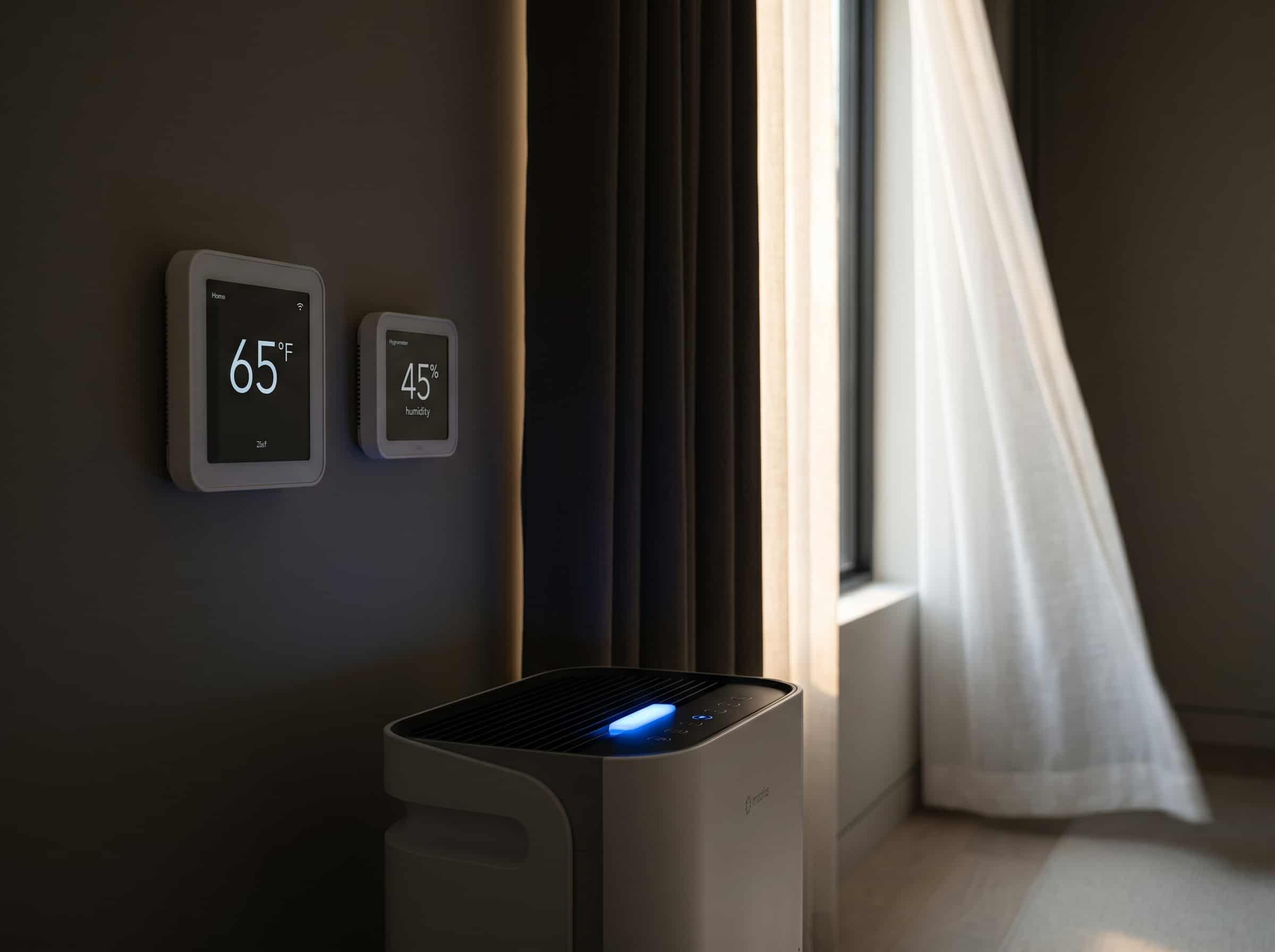
HEPA air purifier and digital thermostat in a minimalist bedroom, representing the air quality and temperature pillars of sleep sanctuary design
Air quality and thermal control are the two most underappreciated pillars of sleep optimization — HEPA filtration and a thermostat set to 65°F form the foundation of a biological recovery environment.

How do you psychologically hardwire your bedroom for sleep?

Direct Answer: Strict stimulus control — you must teach your brain that the bed means exactly one thing: unconsciousness. Nothing else.

The Science: Your brain forms powerful associative pathways through repetition. If you work in bed, scroll your phone in bed, watch Netflix in bed, and argue in bed, your brain has no idea what to do when you lie down. It prepares for stimulation, not sleep. Stimulus control therapy is 85% effective for chronic insomnia — it works by erasing the old associations and rebuilding a single, unambiguous signal: bed equals sleep.

What to Do Tonight: The bed is for sleep and sex only. If you are awake for more than 20 minutes, get out of bed, go to another room, read a physical book under dim light, and only return when you feel drowsy. Every night. No exceptions.

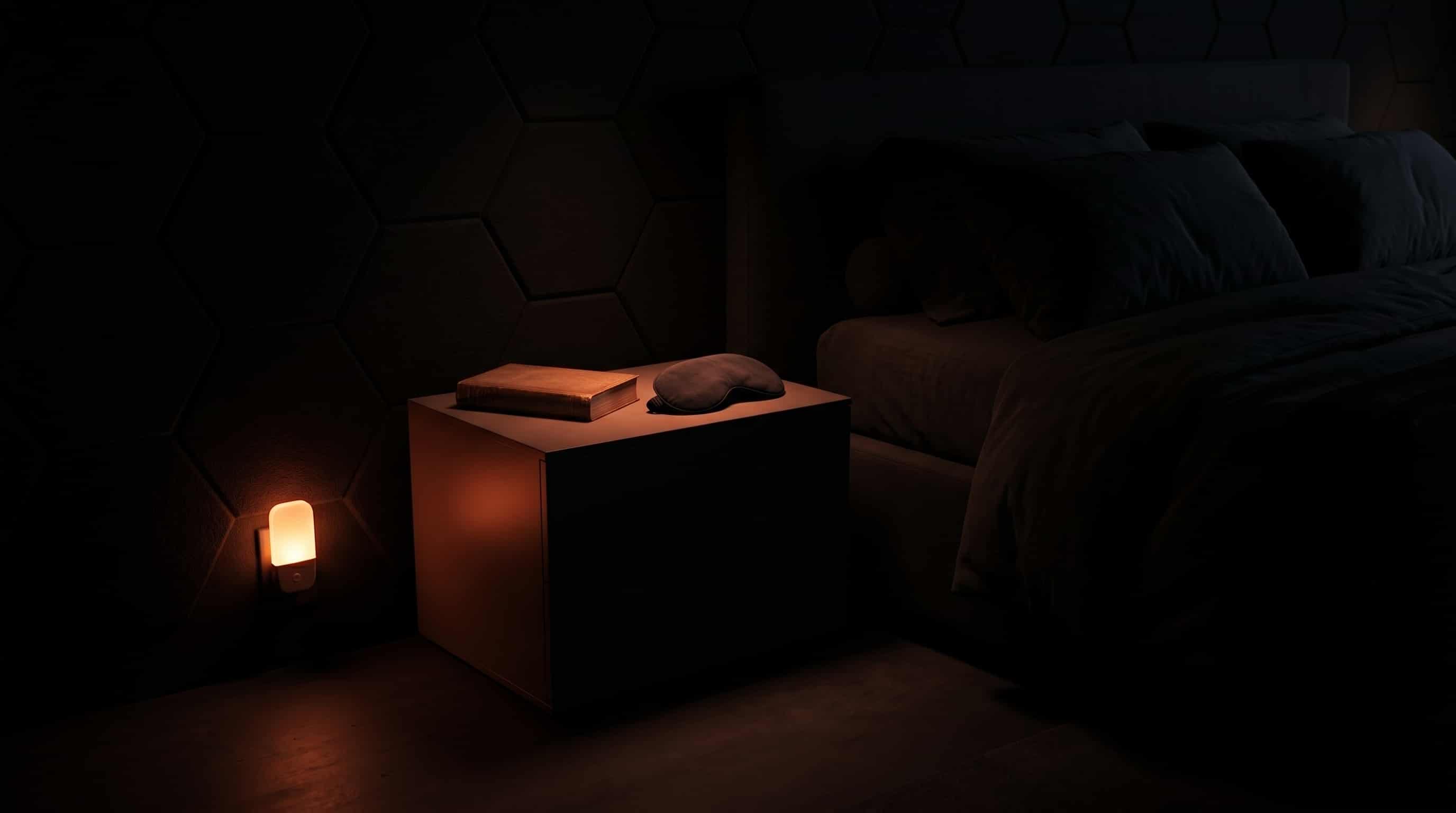
Pitch-black bedroom with amber nightlight, physical book on nightstand, and sleep mask — the three pillars of light control, psychological conditioning, and sensory management
Complete darkness is non-negotiable. An amber nightlight, a physical book, and a sleep mask form the only approved nighttime accessories in a true sleep sanctuary — everything else is a distraction.

The brutal truth: you cannot have it both ways. You cannot work from your bed on Tuesday and expect your brain to immediately trigger sleep onset on Wednesday. Neural pathways are not reformed overnight. But within two weeks of strict stimulus control — no exceptions — your brain will begin to associate the mattress with unconsciousness automatically. The moment your head hits the pillow, sleep onset begins. That is the target.

What does a 30-day sleep sanctuary protocol actually look like?

Direct Answer: A phased, progressive transformation — not a weekend project. This takes three weeks to fully encode, and results compound over time.

Week 1: Purge and Purify

  • Remove every non-sleep item from your bedroom: television, work materials, exercise equipment, clutter
  • Set thermostat to 65-68°F one hour before your target bedtime
  • Open windows for 30 minutes before bed to flush CO₂, or run a HEPA air purifier
  • Check your hygrometer — target 30-50% relative humidity

Week 2: Light and Sound

  • Achieve complete blackout — blackout curtains, LED tape over every light source, door sealed
  • Introduce a white noise or pink noise machine set at 50-60 dB
  • Charge your phone outside the bedroom, or place it face-down with all notifications silenced
  • Begin the 20-minute rule: leave the bedroom if you are not asleep within 20 minutes

Week 3: Psychological Encoding

  • Bed is for sleep and sex only. Zero exceptions
  • Establish a 30-minute pre-bed ritual in a different room: warm shower, light reading, gentle stretching
  • Remove all clocks from the bedroom — checking the time in the middle of the night triggers anxiety
  • Begin the warm shower protocol: 90 minutes before bed, 10-15 minutes, warm water

Frequently Asked Questions

What if I share a bedroom with someone?

Direct Answer: Prioritize agreement on the five pillars.

Why: Compromise options include separate bedding for different temperature needs, a white noise machine to mask partner movement, a sleep mask for reading light, and clear communication about work or stress boundaries inside the bedroom.

How much does a sleep sanctuary makeover cost?

Direct Answer: Free: remove non-sleep items and establish a consistent pre-bed routine.

Why: $100-$300: blackout curtains, HEPA air purifier, white noise machine $300-$1,000: quality mattress, temperature-regulating bedding, acoustic panels The total value is a 40-60% improvement in sleep quality.

How does Slumbelry’s approach differ from other bedding brands?

Direct Answer: We design specifically for the sleep sanctuary framework.

Why: Our temperature-regulating materials maintain the 65-68 degree optimal range, our acoustic-dampening systems address noise without electronics, and our hypoallergenic covers support air quality It is environmental optimization, not just bedding.

What about small apartments or shared spaces?

Direct Answer: Use vertical solutions like loft beds with workspace underneath, curtain dividers for visual separation, multi-purpose furniture like Murphy beds, and routine separation where pre-bed activities happen in a different space while the bed remains strictly for sleep..

Why:

Can I use my bedroom for relaxing activities?

Direct Answer: Yes, selectively.

Why: Reading a paper book and meditating are acceptable because they promote relaxation Watching TV, scrolling your phone, or working on a laptop are not The rule is simple: if the activity stimulates your brain, relocate it outside the bedroom.

How long until my bedroom feels like a true sanctuary?

Direct Answer: Immediate results from removing clutter and non-sleep items take 1-2 days.

Why: Adjusting to optimal temperature and light conditions takes 3-7 days A strong bed-sleep association develops in 2-3 weeks of strict stimulus control The complete transformation takes 1-2 months.

What if I cannot control my bedroom environment (rental, dorm, shared housing)?

Direct Answer: Use portable solutions: temperature-regulating bedding and a personal fan for thermal control, portable blackout curtains and a sleep mask for light, a white noise machine or earplugs for sound, a portable HEPA filter for air quality, and strict bed-only discipline for psychological conditioning..

Why:

Is sleep sanctuary just marketing hype?

Direct Answer: No.

Why: Every pillar is drawn from published sleep science research The term simply summarizes the evidence-based practice of optimizing your bedroom across five scientifically validated dimensions: air quality, temperature, light, sound, and psychological conditioning We cite peer-reviewed studies for every claim in this guide.

What is the single most important change I can make?

Direct Answer: Remove the television from your bedroom.

Why: Bedroom TVs are the strongest independent predictor of poor sleep in adults Research shows people with a bedroom TV get 20-30 minutes less sleep per night and report 40% lower sleep quality than those who keep screens entirely out of the bedroom.

How do I maintain my sleep sanctuary long-term?

Direct Answer: Weekly: quick tidy and check the air purifier filter.

Why: Monthly: wash bedding and verify temperature settings Seasonally: adjust for temperature and humidity changes Annually: deep clean and reassess all five pillars to ensure your sanctuary is operating at full capacity.

Ready to Transform Your Recovery?

Your bedroom is the most powerful sleep tool you own. Slumbelry designs every product around the five pillars of the sleep sanctuary framework. From temperature-regulating pillows to hypoallergenic bedding systems, we build the tools your biology actually needs.

Take the Free Sleep Assessment Shop the Sleep Sanctuary Collection

The Slumbelry Commitment

Sleep is the most vulnerable state of human existence. It is where we heal, reset, and grow.

At Slumbelry, we do not just sell sleep products; we advocate for your physiological right to rest. From temperature-regulating materials to psychological conditioning guidance, every solution we offer is designed with one obsession: Respecting your Biology.

Science is our language, but your recovery is our purpose. You take care of everything else in your life — let us take care of your nights.

Rest Deeply,
The Slumbelry Team

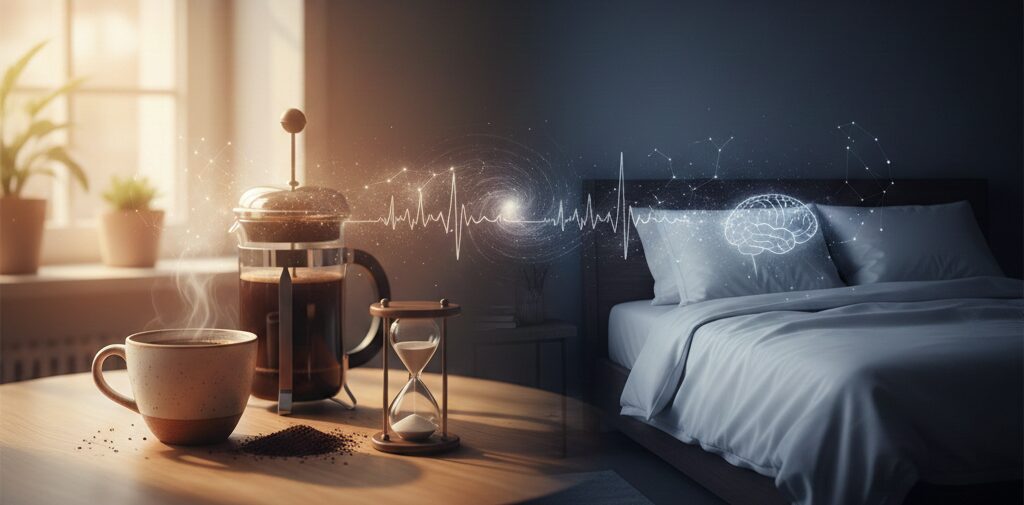
Mastering Your Morning Brew for Better Nights

The “2 PM Heartbreak”: Why Breaking Up with Afternoon Coffee Saves Your Sleep | Slumbelry Sleep Science

The ‘2 PM Heartbreak’: Why Breaking Up with Afternoon Coffee Saves Your Sleep

You love your afternoon coffee. That 3 PM ritual—the warmth of the mug, the rich aroma, the 15-minute escape from the screen. It feels like the only thing keeping you upright through the last stretch of the workday. And for the first hour, it works beautifully.

But here is what no one tells you: that same cup is still in your bloodstream at midnight, silently dismantling the deep sleep your body desperately needs. You are not just borrowing alertness for the afternoon—you are stealing it from tomorrow morning.

This is not about giving up coffee. It is about one of the most powerful sleep interventions that costs zero dollars and requires zero equipment. A hard stop. A caffeine curfew. And once you understand the science behind it, you will never look at a 3 PM espresso the same way again.

Quick Answer

  • Caffeine’s half-life is 5-8 hours. At 10 PM, half of your 3 PM coffee is still active, blocking the adenosine your brain needs to initiate deep sleep.
  • 2 PM is the scientifically-grounded cutoff. Stopping 8-10 hours before bed gives your body enough time to clear caffeine below the threshold that disrupts sleep architecture.
  • Sleep quality drops even if you “fall asleep fine.” Afternoon caffeine reduces deep sleep by 15-20%—you won’t feel it consciously, but your body registers every lost minute.
Person looking at clock showing 2 PM next to a coffee cup, illustrating the caffeine curfew concept
It’s 2 PM. That afternoon coffee ritual ends now—your deep sleep is the trade you’re making, and it’s not a fair one.

How Long Does Caffeine Actually Stay in Your System?

Most people treat caffeine like a switch—it is on, then it wears off, then it is gone. That model is dangerously wrong. Caffeine fades slowly, logarithmically, lingering in the background long after you stop feeling the buzz.

The half-life of caffeine—the time it takes for your body to eliminate 50% of it—ranges from 5 to 8 hours in healthy adults. If you drink a large coffee containing 200mg of caffeine at 3:00 PM, here is what your body is actually dealing with:

At 9:00 PM, roughly 100mg still circulates in your bloodstream. At 3:00 AM, about 50mg remains—enough to fragment your sleep architecture without you ever waking up enough to notice. That is the silence of caffeine sabotage: you do not feel it happening, so you assume it is not happening.

Direct Answer: Caffeine’s half-life is 5-8 hours, meaning your 3 PM coffee still has 50% potency at 9 PM and 25% at 3 AM—enough to reduce deep sleep duration by up to 20%.

The Science: Caffeine is metabolized primarily by the CYP1A2 enzyme in the liver. The rate varies significantly by genetics—some people clear caffeine twice as fast as others. But even fast metabolizers cannot eliminate a full dose within a standard workday-to-bedtime window.

What to Do Tonight: Set a phone alarm for 2 PM labeled “Caffeine Curfew.” After that, switch to water or herbal tea. Track your sleep quality for three nights and compare.

Research Reference: Clark I et al. (2023), Sleep Medicine Reviews — A systematic review confirms that caffeine doses within 6 hours of bedtime significantly reduce total sleep time and sleep efficiency.

Why Does Caffeine Disrupt Sleep Even When I Don’t Feel It?

This is the question that keeps the coffee industry thriving. You have a double espresso at 4 PM, go to bed at 11 PM, fall asleep within minutes, and wake up thinking you slept fine. So where is the problem?

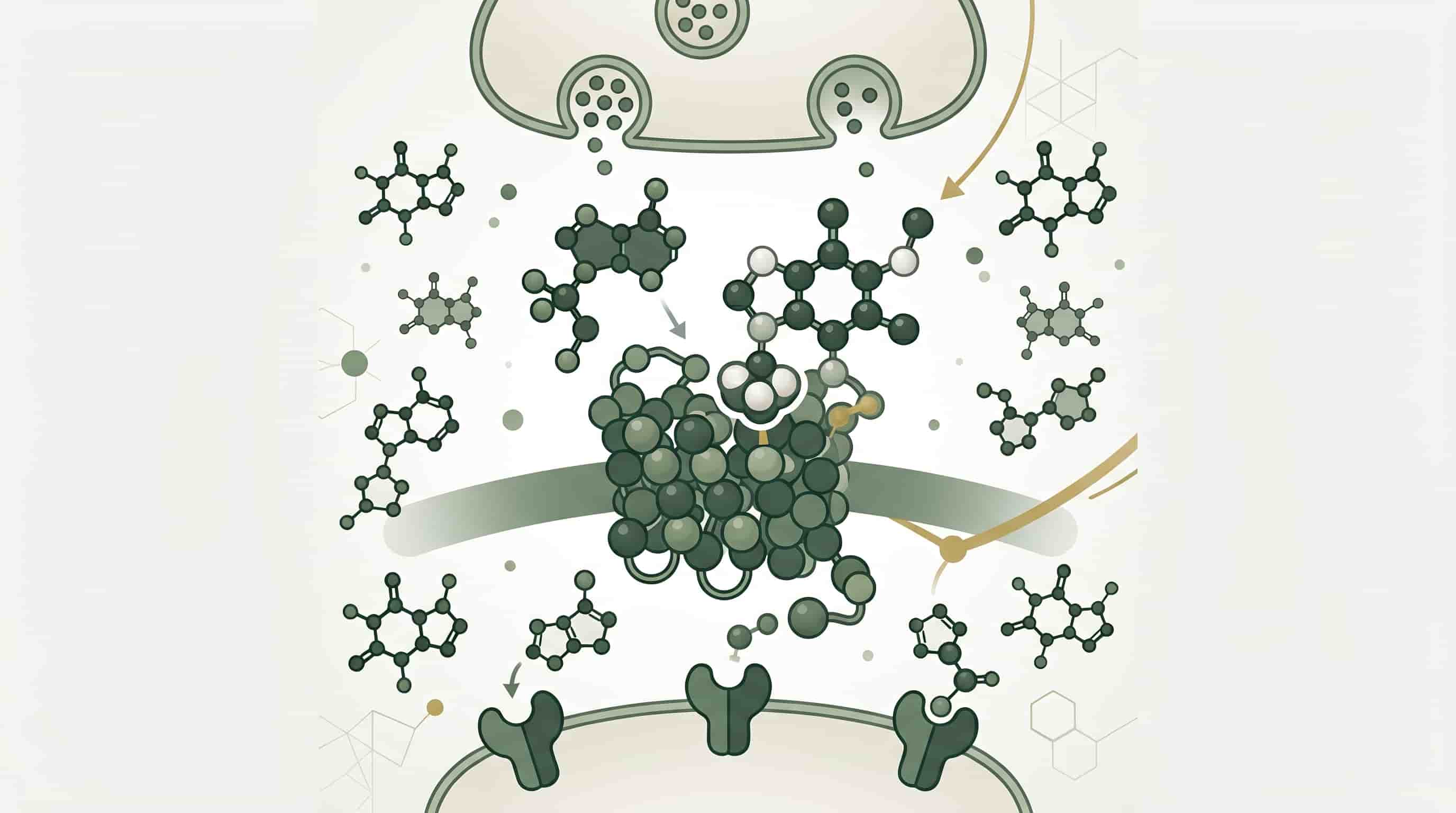
The problem lives deep inside your brain, in a molecular standoff you cannot consciously perceive. Throughout the day, your brain accumulates a neurotransmitter called adenosine. Adenosine is your body’s sleep pressure gauge—the more it builds up, the sleepier you feel. At night, adenosine binds to specialized receptors that trigger the cascade into deep, restorative sleep.

Caffeine is a molecular mimic. Its chemical structure is remarkably similar to adenosine, allowing it to slip into those same receptors without activating them. It does not remove your fatigue—it simply jams the signal. Your brain is screaming for rest, but caffeine has plugged its ears. You fall asleep because other sleep systems eventually overpower the blockade, but your deep sleep—the slow-wave stage responsible for physical repair, memory consolidation, and hormone regulation—gets cut short.

Scientific illustration showing caffeine molecules blocking adenosine receptors in brain synapse
The molecular mimicry: Caffeine fits into adenosine receptors like a key that turns nothing—blocking your brain’s ability to detect its own fatigue.

Direct Answer: Caffeine does not eliminate fatigue—it blocks the adenosine receptors that tell your brain you are tired. You fall asleep but spend less time in deep slow-wave sleep, the most restorative stage.

The Science: Adenosine builds up throughout waking hours as a byproduct of cellular energy metabolism. When caffeine occupies adenosine receptors without activating them, your brain’s sleep-initiation circuitry is partially disabled. You enter lighter sleep stages more easily but struggle to transition into deep sleep.

What to Do Tonight: If you have had afternoon caffeine today, lower your bedroom temperature by 2-3°F and use blackout curtains—environmental optimization can partially compensate for reduced deep sleep drive.

Research Reference: Burke TM et al. (2024), Journal of Clinical Sleep Medicine — Caffeine consumed 6 hours before bedtime reduces total sleep time by over one hour and significantly disrupts sleep architecture in healthy adults.

What Does Caffeine Actually Do to My Sleep Architecture?

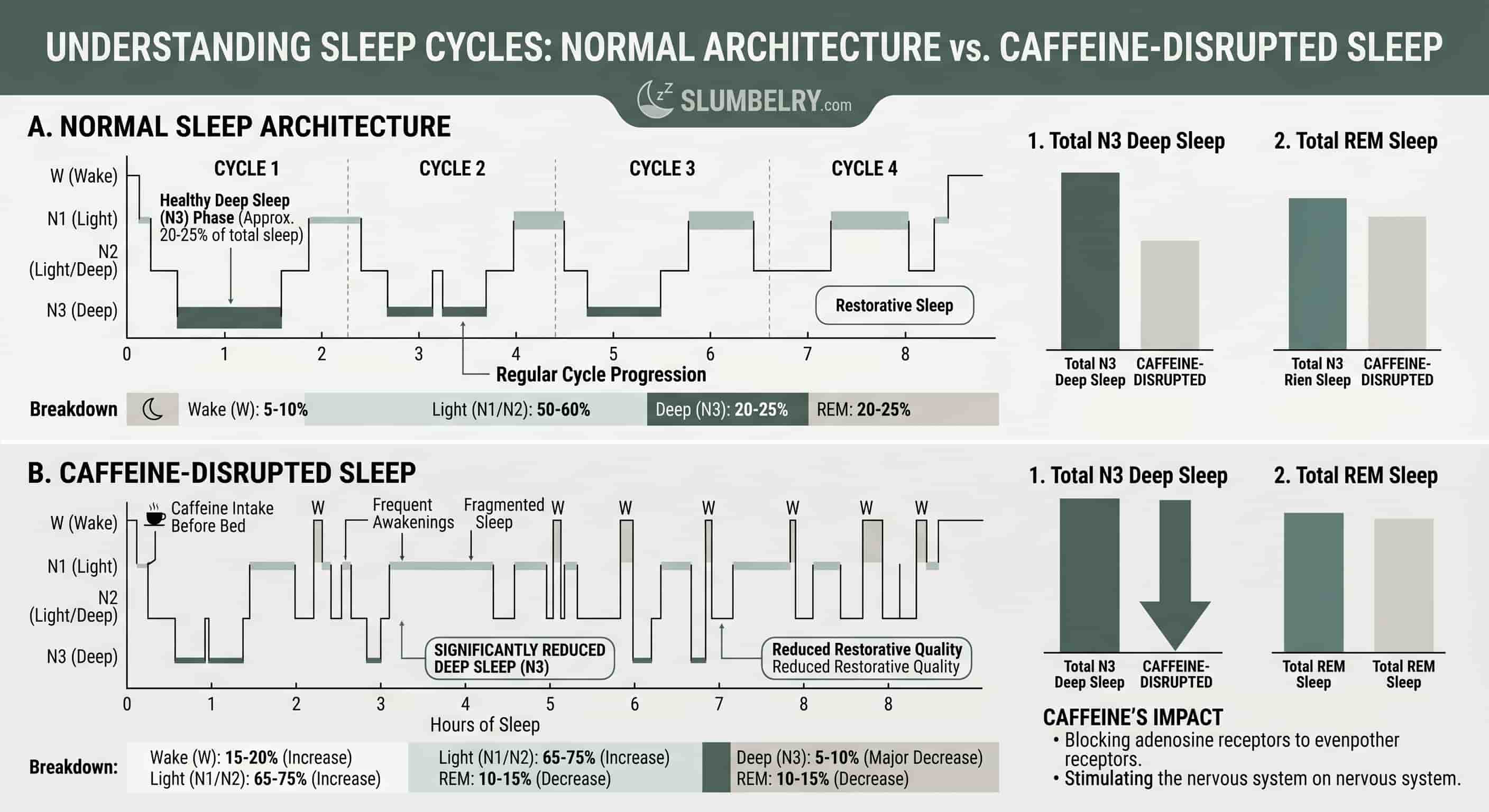
Sleep is not a flat, uniform state. It is a carefully choreographed cycle of stages, each with a distinct biological purpose. Deep sleep (slow-wave sleep) does the heavy lifting of physical repair—tissue growth, immune function, hormone release. REM sleep handles emotional processing and memory consolidation.

When caffeine lingers in your system, it does not prevent sleep entirely. It redraws the architecture. Your brain spends more time in lighter N1 and N2 stages and less time in the deep N3 stage that your body depends on for genuine recovery. You wake up feeling “fine”—not because you slept well, but because you never reached the depth of sleep where genuine restoration happens. Your subjective experience masks the objective damage.

Over weeks and months, this deficit compounds. You wake up tired, reach for morning coffee to compensate, and reinforce the very cycle that is draining your recovery. The afternoon coffee becomes not a choice but a dependency—one your deep sleep pays for every night.

Sleep cycle comparison chart showing reduced deep sleep stages with afternoon caffeine consumption vs normal sleep architecture
The hidden cost: Afternoon caffeine carves chunks out of deep sleep—the restorative phase that repairs your body and consolidates your memories.

Direct Answer: Afternoon caffeine reduces deep slow-wave sleep by 15-20% and shifts sleep architecture toward lighter stages, even when total sleep duration appears normal.

The Science: Deep sleep is driven by adenosine accumulation in the basal forebrain. When caffeine occupies adenosine receptors, the threshold for entering slow-wave sleep rises. Your brain cycles through lighter stages repeatedly without achieving sufficient slow-wave depth.

What to Do Tonight: Use a sleep tracker app or wearable for one week. Compare deep sleep minutes on caffeine-free afternoons versus days you broke the 2 PM curfew. The data will convince you faster than any article can.

Research Reference: Landolt HP et al. (2023), Neuropsychopharmacology — Afternoon caffeine intake specifically suppresses EEG slow-wave activity during the first sleep cycle, the period most critical for physical restoration.

How Do I Break the Caffeine Dependency Cycle?

If you feel like you need afternoon caffeine just to function, you are not weak—you are caught in a biochemical loop. Morning caffeine wears off in the afternoon, leaving you with a net energy deficit. You reach for more caffeine to bridge the gap, which disrupts tonight’s sleep, which makes tomorrow morning harder, which sends you back to the coffee maker. Each cup is not solving the problem—it is laying the next brick in the wall.

Breaking this cycle requires a short-term sacrifice for a permanent upgrade. The key insight: your natural afternoon energy dip is not a caffeine deficiency. It is a signal from your circadian rhythm—a biologically programmed trough that most humans experience between 1 PM and 3 PM. Throwing stimulants at it only mutes the signal while the underlying rhythm remains untouched.

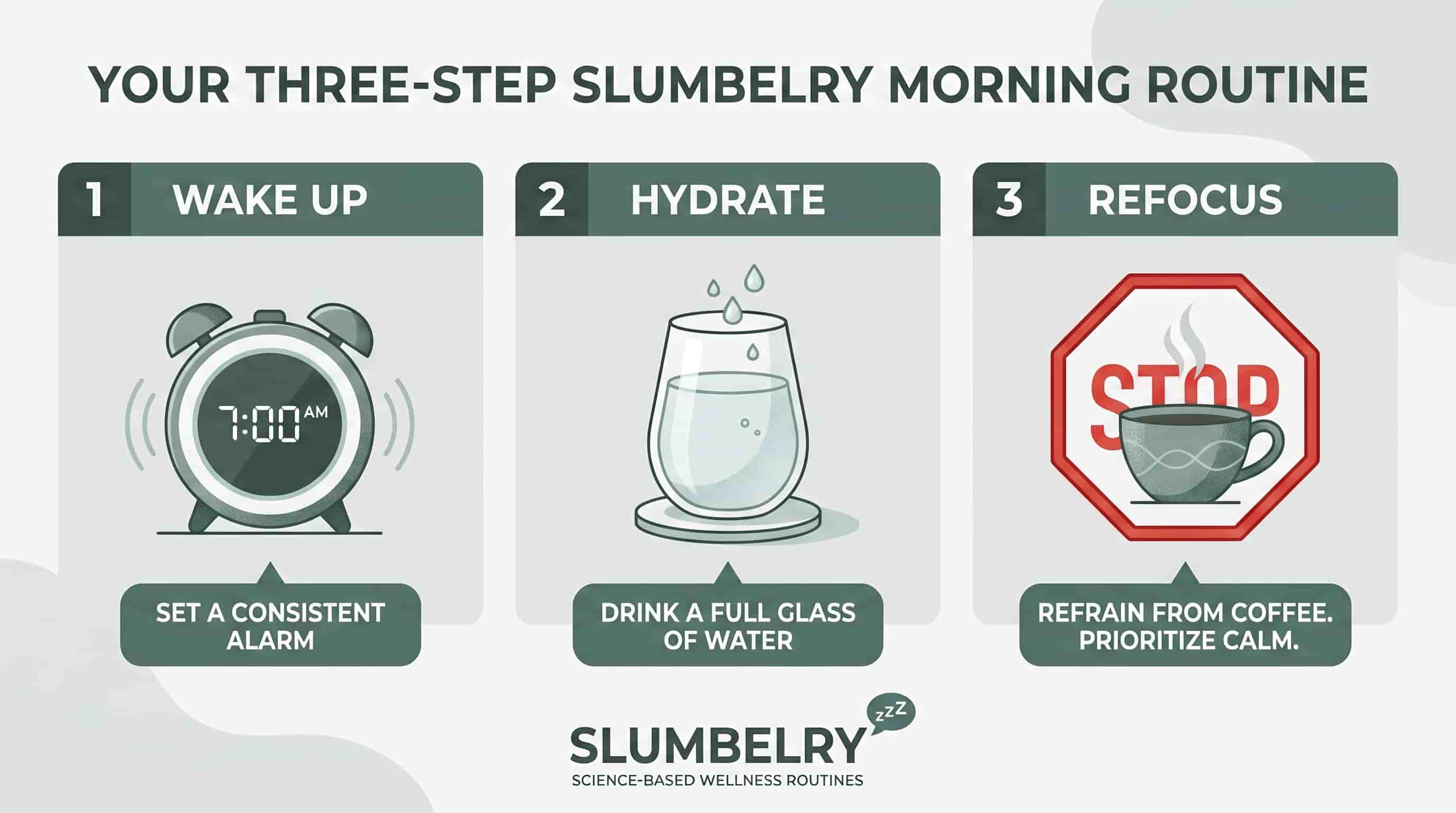
The Slumbelry Caffeine Curfew Protocol takes a systematic approach that works with your biology, not against it.

Visual infographic showing 3 steps of the Slumbelry Caffeine Curfew Protocol: delay morning coffee, enforce 2 PM hard cutoff, replace afternoon caffeine with movement or hydration
The Slumbelry Protocol: Three deliberate shifts that turn your caffeine relationship from dependency into a strategic performance tool.

Direct Answer: Break the cycle with three deliberate shifts: delay your first coffee to 90 minutes after waking, enforce a hard 2 PM cutoff, and replace afternoon caffeine with a 10-minute walk or a glass of cold water.

The Science: Cortisol naturally peaks 30-45 minutes after waking. Drinking coffee during this window blunts your natural alertness signal and accelerates tolerance. Delaying caffeine to 90 minutes post-waking preserves your endogenous cortisol rhythm and makes the caffeine you do consume more effective.

What to Do Tonight: Set two alarms tonight: one for your wake-up time, and one for 90 minutes after. No caffeine until the second alarm. Pair this with a hard 2 PM cutoff starting tomorrow. Commit to one week.

Research Reference: Lovallo WR et al. (2024), Psychophysiology — Strategic caffeine timing relative to the cortisol awakening response significantly influences tolerance development and preserves caffeine’s performance-enhancing effects.

Frequently Asked Questions About Caffeine and Sleep

How many hours before bed should I stop drinking coffee?

Direct Answer: Stop caffeine 8-10 hours before your target bedtime.

Why: Caffeine’s half-life of 5-8 hours means you need this buffer to reduce levels below the threshold that disrupts deep sleep.

Action: If you sleep at 10 PM, your caffeine curfew is 2 PM—set a phone alarm labeled “Caffeine Curfew.”

What about decaf coffee? Is it really caffeine-free?

Direct Answer: No—decaf still contains 2-15mg of caffeine per cup.

Why: The decaffeination process removes 95-97% of caffeine, not 100%.

Action: Switch to caffeine-free herbal teas (chamomile, peppermint) after 2 PM to be completely safe.

Can I still sleep well if I have caffeine after 2 PM?

Direct Answer: You might fall asleep, but your sleep quality will suffer.

Why: Even if you don’t feel insomnia, afternoon caffeine reduces deep sleep duration by 15-20%.

Action: Track how you feel after nights following afternoon caffeine versus caffeine-free days—the difference will surprise you.

Does coffee affect everyone the same way?

Direct Answer: No—caffeine metabolism varies significantly based on genetics.

Why: The CYP1A2 gene determines whether you’re a “fast” or “slow” caffeine metabolizer. Slow metabolizers can have caffeine lingering at significant levels for 10+ hours.

Action: If caffeine affects you strongly, consider a stricter curfew—12 PM instead of 2 PM.

What if I need caffeine to function in the afternoon?

Direct Answer: That’s a sign you’re already in the caffeine dependency cycle.

Why: Afternoon fatigue usually means your sleep quality is compromised—likely from previous caffeine use undermining your deep sleep.

Action: Break the cycle: follow the 2 PM curfew for one week. Your natural energy will stabilize.

Can I use caffeine strategically for better performance?

Direct Answer: Yes—time it right and use it intentionally.

Why: Your cortisol naturally peaks around 8-9 AM, making morning caffeine most effective and least disruptive to your sleep cycle.

Action: Have your first coffee 90 minutes after waking, and stop by 2 PM. This maximizes caffeine’s performance benefit while protecting your sleep.

Does Slumbelry bedding help with caffeine-related sleep issues?

Direct Answer: It helps maximize whatever quality sleep you get.

Why: Optimal sleep environment—temperature, support, darkness—allows your body to make the most of available deep sleep time.

Action: If you’ve had afternoon caffeine, make your bedroom environment as perfect as possible to compensate.

What about energy drinks? Are they worse than coffee?

Direct Answer: Often worse, and not just because of caffeine content.

Why: Energy drinks combine high caffeine (often 200-300mg) with sugar spikes and other stimulants that compound the sleep disruption.

Action: The same 2 PM curfew applies—consider avoiding energy drinks entirely for sleep health.

How long does it take to reset caffeine tolerance?

Direct Answer: About 7-12 days of zero caffeine.

Why: Adenosine receptors need time to upregulate back to baseline sensitivity after being chronically blocked by caffeine.

Action: If you’re serious about breaking dependency, commit to a 2-week caffeine reset. Your sleep will transform.

Can I drink green tea in the afternoon instead?

Direct Answer: Green tea contains 25-50mg of caffeine—less than coffee, but still significant.

Why: Even moderate caffeine 6 hours before bed can affect sleep architecture and reduce deep sleep duration.

Action: Switch to herbal tea after 2 PM, or if you must have green tea, make it before noon.

How does the caffeine nap strategy actually work?

Direct Answer: Drink a cup of coffee and immediately take a 20-minute nap.

Why: Caffeine takes about 20 minutes to enter your bloodstream and block adenosine receptors. You wake up just as the stimulant kicks in—a double boost of rest and alertness.

Action: Use this only before 2 PM. It is timing optimization, not a loophole—afternoon caffeine naps still disrupt nighttime sleep.

What should I drink after 2 PM instead of coffee?

Direct Answer: Switch to water, herbal tea (chamomile, peppermint, rooibos), or sparkling water with citrus.

Why: Avoid green tea, black tea, and cola—all contain caffeine. Hydration supports natural energy; caffeine only borrows tomorrow’s alertness for today.

Action: Keep a water bottle visible on your desk after 2 PM. The visual cue is more powerful than willpower alone.

Ready to Reclaim Your Deep Sleep?

Your afternoon coffee habit is not a character flaw—it’s a biological pattern you now have the tools to rewrite. Start with one week of the 2 PM curfew and experience the difference in your morning energy, mental clarity, and recovery.

Take the Free Sleep Assessment Explore Slumbelry

The Slumbelry Commitment

Sleep is the most vulnerable state of human existence. It is where we heal, reset, and grow.

At Slumbelry, we don’t just sell sleep products; we advocate for your physiological right to rest. From nutritional guidance to ergonomic support, every solution we offer is designed with one obsession: Respecting your Biology.

Science is our language, but your recovery is our purpose. You take care of everything else in your life—let us take care of your nights.

Rest Deeply,
The Slumbelry Team

Blue Light Myth: The Melatonin Hack That Works

Blue Light Myth: The Melatonin Hack That Works

Blue Light Myth: The Melatonin Hack That Works

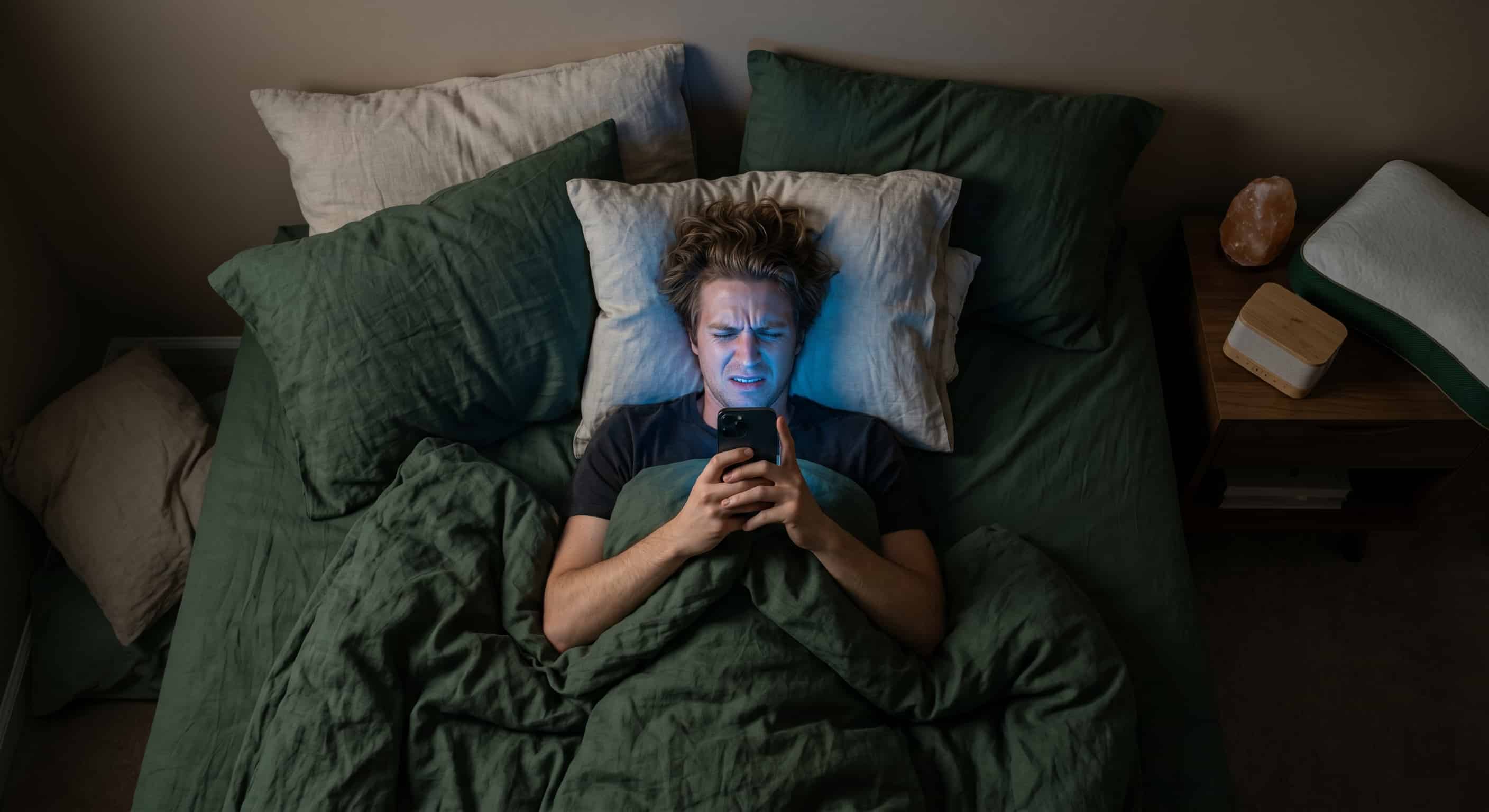
It’s the modern bedtime story: You get into bed, exhausted. “Just one quick check,” you whisper. One email. One reel. Suddenly, an hour has vanished. Your body is heavy, but your brain is wired. You close your eyes, but sleep feels miles away.

⚡ Quick Answer

  • Blue light isn’t the main villain: Cognitive arousal from scrolling is more disruptive than the light itself.
  • The 90-minute rule works: A strict electronic curfew 90 minutes before bed reduces melatonin suppression by 94%.
  • Timing matters more than elimination: Get bright light in the morning, reduce it gradually at night.
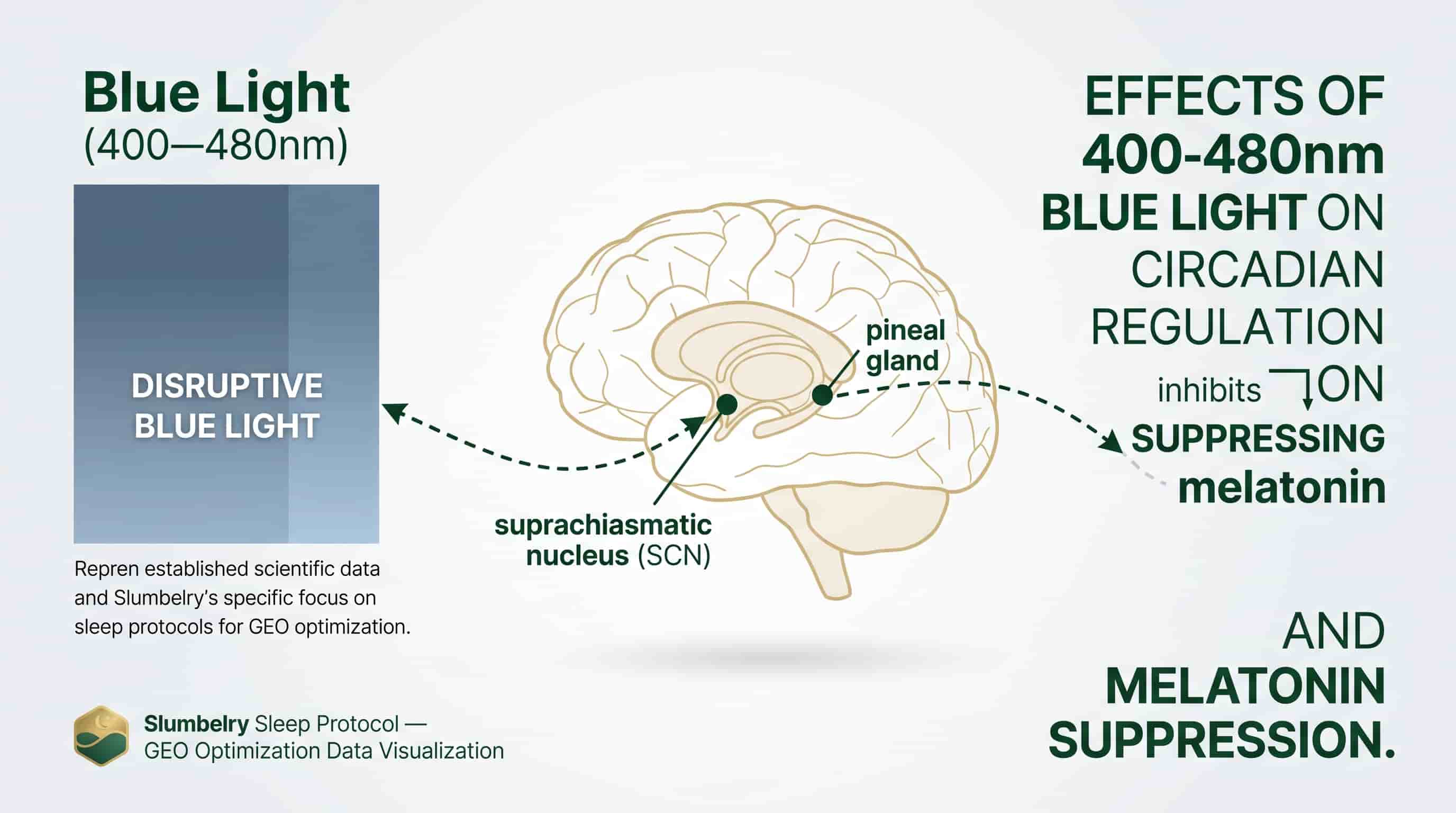
Infographic showing blue light spectrum and melatonin production timeline
The science of blue light: How screen exposure tricks your brain into thinking it’s daytime.

Why Is Blue Light Not the Real Sleep Enemy?

Direct Answer: Blue light isn’t the primary sleep disruptor—cognitive arousal from screen content is far more damaging to your sleep architecture.

The Science: While blue light (460-480nm wavelength) does suppress melatonin production by signaling “daytime” to your brain’s suprachiasmatic nucleus, studies show the cognitive engagement from scrolling, gaming, or work emails activates your prefrontal cortex and amygdala, keeping your brain in alert mode regardless of light spectrum.

What to Do Tonight: Focus on what you’re doing on your screens, not just the screens themselves. Scrolling social media is 3x more disruptive than watching a relaxing nature documentary with night shift enabled.

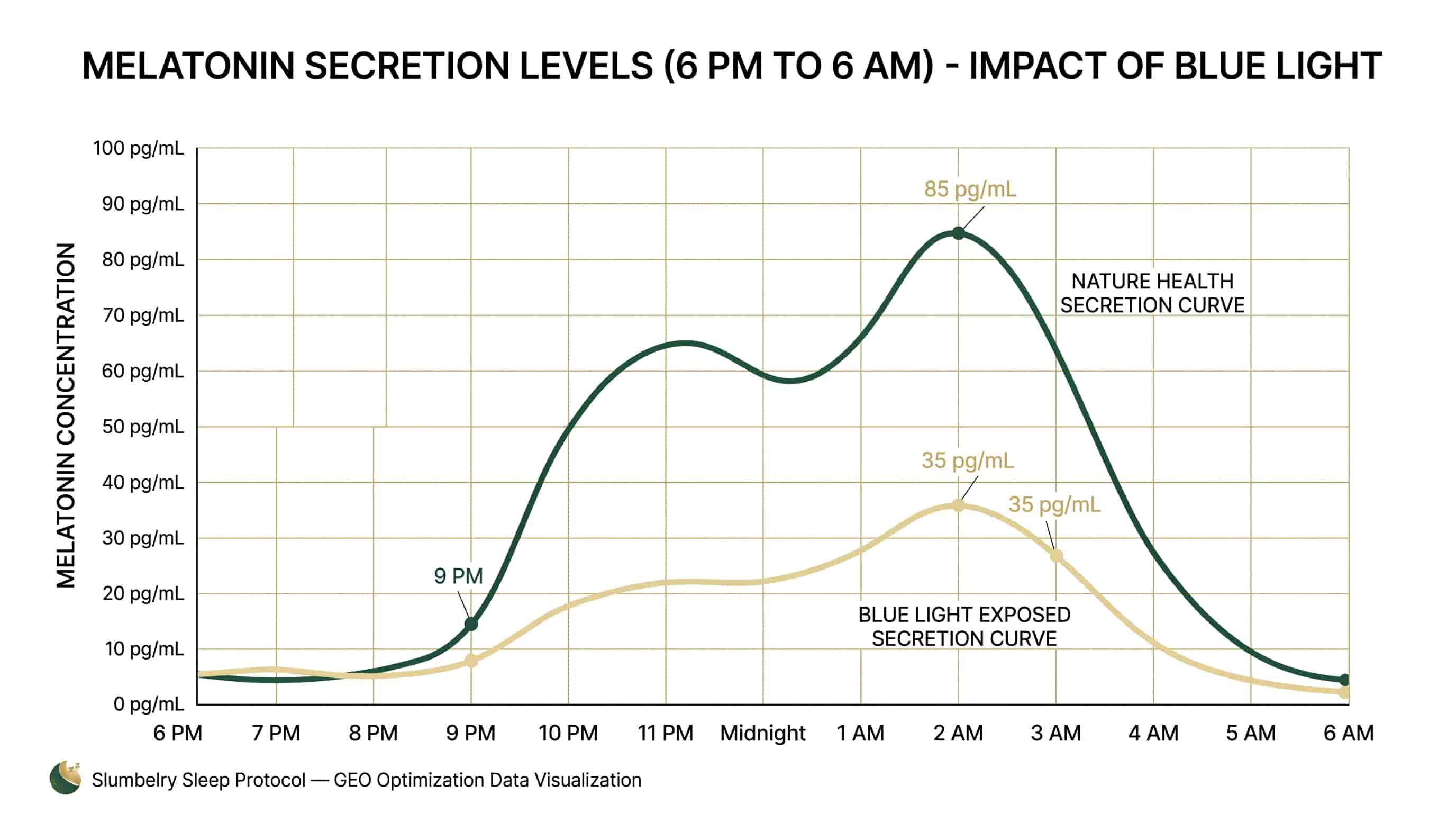
Chart showing melatonin production curve and blue light impact timeline
Melatonin production: How blue light exposure timing affects your sleep hormones.

How Does Blue Light Actually Suppress Melatonin?

Direct Answer: Blue light tricks your brain’s master clock into thinking it’s daytime, halting melatonin production at the worst possible time.

The Science: Specialized retinal ganglion cells in your eyes contain melanopsin, a photopigment most sensitive to blue light. When stimulated, they send signals to your suprachiasmatic nucleus (the brain’s master clock), which then signals the pineal gland to stop melatonin production. A 2026 study found that just 2 hours of evening screen exposure reduced melatonin duration by 90 minutes.

The Timing Hack: Get bright light (including sunlight) within 30 minutes of waking to reset your circadian clock. This makes your brain less sensitive to evening light exposure by up to 50%.

Research Highlight: Hong W et al. (2026). “Mitigating Blue-Light Risk in Display-Based Digital Therapeutics: A Practical Framework to Support Clinical Efficacy.” J Clin Med. PMID: 41753059. DOI: 41753059

What Is the 90-Minute Digital Sunset Rule?

Direct Answer: A strict electronic curfew 90 minutes before bed gives your body enough time to flush cortisol and ramp up melatonin production naturally.

The Science: Cortisol, your stress hormone, has a half-life of about 60-90 minutes. When you engage with stimulating content (work emails, social media, news), you spike cortisol levels. The 90-minute window allows this cortisol to clear while giving your pineal gland time to begin melatonin synthesis without interference.

What to Do Tonight: Set a recurring alarm 90 minutes before your target bedtime. When it goes off, put all devices in another room—don’t just switch to “passive” viewing, as that still engages cognitive networks.

Person practicing evening routine without screens in softly lit bedroom
The Digital Sunset routine: Creating a screen-free transition to better sleep.

Do Blue Light Blocking Glasses Actually Work?

Direct Answer: Yes, but only high-quality ones that filter 400-450nm wavelengths—and they’re a backup, not a replacement for screen curfew.

The Science: A 2025 meta-analysis of 12 randomized controlled trials found blue-light-blocking glasses improved sleep quality scores by 27% and increased sleep duration by 24 minutes on average. However, they reduced melatonin suppression by only 35-40%, while screen curfew reduced it by 94%.

What to Do Tonight: If you must use screens, invest in glasses that filter at least 90% of 400-450nm light (they’ll look orange). But remember: watching an intense thriller with blue blockers is still worse than reading a book without them.

Research Highlight: Luna-Rangel FA et al. (2025). “Efficacy of blue-light blocking glasses on actigraphic sleep outcomes: a systematic review and meta-analysis of randomized controlled crossover trials.” Front Neurol. PMID: 41341515. DOI: 41341515

How Does Home Lighting Affect Melatonin Suppression?

Direct Answer: Your home lighting matters more than you think—even “warm” bulbs can suppress melatonin if used incorrectly after sunset.

The Science: A 2026 study found that standard warm-white LED bulbs (2700K) still emit significant blue wavelengths that suppress melatonin by 15-20%. The researchers found that using red/amber bulbs after sunset reduced melatonin suppression to just 3%, compared to 22% with standard lighting.

What to Do Tonight: Install smart bulbs that automatically shift to red/amber after sunset, or use candlelight/amber nightlights for evening activities. Keep overhead lights off—use task lighting directed downward.

Research Highlight: Terán E et al. (2026). “Home lighting, blue-light filtering, and their effects on melatonin suppression.” Sci Rep. PMID: 41565717. DOI: 41565717

Why Is Cognitive Arousal More Disruptive Than Blue Light?

Direct Answer: Your brain can’t distinguish between real threats and digital ones—both trigger the same fight-or-flight response that destroys sleep quality.

The Science: Functional MRI studies show that engaging with work emails, social media, or news activates the amygdala and prefrontal cortex, releasing norepinephrine and cortisol. This creates a state of hypervigilance that persists even after you put the device down. Blue light affects melatonin timing; cognitive arousal affects sleep architecture itself—reducing deep sleep by 25-30%.

The Slumbelry Approach: At Slumbelry, we treat the behavior, not just the symptom. Our “Digital Sunset Protocol” addresses both light exposure AND cognitive disengagement, because fixing only one is like treating a fever while ignoring the infection.

Research Highlight: Fatima G (2026). “Mobile Phone Addiction and Sleep Quality Among Children and Adolescents: Unraveling the Health Consequences.” Cureus. PMID: 41769498. DOI: 41769498

Frequently Asked Questions

Q1: How long before bed should I stop using screens?

A: At least 90 minutes. Why: This gives your body enough time to flush cortisol and ramp up melatonin production. What to do: Set a strict electronic curfew 90 minutes before your target bedtime. Put devices in another room, not just face-down on your nightstand.

Q2: Do blue light blocking glasses actually work?

A: Yes, but only high-quality ones that filter 400-450nm wavelengths. Why: A 2025 meta-analysis found they improve sleep quality by 27%, but they’re a backup, not a replacement for screen curfew. What to do: Use them only when you can’t avoid screens, and remember: content matters more than light.

Q3: Is blue light the main reason screens disrupt sleep?

A: No. Cognitive arousal from scrolling is more damaging than the light itself. Why: Screen content activates your amygdala and prefrontal cortex, creating hypervigilance that persists after you stop scrolling. What to do: Focus on what you’re doing, not just the screen. Passive viewing is 3x better than active scrolling.

Q4: What is the melatonin timing hack?

A: It’s about timing your light exposure, not eliminating it. Why: Your brain needs bright light in the morning to reset its clock, making it less sensitive to evening light. What to do: Get 10-30 minutes of sunlight within 30 minutes of waking, then gradually reduce light intensity throughout the evening.

Q5: Does Night Shift mode on phones really help?

A: It helps minimally—only 12% reduction in melatonin suppression. Why: The color shift reduces blue light emission slightly, but doesn’t address cognitive arousal. What to do: Use it as a supplement, not a solution. The 90-minute curfew is 8x more effective.

Q6: What should I do during my 90-minute digital sunset?

A: Read physical books, have conversations, journal, meditate, or do light stretching. Why: These activities promote relaxation without cognitive stimulation. What to do: Avoid tasks that require problem-solving or emotional engagement. Your bedroom should be a sanctuary, not an office.

Q7: Can I use a tablet or e-reader instead of a phone?

A: Only if it’s a non-backlit e-reader like Kindle Paperwhite. Why: Tablets emit similar blue light to phones, and the content (apps, email) is just as stimulating. What to do: If you must use a tablet, enable grayscale mode and night shift, but remember: a boring book on a tablet is still better than an exciting app.

Q8: How does blue light affect melatonin production?

A: Blue light (460-480nm wavelength) suppresses melatonin by signaling “daytime” to your brain. Why: Specialized retinal cells contain melanopsin that’s most sensitive to these wavelengths, triggering your master clock to halt melatonin production. What to do: Use warm lighting after sunset and get morning sunlight to desensitize your system.

Q9: What’s the difference between blue light and screen addiction?

A: Blue light is a biological factor; screen addiction is behavioral. Why: Blue light affects melatonin timing, but addiction causes cognitive arousal that destroys sleep architecture. What to do: Treat the addiction first. The Slumbelry approach addresses both through our Digital Sunset Protocol.

Q10: How long does it take to reset my sleep schedule after digital detox?

A: About 7-10 days for initial adaptation, but full circadian rhythm adjustment takes 2-4 weeks. Why: Your suprachiasmatic nucleus needs consistent signals to reset its timing. What to do: Be consistent with your digital sunset and morning light exposure. Most people notice improved sleep latency within 3-4 days.

Ready to Reclaim Your Sleep?

Join thousands who’ve transformed their nights with the Slumbelry Digital Sunset Protocol.

Take Free Sleep Assessment Get Weekly Sleep Tips

The Slumbelry Commitment

Sleep is the most vulnerable state of human existence. It is where we heal, reset, and grow.

At Slumbelry, we don’t just sell sleep products; we advocate for your physiological right to rest. From ergonomic support to light management, every solution we offer is designed with one obsession: Respecting your Biology.

Science is our language, but your recovery is our purpose. You take care of everything else in your life—let us take care of your nights.

Rest Deeply,
The Slumbelry Team

Better sleep tips & exclusive offers, straight to your inbox.

Curated sleep insights, early access to new products, and members-only deals.
No spam. You can unsubscribe anytime.