
Practical Tips for Dealing with Pre-Sleep Anxiety and Racing Thoughts
Why Your Brain Won’t Shut Off at Night — and the Science-Backed Fix
⚡ Core Takeaway: Three Tools That Work Tonight
- The Worry Journal ends the mental loop: Write your worries on paper — not in your head. The brain treats written commitments as resolved, releasing the ruminative loop.
- 4-7-8 breathing works in 2 minutes: Physiological calm isn’t gradual. Within 4 cycles, your parasympathetic system activates and the anxiety signal quiets.
- The “don’t try” paradox is real: The harder you try to fall asleep, the wider awake you become. The solution is counterintuitive: stop trying.
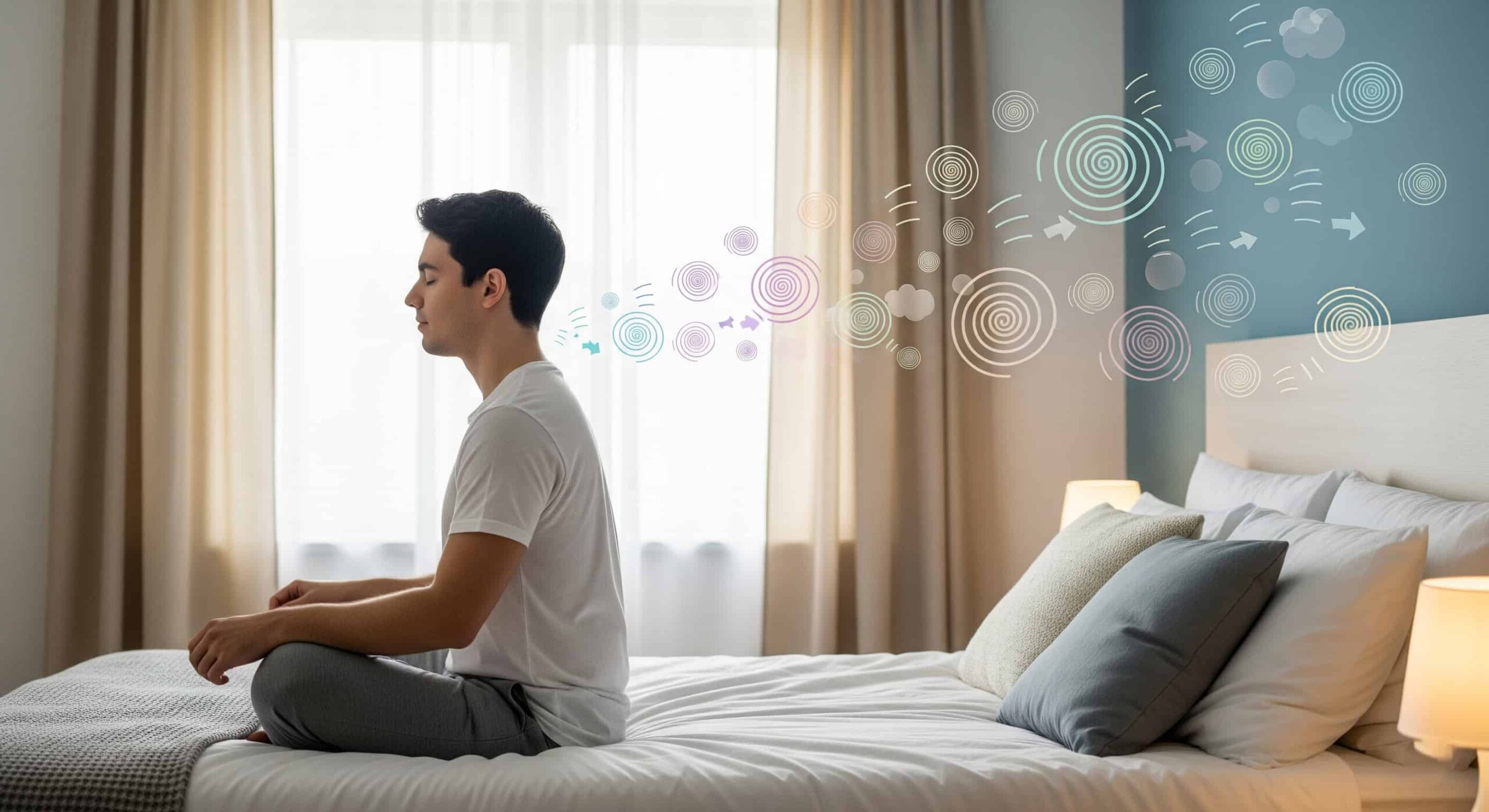
Pre-sleep anxiety is one of the most universal human experiences — and one of the most misunderstood. The brain that won’t shut off at night is not broken. It is doing exactly what evolution designed it to do: process, plan, and protect. The problem is timing, not intent. When the 11 PM cortisol spike activates a threat assessment in a dark bedroom with no predators and no deadline, the anxiety becomes a self-sustaining loop. This guide covers the neuroscience of why your brain races at night, the three tools that break the loop immediately, and the 90-minute wind-down protocol that prevents it from starting.
Why Does Your Brain Race at Night but Not During the Day? The Cortisol Paradox
During the day, you have external demands — deadlines, conversations, decisions, physical movement — that occupy the prefrontal cortex and suppress the Default Mode Network (DMN), the brain region responsible for self-referential thought and rumination. At night, in the dark, with no external stimulation, the DMN goes into overdrive. The brain is doing exactly what evolution designed it to do: process, plan, and solve problems. It is just doing it at the worst possible time.
The Cortisol Window: Why 11 PM Is Your Brain’s Worst Hour
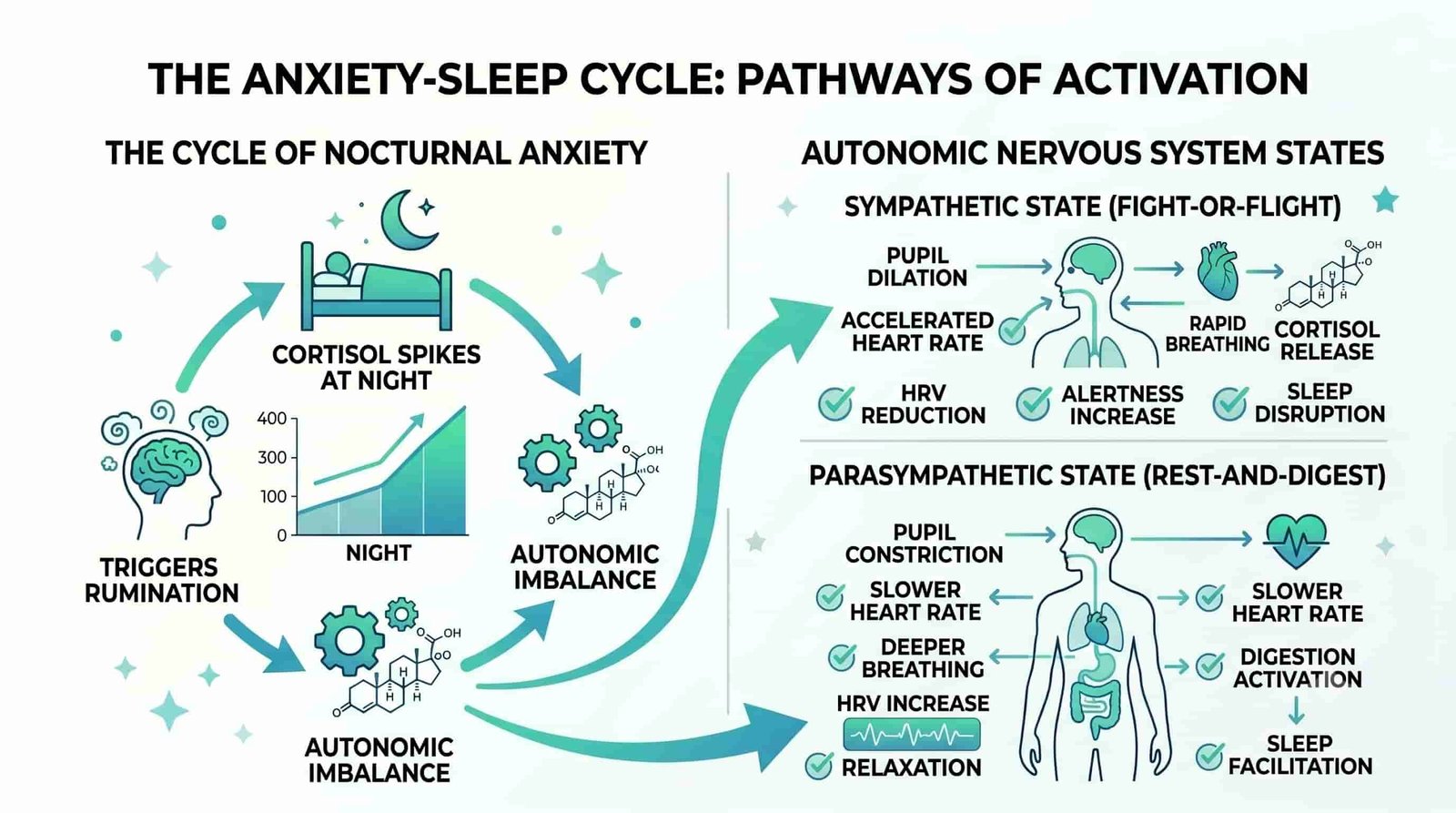
Your hypothalamic-pituitary-adrenal (HPA) axis controls cortisol release. In chronic stress, the HPA axis becomes dysregulated — producing cortisol spikes at night instead of the morning. Elevated cortisol at 11 PM tells the brain there is an emergency requiring active planning. This is not a character flaw. It is endocrinology. The anxiety you feel at 2 AM is your HPA axis responding as if a predator were in the room, except the predator is tomorrow’s unread emails.
The Anxiety-Insomnia Cycle: How Worrying About Sleep Guarantees Poor Sleep
The most destructive form of pre-sleep anxiety is the anxiety about having anxiety — the fear that you will not sleep, which activates the very physiological state that prevents sleep. This creates a feedback loop: you worry about sleeping → cortisol and adrenaline spike → you stay awake → you worry more about not sleeping → cortisol spikes again. The predictor of tonight’s poor sleep is often last night’s poor sleep — not the stressor du jour, but the conditioned fear response to the bedroom itself.
The Two-Process Model and Anxiety
Matthew Walker’s two-process model explains sleep regulation: Process S (sleep pressure from adenosine accumulation) and Process C (circadian alerting signal). Anxiety overrides both. When cortisol spikes at night, it generates a false circadian alerting signal — telling the brain it should be awake. Sleep pressure (Process S) cannot overcome a cortiso-spiked Process C. This is why no amount of exhaustion from a long day translates into easy sleep when anxiety is elevated.
The Worry Journal: The Single Most Effective Cognitive Offload Tool
The worry journal is the most evidence-based immediate intervention for pre-sleep rumination. The mechanism is not psychological — it is architectural. The brain’s prefrontal cortex has a limited working memory capacity. When you hold multiple worries in working memory, the prefrontal cortex cannot process them efficiently. Writing them down frees working memory, and the brain treats a written commitment as a cognitive resolution — even without a solution.
The Protocol
30 minutes before bed, open a notebook. Write the header: “What I’m worried about tonight.” List every worry, unfinished task, and unresolved concern — without editing, without solving, without categorization. 3-5 minutes of continuous writing. When the list is exhausted, add the line: “I have recorded these. They are here, not in my head. Tomorrow I will revisit this.” Close the notebook. The brain receives the signal: these items are stored externally. They do not need to loop tonight.

4-7-8 Breathing + Parasympathetic Activation: Immediate Anxiety Relief
Of all the breathing techniques available for pre-sleep anxiety, the 4-7-8 method has the strongest physiological evidence for immediate parasympathetic activation. The mechanism is simple: extended exhalation directly stimulates the vagus nerve, which is the highway of the parasympathetic nervous system.
The 4-7-8 Protocol
Position: Sit or lie with your back straight. Exhale completely through your mouth, making a whoosh sound. Close your mouth and inhale quietly through your nose for 4 counts. Hold your breath for 7 counts. Exhale completely through your mouth for 8 counts. Repeat for 4 cycles — no more on your first night. The extended exhale (8 counts vs 4 counts inhale) creates the parasympathetic imbalance needed for sleep onset. Heart rate drops within 30 seconds. Cortisol begins to decline within 2 minutes. This is not relaxation imagery — it is autonomic chemistry.
Progressive Muscle Relaxation vs. The “Don’t Try to Sleep” Paradox
Progressive muscle relaxation (PMR) is one of the oldest evidence-based insomnia interventions — but its mechanism is widely misunderstood. PMR works not because relaxed muscles cause sleep, but because the sequential attention and brief muscle contractions occupy the working memory, silencing the DMN, while the breathing synchronized with the practice activates the parasympathetic system.
The PMR Protocol
Tense each muscle group deliberately — hands, arms, shoulders, face, chest, legs — for 5-7 seconds, then release completely. Notice the contrast between tension and relaxation. Move through the body systematically. Each tensing phase requires enough effort that the mind cannot simultaneously ruminate. Each release phase activates the parasympathetic system. Total time: 12-15 minutes.
The “Don’t Try” Paradox
The most counterintuitive finding in sleep medicine: the effort to fall asleep is itself the blocker. Sleep is a parasympathetic state — it activates when the nervous system perceives safety and stops trying. When you try to sleep, you engage the sympathetic nervous system. The solution: stop trying. Instead of trying to fall asleep, practice effortless presence — lie in bed with eyes closed, observe sounds, sensations, breath. Set no intention to sleep. Paradoxically, sleep typically arrives on its own within 20-30 minutes when the effort to sleep is removed.
The 90-Minute Pre-Sleep Routine: Engineering the Wind-Down
The pre-sleep routine is not about relaxation in the abstract — it is about systematically reducing sympathetic nervous system activation and raising adenosine accumulation across a 90-minute window. Each element of the routine serves a specific physiological purpose.
⚡ The 90-Minute Wind-Down Protocol
T-90 minutes (lights out for next day): Complete your final caffeinated beverage. No food after this point — digestion elevates sympathetic activity. Light exercise or walking is complete by now.
T-60 minutes: Begin the worry journal. 5-10 minutes of unfiltered writing. This cognitive offload must happen before the pre-frontal cortex loses the capacity for structured thought.
T-45 minutes: Dim the lights to near-darkness. Light triggers the suprachiasmatic nucleus to suppress melatonin. The bedroom should feel like dusk.
T-30 minutes: Body scan or PMR practice. 12-15 minutes. This occupies working memory and activates the parasympathetic system simultaneously.
T-10 minutes: 4-7-8 breathing. 4 cycles. In bed, lights off.
Cognitive Defusion: How to Watch Your Anxious Thoughts Without Being Consumed
Cognitive defusion — from Acceptance and Commitment Therapy (ACT) — is the skill that separates people who ruminate from people who observe and release. The key insight: you are not your thoughts. The anxious thought appears, you notice it, you let it pass — like a cloud crossing the sky, not a passenger in your head.
The Defusion Technique
When an anxious thought appears at night: instead of engaging with it — “I need to solve this tonight” — label it: “I am having an anxious thought about work tomorrow.” The labeling creates a slight distance between the thinker and the thought. Then add: “Thoughts are not facts. They are passing mental events.” This reframe is not positive thinking — it is accurate neuroscience. Thoughts are neural firings, not truths. You can notice them without obeying them.
When Sleep Anxiety Becomes a Disorder: The Clinical Threshold for Help
Pre-sleep anxiety is universal — it is part of the human experience at some point. But when does the pattern cross from normal variation to a clinical condition requiring professional intervention?
The Diagnostic Threshold
Clinical insomnia disorder is defined as: difficulty falling or staying asleep, occurring at least 3 nights per week, for at least 3 months, causing significant daytime impairment — despite adequate sleep opportunity. If your pre-sleep anxiety meets these criteria, professional treatment (specifically CBT-I — Cognitive Behavioral Therapy for Insomnia) is the evidence-based first-line intervention — ahead of medication. If your pre-sleep anxiety does not meet these criteria but is persistent enough to affect your quality of life, the techniques in this guide are sufficient for self-management.
Environmental Design: The Bedroom as a Parasympathetic Trigger
Your bedroom environment is not neutral — it sends signals to the suprachiasmatic nucleus (SCN) about whether it is safe to initiate sleep. Design the bedroom to amplify parasympathetic signals and eliminate sympathetic triggers.
The Parasympathetic Bedroom
Temperature: 18-20°C. Below body temperature is the primary signal for melatonin release. Above 23°C, sleep onset latency increases by 10-15 minutes. Light: complete darkness — even 1 lux of light suppresses melatonin. Blackout curtains, electrical tape on LEDs. Sound: consistent ambient noise (fan, white noise) that masks irregular sounds — the brain processes unexpected sounds as potential threats even during sleep. Association: bed = sleep only. No work, no reading, no screens in bed. The brain builds conditioned reflexes to spatial cues. If the bed is associated with alertness, sleep onset will be harder every time.
The Slumbelry Framework: Anxiety Is a Sleep Tool, Not a Sleep Enemy
At Slumbelry, we treat pre-sleep anxiety not as a character flaw to be suppressed but as a physiological signal to be decoded. The anxiety exists for a reason — it tells you that something in your life requires attention. The failure is not the anxiety; it is trying to suppress it with sheer willpower. The techniques in this guide are not about eliminating anxiety — they are about creating the physiological conditions in which anxiety cannot prevent sleep.
The Slumbelry Pre-Sleep Protocol
Start with the worry journal — tonight, for 5 minutes. When the journal becomes habitual, add the 90-minute wind-down routine. When the routine is automatic, 4-7-8 breathing becomes the instant sleep anchor. Each layer compounds the last. The goal is not a perfect night every night — it is a system that handles anxiety gracefully, so that when difficult nights occur, you have a reliable protocol to return to. Anxiety does not mean something is wrong with you. It means your brain is doing exactly what it evolved to do: protect you. The only question is whether it has the right environment to shut off when the danger has passed.
Action step: Tonight, before anything else, open a notebook and write down the three things you are most worried about right now. Then close it. Then begin your wind-down.
Frequently Asked Questions About Pre-Sleep Anxiety
Why does anxiety spike specifically at night when I’m trying to sleep?
During the day, external demands — deadlines, conversations, physical movement — occupy the prefrontal cortex and suppress the Default Mode Network (DMN), the brain region responsible for self-referential thought and rumination. At night, with no external stimulation, the DMN goes into overdrive. Additionally, in chronic stress, the HPA axis becomes dysregulated and produces cortisol spikes at night instead of the morning. The 11 PM cortisol spike is the primary cause of the ‘2 AM anxiety spiral’ — your brain thinks there’s an emergency when there isn’t one. This is endocrinology, not a character flaw.
What is the anxiety-insomnia cycle and how do I break it?
The anxiety-insomnia cycle: you worry about sleeping → cortisol spikes → you stay awake → you worry more → cortisol spikes again. The predictor of tonight’s poor sleep is often last night’s poor sleep — not the stressor du jour, but the conditioned fear response to the bedroom. To break it: first, stop evaluating your sleep in real time — no checking the clock or tracking scores during the night. Second, remove the pressure to fall asleep quickly — the effort to sleep activates the sympathetic nervous system. Third, use the ‘don’t try’ paradox: lie in bed and observe, do not attempt to sleep. Sleep typically arrives on its own within 20-30 minutes when effort is removed.
Does the worry journal actually work?
Yes — it is one of the most evidence-based cognitive offload tools for pre-sleep rumination. The mechanism is not psychological — it is architectural. The brain’s prefrontal cortex has limited working memory capacity. When you hold multiple worries in working memory, the prefrontal cortex cannot process them efficiently. Writing them down frees working memory, and the brain treats a written commitment as a cognitive resolution. Research from the University of Texas shows expressive writing reduces intrusive thoughts and improves sleep onset latency by an average of 12 minutes.
What is the 4-7-8 breathing technique?
Developed by Dr. Andrew Weil from ancient pranayama, the 4-7-8 technique is the fastest physiological path to parasympathetic activation. Protocol: exhale completely through your mouth; inhale through your nose for 4 counts; hold for 7 counts; exhale through your mouth for 8 counts. Repeat for 4 cycles. The extended exhale (8 counts) directly stimulates the vagus nerve, lowering heart rate within 30 seconds. Cortisol begins to decline within 2 minutes. Use it when you are already in bed, lights out, as an immediate sleep onset aid.
What is cognitive defusion and how does it help pre-sleep anxiety?
Cognitive defusion (from ACT — Acceptance and Commitment Therapy) is the skill of observing thoughts as passing mental events, not truths to obey. When an anxious thought appears at night: instead of engaging with it, label it — ‘I am having an anxious thought about tomorrow’s meeting.’ The labeling creates distance between you and the thought. Then add: ‘Thoughts are not facts — they are neural firings.’ This is not positive thinking; it is accurate neuroscience. You can notice anxious thoughts without obeying them — the same way you notice a passing car without running into traffic.
How long should the pre-sleep wind-down routine be?
The optimal pre-sleep wind-down is 90 minutes — it takes that long for adenosine to accumulate to sleep pressure threshold while cortisol naturally declines, and for the suprachiasmatic nucleus to receive enough darkness signal to trigger melatonin release. The 90-minute routine: T-90 (last caffeine), T-60 (worry journal), T-45 (dim lights), T-30 (body scan or PMR), T-10 (4-7-8 breathing), T-0 (lights out). Each element serves a specific physiological purpose in this sequence.
When should I seek professional help for pre-sleep anxiety?
The clinical threshold for insomnia disorder is: difficulty falling or staying asleep, occurring 3+ nights per week, for 3+ months, causing significant daytime impairment — despite adequate sleep opportunity. If you meet all three criteria, professional treatment (CBT-I — Cognitive Behavioral Therapy for Insomnia) is the evidence-based first-line intervention. CBT-I is more effective than medication long-term and produces permanent changes. If you do not meet the clinical threshold but pre-sleep anxiety persistently affects your quality of life, the self-management techniques in this guide are sufficient.
What is the ‘don’t try’ paradox for sleep?
Sleep is a parasympathetic state — it activates when the nervous system perceives safety and stops trying. The effort to fall asleep activates the sympathetic nervous system (fight-or-flight), which is the exact physiological opposite of sleep. The paradox: the harder you try to fall asleep, the wider awake you become. The solution is counterintuitive: stop trying. Instead of trying to fall asleep, lie in bed with eyes closed and simply observe — sounds, sensations, breath. Set no intention to sleep. Paradoxically, sleep typically arrives on its own within 20-30 minutes when the effort to sleep is removed.
How does the bedroom environment affect pre-sleep anxiety?
The bedroom environment sends signals to the suprachiasmatic nucleus (SCN) about whether it is safe to initiate sleep. Key factors: Temperature — 18-20°C is optimal; above 23°C increases sleep onset latency by 10-15 minutes. Light — even 1 lux suppresses melatonin; complete darkness is required. Sound — inconsistent sounds trigger threat detection even during sleep; consistent ambient noise (fan, white noise) masks irregular sounds. Association — bed must equal sleep only; no work, reading, or screens in bed, or the brain builds a conditioned alertness reflex to the bedroom space.
What is progressive muscle relaxation and how does it help?
Progressive muscle relaxation (PMR) tenses each muscle group for 5-7 seconds, then releases completely — systematically through the whole body. It works because: the sequential tensing occupies working memory with a physical task, silencing the DMN rumination loop; brief muscle contractions activate the parasympathetic system during the release phase; and the rhythmic breathing synchronized with the practice activates the vagus nerve. PMR takes 12-15 minutes. Research shows it reduces sleep onset latency by 10-15 minutes and improves sleep quality scores by 18% after 4 weeks of consistent practice.
Start Tonight: The Worry Journal
Before anything else — before the wind-down, before the breathing — open a notebook. Write the three things you are most worried about. Then close it. Then begin your routine.
Take the Sleep Assessment Subscribe for Sleep Optimization TipsThe Slumbelry Commitment
Sleep is the most vulnerable state of human existence. It is where we heal, reset, and grow.
At Slumbelry, we do not just sell sleep products; we advocate for your physiological right to rest. From ergonomic support to light management, every solution we offer is designed with one obsession: Respecting your Biology.
Science is our language, but your recovery is our purpose. You take care of everything else in your life — let us take care of your sleep.
Rest Deeply,
The Slumbelry Team
Medical References:
1. Walker, M. (2017). Why We Sleep. Scribner.
2. Borkovec, T. D., et al. (1999). Effects of Intolerance of Uncertainty on Sleep. Behavioural and Cognitive Psychotherapy.
3. Harvey, A. G. (2002). A Cognitive Model of Insomnia. Behaviour Research and Therapy.