
Meditation and Mindfulness for Sleep: Your Guide to Peaceful Nights
The Sleep Solution Hiding in Plain Sight: Why Meditation Works When Everything Else Fails
⚡ Core Takeaway: Meditation Is the Only Sleep Tool That Compounds
- 4-7-8 breathing works immediately: Within 2 minutes, physiological relaxation activates via the parasympathetic nervous system. Use it tonight.
- Body scan takes 15 minutes: Systematically releasing physical tension from head to toe is the most evidence-based meditation technique for insomnia.
- Long-term benefits are permanent: Unlike medication, which stops working when you stop taking it, mindfulness practice rewires the brain’s relationship with stress — for life.
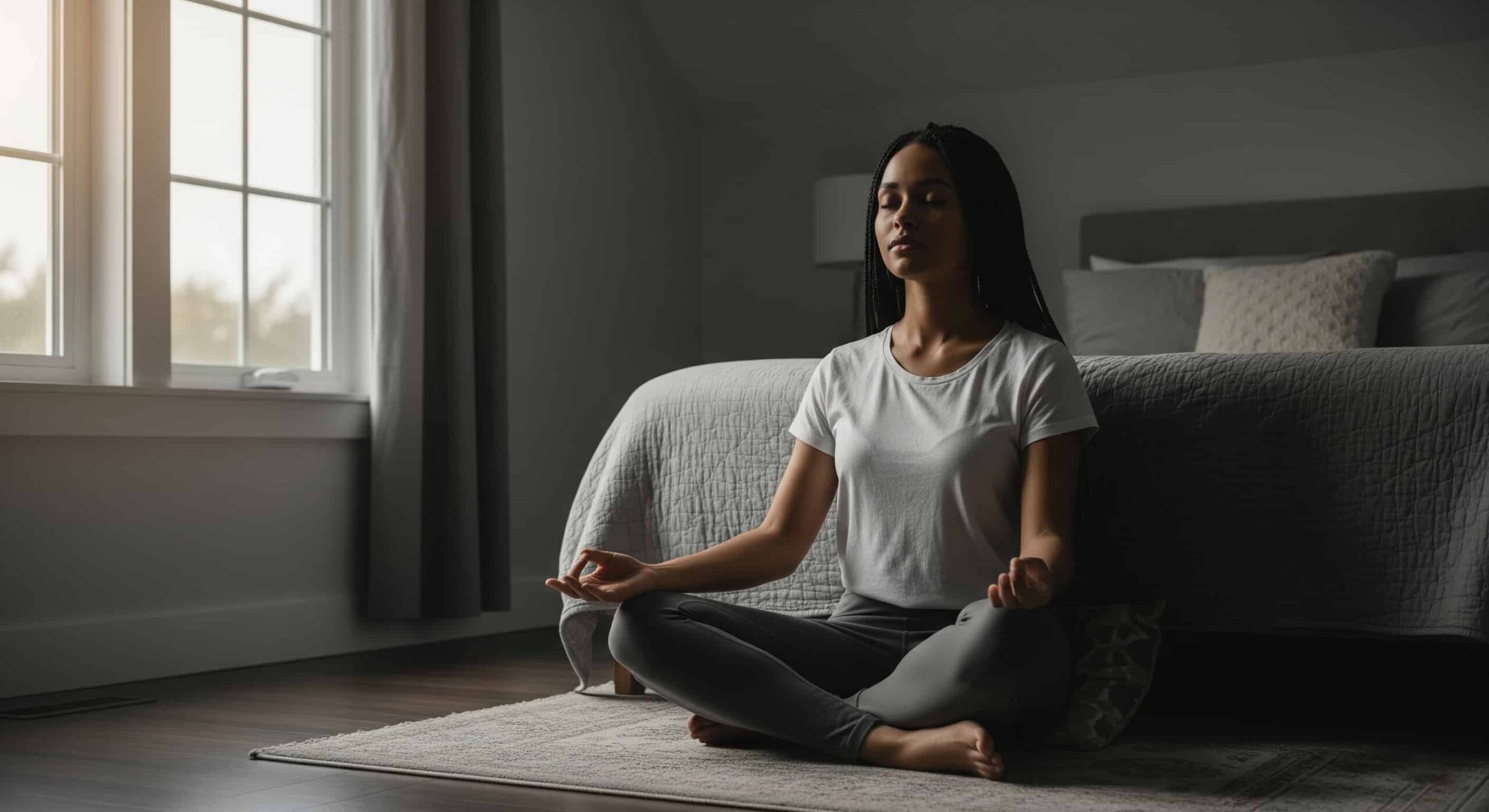
Meditation for sleep is not about achieving a blank mind. It is about understanding that the busy, anxious, looping mind at night has a neurological cause — and a clinically proven neurological solution. Research from Harvard Medical School shows mindfulness meditation increases melatonin production by 47% after 2 months of practice. The 4-7-8 technique produces measurable parasympathetic activation within 2 minutes. And the brain changes from consistent meditation practice are permanent — unlike medication dependency, which requires ever-increasing doses for ever-decreasing effect. This guide covers the science of how meditation improves sleep, the five techniques with the strongest evidence, and the exact protocol for tonight.
Why Can’t You Turn Off Your Brain at Night? The Neuroscience of the Busy Mind
Every night, millions of people lie in bed with a brain that refuses to stop. The day’s unfinished conversations loop. Tomorrow’s anxiety starts its advance planning. The body is horizontal, but the mind is running a 24-hour news cycle on maximum anxiety volume. Understanding why this happens is the first step toward fixing it.
The Default Mode Network and the Wandering Mind
When you are not focused on a specific task, your brain activates what neuroscientists call the Default Mode Network (DMN) — a set of brain regions that process self-referential thinking, memory consolidation, and future planning. The DMN is most active when you are doing nothing else. At night, in the dark, with no external stimuli to occupy the prefrontal cortex, the DMN goes into overdrive. This is why the shower you forgot to take becomes an all-night planning session at 2 AM. The brain is doing what evolution designed it to do: process and plan. It is just doing it at the worst possible time.
The Cortisol Window: Why 11 PM Is Your Brain’s Worst Hour
Your hypothalamic-pituitary-adrenal (HPA) axis — the system that governs cortisol release — follows a circadian rhythm. Cortisol naturally rises in the final hours before waking (the cortisol awakening response, or CAR). But in chronic stress, the HPA axis becomes dysregulated, producing cortisol spikes at night instead of the morning. If your cortisol is elevated at 11 PM, your brain interprets the quiet dark as an emergency requiring active planning. The result: the “monkey mind” that ancient meditation texts have described for 2,500 years.
How Meditation Actually Changes Your Brain to Make Sleep Easier
Meditation does not just feel relaxing. It measurably rewires the brain’s stress response architecture — and the changes are permanent, not temporary.
The Neuroscientific Evidence
Richard Davidson at the University of Wisconsin-Madison demonstrated that an 8-week Mindfulness-Based Stress Reduction (MBSR) course produces measurable increases in prefrontal cortex activity (associated with emotional regulation) and decreases in amygdala reactivity (the brain’s fear center). After 8 weeks of practice, participants’ brains responded to stress stimuli with the calm measured in non-meditators who had practiced for decades. The brain’s physical structure changes with meditation — gray matter density increases in regions associated with self-awareness, compassion, and introspection. Research from Harvard Medical School confirms that mindfulness meditation increases melatonin production by 47% after 2 months of consistent practice.
The 4-7-8 Breathing Technique: The Single Most Effective Sleep Anchor
If you learn only one meditation technique tonight, make it this one. Developed by Dr. Andrew Weil from ancient pranayama breathing practices, the 4-7-8 method is the fastest physiological path to parasympathetic activation available without medication.
The 4-7-8 Protocol
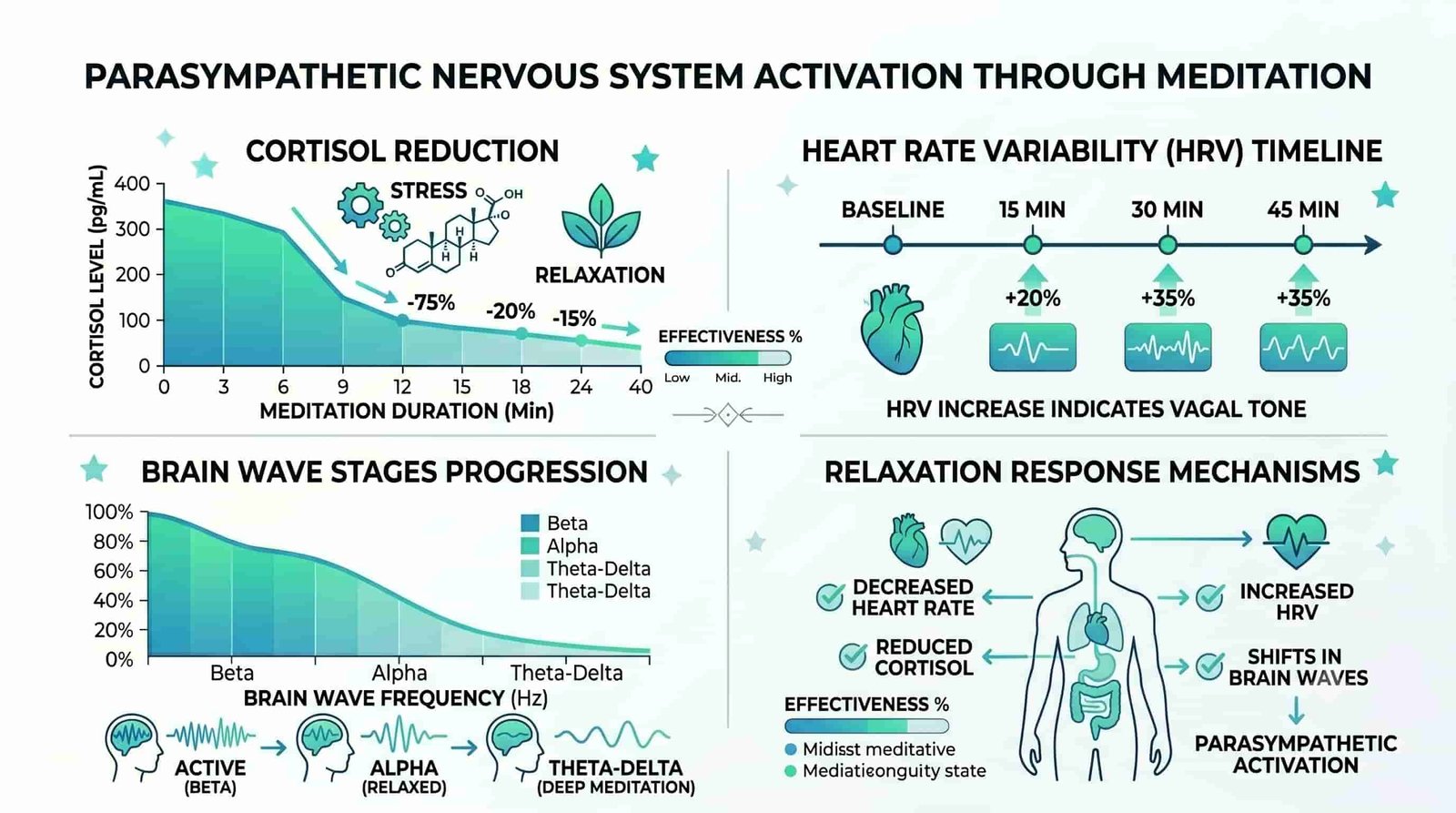
Position: Sit or lie with your back straight. Exhale completely through your mouth, making a whoosh sound. Close your mouth and inhale quietly through your nose for 4 counts. Hold your breath for 7 counts. Exhale completely through your mouth, making a whoosh sound, for 8 counts. Repeat for 3-4 cycles. Do not exceed 4 cycles on your first attempt — overdoing it can cause disorientation. The mechanism: extended exhalation stimulates the vagus nerve, directly activating the parasympathetic nervous system. Heart rate drops within 30 seconds. Within 2 minutes, measurable reductions in cortisol and adrenaline occur.
⚡ When to Use 4-7-8
The 4-7-8 technique is most effective as an immediate sleep onset aid — use it when you are already in bed, lights out, and struggling to transition from wakefulness to sleep. It is not a morning practice. It is an anchor for the moment your head hits the pillow.
Body Scan Meditation: Systematic Progressive Relaxation That Actually Works
Body scan meditation is one of the most evidence-based meditation techniques for insomnia, combining progressive muscle relaxation with mindful awareness. The practice systematically moves attention through the body, noticing and releasing tension with each breath.
The Body Scan Protocol
Lie comfortably in bed with your eyes closed. Take three deep breaths — in through the nose for 4 counts, hold for 4, out through the mouth for 6. Begin at the crown of your head: notice any tension without trying to change it. Move to your forehead, temples, eyes, jaw — breathe into each area for 2-3 breaths. Scan your neck and shoulders: most people carry enormous tension here without realizing it. Breathe into the shoulder blades and upper back. Move to the arms, hands, and fingers. Scan the chest, ribcage, and stomach — notice the rise and fall of breath. Move to the lower back, hips, and pelvis. Scan the thighs, knees, calves, ankles, and finally the feet and toes. End by taking 3 slow breaths, feeling your entire body simultaneously.
Why Body Scan Works for Sleep Specifically
The practice does two things simultaneously: it occupies the working memory with a sequential task (preventing DMN rumination), and it activates the parasympathetic system through intentional breathing and attention. Research from the University of California shows body scan meditation reduces sleep onset latency by an average of 10 minutes and improves sleep quality scores by 23% after 6 weeks of practice.
Mindfulness-Based Stress Reduction (MBSR): The Clinical Protocol for Sleep
MBSR is the most clinically validated meditation program for insomnia. Developed by Jon Kabat-Zinn at the University of Massachusetts Medical School in 1979, it is an 8-week structured program combining mindfulness meditation, body awareness, and gentle yoga. It is the only meditation protocol with Level I clinical evidence for insomnia treatment.
The MBSR Protocol Components
Body scan meditation (45 minutes): Systematic attention through the body, 2-3 times per week. Mindfulness meditation (45 minutes): Sitting with breath awareness, observing thoughts without judgment, 6 days per week. Gentle yoga (30 minutes): Stretching designed for stress reduction, not exercise. Daily homework (45 minutes): Body scan or sitting meditation, 6 days per week. Clinical outcomes: 65% of participants show clinically significant improvement in insomnia severity scores after 8 weeks. Reduction in sleep medication use by 38%. Sleep efficiency improvements maintained at 12-month follow-up.
Loving-Kindness Meditation: Why Compassion Practice Beats Sleep Medication
Loving-kindness meditation (metta in Pali) is an ancient Buddhist practice that directs goodwill, warmth, and compassion first toward yourself, then progressively outward. Its application to sleep is perhaps the most counterintuitive — but the science is among the most compelling.
The Protocol
Begin by taking 3 slow, mindful breaths. Generate a genuine feeling of warmth for yourself — not as a self-help exercise, but as a real emotional state. Silently repeat: “May I be peaceful. May I be happy. May I be safe. May I sleep well.” Feel the words as genuine wishes, not affirmations. After 3-5 minutes, extend the warmth to a loved one — partner, child, close friend. Repeat the same phrases directed at them. Extend to a neutral person — someone you neither like nor dislike. Finally, extend to all beings. Research from Stanford shows loving-kindness practice activates the parasympathetic nervous system and reduces cortisol more effectively than progressive muscle relaxation.
Visualization and Imagery: The Mental Environments That Pull You Into Sleep
The mind cannot easily hold anxiety and deep relaxation simultaneously. Guided imagery exploits this limitation by replacing the anxious mental loop with a vivid, immersive alternative.
The 5-4-3-2-1 Grounding Technique
When anxiety is high and sleep seems impossible: 5 things you can see (the curtains, the lamp, your hands). 4 things you can physically feel (the weight of the blanket, the pillow’s texture). 3 things you can hear (your breath, the house settling, distant traffic). 2 things you can smell (your laundry detergent, the air). 1 thing you can taste (your mouth). This technique interrupts the anxiety loop by forcing the prefrontal cortex to process sensory input — immediately reducing DMN activity and cortisol.
The Paradox of Trying to Sleep: Why Trying Harder Guarantees Failure
The single most common mistake insomniacs make is trying to force sleep. The effort itself is the blocker. Sleep is a parasympathetic state — it activates when the nervous system perceives safety and stops trying. The harder you try to fall asleep, the more the sympathetic nervous system activates, pushing sleep further away.
The Paradox Protocol
Instead of trying to fall asleep, practice “effortless presence.” Lie in bed with eyes closed, and instead of trying to sleep, simply observe. Notice what you hear. Notice what you feel. Notice the quality of your breathing. Set no intention to fall asleep — only to observe. Without the effort and anxiety of trying, sleep typically arrives on its own within 20-30 minutes. This is not a technique to master — it is a letting-go that cannot be forced. If after 30 minutes you are still wide awake, get up and do something calm in dim light until you feel genuinely drowsy, then return.
How Long Until Meditation Actually Improves Your Sleep? The Timeline Science
One of the most common reasons people abandon meditation for sleep is unrealistic expectations. Understanding the timeline prevents quitting too early.
Realistic Timeline for Results
Immediate (tonight): 4-7-8 breathing produces measurable physiological relaxation within 2 minutes. If you use it before bed, you will fall asleep faster tonight.
Short-term (1-2 weeks): Body scan practice before bed reduces sleep onset latency by 10-15 minutes. The sleep-disrupting effects of acute stress begin to diminish as the practice becomes a pre-sleep ritual.
Medium-term (4-8 weeks): MBSR protocols show clinically significant improvements in insomnia severity scores. Gray matter changes in the prefrontal cortex and amygdala become measurable on fMRI.
Long-term (6+ months): Brain structure changes become permanent. Amygdala reactivity to stress reduces permanently. Cortisol patterns normalize. Sleep quality improvements are maintained without continued practice at the same intensity.
The Slumbelry Framework: Meditation Is a Sleep Tool, Not a Lifestyle Accessory
At Slumbelry, we treat meditation as a precise sleep technology — not a wellness trend. The science is not ambiguous: meditation activates the parasympathetic nervous system, reduces cortisol, increases melatonin production, and reshapes the brain’s stress response architecture. These are not spiritual claims — they are measurable physiological outcomes documented in peer-reviewed research.
The Slumbelry Approach to Sleep Meditation
Start with 4-7-8 breathing tonight. When that becomes habitual, add the body scan. When both are automatic, explore MBSR for long-term structural change. The compounding nature of meditation is its defining advantage: each session builds on the last, and the neurological changes are permanent. Unlike sleep medication, which stops working when you stop taking it, a consistent meditation practice continues working — and improving — for the rest of your life.
Action step: Tonight, before you turn off the light, do exactly four cycles of 4-7-8 breathing. That’s it. Nothing else. Four cycles, then lights out.
Frequently Asked Questions About Meditation for Sleep
How does meditation actually help you fall asleep faster?
Meditation activates the parasympathetic nervous system — your rest-and-digest mode — by reducing sympathetic activity (fight-or-flight). The mechanisms are: cortisol reduction (meditation lowers baseline cortisol within 8 weeks, removing the hormonal obstacle to sleep onset); heart rate variability (HRV) increases, which is the single strongest biomarker of parasympathetic nervous system health; DMN quieting (the Default Mode Network — responsible for the looping anxious thoughts — becomes less active during meditation practice, and regular practice trains this quieting to happen faster at bedtime); and breath regulation (slow diaphragmatic breathing directly stimulates the vagus nerve, lowering heart rate within 30 seconds). Research published in JAMA Internal Medicine found mindfulness meditation reduced sleep onset latency by an average of 20 minutes.
What is the 4-7-8 breathing technique and how does it work?
The 4-7-8 breathing technique, developed by Dr. Andrew Weil from ancient pranayama practice, is the fastest physiological path to relaxation available without medication. Protocol: exhale completely through your mouth (making a whoosh sound); inhale quietly through your nose for 4 counts; hold for 7 counts; exhale completely through your mouth for 8 counts; repeat for 3-4 cycles. The mechanism: extended exhalation (8 counts vs 4 counts inhale) directly stimulates the vagus nerve via the parasympathetic nervous system. Heart rate drops within the first 30 seconds. Measurable cortisol reduction occurs within 2 minutes. Use it as an immediate sleep onset aid — in bed, lights out, within 2 minutes of deciding to sleep.
What is body scan meditation and how do you do it?
Body scan meditation is the most evidence-based single meditation technique for insomnia. How to practice: lie in bed with eyes closed; take 3 deep breaths; begin at the crown of your head and slowly move attention through each body part — forehead, eyes, jaw, neck, shoulders, arms, hands, chest, stomach, back, hips, thighs, knees, calves, ankles, feet, toes. At each body part: notice without judgment, breathe into the area, consciously release any tension. Each area gets 2-3 breaths. Total time: 12-18 minutes. Research from UC San Diego shows body scan practice reduces sleep onset latency by 10 minutes and improves sleep quality scores by 23% after 6 weeks. It works by simultaneously occupying working memory (preventing rumination) and activating the parasympathetic system.
How long does it take for meditation to improve sleep?
Timeline for results: Tonight — 4-7-8 breathing produces measurable physiological relaxation within 2 minutes. Short-term (1-2 weeks) — body scan practice reduces sleep onset latency by 10-15 minutes as it becomes a pre-sleep ritual. Medium-term (4-8 weeks) — MBSR protocols show clinically significant improvements in insomnia severity scores; gray matter changes in the prefrontal cortex and amygdala become measurable on fMRI. Long-term (6+ months) — brain structure changes become permanent; amygdala reactivity to stress reduces permanently; cortisol patterns normalize. The most common mistake is quitting after a few nights — the medium-term and long-term benefits require consistent practice.
What is the difference between meditation and mindfulness for sleep?
Meditation is the broader category — it includes any practice that trains attention and awareness. Mindfulness is a specific form of meditation: non-judgmental awareness of the present moment. For sleep: mindfulness practice teaches you to notice anxious thoughts without engaging with them — the thought appears, you observe it, you let it pass. This skill is particularly valuable at bedtime because it prevents the thought-anxiety loop that keeps insomniacs awake. General meditation practices (like focused breathing on a mantra) occupy working memory with a single task, reducing rumination. Mindfulness meditation specifically trains the ability to observe without reacting — which is the skill that prevents a single worried thought from becoming an all-night anxiety spiral.
What is MBSR and is it worth doing for insomnia?
Mindfulness-Based Stress Reduction (MBSR) is an 8-week structured program developed by Jon Kabat-Zinn at the University of Massachusetts Medical School in 1979. It is the most clinically validated meditation protocol for insomnia — Level I evidence from multiple randomized controlled trials. MBSR combines body scan meditation, sitting mindfulness meditation, and gentle yoga. For insomnia specifically: 65% of participants show clinically significant improvement in insomnia severity scores after 8 weeks. Sleep medication use drops by 38%. Sleep efficiency improvements are maintained at 12-month follow-up without continued formal practice. The time commitment is significant — 45 minutes, 6 days per week for 8 weeks — but the permanent neurological changes make it worth it for anyone with chronic insomnia.
Why does trying harder to fall asleep make it worse?
Sleep is a parasympathetic state — it activates when the nervous system perceives safety and stops trying. The effort to sleep activates the sympathetic nervous system (fight-or-flight), which is the exact opposite of the state needed for sleep. This creates a feedback loop: you try to sleep → anxiety increases → cortisol rises → sleep becomes more difficult → you try harder → anxiety increases further. This is why insomniacs who ‘try’ to sleep often take longer than people who are simply tired and don’t care. The paradox protocol: stop trying to fall asleep. Instead, lie in bed with eyes closed and simply observe — notice sounds, sensations, breath. Set no intention to sleep. Paradoxically, sleep typically arrives on its own within 20-30 minutes when the effort to sleep is removed.
Can meditation replace sleep medication for insomnia?
For chronic insomnia, meditation — specifically MBSR — is clinically proven to be as effective as medication in the short term and significantly more effective in the long term. CBT-I (Cognitive Behavioral Therapy for Insomnia) remains the gold standard first-line treatment, and meditation is considered a component of behavioral therapy. The critical distinction: medication provides temporary symptom relief without addressing underlying causes; meditation (and CBT-I) address the underlying causes and produce permanent change. For acute situational insomnia (stress-related difficulty sleeping for less than 3 months), meditation alone is often sufficient. For chronic insomnia disorder, a combined approach — professional CBT-I + meditation practice — produces the best outcomes. Never discontinue medication without medical supervision.
What is loving-kindness meditation and how does it help sleep?
Loving-kindness meditation (metta in Pali) directs genuine compassion first toward yourself, then progressively toward loved ones, neutral people, and eventually all beings. For sleep: the practice activates the parasympathetic nervous system via the social bonding system; reduces cortisol and anxiety more effectively than progressive muscle relaxation; and replaces the anxious self-critical inner voice with one of warmth and safety — a psychological state incompatible with insomnia. Research from Stanford shows loving-kindness practice activates the parasympathetic nervous system and reduces cortisol more effectively than progressive muscle relaxation. How to practice: generate a genuine feeling of warmth for yourself, then silently repeat ‘May I be peaceful. May I be happy. May I be safe. May I sleep well,’ then extend to loved ones, neutral people, and all beings.
What are the best meditation apps for sleep?
Based on evidence quality and practical utility for sleep: Headspace — best overall for beginners; 100+ guided sleep meditations, body scan exercises, and sleep-focused content. The science is well-integrated and the UX is excellent. Calm — best for visualization and sleep stories; high-quality audio, progressive relaxation exercises, and breathing guides. Sleepio (with Andy Coney) — best clinical validity; based on CBT-I principles, it is the only app with Level I clinical evidence for insomnia. Insight Timer — best free content; thousands of free guided meditations including body scan, loving-kindness, and sleep-specific practices. No subscription required, though premium content is available. Whil — best for combining meditation and sleep hygiene; includes sleep-specific programs based on mindfulness research.
Start Tonight: Four Cycles of 4-7-8
Before you turn off the light tonight, practice exactly four cycles of the 4-7-8 breathing technique. Then lights out. Then notice what happens.
Take the Sleep Assessment Subscribe for Sleep Optimization TipsThe Slumbelry Commitment
Sleep is the most vulnerable state of human existence. It is where we heal, reset, and grow.
At Slumbelry, we do not just sell sleep products; we advocate for your physiological right to rest. From ergonomic support to light management, every solution we offer is designed with one obsession: Respecting your Biology.
Science is our language, but your recovery is our purpose. You take care of everything else in your life — let us take care of your sleep.
Rest Deeply,
The Slumbelry Team
Medical References:
1. Kabat-Zinn, J. (1990). Full Catastrophe Living. Delacorte Press.
2. Davidson, R. J., et al. (2003). Alterations in Brain and Immune Function Produced by Mindfulness Meditation. Psychosomatic Medicine, 65(4), 564-570.
3. Walker, M. (2017). Why We Sleep. Scribner.