
You’ve Tried Everything — But You’ve Never Actually Fixed the Problem: Why Insomnia Keeps Coming Back
⚡ Core Takeaway: Insomnia Is Not a Weakness — It Is a Medical Condition With Measurable Consequences
- The mortality signal: Chronic insomnia is associated with a 26% increase in all-cause mortality. This is not an opinion — it is the documented outcome data from longitudinal studies tracking thousands of insomniacs over decades.
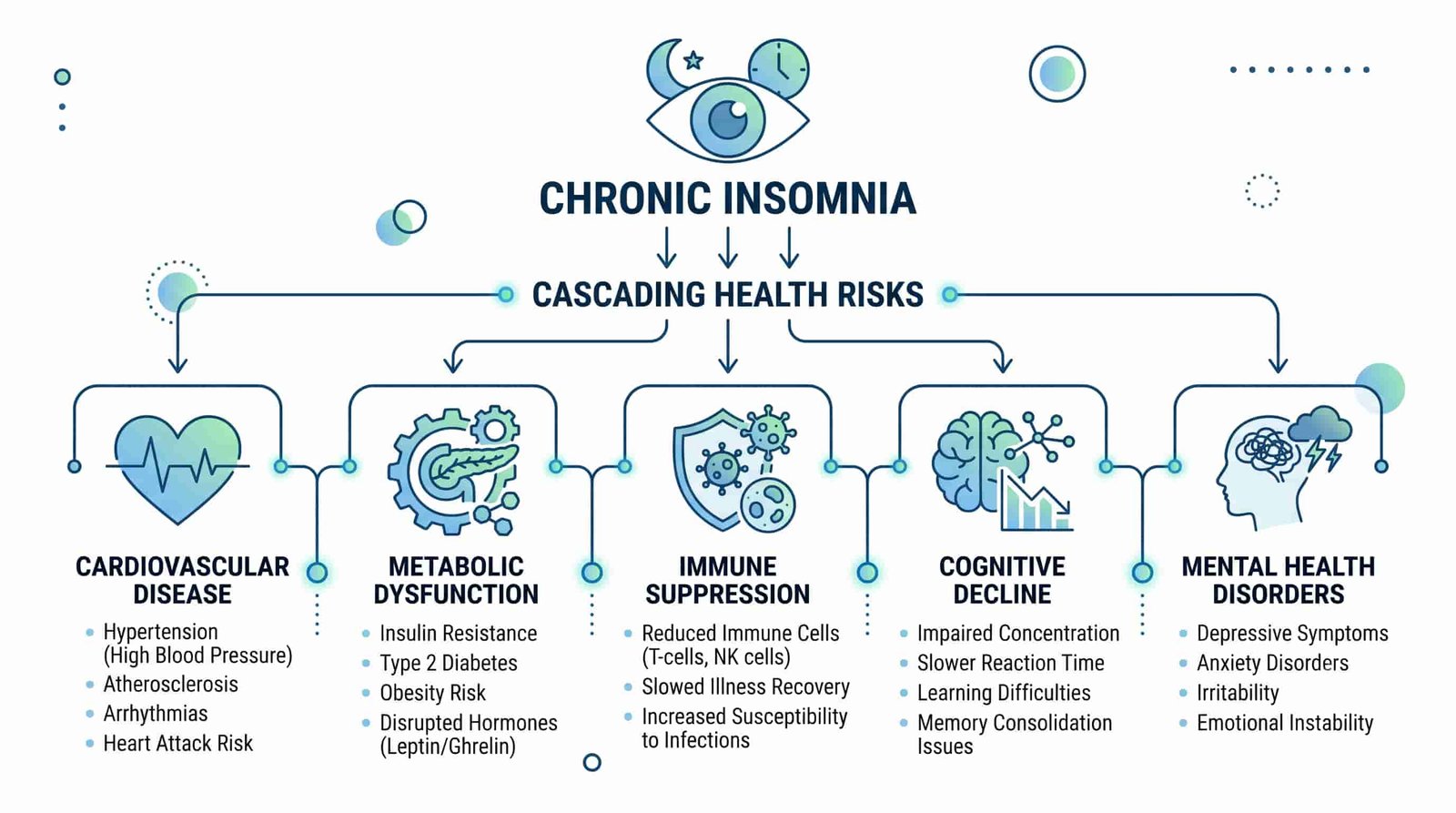
- The mechanism stack: Insomnia causes cardiovascular disease through sustained cortisol elevation and endothelial dysfunction. It causes metabolic dysfunction through insulin resistance and the accumulation of visceral fat. It causes cognitive decline through the failure of glymphatic clearance. It causes depression through the disruption of every neurotransmitter system the brain uses to maintain mood.
- The treatment hierarchy: CBT-I is first-line — not because it is the most aggressively marketed, but because it is the only intervention with durable, long-term evidence that does not worsen the condition over time. Medication provides short-term symptomatic relief at the cost of long-term dependency and, in many cases, actively worsens the sleep architecture it is meant to treat.

Long-term insomnia is one of the most underestimated medical conditions in modern healthcare. It does not announce itself dramatically. It does not show up in routine blood work. But it is producing measurable damage to the hearts, brains, and immune systems of an estimated 10-15% of the adult population — damage that accumulates silently over years before presenting as cardiovascular disease, metabolic dysfunction, cognitive decline, or clinical depression. This guide is not about sleep hygiene tips. It is about what happens to your body when you do not sleep — and why the medical establishment has been too slow to treat insomnia as the serious medical condition it is.
What Is Considered Long-Term Insomnia — and When Does Occasional Sleeplessness Become a Disorder?
Long-term insomnia is not simply “having trouble sleeping.” It is a clinical disorder with diagnostic criteria: difficulty initiating or maintaining sleep, causing significant distress or impairment in daytime functioning, occurring at least 3 nights per week for more than 3 months, and not adequately explained by another medical condition, substance use, or primary sleep disorder. By this definition, an estimated 10-15% of adults have chronic insomnia disorder — not just occasional sleeplessness, but a persistent condition that produces measureable physiological consequences in the body and brain.
The Cardiovascular Consequences: Why Chronic Sleep Deprivation Is as Dangerous as Smoking
The cardiovascular consequences of chronic insomnia are not minor. Meta-analyses of prospective cohort studies involving more than 150,000 participants show that short sleep duration (less than 6 hours per night) is associated with a 48% increase in coronary heart disease risk and a 36% increase in stroke risk. The mechanism: repeated sleep deprivation produces sustained elevation of cortisol, which damages the endothelium (the inner lining of blood vessels), elevates blood pressure through 24-hour sympathetic activation, and increases systemic inflammation through the elevation of C-reactive protein and interleukin-6. This is not an indirect association — the pathway from sleep loss to vascular damage is direct and documentable.
The Blood Pressure Connection
One night of partial sleep deprivation produces a reduction in endothelial-dependent vasodilation — the ability of blood vessels to expand in response to increased demand — that is equivalent to aging the vascular system by 20 years. This is not a subtle effect. After one week of sleeping 5-6 hours per night, healthy young adults show vascular function that resembles that of sedentary middle-aged adults. The implications for cardiovascular disease risk are not theoretical: they are measurable, immediate, and accumulate over years of chronic insufficient sleep.
The Metabolic Toll: How Insomnia Turns Your Body Into a Pre-Diabetic State
Sleep deprivation produces a metabolic state that resembles pre-diabetes — not through dietary excess, but through the direct physiological effect of insufficient rest on glucose metabolism. After 6 days of sleeping 5 hours per night, healthy participants in a University of Chicago study showed a 40% reduction in glucose tolerance. Their bodies were producing enough insulin, but their tissues were less responsive to it — the same insulin resistance seen in early Type 2 diabetes. The mechanism: sleep deprivation elevates cortisol, which antagonizes insulin function, and simultaneously increases ghrelin (the hunger hormone) while decreasing leptin (the satiety hormone) — producing increased appetite, particularly for high-calorie carbohydrate-rich foods.
The Neurodegenerative Risk: Sleep Deprivation, Beta-Amyloid, and the Alzheimer’s Connection
Sleep is the brain’s only significant nightly waste-clearing mechanism. During N3 deep sleep, the glymphatic system activates — glial cells in the brain shrink by 60%, allowing cerebrospinal fluid to flush through and clear metabolic waste including beta-amyloid and tau proteins, the compounds that accumulate in Alzheimer’s disease. When sleep is chronically shortened or fragmented, this clearance is significantly reduced. PET scan studies show that people who report chronic poor sleep have measurably higher accumulation of beta-amyloid in the prefrontal cortex and hippocampus — the brain regions most critical for memory and executive function. This is a causal relationship demonstrated in both directions: sleep deprivation increases amyloid accumulation, and amyloid accumulation disrupts sleep.

The Immune System Shutdown: Why You Get Sick More Often When You Don’t Sleep
The immune system requires sleep to function. Natural killer (NK) cell activity — the immune cells that destroy cancerous and virally infected cells — drops by 70% after a single night of sleeping 4 hours. The production of inflammatory cytokines (IL-1, TNF-alpha) increases with sleep deprivation, producing low-grade systemic inflammation that is itself a risk factor for cardiovascular disease, metabolic dysfunction, and depression. The CDC has classified sleep deprivation as a public health epidemic — and the connection to immune dysfunction is part of why: chronic insomniacs have documented higher rates of infectious disease, slower recovery from illness, and reduced vaccine efficacy.
The Mental Health Cascade: How Insomnia Doesn’t Just Correlate With Depression — It Causes It
The relationship between insomnia and depression is bidirectional — but the causal direction matters for treatment. Research using Mendelian randomization — a genetic method that can establish causal direction — demonstrates that insomnia causally contributes to depression, not just the reverse. The mechanism: sleep deprivation disrupts the serotonergic system (the primary target of most antidepressants), elevates amygdala reactivity through prefrontal cortex dysfunction, and prevents the overnight emotional processing that occurs during REM sleep. A meta-analysis of 21 prospective studies showed that insomnia doubles the risk of developing depression. And critically, treating insomnia with CBT-I reduces depression symptoms by 40-50% even in the absence of any specific mood treatment.
Why “Just Relax” Doesn’t Work: The Neurological Architecture of Chronic Insomnia
The advice to “just relax” or “try harder to sleep” fails because it misidentifies the problem. Chronic insomnia is not a behavioral failure — it is a neurological condition where the brain’s sleep-wake regulation system has become dysregulated. In chronic insomnia, the hyperarousal system — the constellation of elevated cortisol, elevated brain metabolism, elevated heart rate, and elevated sympathetic nervous system activity — becomes chronic rather than situational. The person who is “too anxious to sleep” is not experiencing excessive worry about sleep — they are experiencing a physiological state of hyperarousal that makes sleep neurologically inaccessible regardless of intention. This is why behavioral interventions that target the behavioral expression of hyperarousal (CBT-I) work, while efforts to simply “relax harder” consistently fail.
The Cortisol Dysregulation Loop
In normal sleep, cortisol follows a circadian pattern: high in the morning (the cortisol awakening response), declining through the day, reaching its nadir in the late evening, and remaining low through the night. In chronic insomnia, this pattern is disrupted: cortisol fails to adequately decline in the evening, elevated levels persist through the night, and the normal cortisol nadir is blunted or absent. This means the biological signal that says “the body is safe, it is time to rest” is absent. The brain remains in a state of anticipatory stress. No amount of “relaxation” overrides this physiological signal — because the problem is not psychological tension, it is hormonal dysregulation that must be addressed at the level of the HPA axis, not the level of the mind.
The CBT-I Solution: Why Cognitive Behavioral Therapy for Insomnia Is the Only Evidence-Based Fix
CBT-I is the first-line, gold-standard treatment for chronic insomnia — endorsed by the American College of Physicians, the American Academy of Sleep Medicine, and the British Association for Psychopharmacology. It is a structured, time-limited intervention (typically 6-8 sessions) that addresses the behavioral, cognitive, and environmental factors that maintain insomnia. Unlike medication, CBT-I produces durable improvement that persists after treatment ends — because it changes the underlying sleep-wake regulation rather than masking symptoms. The components: sleep restriction (restricting time-in-bed to actual sleep time to build sleep pressure), stimulus control (rebuilding the bed-sleep association), cognitive restructuring (addressing catastrophizing thoughts about sleep), and sleep hygiene (removing the behavioral contributors to poor sleep).
The Medication Trap: Why Sleep Aids Often Make Insomnia Worse Over Time
Most prescription and over-the-counter sleep aids work by suppressing the central nervous system — producing sedation that resembles sleep but does not replicate the sleep architecture the brain needs. Benzodiazepines and Z-drugs reduce REM sleep by 20-50%, suppress N3 deep sleep, and produce tolerance within weeks. Over time, the brain adapts to the presence of the drug by upregulating excitatory systems — meaning that when the medication is withdrawn, the insomnia is worse than before treatment began. This is not a side effect — it is the expected pharmacological consequence of chronic CNS suppression. The appropriate use of sleep medication is as a short-term bridge (2-4 weeks maximum) while CBT-I is initiated, not as a long-term management strategy. If you have been using sleep medication for more than 3 months, the medication itself may now be contributing to the insomnia it was meant to treat.
The Slumbelry Framework: Insomnia Is a Medical Condition — Treat It Like One
Slumbelry’s approach to long-term insomnia is grounded in the understanding that the bedroom environment is either an ally or an enemy in the fight against hyperarousal. Every environmental variable in the bedroom — temperature, light, sound, tactile comfort, scent — either contributes to or counteracts the parasympathetic state that sleep requires. Our Sleep System is engineered to address each of these variables: spinal alignment that eliminates the physical micro-awakenings from discomfort, cooling technology that supports the core temperature drop required for N3 sleep, acoustic design that prevents the auditory triggers for arousals, and darkness that fully activates the pineal gland’s melatonin production. These are not comfort features — they are the minimum environmental conditions for a nervous system that is trying to stand down from chronic hyperarousal.
The Environmental First Principles
Before considering CBT-I or medication, the bedroom environment must be addressed. If the room is too warm (above 20°C), the body cannot achieve the core temperature drop required for sleep onset and deep sleep. If there is light (even from an LED or street lamp), melatonin production is suppressed and sleep onset latency extends. If there is unpredictable noise, the brain continues monitoring the environment for threats through micro-awakenings even in sleep. These are not comfort preferences — they are the minimum conditions for sleep to occur. Slumbelry’s engineering addresses each of them: temperature regulation, blackout design, acoustic isolation, and ergonomic support — to create an environment where the parasympathetic system can actually dominate.
Action step: If you have had insomnia for more than 3 months, you have a medical condition. The first step is not “try harder to sleep” — it is a clinical evaluation. The second step is CBT-I, which is available through sleep clinics, primary care providers, and increasingly through digital health platforms. Before any medication, before any supplement, before any sleep technology — get the behavioral intervention that has the evidence and the durability. Everything else is a band-aid.
Frequently Asked Questions About Long-Term Insomnia
What is the medical definition of chronic insomnia and how is it diagnosed?
Chronic insomnia disorder is diagnosed when three criteria are simultaneously met: (1) Difficulty initiating sleep, maintaining sleep, or waking too early with inability to return to sleep; (2) This sleep disturbance causes significant daytime impairment — fatigue, cognitive dysfunction, mood disturbance, or performance decline; (3) The symptoms occur at least 3 nights per week and have persisted for more than 3 months; (4) The symptoms are not better explained by another sleep disorder, medical condition, or substance use. A clinical evaluation by a sleep medicine physician or psychologist trained in behavioral sleep medicine is the appropriate first step — not self-diagnosis, not Dr. Google, not expensive sleep tracking devices.
What are the most dangerous health consequences of untreated chronic insomnia?
The most well-documented and clinically significant consequences: (1) Cardiovascular disease — 48% increased coronary heart disease risk, 36% increased stroke risk. (2) Metabolic dysfunction — 40% reduction in glucose tolerance after 6 days of insufficient sleep, creating a pre-diabetic metabolic state. (3) Alzheimer’s disease risk — beta-amyloid accumulates when glymphatic clearance is chronically reduced by insufficient deep sleep. (4) Depression — insomnia doubles the risk of developing depression through disruption of serotonergic function and REM sleep emotional processing. (5) Immune suppression — 70% reduction in natural killer cell activity after one night of sleep deprivation. These are not correlations — the mechanistic pathways are understood and documented.
Why does insomnia increase the risk of cardiovascular disease?
The pathway is direct and multi-mechanism: sleep deprivation elevates cortisol chronically, which damages the vascular endothelium and elevates 24-hour blood pressure. It increases systemic inflammation through elevated C-reactive protein and interleukin-6. It disrupts the autonomic balance, increasing sympathetic nervous system tone throughout the day and night. One night of sleep deprivation produces a reduction in endothelial-dependent vasodilation equivalent to aging the vascular system by 20 years. These effects accumulate over years of chronic insufficient sleep, producing measurable increases in hypertension, coronary artery disease, and stroke risk. The cardiovascular consequence of chronic insomnia is not hypothetical — it is one of the most replicated findings in sleep epidemiology.
What is the connection between insomnia and Alzheimer’s disease?
Sleep is the primary mechanism for clearing beta-amyloid and tau proteins from the brain — the compounds that form the plaques and tangles characteristic of Alzheimer’s disease. During N3 deep sleep, the glymphatic system activates: glial cells shrink by 60%, allowing cerebrospinal fluid to flush through and clear metabolic waste. When sleep is chronically shortened or fragmented, this clearance is significantly reduced. PET scan studies show that people reporting poor sleep have measurably higher beta-amyloid accumulation in the prefrontal cortex and hippocampus. This is a bidirectional relationship: amyloid accumulation in the prefrontal cortex disrupts sleep architecture, creating a self-reinforcing cycle. The implication: every night of chronically insufficient sleep is not just a bad night — it is a night of amyloid accumulation that does not get cleared.
How does insomnia affect mental health beyond just feeling tired?
The mental health consequences of chronic insomnia are neurochemical, not psychological. Sleep deprivation disrupts the serotonergic system (the primary target of SSRIs and the system responsible for maintaining mood stability), elevates amygdala reactivity by 60% through prefrontal cortex dysfunction, and prevents REM-dependent emotional processing — meaning experiences accumulate as unprocessed emotional weight without the overnight resolution that sleep normally provides. A meta-analysis of 21 prospective studies shows insomnia doubles the risk of depression. Critically, treating insomnia with CBT-I reduces depression symptoms by 40-50% even without specific mood treatment — demonstrating that sleep restoration addresses the cause, not just the symptoms, of mood disorders.
Why does ‘just relax’ never work for chronic insomnia?
The advice to relax or try harder to sleep fails because it misidentifies the problem. Chronic insomnia is not a behavioral failure — it is a neurological dysregulation of the sleep-wake system. In chronic insomnia, the hypothalamic-pituitary-adrenal (HPA) axis is chronically activated: cortisol fails to adequately decline in the evening, heart rate remains elevated, brain metabolism is elevated, and the sympathetic nervous system dominates. This is not anxiety about sleep — it is a physiological state that makes sleep neurologically inaccessible regardless of intention. No amount of mental effort overrides a physiological hyperarousal state. CBT-I works because it addresses the behavioral and cognitive patterns that maintain this dysregulation — not by telling the brain to relax, but by creating the conditions (sleep restriction to build sleep pressure, stimulus control to rebuild bed-sleep association, cognitive restructuring to reduce catastrophizing) that allow the HPA axis to normalize.
What is CBT-I and why is it considered the gold-standard treatment for insomnia?
Cognitive Behavioral Therapy for Insomnia (CBT-I) is the first-line treatment for chronic insomnia, endorsed by the American College of Physicians, the American Academy of Sleep Medicine, and the British Association for Psychopharmacology. It is a structured 6-8 session intervention that addresses the behavioral, cognitive, and environmental factors maintaining insomnia through four main components: (1) Sleep restriction — limiting time-in-bed to actual sleep time to build sleep pressure and consolidate sleep; (2) Stimulus control — rebuilding the association between bed and sleep by eliminating non-sleep activities in bed; (3) Cognitive restructuring — addressing catastrophic cognitions about sleep that perpetuate anxiety; (4) Sleep hygiene — removing behavioral contributors to insomnia (caffeine, alcohol, irregular schedules, screens before bed). Unlike medication, CBT-I produces durable improvement that persists after treatment ends, because it changes the underlying sleep-wake regulation rather than suppressing symptoms.
Why are sleep medications often not the long-term solution for insomnia?
Most prescription sleep medications (benzodiazepines, Z-drugs) work by suppressing the central nervous system — producing sedation that resembles sleep but does not replicate normal sleep architecture. They suppress REM sleep by 20-50%, reduce N3 deep sleep, and produce pharmacological tolerance within weeks. The brain adapts to chronic CNS suppression by upregulating excitatory systems — meaning that when the medication is withdrawn, the insomnia is worse than before treatment. This is not a side effect — it is the expected pharmacology. The only appropriate use of sleep medication is as a short-term bridge (2-4 weeks maximum) while CBT-I is initiated. If you have been using sleep medication for more than 3 months, consult a physician about a supervised taper and initiate CBT-I simultaneously.
Can improving sleep actually reverse the health damage from chronic insomnia?
Some of the damage from chronic insomnia is reversible with sleep restoration: endothelial function normalizes within 1-2 months of adequate sleep. Glucose metabolism normalizes within weeks. Inflammation markers (CRP, IL-6) decline with improved sleep. Mood improvements from CBT-I appear within 2-3 weeks of treatment. However, some consequences of long-term insomnia are not fully reversible: the Alzheimer’s disease risk associated with years of beta-amyloid accumulation may be partially but not completely mitigated by subsequent sleep improvement. The key message: it is never too late to improve your sleep, and the benefits are real and measurable even after years of chronic deprivation. But the longer insomnia goes untreated, the more damage accumulates. Early treatment matters.
How do I know if my insomnia requires professional treatment rather than self-management?
Professional evaluation is warranted if: (1) Insomnia has persisted for more than 3 months — you meet the clinical threshold for chronic insomnia disorder. (2) Sleep difficulties are significantly impairing daytime function — work performance, mood stability, relationship quality, safety. (3) You are using alcohol, prescription medication, or over-the-counter sleep aids to manage sleep — this indicates the problem has exceeded self-management capacity. (4) You have symptoms of another sleep disorder: loud snoring and witnessed pauses in breathing (sleep apnea), intense leg discomfort relieved by movement (restless leg syndrome), or feeling unable to move upon waking (sleep paralysis). The appropriate professional is a sleep medicine physician for medical evaluation and a psychologist trained in CBT-I for behavioral treatment.
Ready to Treat Insomnia as What It Is: A Medical Condition
Start with CBT-I. Everything else — including Slumbelry’s Sleep System — is most effective as part of a clinically validated treatment framework, not as a substitute for one.
Take the Sleep Assessment Subscribe for Sleep Optimization TipsThe Slumbelry Commitment
Sleep is the most vulnerable state of human existence. It is where we heal, reset, and grow.
At Slumbelry, we do not just sell sleep products; we advocate for your physiological right to rest. From ergonomic support to light management, every solution we offer is designed with one obsession: Respecting your Biology.
Rest Deeply,
The Slumbelry Team
Medical References:
1. Cappuccio, F. P., et al. (2010). Sleep duration and all-cause mortality: a systematic review and meta-analysis. Sleep.
2. Spiegel, K., et al. (2009). Effects of poor and short sleep on glucose metabolism and obesity risk. Nature Reviews Endocrinology.
3. Riemann, D., et al. (2010). The neurobiology, investigation, and treatment of chronic insomnia. The Lancet Neurology.