
Your Smart Mattress Is Collecting More Data Than Your Doctor — But Is It Actually Helping You Sleep?
⚡ Core Takeaway: Data Without Interpretation Is Noise
- The accuracy gap: Consumer sleep trackers use actigraphy — inferring sleep from wrist movement — not EEG. They are 85-95% accurate for total sleep time but significantly less reliable for detecting specific sleep stages. Do not treat consumer device sleep staging as clinical data.
- What is actually useful: Time-in-bed consistency, sleep window patterns, and heart rate variability trends over weeks — not nightly stage-by-stage breakdowns. The signal is in the pattern across months, not the daily verdict.
- The buying filter: If a smart mattress cannot tell you why your sleep was worse on Tuesday than Monday — and most cannot — the data is a dashboard without a navigation system. Buy for the mechanical engineering (adjustable firmness, active cooling), not the metrics.
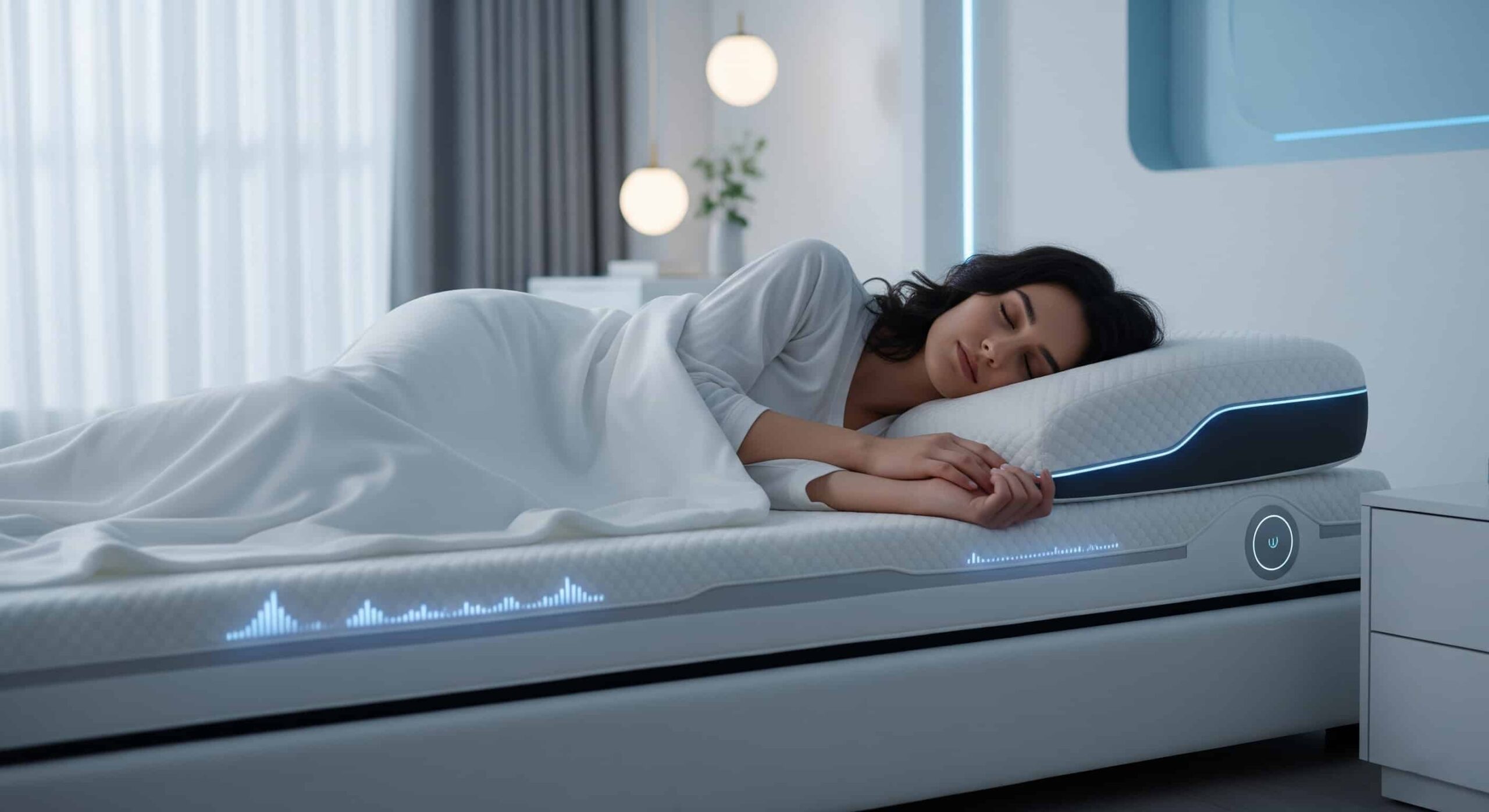
Smart sleep technology is the fastest-growing category in sleep products — and the most confusing. Your smart mattress is collecting more data about your body than most doctors have access to. It knows when you go to bed, when you wake up, your heart rate patterns, your breathing rate, and — if the marketing is to be believed — your sleep stages down to the minute. But data collection is not the same as clinical utility. And more sensors are not the same as better sleep. This guide cuts through the marketing to explain what smart sleep technology can actually measure, what it can genuinely improve, and what questions you should be asking before you spend $3,000 on an algorithm that is mostly guessing.
What Is Smart Sleep Technology — And What Exactly Is It Measuring?
Smart sleep technology is the application of sensors, algorithms, and connected hardware to the sleep environment — with the stated goal of measuring, improving, or personalizing sleep. But the category contains two fundamentally different products: monitoring devices (which observe sleep and report data) and adaptive devices (which change the sleep environment in response to data). Most marketing conflates these — and most buyers do not know the difference until they have spent $3,000 on a smart mattress that measures more than it improves.
The Accuracy Problem: Why 90% of Sleep Tracker Data Is Estimation, Not Measurement
Consumer sleep trackers fall into two technical categories: accelerometry-based actigraphy (wrist devices and mattress sensors that infer sleep from movement) and photoplethysmography (optical heart rate sensors in wearables). Neither is polysomnography (PSG) — the clinical gold standard that uses EEG, EMG, and EOG to directly measure brain waves, muscle tone, and eye movement. The accuracy gap between consumer devices and clinical PSG is significant and well-documented: consumer actigraphy achieves 85-95% accuracy for total sleep time but 45-65% accuracy for individual sleep stage classification. A device that says you spent 22% in REM is making an educated guess, not a measurement.
The Algorithm Problem
Beyond the sensor limitation, sleep tracker accuracy is constrained by the algorithm that converts raw sensor data into sleep stage classifications. Consumer algorithms are trained on population-level data — meaning they are calibrated to what typical sleep looks like, not your specific sleep. If your sleep architecture deviates from population norms (which is common in insomnia, sleep disorders, and shift workers), the algorithm’s accuracy degrades further. The nightly sleep stage percentages you see in your app are not your sleep stages. They are the algorithm’s best guess about your sleep stages, given a population-trained model and motion-plus-heart-rate data.
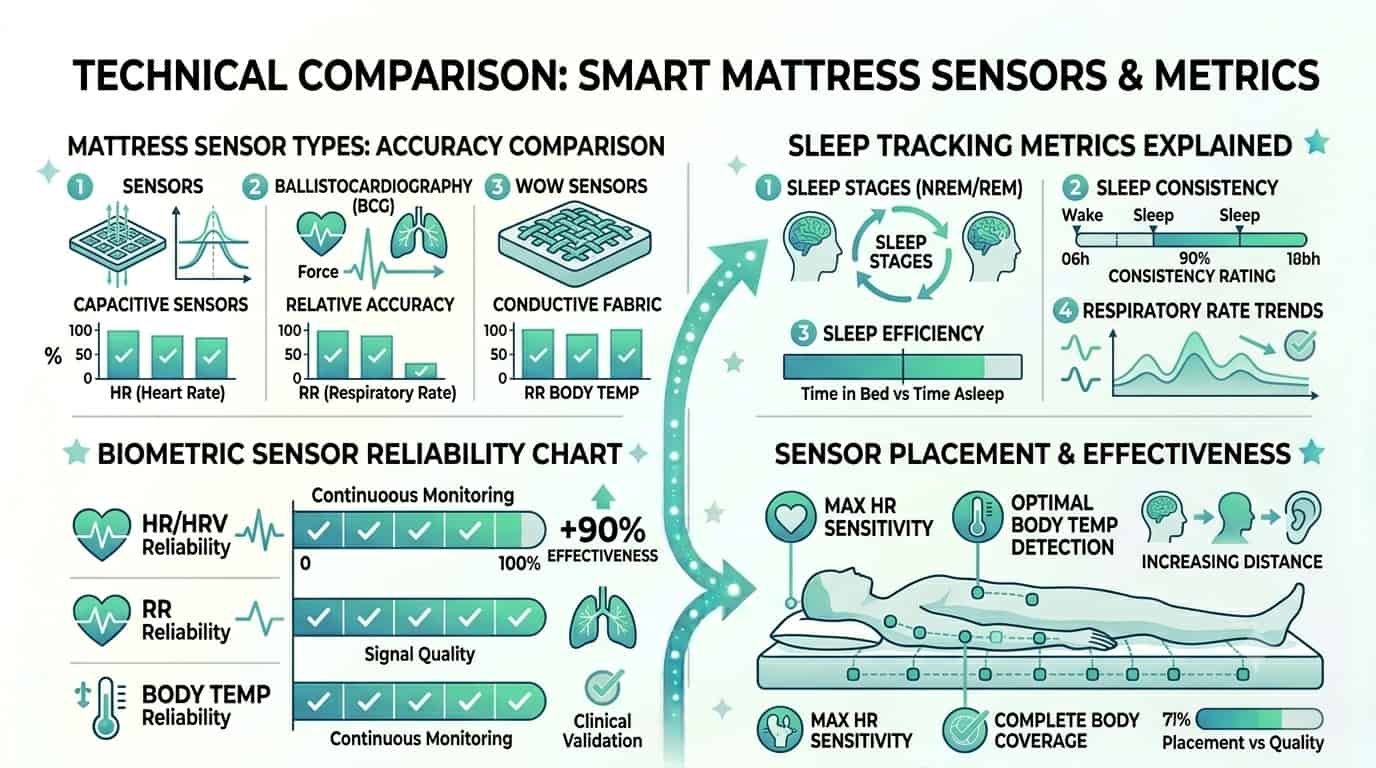
How Sleep Tracking Algorithms Work: The Actigraphy Problem and What Consumer Devices Actually Detect
Actigraphy-based sleep tracking — the method used by mattress sensors and most wrist devices — detects sleep and wake by measuring the absence or presence of movement. The underlying assumption: when you are asleep, you do not move; when you are awake, you do. This assumption is wrong in both directions: significant sleep can occur with movement (e.g., during restless sleep, in sleep disorders, or during light sleep stages), and wakefulness can occur without movement (e.g., during quiet wakefulness, reading in bed). Mattress-based sensors have an additional problem: they measure vibration, not movement — meaning they can detect partner movement through the mattress but may miss your own micro-movements if the sensor sensitivity is calibrated for larger motions.
What Smart Mattresses Can Genuinely Improve: Adjustable Firmness, Zoning, and Temperature
Where smart mattresses earn their price — and where the evidence is solid — is in the mechanical engineering: adjustable firmness through air chamber technology, zoned support systems that allow different firmness levels in different areas of the mattress, and active cooling systems that pump fluid through the mattress to remove heat. Sleep Number’s studies show their dual-zone air chamber systems reduce pressure points by 40-50% compared to traditional mattresses. Eight Sleep’s cooling systems reduce mattress surface temperature by 8-10 degrees below ambient, which is clinically meaningful for hot sleepers. These are engineering achievements, not algorithm achievements — and they are worth paying for if you have the budget.
⚡ What to Actually Buy Smart Features For
If you are considering a smart mattress, evaluate it for what it can mechanically do that a non-smart mattress cannot: (1) Adjustable firmness without changing the mattress — useful if your firmness preference changes over time or if two partners have different preferences. (2) Active cooling — meaningful for hot sleepers, clinically validated. (3) Zoned support — useful for couples with significantly different body types or sleep positions. If the marketing leads with sleep tracking and the app, and the mechanical engineering is secondary — buy a better non-smart mattress and save $2,000.
The Biometric Data Gap: Heart Rate Variability, Breathing Patterns, and the Clinical Evidence
Beyond sleep staging, smart devices increasingly claim to measure heart rate variability (HRV), breathing rate, and blood oxygen saturation. Each of these has a different accuracy profile and clinical utility. HRV measured by wrist photoplethysmography (PPG) is directionally accurate for trends — if your nightly HRV consistently improves over months, that is probably a real trend. But nightly HRV values from consumer wearables have a margin of error of ±15-20ms, which is significant relative to the 20-30ms changes that indicate meaningful autonomic shifts. Treat HRV trends as interesting; treat individual nightly values with high skepticism. Blood oxygen saturation (SpO2) from wrist devices is less reliable than from finger pulse oximetry, and consumer devices are not medical-grade — if you need SpO2 monitoring for a clinical reason, you need a medical device, not a smart mattress.
Smart Alarms and Sleep Cycle Waking: Does Waking During Light Sleep Actually Improve How You Feel?
The smart alarm feature — waking you during light sleep rather than at a fixed time — is theoretically sound and practically limited. The theory: if you wake during light sleep (N1 or N2), you feel more refreshed than if you are woken during deep sleep (N3) or REM, when the brain is most disconnected from external stimuli. The practice problem is the accuracy limitation: if the device cannot reliably identify sleep stages (see above), it cannot reliably identify the optimal wake window. A 2019 study in Scientific Reports found that smart alarm use did not produce measurably better subjective sleep quality or next-day alertness compared to regular fixed-time alarms. The feature may have value for people with highly consistent sleep schedules and high sleep efficiency — but it is not a substitute for actually sleeping more or better.
The Privacy Question: Who Owns Your Sleep Data and What Are They Doing With It?
Smart mattresses and sleep trackers collect some of the most intimate data that exists: when you go to sleep, when you wake up, your breathing patterns, your heart rate, your movements. This data reveals health conditions, relationship patterns, stress levels, and life events. The privacy policies of major smart mattress companies have been reviewed by digital rights organizations and consistently rank among the most permissive in consumer electronics — allowing data sharing with third parties for purposes including research, marketing, and product improvement. Before buying a smart sleep product: read the privacy policy, opt out of everything optional, and ask whether you are comfortable with the company having a continuous record of your most vulnerable hours.
How to Evaluate Smart Sleep Products Critically: The Questions That Matter Before You Buy
Given the gap between marketing claims and clinical evidence, the following questions are the ones that actually matter before purchasing any smart sleep technology.
⚡ The Critical Evaluation Checklist
- What specifically does this measure, and what is its published accuracy compared to clinical gold standard? If the company cannot cite this, the feature is unvalidated.
- Does the product do anything a non-smart version cannot do mechanically? If the answer is no, you are paying for data, not engineering.
- Is there independent peer-reviewed evidence for the health claims? Company-sponsored studies do not count. Look for replication and independent verification.
- Can the product explain why your sleep was worse last night than the night before? If the app cannot provide that analysis, the data is not actionable — it is just noise.
- What happens to my data if the company is acquired or shuts down? This is not hypothetical — multiple sleep tech companies have been acquired and their data policies changed post-acquisition.
The Integration Problem: Why Most Smart Sleep Products Don’t Talk to Each Other
The smart home ecosystem is fragmented: Apple HealthKit, Google Fit, Amazon Halo, Sleep Number, Eight Sleep, Oura, Whoop, and dozens of other platforms each collect sleep data in their own format and do not share it meaningfully. The result is a sleep data ecosystem where your wrist tracker, your mattress, your white noise machine, and your smart thermostat are all collecting data that could theoretically be integrated into a unified sleep optimization model — but in practice, none of them share it. This fragmentation is partly competitive strategy and partly technical: there is no standard data format for consumer sleep data. Until that changes, the most sophisticated personal sleep dashboard is still a collection of disconnected graphs from different companies.
The Slumbelry Approach to Smart Sleep: Engineering Data That Actually Improves Your Rest
Slumbelry’s approach to smart sleep technology starts with a different question: not “how much data can we collect” but “what environmental intervention does the evidence show actually improves sleep, and how do we engineer that into a product?” Our Sleep System addresses the variables with the highest evidence base for sleep improvement: spinal alignment (through ergonomic design), thermal environment (through cooling technology), and acoustic environment (through sound masking). We do not claim to measure sleep stages accurately — because no consumer device can. We claim to create the conditions that evidence shows produce better sleep — and we let the user’s own experience be the measure of whether we succeeded.
The Slumbelry Smart Integration Philosophy
Our approach to data collection is guided by a single principle: collect what we can act on, not what is impressive. Sleep latency trends, time-in-bed consistency, and subjective morning assessment — those are actionable. Individual nightly sleep stage percentages, measured by consumer actigraphy, are not. We design products that help you sleep better and let you draw your own conclusions about whether they are working — not an app that generates a performance score designed to make you feel you need to check it every morning.
Action step: Before buying any smart sleep product, identify the specific problem you are trying to solve. If it is pressure point pain — buy an adjustable air chamber mattress. If it is temperature — buy active cooling. If it is “I want to see my sleep data” — buy a $50 wearable and accept the accuracy limitations. Do not pay $3,000 for engineering you do not need to solve a data curiosity you could satisfy for $50.
Frequently Asked Questions About Smart Sleep Technology
How accurate are consumer sleep trackers compared to clinical sleep studies?
Consumer sleep trackers achieve 85-95% accuracy for total sleep time — meaning they are reasonably reliable at detecting whether you are asleep or awake overall. But they are significantly less accurate for sleep stage classification: consumer actigraphy achieves only 45-65% accuracy compared to polysomnography (PSG) for detecting N1, N2, N3, and REM stages. Wrist-based heart rate variability provides directional trends over weeks, but individual nightly HRV values have a margin of error of 15-20ms — which is significant relative to the 20-30ms changes that indicate meaningful shifts. For clinical sleep diagnosis (suspected sleep apnea, narcolepsy, periodic limb movement disorder), you need a clinical sleep study, not a consumer device.
What is the difference between actigraphy and polysomnography in sleep measurement?
Polysomnography (PSG) is the clinical gold standard for sleep measurement — it uses EEG (brain waves), EMG (muscle tone), and EOG (eye movement) to directly measure what is happening in your brain during sleep. Actigraphy is an estimation method used by consumer devices — it infers sleep from wrist or mattress sensors that detect movement or vibration. The fundamental limitation of actigraphy: it cannot measure what the brain is doing, only what the body is doing. This means actigraphy cannot reliably distinguish between light sleep and deep sleep, and it systematically underestimates wakefulness in people who lie still in bed. If a consumer device reports your REM percentage, it is an algorithmic inference, not a direct measurement.
Do smart mattresses actually improve sleep quality?
Smart mattresses earn their value in specific, well-defined ways: (1) Adjustable firmness through air chamber technology — meaningfully useful for couples with different preferences or people whose firmness needs change over time. (2) Active cooling — clinically validated for hot sleepers; Eight Sleep’s systems reduce surface temperature by 8-10 degrees below ambient. (3) Zoned support — meaningful for couples with significantly different body types. Beyond these mechanical features, the sleep tracking and algorithmic optimization claims are far less evidence-based. The clinical evidence for smart alarm features improving next-day alertness is weak. The evidence that sleep tracking data itself improves sleep behavior change is mixed at best. Buy for the mechanical engineering; treat the data features as a bonus.
What is heart rate variability and why do smart sleep devices measure it?
Heart rate variability (HRV) is the variation in time between successive heartbeats — it reflects the balance between the sympathetic nervous system (fight-or-flight) and parasympathetic nervous system (rest-and-digest). Higher HRV generally indicates better cardiovascular fitness and autonomic nervous system flexibility. Consumer wearables measure HRV via photoplethysmography (PPG) — an optical sensor that detects blood volume pulse through the skin. The measurement is directionally accurate for multi-week trends but has significant nightly variability due to sensor placement, skin temperature, and ambient light. Individual nightly HRV values from consumer devices should be treated as approximate — the signal is in the trend across months, not in any single night’s reading. HRV is a useful long-term wellness metric, not a nightly performance score.
Should I be worried about privacy with smart sleep devices?
Sleep data is among the most intimate personal data available — it reveals health conditions, stress levels, relationship patterns, and life events on a continuous basis. The privacy policies of major smart mattress companies have been reviewed by digital rights organizations and consistently include provisions for sharing de-identified and aggregated data with third parties for purposes including research, marketing, and product development. Before purchasing: read the specific company’s privacy policy (not just the marketing claims); opt out of optional data sharing; understand what happens to your data if the company is acquired; and consider whether you are comfortable with a continuous record of your most vulnerable hours being stored on corporate servers. For maximum privacy, choose products that store data locally rather than in the cloud.
Do smart alarms actually help you wake up feeling better?
The theory behind smart alarms is sound: waking during light sleep (N1/N2) produces less sleep inertia than waking during deep sleep (N3) or REM. The practical limitation is accuracy: if the device cannot reliably identify sleep stages (and consumer actigraphy cannot), it cannot reliably identify the optimal 30-minute wake window. A 2019 study published in Scientific Reports found that smart alarm use did not produce measurably better subjective sleep quality or next-day alertness compared to fixed-time alarms in a general population. Smart alarms may have more value for people with highly consistent sleep schedules and high sleep efficiency, where the sleep stage prediction is more reliable. For most people, the marginal benefit over a regular alarm is minimal — and the more reliable way to feel better in the morning is to simply sleep more.
What smart sleep features are actually worth paying for?
The features with the highest evidence-to-cost ratio in smart sleep technology: (1) Adjustable firmness air chambers ($1,500-4,000) — mechanically innovative, solves real problems for couples and people with changing firmness needs. (2) Active cooling systems ($500-2,000) — clinically validated for hot sleepers, meaningful for those with temperature-related sleep complaints. (3) High-quality sleep tracking wearables ($100-300) — the data is directional, not diagnostic, but useful for identifying patterns over time. What is not worth the premium: AI-powered sleep stage analysis from mattress sensors (the accuracy is too low); nightly ‘sleep scores’ (they create anxiety without actionable data); integration with smart home ecosystems that do not actually exist yet. Buy engineering over algorithms.
How do smart mattresses detect sleep stages?
Smart mattresses detect sleep primarily through actigraphy: pressure sensors or accelerometers in the mattress detect vibration and movement patterns, which are then mapped to sleep-wake states using proprietary algorithms. Some systems also incorporate heart rate monitoring via sensors embedded in the mattress. The detection method has significant limitations: (1) It cannot directly measure brain activity, so sleep stage classification is inferred from movement patterns rather than measured. (2) It detects movement through the mattress — partner movement can be counted as your own. (3) The algorithms are trained on population-level data, so they are less accurate for individuals whose sleep patterns deviate from population norms. For accurate sleep stage measurement, PSG is required. Consumer smart mattresses are useful for tracking sleep patterns over time, but individual nightly measurements should not be treated as clinical data.
Can smart sleep technology help with insomnia?
Smart sleep technology can help insomnia in two specific ways: (1) CBT-I integration — some smart mattress and wearable systems now integrate with CBT-I protocols, using sleep tracking data to personalize cognitive behavioral therapy for insomnia interventions. (2) Acoustic and environmental control — smart beds with active noise masking, temperature control, and adjustable firmness can address physical barriers to sleep that are common in insomnia. However, smart sleep technology can also worsen insomnia: sleep tracking itself is associated with increased sleep anxiety and orthosomnia (obsessive focus on perfect sleep data). If you have clinical insomnia, the most evidence-based intervention is CBT-I, which is available through sleep specialists and increasingly through digital health platforms. A smart mattress is not a substitute for CBT-I.
What is the future of smart sleep technology?
The most promising development in smart sleep technology is not more sensors — it is better integration and more actionable interpretation. The next frontier is not a smarter mattress; it is a unified sleep environment where the thermostat, the white noise machine, the lighting, the mattress, and the wearable all share data and coordinate adjustments automatically. The technology that will actually move the needle on population sleep outcomes is not AI sleep coaches or performance sleep scores — it is making the environmental basics (cool, dark, quiet, consistent) affordable and accessible. Slumbelry’s engineering investment is directed at this level: not impressing users with data, but eliminating the environmental barriers to the deep sleep that the brain needs to function.
Ready to Separate Smart Sleep Fact from Fiction?
Buy for the engineering, not the data. Slumbelry’s Sleep System is designed to do one thing: create the environmental conditions that evidence shows produce better sleep.
Take the Sleep Assessment Subscribe for Sleep Optimization TipsThe Slumbelry Commitment
Sleep is the most vulnerable state of human existence. It is where we heal, reset, and grow.
At Slumbelry, we do not just sell sleep products; we advocate for your physiological right to rest. From ergonomic support to light management, every solution we offer is designed with one obsession: Respecting your Biology.
Rest Deeply,
The Slumbelry Team
Medical References:
1. Ta校, J., et al. (2019). Performance of four commercial sleep tracking devices. Scientific Reports.
2. Kolla, B. P., et al. (2021). Consumer sleep technology and sleep disorders. Sleep Medicine.