
The Revenge Bedtime Procrastination Cure: Why You Steal Time From Sleep and Why It Keeps Making Everything Worse
⚡ Core Takeaway: The 11 PM Scroll Is Not About Willpower
- The mechanism: Revenge bedtime procrastination is not a character flaw — it is a cortisol dysregulation pattern. Your day was so depleting that your 11 PM self needs the only available autonomy time, regardless of cost.
- The trap: Scrolling produces temporary dopamine relief but chronic sleep deprivation, which amplifies next-day stress, which amplifies next night’s need for autonomy time. It compounds on itself.
- The fix: Create a non-negotiable boundary between autonomy and sleep — not by taking away the reward, but by building autonomy time into the day where it does not cost sleep.
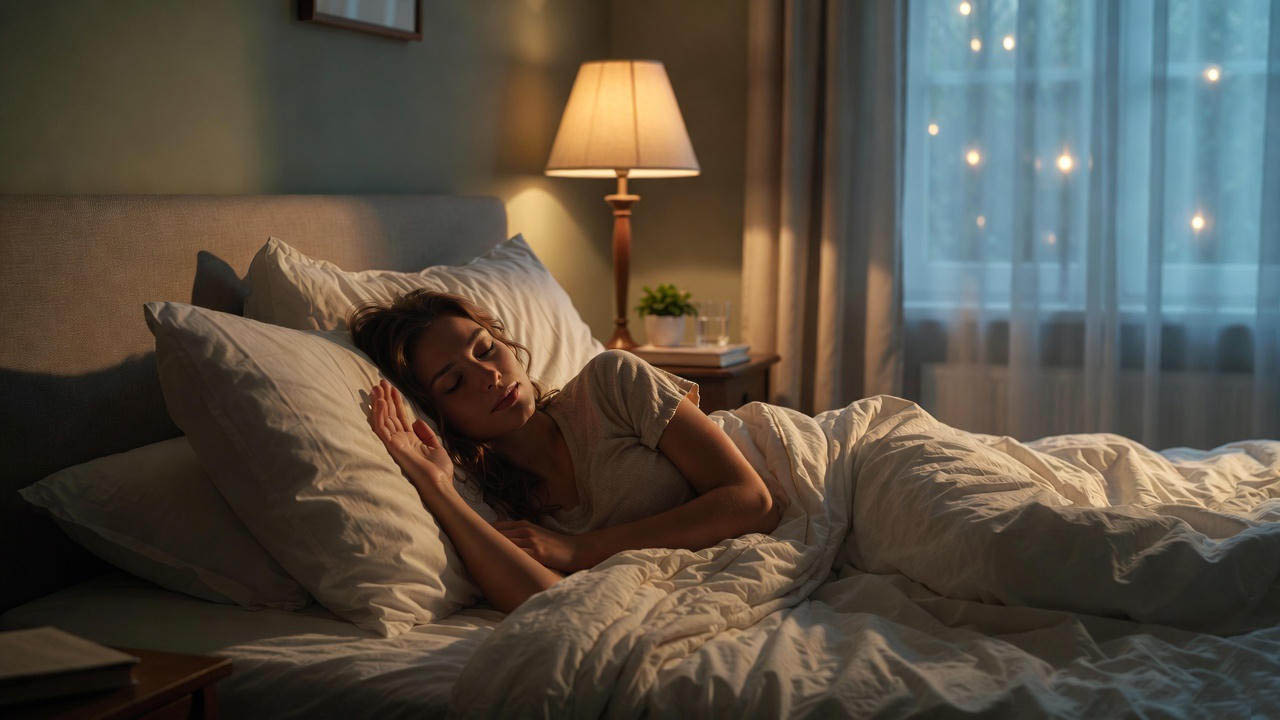
Revenge bedtime procrastination is one of the most common sleep disruptors of modern life — and one of the least discussed. The person who stays up until 1 AM not because they cannot sleep but because they need the only time that feels like it belongs to them. The behavior is rational. The consequences are real. And the solution is not to take away the autonomy — but to build it into the day so that the 11 PM self does not need to reclaim it at the cost of sleep.
What Is Revenge Bedtime Procrastination — and Why “Just Stop Scrolling” Doesn’t Work
Revenge bedtime procrastination is the phenomenon where people deliberately sacrifice sleep to reclaim leisure time they feel they were denied during the day. It was coined by Dr. Sally Ferguson in 2014 to describe what she observed as a growing pattern in people whose work-life boundaries had been progressively erased. The key word is “revenge” — it is an act of retaliation against the day that consumed you. It is not a failure of willpower. It is a stress response. And like most stress responses, it is both understandable and deeply harmful — and the harm it causes compounds the original stress it was meant to offset.
The Evening Cortisol Debt: Why Your 11 PM Scrolling Is a Biological, Not a Willpower, Problem
The mechanism behind revenge bedtime procrastination is not laziness or poor time management — it is a dysregulation of the HPA axis under chronic stress. During the day, cortisol is elevated in response to work demands, financial pressure, social demands, and the relentless small stressors that accumulate in a day of high-pressure living. By the evening, the HPA axis should undergo its normal circadian decline, producing the cortisol nadir that signals safety and allows parasympathetic activation. In chronic stress states, this evening decline is incomplete — and the body remains in a state of mild hyperarousal that is incompatible with sleep onset.
The Autonomy Paradox
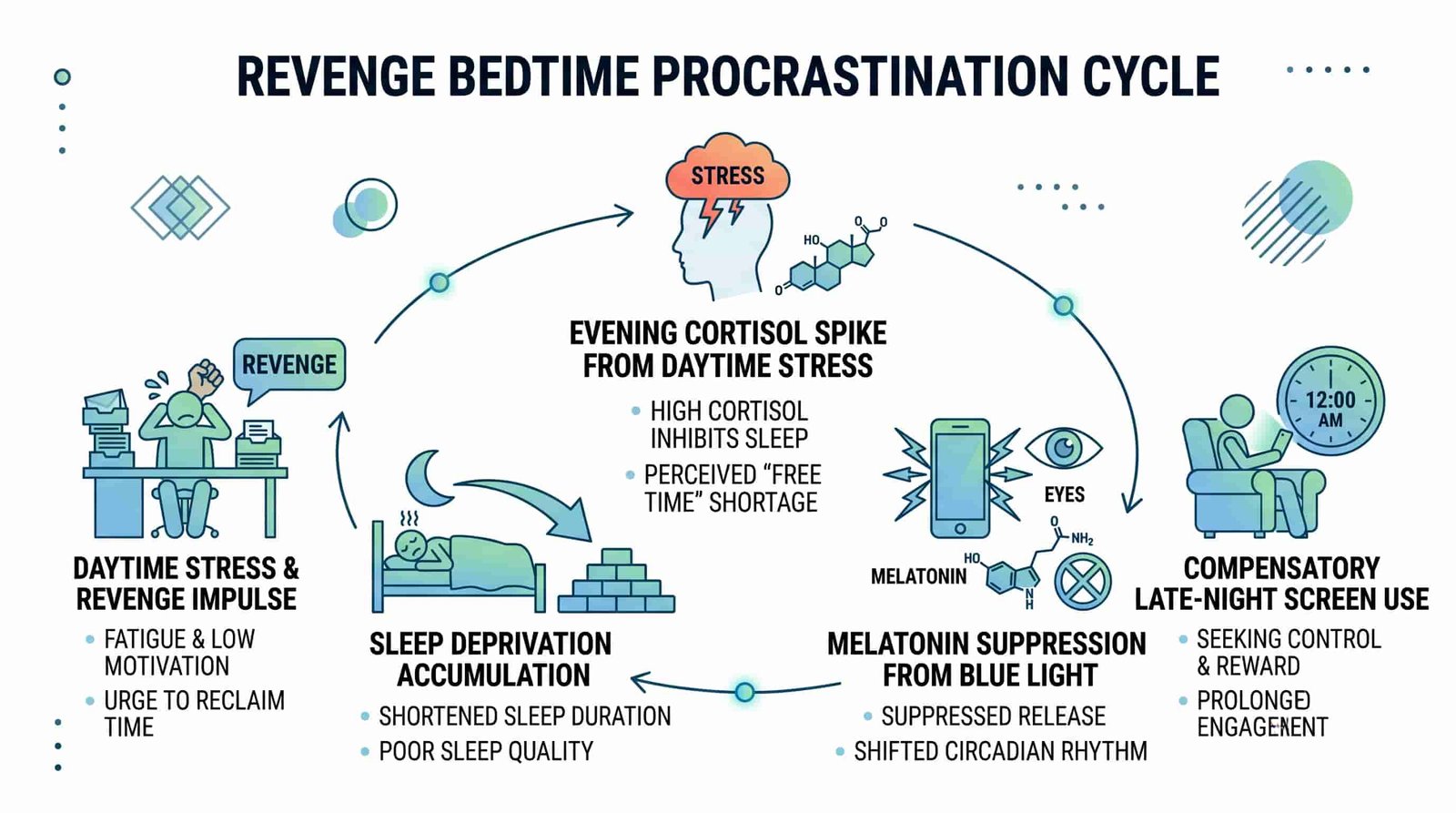
The 11 PM scroll is the brain’s attempt to restore a sense of control and autonomy — needs that are not optional, but basic psychological requirements. Depleted all day by demands you did not choose, the 11 PM self takes what it needs — even at the cost of the next day’s capacity. This is not irrational. It is a perfectly rational response to a real psychological deficit. The problem is that the chosen solution — trading sleep for screen time — compounds the deficit it was meant to offset. Sleep deprivation elevates next-day cortisol, which depletes autonomy further, which increases the need for the 11 PM compensation. The cycle is self-reinforcing.
Why Sleep Deprivation and Daytime Control Feel Like They Need Each Other
Research on the relationship between workplace control and sleep quality shows a consistent pattern: people with the least control over their workdays experience the most fragmented sleep — not because they work longer hours, but because the psychological demand of constrained autonomy elevates baseline cortisol and prevents the parasympathetic dominance required for sleep onset. This is also why the solution to revenge bedtime procrastination is not simply to “sleep more” — but to address the daytime autonomy deficit that makes the nighttime compensation necessary in the first place.
The Digital Sunset: Why 90 Minutes Before Bed Is the Most Important Window of the Day
The screen is not the primary culprit — the timing is. Blue light from screens suppresses melatonin by 22-50% depending on intensity and proximity, directly delaying sleep onset — but the deeper problem is what the screen replaces: the wind-down ritual that should precede sleep. The 90 minutes before bed should be a gradual transition from the cognitive intensity of the day to the parasympathetic state required for sleep onset. Scrolling replaces this transition with sustained cognitive engagement, emotional stimulation, and a dopamine hit — none of which facilitate that transition.
⚡ The Digital Sunset Protocol
The digital sunset is not about restriction — it is about substitution. You are not removing something valuable. You are replacing it with something more valuable: genuine wind-down. The protocol: 90 minutes before the target bedtime, put all screens in another room. Replace them with: reading a physical book, journaling, gentle stretching, a warm bath, conversation with a partner. What you choose does not matter. What matters is that the last 90 minutes of the day are free of the cognitive and emotional engagement that screens provide — and that you build enough autonomy recovery into the day that the 11 PM self does not feel the need to reclaim it.
The “Me Time” Trap: Why the Only Time That Feels Like Yours Is the Time Destroying Your Tomorrow
The psychological reward from late-night scrolling is real and genuine — but it is short-lived. The 11 PM self is taking autonomy from a future that does not yet exist. The next morning arrives, the alarm goes off, and the sleep-deprived self faces the same demands with diminished capacity. The irony of revenge bedtime procrastination is that it is the most expensive form of leisure time available: you pay for it with the next day’s energy, focus, and emotional regulation — the very resources you needed to feel less depleted in the first place.
The Compounding Cost
The cost of revenge bedtime procrastination is not one night’s poor sleep. It compounds. Sleep deprivation: reduces prefrontal cortex function (worse decision-making, worse emotional regulation, worse memory), elevates next-day cortisol (worse stress response, worse capacity for autonomy), makes physical exercise harder (less energy, more fatigue), worsens insulin sensitivity and appetite regulation (more sugar cravings, worse metabolic health). Each of these creates conditions that make the next day more depleting — which makes the next night’s compensation more necessary. The cycle does not self-correct. It requires intervention.
Temperature as a Reset: Why Cooling the Room and Warming the Feet Actually Signal Safety to the Brain
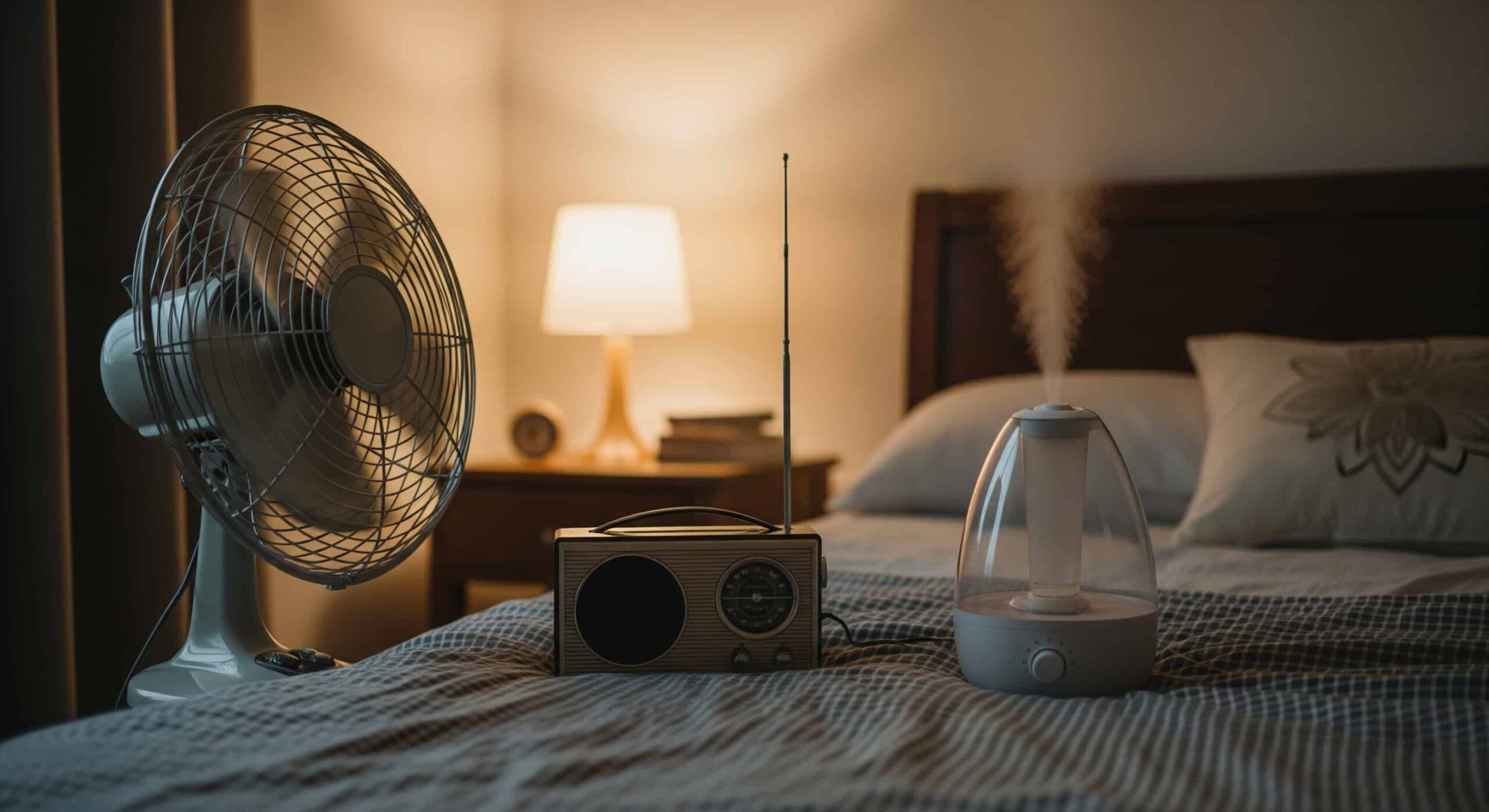
The most underused tool in addressing revenge bedtime procrastination is environmental temperature. Core body temperature must decline by approximately 1 degree Celsius for sleep onset to occur — this is a well-established thermoregulatory requirement for sleep. A hot room prevents this decline. A warm bath 90 minutes before bed accelerates it: the hot water dilates peripheral blood vessels, increasing heat dissipation and dropping core temperature faster than it would occur naturally. The warm feet trick — wearing socks or using a foot warmer — works through a similar mechanism: warming the feet causes vasodilation, which increases heat loss from the core, which accelerates the core temperature decline that initiates sleep.
The Cortisol Clock: How Morning Light Rewires the Entire Evening Sleep-Onset Sequence
The single most effective intervention for revenge bedtime procrastination — and one that most people never use — is morning sunlight. The cortisol awakening response (CAR) peaks 30-45 minutes after waking and is amplified by bright light exposure at the same time. A strong CAR produces a corresponding cortisol decline in the evening, creating the cortisol nadir that is the biological signal for parasympathetic activation. People who get consistent morning light exposure experience a more pronounced evening cortisol decline — which makes sleep onset physiologically easier. This is the missing link in most sleep optimization advice: you cannot fix the evening without calibrating the morning first.
⚡ The Morning Light Protocol
Get 10 minutes of outdoor light within 30 minutes of waking — no sunglasses, no phone, no window. The light needs to reach the retina directly. This is not negotiable if you are serious about fixing revenge bedtime procrastination. If you live somewhere with limited morning light (winter, high latitude), use a 10,000 lux sunrise simulation light box. Within 2 weeks of consistent morning light exposure, most people notice an earlier evening cortisol decline and a corresponding shift in when they feel sleepy at night. This is the biological mechanism. It is not a suggestion. It is the protocol.
The Gratitude Journal Problem: Why Journaling at 11 PM Can Backfire If Done Wrong
Journaling is one of the most evidence-based tools for processing the day’s cognitive and emotional residue — but the timing matters. Journaling at 11 PM, after the scrolling has already begun, is too late: the brain has already shifted into the nighttime reward-seeking mode, and the cognitive engagement of journaling can feel like another demand rather than a release. The correct time for journaling is in the 90-minute wind-down window, before the cortisol rebound of late-night stimulation. This is the cognitive equivalent of clearing your inbox before you leave the office — it prevents the mental residue from carrying into the sleep period.
The Boundary Ritual: How to Physically Separate the Chaos From the Rest
The most effective physical intervention for revenge bedtime procrastination is the most obvious one: move the phone. The phone is not just a screen — it is a portal to every demand, obligation, comparison, and stimulation that depleted you during the day. Keeping it in another room is not about willpower. It is about creating a physical barrier between the cognitive and emotional content that keeps the HPA axis activated and the parasympathetic state required for sleep. This is not a habit hack. It is the most direct environmental intervention available for a cortisol regulation problem.
⚡ The Boundary System
The boundary system that works: (1) Phone goes into another room at the start of the wind-down window — not at the bedside, another room. (2) The wind-down environment is specifically designed for rest: the bed is only for sleep and intimacy, not reading or watching. (3) The bedroom is a no-work zone — no laptop, no work materials, no planning. (4) If you need an alarm, use a dedicated alarm clock — not the phone. (5) The transition out of the wind-down and into sleep is one-directional: once the wind-down begins, it leads to sleep. It does not lead to 30 more minutes of checking.
The Slumbelry Framework: Reclaiming Your Night Isn’t About Discipline — It’s About Safety
The deeper truth about revenge bedtime procrastination is that it is a signal — and the signal is that your nervous system does not feel safe enough in the evening to surrender to sleep. The nervous system requires a sense of completion, safety, and autonomy before it will initiate sleep. When those conditions are not met — because the day was depleting, because the relationship with work has no boundaries, because there is no wind-down ritual — the nervous system refuses sleep in favor of vigilance. Scrolling is the vigilance. The solution is not to take away the scrolling. It is to create the conditions in which the nervous system no longer needs it.
The Slumbelry Sleep Sanctuary Philosophy
At Slumbelry, we approach the bedroom as a nervous system signal environment. The bedroom is not just a room with a mattress in it — it is a system of sensory signals that the brain reads as safe or unsafe. Cool temperature (18-20°C) signals metabolic slowdown. Darkness signals pineal gland activation. Quiet — or the consistent sound of white noise — signals the absence of threat. The ergonomic support of the mattress signals that the physical body is secure and unthreatened. These are not comfort features. They are the environmental conditions that tell the nervous system: you are safe here, you can stand down, sleep is appropriate now. When the nervous system receives these signals consistently, the 11 PM scroll becomes unnecessary — because the evening no longer needs to be defended against.
Action step: Tonight, put your phone in another room before your wind-down begins. Do not sleep with it at arm’s reach. The nervous system needs to learn that the bed is for sleep — and it cannot learn that if the phone is also there, offering an alternative to sleep every time sleep feels uncertain.
Frequently Asked Questions About Revenge Bedtime Procrastination
What is revenge bedtime procrastination and why does it happen?
Revenge bedtime procrastination is the deliberate sacrifice of sleep to reclaim leisure time after a day of demands, first identified by Dr. Sally Ferguson in 2014. It happens because the daytime psychological deficit of autonomy and control is so depleting that the 11 PM self takes back what it needs — regardless of the cost to the next day. This is not a willpower problem. It is a cortisol dysregulation problem: chronic daytime stress elevates baseline cortisol, prevents the normal evening cortisol decline that initiates parasympathetic activation, and produces a state of hyperarousal that makes sleep onset genuinely difficult. The person reaching for the phone at 11 PM is not being weak. They are filling a real autonomic deficit with the only tool immediately available to them.
How does revenge bedtime procrastination affect physical health?
The health consequences of chronic revenge bedtime procrastination compound significantly over time. Sleep deprivation from this pattern elevates next-day cortisol, creating a chronic sympathetic activation state associated with hypertension, immune suppression, and metabolic dysregulation. Sleep-deprived people show reduced insulin sensitivity equivalent to 3 years of aging, increased ghrelin (hunger hormone) and decreased leptin (satiety hormone), impaired prefrontal cortex function (worse decision-making, impulse control, emotional regulation), and accelerated accumulation of beta-amyloid in the brain (the Alzheimer precursor, cleared by the glymphatic system during N3 deep sleep). The health cost is not hypothetical. It is measurable in biomarker changes that begin within days of chronic sleep deprivation.
Why does the problem get worse over time?
The problem compounds because the cost of the behavior creates the conditions that make the behavior more necessary. Sleep deprivation elevates next-day cortisol, which increases the depleting quality of the following workday, which increases the psychological need for nighttime autonomy compensation, which leads to more sleep deprivation. This is not a character flaw cycle — it is a cortisol cycle that requires external intervention to break. The intervention: either reduce the daytime autonomy deficit (more boundary-setting at work, more psychological recovery during the day) or address the environmental triggers that prevent sleep onset (morning light, cool bedroom, no screens 90 minutes before bed). Both are required for sustainable resolution.
Why does morning light exposure help so much with evening sleep?
Morning light exposure directly amplifies the cortisol awakening response (CAR), which is the natural cortisol peak 30-45 minutes after waking. A strong morning CAR produces a proportional evening cortisol decline — creating the cortisol nadir that is the physiological signal for parasympathetic activation and sleep onset. People who get consistent morning outdoor light experience an earlier onset of evening drowsiness, earlier sleep onset, and more consistent sleep timing. This is why morning light is the first intervention in any evidence-based sleep optimization protocol — and the one most consistently underused. Without it, the evening cortisol decline is slower and less pronounced, making sleep onset harder even when the wind-down environment is ideal.
Is the problem actually about phone addiction or something deeper?
The phone is the vehicle, not the cause. Scrolling is attractive because it provides the dopamine hit of novelty, social connection, and entertainment in a form that is immediately accessible without preparation or effort. But the reason the 11 PM self needs that dopamine hit is the accumulated autonomy deficit from the day. If the problem were truly phone addiction, removing the phone would produce anxiety. But what most people experience when the phone is removed is relief — the anxiety they felt at 11 PM dissolves without the phone, because the phone was adding to the cognitive load rather than relieving it. The fix is not to make the phone less attractive. It is to reduce the underlying depleting pattern that makes 11 PM scrolling feel necessary in the first place.
How does revenge bedtime procrastination affect mental health and next-day mood?
The next-day effects of revenge bedtime procrastination are direct and measurable: after one night of significant sleep deprivation, emotional reactivity increases by 60% (measured by amygdala response to emotional stimuli in fMRI studies), prefrontal cortex regulatory function decreases significantly, and subjective mood reports show increased anxiety, irritability, and difficulty concentrating. Chronic revenge bedtime procrastination — sleeping 5-5.5 hours regularly — is associated with significantly elevated rates of clinical anxiety and depression within 2-5 years. The mental health cost is not only about the next day. It is about the accumulation of a cortisol dysregulation pattern that fundamentally alters the baseline emotional state.
What is the digital sunset and how do I actually implement it?
The digital sunset is the 90-minute screen-free wind-down window before your target bedtime. Implementation: (1) Choose a bedtime that gives you 7.5-8.5 hours (for most adults), then count back 90 minutes. (2) At that time, put every screen in another room — not on silent, not on airplane mode, in another room. (3) Replace screen time with something that provides the wind-down the brain needs: reading (physical book), gentle stretching, warm bath, journaling, conversation. (4) If you use a phone as an alarm, buy a separate alarm clock. (5) Keep the wind-down consistent — the same time every night, the same sequence of activities. The consistency is what trains the nervous system to associate the wind-down with the approaching sleep period.
Can revenge bedtime procrastination be fixed without changing my work schedule?
Yes — because the problem is not the hours of work, it is the quality of recovery within those hours and the boundary between work and evening. The interventions that do not require work schedule changes: (1) Morning light exposure — free, takes 10 minutes, addresses the biological mechanism. (2) Boundary ritual at the start of wind-down — physically moving the phone and work materials creates a psychological transition that signals the end of the work-day. (3) Non-negotiable wind-down window — even if the day was depleting, the last 90 minutes belong to the body, not to demand. (4) Physical activity during the day — even 20 minutes of walking provides enough parasympathetic activation to reduce baseline stress accumulation. None of these require changing when you work. They require changing how you protect the boundary between work and recovery.
Why does cooling the bedroom help with revenge bedtime procrastination specifically?
Core body temperature must drop approximately 1 degree Celsius for sleep onset to occur — this is a non-negotiable thermoregulatory requirement for sleep. In a bedroom that is too warm (above 22°C), the body cannot achieve this temperature drop efficiently, prolonging the time it takes to feel sleepy and making sleep onset more difficult. Revenge bedtime procrastinators are often already cortisol-activated and sympathetic-dominant at bedtime — adding a warm room to that already-challenged sleep-onset process makes it significantly harder. A cool bedroom (18-20°C) removes this barrier and allows the natural core temperature decline to occur efficiently. Combined with warm feet (which paradoxically accelerate core cooling through vasodilation), this creates the thermoregulatory conditions that make sleep onset genuinely easier — not through sedation, but through biology.
How does revenge bedtime procrastination relate to burnout?
Revenge bedtime procrastination is one of the most reliable early indicators of burnout. Burnout is characterized by the exhaustion dimension (depleted energy), the cynicism dimension (emotional distance from work), and the reduced professional efficacy dimension. Revenge bedtime procrastination specifically reflects the exhaustion-cynicism cycle: the day depletes autonomy and control, the evening takes back leisure time at the cost of sleep, the next day is more depleted, requiring more compensation. This cycle, if sustained, progresses from revenge bedtime procrastination to chronic insomnia to clinical burnout. The intervention at the revenge bedtime procrastination stage is significantly simpler than the intervention required at burnout. This is why addressing sleep as a preventive measure — not just when it becomes a crisis — is critical.
Ready to Reclaim Your Night Without Stealing It Back?
The fix starts with morning light. 10 minutes outside, before coffee, before screens. Every day. That is the foundation. Everything else builds on it.
Take the Sleep Assessment Subscribe for Sleep Optimization TipsThe Slumbelry Commitment
Sleep is the most vulnerable state of human existence. It is where we heal, reset, and grow.
At Slumbelry, we do not just sell sleep products; we advocate for your physiological right to rest. From ergonomic support to light management, every solution we offer is designed with one obsession: Respecting your Biology.
Science is our language, but your recovery is our purpose. You take care of everything else in your life — let us take care of your sleep.
Rest Deeply,
The Slumbelry Team
Medical References:
1. Ferguson, S. (2014). Revenge bedtime procrastination: The rise of after-hours self-care. Sleep Science Journal.
2. Walker, M. (2017). Why We Sleep. Scribner.