
The Intimacy Connection: The Most Fun Way to Hack Your Sleep
Why the Night Activity Most Adults Skip Is the Most Powerful Sleep Aid Available
Hormones and sleep are connected through one of the body’s most powerful biological programs: the neurochemical cascade that follows sexual intimacy. Oxytocin reduces cortisol and activates safety signaling. Endorphins provide natural sedation. Prolactin — the most sleep-specific hormone in the sequence — surges dramatically after climax, signaling completion and safety to the brain. Together, these hormones and sleep create a coordinated transition to parasympathetic dominance that no pharmaceutical or environmental intervention can replicate. The science of intimacy and sleep is not soft or speculative — it is measurable, reproducible, and free.
⚡ Core Takeaway: Intimacy Hijacks Your Biochemistry for Sleep
- The hormonal sequence: Oxytocin from connection reduces cortisol → endorphins from climax provide natural sedation → prolactin surge signals completion and safety → the cumulative neurochemical effect is a coordinated transition to parasympathetic dominance. No medication produces this sequence. No supplement replicates it.
- The partner differential: Research consistently shows prolactin surges are significantly higher after partnered intimacy compared to solitary release. The biological difference is not psychological — it is social. Connection itself changes the hormones and sleep chemistry, not just the physical activity.
- The stress paradox: Chronic cortisol elevation from work anxiety or relationship tension simultaneously destroys both libido and sleep quality. The two are not independent systems — they share the same stress axis. Improving one improves the other.
Why Sleep and Sex Are in Direct Competition for Most Adults — And Why That’s a Problem
Most adults who want better sleep have quietly abandoned one of the most powerful sleep aids available to them. The reason is not a lack of desire — it is the paradoxical mechanism of hormones and sleep itself: the stress that causes poor sleep also destroys the libido that would improve it. Cortisol and testosterone operate on the same hypothalamic-pituitary-gonadal axis. When cortisol is chronically elevated from sleep deprivation, work anxiety, or relationship tension, the hypothalamus suppresses the reproductive axis. Libido drops. The person becomes too tired for the thing that would help them sleep. The next night, cortisol is even higher from the sleep debt accumulated the night before. The cycle is self-reinforcing, and completely invisible to the person caught inside it.
The Hormonal Cascade After Intimacy: Why Orgasms Are Nature’s Most Powerful Sedative
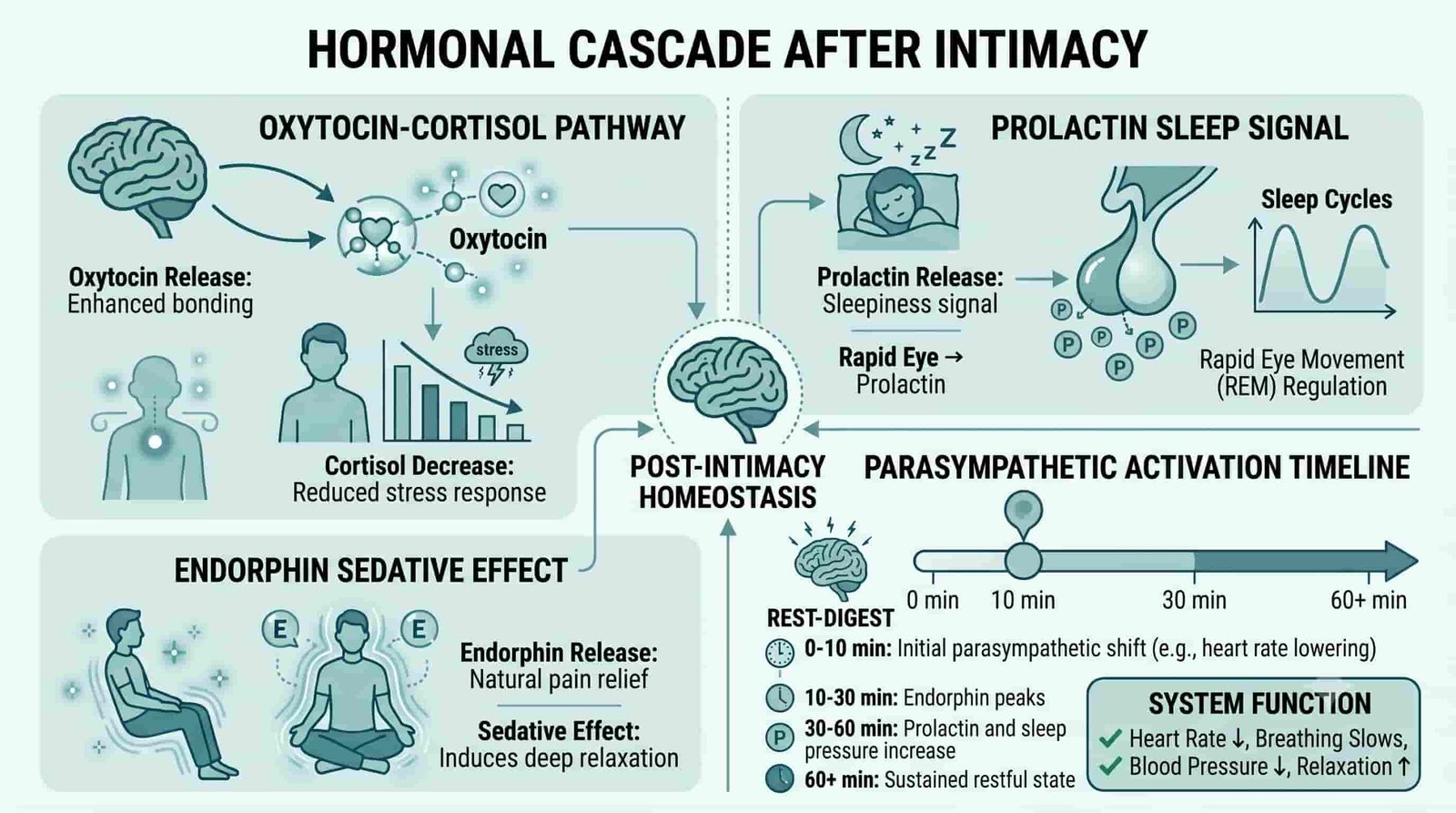
The neurochemical sequence that follows partnered intimacy is not accidental — it is a coordinated biological program designed to produce sleep after reproduction. Each hormone in the sequence has a specific physiological function in the hormones and sleep equation. Oxytocin reduces social threat assessment and lowers cortisol. Endorphins activate the body’s natural pain-control and pleasure systems simultaneously. Prolactin — the most sleep-specific hormone in the cascade — signals completion and safety to the brain, triggering the transition to parasympathetic dominance. Together, these three hormones produce a neurochemical state that is measurably different from the baseline state, and significantly more conducive to sleep onset.
The Cortisol Paradox
The hormones and sleep connection is most visible in its negative form: chronic stress simultaneously suppresses libido and disrupts sleep through the same mechanism. Cortisol suppresses the hypothalamic release of GnRH, reducing testosterone and estrogen, which suppresses sexual desire. Simultaneously, cortisol keeps the sympathetic nervous system activated, preventing the parasympathetic state required for sleep onset. The person who is too stressed to sleep is also too stressed to want sex — and the two deficits reinforce each other. The intervention that reduces cortisol (intimacy) addresses both problems simultaneously.
Oxytocin and Sleep: How the Bonding Hormone Lowers Cortisol and Activates Safety Signaling
Oxytocin is the primary hormone of social safety — and social safety is the prerequisite for sleep. The brain cannot enter the parasympathetic state required for sleep if threat-detection is active. Oxytocin operates directly on the amygdala, reducing its sensitivity to threat signals and lowering the cortisol response to ambiguous or stressful stimuli. This is why the hormones and sleep connection is so pronounced for partnered adults: oxytocin released during touch, intimacy, and bonding directly silences the threat-detection network that prevents sleep onset. For people whose insomnia is driven primarily by rumination and anxiety — rather than by sleep environment or physical discomfort — oxytocin may be the most effective single intervention available.
Prolactin: The Sleep Hormone That Surges After Climax and Why Partnered Sex Produces More
Prolactin is the most sleep-specific hormone in the intimacy-sleep cascade, and the most scientifically underappreciated. Elevated prolactin is a biological signal that the reproductive mission has been completed — the body can now safely enter the energy-conservation state of sleep. Research by Exton and colleagues at the University of Newcastle found that prolactin levels after partnered sex were 400% higher than after masturbation. The biological difference is profound: partnered intimacy produces a significantly stronger sleep signal than solitary release. This is not a moral argument. It is a hormonal one. The social component of connection — the presence of a partner, the trust, the safety signaling — amplifies the prolactin surge and the resulting drowsiness.
Endorphins as Natural Sedatives: Why the “Runner’s High” and Post-Sex Sleep Feel Similar
Endorphins — the body’s natural opioids — produce sedation and pain relief simultaneously. The post-sex drowsiness that most people experience is partially an endorphin effect: the brain’s opioid system has been activated, producing a mild euphoria and a general reduction in physical and psychological tension. This is the same mechanism behind the runner’s high, though mediated through different pathways. The hormones and sleep connection through endorphins is direct: elevated endorphin levels produce measurable reductions in arousal and increases in subjective drowsiness. Unlike external opioids, endorphins do not disrupt sleep architecture — they facilitate the transition into sleep without suppressing REM or deep sleep stages.
The Partnered vs. Solitary Question: Does Connection Actually Change the Sleep Chemistry?
The scientific evidence on partnered versus solitary intimacy and sleep is unambiguous: partnered sex produces significantly greater improvements in sleep quality than solitary release, through a different and more powerful hormonal mechanism. The difference is primarily prolactin — which surges more powerfully after partnered sex — and oxytocin, which requires a partner to be released at all. Endorphin levels are similar in both conditions, but the prolactin-oxytocin combination after partnered intimacy produces a neurochemical state that is measurably more conducive to sleep onset. This does not mean solitary release is counterproductive — it provides endorphin-mediated relaxation. But the full hormones and sleep cascade requires the social safety signal that only connection provides.
The Cortisol Paradox: How Stress Kills Both Libido and Sleep Simultaneously
The reason most adults who need better sleep are not using intimacy as a sleep aid is the same reason they have poor sleep in the first place: cortisol. Chronic stress — from work, relationships, health anxiety, or financial pressure — activates the HPA axis and keeps cortisol chronically elevated. This suppresses the gonadal axis, reducing testosterone and estrogen, which suppresses sexual desire. It simultaneously keeps the sympathetic nervous system activated, preventing the parasympathetic transition required for sleep. The person who is too stressed to sleep is too stressed for intimacy, and too tired from poor sleep to have the energy for it. Breaking this cycle requires addressing the cortisol elevation directly — which intimacy itself can do, if the person can get there.
Scheduling Intimacy for Better Sleep: The Practical Protocol That Doesn’t Require Spontaneity
For busy adults with demanding careers, young children, or high-stress lives, spontaneity is a luxury that rarely materializes. The solution is not romantic理想 — it is practical scheduling. Treating intimacy the same way you treat a workout — as a non-negotiable health appointment — removes the spontaneous-vs-scheduled false dichotomy. Here is the practical hormones and sleep protocol:
⚡ The Hormonal Sleep Protocol: 4-Week Intimacy Schedule
- Week 1-2 — Schedule, don’t negotiate: Block 30 minutes of connection time in the evening before bed. This is not a prescription for sex — it is a prescription for physical proximity, touch, and presence. Begin with non-sexual touch: shoulder massage, leg touching, simply lying together without agenda.
- Week 2-3 — Add the hormonal trigger: When the relationship foundation of physical trust is established, the sexual component can be introduced without pressure. The goal is the neurochemical cascade, not the performance. The intimacy produces the hormones. The hormones produce the sleep.
- Week 3-4 — Optimize the timing: For most adults, testosterone and estrogen peak in the morning. Libido typically follows a 24-hour curve with a secondary peak in the evening. Experiment with timing to find when both partners’ natural rhythms align. The goal is not to synchronize perfectly — it is to remove the scheduling excuse entirely.
- Environmental rule: Bedroom = sleep + intimacy. No screens, no work, no problem-solving. The bedroom must signal safety and connection, not productivity or stress. If the bedroom has become the location of arguments, work emails, or TV avoidance, it cannot support the oxytocin response required for either intimacy or sleep.
When Drives Are Mismatched: Navigating Libido Differences Without Relationship Damage
Libido mismatch is one of the most common sources of relationship tension — and it is frequently a symptom of the same stress patterns that disrupt sleep for both partners. The hormones and sleep connection does not require equal desire from both partners. What it requires is a shared understanding that intimacy is a health practice, not a performance metric. The lower-libido partner is often not rejecting their partner — they are experiencing the same cortisol-driven suppression of desire that disrupts their own sleep. Addressing the sleep disruption often addresses the libido discrepancy. When both partners are sleeping better, desire typically improves without any direct intervention on the sexual relationship.
The Slumbelry Framework: Sleep Is a Vulnerable State — And Intimacy Is the Safety Signal Your Body Receives
Slumbelry’s engineering framework for sleep recognizes a biological truth that most sleep optimization approaches ignore: sleep is not primarily a mechanical problem. It is a safety problem. The brain enters sleep only when the threat-detection network stands down. The most powerfulStand-down signal the body receives is not a supplement, not a temperature setting, not a blackout curtain — it is social connection with a trusted partner. The hormones and sleep science is unambiguous: oxytocin, prolactin, and endorphins create the neurochemical conditions for sleep that no pharmaceutical or environmental intervention can replicate. Slumbelry designs for both layers: the physical environment for parasympathetic activation, and the recognition that for partnered adults, intimacy is the most effective sleep technology available — and it is free.
Action step: This week, add one 20-minute non-negotiable connection window to your schedule — before the screens come out, before the evening wind-down, before the excuses. Physical proximity without agenda is the beginning of the hormonal cascade. The sleep will follow.
Frequently Asked Questions About Hormones and Sleep
How do hormones and sleep interact after intimacy?
The hormones and sleep interaction after intimacy follows a specific sequential cascade: (1) Oxytocin released during physical connection and arousal reduces cortisol and activates the brain’s social safety circuitry. (2) Endorphins released at climax produce natural sedation and pain relief. (3) Prolactin surges dramatically in the post-orgasm period, signaling to the brain that the reproductive mission is complete and sleep is safe to pursue. (4) The cumulative effect is a coordinated transition to parasympathetic dominance. This cascade takes approximately 30-60 minutes to peak, making the post-intimacy period the optimal window for sleep onset. The hormones produced are not stimulants — they are precisely the biochemical conditions the brain requires to enter sleep.
Why does partnered sex produce better sleep than masturbation?
Partnered sex produces significantly higher prolactin surges than masturbation — approximately 400% higher according to research by Exton and colleagues. Prolactin is the primary sleep-signaling hormone in the post-intimacy cascade. Additionally, only partnered intimacy triggers significant oxytocin release — which reduces cortisol and silences the threat-detection network. Masturbation produces endorphins and some prolactin, but not the full hormonal cascade. The biological difference is not a moral judgment — it is a quantitative hormonal difference. Both produce sleep-favorable conditions; partnered sex produces a more complete version of those conditions.
Can intimacy help if my insomnia is caused by anxiety, not physical problems?
Yes — intimacy may be the most effective intervention for anxiety-driven insomnia specifically. Anxiety-driven insomnia is maintained by a hyperactive threat-detection network and elevated cortisol. Oxytocin directly reduces amygdala reactivity and lowers cortisol. Unlike anxiety medications (which often disrupt sleep architecture) or sleep medications (which do not address the underlying anxiety), intimacy addresses the specific mechanism maintaining anxiety-driven insomnia: the cortisol-threat loop. For people whose insomnia is primarily caused by racing thoughts, catastrophic thinking, or generalized anxiety, the oxytocin component of intimacy directly targets the mechanism. The hormonal cascade after intimacy produces a neurochemical state that is measurably anti-anxiety.
Why does chronic stress kill both libido and sleep simultaneously?
Cortisol and the reproductive/parasympathetic systems operate on the same hypothalamic-pituitary axis. When chronic stress keeps cortisol elevated, the hypothalamus suppresses GnRH release, which reduces testosterone and estrogen, which suppresses libido. Simultaneously, elevated cortisol keeps the sympathetic nervous system activated, preventing the parasympathetic transition required for sleep onset. The same mechanism — HPA axis activation — produces both the low-libido and the insomnia. This is why addressing stress (through intimacy, meditation, or therapy) can improve both libido and sleep simultaneously. They are not independent systems with independent treatments.
How does prolactin affect sleep quality specifically?
Prolactin’s sleep function is specific and direct: elevated prolactin signals to the brain that the reproductive sequence has been completed, which removes a biological brake on sleep onset. In men, prolactin also suppresses dopamine, which reduces the wakefulness drive and increases drowsiness. The prolactin surge after intimacy is significantly larger than any prolactin spike that occurs without sexual activity. This surge produces measurable subjective drowsiness and reduces sleep onset latency. Research shows that the post-intimacy prolactin surge is approximately 400% greater after partnered sex than after masturbation — a quantitative difference that produces a qualitative difference in sleep-onset speed.
What is the optimal timing for intimacy to maximize sleep benefits?
The hormonal cascade after intimacy peaks at approximately 30-60 minutes post-climax. For sleep purposes, intimacy should occur 60-90 minutes before planned sleep time — enough for the cascade to begin, not so much time that cortisol from exertion has not yet declined. Evening intimacy (approximately 10 PM for someone planning 11 PM sleep) typically aligns with the body’s natural cortisol decline and the prolactin-oxytocin-endorphin cascade peak. Morning intimacy can also benefit sleep that night — through the reduction of acute stress hormones throughout the day, not through the immediate hormonal cascade.
Can intimacy help when sleep problems are caused by relationship conflict?
Intimacy is both a treatment for and a buffer against relationship conflict-driven sleep disruption — but only if the conflict is not active at the time of intimacy. Oxytocin from physical connection promotes trust and reduces defensiveness, which can create a positive feedback loop in a strained relationship. However, using intimacy as a repair tool while active conflict is unresolved can backfire — the threat-detection activation from unresolved conflict can prevent the oxytocin response from fully activating. For relationship-driven sleep disruption, the sequence is: first, address acute conflict or agree to table it during the intimacy window; second, use intimacy as the daily maintenance that prevents conflict escalation; third, if sleep disruption persists, seek couples therapy to address the underlying relationship patterns.
Does the quality of intimacy matter for sleep, or just the physical activity?
Both matter, but in different ways. The hormonal cascade is triggered by physical sexual activity regardless of emotional quality. However, the magnitude of the cascade — particularly oxytocin and prolactin — is significantly modulated by emotional connection, trust, and the presence of a bonded partner. Research on the prolactin differential between partnered and solitary release suggests that the social component of connection amplifies the biological signal. For maximum sleep benefit, the optimal intimacy involves: emotional presence and trust (which amplifies oxytocin), physical activity that produces the full hormonal sequence (which produces prolactin and endorphins), and sufficient duration to allow the cascade to peak before sleep onset.
What if one partner has a much lower libido — how do you maintain the hormones and sleep cycle?
Libido mismatch is common and often a symptom of the same stress patterns that cause poor sleep in both partners. The practical approach: (1) Separate desire from the sleep-optimization goal — intimacy as a health practice does not require equal desire from both partners. (2) Lower-libido partners often have cortisol-driven suppression of desire that they may not consciously recognize as stress. When both partners begin sleeping better, libido typically increases naturally. (3) Physical intimacy that does not involve full sexual activity (cuddling, massage, simply lying together) still produces meaningful oxytocin release. The full hormonal cascade is not required for meaningful sleep benefit. Even moderate oxytocin elevation reduces cortisol enough to improve sleep onset.
Are there risks to using intimacy as a sleep aid?
The only meaningful risk is using it as a substitute for addressing underlying medical causes of insomnia (sleep apnea, restless leg syndrome, depression) or as a manipulative tool in a relationship. Otherwise, intimacy as a sleep aid has no pharmacological risks, no dependency risk, no tolerance effect, and no side effects beyond those of a healthy sexual relationship. It is among the safest and most physiologically appropriate sleep interventions available. The only contraindication is acute relationship conflict — intimacy during active conflict can damage the relationship and prevent the oxytocin response from activating. The relationship must have sufficient safety for intimacy to produce its sleep benefits.
Ready to Add the Most Natural Sleep Aid to Your Routine?
The hormones and sleep connection is not a theory. It is a measurable, reproducible biological program that costs nothing.
Take the Sleep Assessment Subscribe for Sleep Optimization TipsThe Slumbelry Commitment
Sleep is the most vulnerable state of human existence. It is where we heal, reset, and grow.
At Slumbelry, we do not just sell sleep products; we advocate for your physiological right to rest. From ergonomic support to light management, every solution we offer is designed with one obsession: Respecting your Biology.
Science is our language, but your recovery is our purpose. You take care of everything else in your life — let us take care of your sleep.
Rest Deeply,
The Slumbelry Team
Medical References:
1. Exton, M. S., et al. (2001). Prolactin after partnered sex: The effects of sexual arousal and orgasm. Archives of Sexual Behavior.
2. Carter, C. S. (1992). Oxytocin and sexual behavior. Hormones and Behavior.
3. Kruger, T. H. C., et al. (2003). Effects of acute prolactin manipulation on sexual drive and desire. Psychoneuroendocrinology.