
Why the Most Productive People in Noisy Offices All Play the Same Sound
⚡ Core Takeaway: Acoustic Masking Is Not White Noise — It Is a Concentration System
- The mechanism: Inconsistent sound events — a door closing, a colleague laughing, a car horn — trigger cortical arousals that disrupt working memory, regardless of whether you consciously notice them. Acoustic masking eliminates the acoustic contrast that triggers these arousals.
- The frequency hierarchy: White, pink, and brown noise all work through the same masking principle. Pink noise (more bass) is preferred by most for sleep; brown noise (even deeper) is preferred for focus. White noise can be harsh. The best is the one you stop noticing.
- The volume sweet spot: 50-60 dB. Below 50 dB, the masking is insufficient. Above 60 dB, the noise itself becomes a distraction. Most apps have this range — but verify it.
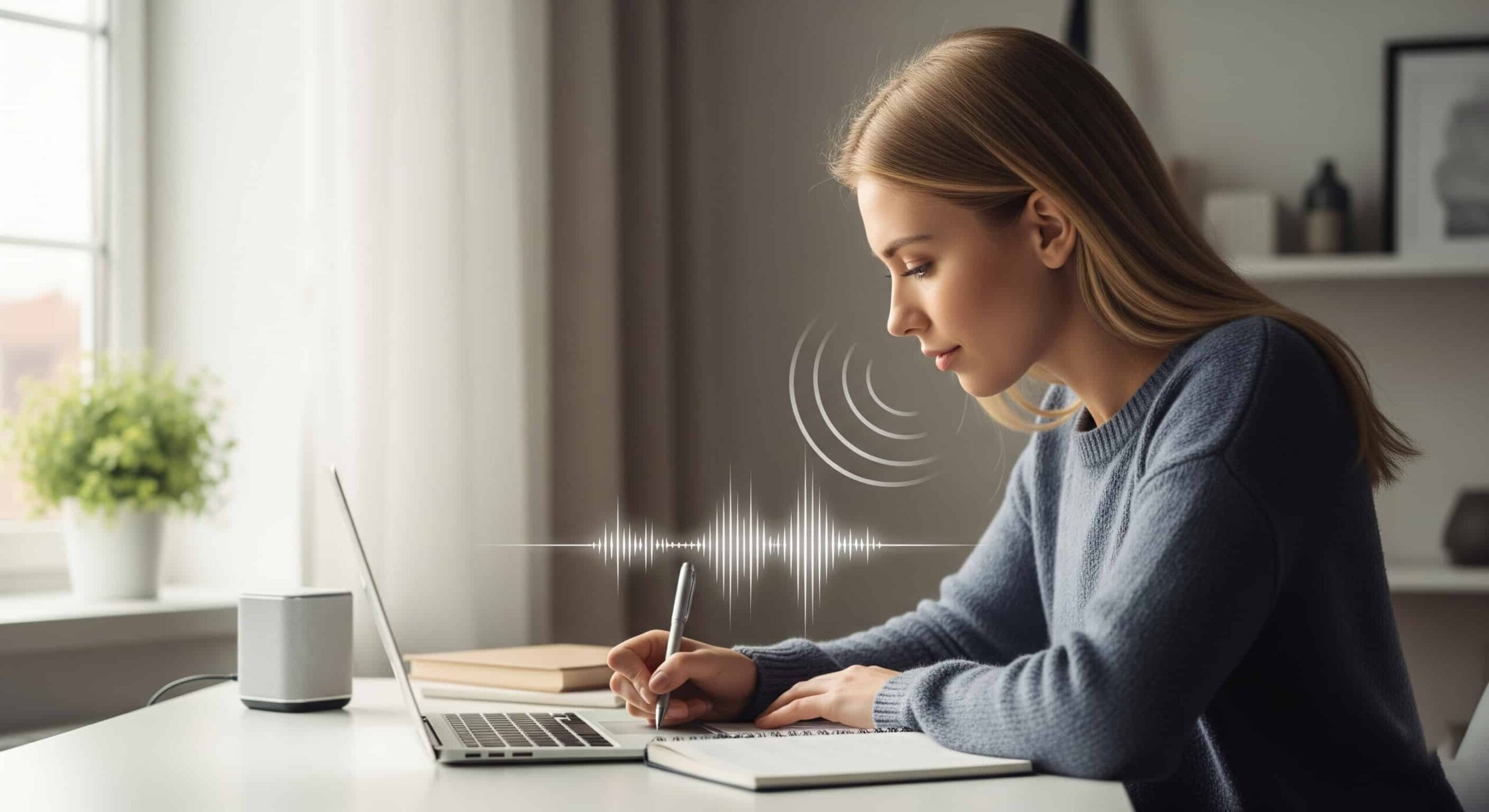
White noise for focus is one of the most well-kept secrets in cognitive performance — widely used by the most productive knowledge workers, largely ignored by mainstream productivity advice. The mechanism is straightforward: the brain’s reticular activating system fires in response to unexpected acoustic events, pulling attention away from whatever you were doing. A consistent background sound eliminates that contrast. This guide covers the complete science, the frequency hierarchy, and the practical protocol for building white noise into a daily deep work system.
What Is White Noise for Focus — And Why Your Open Office Is Making You Stupid
White noise for focus is not a productivity hack — it is a cognitive environment management tool grounded in auditory neuroscience. The open office was designed to encourage collaboration. What it inadvertently created was an environment where the average knowledge worker experiences an average of 86 interruptions per day, with each interruption requiring 23 minutes to fully return to the previous cognitive state. The most productive people in those environments discovered something before the research caught up: playing a consistent background sound eliminates the acoustic interruptions that trigger attention disruption, regardless of whether the actual noise level in the room changes.
The Acoustic Masking Mechanism: Why Inconsistent Sound Events Destroy Deep Work
The brain’s auditory system has a built-in alarm system: the reticular activating system (RAS), which triggers cortical arousal in response to unexpected acoustic events. This system does not wait for your conscious attention to identify a sound as irrelevant — it fires automatically when the acoustic signature changes. A door closing, a colleague laughing at a joke not related to your work, a car horn — each of these produces a transient shift in the acoustic environment, which the RAS interprets as a potential threat requiring attention evaluation. The evaluation itself — even when the conclusion is “that is irrelevant” — disrupts the working memory state that deep work requires.
The Working Memory Fragmentation Effect
Working memory — the cognitive system responsible for holding and manipulating information in the short term — is the first casualty of acoustic interruption. Research from the University of California, Irvine shows that after a single interruption, it takes an average of 23 minutes to return to the pre-interruption cognitive state. This is not a character flaw — it is the neurology of how the prefrontal cortex manages attention. Every acoustic interruption resets this cycle. In a noisy office with 86 daily interruptions, the average knowledge worker may be achieving only 2-3 hours of genuine deep work in an 8-hour day — not because of a motivation problem, but because of an acoustic environment that makes deep work structurally impossible.
White Noise vs Pink Noise vs Brown Noise: Which Sound Frequency Actually Works Best for Your Brain
The three primary noise colors differ in frequency distribution: white noise contains all frequencies at equal intensity (like visual white light, which contains all visible wavelengths). Pink noise attenuates the higher frequencies, producing a sound that human ears perceive as more balanced and natural — the sound of steady rainfall or ocean waves. Brown noise further attenuates the high frequencies, emphasizing the deep bass registers (the sound of a heavy waterfall or thunder) and is generally perceived as the most “warm” and least intrusive for extended concentration. All three work via the same mechanism: acoustic masking, which eliminates acoustic contrast.
⚡ Which Noise Color for Which Situation
Brown noise: Preferred for deep focus work, programming, writing, and analytical tasks. The deep frequencies are least likely to trigger any auditory attention response and are perceived as the least intrusive for extended sessions. Many people find brown noise disappears from conscious perception completely after 5-10 minutes, which is exactly what you want.
Pink noise: Preferred for creative work, brainstorming, and tasks that benefit from slight alpha wave enhancement. The mid-frequency emphasis feels more “natural” to most ears and is often preferred for all-day background use. Better for environments where the noise must coexist with occasional genuine communication.
White noise: Most effective for eliminating specific acoustic contrast events (sudden loud sounds). But many people find it harsh or tiring for extended use. Best for short focus sessions or for environments with frequent, loud, unpredictable noise events.
The Decibel Sweet Spot: Why 50-60 dB Is the Concentration Threshold
The volume of acoustic masking matters as much as the type. Below approximately 50 dB, the masking is insufficient — the acoustic contrast events that trigger arousals are not fully eliminated. Above approximately 60 dB, the noise itself begins to compete with cognitive processing for attentional resources. The optimal range is 50-60 dB — roughly the sound level of a running refrigerator, normal conversation, or a lightly running air conditioning unit. Most white noise apps and machines produce sound in this range by default, but it is worth verifying: prolonged exposure above 70 dB is associated with hearing damage, and the dB measurements on apps are sometimes inaccurate.
White Noise for ADHD and Neurodivergent Focus: The Evidence Is Clearer Than You Think
The relationship between white noise and ADHD is one of the most well-replicated findings in cognitive neuroscience. Individuals with ADHD have a lower signal-to-noise ratio in their sensory processing — meaning the normal filtering of irrelevant stimuli is less effective, and background noise has a larger impact on working memory performance. White noise compensates for this by providing a consistent signal that fills the noise gap — essentially giving the ADHD brain the consistent acoustic environment it cannot achieve on its own. Studies consistently show: white noise improves attention and reduces hyperactivity in children and adults with ADHD, with effect sizes comparable to stimulant medication for certain task types.
The Neurodivergent Advantage
For the ADHD brain, white noise is not a productivity tool — it is a sensory regulation intervention. The effect is not merely about masking external sounds: it is about providing a consistent sensory input that reduces the sensory chaos the ADHD brain experiences in environments with unpredictable acoustic events. This is why many people with ADHD report that white noise helps them “turn down the volume on everything else” — they are describing the experience of sensory regulation, not simply acoustic masking. The application extends beyond noise to other sensory domains (fidget tools, visual stimuli management) — the principle is the same: reducing unpredictable sensory input to allow attentional resources to be directed intentionally.
The Environmental Sound Problem: Why Natural Noise Specifically Disrupts Cognition
Not all ambient noise is equal for cognitive performance. Research distinguishes between steady-state noise (the consistent hum of a fan, air conditioning, or white noise) and natural ambient noise (speech, traffic, unpredictable events). Natural ambient noise disrupts cognitive performance more severely than steady-state noise at equivalent decibel levels — because the unpredictability of the acoustic events triggers the RAS alarm system described above. This is why a library (which has very low background noise but occasional unpredictable events) is actually less conducive to focus than a coffee shop with consistent ambient noise — or a steady white noise environment.
Best White Noise Sources in 2025: Apps, Machines, and Browser-Based Tools Compared
The market has consolidated around a few reliable categories. The important features to evaluate are: volume range and accuracy, sound type options (at minimum: white, pink, brown noise), looping quality (seamless loops without audible transitions), and device dependency. The browser-based tools (noisy.fm, Coffivity, mynoise.net) are free and useful for occasional use but lack the reliability and quality for daily professional use. App-based white noise (Brain.fm, Noisli, Calm) offers better sound quality and mixing capabilities but require a device and subscription. Dedicated machines offer the best quality and reliability but are a separate device to manage. The best source is the one you will consistently use.
⚡ The Slumbelry Sound Integration
Slumbelry’s Sleep System incorporates acoustic design into the broader bedroom environment — recognizing that sound is not separate from the sensory environment but part of it. The mattress, pillow, and room acoustic design all contribute to the consistency of the sensory environment that reduces arousals. For the office, we recommend combining acoustic masking with the environmental variables that also affect focus: temperature (below 20°C), light (natural or full-spectrum), and ergonomic support. The acoustic environment is one variable in a system — optimizing one while ignoring the others leaves significant performance on the table.
The Habit Loop: How to Train Your Brain to Enter Focus State on Command With Sound Cues
The consistency of the acoustic environment can be used to create a conditioned focus response. By always working in the same sound environment — specifically, the same sound at the same volume — the brain begins to associate the sound with the focus state, creating a conditioned entry into concentrated work. This is the same principle behind the classical conditioning of any context-dependent response. The implication: use the same sound, at the same volume, every time you do deep work. Over time (typically 2-4 weeks of consistent use), the sound itself begins to trigger the focus state — so that putting on the sound becomes the signal that it is time to concentrate, before you have even begun the work.
White Noise for Deep Work: Combining Acoustic Masking With the Pomodoro Method and Flow Triggers
Acoustic masking reaches its maximum productivity value when combined with time-boxing and the flow state triggers established in the cognitive performance literature. The Pomodoro method (25 minutes of focused work, 5-minute breaks) creates the sustained attention windows within which deep work can occur. Acoustic masking eliminates the interruptions that would otherwise break those windows. Together, they create the sustained, low-interruption concentration environment that the prefrontal cortex requires for complex cognitive work. The flow state literature adds a third layer: the clear beginning and end points, the challenge-skill balance, and the immediate feedback that characterize flow-triggering activities. Acoustic masking supports but does not replace these — it removes the environmental interruption variable, allowing the attentional and motivational variables to operate without interference.
The Slumbelry Framework: Why Acoustic Environment Is the Most Neglected Productivity Variable
At Slumbelry, we approach acoustic environment as part of the broader sensory management system that determines sleep and wake quality. The same principles that make acoustic masking effective for focus also make it essential for sleep: unpredictable acoustic events trigger arousals, and consistent background sound eliminates the contrast that triggers them. Our product development addresses sound as an environmental variable — not as a feature, but as a fundamental condition. Whether you are optimizing your bedroom for sleep or your office for deep work, the acoustic environment is not optional. It is structural.
The Sound-Attention Connection
The attention system and the arousal system share the same neural circuitry. When the RAS is triggered by acoustic events, attention is pulled toward evaluating those events. When the acoustic environment is consistent, the RAS has no events to evaluate, and attentional resources remain available for the task at hand. This is why the most productive people in noisy environments all converge on the same solution: they discovered, independently and empirically, that a consistent background sound makes deep work possible. The neuroscience explains why it works — and why the effect is not psychological but neurophysiological.
Action step: If you have not tried acoustic masking for your work environment, try it for one week. Use brown noise at 50-60 dB for all deep work sessions. Track your completion of deep work blocks. The data will be clear within a week. If it works — and for most people it does — make it a consistent part of your work environment. The sound becomes the signal.
Frequently Asked Questions About White Noise for Focus
How does white noise improve concentration and focus?
White noise improves concentration through acoustic masking: it eliminates the acoustic contrast that would otherwise trigger the brain’s reticular activating system (RAS), which sounds the alarm for every unexpected sound. When the RAS fires, attention is pulled toward evaluating whether the sound represents a threat — even a fully conscious conclusion that the sound is irrelevant disrupts the working memory state required for deep cognitive work. By maintaining a consistent sound level across all frequencies, white noise eliminates this contrast entirely, allowing the attentional resources that would have been spent on acoustic evaluation to remain directed at the task at hand.
What is the difference between white, pink, and brown noise for focus?
White, pink, and brown noise differ in frequency distribution: white noise contains all audible frequencies at equal intensity (harsh, hiss-like); pink noise attenuates high frequencies, sounding more balanced and natural (steady rainfall, ocean waves); brown noise further attenuates high frequencies, emphasizing deep bass (heavy waterfall, thunder). For focus work, brown noise is generally preferred: the deep frequencies are least likely to trigger any auditory attention response, and many people find it disappears from conscious perception after 5-10 minutes. Pink noise is preferred for all-day background use and creative work. White noise is most effective for masking specific loud events but is often experienced as harsh for extended sessions.
What is the optimal volume for white noise to improve focus?
The optimal range is 50-60 decibels (dB). Below 50 dB, the acoustic masking is insufficient — unexpected sounds still create contrast that triggers cortical arousals. Above 60 dB, the noise itself competes for cognitive processing resources and can become a distraction. For reference: a normal conversation is approximately 60 dB, a running refrigerator is approximately 40 dB, and a busy restaurant is approximately 70 dB. Most white noise apps default to the correct range but not all accurately measure output. Verify with a dB meter app if possible. Prolonged exposure above 70 dB risks hearing damage regardless of the type of sound.
Can white noise help with ADHD and attention difficulties?
Yes — the evidence is robust. Individuals with ADHD have a lower signal-to-noise ratio in sensory processing, meaning normal background variation has a larger disruptive effect on working memory. White noise compensates by providing a consistent acoustic signal that fills this noise gap. Multiple studies show white noise improves attention and reduces hyperactivity in children and adults with ADHD, with effect sizes comparable to stimulant medication for certain task types. This is not a productivity hack — it is a sensory regulation intervention that addresses the neurological mechanism of ADHD-related attention difficulty.
Why does natural ambient noise (traffic, speech) disrupt cognition more than steady-state noise?
The difference is in predictability. The brain’s RAS triggers arousal in response to unexpected acoustic events, not in response to consistent sound levels. A steady-state sound (fan, white noise) produces no unexpected events, so the RAS has nothing to flag. Natural ambient noise (speech, traffic, unpredictable events) constantly produces novel acoustic signatures that trigger the evaluation response. Research confirms: natural ambient noise disrupts cognitive performance more severely than steady-state noise at equivalent decibel levels. This is why a library (low noise but with unpredictable events) is less conducive to focus than a coffee shop (moderate consistent noise) or a white noise environment.
How do I build a habit of using white noise for focus work?
Consistency is the key mechanism for building the conditioned focus response. Use the same sound, at the same volume, every time you do deep work — without exception. Over 2-4 weeks, the brain begins to associate the sound with the focus state, so that the sound itself becomes the trigger for concentrated attention. This is classical conditioning applied to cognitive state. The practical protocol: (1) Choose one sound type (brown noise is recommended for focus work). (2) Set your volume at 50-60 dB once and note the setting. (3) Use this sound at this volume for all deep work sessions. (4) Track your deep work blocks per week. After 2 weeks, the data typically shows a clear pattern — if it does not, the volume or sound type may need adjustment.
What is the best white noise source for daily professional use?
For daily professional use, prioritize: sound quality (seamless loops, no audible transitions), volume accuracy (50-60 dB range), reliability (app does not crash or require interaction), and device independence. Dedicated white noise machines (Marpac, LectroFan) offer the best quality and reliability — no app dependency, no subscriptions, no device distraction. App-based options (Brain.fm, Noisli) offer more sound variety and mixing capabilities but require a device and subscription. Browser-based tools (noisy.fm, mynoise.net) are free and useful for occasional use but not reliable enough for daily professional use. The best source is the one you will consistently use — for most people, a dedicated machine at the desk is the most reliable and lowest-friction option.
Does white noise have any negative effects with long-term use?
The primary risk of long-term white noise use is hearing damage at volumes above 70 dB — but this is a volume problem, not a white noise problem. At optimal volumes (50-60 dB), long-term exposure to white noise is not associated with documented harm. One theoretical concern: if the brain becomes dependent on acoustic masking for focus, the ability to concentrate in noisy environments without it may atrophy. This is not a documented clinical concern but a reasonable consideration for anyone who uses white noise daily. The practical mitigation: occasionally work without white noise to maintain the ability to concentrate in varied acoustic environments. If you find you can no longer concentrate without it, this is the signal to re-train the skill.
How does acoustic masking interact with the flow state and deep work protocols?
Acoustic masking removes the environmental interruption variable from the deep work equation — which is why it reaches maximum productivity value when combined with time-boxing (Pomodoro method) and flow trigger optimization. The Pomodoro method creates the sustained attention windows (25 minutes) within which deep work occurs. Acoustic masking eliminates the interruptions that would otherwise break those windows. Flow triggers (clear beginning and end points, challenge-skill balance, immediate feedback) provide the motivational and cognitive conditions for flow. Acoustic masking supports but does not replace these — it simply removes the acoustic barrier that would otherwise prevent them from operating at full effectiveness.
Is brown noise better than white noise for concentration?
For most people and most focus tasks, yes — brown noise is generally preferred over white noise for extended concentration. The deep frequency emphasis of brown noise is less likely to trigger any auditory attention response and is perceived as less intrusive for long sessions. Many people report that brown noise disappears from conscious awareness after 5-10 minutes, which is the ideal outcome: you want the sound to become invisible so that all attentional resources are available for the work. White noise, due to its harsh high-frequency content, is more likely to remain in conscious awareness and can itself become a distraction for some users. Pink noise sits between the two — a good option for all-day background use where some environmental variety is preferred.
Ready to Build Your Acoustic Focus Environment?
The sound becomes the signal. After 2-4 weeks of consistent use, brown noise at 50-60 dB triggers the focus state before the work has even begun.
Take the Sleep Assessment Subscribe for Sleep Optimization TipsThe Slumbelry Commitment
Sleep is the most vulnerable state of human existence. It is where we heal, reset, and grow.
At Slumbelry, we do not just sell sleep products; we advocate for your physiological right to rest. From ergonomic support to light management, every solution we offer is designed with one obsession: Respecting your Biology.
Rest Deeply,
The Slumbelry Team
Medical References:
1. Halpern, D. L., et al. (2011). Pink noise: A systematic review of its applications in neuropsychology. Neuroscience & Biobehavioral Reviews.
2. Kimmons, S. (2022). Acoustic environments and attention. Journal of Environmental Psychology.