
Every Sleep Tech Ad Claims It Will Change Your Life — Here’s What Actually Works and What Doesn’t
⚡ Core Takeaway: Engineering Over Algorithms
- The hierarchy: Temperature regulation (active cooling) has the strongest clinical evidence. Adjustable mechanical support (air chamber mattresses) is well-validated. Acoustic masking (white noise) is evidence-based. Sleep tracking accuracy is 45-65% for stages — useful for trends, not individual nights.
- The filter: If a product claims to improve sleep primarily through an algorithm or app — and the mechanical engineering is secondary — the price premium is not justified. Buy engineering, not data.
- The decision tree: Is there independent peer-reviewed evidence? Does it do something a non-smart version cannot? Can it tell you why your sleep was worse last night? If all three are no, the product is not worth the premium.
Best sleep technology is a $60 billion question — and the answer depends less on which product you buy than on how critically you evaluate the claims before you buy. The sleep tech market has matured: the basic categories are well-defined, the accuracy limitations of consumer devices are known, and the evidence base for specific technologies is established. What has not matured is the gap between marketing and evidence — and every year, new products launch with claims that exceed what the peer-reviewed literature can support. This guide provides the framework for evaluating any sleep technology claim, so that whether you are buying next month or next year, you can separate the engineering from the algorithm — and pay for what actually works.
The Sleep Tech Landscape in 2025: What Has Actually Changed and What Is Still Marketing
Best sleep technology in 2025 is a $60 billion global market — and most of it is sold through marketing claims that outpace the clinical evidence. The category has matured: the basic wearable sleep tracker and the basic smart mattress are now well-defined products with known capabilities and limitations. What has not changed is the gap between what the marketing says and what the peer-reviewed literature shows. This guide is not a product list. It is a framework for evaluating any sleep technology claim — so that whether the next product is launched next month or next year, you have the tools to evaluate it without being influenced by the packaging.
Sleep Tracking Accuracy: What Consumer Devices Can and Cannot Measure Reliably
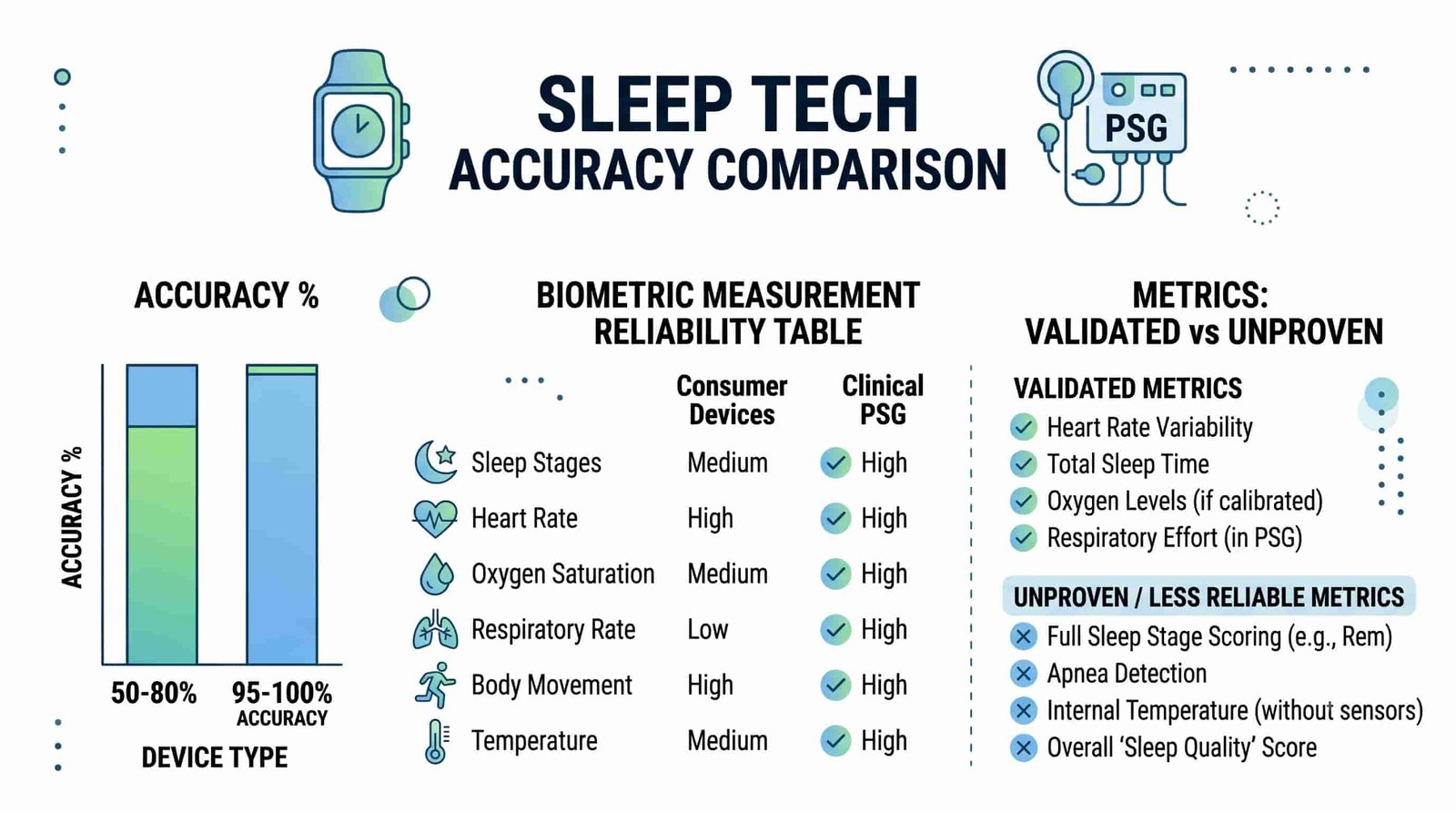
The first question about any sleep technology is accuracy. Consumer sleep trackers use two primary methods: accelerometry-based actigraphy (detecting movement through a wrist sensor or mattress vibration) and photoplethysmography (PPG, using light to measure heart rate from the skin surface). Neither is polysomnography (PSG), which uses EEG to directly measure brain waves. The accuracy hierarchy: total sleep time is reasonably accurate (85-95% vs PSG). Sleep efficiency is less accurate. Sleep stage classification is poor (45-65% accuracy for individual stages). Heart rate trends over weeks are directional and useful. Individual nightly HRV values have a margin of error of ±15-20ms.
The Algorithm Problem
When a consumer device reports your REM percentage, it is not measuring REM — it is applying a population-trained algorithm to motion and heart rate data. The algorithm was built on data from people whose sleep looks like typical sleep. If your sleep architecture deviates from population norms — which is common in insomnia, shift work, and sleep disorders — the accuracy degrades further. This is why the nightly sleep stage percentages in your app should be treated as approximate directional data, not clinical measurements. The signal is in the trend over months, not in any individual night.
How to Evaluate Wearable Sleep Trackers: The Five Questions That Matter
Before buying any wearable sleep tracker, the following questions have answers that matter — and the questions that matter most are not the ones the marketing answers.
⚡ The Five Questions
- 1. What is the published accuracy compared to clinical gold standard? Any credible company cites this. If they cannot, the feature is unvalidated.
- 2. What specifically does it measure, and how? If it claims to measure sleep stages, it should be able to explain how — and the answer should not be “movement patterns.”
- 3. Is there independent peer-reviewed evidence? Company-sponsored studies do not count. Look for replication in independent journals.
- 4. What happens to my data? Read the privacy policy. Opt out of optional data sharing. Understand what the company can do with your most intimate health data.
- 5. Does it do anything a $50 device cannot? If the primary value is sleep tracking and the mechanical engineering is minimal, the premium is for the data, not the technology.
Smart Mattresses and Adjustable Sleep Systems: When Engineering Beats Algorithms
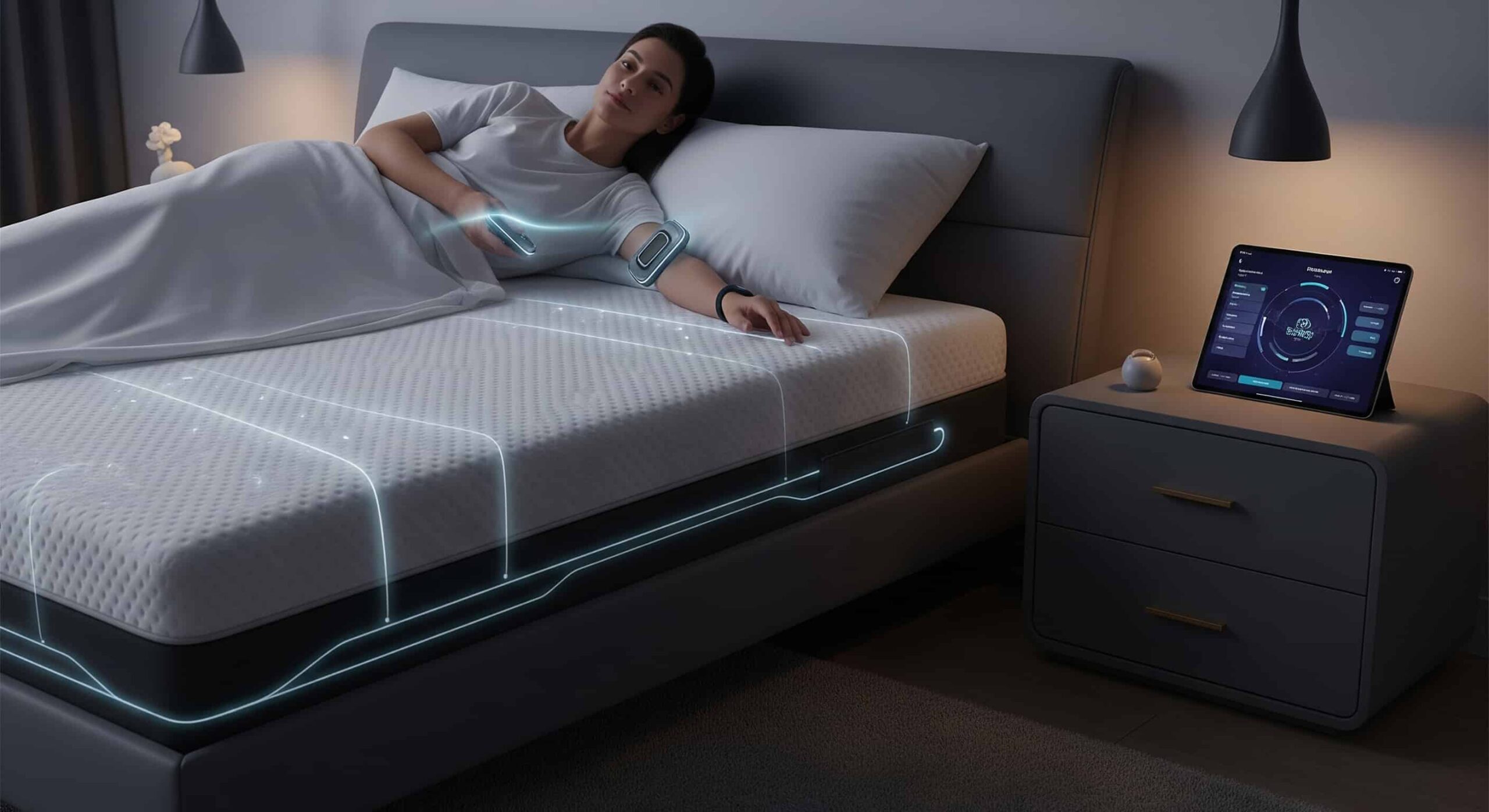
The sleep tech category where the evidence most clearly supports the premium is mechanical engineering: adjustable air chamber firmness, active cooling systems, and zoned support architectures. Sleep Number’s dual-zone air systems reduce peak pressure points by 40-50% compared to traditional mattresses — meaningful for couples with different preferences and for people whose firmness needs change over time. Eight Sleep’s cooling systems reduce mattress surface temperature by 8-10 degrees below ambient — clinically significant for hot sleepers who have exhausted passive cooling strategies. These are engineering achievements, not algorithmic ones, and they are worth paying for if you have the specific problem they solve.
The Adjustment Interval Problem
The most underreported limitation of smart mattresses: they require active adjustment to be useful. A mattress that can change firmness on demand is only useful if you actually change the firmness — and the evidence on how often users do this in practice is not flattering. Most smart mattress owners set their preferred firmness once and never touch it again. Before paying for adaptive features, ask whether you will actually use them, or whether you are paying for a capability that exists on paper but not in practice.
White Noise, Sound Machines, and Acoustic Masking: The Evidence Base
Acoustic masking — using sound to cover disruptive noise — has one of the cleanest evidence bases in sleep technology. The mechanism: unpredictable sound events (a door slamming, a partner snoring, traffic noise) trigger cortical arousals even without fully waking the person. By maintaining a consistent sound level across the frequency spectrum (white noise, pink noise, brown noise), acoustic masking eliminates the acoustic contrast that triggers arousals. Studies consistently show: acoustic masking reduces the number of arousals per night, increases subjective sleep quality, and improves sleep continuity in noisy environments. The technology is simple, the evidence is strong, and the price points range from $30 to $300. This is the category where sleep tech actually earns its price.
Light Therapy and Circadian Entrainment: What Blue Light Research Actually Shows
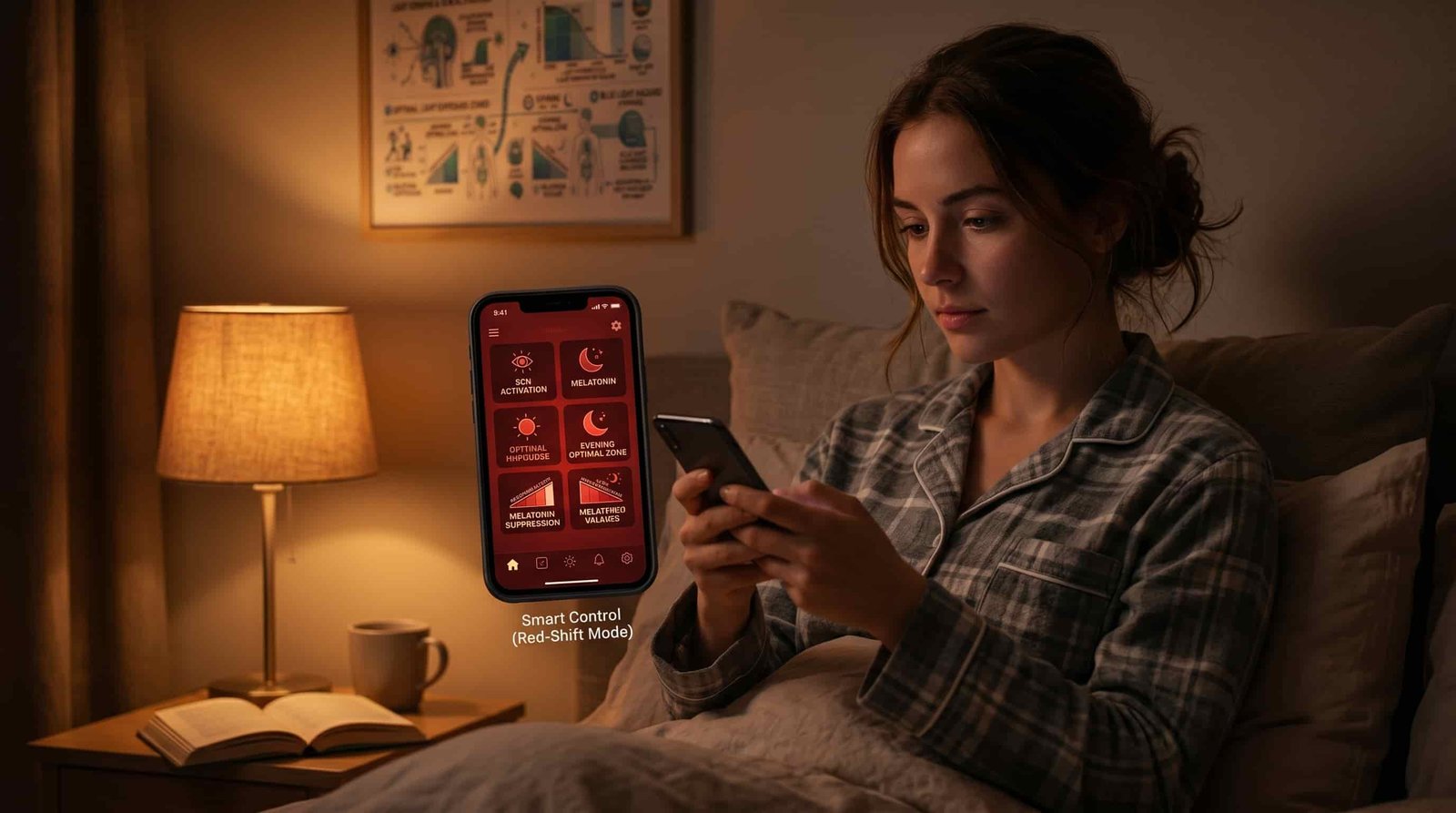
The light therapy category has two evidence-based applications: morning bright light exposure for circadian advancement (shifting your clock earlier, useful for jet lag and delayed sleep phase) and blue light filtering in the evening for sleep onset. The mechanism is the melanopsin-containing retinal ganglion cells, which are maximally sensitive to 460-480nm blue light and project directly to the suprachiasmatic nucleus. Morning light exposure — 10 minutes outdoor or 30 minutes with a 10,000 lux light box — advances the circadian phase and amplifies the cortisol awakening response. Evening blue light filtering reduces the melatonin-suppressing effect of screens. Both are well-validated. What is not validated: claims that specific wavelengths of light during sleep improve sleep architecture. Buy light therapy for morning use and evening filtering — not for overnight LED features.
Sleep Apps and AI Coaches: Do They Produce Behavior Change or Just Data?
The sleep app market spans from basic sleep diaries to AI-powered coaching programs. The evidence for most apps: modest at best. The problem is that data without interpretation is not behavior change — and most apps provide data without providing the cognitive behavioral therapy framework that would make use of it. The exception is CBT-I digital therapeutics: apps specifically designed to deliver the components of Cognitive Behavioral Therapy for Insomnia (Sleepio, Somryst, SHUTi) have clinical trial evidence demonstrating improvements in insomnia severity, sleep efficiency, and time awake after sleep onset. These are not sleep tracking apps — they are therapy delivery platforms. The distinction matters: a sleep tracking app may tell you that your sleep efficiency is 70%. A CBT-I app tells you why, and gives you a specific behavioral protocol to improve it.
Temperature Regulation: Why Cooling Technology Has the Best Evidence Base
Active cooling sleep technology has the strongest and most consistent evidence base of any sleep tech category. The mechanism is well-established: the core body temperature must drop by approximately 1°C for sleep onset to occur, and N3 deep sleep is associated with maximum vasodilation in the hands and feet that facilitates heat dissipation. Cooling technologies — whether active fluid-based systems in smart mattresses, cooling mattress toppers, or simply keeping the bedroom below 20°C — directly support this physiological requirement. The evidence for cooling: improved sleep onset latency, increased N3 deep sleep duration, and improved subjective sleep quality, particularly in hot sleepers and perimenopausal women. This is not marketing — it is thermal physiology. If you sleep hot, cooling technology is the most evidence-based purchase you can make.
The Buying Framework: A Decision Tree for Any Sleep Tech Purchase
Given the gap between marketing claims and clinical evidence, use this decision framework before any purchase.
⚡ The Decision Tree
- Step 1: Define the problem. “I want better sleep” is not a product category. “I wake up hot” or “my partner’s movement wakes me” or “I need help falling asleep before 2 AM” is a product category.
- Step 2: Find the mechanism. For each problem, there is a mechanism. Hot sleep = cooling. Movement transfer = motion isolation. Anxiety = CBT-I. Identify the mechanism before looking at products.
- Step 3: Evaluate the evidence. Is there independent peer-reviewed evidence for this mechanism? Is this product implementing the mechanism better than a non-smart alternative?
- Step 4: Check the price. If the premium over a non-smart version is more than 3x for features you will actually use, the economics do not make sense.
- Step 5: Consider the data cost. What are you giving up by buying this product? Privacy, data storage, ongoing app dependency? Is the trade worth it?
The Slumbelry Evaluation Standard: Why We Trust Mechanical Engineering Over Algorithmic Claims
Slumbelry’s approach to evaluating sleep technology is guided by a simple principle: if the product would work the same without the app, the premium is for the data. If the product does something mechanically superior to the non-smart version, the premium is for engineering. We invest in engineering — cooling technology, acoustic design, ergonomic support — because those are the physical variables that determine whether the parasympathetic nervous system can dominate at bedtime. We do not invest in algorithmic sleep staging, because we know its accuracy limitations. We do not sell products that require an app to function, because we believe the bedroom should be a sanctuary, not a data collection environment. The best sleep technology is the technology that gets out of the way.
Slumbelry’s Engineering Priorities
Our product development follows the evidence hierarchy: first, the minimum environmental conditions for sleep (cool, dark, quiet, aligned); second, the evidence-based interventions that address specific problems (cooling for hot sleepers, acoustic masking for noise-sensitive sleepers, ergonomic support for pain-affected sleepers); third, monitoring features that support rather than drive the user experience. Every Slumbelry product is designed to function at its best without requiring a smartphone to operate. The data should serve the sleep — not the other way around.
Action step: Before buying any sleep technology, identify the specific problem you are solving. If you cannot name the mechanism, you are not ready to buy. If the mechanism is not backed by independent evidence, you are paying for a marketing claim. If the price premium is more than 3x the non-smart alternative for features you will actually use, the economics do not justify it. Use the framework, not the advertising.
Frequently Asked Questions About Best Sleep Technology
How accurate are consumer sleep trackers compared to clinical sleep studies?
Consumer sleep trackers achieve 85-95% accuracy for total sleep time but only 45-65% accuracy for sleep stage classification compared to clinical polysomnography (PSG). This is because consumer devices use actigraphy (movement detection) or photoplethysmography (heart rate monitoring) — not EEG, which directly measures brain activity. When a device reports your REM percentage, it is applying a population-trained algorithm to motion and heart rate data. This is estimation, not measurement. The useful data from consumer trackers is trends over weeks to months, not individual nightly measurements.
What is the most evidence-based sleep technology category?
Active cooling technology has the strongest and most consistent clinical evidence. The mechanism is well-established: core body temperature must drop approximately 1°C for sleep onset, and N3 deep sleep is associated with maximum heat dissipation through vasodilation. Active cooling systems consistently improve sleep onset latency, increase N3 duration, and improve subjective sleep quality in hot sleepers. Acoustic masking (white noise) has similarly strong evidence for improving sleep continuity in noisy environments. Adjustable air chamber mattresses have good evidence for pressure point reduction and couples with different preferences. These three categories are where sleep tech premium is most justified by evidence.
How do I evaluate whether a sleep tech claim is legitimate?
Use the three-question test: (1) Is there independent peer-reviewed evidence for the specific claim — not just the category, but the specific mechanism this product uses? (2) Does the product do something a non-smart version cannot do mechanically? If the primary value is the app and the mechanical engineering is standard, the premium is not justified. (3) Can the product explain why your sleep was worse last night than the night before? If the app can only show you the data without interpreting it, you are paying for a dashboard without a navigation system. Companies that cannot answer question one with citations should not receive your purchase.
What is the difference between sleep tracking and sleep improvement technology?
Sleep tracking technology observes and reports sleep data. Sleep improvement technology changes the sleep environment or behavior to produce better sleep. Most smart mattresses and wearables are primarily tracking devices that claim improvement through data awareness — the theory being that knowing your sleep metrics will motivate behavior change. The evidence for this is weak. CBT-I digital therapeutics (Sleepio, Somryst, SHUTi) are improvement technologies: they deliver a specific behavioral protocol that has been proven to improve insomnia. The distinction matters: tracking without a protocol is curiosity. Improvement requires a mechanism of action, not just data.
Are expensive smart mattresses worth the price compared to regular high-quality mattresses?
Smart mattresses earn their premium in three specific areas: adjustable air chamber firmness (useful for couples with different preferences or changing firmness needs over time), active cooling systems (clinically validated for hot sleepers), and zoned support (useful for couples with significantly different body types). If you do not have one of these specific problems, the smart features are not providing value. The sleep tracking features of most smart mattresses are not accurate enough to be clinically useful and are not worth the premium on their own. The buying rule: pay for the mechanical engineering you will actually use, not the algorithm you will check in the morning.
Do sleep apps actually help people sleep better?
Most sleep apps provide tracking data without a behavioral protocol — and data without interpretation does not produce behavior change. The exception is CBT-I digital therapeutics: apps specifically designed to deliver Cognitive Behavioral Therapy for Insomnia (Sleepio, Somryst/PEAR, SHUTi) have clinical trial evidence demonstrating significant improvements in insomnia severity scores, sleep efficiency, and time awake after sleep onset. These apps are not sleep trackers — they are therapy delivery platforms. The distinction is critical: a sleep tracking app tells you that your sleep efficiency is 70%. A CBT-I app tells you it is 70%, explains why, and gives you a two-week protocol to improve it.
What is the best sleep technology for hot sleepers?
For hot sleepers, the evidence hierarchy is: (1) Lower bedroom temperature (below 20°C/68°F) — the most evidence-based and least expensive intervention. (2) Active cooling mattress systems (Eight Sleep, Sleep Number with cooling) — clinically validated for hot sleepers, reduces surface temperature by 8-10 degrees below ambient. (3) Cooling mattress toppers with phase-change materials — effective at moderate price points ($100-300). (4) Breathable bedding materials (linen, Tencel) — helpful at the margin. The key principle: cooling the skin surface, not the room, is the mechanism. Any technology that cools the sleeper’s skin directly is addressing the mechanism — regardless of how sophisticated the marketing is.
How important is privacy in sleep tech selection?
Sleep data is among the most intimate personal data available — it reveals health conditions, stress levels, relationship patterns, and life events continuously. Before purchasing any sleep technology: read the specific privacy policy (not the marketing claims); understand what data is stored locally versus cloud; know what happens to data if the company is acquired; opt out of optional third-party data sharing; and consider whether the value you receive justifies the privacy cost. For maximum privacy, choose products that store data locally and do not require cloud connectivity. The health implications of continuous intimate data collection are not hypothetical — they are a present reality in the regulatory environment.
What is the most overrated sleep technology category?
AI-powered sleep coaching and personalized sleep optimization claims are the most overstated category. Most AI sleep coaches apply population-level sleep science to your data — meaning they are not truly personalized in any medically meaningful sense. The recommendations they generate (earlier bedtime, reduce blue light, sleep restriction) are standard CBT-I components that do not require AI to deliver. The premium charged for AI-powered features over a standard CBT-I app or a $30 sleep hygiene book is substantial, and the marginal benefit over evidence-based behavioral protocols delivered without AI is minimal to nonexistent. Buy the evidence-based protocol — not the AI wrapper.
How should I evaluate sleep tech for a specific sleep problem?
The correct evaluation process: (1) Name the specific problem in physiological terms — not ‘I don’t sleep well’ but ‘I wake up with a racing heart and cannot fall back asleep within 30 minutes.’ (2) Research the mechanism: for nocturnal arousal and anxiety, the mechanism is sympathetic hyperarousal, and the evidence-based interventions are CBT-I, parasympathetic breathing, and environmental temperature reduction. (3) Find the technology that addresses the mechanism — not the symptom. (4) Evaluate the evidence using the three-question test (independent evidence, mechanical superiority, actionable interpretation). (5) Compare the price to the non-smart alternative that addresses the same mechanism. If the premium exceeds 3x for features you will actively use, the economics do not justify it.
Ready to Buy Sleep Tech With a Critical Eye?
Use the framework. Define the problem. Find the mechanism. Evaluate the evidence. Buy the engineering — not the algorithm.
Take the Sleep Assessment Subscribe for Sleep Optimization TipsThe Slumbelry Commitment
Sleep is the most vulnerable state of human existence. It is where we heal, reset, and grow.
At Slumbelry, we do not just sell sleep products; we advocate for your physiological right to rest. From ergonomic support to light management, every solution we offer is designed with one obsession: Respecting your Biology.
Rest Deeply,
The Slumbelry Team
Medical References:
1. Ta校, J., et al. (2019). Performance of four commercial sleep tracking devices. Scientific Reports.
2. Kolla, B. P., et al. (2021). Consumer sleep technology and sleep disorders. Sleep Medicine.
3. Freeman, D., et al. (2017). The effects of improving sleep on mental health. The Lancet Psychiatry.