
Why a Warm Bath Makes You Sleepy: Thermoregulation, Timing, and the 90-Minute Protocol
You have been told to take a warm bath before bed. It sounds like old-fashioned advice — the kind your grandmother gave. But the science behind body temperature and sleep is remarkably precise, and most people get it completely wrong.
They take the bath too hot, too close to bedtime, or in a bedroom that is too warm — undoing the very mechanism that makes it work. The result: they spend 20 minutes in the tub, feel temporarily relaxed, and then lie awake wondering why they are still not sleeping.
Here is what the research actually shows: it is not about relaxation. It is about engineering a precise core body temperature drop that triggers your brain to release melatonin and initiate sleep. Done correctly, the relationship between body temperature and sleep onset is one of the most powerful natural sleep-onset tools available. Done incorrectly, it is a waste of time.
In this guide: the thermoregulation science, the 90-minute protocol, and the room temperature rule that makes everything else work.
⚡ Core Takeaway: Cool Down to Sleep Up
- The Paradox: A warm bath 90 minutes before bed triggers core body temperature to drop ~1 degree C, signaling sleep
- The Timing: 90 minutes is the magic window — it aligns the temperature drop with your circadian sleep onset
- The Room: Keep bedroom at 18-20 degrees C to sustain the temperature drop; otherwise the effect reverses
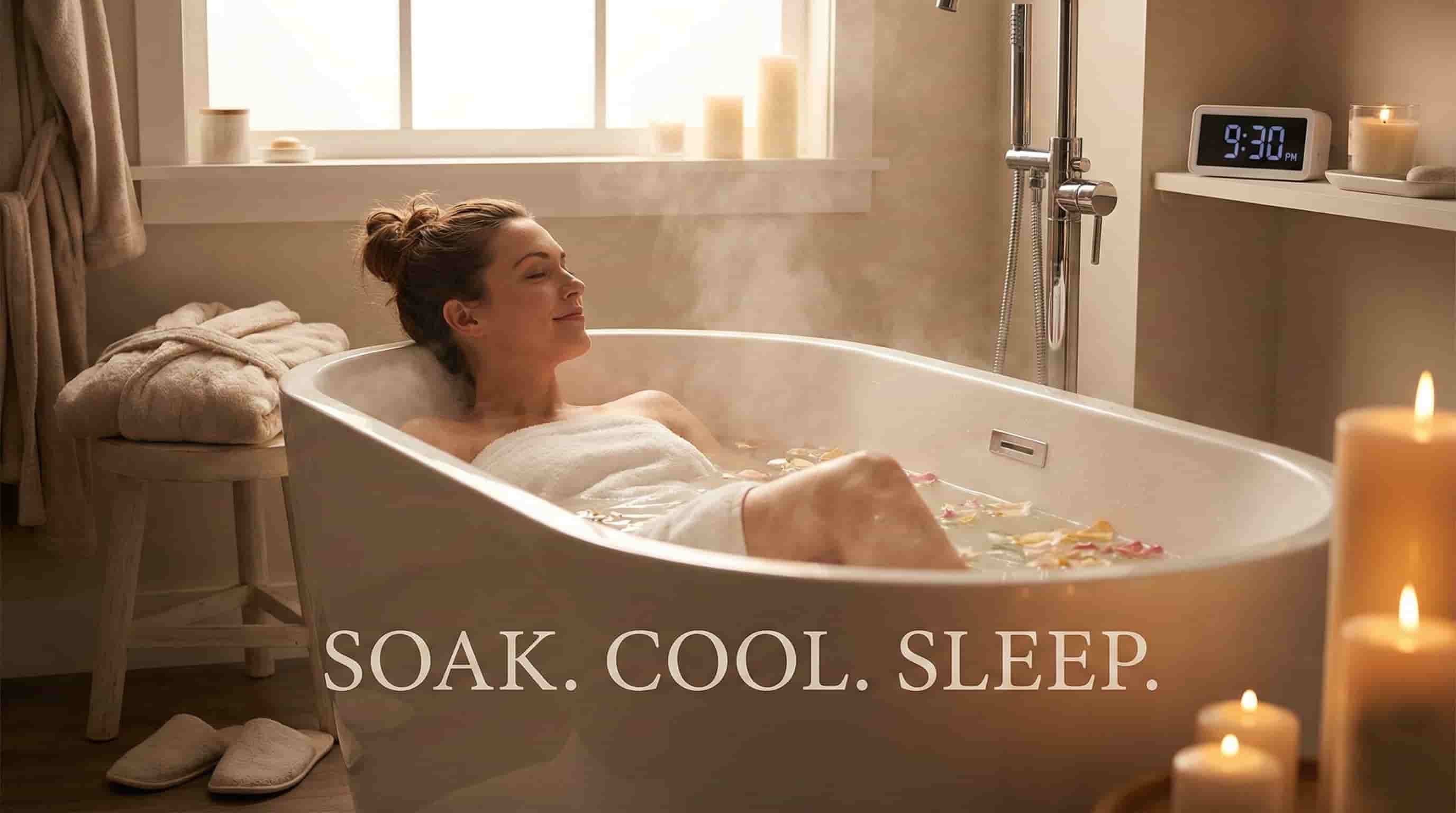
Why Does a Warm Bath Actually Help You Fall Asleep?
Direct Answer: Because the body uses external heat to accelerate its own cooling process — and core body temperature drop is the primary physiological signal that triggers sleep onset.
Mechanism: When you soak in hot water, blood vessels near the skin dilate (vasodilation), routing warm blood to the skin surface where heat dissipates into the environment. The moment you step out, core body temperature plummets as radiated heat is released. This temperature drop — roughly 1°C — signals the pineal gland to release melatonin, initiating the transition from wakefulness to sleep (Stevenson, 2016). The warmth is not relaxing you into sleep; it is engineering the precise physiological conditions your body needs to sleep.
Actionable Advice: Think of the warm bath not as relaxation, but as a temperature tool. You are not trying to calm your mind — you are cooling your core to flip the biological switch for sleep.
What Is Thermoregulation and Why Does It Control Sleep?
Direct Answer: Thermoregulation is your body’s continuous effort to maintain a stable internal temperature — and it is the single most powerful environmental signal for the sleep-wake cycle, more reliable than light or sound.
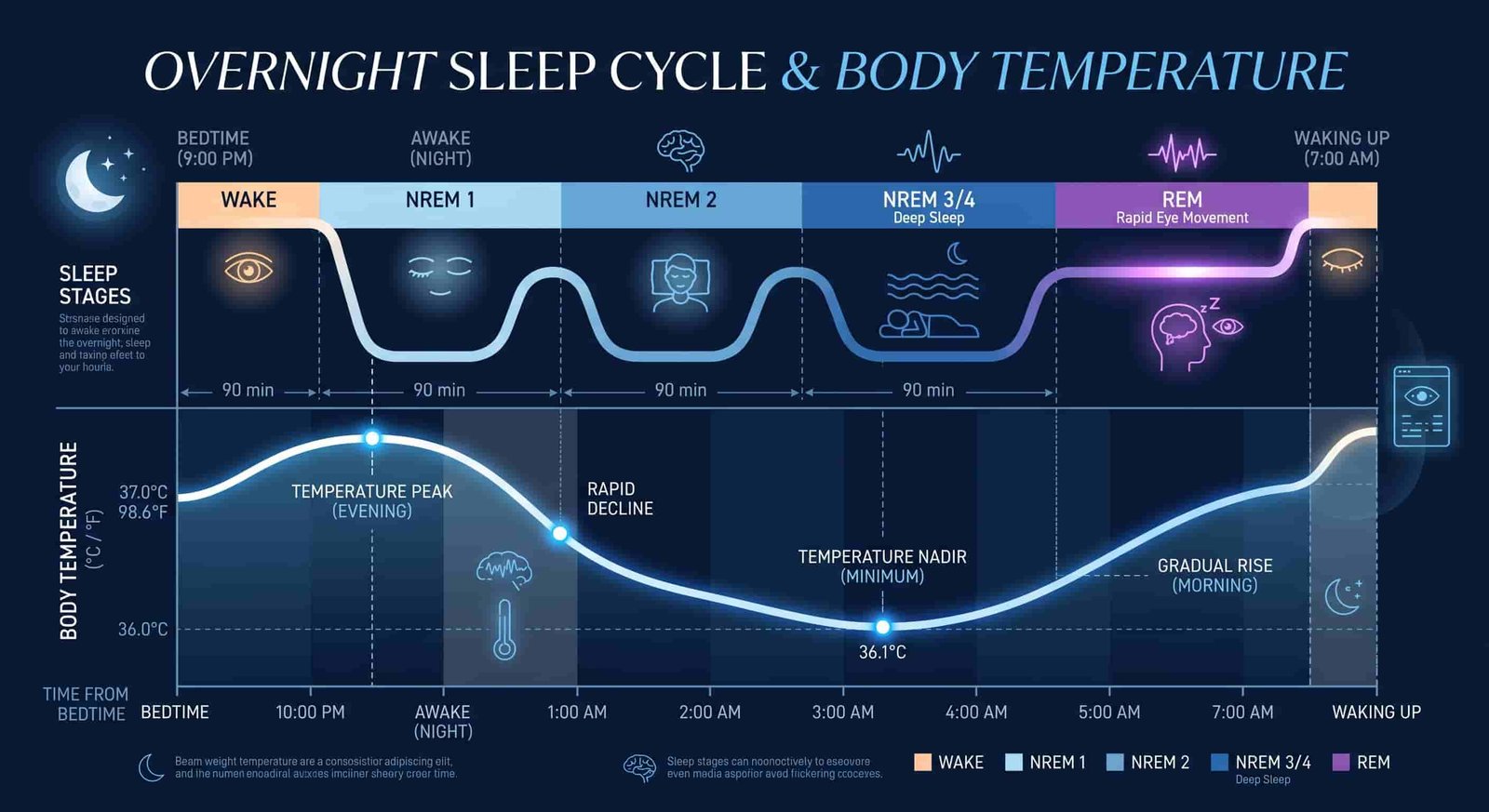
Mechanism: Your circadian clock (suprachiasmatic nucleus, SCN) is fundamentally a temperature regulator. It coordinates the 24-hour temperature rhythm: peaking at 4 PM, dropping to its lowest point around 4 AM. This temperature rhythm drives the sleep-wake cycle directly. When ambient or skin temperature signals that it is safe to be warm, the SCN promotes wakefulness. When the core begins to cool, the SCN triggers sleep pathways. This is why shift workers sleeping during daylight face double opposition: a misaligned circadian clock and a temperature rhythm that is fighting daytime alertness (Walker, 2017).
Actionable Advice: Stop treating sleep as a mental challenge. It is a temperature challenge. Control your body temperature, and the brain follows automatically.
How Does Core Body Temperature Drop to Trigger Sleep?
Direct Answer: Core body temperature must fall approximately 1°C from its evening peak to initiate sleep onset — this is the temperature “gate” your brain requires before releasing melatonin.
Mechanism: Stevenson (2016) describes the temperature rhythm as the body’s most precise sleep signal. Hands and feet act as radiators: when they dilate, they shed heat rapidly, and core temperature falls fast. This is why cold feet can delay sleep (your body cannot shed heat efficiently without vasodilation in the extremities). The distal-proximal temperature gradient — warm hands and feet, cool core — is the precise physical signature of sleep readiness. Melatonin release is not triggered by darkness alone; it follows the temperature drop. Both signals together — evening dim light plus core cooling — create the optimal sleep-onset conditions.
Actionable Advice: If you have cold feet before bed, warm them first. Wear socks during the bath soak to maximize peripheral vasodilation, or warm your feet in the water for 10 minutes before bed to accelerate the heat-shedding process.
What Is the 90-Minute Warm Bath Protocol and How Does It Work?
Direct Answer: The 90-minute protocol aligns the warm bath’s thermal effect with your circadian temperature nadir — giving your body enough time to complete the heat-shedding process before your natural sleep window opens.
Mechanism: Littlehales (2016), author of the R90 method, identifies 90 minutes as the optimal window because it works with — not against — the circadian temperature cycle. If you bathe 90 minutes before your target bedtime, the core temperature drop peaks precisely when your circadian clock begins promoting sleep. If you bathe too close to bedtime (30–45 minutes), you introduce heat during the early sleep window, fragmenting the first sleep cycles. If you bathe too early, the temperature-regulating effect may wear off before sleep onset. The 90-minute buffer also allows the vasodilatory relaxation effect to naturally dissipate, reducing cortisol spike risk from a too-hot or too-long soak.
Actionable Advice: Set your bath time 90 minutes before target bedtime. Water temperature: 38–40°C (100–104°F) — hot enough to trigger vasodilation but not so hot that it raises cortisol. Soak for 20 minutes. Step out and let the cooling happen naturally. Do not bundle up in robes or blankets immediately after; let heat escape freely.
Why Is the 90-Minute Timing Critical for This to Work?
Direct Answer: Because the warm bath works by synchronizing an artificial temperature event with your natural circadian rhythm — and the two must align within a specific temporal window for the effect to hold.
Mechanism: McKenna and Meadows (as cited in sleep science literature) warn that the most common warm bath failure is taking it at the wrong time relative to your circadian phase. If you are a night owl whose circadian temperature nadir is at 2 AM, bathing at 10 PM is too early — your core temperature has not yet begun its natural descent, and the bath creates a competing signal. The 90-minute rule works because it creates a window of heat followed by accelerated cooling that is long enough to interact with the natural temperature decline but short enough to end before sleep onset pressure is disrupted. Evening bathing outside this window can paradoxically delay melatonin onset by 30–60 minutes.
Actionable Advice: Know your approximate circadian phase. If you are a morning type (Lion/early chronotype), 90 minutes may need adjusting earlier. For most people, the 90-minute protocol works when bath time falls between 9:30–11:00 PM for a 11:00 PM–12:00 AM target bedtime.
What Are the Most Common Warm Bath Mistakes That Ruin Sleep?
Direct Answer: Three errors dominate: bathing too close to bedtime, water too hot, and staying in too long — all of which activate the fight-or-flight system instead of sleep pathways.
Mechanism: Walker (2017) documents that water above 40°C (104°F) can elevate heart rate and trigger cortisol release, turning a sleep-promoting ritual into a sympathetic nervous system activation event. Stanley (2018) adds that prolonged immersion (>25 minutes) in hot water can cause the opposite effect — extended vasodilation followed by a rebound core temperature elevation that fragments the first two sleep cycles. Finally, McKenna’s research on sleep hypnosis demonstrates that excessive cognitive effort (“I must do this correctly”) activates the prefrontal cortex, which is precisely what you need to quiet for sleep.
Actionable Advice: Keep water at 38–40°C, soak for no more than 20 minutes, and treat the bath as a routine, not a performance. No screens during the bath — the transition from hot water to cool bedroom air is part of the protocol.
How Does Room Temperature Amplify or Kill the Warm Bath Effect?
Direct Answer: If your bedroom is above 21°C, the warm bath effect reverses — your body cannot shed heat efficiently, and sleep onset is delayed or fragmented.
Mechanism: Stevenson (2016) and Littlehales (2016) both identify 18–20°C as the critical bedroom temperature range for sleep. After a warm bath, your body relies on the ambient air temperature to facilitate radiative heat loss from dilated skin vessels. If the room is too warm, heat accumulates in the skin rather than dissipating, preventing the core temperature drop that triggers melatonin. Above 24°C, the body’s sweating mechanism activates — which is not sleep-promoting. Below 16°C, shivering begins, which also fragments sleep. The 18–20°C window is the “Goldilocks zone” where heat loss is maximally efficient without triggering either sweating or shivering.
Actionable Advice: Set your bedroom thermostat to 18°C before your bath. Open a window slightly if outdoor temperature is below 15°C and you have adequate bedding. This combination — warm bath plus cool bedroom — is the most powerful natural sleep-onset trigger available.
Can You Use a Shower Instead of a Bath and Get the Same Effect?
Direct Answer: Partially — a shower provides vasodilation but misses the sustained heat immersion that drives the full core temperature drop. You can optimize it, however.
Mechanism: A full bath allows全身heat accumulation and sustained peripheral vasodilation — the full immersion means more surface area is exposed to warm water, driving deeper vasodilation than a standing shower. A shower still triggers a temperature rise and subsequent drop, but the effect is shorter and less pronounced because the body is not fully immersed. Water running down the body also has a massaging/alerting effect via pressure receptors in the skin, which can counteract the sedating effect. For those without a bath, a hot foot soak (bucket or basin, 15 minutes) plus a warm shower can approximate the effect by concentrating heat on the extremities, where the vasodilation is most effective at shedding core heat.
Actionable Advice: If only showering is available: use warm (not hot) water for 10 minutes, finishing 90 minutes before bed. Immediately after, sit or stand in a cooler environment (16–18°C) for 10–15 minutes to accelerate the temperature drop. Do not go from hot shower directly into a warm bed.
Why Is Sleep Efficiency More Important Than Sleep Duration?
Direct Answer: Because the quality of sleep cycles — specifically deep sleep and REM — is what restores the brain and body. A short, efficient sleep delivers more restorative sleep than a long, fragmented one.
Mechanism: Walker (2017) documents that deep N3 sleep is when the glymphatic system clears the most beta-amyloid — the Alzheimer-related waste product. Deep sleep is also when human growth hormone is released, primarily during the first two sleep cycles. Fragmented sleep — even at 8 hours — reduces N3 proportion and increases lighter N1/N2, meaning less restoration per hour in bed. Sleep efficiency (time asleep divided by time in bed) captures this. A person with 6 hours in bed and 5.5 asleep (91.7% efficiency) will wake more restored than someone in bed for 8 hours and sleeping 6 (75% efficiency). The warm bath protocol, when done correctly, specifically improves sleep efficiency by accelerating sleep onset and deepening the first two cycles.
Actionable Advice: Measure your sleep efficiency, not your total hours. If your time-in-bed is significantly more than your time-asleep, reduce time in bed (as in CBT-I stimulus control) while maintaining the warm bath protocol.
How to Build the Perfect Pre-Sleep Temperature Routine (Step-by-Step)
Direct Answer: Combine the warm bath protocol with ambient temperature control and sleep hygiene — a coordinated temperature sequence that prepares the body for sleep across the 90-minute pre-bed window.
Mechanism: This integrates the R90 pre-sleep routine (Littlehales, 2016), the warm bath effect (Stevenson, 2016), and CBT-I stimulus control principles. A structured temperature sequence trains the brain to recognize a consistent pre-sleep signal — the same way a bedtime story or white noise machine does for children. Neuroplasticity requires repetition: one night will not retrain your sleep pathways, but 14–21 nights of consistent temperature routines will significantly shift your sleep onset latency and quality.
Actionable Advice: Step 1 (T-90): Start the bath at the same time for 14 consecutive nights — your body will begin anticipating the temperature shift. Step 2 (T-70, during bath): No screens. Dim lights. Optional: 5 minutes of slow breathing. Step 3 (T-20, after bath): Cool bedroom to 18°C. Step 4 (T-10): Lightweight bedding. No heavy pajamas. Step 5 (T-0): Get into bed only when genuinely sleepy, not simply because it is bedtime. Combine with Slumbelry ergonomic support to minimize physical micro-arousals during the deep sleep window.
Frequently Asked Questions
How long before bed should you take a warm bath?
Direct Conclusion: Ninety minutes before your target bedtime is the optimal window. This aligns the peak of core body temperature drop with your natural sleep onset window. Bathing closer than 60 minutes risks fragmenting the first sleep cycles with residual heat; bathing earlier than 2 hours reduces the temperature effect before you are ready for bed.
Does a warm bath actually lower your body temperature?
Direct Conclusion: Yes — paradoxically, a warm bath lowers core body temperature faster than no bath at all. When you soak in hot water, blood vessels near the skin dilate and route warm blood to the surface, where heat dissipates into the air. Stepping out triggers a rapid temperature drop as the body sheds accumulated heat through radiative loss. This drop — approximately 1 degree Celsius — is the physiological signal that triggers melatonin release.
What water temperature is optimal for the sleep effect?
Direct Conclusion: Thirty-eight to 40 degrees Celsius (100–104 degrees Fahrenheit) is the optimal range. Water hotter than 40 degrees C elevates heart rate and triggers cortisol release via the sympathetic nervous system — the opposite of what you want. Water below 37 degrees C is insufficient to trigger meaningful vasodilation. Use a bath thermometer; subjective temperature assessment is unreliable when you are immersed.
Can I just take a warm shower instead of a bath?
Direct Conclusion: A shower delivers a partial effect. Full immersion in a bath maximizes peripheral vasodilation across全身surface area, driving a deeper core temperature drop than a standing shower, where the alerting effect of water pressure on skin receptors can counteract sedation. If only a shower is available, use warm (not hot) water for 10 minutes and follow with 10–15 minutes in a cooler room to approximate the cooling effect.
How long should you soak in the bath for maximum benefit?
Direct Conclusion: Twenty minutes is the sweet spot. Under 15 minutes, vasodilation does not fully develop. Over 25 minutes risks cortisol elevation from prolonged heat exposure and can cause rebound hyperthermia — a slight rise in core temperature after getting out that fragments early sleep cycles. The goal is 20 minutes at 38–40 degrees C, followed by free radiative cooling in a room at 18–20 degrees C.
Does the warm bath effect work if your room is too warm?
Direct Conclusion: No — if your bedroom is above 21 degrees C, your body cannot efficiently shed the heat accumulated during the bath. The warm bath effect requires the ambient air to be cooler than your skin surface so radiative heat loss can occur. Above 24 degrees C, the body switches to sweating as its primary cooling mechanism, which is not sleep-promoting and will fragment sleep onset even if you did everything else correctly.
What time should you stop bathing to avoid disrupting circadian rhythm?
Direct Conclusion: Finish bathing at least 90 minutes before your target bedtime and avoid any significant heat exposure within 60 minutes of sleep. The transition from hot water to cool bedroom air is itself part of the temperature-drop signal — rushing this transition by going from hot bath directly into a warm bed eliminates the cooling phase that triggers melatonin. If your target bedtime is 11 PM, your bath should be complete by 9:30 PM at the latest.
Can you do the warm bath protocol every night?
Direct Conclusion: Yes — consistency is one of the protocol is strongest features. Neuroplasticity research shows that repeating a behavior at the same time each night strengthens the neural association between the temperature routine and sleep onset. After 14–21 consecutive nights, many people find they feel drowsy around their bath time automatically. This is your circadian clock learning the signal.
Does the warm bath effect still work for shift workers or people with irregular schedules?
Direct Conclusion: It works but requires adaptation. Shift workers should time the bath relative to their target sleep window, not the clock. For someone sleeping during the day, the cool room is even more critical (daylight is a competing wake signal), and blackout curtains plus eye masks are essential. The temperature protocol still functions during daytime sleep — core temperature follows the circadian rhythm even when light does not, which is why afternoon naps feel natural despite bright sunlight.
What is the single most important factor in making the warm bath protocol work?
Direct Conclusion: Room temperature. The warm bath triggers vasodilation, but if the bedroom is too warm, your body cannot shed the accumulated heat and the core temperature drop never fully occurs. Keep the room at 18–20 degrees C — this single variable determines whether the 90-minute protocol delivers its full sleep-onset benefit or wastes the entire routine.
Ready to Transform Your Recovery?
If you have been taking baths at the wrong time, wrong temperature, or in the wrong room, take action today. Discover science-backed solutions for better rest.
Take the Sleep Assessment Explore Our Cooling MattressThe Slumbelry Commitment
Sleep is the most vulnerable state of human existence. It is where we heal, reset, and grow.
At Slumbelry, we do not just sell sleep products; we advocate for your physiological right to rest. From ergonomic support to light management, every solution we offer is designed with one obsession: Respecting your Biology.
Science is our language, but your recovery is our purpose. You take care of everything else in your life — let us take care of your sleep.
Rest Deeply,
The Slumbelry Team