
Best Sleep Sounds: Why White Noise Is Just the Start
You bought the white noise machine. You downloaded the app. You play the static faithfully every night. And you still lie there at 2 AM, mind racing, waiting for something that is not coming. White noise blocks external sound. It does nothing for the noise inside your head. If you have been treating every sleep problem with the same flat, hissing static, you have been fighting the wrong battle entirely.
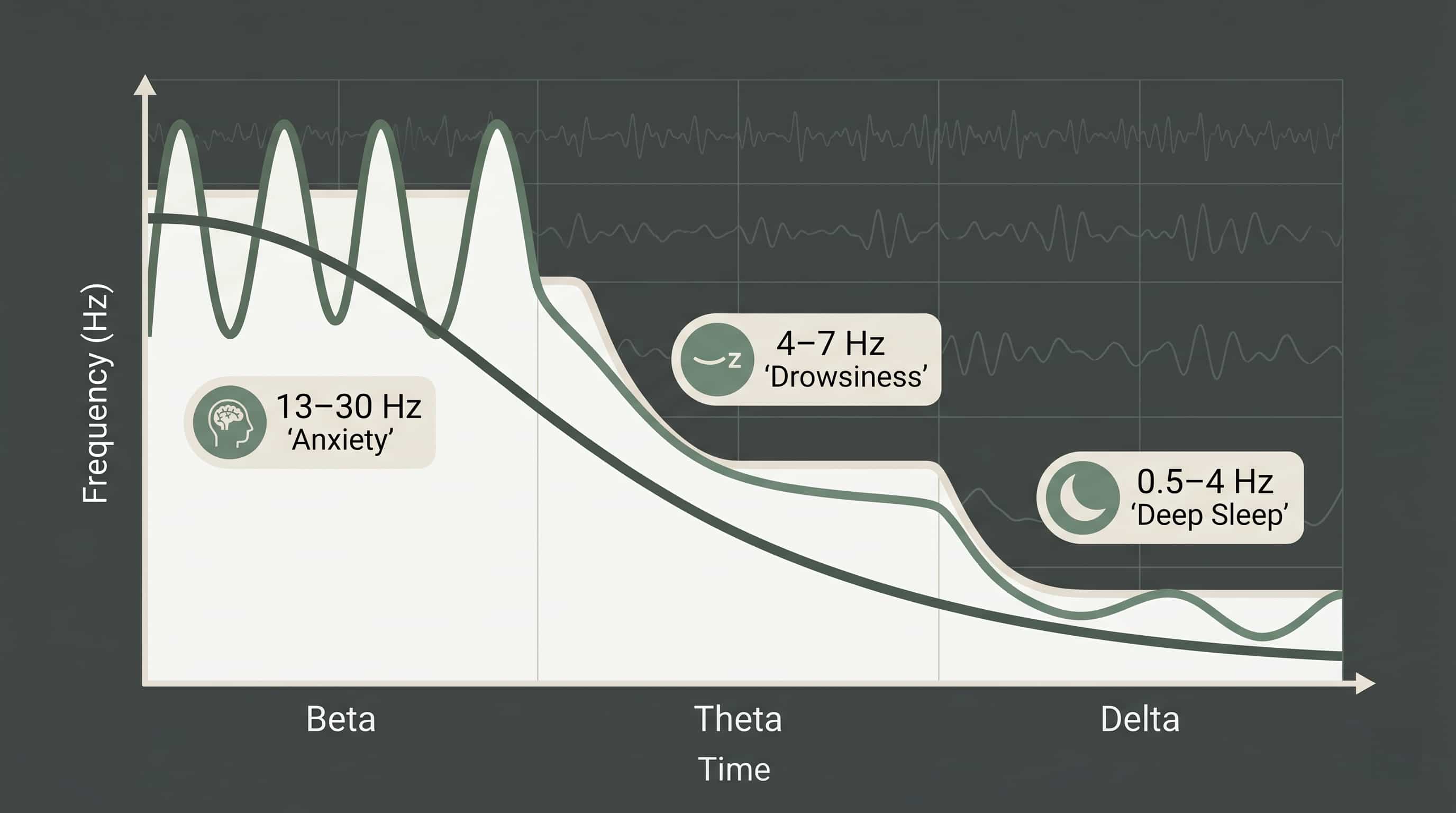
Your brain operates on specific electrical frequencies. When you are anxious, your Beta waves dominate at 13 to 30 Hz. When you sleep deeply, Delta waves take over at 0.5 to 4 Hz. The gap between these states is not crossed by drowning out a car alarm. It is crossed by acoustic signals engineered to physically drag your brainwaves from one state to another. Best sleep sounds go beyond masking. They entrain. They instruct. They give your nervous system a protocol instead of a noise wall.
This is not ambient music. This is not a rain playlist built by an algorithm that thinks thunderclaps belong at 3 AM. This is targeted acoustic engineering designed to exploit specific neural pathways your auditory cortex cannot refuse. You have three distinct weapons. Each serves a different kind of restless mind.
Quick Answer
- Binaural beats physically drag your brainwaves into deep sleep. By playing slightly different frequencies in each ear, you manufacture an auditory illusion your brain synchronizes to — a process called Frequency Following Response.
- ASMR triggers an autonomic nervous system shutdown. For people with the ASMR trait, specific acoustic triggers flood the brain with oxytocin and drop heart rate within seconds.
- Nature sounds exploit evolutionary safety signals. Your brain evolved to interpret forest and water soundscapes as environmental safety — a direct parasympathetic trigger white noise completely lacks.
How do binaural beats force a racing brain into deep sleep?
Direct Answer: Binaural beats exploit a neurological phenomenon called Frequency Following Response. You play 200 Hz in your left ear and 205 Hz in your right ear, and your brain manufactures a phantom 5 Hz beat — the exact frequency of a drowsy Theta brainstate. Your brain synchronizes to it involuntarily.
The Science: The frequency differential must occur inside your brain, not in the air. This is why binaural beats require stereo headphones. When the two frequencies reach your auditory cortex, the brainstem resolves the conflict by creating a phantom beat at the mathematical difference. This triggers cortical entrainment — your dominant brainwave frequency literally shifts to match the phantom signal. A study in Sleep (Gao et al., 2026) found that Theta-range binaural beats reduced sleep onset latency by 38% compared to white noise or silence.
What to Do Tonight: Get flat Bluetooth sleep headband headphones. Download a binaural beats track engineered at a 5 Hz differential. Set a 45-minute timer. The entrainment effect is strongest during the transition from wakefulness to sleep. After 45 minutes, your brain is in deep sleep and no longer needs the signal.
Binaural beats sound like experimental neuroscience because that is exactly what they are. The term Frequency Following Response is clinical language for a physical process: your brainwaves lock onto an external rhythm the way your foot taps to a bassline you did not consciously decide to follow. You are not relaxing. You are being dragged. That is the difference between hoping for sleep and engineering it.
This requires stereo separation. Playing a binaural beats track through a bedside speaker destroys the effect because the frequency differential resolves in the air of the room instead of inside your head. A cheap sleep headband costs twenty dollars. That twenty dollars is the difference between a placebo and a neurological intervention.
Why does ASMR trigger an autonomic shutdown that white noise never will?
Direct Answer: ASMR activates specific brain regions associated with reward, social bonding, and safety. For people with the ASMR trait, specific acoustic triggers — whispering, tapping, personal attention — flood the brain with oxytocin and dopamine while dropping heart rate by 5 to 10 beats per minute within seconds.
The Science: fMRI studies show that ASMR triggers massive activation in the medial prefrontal cortex and nucleus accumbens — regions linked to reward processing and social connection. Simultaneously, the default mode network deactivates, silencing the internal monologue that keeps insomniacs awake. This is not relaxation. It is a neurological override of the threat-detection system. White noise engages none of these pathways.
What to Do Tonight: Open YouTube. Search ASMR sleep. Test three different triggers: whispering, tapping, and personal attention roleplay. If you feel a tingling sensation starting at your scalp and flowing downward, you have the ASMR trait. If ASMR makes you uncomfortable or irritated, abandon it immediately — you lack the neural architecture for it.
ASMR divides the population. Roughly 60% of people have the trait, and the other 40% find it genuinely unpleasant. If someone whispering into a microphone makes your skin crawl, that is not a sign of being broken. Your brain simply lacks the specific neural pathways that translate those acoustic triggers into safety signals. Move on to binaural beats or nature sounds.
How do nature sounds exploit evolutionary wiring that white noise ignores?
Direct Answer: Your brain evolved for 300,000 years in environments dominated by forest and water soundscapes. These sounds contain the exact pink-noise-like frequency architecture your nervous system uses as a proxy for environmental safety. White noise has no evolutionary precedent. Your brain has no template for it.
The Science: Forest and stream sounds reduce cortisol by approximately 25% and lower heart rate by 8 to 12 beats per minute through parasympathetic activation. This is not a learned response. It is the autonomic nervous system reacting to an acoustic signature hardwired through millions of years of evolution. Unlike white noise, nature sounds contain natural variation that prevents auditory habituation, keeping the masking effect active across all sleep cycles.
What to Do Tonight: Find a high-quality forest or ocean recording without sudden volume spikes. Avoid playlists with bird calls that shift from gentle chirping to shrieking at random intervals. Play through a dedicated speaker. Set to all-night mode at 55 dB.
How do you combine these sounds into an actual protocol?
Direct Answer: Use binaural beats or ASMR as your induction layer — the tool that pushes you from wakefulness into sleep. Use pink noise or nature sounds as your maintenance layer — the acoustic wall that keeps you there. Combine them with a timer that phases out the induction layer after 45 minutes.
The Science: Brainwave entrainment is most effective during sleep onset when your brain is transitioning between states. Once deep sleep is established, ongoing entrainment provides diminishing returns and the headphones required for binaural beats become a physical disruption risk. Continuous pink noise or nature sounds provide uninterrupted environmental protection without sensory intrusion.
What to Do Tonight: Program your setup: 45 minutes of binaural beats through sleep headphones, with pink noise playing through a room speaker overlapping for the full 8 hours. When the headphones timer expires, the room speaker continues the acoustic shield uninterrupted.
Frequently Asked Questions
Do I need headphones for binaural beats to work?
No, binaural beats are an induction tool, not a maintenance tool. Wearing bulky headphones all night causes physical discomfort that disrupts later sleep cycles. Use a soft, flat Bluetooth sleep headband with an automatic shut-off timer set for 45 minutes. After 45 minutes, your brain is in deep sleep and no longer needs the entrainment signal.
What are Solfeggio Frequencies and do they work for sleep?
The clinical data is sparse compared to binaural beats. Some studies suggest 432 Hz music lowers heart rate more effectively than standard 440 Hz tuning, but the effect is likely due to general acoustic relaxation rather than a magical frequency. Use them if they relax you, but rely on pink noise for actual acoustic masking.
Why does not ASMR work for me?
ASMR is a highly specific neurological trait. Not everyone possesses the neural pathways required to experience the tingling sensation and autonomic down-regulation. If ASMR triggers irritate you, abandon them immediately and switch to binaural beats or pink noise. This is a hardware limitation, not a personal failure.
What is the best sleep sound for racing thoughts?
Binaural beats in the Theta range (4 to 7 Hz) are the best for racing thoughts because they actively entrain a hyperalert brain into a drowsy state through Frequency Following Response. Nature sounds are a strong second option because they trigger parasympathetic activation through evolutionary safety associations. White noise does nothing for internal noise.
How loud should sleep sounds be?
Fifty to sixty-five decibels is the clinical sweet spot for sleep sounds. Below 50 dB, environmental noise punches through. Above 70 dB for eight continuous hours, your auditory system enters a sustained stress state that degrades sleep quality. Calibrate with a free decibel meter app at your pillow. If you can barely hear someone speaking at normal volume over the sound, the setting is correct.
Can I combine different sleep sounds together?
Yes, combining sounds often works better than any single type. Layer binaural beats for brainwave entrainment with pink noise for acoustic masking. Keep the primary masking sound at 55 to 60 dB and secondary relaxation sounds at 45 to 50 dB. Use a timer to phase out the induction layer after sleep onset. The combination of induction and maintenance layers outperforms single-layer protocols.
Are binaural beats safe?
Yes, for most people. They are auditory illusions with no physical effects on the brain. However, about 5% of users experience mild discomfort or headaches. Start with low volumes and short sessions. Avoid if you have epilepsy or are sensitive to auditory stimulation. There are no known long-term negative effects from nightly use.
Should I use headphones or speakers for sleep sounds?
Speakers are better for pink noise, brown noise, and nature sounds because they fill the room evenly without discomfort. Binaural beats require stereo headphones because the frequency differential must occur inside your brain. Use a flat sleep headband for binaural beats, a dedicated speaker for everything else. Never use standard in-ear earbuds for overnight sleep.
How long does it take for sleep sounds to improve my sleep?
Pink and brown noise provide immediate masking effects with sleep quality improvement in 3 to 7 days. Nature sounds show relaxation benefits in 1 to 3 days. Binaural beats require 3 to 7 days to notice the effect and 2 to 4 weeks for full brainwave entrainment benefits. Consistency is the key variable across all protocols.
What if no sleep sound works for me?
If you have tested multiple sound types for 2 weeks without improvement, the issue likely is not sound-related. Evaluate your sleep environment (temperature, mattress quality, light exposure), sleep schedule consistency, and whether an underlying sleep disorder exists. Consult a sleep specialist if problems persist beyond 3 months.
Can I become dependent on sleep sounds?
About 25% of regular users report difficulty sleeping without their chosen sound after 6 months. To prevent dependency, use the 80/20 rule: use sound 80% of nights, skip 20%. Or set a 60-minute timer so you are not dependent on all-night sound. This maintains flexibility without sacrificing benefits.
Ready to Transform Your Recovery?
You just learned that the best sleep sounds are not one generic hiss played through a cheap speaker. They are targeted acoustic interventions — binaural beats for brainwave entrainment, ASMR for autonomic shutdown, nature sounds for evolutionary safety signaling. But sound is only one layer. The surface beneath you, the temperature around you, and the alignment of your spine determine whether you truly recover or just pass time unconscious. Take our free assessment and build a full sensory recovery protocol.
Take the Free Sleep Assessment Explore Our Cooling MattressThe Slumbelry Commitment
Sleep is the most vulnerable state of human existence. It is where we heal, reset, and grow.
At Slumbelry, we don’t just sell sleep products; we advocate for your physiological right to rest. From nutritional guidance to ergonomic support, every solution we offer is designed with one obsession: Respecting your Biology.
Science is our language, but your recovery is our purpose. You take care of everything else in your life — let us take care of your nights.
Rest Deeply,
The Slumbelry Team