
White Noise for Sleep: Why It’s Wrong (And What Works)
Your bedroom is dead silent. You climb into bed, close your eyes, and wait for sleep to land. Then it starts — the compressor hum from the refrigerator downstairs. A car door slams three streets away. Floorboards creak somewhere in the house. Your partner shifts and exhales. These sounds do not wake you in the way you recognize. They trigger something far more destructive: a micro-arousal.
Micro-arousals are subconscious spikes in brain activity that rip you out of Deep Sleep and throw you into Light Sleep without you ever becoming consciously aware it happened. Your auditory cortex never clocks out. Even in the deepest stages of non-REM sleep, it actively scans the environment for threats — a survival mechanism hardwired into every mammal on the planet. When morning arrives, you feel wrecked and have zero idea your brain fought and lost a dozen invisible acoustic battles between midnight and 6 AM. White noise for sleep is not about drowning out the world. It is about engineering an acoustic environment convincing enough to let an ancient threat-detection system finally stand down.
But nobody tells you this part: generic white noise is neurologically exhausting. It bombards your ears with every audible frequency at equal intensity — including harsh, piercing high bands that your brain reads as distress signals. Over eight hours, this constant high-frequency assault keeps the auditory cortex in sustained low-level vigilance. You trade environmental noise disruption for acoustic fatigue and congratulate yourself for being scientific. The noise color you choose makes all the difference. The wrong one worsens things while you feel proud of your solution. Let us strip this down and fix it.
Quick Answer
- Generic white noise is neurologically fatiguing. Equal energy across all frequencies bombards your auditory cortex with harsh highs that mimic alarm signals, keeping your brain in low-level vigilance for eight straight hours.
- Pink noise physically deepens slow-wave sleep. It mirrors the exact frequency architecture of your brainwaves during deep sleep, actively entraining the brain to decelerate instead of simply masking external sound.
- Brown noise blocks what pink noise cannot touch. Low-frequency urban vibrations — diesel engines at idle, subwoofers through walls, distant construction rumble — penetrate solid structures at wavelengths pink noise passes straight through.
Why does traditional white noise fail to deliver deep sleep?
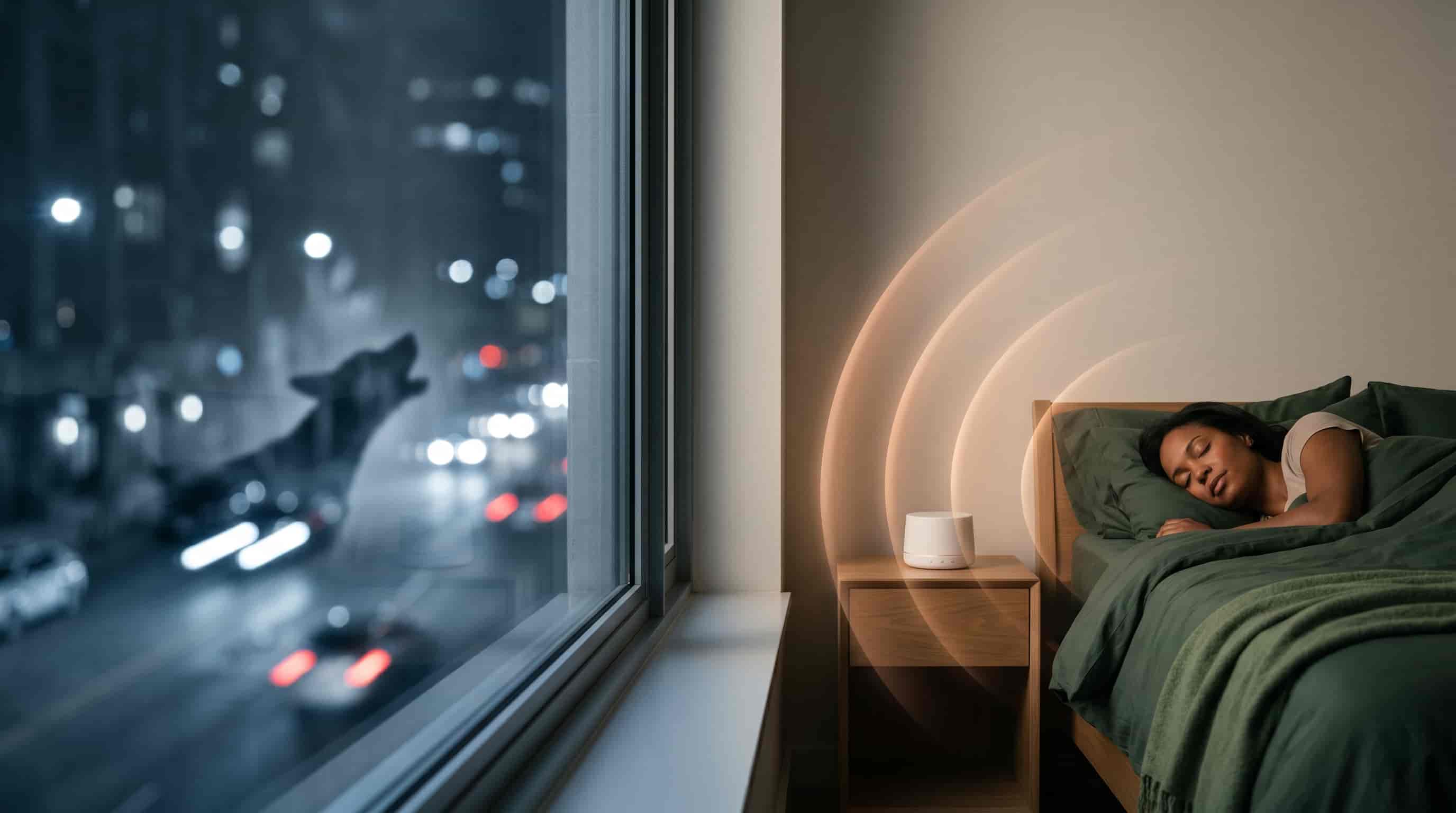
Direct Answer: White noise contains all audible frequencies at equal intensity — including sharp, high-pitched bands your brain interprets as a distress signal. After eight hours of this, your auditory cortex is more fatigued than if you had slept in relative silence.
The Science: Your auditory system evolved over millions of years to detect sudden acoustic changes — a twig snapping underfoot, an animal exhaling nearby, steam escaping under pressure. White noise sounds like pressurized static, an acoustic signature that triggers a low-grade sympathetic nervous system response. The acoustic reflex, which should disengage completely during deep sleep, never fully releases. You stay asleep. You do not recover.
What to Do Tonight: Stop using pure white noise generators. Open your app, locate the pink noise or brown noise setting, and play it through a dedicated Bluetooth speaker — not your phone’s built-in speaker. Your phone physically cannot produce the low frequencies that give colored noise its masking power.
White noise sounds scientific because someone in 1962 stuck the word “white” on it and the culture never questioned it. The advice got popular because white noise machines were the first commercially available sound maskers, not because white noise was ever clinically proven superior to alternatives. The science moved on decades ago. The marketing did not. You are screaming static at your own brain for one-third of your life because a product team in the mid-20th century thought “white noise” would sell.
High-frequency sounds produce a genuine stress response. Your body processes sharp, hissing frequencies — the same acoustic fingerprint as a snake’s warning hiss, an enraged animal, gas escaping at high pressure — as environmental threats. This is not metaphor or wellness-speak. This is the autonomic nervous system reacting to acoustic stimuli entirely below conscious awareness. You wake up exhausted not because you slept poorly but because your body spent the night on guard duty it never needed to pull.
Why does pink noise physically deepen your sleep?
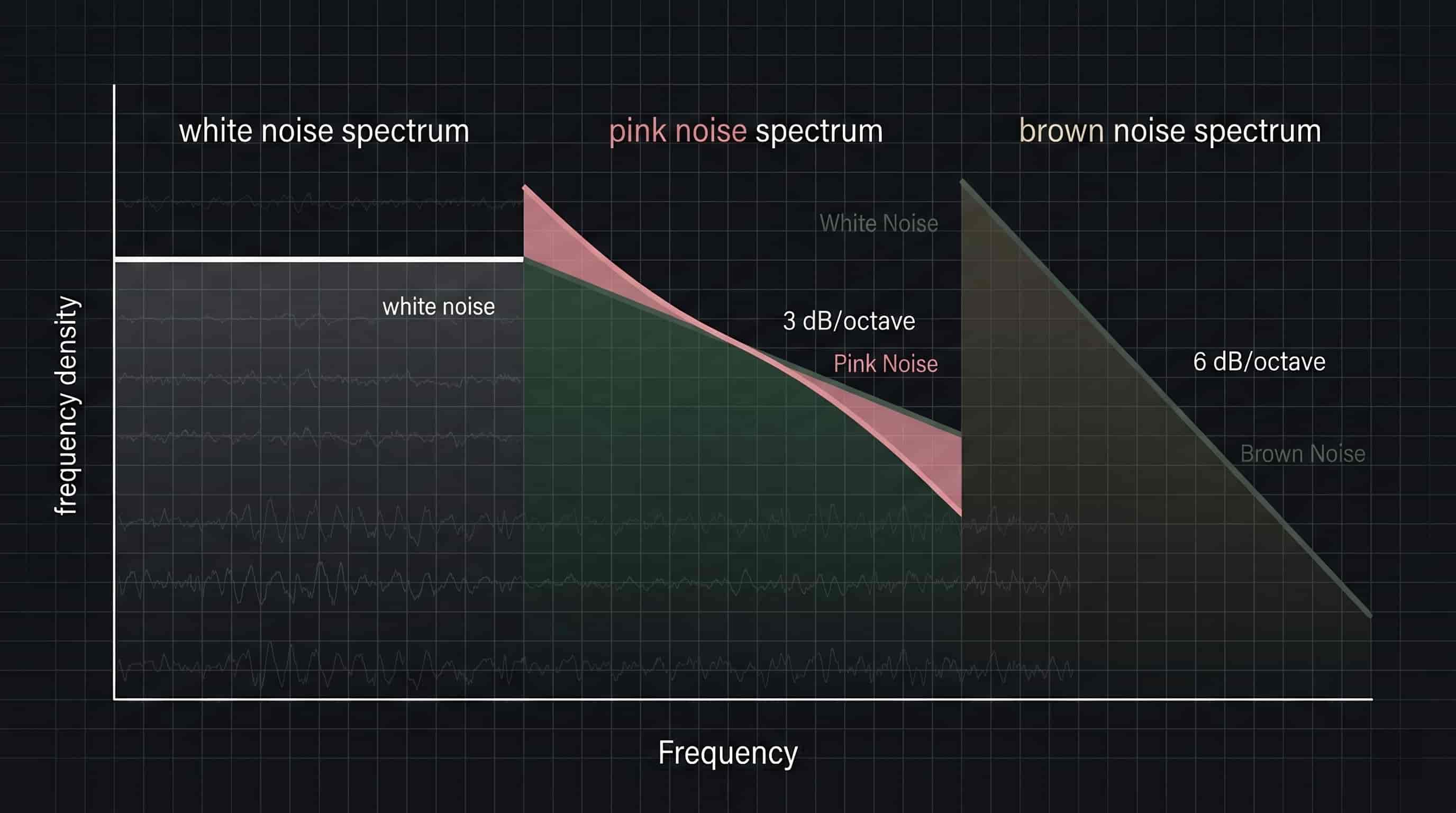
Direct Answer: Pink noise mirrors the exact frequency structure of your brainwaves during deep sleep. When you fill the room with pink noise, you inject a biological command that entrains your brain to decelerate, increasing the amplitude of slow-wave oscillations.
The Science: In pink noise, lower frequencies carry more power than higher ones — the identical acoustic architecture found in steady rainfall, wind through trees, and ocean surf. This is not coincidence. Your brain evolved in environments dominated by pink-noise-like natural soundscapes, and the auditory system uses those frequency patterns as a proxy for safety. Clinical research confirms pink noise synchronized with the delta band (0.5 to 4 Hz) physically increases slow-wave sleep amplitude and improves next-day memory consolidation by up to 30% compared to either silence or white noise.
What to Do Tonight: Set a pink noise app as your default acoustic baseline. Play it through an external speaker with actual bass response — your phone speaker diaphragm measures roughly the size of a coin and cannot push the low-end frequencies that give pink noise its biological power. Place the speaker at least three feet from your head.
This is where the conversation shifts from “blocking annoying sounds” to “engineering your nervous system.” Pink noise is not white noise with a different name. It is a fundamentally different acoustic signal, and your brain routes it through an entirely separate processing pathway. The parasympathetic nervous system — your rest-and-digest branch — responds to low-frequency dominance by downregulating cortisol production and shifting heart rate variability into recovery mode. White noise traps you in neutral. Pink noise puts you in park.
Think about the last time you fell asleep to actual rainfall. Not a recording — real rain hitting your window and roof. That sound is not white noise. It is natural pink noise, and your body responds to it before your conscious mind even registers what is happening. Your shoulders drop. Your jaw loosens. Your breathing deepens from the diaphragm. These are not psychological reactions to “relaxing sounds.” They are hardwired autonomic responses to a frequency profile your nervous system recognizes as the acoustic signature of safety — the sound of being sheltered, warm, and protected while the world outside is wet and cold.
How do you block heavy traffic and thudding bass that pink noise cannot stop?
Direct Answer: Deploy brown noise — a heavy, low-frequency acoustic blanket that intercepts and neutralizes the physical vibrations pink and white noise pass straight through. If you live near a road, in an apartment building, or anywhere with subwoofer-range disruption, brown noise stops being optional.
The Science: A 50 Hz diesel engine rumble has a wavelength of roughly seven meters. It travels through standard wall construction as physical vibration, not just as airborne sound. Pink noise’s power curve drops off before reaching those frequencies — there is simply not enough low-end energy to mask a bus at idle. Brown noise amplifies the lowest frequencies even further, creating what amounts to a deep, roaring waterfall of sound that sits directly on top of urban vibrations and neutralizes them at the waveform level.
What to Do Tonight: If you hear traffic, neighbor bass, or any low-frequency thrumming from your bed, switch to brown noise immediately. You need a speaker with a dedicated subwoofer or heavy bass radiator. A cheap Bluetooth speaker outputs functionally zero bass below 100 Hz and renders brown noise indistinguishable from pink noise — which leaves you completely exposed to the frequencies you are actually fighting.
You cannot negotiate with physics. The math does not care about your intentions. If the threat is a 50 Hz bass wave with a seven-meter wavelength, your countermeasure must produce energy at 50 Hz. Nothing else matters. Most people who say noise machines do not work for them are unknowingly describing a hardware problem — their speaker literally cannot reproduce the frequencies they need, and the app is feeding them the wrong noise color on top of that. Three failures stacked together, all invisible to the person lying awake at 3 AM.
Test this tonight: play brown noise through your phone speaker, then play the same track through a proper Bluetooth speaker with a bass radiator. If the two sound identical, your speaker is the bottleneck and you have been sleeping with a placebo. A real brown noise setup should feel physical — you should sense the low-end presence in your chest cavity, not just hear it with your ears. That physical sensation is what blocks the physical vibration traveling through your walls. Acoustic physics is not a negotiation.
How do you choose the right app instead of wasting money on the wrong one?
Direct Answer: Match the app to your specific acoustic threat. Urban noise demands apps with strong brown noise generators and algorithmically created sound — not compressed audio loops. myNoise and White Noise (free version) dominate in sound quality and frequency coverage. Racing thoughts respond better to apps with high-fidelity pink noise blending and nature sound layering like Noisli.
The Science: Most “white noise” apps compress their audio so aggressively to save storage space that the masking effect is destroyed. Compression strips away the exact low and high frequencies your brain requires for true acoustic masking, leaving you with a thin, tinny hiss that is acoustically useless. The best apps generate sounds algorithmically in real time rather than playing looped MP3 files, preserving the full 20 Hz to 20 kHz frequency range your auditory system needs.
What to Do Tonight: Download both White Noise (free version, 50-plus algorithmically generated sounds) and myNoise (200-plus customizable generators with frequency sliders). Test each for three nights. The winner: whichever app runs zero ads during sleep hours. One ad blast at 3 AM destroys the entire protocol.
You just spent forty dollars on a silk pillowcase and zero minutes researching the app that will play in your bedroom for eight hours every single night. The platform matters. The audio fidelity matters. The noise color matters. Skip any one of these three and you are running a protocol structurally incapable of producing results — no matter how consistent you are with it.
What volume and setup actually produce results instead of placebo?
Direct Answer: Calibrate to 50 to 65 decibels at your pillow — the volume of a normal conversation or a soft shower. Below 50 dB, environmental noise punches straight through the masking layer. Above 70 dB for eight continuous hours, your auditory system enters a sustained stress state that degrades sleep quality and risks permanent threshold shifts.
The Science: Each 10 dB increase in background noise raises the threshold required for an external sound to trigger awakening by roughly 15%. The 50 to 65 dB sweet spot provides enough gain to neutralize sudden disruptions — car doors, barking dogs, hallway footsteps — without crossing into the range where the noise itself becomes a physiological stressor. This is not a preference band. It is a clinical window validated in ICU environments where acoustic masking is deployed as a medical intervention.
What to Do Tonight: Download a free decibel meter app. Place your phone at your pillow. Play your chosen noise color through your speaker from its permanent position across the room. Calibrate to 55 to 60 dB. This 60-second step separates effective acoustic shielding from an expensive placebo you will abandon in two months.
Never eyeball the volume. The human ear is a horrible measurement instrument — what sounds “about right” at 11 PM when you are exhausted will be acoustically useless at 3 AM when a garbage truck reverses outside your window. Most people set noise machines far too low because they are subconsciously anxious about the sound interfering with their sleep, not realizing an underpowered noise machine is functionally identical to having no machine at all. Calibrate once. Sleep correctly for the rest of your life.
Your Sleep Questions, Answered
Should I play the noise app through my phone speakers or headphones?
Never use in-ear headphones for eight hours of sleep; they cause physical ear canal fatigue and pressure sores. Standard phone speakers are physically incapable of producing the low frequencies required for true pink or brown noise — you are getting a distorted, tinny version stripped of all masking power. Use a dedicated external Bluetooth speaker with actual bass response, placed at least three feet away from your head.
Will my brain become dependent on white noise to fall asleep?
Yes, through classical conditioning — and that is a positive bio-hack, not a weakness. You are building a Pavlovian trigger where your brain instantly associates the acoustic signature with sleep onset, reducing sleep latency by up to 38%. The only risk is losing access to the sound while traveling. Use a portable noise machine or app to replicate the exact same frequency profile anywhere you go. Apply the 80/20 rule — skip noise 20% of nights to maintain flexibility.
Is it safe to play noise all night for a baby?
Yes, but volume and placement are non-negotiable. Infant ear canals amplify high frequencies by up to 20 dB compared to adult ears — harsh white noise at close range is genuinely dangerous. Use pink or brown noise only. Place the machine across the room, never in or attached to the crib. Keep volume below 50 decibels measured at the baby’s head position. The sound should be barely perceptible, not a wall of noise.
What is the best noise color for deep sleep?
Pink noise is the undisputed champion for deep sleep. It mirrors the frequency structure of your brainwaves during slow-wave sleep and actively entrains the brain to decelerate. White noise — equal energy across all frequencies — sounds harsh and causes acoustic fatigue after prolonged exposure. Brown noise is your weapon against urban low-frequency threats: traffic rumble, neighbor bass, construction vibration. Start with pink noise as your default. Add brown noise only if your specific environment demands it. Skip pure white noise entirely.
How loud should my noise machine be for optimal sleep?
Fifty to sixty-five decibels is the clinical sweet spot — roughly the volume of a normal conversation or a soft shower. Below 50 dB, environmental noise punches through immediately. Above 70 dB for eight continuous hours, your auditory system enters a stress state that degrades sleep quality and risks permanent hearing damage. Calibrate with a free decibel meter app at your pillow. If you can barely hear someone speaking at normal volume over the noise, the setting is correct.
Can white noise apps help with tinnitus at night?
Yes — this is one of the most clinically validated uses of acoustic masking. Tinnitus perception spikes in silence because your auditory system, deprived of external input, amplifies internal noise. White or pink noise raises the ambient sound floor above your tinnitus threshold, pushing the ringing perception below conscious awareness. Use an app like myNoise with frequency-targeted sliders to match your specific tinnitus pitch. For severe or sudden-onset tinnitus, consult an audiologist before self-treating.
What is the best free white noise app?
White Noise (free version) offers 50-plus algorithmically generated sounds including true white, pink, and brown noise with zero compressed audio loops. myNoise provides 200-plus customizable sound generators with individual frequency sliders, making it the best free option for users who need precise frequency control. Download both. Test each for three nights. The winner is whichever app does not blast an ad during your sleep. Offline capability is not negotiable.
Do I need a timer or should the noise play all night?
Use a 60-minute timer if your environment stays quiet after midnight and you want to avoid acoustic dependency. Use all-night mode if you live near traffic, sleep next to a snoring partner, or have tinnitus that wakes you during lighter sleep cycles. Start with a 60-minute timer for one week. Track how many times you wake up after the noise stops. If you wake more than once, switch to all-night mode at 50 to 55 dB.
What happens if I use the wrong noise color for months?
Long-term white noise use causes cumulative low-grade acoustic fatigue. Your auditory cortex never fully disengages vigilance mode because the harsh, flat frequency profile does not match any natural sound your brain evolved to interpret as safe. You stay asleep but your deep sleep quality erodes month by month. If you have been using white noise for months and still feel unrested despite eight hours in bed, the noise color itself is the likely hidden culprit. Switch to pink noise tonight. Most people feel the difference within three nights.
Can I combine white noise with other sleep strategies?
Yes, and you should. Acoustic masking works best as one pillar of a layered recovery protocol. Combine pink or brown noise with a 100% blackout eye mask for visual downregulation, consistent bedroom temperature at 65 to 68 degrees Fahrenheit for thermoregulation, and a fixed wake time for circadian entrainment. Acoustic armor solves the noise problem. The other three pillars solve the light, temperature, and rhythm problems. Together they deliver the full signal your nervous system needs: you are safe, you can let go, you can recover.
When should I see a doctor instead of relying on noise apps?
See a doctor immediately if you suspect sleep apnea — loud snoring interrupted by gasping or choking sounds, witnessed breathing pauses, or waking up with a racing heart and morning headache. See a sleep specialist if you have chronic insomnia lasting more than three months despite consistent sleep hygiene. White noise and acoustic masking address environmental sleep disruption. They cannot fix a collapsed airway, a neurological sleep disorder, or a hormonal imbalance driving your insomnia. Track your symptoms for two weeks. If the pattern does not improve with properly calibrated pink noise and the right hardware, bring the log to a professional.
Ready to Transform Your Recovery?
You just learned that the sound filling your bedroom for eight hours a night is either deepening your sleep or silently eroding it — and the difference comes down to noise color, audio fidelity, and calibrated volume. But acoustic masking addresses only one sensory input. The surface you sleep on, the alignment of your spine, and the complete sensory environment around you determine whether you truly recover or just pass time unconscious. Take our free assessment and build a full recovery protocol calibrated to your biology, not generic advice from a blog post.
Take the Free Sleep Assessment Explore Our Cooling MattressThe Slumbelry Commitment
Sleep is the most vulnerable state of human existence. It is where we heal, reset, and grow.
At Slumbelry, we don’t just sell sleep products; we advocate for your physiological right to rest. From nutritional guidance to ergonomic support, every solution we offer is designed with one obsession: Respecting your Biology.
Science is our language, but your recovery is our purpose. You take care of everything else in your life — let us take care of your nights.
Rest Deeply,
The Slumbelry Team