Are You an AMer or PMer? Why You Can’t Fight Your Biology
How to Become a Morning Person (Even If Your Genes Say No)
How to Become a Morning Person (Even If Your Genes Say No)
Written by Dr. Lycan Dizon, Slumbelry Chief Sleep Consultant · Updated 2025
You have heard the mantras a thousand times. CEOs brag about their 4 AM alarms. Influencers post sunrise gym selfies. The message is everywhere: early risers win, and the rest of us are simply lazy. If you hit snooze four times, feel physically queasy at 7 AM, and then suddenly find razor-sharp focus at 10 PM — you have been shamed for your DNA.
How to become a morning person is one of the most searched sleep questions on the internet. But the framing is wrong. The real question is: can you even become one? And if your genes are fighting you, is the fight worth winning? Modern chronobiology has a definitive answer. Your sleep timing is not a habit — it is a phenotype encoded in your PER3 gene. You are not lazy. You are fighting biology with willpower, and biology always wins.
Quick Answer: How to Become a Morning Person (Without Lying to Yourself)
Your chronotype is genetic: The PER3 gene variant you inherited determines whether you naturally wake at dawn or peak at midnight. You cannot override it — you can only negotiate with it.
Social jet lag is the real enemy: Forcing a night owl into a 6 AM alarm creates the same physiological stress as flying across time zones every single day.
You can shift by 1-2 hours: Strategic light exposure and consistent sleep timing move your circadian phase. It will not change your genes, but it makes early obligations survivable without destroying your health.
Morning larks and night owls are not divided by discipline. They are divided by a single gene variant that controls when the brain releases melatonin and cortisol.
What actually decides whether I am a morning person or a night owl?
Direct Answer: Your chronotype is overwhelmingly determined by the PER3 gene — a core clock gene that regulates how fast sleep pressure builds and when your brain releases melatonin. This is biology, not behavior.
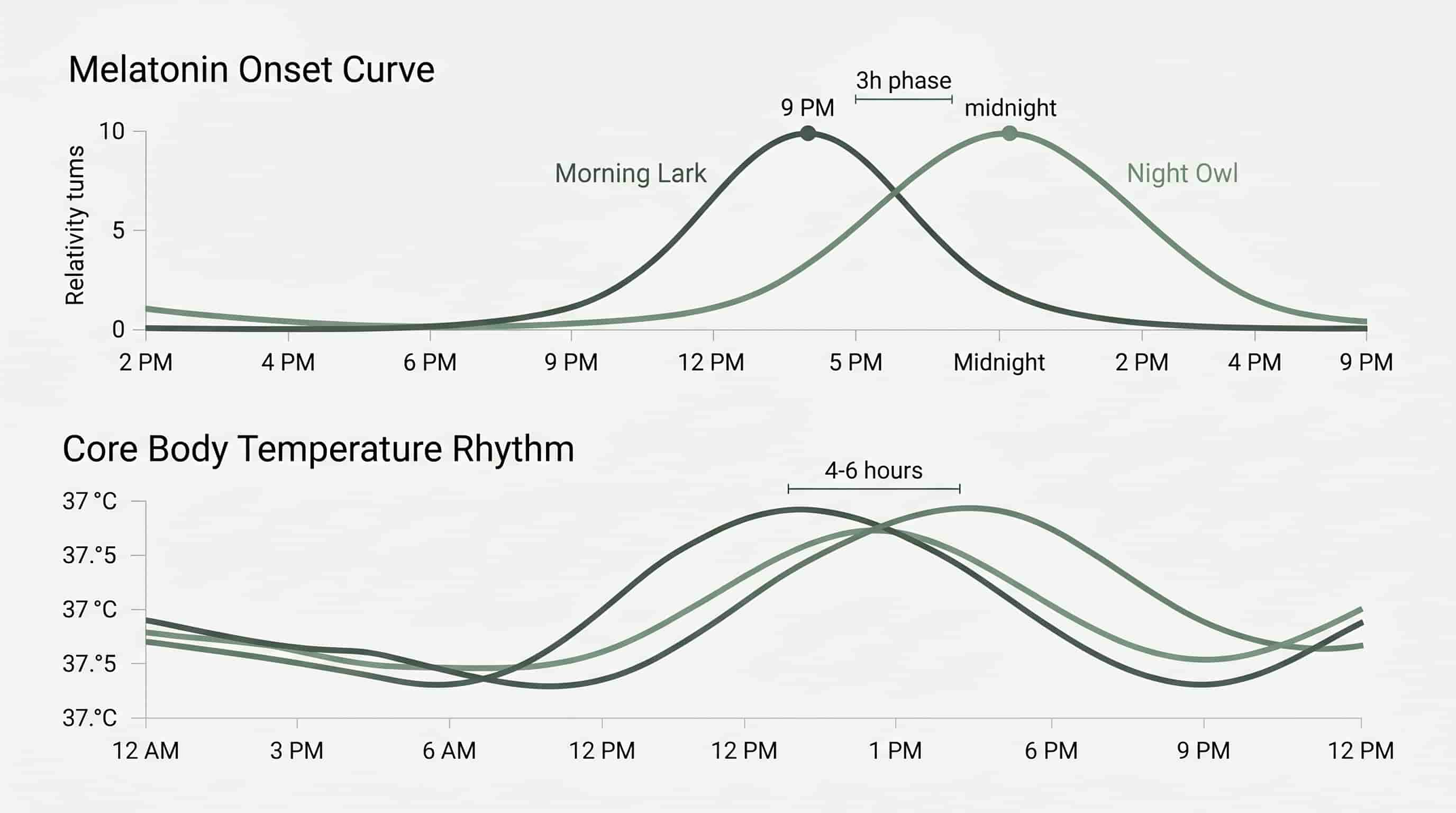
The Science: The PER3 gene contains a Variable Number Tandem Repeat (VNTR) polymorphism. If you carry the long 5-repeat allele (PER3 5/5), your circadian clock runs slightly shorter than 24 hours. You build sleep pressure faster, melatonin rises earlier, and you naturally crave bed by 9-10 PM. If you carry the short 4-repeat allele (PER3 4/4), your clock runs slightly longer. Melatonin onset is delayed by 2-4 hours, your core body temperature stays elevated late into the evening, and your brain enters peak cognitive performance at the exact hour morning larks are winding down.
What to Do Tonight: Stop trying to fix yourself. If you have schedule flexibility, shift your most demanding cognitive work to your biological peak — for night owls, this is typically 4-9 PM. If you must wake early, the intervention is light, not willpower: get 30 minutes of outdoor light immediately upon waking to suppress residual melatonin and signal to your SCN that day has begun.
Your PER3 variant is fixed at conception. No motivational video, no productivity hack, no amount of self-flagellation will change those alleles. What changes is how well you negotiate with them. A 2020 study in Frontiers in Psychology (Weiss et al.) found that the genetic mismatch between chronotype and forced social schedule — not the chronotype itself — was the primary mediator of sleep disturbance and depression in young adults. The variable that destroys your mental health is not your genes. It is the world’s refusal to accommodate them.
Research Reference: Weiss et al. (2020), Frontiers in Psychology — demonstrated that social jet lag, not chronotype type, was the primary predictor of depressive symptoms and sleep disruption, confirming that misalignment causes the damage, not the sleep timing itself.
The biological clock gap: a 4-6 hour shift in melatonin onset, temperature rhythm, and cognitive peak explains why night owls feel drugged at 7 AM and brilliant at 10 PM. This gap is genetic, not behavioral.
Why do I feel physically sick when I force myself to wake up at 6 AM?
Direct Answer: Your brain is still in its biological night. Melatonin saturates your bloodstream, your core body temperature is at its daily minimum, and your prefrontal cortex — the part of your brain responsible for decision-making — is functionally offline. You are asking a sleeping brain to perform executive tasks.
The Science: Morning larks experience melatonin onset around 8-9 PM and melatonin offset around 4-5 AM. Their body temperature begins rising before dawn, priming them for wakefulness. Night owls experience melatonin onset closer to midnight and offset around 8-9 AM. When a night owl’s 6 AM alarm fires, their melatonin levels are identical to a morning lark’s at 2 AM. The resulting sleep inertia — that drugged, heavy, disoriented sensation — is your brain being forced to boot up while still flooded with sedative hormones.
What to Do Tonight: Use a dawn-simulator alarm clock that gradually increases light intensity over 30 minutes before your target wake time. This mimics a natural sunrise, triggering your SCN to begin melatonin suppression before you open your eyes. The gentler the transition, the less severe the sleep inertia.
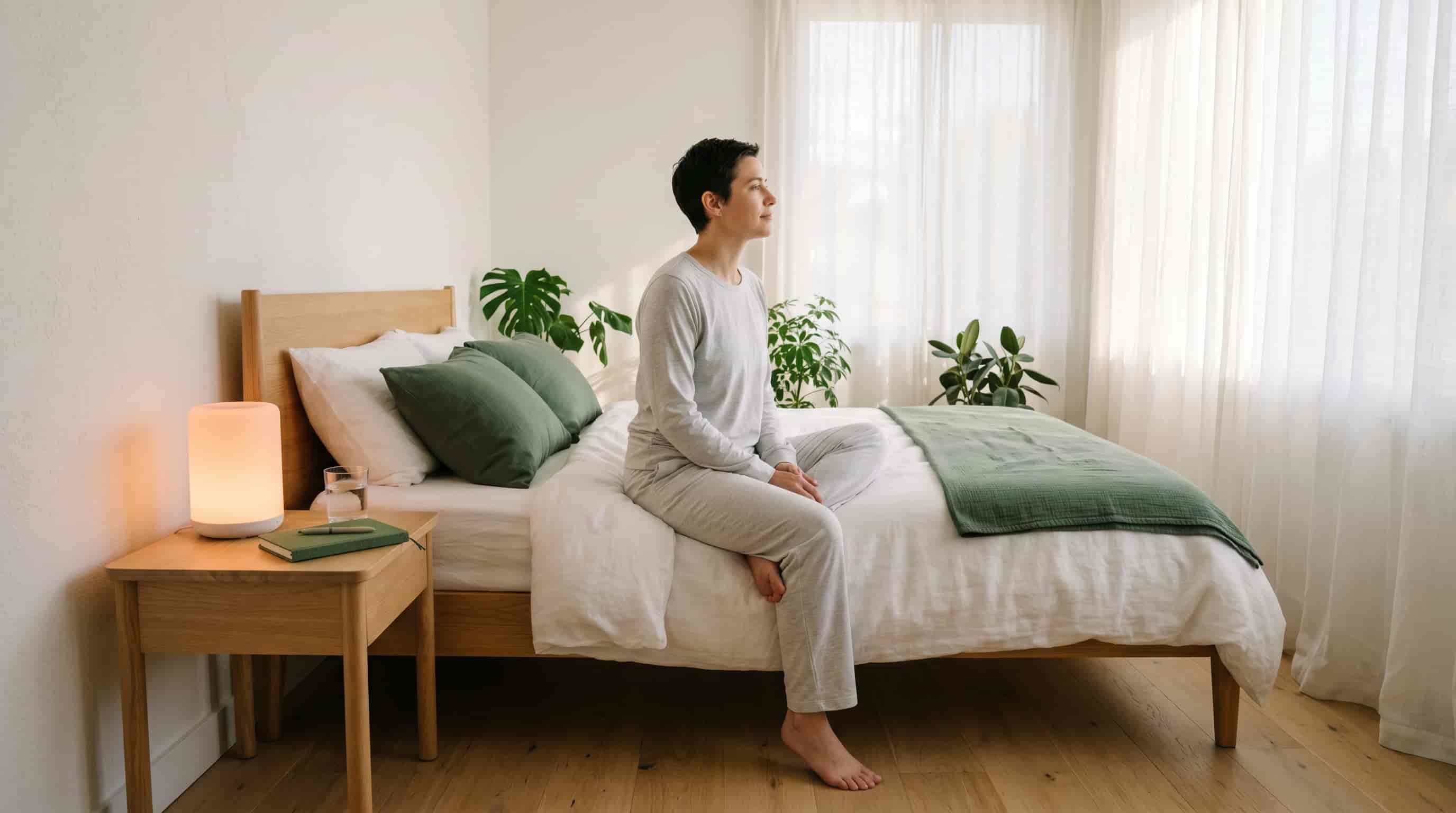
Real chronotype alignment starts in the bedroom: a dawn simulator, consistent sleep timing, and a temperature-regulated sleep surface create the conditions your brain needs to accept an earlier schedule.
What actually works to shift my sleep schedule — and what is a lie?
Direct Answer: Light exposure timing is the only intervention with Level 1 evidence for shifting circadian phase. Everything else — supplements, sleep hygiene checklists, motivational alarm clocks — is secondary.
The Science: Your SCN is fundamentally a light detector. Specialized retinal ganglion cells containing melanopsin are wired directly to the SCN. When these cells detect blue-wavelength light (460-480nm), they fire a signal that says it is day — suppress melatonin, raise cortisol, initiate wakefulness. This system evolved over millions of years before artificial lighting existed. The protocol is brutally simple: get bright light at the right time and block it at the right time. Morning light advances your phase (makes you sleepy earlier). Evening light delays it (keeps you awake later). Night owls need morning light urgently and evening light restriction ruthlessly.
What to Do Tonight: Protocol: (1) 30 minutes of outdoor light within 30 minutes of waking, no sunglasses; (2) Blue-light blocking glasses after 8 PM every single night; (3) Dim all indoor lights to candle-brightness levels 2 hours before your target bedtime. Do not miss a day for 3 weeks. This is the minimum dose for a meaningful phase shift.
Ignore the wake-up-at-5-AM gurus who tell you to just force it. Forced early waking without light management is like trying to fall asleep by closing your eyes harder — you are fighting a biological process, not a behavioral one. Sleep is a parasympathetic nervous system function. It cannot be forced. It can only be invited.
Why does caffeine timing matter more for night owls trying to shift?
Direct Answer: Caffeine consumed too early blunts your natural cortisol awakening response and guarantees a severe afternoon energy crash — exactly what a night owl trying to function on an early schedule cannot afford.
The Science: Upon waking, your adrenal glands release a surge of cortisol — the Cortisol Awakening Response (CAR) — to naturally raise blood pressure and initiate alertness. If you introduce caffeine during this peak, you build tolerance to caffeine while simultaneously blunting the hormonal signal your body needs to wake up. When both the cortisol and caffeine wear off 3-4 hours later, you crash. For a night owl already fighting melatonin at 7 AM, this double crash is catastrophic.
What to Do Tonight: Set a hard rule: no caffeine for 90-120 minutes after waking. Drink a full glass of water immediately, then get your morning light exposure. Have your first coffee at 9-10 AM, when your natural cortisol begins its normal daytime decline. This timing means caffeine bridges the gap rather than competing with your biology.
Frequently Asked Questions About Becoming a Morning Person
Q: Can a night owl actually become a morning person?
Direct Answer: You can shift your circadian phase by 1-2 hours, but you cannot change your underlying chronotype genetics. What you can do is optimize sleep quality during whatever hours your body naturally wants to sleep, so that early wake-ups are less punishing. Why: The PER3 gene variant you inherited is fixed — it determines how fast sleep pressure builds and when melatonin rises. Environmental light exposure is the only lever that moves the clock, and even that has limits. What to do: Commit to 30 minutes of outdoor light within 30 minutes of waking and blue-light blocking glasses 2 hours before bed, every day for 3 weeks. This shifts your phase by the maximum achievable amount.
Q: What is the PER3 gene and why does it control my sleep timing?
Direct Answer: PER3 is a core circadian clock gene that produces a protein controlling how quickly sleep pressure builds in your brain. If you carry the long 5-repeat allele, your clock runs slightly shorter than 24 hours — you naturally wake early and feel sleepy by 9 PM. If you carry the short 4-repeat allele, your clock runs slightly longer — your melatonin onset is delayed and your cognitive peak hits late evening. Why: This genetic variation evolved because human tribes needed sentinels at different hours. A tribe with all morning larks gets eaten by predators at 2 AM. A tribe with all night owls gets ambushed at dawn. What to do: Recognize your chronotype as an evolutionary adaptation, not a character flaw.
Q: Why do I feel like a failure because I cannot wake up early?
Direct Answer: Society equates early rising with discipline because the 9-to-5 schedule was designed during the Industrial Revolution to maximize daylight hours for factory work — electricity has existed for over a century, but the schedule has not updated. This bias is cultural, not biological. Why: Billionaire CEOs and productivity influencers are disproportionately morning larks because the entire corporate infrastructure was built by and for them. Their advice to just wake up earlier is survivorship bias dressed as wisdom. What to do: Separate self-worth from wake time. Measure productivity by output, not by what hour you started.
Q: Is being a night owl bad for my health?
Direct Answer: Not inherently. The damage comes from chronotype misalignment — forcing a night owl biology into a morning lark schedule. This misalignment creates chronic social jet lag, which independently increases metabolic syndrome risk by 33% and significantly elevates depression risk. Why: When you wake your body in its biological night, you are flooding a melatonin-soaked brain with stress hormones. Do this 5 days a week for 30 years, and your cardiovascular and metabolic systems accumulate damage. What to do: If you have any schedule flexibility, negotiate later start times. Even a 1-hour delay reduces social jet lag measurably.
Q: What is social jet lag?
Direct Answer: Social jet lag is the gap between your biological sleep schedule and your socially mandated wake time — measured as the difference between your natural wake time on free days and your forced wake time on work days. A night owl who naturally wakes at 9 AM but forces a 6 AM alarm Monday through Friday is accumulating the equivalent of 3 time zones of jet lag per week. Why: Your SCN clock cannot adjust quickly. It responds to light signals over days, not hours. Every early alarm is a shock to a system that expected 3 more hours of biological night. What to do: Keep your weekend wake time within 1 hour of your weekday alarm. Oversleeping on Saturday resets your clock backward, making Monday worse.
Q: Should I delay my morning coffee if I am a night owl forced to wake early?
Direct Answer: Yes — wait 90-120 minutes after waking before your first caffeine. Your body produces a natural cortisol spike upon waking. Introducing caffeine during this spike blunts the hormonal response and guarantees an afternoon crash. Why: Cortisol and caffeine both act on adenosine receptors. When they peak together, you build rapid tolerance and get less benefit from both. What to do: Wake up, drink water, get outdoor light, and have your first coffee at 9-10 AM when cortisol naturally dips.
Q: How do I figure out my true chronotype?
Direct Answer: Take the Morningness-Eveningness Questionnaire (MEQ) — a validated 19-question assessment with 90% accuracy — or observe your natural sleep patterns over a 7-day vacation with zero alarms. Your natural sleep onset and spontaneous wake time reveal your genetic chronotype. Why: Self-reported preferences are unreliable because they are contaminated by social obligations and guilt. You need data from a free-running schedule to see what your body actually does. What to do: On your next vacation, turn off alarms, note when you genuinely feel sleepy, and track when you wake up naturally. That pattern is your chronotype.
Q: Why am I wide awake at 11 PM but exhausted at 7 AM?
Direct Answer: This is the defining pattern of a night owl chronotype — your melatonin onset is delayed by 2-4 hours compared to morning types. While a morning lark’s melatonin rises at 8-9 PM, yours may not start until midnight, meaning 7 AM is still the middle of your biological night. Why: Your SCN’s timing signal is genetically set to run long. The PER3 4-repeat allele means your sleep pressure builds slowly and dissipates slowly, keeping you alert past midnight and sedated past dawn. What to do: Shift cognitively demanding work to your biological peak (4-9 PM). Schedule passive, routine tasks for the morning hours when your prefrontal cortex is still booting up.
Q: Does my mattress actually matter if I am a night owl with a short sleep window?
Direct Answer: Yes — a night owl forced to wake at 6 AM may only have a 5-6 hour sleep window, and every minute of that must be deep, restorative sleep. If your mattress traps heat or creates pressure points, your nervous system stays agitated, delaying deep sleep onset. Why: Night owls already have reduced sleep opportunity. A 30-minute tossing-and-turning phase represents 10% of their available sleep time versus 6% for someone with an 8-hour window. Mattress efficiency matters disproportionately. What to do: A temperature-regulating, pressure-relieving mattress like Slumbelry’s adaptive foam system shortens sleep onset latency, ensuring every available minute contributes to genuine recovery rather than discomfort.
Q: Can light therapy actually shift my sleep schedule?
Direct Answer: Yes, light is the single most powerful circadian reset tool available — it is the primary zeitgeber your SCN evolved to respond to. Bright light exposure (10,000 lux) within 30 minutes of waking advances your circadian phase. Combined with blue-light blocking 2 hours before target bedtime, you can shift your schedule by 1-2 hours over 2-3 weeks. Why: Specialized melanopsin-containing retinal ganglion cells are wired directly to your SCN. When they detect morning light, they suppress melatonin and initiate the daytime alertness cascade. What to do: Use a 10,000 lux light therapy lamp for 30 minutes upon waking if outdoor light is unavailable. Wear blue-light blocking glasses after 8 PM. Consistency is everything — missed days reset progress.
Q: Is there a DNA test for my chronotype?
Direct Answer: Genetic testing services can identify your PER3 VNTR variant, but the Morningness-Eveningness Questionnaire (MEQ) is more practical and correlates strongly with genetic markers. Your PER3 alleles predict chronotype with about 75% accuracy — the remaining variance comes from age, light exposure history, and environmental factors. Why: Chronotype is influenced by both genes and environment. A PER3 4/4 carrier who has spent 20 years waking at 5 AM for the military will present differently from a PER3 4/4 freelancer who has always slept until 10 AM. What to do: The most accurate measure is actigraphy — wear a sleep tracker for 2 weeks to record your actual sleep-wake patterns under free-running conditions.
Q: What is the biological difference between a morning lark and a night owl brain?
Direct Answer: The difference is in the timing of suprachiasmatic nucleus (SCN) output signals — morning larks have a SCN that peaks around 4-6 AM, while night owls peak around 8-10 PM. This 4-6 hour phase gap means the two chronotypes experience the same 24-hour day as fundamentally different physiological environments. Why: The SCN controls the timing of every major hormonal cascade: cortisol, melatonin, growth hormone, and body temperature. When your SCN peaks at 9 PM, you are biologically primed for late-night creativity and focus — exactly the qualities that disappear when you force yourself into an early schedule. What to do: Audit your day for chronotype mismatch. Are you scheduling creative work for 8 AM when your brain does not fully wake until 10 AM? Move your hardest tasks to your biological peak and your routine tasks to your biological trough.
Transform your evenings with the Slumbelry Sleep Nutrition Protocol.
Your chronotype is not a weakness — but forcing it into the wrong schedule is. Whether you sleep at 9 PM or 2 AM, the quality of your recovery determines how well you function. Slumbelry builds sleep systems engineered for maximum efficiency, so every hour you spend in bed — no matter when it starts — contributes to genuine restoration.
Sleep is the most vulnerable state of human existence. It is where we heal, reset, and grow.
At Slumbelry, we don’t just sell sleep products; we advocate for your physiological right to rest. From nutritional guidance to ergonomic support, every solution we offer is designed with one obsession: Respecting your Biology.
Science is our language, but your recovery is our purpose. You take care of everything else in your life — let us take care of your nights.