
Stop Fighting Biology
Why is my teenager always tired — Why Your Teen Is Not Lazy, The Circadian Shift That Makes Early School Start Times Physiological Cruelty, Not a Disciplinary Problem
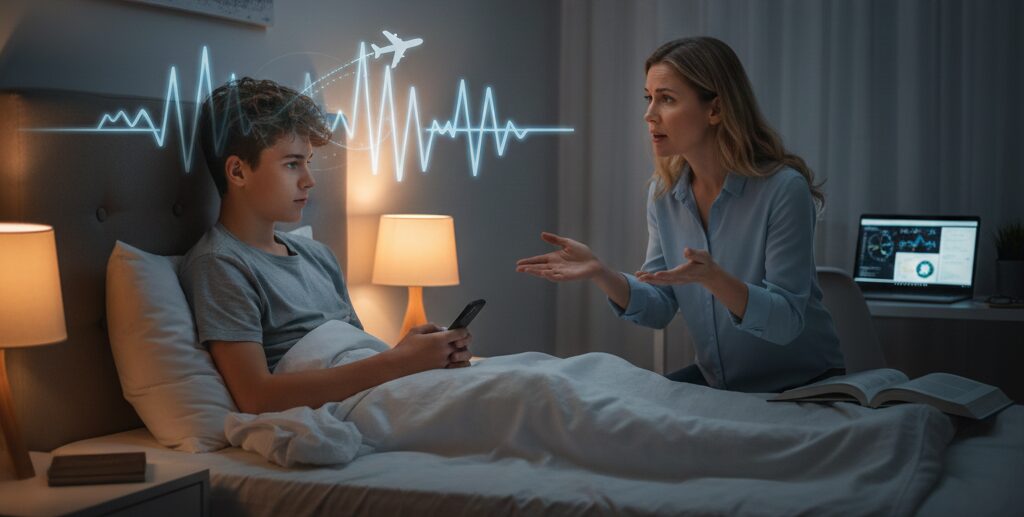
The scenario is predictable: every morning, a parent faces a teenager who cannot get out of bed, is irritable, and seems physiologically incapable of being awake at 7 AM. The parent calls it laziness. The teenager feels something is wrong with them. The reality is neither — why is my teenager always tired — it is social jetlag, a universal biological phenomenon that makes 11 PM the biological bedtime for a typical teenager and 7 AM a state equivalent to 5 AM for their parents. This is not a behavioral problem. It is a physiological mismatch that families can manage with the right protocol.
⚡ Core Takeaway: Your Teenager Is Not Lazy — Their Brain Has Undergone a Normal Developmental Circadian Phase Delay That Makes 11 PM the Biological Bedtime and 7 AM a State Equivalent to 5 AM for Their Parents; This Is Social Jetlag, Not Disciplinary Failure; The Protocol Combines Morning Light Therapy (10,000 lux at 6:30 AM), Weekend Sleep Banking, Room Environment Optimization, and Parental Language Reframing
- The Problem: The morning conflict with teenagers is not a behavioral problem — it is a biological mismatch. During puberty, rising testosterone and estradiol shift the circadian rhythm later by approximately 2 hours through changes in melatonin regulation. Melatonin onset moves from 9-10 PM (pre-pubescent) to 11 PM-12 AM (adolescent). The result is a biological night that begins at 11 PM. Any wake time before 7-8 AM produces chronic partial sleep deprivation. The adolescent brain is not being lazy — it is being exactly as biology dictates. Asking a 15-year-old to wake at 6 AM is physiologically equivalent to asking an adult to wake at 4 AM every day
- The Mechanism: S1-1 and S5-2 on adolescent circadian phase delay: the phase delay is driven by changes in SCN timing and the melatonin regulatory system during puberty. During the school week, the mismatch between biological time (11 PM bedtime) and social time (6-7 AM wake) produces approximately 6-7 hours of sleep when 8-9 are needed. This chronic partial sleep deprivation produces measurable reductions in prefrontal cortex function (executive function, working memory, emotional regulation), REM sleep debt (specific impairment in emotional regulation and memory consolidation), and metabolic disruption (elevated cortisol, reduced insulin sensitivity). The morning moodiness and irritability are neurological, not behavioral
- The Protocol: Step 1: morning light therapy — 10-30 minutes of 10,000 lux bright light at 6:30-7:00 AM (light box or outdoor exposure) advances the circadian phase by approximately 30 minutes over 1-2 weeks, moving the biological bedtime earlier. Step 2: weekend sleep banking — allow the teenager to sleep until 11 AM-12 PM on weekends. This partially repays the accumulated sleep debt from the school week. Step 3: room environment — blackout curtains, 18-19C, phone charged outside the bedroom. The bedroom is for sleep only. Step 4: parental language reframing — replace ‘lazy’ with ‘biologically delayed.’ ‘Your body thinks it is 5 AM’ is accurate and depathologizing. This language shift alone reduces the morning conflict
What Is the Adolescent Circadian Phase Delay — and Why Does the Hormonal Shift During Puberty (Rising Testosterone, Estradiol, and Melatonin Regulation Changes) Delay the Melatonin Onset by Approximately 2 Hours, Making 11 PM the Biological Bedtime for a Typical 15-Year-Old vs 10 PM for Their Parents?
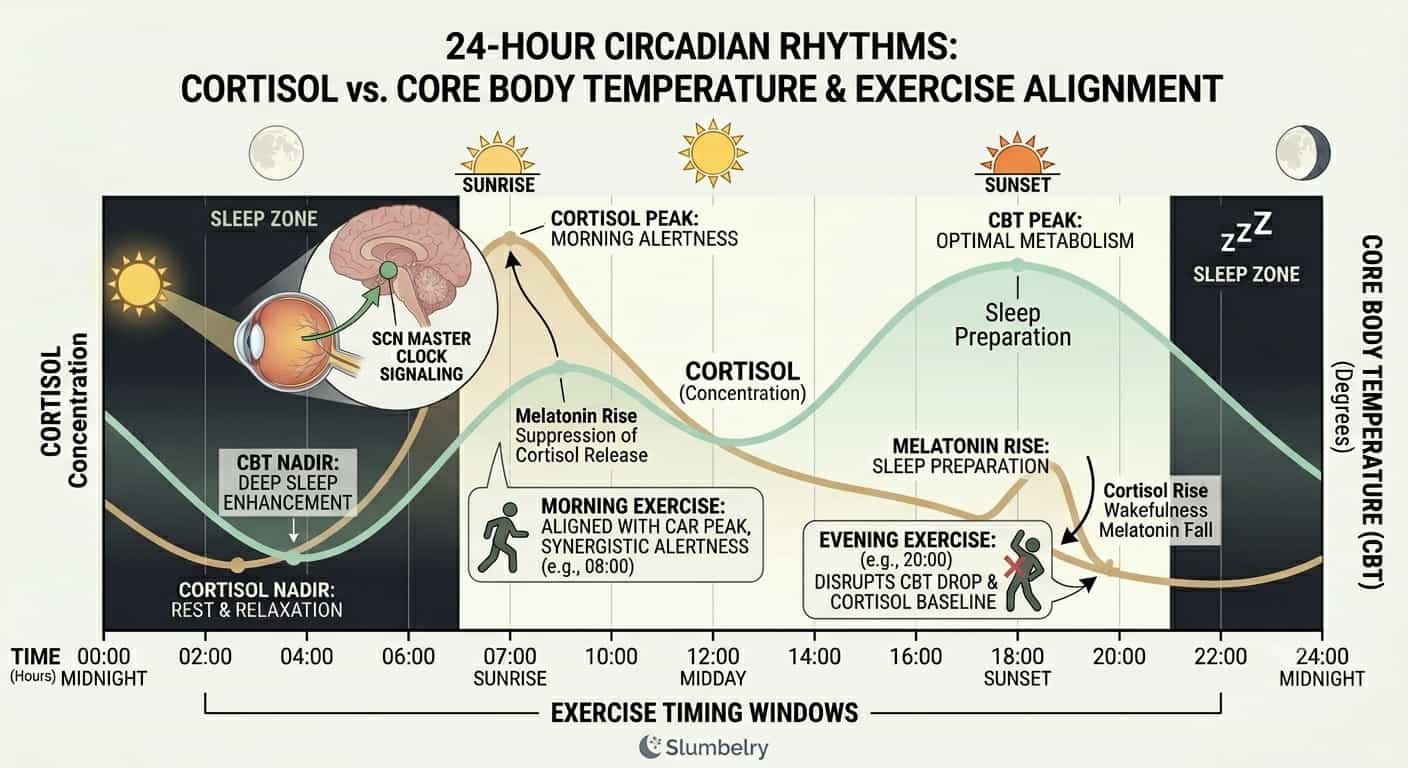
Direct Answer: During puberty, the circadian rhythm shifts later by approximately 2 hours due to changes in SCN timing and melatonin regulation driven by rising sex hormones. Melatonin onset (the beginning of the biological night) moves from approximately 9-10 PM in pre-pubescent children to 11 PM-12 AM in adolescents. The core body temperature nadir shifts by the same 2 hours. The result: a 15-year-old’s brain at 10 PM is equivalent to a 25-year-old’s brain at 8 PM. This is not a preference — it is universal developmental biology.
Mechanism: S1-1 and S5-2 on adolescent circadian phase delay: the SCN’s circadian clock is recalibrated during puberty through the interaction between sex hormones (testosterone, estradiol) and the melatonin regulatory system. Studies using dim light melatonin onset (DLMO) measurements consistently show a 1.5-2.5 hour delay in melatonin onset during mid-to-late puberty. The mechanism involves changes in SCN sensitivity to light, shifts in the timing of the pineal gland’s melatonin secretion, and changes in the feedback loops between the reproductive axis and the circadian system. This is a universal phenomenon — every adolescent in every culture with modern school schedules experiences some degree of this phase delay. The magnitude varies individually, but the direction is consistent.
What Is Social Jetlag — and Why Does the Mismatch Between the Adolescent Delayed Sleep Phase and the Institutional Early School Start Time (7 AM) Produce the Same Physiological State as Flying Across 2-3 Time Zones Every Week, With Identical Cognitive and Emotional Consequences?
Direct Answer: Social jetlag is the term for the mismatch between biological time (the circadian phase) and social time (school/work schedules). When teenagers must wake at 6-7 AM, their bodies are in a state equivalent to waking an adult at 4-5 AM and demanding they perform complex cognitive tasks. This is not an exaggeration — the physiological state is identical to chronic jet lag from transatlantic travel, with the same cognitive impairment, emotional dysregulation, and metabolic disruption.
Mechanism: S1-1 and S5-2 on social jetlag: the term social jetlag (Wittmann et al., 2006, Chronobiology International) describes the phenomenon of forced misalignment between biological and social schedules. For adolescents, the magnitude of this misalignment is typically 2-3 hours per school day — equivalent to flying from New York to London every Monday and back every Friday. The cumulative effect of this weekly jet lag on cognitive performance is measurable: reaction time, working memory, executive function, and emotional regulation all show degradation equivalent to mild sleep deprivation. The metabolic consequences are also measurable: insulin sensitivity, cortisol regulation, and immune function are all disrupted by chronic social jetlag. This is not a behavioral problem — it is a physiological assault on the developing brain.
Why Does Chronic Social Jetlag Produce Measurable Cognitive Impairment in Adolescents — and What Is the Evidence That Sleep-Deprived Teenagers Show Reduced Prefrontal Cortex Function (Impaired Executive Function, Working Memory, and Emotional Regulation) That Is Misdiagnosed as Motivational Failure?
Direct Answer: Sleep-deprived teenagers show measurable reductions in prefrontal cortex function — the brain region responsible for executive function, impulse control, working memory, and emotional regulation. This is often misdiagnosed as laziness, lack of motivation, or defiance when it is actually the measurable cognitive consequence of chronic partial sleep deprivation from social jetlag.
Mechanism: S1-1 and S5-2 on adolescent sleep deprivation and PFC function: the prefrontal cortex is disproportionately sensitive to sleep loss compared to other brain regions. In adolescents, who are in a critical period of PFC development, chronic sleep deprivation from social jetlag produces measurable reductions in gray matter volume, synaptic pruning efficiency, and functional connectivity in the prefrontal networks. Studies using fMRI show reduced PFC activation during cognitive tasks in sleep-deprived adolescents compared to well-rested controls, even when the adolescents report feeling alert. The behavioral manifestation — inattention, emotional volatility, poor planning, impulsivity — is identical to what would be observed in an adult with PFC damage. The difference is that the adolescent’s brain is structurally intact — the problem is functional, caused by sleep deprivation, and reversible with adequate sleep.
Why Does REM Sleep Loss From Early Waking Specifically Impair Emotional Regulation in Teenagers — and What Is the Mechanism by Which REM-Dependent Memory Consolidation and Amygdala Prefrontal Cortex Integration Are Disrupted by the Morning REM Debt Produced by a 6-7 AM Wake Time?
Direct Answer: REM sleep is disproportionately located in the second half of the sleep period — the hours that are cut off first when a teenager is forced awake at 6-7 AM. REM sleep is responsible for emotional memory consolidation and the integration of amygdala activity with prefrontal cortex regulation. When REM sleep is cut short, emotional regulation is specifically impaired, producing the moodiness and emotional volatility that is incorrectly attributed to teenage hormones or attitude.
Mechanism: S1-1 and S5-2 on REM sleep and emotional regulation: during REM sleep, the hippocampus replays the day’s experiences and transfers them to long-term cortical storage. The amygdala, which processes emotional salience, is active during REM — and the prefrontal cortex, which normally inhibits amygdala activity during waking hours, is relatively quiescent during REM, allowing emotional memories to be processed without prefrontal suppression. This is why REM sleep is critical for emotional regulation: it is the period when the brain processes emotional experiences and ‘tunes’ the amygdala-prefrontal cortex circuit. When REM sleep is shortened by early waking, this processing is incomplete — the emotional experiences of the day are not fully integrated, and the amygdala remains relatively less regulated by the PFC. In teenagers, who are already experiencing significant emotional development and social cognition expansion, this REM debt has a disproportionate effect on emotional stability.
What Is the Sleep Banking Hypothesis — and Why Does Allowing Teenagers to Sleep Until 11 AM-12 PM on Weekends Partially Repairs the Chronic Sleep Debt Accumulated During the School Week, Without the Full Cognitive Recovery That Would Require Consistent 9-Hour Sleep Opportunities?
Direct Answer: The sleep banking hypothesis states that allowing extended sleep on weekends partially repays the accumulated sleep debt from the school week, producing measurable improvements in cognitive function and mood compared to continuing to restrict sleep. It does not fully substitute for consistent adequate sleep, but it is a clinically meaningful intervention that reduces the worst consequences of chronic partial sleep deprivation.
Mechanism: S1-1 and S5-2 on sleep banking: the homeostatic sleep drive (process S) accumulates during waking hours — the longer you are awake, the greater the pressure for SWS and REM. When sleep is restricted during the school week (6-7 AM wake, 11 PM biological bedtime = 6-7 hours when 8-9 are needed), the homeostatic pressure builds. Weekend sleep extension allows the body to ‘bank’ additional sleep — particularly SWS and REM that were restricted during the week. Studies using extended weekend sleep protocols show that cognitive performance (reaction time, working memory) improves measurably on weekend mornings compared to weekday mornings in adolescents with chronic sleep restriction. However, sleep banking cannot fully compensate for weekday sleep loss — the cognitive recovery is partial, and the metabolic and immune consequences of chronic sleep debt persist even with weekend recovery sleep. The goal is still consistent adequate sleep; sleep banking is a partial mitigation strategy.
Why Does Morning Light Exposure (at the Correct Time) Shift the Circadian Phase Earlier — and What Is the Mechanism by Which 10-30 Minutes of Bright Light (10,000 lux) at 6:30-7:00 AM Resets the SCN and Advances Melatonin Onset, Counteracting the Natural Phase Delay?
Direct Answer: Morning light exposure at the correct time (6:30-7:00 AM) advances the circadian phase earlier — shifting melatonin onset back to an earlier time. This is the opposite effect of evening light, which delays the phase. Using 10,000 lux bright light (equivalent to outdoor light on an overcast morning) for 10-30 minutes at this specific time advances the SCN’s clock, moving the biological bedtime earlier and making it easier for the teenager to fall asleep at 10-11 PM.
Mechanism: S1-1 and S5-2 on morning light therapy and circadian phase advance: the SCN uses light as its primary time-giver (zeitgeber). Light exposure in the morning (before the temperature minimum, which is typically around 4-5 AM for a delayed adolescent) produces a phase advance — it shifts the circadian clock earlier. Light exposure in the evening (after the temperature minimum) produces a phase delay — it shifts the clock later. For adolescents with a natural phase delay, morning light at 6:30-7:00 AM (before the delayed temperature minimum) advances the phase, effectively ‘resetting’ the biological clock to an earlier schedule. Studies of morning light therapy in adolescents (Chang et al., 2011, New England Journal of Medicine, using 10,000 lux light boxes) showed a 30-minute advance in circadian phase and a corresponding improvement in sleep onset time and total sleep duration. The combination of morning light therapy and evening light restriction (no screens after 10 PM) produces the most consistent circadian advancement.
What Is the Relationship Between Blue Light From Screens and the Adolescent Circadian Phase Delay — and Why Does Late-Night Phone Use Amplifies the Natural Circadian Shift Rather Than Being the Primary Cause, With the Screen Light Acting as an Additional Phase-Delaying Signal on Top of the Existing Biological Delay?
Direct Answer: Late-night screen use is a significant contributor to adolescent sleep problems, but it is not the primary cause of the circadian phase delay — it is an amplifier of an existing biological phenomenon. The blue light from screens suppresses melatonin through the melanopsin retinal ganglion cell pathway, delaying sleep onset. When combined with the natural adolescent phase delay, late-night phone use produces a cumulative phase-delaying effect that pushes bedtime even later.
Mechanism: S1-1 and S5-2 on screen light and circadian disruption: the melanopsin retinal ganglion cells (mRGCs) that mediate light’s effect on the SCN are most sensitive to blue light (around 480nm). Screen light from phones, tablets, and computers has a significant blue-light component that suppresses melatonin through the retinohypothalamic tract to the SCN. In adolescents, who already have a 2-hour delayed melatonin onset from hormonal changes, additional evening light exposure further delays the melatonin signal, pushing the biological bedtime later. The cognitive content of screen use (social media, gaming) also activates the prefrontal cortex and amygdala, producing arousal that opposes sleep onset. The solution is not to eliminate the biological phase delay (which is inevitable) but to remove the additional amplifier: no screens for 1 hour before the target bedtime, blue-light filtering enabled on all devices, and ideally the phone charged outside the bedroom.
Why Does the Let Them Sleep In on Weekends Prescription Work — and Why Is Weekend Recovery Sleep Banking a Partial but Clinically Meaningful Intervention That Reduces the Weekday-Weekend Sleep Debt Gradient, Even Though It Cannot Fully Substitute for Consistent Sleep Scheduling?
Direct Answer: Allowing teenagers to sleep until 11 AM-12 PM on weekends is one of the most effective and immediately implementable interventions for adolescent social jetlag. Weekend recovery sleep partially repays the accumulated sleep debt from the school week, producing measurable improvements in cognitive function, mood, and emotional regulation. It does not fully substitute for consistent adequate sleep, but it is clinically meaningful and has an immediate effect on the morning conflict.
Mechanism: S1-1 and S5-2 on weekend sleep banking: the homeostatic sleep pressure accumulated during the school week (from 6-7 AM wake times combined with 11 PM biological bedtimes) produces measurable cognitive impairment and emotional dysregulation. Weekend extended sleep allows the body to catch up on the missing SWS and REM — particularly the morning REM that is lost to early waking. The sleep architecture during recovery sleep shows increased REM percentage and increased SWS, which are the two stages most impacted by early waking. Studies of weekend recovery sleep in adolescents (such as Klonoff et al.) show measurable improvement in reaction time and self-reported alertness on weekend mornings compared to weekday mornings. The only caveat: sleeping until 1-2 PM on Sunday morning can itself produce a mild case of Sunday night insomnia due to the advanced phase from weekend recovery — so the sleep banking should be balanced with a consistent target bedtime on Sunday night.
What Are the Long-Term Health Consequences of Chronic Adolescent Social Jetlag — and Why Does Sustained Sleep Debt During the Developmental Period Produce Elevated Cortisol, Insulin Resistance, Immune Suppression, and Cardiovascular Risk Factors That Persist Beyond the Teenage Years?
Direct Answer: Chronic social jetlag during adolescence is not just a short-term performance issue — it produces measurable long-term health consequences. Sustained partial sleep deprivation during a critical developmental period affects the trajectory of metabolic, immune, and cardiovascular health in ways that persist into adulthood.
Mechanism: S1-1 and S5-2 on long-term consequences of adolescent sleep debt: during adolescence, the metabolic and endocrine systems are still developing. Chronic sleep debt disrupts the cortisol diurnal rhythm (flattening the morning cortisol peak and elevating evening cortisol), produces insulin resistance (increasing Type 2 diabetes risk), suppresses immune function (reducing cytokine production and NK cell activity), and elevates cardiovascular risk factors (elevated blood pressure, increased inflammatory markers). The critical period issue: these systems are being calibrated during adolescence. Sleep debt during this calibration period may ‘reset’ the set points for these systems at a less healthy level — meaning the health consequences are not just immediate but potentially permanent. Studies tracking adolescent sleep patterns into adulthood (Taheri, 2006, and others) show associations between short sleep in adolescence and increased BMI, Type 2 diabetes, and cardiovascular disease in adulthood.
What Is the Complete Social Jetlag Protocol for Families — and How Do You Combine Morning Light Therapy, Weekend Sleep Banking, Room Environment Optimization, and Parental Language Reframing to Reduce the Morning Conflict While Acknowledging the Adolescent’s Biological Reality?
Direct Answer: The complete social jetlag protocol combines four evidence-based interventions: morning light therapy to advance the circadian phase, weekend sleep banking to repay accumulated debt, room environment optimization for maximum sleep quality, and parental language reframing to reduce conflict by replacing ‘lazy’ with ‘biologically delayed.’ These four elements work together to reduce morning conflict while acknowledging the adolescent’s biological reality.
Mechanism: S1-1 and S4-4 on the complete social jetlag protocol: Step 1: morning light therapy — 10-30 minutes of 10,000 lux bright light exposure at 6:30-7:00 AM (light box or outdoor exposure on the way to school). This advances the circadian phase by approximately 30 minutes over 1-2 weeks, moving the biological bedtime earlier. Step 2: weekend sleep banking — allow sleep until 11 AM-12 PM on Saturday and Sunday. This partially repays the week’s sleep debt. On Sunday, set a soft limit of 11 AM to avoid Sunday night insomnia. Step 3: room environment optimization — blackout curtains (18-19C) and no screens in the bedroom. Remove phones from the bedroom entirely (charge in another room). The bedroom is for sleep only. Step 4: parental language reframing — ‘Your body thinks it is 5 AM’ is accurate and depathologizing. ‘You are not lazy, you are biologically delayed’ is the reframe that reduces the shame and conflict that make the situation worse. This is not about accepting poor performance — it is about understanding the mechanism and working with the biology rather than against it.

Frequently Asked Questions
Why do teenagers stay up so late?
Direct Conclusion: Teenagers stay up late because of a universal developmental circadian phase delay driven by rising sex hormones during puberty. Melatonin onset shifts from 9-10 PM to 11 PM-12 AM. This is not a preference or a choice — it is biology. The adolescent brain at 10 PM is equivalent to an adult brain at 8 PM. Asking a teenager to fall asleep at 10 PM is equivalent to asking an adult to fall asleep at 8 PM.
How much sleep do teenagers actually need?
Direct Conclusion: Teenagers need 8-10 hours of sleep per night (American Academy of Sleep Medicine recommendation for ages 13-18). Most are getting 6-7 hours on school nights due to the mismatch between biological bedtime (11 PM) and school start time (7 AM). This chronic partial sleep deprivation is the primary driver of the cognitive, emotional, and metabolic consequences of adolescent social jetlag.
Is letting my teen sleep in on weekends okay?
Direct Conclusion: Yes — weekend sleep banking is one of the most effective immediate interventions for adolescent social jetlag. Allowing teenagers to sleep until 11 AM-12 PM on weekends partially repays the accumulated sleep debt from the school week. The only caveat: sleeping past noon on Sunday can interfere with Sunday night sleep, so set a soft limit of 11 AM-12 PM.
Does morning light therapy work for teens?
Direct Conclusion: Yes — morning light therapy is one of the most evidence-based interventions for adolescent circadian phase delay. 10-30 minutes of 10,000 lux bright light at 6:30-7:00 AM advances the circadian phase by approximately 30 minutes over 1-2 weeks, making it easier to fall asleep earlier. Chang et al. (2011, NEJM) demonstrated this effect in a randomized controlled trial.
Why is my teenager so moody in the morning?
Direct Conclusion: Morning moodiness in teenagers is primarily the result of REM sleep debt from early waking, combined with the circadian nadir (the time when the body is at its lowest temperature and highest sleepiness) occurring in the early morning hours for adolescents with a delayed phase. The emotional volatility is neurological, not behavioral — it is the consequence of inadequate REM sleep and the circadian nadir.
What is social jetlag?
Direct Conclusion: Social jetlag is the mismatch between biological time (circadian phase) and social time (school schedules). For teenagers, it is approximately 2-3 hours per day — equivalent to flying from New York to London every Monday. Chronic social jetlag produces the same cognitive impairment, emotional dysregulation, and metabolic disruption as chronic transcontinental jet lag.
Should I take away my teen’s phone at night?
Direct Conclusion: Removing or restricting phone use at night is one of the most effective interventions for adolescent social jetlag. Late-night screens suppress melatonin through mRGC pathway activation, amplify the natural phase delay, and activate the prefrontal cortex (opposing sleep onset). The recommendation: no screens for 1 hour before target bedtime, charge phone outside the bedroom.
Why do schools start so early?
Direct Conclusion: Most school districts schedule high schools to start at 7:00-7:30 AM for administrative reasons (bus routing, sports schedules) that have nothing to do with adolescent biology. The American Academy of Pediatrics has recommended since 2014 that middle and high schools start no earlier than 8:30 AM. Most schools do not follow this recommendation. Until school schedules change, families must manage the consequences.
Can teenagers develop permanent sleep problems from social jetlag?
Direct Conclusion: Chronic social jetlag during adolescence can contribute to the development of persistent insomnia and circadian rhythm disorders that extend beyond the teenage years. The sleep-wake homeostasis calibration that occurs during adolescence may be affected by chronic disruption, potentially leading to adult sleep disorders. Addressing social jetlag early reduces this risk.
How do I talk to my teenager about sleep without conflict?
Direct Conclusion: The most effective language reframe for parents: ‘Your body thinks it is 5 AM’ replaces ‘You are lazy.’ This is biologically accurate, depathologizing, and removes the shame that makes adolescent sleep problems worse. Acknowledge the biology before asking for behavior. ‘I know your brain thinks it is the middle of the night — but we need to get going’ is more effective than ‘Get up, you are going to be late.’
Ready to Transform Your Recovery?
If social jetlag is affecting your teenager’s performance and mood, the complete protocol — morning light therapy, weekend sleep banking, and environment optimization — is the first-line intervention.
Take the Sleep Assessment Explore Our Cooling MattressThe Slumbelry Commitment
Sleep is the most vulnerable state of human existence. It is where we heal, reset, and grow.
At Slumbelry, we do not just sell sleep products; we advocate for your physiological right to rest. From ergonomic support to light management, every solution we offer is designed with one obsession: Respecting your Biology.
Science is our language, but your recovery is our purpose. You take care of everything else in your life — let us take care of your nights.
Rest Deeply,
The Slumbelry Team