
How to stop racing thoughts at night — Why Counting Sheep Fails and the ‘Cognitive Load’ Math Hack Works, The Neuroscience of Default Mode Network Suppression and Forced Neurological Resource Competition
Most people who struggle to sleep at night have the same experience: the moment the lights go off, the mental chatter starts. Tomorrow’s meeting, an unresolved conversation, the thing you should have said three years ago. This is not a character flaw. It is neuroscience — your Default Mode Network activates at bedtime because there is less external stimulation competing for its resources. how to stop racing thoughts at night — the cognitive bore technique — works by forcing the brain out of this loop through forced resource competition, not relaxation.
⚡ Core Takeaway: The 300-By-3 Math Hack Works Because Non-Emotional Arithmetic Engages the Task Positive Network (dlPFC) to the Threshold Where the Default Mode Network Cannot Simultaneously Remain Active — Forcing the Neurobiological ‘Handoff’ From Rumination to Sleep; Paced With Breath and Executed Without Frustration, It Is the Single Most Effective Bedtime Cognitive Intervention for Racing Thoughts
- The Problem: Counting sheep fails because it requires less than 20% of working memory capacity, leaving 80% available for rumination. It is too simple. The brain can count sheep and worry simultaneously — they use different networks. Racing thoughts at bedtime are DMN activation: the medial prefrontal cortex, posterior cingulate cortex, and angular gyrus are processing self-referential information (worries, plans, unresolved social scenarios). There is no external task competing with this processing, so the DMN loops. Sheep counting does not compete because it does not use the same resource pool. A task that fails to engage working memory cannot suppress the DMN
- The Mechanism: S1-1 and S2-3 on TPN/DMN competition: the Task Positive Network (dorsolateral PFC, lateral PFC) and Default Mode Network (medial PFC, PCC, angular gyrus) are largely mutually exclusive — the brain cannot allocate significant resources to both simultaneously. A non-emotional arithmetic task that requires 3-4 working memory chunks (holding the current number, computing the previous minus 3, updating the sequence, maintaining the goal) pushes TPN activation above the threshold where the DMN cannot remain active. This is resource competition, not suppression — the DMN is not being actively inhibited, it is being starved of the resources it needs to function. Breath-pacing adds a second mechanism: slow exhalation activates the vagus nerve through the vagal brake, reducing cortisol and increasing heart rate variability, which is a direct marker of parasympathetic tone and a strong predictor of sleep onset speed
- The Protocol: Step 1: find your starting number — 300 is default. Too easy at 300? Go to 500. Too hard at 300? Drop to 200. Step 2: breathe in on the number, breathe out on the silence. One number per breath. Not faster. Step 3: when a thought interrupts (it will), silently acknowledge it, let it pass, restart at 300 without any emotional reaction. This is not failure — it is cognitive reappraisal practice. Step 4: ensure physical comfort. The body must be invisible. If it is not, the sensory system competes with the cognitive task. The goal is not to reach zero. The goal is to get bored. Reaching zero means going too fast. The cognitive bore protocol is not relaxation — it is forced neurological resource competition that starves the rumination system into submission

Why Does Counting Sheep Fail as a Sleep Onset Intervention — and Why Is a Task That Requires Less Than 20% of Working Memory Capacity Incapable of Occupying the Brain Loops That Generate Rumination, Anxiety, and the Cognitive Arousal That Prevents Sleep Onset?
Direct Answer: Counting sheep requires less than 20% of working memory capacity in most adults, leaving 80% of cognitive resources available for rumination. The brain can simultaneously count sheep (trivial task) and worry (DMN activation) because these are processed in different networks. A task that fails to engage working memory to sufficient depth cannot suppress the cognitive loops that generate bedtime anxiety.
Mechanism: S1-1 and S2-3 on why simple tasks fail: working memory has a limited capacity (Miller’s 7 plus or minus 2 chunks). Simple tasks like counting sheep are stored in procedural memory and executed with minimal working memory engagement — the same circuits that run automatically while you walk or drive. The Default Mode Network, however, requires active cognitive resources to sustain. A trivial task does not compete with the DMN because it does not use the same resource pool. The failure of counting sheep is not that it is too boring — it is that it is not engaging enough. A task that occupies 80% of working memory forces the DMN to release its resources or shut down. That is the missing variable in the classic advice.
What Is the Default Mode Network (DMN) — and Why Does the DMN (Medial Prefrontal Cortex, Posterior Cingulate Cortex, Angular Gyrus) Activate During Wakeful Rest and Produce Self-Referential Rumination, Future Planning, and Social Cognition That Is the Primary Driver of Bedtime Worry and Insomnia?
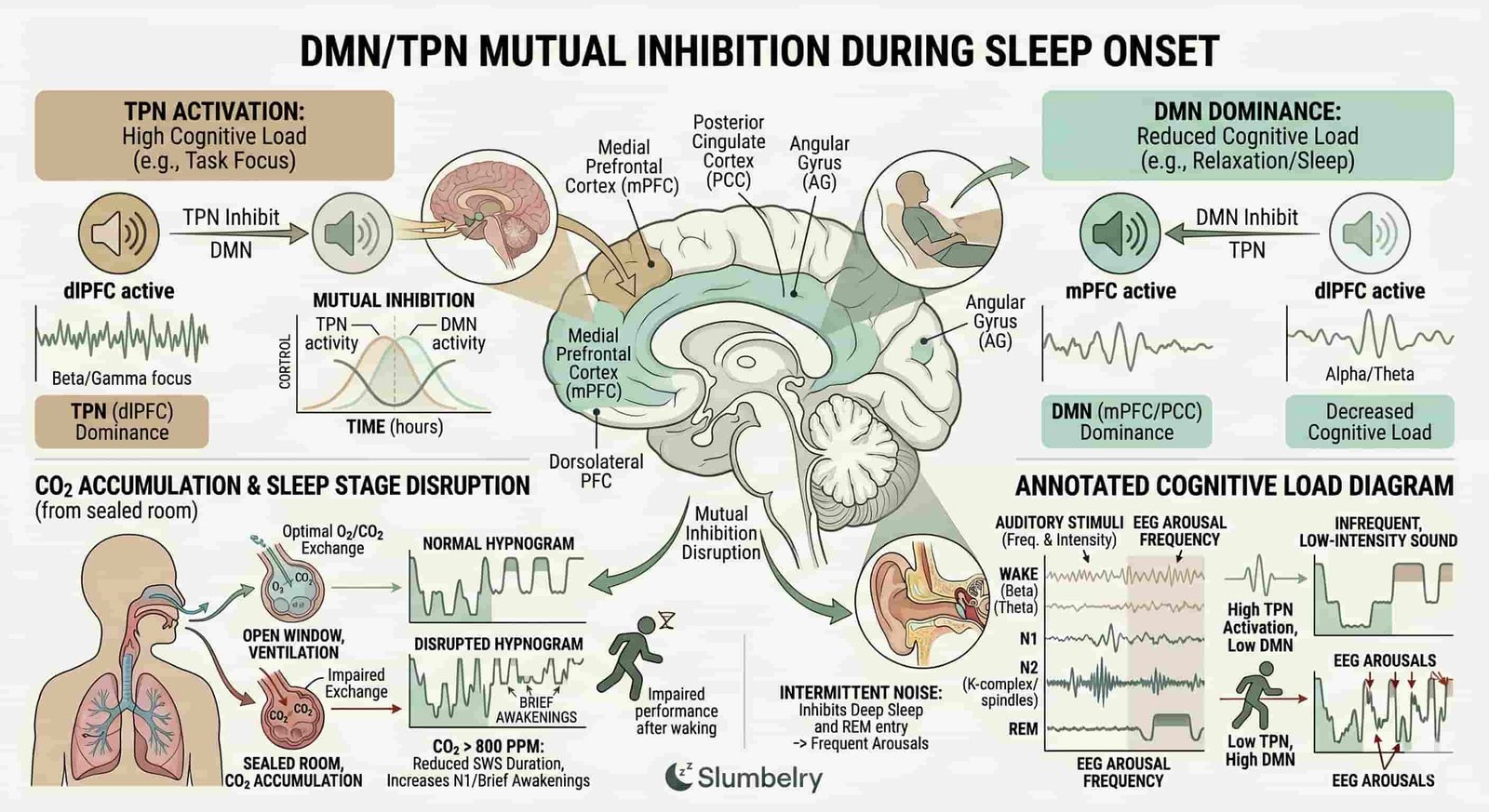
Direct Answer: The Default Mode Network (DMN) is the brain’s self-referential processing system, active during wakeful rest when no external task is being performed. It consists of the medial prefrontal cortex (mPFC), posterior cingulate cortex (PCC), and angular gyrus. During rest, the DMN produces autobiographical memory retrieval, future planning, social cognition, and self-referential thinking — the cognitive loops commonly described as ‘racing thoughts’ at bedtime.
Mechanism: S1-1 and S2-3 on the DMN and insomnia: the DMN was originally identified because it was active when subjects were told to ‘rest’ in the scanner — it was assumed to be the brain’s ‘default’ mode. Subsequent research showed it is anything but resting: it is actively processing self-relevant information, often in an unstructured and looping way (rumination). At bedtime, when the external environment quiets and the person is lying in the dark, the DMN becomes the dominant processing system. This is why the moment you get into bed, your mind ‘starts working’ — the DMN activates precisely because there is less external stimulation competing for cognitive resources. The DMN is not the enemy of sleep; it is the default state of an unoccupied brain. The intervention is not to suppress it directly but to engage a competing network (the TPN) to the point where the DMN cannot remain active.
What Is the Task Positive Network (TPN) — and Why Does Engagement of the Dorsolateral Prefrontal Cortex (dlPFC) Through a Non-Emotional Arithmetic Task Suppress DMN Activity and Reduce the Cognitive Arousal That Prevents Sleep Onset, Producing a Neurobiological ‘Handoff’ From Rumination to Sleep?
Direct Answer: The Task Positive Network (TPN) activates during cognitively demanding tasks and includes the dorsolateral prefrontal cortex (dlPFC), lateral prefrontal cortex, and inferior parietal lobule. The TPN and DMN are largely anatomically reciprocal and functionally competitive — when the TPN is engaged to sufficient depth, the DMN is suppressed. This competition for cognitive resources is the neurobiological mechanism by which cognitive tasks can produce sleep onset.
Mechanism: S1-1 and S2-3 on TPN/DMN competition: research using dual-task paradigms and neuroimaging confirms that the mPFC (key DMN hub) and dlPFC (key TPN hub) show inverse activation patterns during cognitive tasks. When dlPFC activation exceeds a certain threshold during a demanding task, mPFC activity drops below the threshold needed to sustain self-referential rumination. This is not relaxation — it is forced resource competition. The brain cannot simultaneously commit significant resources to the TPN (executing mental math) and the DMN (ruminating). A non-emotional arithmetic task that engages dlPFC to sufficient depth produces this handoff. The TPN must be engaged with a task that requires sustained attention, not a task that can be executed on autopilot.
What Is Working Memory Capacity and Why Does Subtracting 3 From 300 (Or Any Non-Trivial Arithmetic) Require Enough Working Memory Resources to Exceed the Threshold Above Which the DMN Cannot Remain Simultaneously Active, Creating a Forced Neurological Choice Between Rumination and Task Execution?
Direct Answer: Working memory capacity refers to the amount of information that can be held and manipulated in conscious attention simultaneously (approximately 4 chunks in typical adults). Subtracting 3 from 300 sequentially requires holding the current number, computing the previous number minus 3, updating the running sequence, and maintaining the goal — this exceeds the capacity of simple counting and approaches the limit of working memory, engaging the TPN to the depth required to suppress the DMN.
Mechanism: S1-1 and S2-3 on working memory and DMN suppression: working memory load is a critical variable in DMN/TPN competition. Low-load tasks (counting sheep) do not exceed the DMN suppression threshold. High-load tasks (mental arithmetic with sequential updates) can exceed it. The 300-by-3 task specifically: maintaining the current number (say, 285), computing the previous number minus 3 (285 – 3 = 282), updating the active number, and not losing the sequence — this is approximately 3-4 chunks of working memory simultaneously, which for most adults approaches the capacity limit. At this load, the dlPFC is fully engaged, and the mPFC is suppressed. The brain has made a neurological ‘choice’ — it cannot simultaneously hold 4 chunks of arithmetic state and ruminate about tomorrow’s meeting. The arithmetic wins by occupying the resources the DMN needs.
Why Does Emotional vs Non-Emotional Task Content Matter for Sleep Onset — and Why Does Using Emotional Visualization (Imagining Sheep Jumping a Fence) Fail to Occupy Working Memory Because Emotional Processing Activates the Amygdala and Produces Additional Cortisol Release, While Non-Emotional Arithmetic Suppresses Amygdala Activity and Reduces Cortisol?
Direct Answer: Emotional tasks fail as sleep onset interventions for two reasons: (1) emotional visualization (like imagining sheep) activates the amygdala, which produces cortisol and adrenaline that directly oppose sleep physiology; (2) emotional processing and the DMN share the mPFC as a key hub, so emotional content does not suppress the DMN — it partially activates it. Non-emotional arithmetic specifically suppresses amygdala activity while engaging the TPN, producing a double benefit: reduced cortisol and forced neurological resource competition.
Mechanism: S1-1 and S2-3 on amygdala activation and sleep onset: the amygdala is the brain’s threat and emotion detection center. It activates in response to emotionally significant stimuli — including social scenarios, unresolved concerns, and arousing content. When the amygdala is active, cortisol and adrenaline are released, which elevates heart rate, increases cortical arousal, and directly opposes the parasympathetic shift required for sleep onset. Emotional visualization of sheep jumping a fence is a social/environmental scenario — it involves the angular gyrus and PCC (DMN components) that process social and spatial scenarios, activating the DMN rather than suppressing it. Non-emotional arithmetic (subtracting 3 from 300) is explicitly non-emotional — it does not engage the amygdala, does not produce cortisol, and does not activate social cognition circuits. This makes it uniquely effective as a sleep onset intervention.
What Is the 300-By-3 Protocol — Starting at 300 and Subtracting 3 Sequentially (300, 297, 294) at the Pace of One Number Per Breath, With a Reset to 300 When Distracted — and Why Is the ‘Just Awkward Enough’ Difficulty Level the Critical Variable That Prevents Automaticity While Maintaining Engagement?
Direct Answer: The 300-by-3 protocol is a structured mental arithmetic task: start at 300, subtract 3 each time (300, 297, 294, 291…), one number per breath, reset to 300 when distracted. The ‘just awkward enough’ property is the critical variable: subtracting by 3 (not 1 or 2) requires enough cognitive effort to prevent automaticity; it is simple enough (not algebra) to remain executable when drowsy. This difficulty sweet spot is what makes the protocol effective for sleep onset in most adults.
Mechanism: S1-1 and S4-4 on the optimal difficulty level: automaticity is the enemy of cognitive engagement. If the task can be executed on autopilot (counting 1, 2, 3…), the TPN is not sufficiently engaged and the DMN remains active. If the task is too difficult (complex arithmetic, foreign language vocabulary), the brain stays in high-alert TPN mode rather than transitioning to sleep. The 300-by-3 subtraction is at the intersection: it requires active computation (not memorized sequence), but the computation is simple enough that it does not produce frustration or alertness. The sequence 300, 297, 294… is not a memorized pattern — it must be computed — but the computation is fast enough to maintain in working memory while transitioning to sleep. If 300 is too easy, start at 500. If 500 is too easy, start at 1000. The goal is to find the starting number where the task is ‘just awkward’ — engaging but not frustrating.
Why Does Pacing the Math With Breath (Inhale on Number, Exhale on Silence) Enhance Sleep Onset — and Why Does Slow Rhythmic Breathing (Box Breathing at 4-6 BPM) Activates the Parasympathetic Nervous System Through the Vagal Brake Mechanism, Producing Additional Heart Rate Variability Increase That Further Reduces Cortisol?
Direct Answer: Adding breath-pacing (inhale on the number, exhale on the silence) engages the parasympathetic nervous system through the vagal brake mechanism, producing heart rate variability (HRV) increases that directly reduce cortisol. This adds a second independent mechanism (parasympathetic activation) to the first mechanism (TPN/DMN competition), making breath-paced math significantly more effective than math alone.
Mechanism: S1-1 and S2-3 on vagal brake and sleep onset: slow rhythmic breathing at 4-6 breaths per minute activates the vagus nerve through the vagal brake mechanism — sustained exhalation reduces heart rate by increasing parasympathetic outflow via the vagus nerve. This produces measurable increases in heart rate variability (HRV), which is a marker of parasympathetic tone and a strong predictor of sleep onset speed. Elevated HRV at bedtime is associated with faster sleep onset and greater sleep depth. The cognitive task and breath-pacing work through different mechanisms simultaneously: the TPN competition forces the DMN down, and the breath-pacing reduces cortisol through the vagal brake. This dual mechanism is why the combination is more effective than either component alone.
What Is the Cognitive Blocking Principle — and Why Does Filling Working Memory With a Non-Emotional Task Produce the Same Effect as the ‘Jam the Signal With Static’ Approach, Where the Brain Cannot Simultaneously Process Anxiety (DMN) and Execute an Arithmetic Task (TPN) Due to Limited Cognitive Resources?
Direct Answer: Cognitive blocking is the principle of occupying cognitive resources with a non-emotional task to prevent the brain from processing anxiety. This is the same logic as ‘jamming’ a radio signal with static — the signal (worry) is still being broadcast, but the brain’s receiver has allocated its resources to the static (math) and cannot process the worry. The DMN and TPN compete for limited cognitive resources; occupying those resources with non-emotional arithmetic prevents rumination.
Mechanism: S1-1 and S2-3 on cognitive blocking: the brain’s information processing capacity is finite. When working memory is 80% occupied by a non-emotional arithmetic task, the DMN does not have sufficient resources to maintain the complex, looping self-referential processing that characterizes rumination. This is not suppression — the DMN is not being actively inhibited — it simply does not have the resources to run. Think of it as resource starvation rather than active inhibition. The 300-by-3 task is specifically designed to create this resource competition: enough complexity to occupy working memory, enough simplicity to remain executable when drowsy, zero emotional content to avoid amygdala activation. The goal is cognitive boredom — not mental exercise, not relaxation, just enough cognitive occupation to starve the rumination system of the resources it needs.
Why Does the Reset Rule (Start Over at 300 When Distracted) Work — and Why Is the Instruction to ‘Not Get Frustrated, Just Restart’ the Critical Component That Prevents the Cortisol Spike From Frustration, Which Would Otherwise Undermines the Very Cognitive State the Protocol Is Trying to Create?
Direct Answer: The reset rule (start over at 300 when distracted) is the most psychologically counterintuitive and most physiologically important part of the protocol. Getting frustrated when losing count produces a cortisol spike that undermines the cognitive state the protocol is trying to create. The instruction to ‘restart without frustration’ is essentially a cortisol management technique disguised as a cognitive task rule.
Mechanism: S1-2 and S2-3 on frustration and cortisol: frustration is an emotional response to failure or obstruction that activates the amygdala and produces cortisol and adrenaline. This is the body’s threat response — it interprets the frustration as a form of failure or social-evaluative threat, which triggers the HPA axis and cortisol release. A cortisol spike at bedtime is precisely the opposite of what the protocol is trying to achieve: it elevates heart rate, increases cortical arousal, and directly opposes the parasympathetic shift required for sleep onset. The reset rule short-circuits this response: instead of interpreting the loss of count as a failure (which triggers cortisol), the protocol reframes it as a neutral event — just start again. This is a form of cognitive reappraisal, the psychological technique of reframing a situation to change its emotional impact. Over repeated practice, this cognitive reappraisal skill itself becomes a sleep-promoting habit.
What Is the Complete Cognitive Bore Protocol — and How Do You Combine 300-By-3 Subtraction, Breath-Paced Execution, Reset-Without-Frustration Rules, and the Physical Foundation Requirement (Comfortable Mattress, Invisible Body) to Create the Complete Sleep Onset Intervention?
Direct Answer: The complete cognitive bore protocol combines four elements: (1) 300-by-3 subtraction, (2) breath-paced execution (inhale on number, exhale on silence), (3) reset-without-frustration when distracted, and (4) a comfortable physical foundation where the body is invisible. These four elements work through two independent mechanisms (TPN/DMN competition and vagal parasympathetic activation) plus a cortisol management component (reset without frustration) and a sensory requirement (comfortable body).
Mechanism: S1-1 and S4-4 on the complete protocol: Step 1: find your starting number — 300 is the default, start at 500 if 300 is too easy (you are going to zero in under 90 seconds), start at 200 if 500 is too hard. Step 2: breathe in on the number, breathe out on the silence. One number per breath. Not faster. Slower is better. Step 3: when a thought interrupts (it will), acknowledge it silently, let it pass, and restart at 300 without any emotional reaction. The instruction is neutral: you are not failing, you are just starting again. Step 4: ensure physical comfort. If your neck is crooked, your shoulder is tense, or your hip is pressing on a spring — the sensory system will compete with the cognitive task. The body must be comfortable enough to be invisible. This is not luxury; it is the minimum requirement for the cognitive task to be the only active system. The goal of the complete protocol is not to reach zero. The goal is to get bored. If you reach zero, you are going too fast — restart at 500 next time.

Frequently Asked Questions
Why does counting sheep not work for sleep?
Direct Conclusion: Counting sheep requires less than 20% of working memory capacity in most adults, leaving 80% of resources available for rumination. It also involves emotional/environmental visualization (sheep jumping a fence) that activates the Default Mode Network and amygdala, which is the opposite of what you need for sleep onset.
How does the 300-by-3 method work scientifically?
Direct Conclusion: The method works through two mechanisms: (1) Task Positive Network / Default Mode Network competition — non-emotional arithmetic engages the dlPFC to the threshold where the DMN cannot simultaneously remain active, forcing the brain out of rumination mode; (2) breath-pacing activates the vagal brake, reducing cortisol and increasing heart rate variability. The dual mechanism is why it is significantly more effective than counting sheep.
Should I start at 300 or 500?
Direct Conclusion: 300 is the default starting point for most adults. If you reach zero in under 2 minutes (before feeling drowsy), increase to 500. If you find 300 already too difficult to compute sequentially (losing track repeatedly, not just getting distracted), decrease to 200. The goal is ‘just awkward enough’ — engaging but not frustrating.
What if I keep losing count?
Direct Conclusion: Losing count is not failure — it is the protocol working. When a thought interrupts and you restart at 300 without frustration, you are practicing cognitive reappraisal (letting intrusive thoughts pass without emotional reaction). This skill itself reduces cortisol at bedtime over time. Restart at 300. No judgment. No frustration.
Does this work for anxiety-related insomnia?
Direct Conclusion: Yes — anxiety-related insomnia is precisely the mechanism this protocol targets. Anxiety keeps the DMN active at bedtime. The TPN/DMN competition from 300-by-3 math forces the DMN down by resource competition, not by suppressing anxiety directly. It is more effective for anxiety-driven insomnia than for pain-driven insomnia (where physical comfort is the limiting factor).
Why does breath-pacing enhance the effect?
Direct Conclusion: Breath-pacing adds a second independent mechanism to the cognitive blocking effect. Slow exhalation activates the vagus nerve through the vagal brake mechanism, reducing cortisol and increasing heart rate variability. This parasympathetic activation directly opposes the cortisol and sympathetic arousal that anxiety produces. The cognitive task (TPN/DMN) and breath-pacing (vagal) work simultaneously through different pathways.
What is the default mode network?
Direct Conclusion: The Default Mode Network (DMN) is the brain’s self-referential processing system, active during wakeful rest when no external task is being performed. It includes the medial prefrontal cortex, posterior cingulate cortex, and angular gyrus, and produces autobiographical memory, future planning, social cognition, and rumination. At bedtime, the DMN becomes dominant because there is less external stimulation competing for resources — this is why the moment you get into bed, your mind starts working.
Can I use other math sequences?
Direct Conclusion: Yes — the specific numbers (300 by 3) are a starting point, not a requirement. Any non-trivial arithmetic sequence works: subtracting by 7 from 500, counting backward by 13 from 1000, multiplying 2x tables from 512. The principle is the same: non-emotional, just awkward enough to require active computation, paced with breath.
What if I reach zero before falling asleep?
Direct Conclusion: If you reach zero, you went too fast. The goal is not to reach zero — the goal is to get bored. The boredom itself is the intervention. If you reach zero, restart at 500 (or 1000) next time. Going faster does not help; going slower with more breath-pacing helps more.
Why does frustration undermine the technique?
Direct Conclusion: Frustration activates the amygdala and triggers cortisol and adrenaline release, which directly elevates heart rate and cortical arousal — the opposite of what the protocol is trying to achieve. Getting frustrated at losing count produces the same physiological state that was preventing sleep in the first place. The instruction to ‘restart without frustration’ is a cortisol management technique disguised as a task rule.
Ready to Transform Your Recovery?
If racing thoughts are keeping you up, the cognitive bore technique is your first-line intervention. Discover science-backed solutions for better rest.
Take the Sleep Assessment Explore Our Cooling MattressThe Slumbelry Commitment
Sleep is the most vulnerable state of human existence. It is where we heal, reset, and grow.
At Slumbelry, we do not just sell sleep products; we advocate for your physiological right to rest. From ergonomic support to light management, every solution we offer is designed with one obsession: Respecting your Biology.
Science is our language, but your recovery is our purpose. You take care of everything else in your life — let us take care of your nights.
Rest Deeply,
The Slumbelry Team