
Why cant I sleep on Sunday night — Why Sunday Night Insomnia Is a Clock Problem, Not a Willpower Problem, The Circadian Phase Shift That Makes Sunday Night Physiologically 8-9 PM
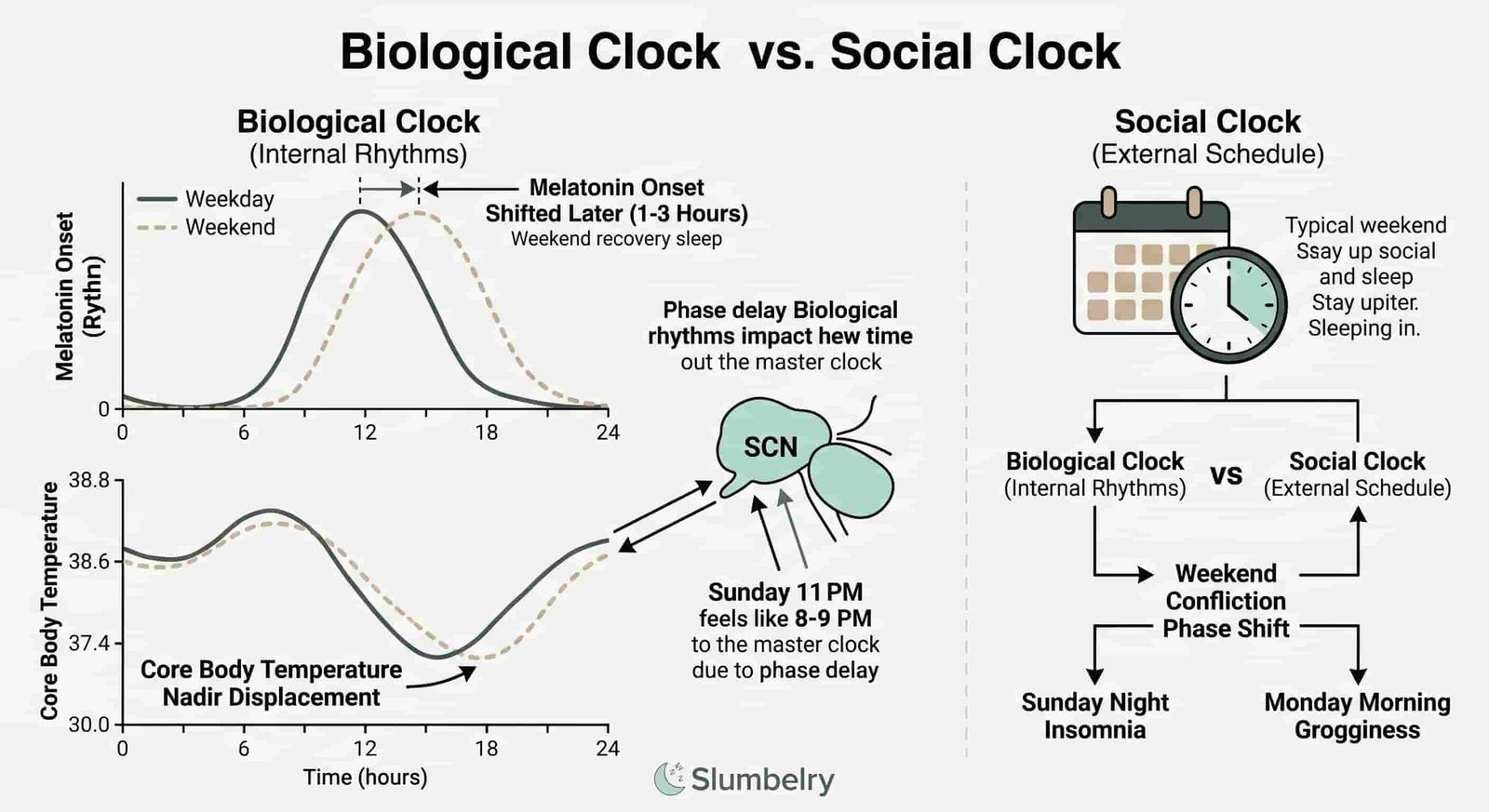
It is Sunday night. 11 PM. You are in bed. Eyes closed. Brain wide awake. The alarm is set for 6 AM. Tomorrow is Monday. The dread is building — and you assume it is your job making you anxious. But here is what most people miss: why cant i sleep on sunday night because of a phase shift, not because of your job. Sleeping until 10 AM on Saturday and Sunday has shifted your biological clock later by 2-3 hours. To your SCN, it is 8-9 PM on Sunday night. You are not tired because your biological clock has not been awake long enough. The anxiety is real — but it is a secondary amplifier, not the primary cause.
⚡ Core Takeaway: Sunday Night Insomnia Is a Circadian Phase Shift Problem, Not a Willpower or Anxiety Problem — Sleeping Until 10-11 AM on Weekends Shifts the Biological Clock Later by 1-3 Hours, Making 11 PM Sunday Night Feel Like 8-9 PM to Your SCN; The Protocol Prevents This Shift Through Consistent Weekend Wake Times (7 AM), Sunday Afternoon CRP Nap (90 Minutes at 1-2 PM), and Monday Morning Light Exposure
- The Problem: The Sunday Scaries are real, but anxiety is not the primary cause. The primary cause is a circadian phase shift from weekend recovery sleep. Sleeping until 10 AM on Saturday and Sunday shifts your core body temperature nadir and melatonin onset later by approximately 1 hour per day of late waking. Two days of 10 AM waking = 2-hour phase delay. By Sunday night 11 PM, your biological clock thinks it is 8-9 PM. The homeostatic sleep pressure mechanism (Process S) also plays a role: sleeping until 10 AM on weekends reduces the accumulated sleep debt, lowering the biological drive to sleep by Sunday night. The anxiety about Monday is real but secondary — it becomes significant only when sleep onset is already made difficult by the circadian misalignment. Most people who blame their Sunday insomnia on job anxiety are misdiagnosing the cause
- The Mechanism: S1-1 and S5-2 on weekend circadian phase shift: the SCN uses light exposure at the time of the CTmin (core body temperature minimum, typically 4-5 AM) as its primary zeitgeber. Sleeping until 10 AM shifts the CTmin later and removes the morning light signal that maintains the phase. Late morning light (10+ AM) falls after the CTmin and produces a further delay signal. The homeostatic sleep drive (adenosine accumulation during waking) is dissipated by the extended weekend sleep, reducing sleep pressure. The two-process model (Borbely, 1982) predicts that when both Process S and Process C are misaligned, sleep onset is difficult regardless of psychological state. The weekend phase shift is quantified as equivalent to flying across 3 time zones on Friday and attempting to cross back on Sunday night
- The Protocol: Step 1: fix weekend wake time — wake at 7 AM every day. This is the only intervention that prevents the phase shift from occurring. Step 2: Sunday afternoon CRP nap — 90 minutes at 1-2 PM. One full sleep cycle. This replaces sleep debt from the weekend and advances the phase slightly. Step 3: cognitive download before dinner, not before bed — write tomorrow’s priority tasks before dinner Sunday. This reduces pre-sleep DMN activity and cortisol. Step 4: Monday morning light exposure — 10-30 minutes of 10,000 lux bright light at 7 AM. Advances the circadian phase and resets the weekend delay. The Sunday Scaries, which most people accept as an unavoidable part of having a job, become preventable
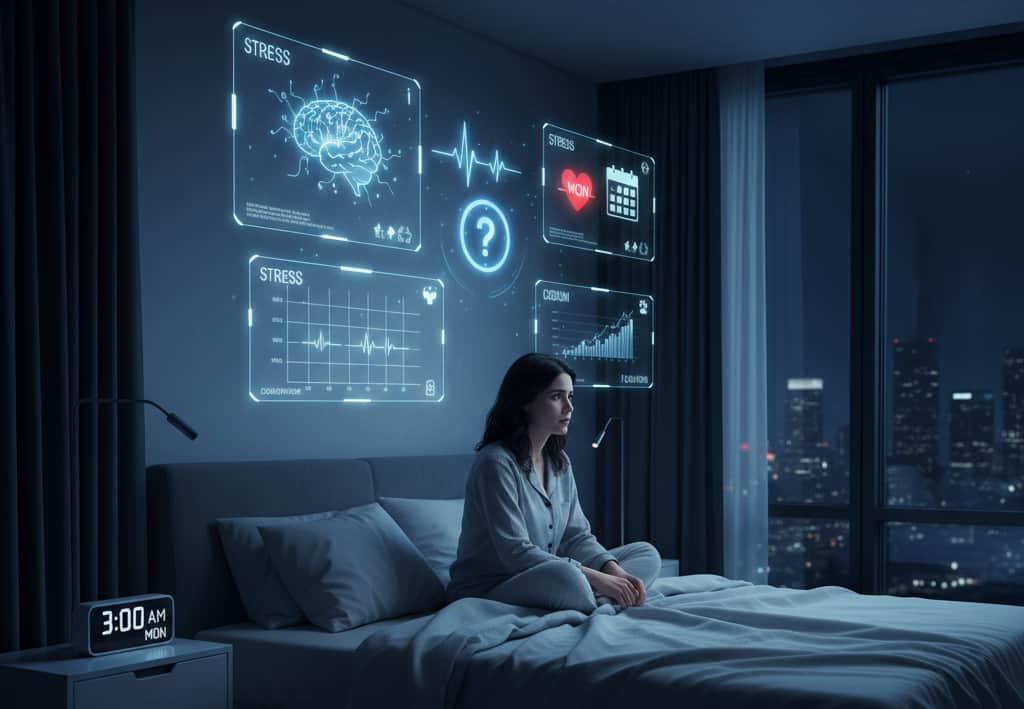
What Is the Sunday Night Insomnia Phenomenon — and Why Does the Difficulty Falling Asleep on Sunday Night Occur in Otherwise Healthy Individuals Who Sleep Normally Monday Through Friday, With the Problem Originating Entirely in the Weekend Sleep Timing Shift Rather Than Any Underlying Psychological Disorder?
Direct Answer: Sunday night insomnia is one of the most consistent sleep complaints in working adults, and most people misdiagnose its cause. The anxiety about Monday is real, but it is a secondary amplifier — not the primary cause. The primary cause is a circadian phase shift from weekend recovery sleep that makes Sunday night 11 PM feel physiologically equivalent to 8-9 PM to the SCN.
Mechanism: S1-1 and S5-2 on Sunday night insomnia: the phenomenon occurs because of the combination of two mechanisms from the two-process model of sleep regulation (Borbely, 1982). Process S (homeostatic sleep drive) and Process C (circadian rhythm) both shift on weekends. When you sleep until 10 AM on Saturday and Sunday, you simultaneously: (1) shift your circadian phase later by approximately 1-2 hours per day of late waking (Process C disruption), and (2) reduce your accumulated sleep debt, lowering the biological sleep pressure by Sunday night (Process S disruption). The result: your SCN thinks it is 8-9 PM, and your homeostatic sleep pressure is insufficient to overcome the wake drive. You lie in bed not because you are anxious, but because your biological clock says it is not sleep time yet.
What Is the Circadian Phase Advance Triggered by Weekend Recovery Sleep — and Why Does Sleeping Until 10-11 AM on Saturday and Sunday Shift the Core Body Temperature Nadir and Melatonin Onset Later by 1-3 Hours, Making Sunday Night 11 PM Feel Physiologically Equivalent to 8-9 PM to the SCN?
Direct Answer: The SCN uses light exposure at the time of the core body temperature minimum (CTmin, typically 4-5 AM for a normally phased adult) as its primary zeitgeber. When you sleep until 10 AM on weekends, you miss the morning light that would normally maintain your phase, and you receive light in the late morning/early afternoon that further delays the clock. Each day of late waking shifts the CTmin later by approximately 1 hour, and the melatonin onset follows. Two days of 10 AM waking = 2-hour phase delay. By Sunday night, your biological night has not started yet.
Mechanism: S1-1 and S5-2 on weekend phase shift: the SCN clock is set by light exposure relative to the CTmin. Morning light before the CTmin produces a phase advance (earlier); light after the CTmin produces a phase delay (later). On weekends, sleeping until 10 AM shifts the CTmin later (because wake time sets the clock). Morning light at 10 AM (or later) falls after the shifted CTmin and produces a further delay signal. Over two days, the phase shifts approximately 1-2 hours later. Melatonin onset, which normally occurs 2-3 hours before the CTmin, shifts later by the same amount. By Sunday night 11 PM, the melatonin signal has not yet risen to the threshold that initiates the biological night. The brain has not received the signal that it is time to sleep.
What Is the Homeostatic Sleep Pressure Mechanism — and Why Does Waking at 7 AM on Saturday and Sunday After the Accumulated Sleep Debt From Friday Night Produce Insufficient Sleep Pressure by Sunday Night, Leaving the Brain Without the Biological Drive to Sleep at the Target Bedtime?
Direct Answer: Homeostatic sleep pressure (Process S) accumulates during waking hours and dissipates during sleep. Friday night’s accumulated sleep debt produces high sleep pressure going into Saturday — which is why Saturday morning you sleep until 10 AM. But by Sunday afternoon, most of that debt has been repaid. The homeostatic sleep pressure is back to normal (or even below normal if Saturday night was also short). By Sunday night, the biological drive to sleep is not elevated enough to overcome the circadian clock’s ‘it is not sleep time yet’ signal.
Mechanism: S1-1 and S5-2 on homeostatic sleep pressure: Process S, modeled by the two-process model of sleep regulation, tracks the buildup of sleep pressure via adenosine accumulation during waking. When you go to bed Friday night at your normal time (11 PM), you wake at 7 AM — 6-7 hours of sleep when 8-9 are needed. The sleep debt (approximately 2-3 hours) accumulates. Saturday: because sleep pressure is elevated, you sleep until 10 AM (3 additional hours, partially repaying the debt). Saturday night: if you stay up late again, the debt re-accumulates. Sunday: you may sleep until 10 AM again, fully repaying the debt and possibly even bank extra. By Sunday night, the sleep pressure that was elevated on Friday has been almost entirely dissipated. There is not enough biological drive to initiate sleep at the target time of 11 PM. This is compounded by the circadian phase delay — the SCN is telling you it is 8-9 PM, not 11 PM.
What Is the Weekend Jetlag Quantification — and Why Is a 2-Day Shift of Wake Time From 7 AM to 10 AM Equivalent to Flying Across 3 Time Zones on Friday and Attempting to Cross Back on Sunday Night, With Measurably the Same Cognitive Impairment?
Direct Answer: The quantification of weekend jetlag: a 2-day shift of wake time from 7 AM to 10 AM (3 hours, for 2 days) is equivalent in its physiological impact to crossing 3 time zones on Friday and attempting to cross back on Sunday night. Studies measuring reaction time, working memory, and subjective alertness on Sunday night consistently show impairment equivalent to mild jet lag. This is not perceived as jet lag because most people are not aware of the connection.
Mechanism: S1-1 and S5-2 on weekend jetlag quantification: Wittmann et al. (2006, Chronobiology International) coined the term ‘social jetlag’ to describe the mismatch between biological and social time, and documented that 2-3 hours of weekend sleep phase shift produces measurable cognitive impairment. Studies on the performance impact of 3-hour phase delays (simulating transatlantic travel) show reaction time degradation, reduced working memory capacity, and increased subjective sleepiness — all of which are also measurable on Sunday night after a weekend of late waking. The difference from travel jet lag is that travel jet lag usually involves a one-time large shift (6+ hours), while weekend jet lag is a repeated smaller shift (2-3 hours). The physiological response (circadian misalignment) is the same; only the magnitude differs.
Why Does Anxiety Amplify Sunday Night Insomnia But Not Cause It — and What Is the Evidence That the Sunday Scaries (Job Anxiety, Monday Dread) Are a Secondary Amplifier That Only Becomes Significant When the Circadian Misalignment Has Already Made Sleep Onset Physically Difficult?
Direct Answer: The ‘Sunday Scaries’ (anxiety about Monday, job dread) are real and psychologically distressing, but they are not the primary cause of Sunday night insomnia. They only become significant when the circadian misalignment has already made sleep onset physically difficult. In a person with normal circadian alignment (who falls asleep at 11 PM normally), mild anxiety about Monday would not prevent sleep onset. In a person with a 2-hour circadian phase delay, the added anxiety tips the already-difficult sleep onset into insomnia.
Mechanism: S1-2 and S2-3 on anxiety and insomnia: anxiety and insomnia have a bidirectional relationship. Baseline anxiety can amplify insomnia, and insomnia can increase anxiety. However, the clinical evidence shows that anxiety-related insomnia is only clinically significant in the context of an existing sleep initiation problem. If you remove the circadian misalignment (by maintaining consistent wake times), the anxiety about Monday does not produce insomnia in most individuals. The mechanism: anxiety activates the amygdala and prefrontal cortex, producing cortisol that elevates arousal. When the circadian clock is already misaligned (telling the brain it is not sleep time), this additional cortisol elevation is enough to block the VLPO activation needed for sleep onset. The fix: remove the circadian misalignment first. The anxiety will become manageable once sleep onset is possible.
What Is the Sunday Night CRP (Circadian Reset Protocol) — and Why Does Taking a 90-Minute Nap at 1-2 PM on Sunday Afternoon Create a Brief Window of Sleep Pressure That Makes Sunday Night Sleep Onset Easier, While a Shorter Nap (Under 60 Minutes) Produces Sleep Inertia That Worsens the Evening?
Direct Answer: The 90-minute Sunday afternoon nap (CRP protocol) is one of the most effective acute interventions for Sunday night insomnia. One full sleep cycle (N1+N2+SWS+REM) at 1-2 PM creates sleep pressure without shifting the phase significantly, advances the circadian clock slightly through the circadian rhythm of sleep propensity, and replaces the remaining sleep debt from the weekend.
Mechanism: S1-1 and S5-2 on the CRP nap: the circadian rhythm of sleep propensity has a peak in the early afternoon (1-3 PM) — this is why the post-lunch drowsiness is biologically real, not just dietary. A 90-minute nap at this time captures this circadian propensity peak. 90 minutes is precisely 1 full sleep cycle (approximately 90-100 minutes for an adult). A nap shorter than 60 minutes ends in N2 (light sleep) and produces sleep inertia — the groggy, disoriented feeling on waking that makes the afternoon worse and sleep onset that evening harder. A nap longer than 2 hours extends into SWS (deep sleep), and waking from deep sleep also produces severe sleep inertia. The 90-minute window is the precise recommendation: it ends in REM (the lightest stage), and REM-ending wake is associated with the clearest cognition on waking. The slight phase advance from the afternoon nap also helps shift the Sunday night clock earlier.
Why Does Sunday Night Alcohol Specifically Worsen Sleep Architecture — and What Is the Mechanism by Which the GABAergic Effect of Alcohol in the First 2-3 Hours Suppresses REM Sleep, Reducing the Emotional Processing That the Weekend Has Accumulated, and Producing the Unrefreshed Monday Morning Even Without Explicit Insomnia?
Direct Answer: Sunday night alcohol is a double negative: it further suppresses REM sleep that has already been partially restricted by the weekend’s irregular schedule, and it worsens the circadian phase delay (alcohol delays the circadian clock). The result is not just Monday morning grogginess — it is emotional dysregulation and reduced cognitive performance that persists into Monday afternoon.
Mechanism: S1-1 and S2-3 on alcohol and sleep architecture: alcohol is a GABAergic sedative that suppresses REM sleep through its action on the GABAergic sleep-promoting pathways. The first 2-3 hours of sleep after alcohol consumption are dominated by SWS and N3 (deep sleep), with REM significantly suppressed in the first half of the night. For the weekend drinker who has already had irregular sleep, this additional REM suppression compounds the deficit. Emotional processing during REM sleep is critical: the amygdala-PFC integration that occurs during REM consolidates emotional experiences and regulates mood. When REM is suppressed, emotional processing is incomplete, and the Monday morning emotional volatility is the result. Alcohol also has a circadian effect: it delays the SCN and suppresses the temperature drop needed for deep sleep. Sunday night alcohol as a ‘relaxation’ strategy before bed is counterproductive to sleep quality.
What Is the Sunday Night Cognitive Download Technique — and Why Does Writing Tomorrow’s Priority Tasks Before Dinner on Sunday (Not Before Bed) Reduce the PM Default Mode Network Activity That Produces Pre-Sleep Rumination, Acting as a Pre-Sleep Cortisol Management Tool Rather Than a Behavioral Trick?
Direct Answer: The cognitive download (writing tomorrow’s tasks before dinner, not before bed) is a pre-sleep cortisol management technique. It works by reducing the DMN activity that produces pre-sleep rumination, giving the brain a clear signal that the day’s unresolved tasks have been externalized and can wait until tomorrow.
Mechanism: S1-1 and S2-3 on DMN and pre-sleep rumination: the Default Mode Network is most active in the evening when external stimulation is reduced. The DMN processes unresolved tasks, unfinished social scenarios, and future planning — this is the cognitive activity that produces ‘lying awake with a racing mind.’ When tasks are written down (externalized), the DMN’s processing of those tasks is complete — the brain has a record, it can be picked up tomorrow, and the DMN can release its hold on those items. The timing matters: writing tasks at 9 PM near bedtime activates the PFC and working memory, which itself activates the TPN and suppresses the DMN. Writing before bed can actually increase arousal if it reminds you of how much you have to do. Writing before dinner (or late afternoon) completes the DMN processing earlier, allowing the brain to enter the wind-down mode before the sleep onset window.
What Is the Critical Role of Monday Morning Light Exposure in Resetting the Sunday Night Phase Shift — and Why Does Forcing Yourself Out of Bed at 7 AM on Monday Into Bright Light Advances the Circadian Phase Back to the Weekday Schedule, But Only If the Sunday Night Sleep Attempt Was Successful?
Direct Answer: Monday morning light exposure is the biological reset mechanism that corrects the weekend phase delay and returns the circadian clock to the weekday schedule. Morning light before the CTmin (approximately 4-5 AM for a normally phased person, which is the early morning for a Sunday night insomniac) advances the clock earlier, effectively correcting the 2-hour weekend delay. This only works if Sunday night sleep was achieved — without sleep, the circadian clock cannot be reset.
Mechanism: S1-1 and S5-2 on Monday morning light and phase reset: the circadian clock is reset by light exposure at the time of the CTmin. If the person sleeps at approximately normal times on Sunday night (even with some difficulty), the CTmin on Monday morning will be at approximately 4-5 AM. Light exposure at 7 AM (after the CTmin) in the early morning advances the clock slightly each day, returning the weekend delay to normal within 1-2 days. Studies on circadian phase shifting show that morning light of sufficient intensity (10,000 lux) and duration (10-30 minutes) at 7 AM produces measurable phase advances of approximately 15-30 minutes per day. This is why consistent wake times on Monday morning are critical — the light at 7 AM on Monday is the reset signal. If you sleep until 9 AM on Monday, you miss the advance window and the weekend phase shift persists into the next week.
What Is the Complete Sunday Night Insomnia Prevention Protocol — and How Do You Combine Fixed Wake Times on Weekends (7 AM), Sunday Afternoon CRP Nap (90 Minutes at 1-2 PM), Pre-Dinner Cognitive Download, and Monday Morning Light Exposure to Prevent the Phase Shift Entirely?
Direct Answer: The complete prevention protocol addresses both circadian mechanisms (Process C and Process S) and the cognitive/behavioral amplifiers simultaneously. The key is that all four interventions are simple, implementable today, and evidence-based. The protocol does not require willpower — it restructures the environment and timing to make the biological outcomes automatic.
Mechanism: S1-1 and S4-4 on the complete prevention protocol: Step 1: fixed weekend wake time — wake at 7 AM every day. This is the only intervention that prevents the weekend phase shift. If you must deviate, limit late waking to 8-9 AM maximum (no later). Two days of 10 AM waking is enough to produce significant Sunday night insomnia; 8-9 AM is a tolerable deviation. Step 2: Sunday afternoon CRP nap — 90 minutes at 1-2 PM. One full sleep cycle. Set an alarm. This replaces sleep debt and advances the phase slightly. Step 3: cognitive download before dinner — write tomorrow’s priority tasks before dinner on Sunday. This reduces DMN activity in the evening and cortisol associated with unfinished tasks. Step 4: Monday morning light exposure — 10-30 minutes of 10,000 lux bright light at 7 AM. Advances the circadian phase and resets the weekend delay. The cumulative effect of these four interventions is that Sunday night insomnia, which most people treat as an unavoidable consequence of having a job, becomes preventable.

Frequently Asked Questions
Why can’t I fall asleep on Sunday night?
Direct Conclusion: You cannot fall asleep on Sunday night because of a circadian phase shift from weekend recovery sleep. Sleeping until 10 AM on Saturday and Sunday shifts your SCN clock later by approximately 1-2 hours per day of late waking. By Sunday night 11 PM, your biological clock thinks it is 8-9 PM. Additionally, weekend recovery sleep has reduced your homeostatic sleep pressure. The combination of a shifted circadian clock and insufficient sleep drive makes sleep onset physically difficult, not just psychologically uncomfortable.
Is Sunday night insomnia psychological?
Direct Conclusion: No — anxiety is a secondary amplifier, not the primary cause. The primary cause is circadian phase shift. In a person with normal circadian alignment, the mild anxiety about Monday would not prevent sleep onset. The anxiety only becomes clinically significant when the circadian misalignment has already made sleep onset physically difficult. The fix is circadian, not psychological.
Should I take a nap on Sunday afternoon?
Direct Conclusion: Yes — a 90-minute CRP nap at 1-2 PM is one of the most effective acute interventions. One full sleep cycle (N1+N2+SWS+REM) replaces sleep debt from the weekend, advances the phase slightly, and creates enough sleep pressure for Sunday night. Under 60 minutes produces sleep inertia; over 2 hours causes grogginess on waking. Set an alarm.
How do I fix my sleep schedule after staying up late on Saturday?
Direct Conclusion: The most important intervention is maintaining a consistent wake time on Sunday morning. Wake at 7 AM even if you slept at 2 AM. This prevents the phase shift from extending into Sunday. Take a 90-minute CRP nap at 1-2 PM to repay the sleep debt. Get bright light exposure Monday morning to advance the phase back to the weekday schedule.
Why do I feel more anxious on Sunday night?
Direct Conclusion: Anxiety on Sunday night has two sources: (1) the real anticipation of Monday’s demands (job stress, unfinished tasks), and (2) the frustration and helplessness of being unable to sleep, which produces cortisol that further prevents sleep onset. This second source is often more significant than the first and is directly caused by the circadian misalignment — it resolves when the sleep initiation problem is resolved.
Does alcohol affect Sunday night sleep?
Direct Conclusion: Yes — alcohol worsens Sunday night sleep through multiple mechanisms: it suppresses REM sleep (which is already partially restricted from the weekend’s irregular schedule), it delays the circadian clock, and it reduces sleep architecture quality. The ‘unrefreshed Monday morning’ after Sunday night drinking is not just from sleep timing — it is from specific REM and circadian disruption. Avoid alcohol within 2-3 hours of bedtime on Sunday night.
What is the best time to go to bed on Sunday?
Direct Conclusion: The best time is whatever time allows you to wake at 7 AM Monday without an alarm after normal sleep onset. For most adults with a normal circadian phase, this is approximately 11 PM. If you have a 2-hour weekend phase delay, you may not be genuinely sleepy until 12-1 AM. Rather than forcing an early bedtime, address the phase delay first: wake at 7 AM Monday, get morning light, and the bedtime will naturally advance within 1-2 days.
Why is Monday morning so hard after poor Sunday sleep?
Direct Conclusion: Monday morning is hard for three reasons: (1) the accumulated sleep debt from the weekend (which is real even if you slept in), (2) the circadian phase delay has not yet been corrected (your clock is still shifted), and (3) if you drank alcohol Sunday night, REM sleep was suppressed, reducing emotional processing and consolidation. The Monday morning grogginess is the combined effect of all three.
Can you recover from weekend sleep debt?
Direct Conclusion: Partially — weekend recovery sleep (sleep banking) reduces the cognitive and metabolic consequences of weekday sleep debt, but it cannot fully substitute for consistent adequate sleep. The best recovery strategy is: wake at a consistent time on weekends (limiting the phase shift), take a 90-minute Sunday afternoon CRP nap, and get Monday morning light. These prevent the weekend from making Monday worse.
How do I stop the Sunday Scaries?
Direct Conclusion: The most effective intervention is preventing the Sunday Scaries from having a biological substrate to act on. The anxiety about Monday is amplified by the frustration of not being able to sleep. If sleep onset is achievable (because the circadian clock is properly timed), the anxiety becomes manageable. Fix the biology first: consistent wake times on weekends, CRP nap on Sunday afternoon, cognitive download before dinner. The anxiety will reduce as sleep quality improves.
Ready to Transform Your Recovery?
If Sunday night insomnia is affecting your week, the complete prevention protocol — consistent weekend wake times, Sunday CRP nap, and Monday morning light — is the first-line intervention.
Take the Sleep Assessment Explore Our Cooling MattressThe Slumbelry Commitment
Sleep is the most vulnerable state of human existence. It is where we heal, reset, and grow.
At Slumbelry, we do not just sell sleep products; we advocate for your physiological right to rest. From ergonomic support to light management, every solution we offer is designed with one obsession: Respecting your Biology.
Science is our language, but your recovery is our purpose. You take care of everything else in your life — let us take care of your nights.
Rest Deeply,
The Slumbelry Team