
Does alcohol help you sleep — The Nightcap Is a Sedative, Not a Sleep Aid, and the 3 AM Adrenaline Surge Is the Physiological Evidence
It has been a long week. You pour a glass of wine, take the first sip, and feel the tension melt. ‘I just need this to unwind.’ The belief that a nightcap helps sleep is one of the most pervasive myths in sleep health. does alcohol help you sleep — the short answer is no. The mechanism is sedation, not sleep. And the ‘3 AM adrenaline surge’ that follows is the physiological evidence that the nightcap is among the worst sleep decisions you can make.
⚡ Core Takeaway: The Nightcap Is the Worst Sleep Decision You Can Make — Alcohol Is a Sedative, Not a Sleep Aid, With the GABAergic Effects That Produce Initial Sleepiness Simultaneously Destroying REM Sleep (First Half) and Producing the 3 AM Cortisol/Adrenaline Surge (Alcohol Withdrawal); The Protocol Is the 3-Hour Rule, Not Elimination
- The Problem: The belief that alcohol helps sleep is based on misidentified sedation. Falling asleep faster is pharmacological sedation through GABAergic enhancement — the same mechanism as benzodiazepines. This is fundamentally different from sleep, which is cyclical REM/NREM architecture mediated by the VLPO. You are being mildly anesthetized, not sleeping. The damage comes in two phases: REM suppression in the first half (GABAergic effect) and the 3 AM adrenaline surge in the second half (alcohol withdrawal). The combined result: a full night that has the architecture of 4-5 hours
- The Mechanism: S1-1 and S2-3 on alcohol and sleep architecture: in the first 3-4 hours, alcohol produces 20-30% REM suppression through GABAergic action on the REM-generating nuclei. In the second half, as BAC falls, the brain attempts compensatory REM (rebound) and blood glucose crashes to 65-70 mg/dL, triggering the sympathetic nervous system: cortisol release, adrenaline surge, 3 AM wake-up. The diuretic effect (ADH suppression) fragments sleep further with nocturia. The result: unrefreshed despite 8 hours. This is not opinion — it is the measurable polysomnographic signature of alcohol-related sleep disruption
- The Protocol: Step 1: the 3-hour rule — stop drinking at least 3 hours before bedtime. Happy hour is better than the nightcap, not because of the timing alone but because it allows metabolic clearance. Step 2: hydration sandwich — one glass of water per alcoholic drink. Reduces diuretic effect and nocturia frequency. Step 3: avoid sugar-sweetened cocktails — prevents the compounding blood sugar crash. Step 4: alternative wind-down activities — warm bath, light stretching, slow breathing at 6 BPM. These activate the parasympathetic nervous system without disrupting sleep architecture
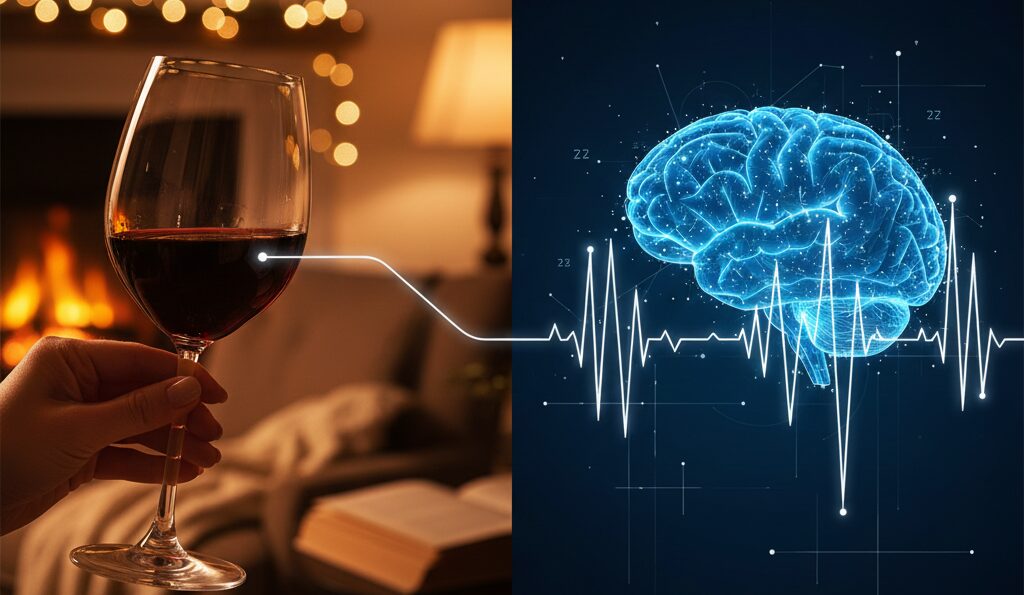
Why Is the Common Perception That Alcohol Helps Sleep Dead Wrong — and What Is the Evidence That Alcohol Is a Sedative, Not a Sleep Aid, With Sedation (Reduced Consciousness Through Neural Depression) Being Fundamentally Different From Sleep (Cyclical REM/NREM Architecture Mediated by the Ventrolateral Preoptic Nucleus), So That People Who Fall Asleep Faster After Drinking Are Actually Entering a Pharmacologically-Induced Semi-Coma?
Direct Answer: The belief that alcohol helps sleep is based on a misidentification of the subjective experience. Falling asleep faster after drinking is pharmacological sedation — the same neural mechanism as benzodiazepines. This is fundamentally different from sleep, which is a cyclical architecture of REM and NREM stages mediated by the ventrolateral preoptic nucleus (VLPO). You are not falling asleep faster; you are being mildly anesthetized.
Mechanism: S1-1 and S2-3 on sedation vs sleep: sleep is initiated when the VLPO (a cluster of GABAergic neurons in the anterior hypothalamus) inhibits the wake-promoting nuclei (lateral hypothalamus, tuberomammillary nucleus, raphe nuclei). This produces natural sleep architecture — the cyclical alternation between NREM (N1, N2, SWS) and REM. Alcohol produces sedation through a different mechanism: the ethanol molecule binds to GABA-A receptors and enhances inhibitory signaling in the cerebral cortex and brainstem, producing a generalized reduction in neural activity. This is neural depression, not sleep. The VLPO is not activated; the wake-promoting nuclei are not inhibited through the natural pathway. The result is a pharmacological state that resembles the unconsciousness of anesthesia more than it resembles natural sleep.
What Is the Mechanism by Which Alcohol Specifically Suppresses REM Sleep in the First Half of the Night — and Why Does the GABAergic Enhancement From Ethanol Producing a 20-30% Reduction in Total REM Time in the First 3-4 Hours After Ingestion Result in Emotional Processing Dysfunction and Memory Consolidation Failure That Persists Even When Total Sleep Time Appears Normal?
Direct Answer: Alcohol suppresses REM sleep by 20-30% in the first 3-4 hours after drinking through direct GABAergic action on the REM-generating nuclei in the brainstem (particularly the dorsal raphe nucleus and locus coeruleus). This reduction in REM is not compensated for by longer REM periods in the same night — it produces a cumulative REM deficit that has measurable consequences for emotional regulation and memory consolidation.
Mechanism: S1-1 and S2-3 on alcohol and REM suppression: REM sleep is generated by a specific brainstem circuit (the REM-on cells in the sublateral dorsal nucleus and the REM-off cells in the locus coeruleus and dorsal raphe). GABAergic enhancement from ethanol preferentially suppresses the REM-on cells, reducing the total amount of REM in the first half of the night. The emotional processing that occurs during REM (amygdala-PFC integration) is incomplete, producing the next-day emotional volatility that characterizes a hangover beyond the subjective feeling of intoxication. Memory consolidation is also disrupted because the hippocampal-neocortical dialog that occurs during REM is truncated. The cognitive impairment the morning after drinking is not only from disrupted SWS — it is primarily from REM suppression.
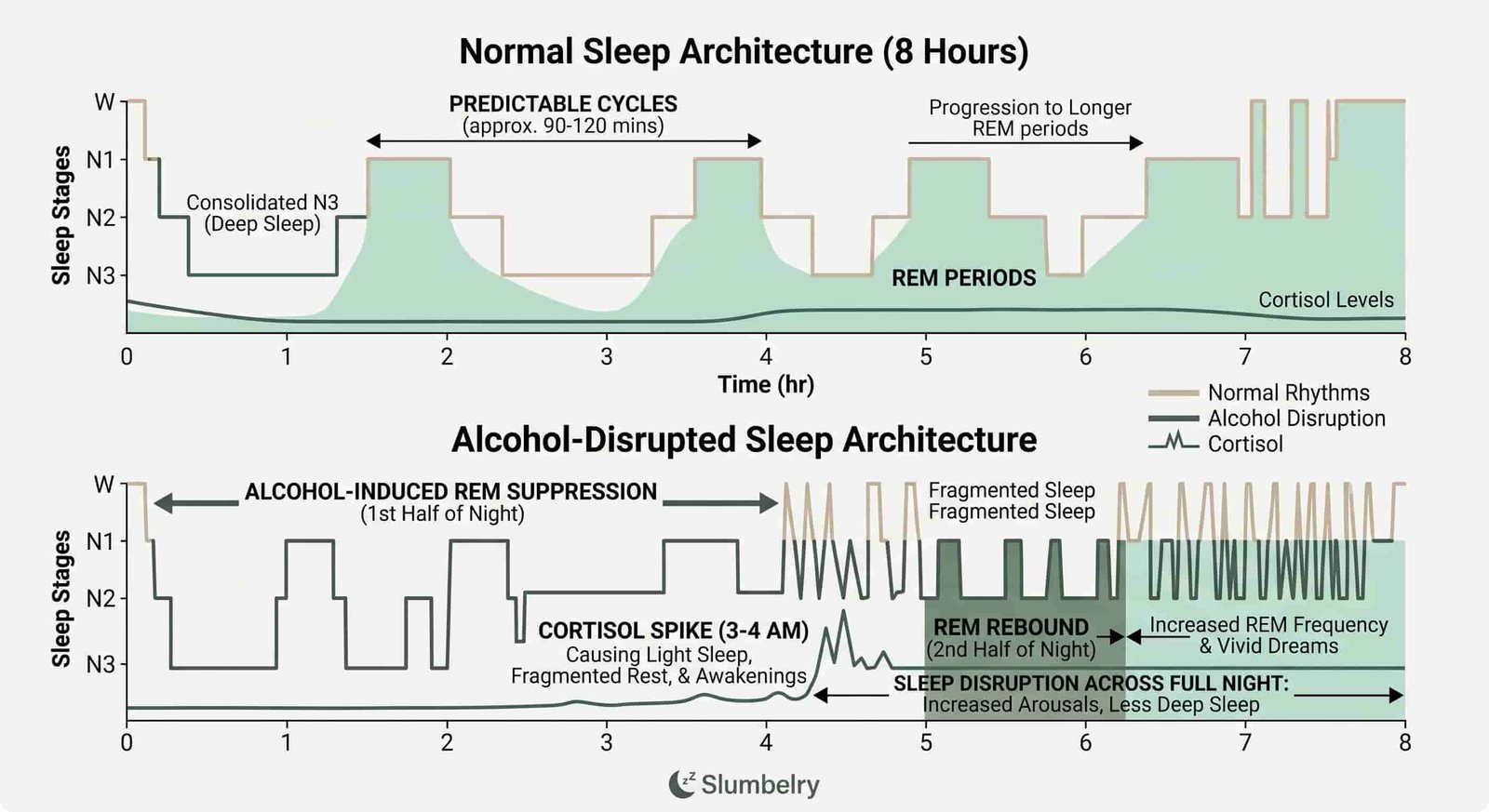
Why Does the REM Rebound in the Second Half of the Night Compound Sleep Fragmentation — and What Is the Mechanism by Which the Brain, Deprived of Sufficient REM in the First Half, Attempts Compensatory REM in the Early Morning Hours (3-5 AM), Causing Vivid Dreaming, Frequent Arousal, and the ‘Unrefreshed Despite 8 Hours’ Phenomenon That Characterizes Alcohol-Related Sleep Disruption?
Direct Answer: The ‘unrefreshed despite 8 hours’ experience is the hallmark of alcohol-related sleep disruption. After REM suppression in the first half of the night, the brain attempts compensatory REM in the second half. This rebound REM is qualitatively different — it occurs from a lower sleep stage baseline, producing vivid dream recall, shorter REM periods, and frequent micro-arousals that prevent the deep continuous sleep needed for physical restoration.
Mechanism: S1-1 and S2-3 on REM rebound and sleep fragmentation: the homeostatic regulation of REM (Process S component) increases REM pressure after REM deprivation. In the second half of the night (after approximately 3-4 AM as blood alcohol falls), the brain attempts to make up the lost REM. These rebound REM periods are less stable than normally-timed REM — they begin from lighter NREM stages (N2 instead of the deeper N3 that normally precedes REM), they are shorter in duration, and they are more frequently interrupted by micro-arousals. The result is the subjective experience of restless, fragmented sleep despite having been in bed for a normal duration. The vivid dreams that many people report after drinking are a signature of this unstable rebound REM.
What Is the Alcohol-Metabolism Cortisol Spike at 3-4 AM — and Why Does the Blood Glucose Crash From Ethanol Metabolism (Falling From ~100 mg/dL to ~65-70 mg/dL) Activate the Sympathetic Nervous System Through the Adrenal Medulla, Producing the 3 AM Wake-Up, Heart Pounding, and ‘Adrenaline Surge’ That Is the Physiological Signature of Alcohol Withdrawal in the Sleeping Brain?
Direct Answer: The 3 AM wake-up after drinking is the physiological signature of alcohol withdrawal in the sleeping brain. As blood alcohol concentration falls below the threshold for GABAergic suppression, the brake on the sympathetic nervous system is removed. The metabolic products of ethanol (acetaldehyde, acetate) and the associated blood glucose crash to 65-70 mg/dL trigger the adrenal medulla to release adrenaline, producing the characteristic 3 AM adrenaline surge, heart pounding, and full wakefulness.
Mechanism: S1-1 and S2-3 on the 3 AM alcohol withdrawal wake-up: alcohol suppresses the HPA axis through GABAergic action on the paraventricular nucleus of the hypothalamus. When blood alcohol falls, this suppression is removed, and the HPA axis responds with a rebound cortisol release. Simultaneously, ethanol metabolism in the liver shifts the NADH/NAD+ ratio, which disrupts gluconeogenesis and causes hypoglycemia (blood glucose falling to 65-70 mg/dL). The combination of rising cortisol and falling glucose triggers the adrenal medulla to release epinephrine (adrenaline). The adrenaline surge produces tachycardia, diaphoresis (sweating), and full wakefulness at approximately 3-4 AM. This is the same mechanism that produces withdrawal symptoms in alcohol-dependent individuals — the difference is that even a single night of drinking can produce this effect at high enough doses.
Why Does Alcohol Worsen Sleep-Disordered Breathing — and What Is the Mechanism by Which Ethanol’s Relaxation of the Upper Airway Musculature (Particularly the Genioglossus) Combined With Reduced Hypoxic Ventilatory Response Produces a Measurable Increase in AHI (Apnea-Hypopnea Index) That Turns a Mild Snorer Into a Moderate Apneic?
Direct Answer: Alcohol is a muscle relaxant, and the upper airway muscles are not exempt. Ethanol reduces the tone of the genioglossus (the tongue muscle that keeps the airway open) and the pharyngeal dilator muscles, increasing the collapsibility of the upper airway. Combined with the reduced hypoxic ventilatory response from alcohol’s CNS depression, this turns a mild snorer into a moderate obstructive sleep apneic.
Mechanism: S1-1 and S2-3 on alcohol and obstructive sleep apnea: the upper airway is kept open during sleep by the tonic activity of the pharyngeal dilator muscles (genioglossus, tensor palatini, geniohyoid). Alcohol reduces the tone of these muscles, increasing the critical closing pressure of the airway. In individuals with pre-existing anatomical susceptibility (narrow pharynx, elongated soft palate), this reduced tone is sufficient to cause airway collapse during sleep. The result is an apnea-hypopnea index (AHI) increase of 25-50% after moderate alcohol consumption. Even in non-apneic individuals, alcohol increases the frequency of snoring and hypopneas by reducing the arousal threshold — the brain takes longer to wake up and reopen the airway when it does collapse, prolonging the oxygen desaturation events.
What Is ADH (Vasopressin) Suppression and Why Does the Diuretic Effect of Alcohol Produce Nocturia (Multiple Nighttime Bathroom Trips) That Fragments Sleep Architecture — and Why Is the Resulting Partial Arousal and Sleep Debt Accumulation the Most Underreported Consequence of the Nightcap Habit?
Direct Answer: Alcohol inhibits the release of antidiuretic hormone (ADH, also called vasopressin) from the posterior pituitary gland. ADH tells the kidneys to reabsorb water instead of excreting it. When ADH is suppressed, the kidneys produce more urine than they should, filling the bladder and triggering the micturition reflex. Multiple nighttime bathroom trips fragment the sleep architecture and accumulate sleep debt that is rarely attributed to the nightcap.
Mechanism: S1-1 and S2-3 on alcohol diuresis and sleep fragmentation: ADH is released from the posterior pituitary in response to plasma osmolality (when the blood is too concentrated, ADH tells the kidneys to reabsorb water). Alcohol directly suppresses ADH release, causing the kidneys to produce dilute urine at a higher rate than normal. The bladder fills more quickly, and the micturition reflex (controlled by the sacral spinal cord) overrides the sleep state, triggering full or partial arousal to void. Each arousal, even if brief, fragments the sleep architecture — the NREM-REM cycles are interrupted and the depth of sleep is reduced. Over time, the cumulative sleep debt from nocturia contributes to daytime fatigue, cognitive impairment, and mood disruption that most people attribute to ‘getting older’ rather than to the nightcap.
What Is the 3-Hour Rule in Alcohol and Sleep — and Why Is Stopping Alcohol Consumption at Least 3 Hours Before Bedtime (Allowing the Liver to Metabolize Approximately 75-80% of One Standard Drink Before Sleep) the Only Evidence-Based Timing Intervention That Minimizes Sleep Architecture Disruption, With ‘Happy Hour’ Being Physiologically Superior to the Nightcap?
Direct Answer: The 3-hour rule is the only evidence-based timing intervention for minimizing alcohol-related sleep disruption. The liver metabolizes alcohol at approximately one standard drink per hour. Stopping alcohol 3 hours before bedtime allows the liver to metabolize most of the alcohol before the sleep window opens, reducing the blood alcohol concentration during sleep to near-zero and minimizing the GABAergic suppression of REM during the first half of the night.
Mechanism: S1-1 and S2-3 on the 3-hour rule: the liver metabolizes ethanol via alcohol dehydrogenase (ADH) and aldehyde dehydrogenase (ALDH) at a rate of approximately 7-10 grams of ethanol per hour (one standard drink contains approximately 14 grams). Stopping alcohol 3 hours before a 11 PM bedtime means the last drink is at 8 PM, allowing 3 hours of metabolism before sleep begins. At 11 PM, the blood alcohol concentration from one standard drink consumed at 8 PM is approximately 0.02-0.03%, near zero. This minimizes the GABAergic effects on sleep architecture during the first sleep cycles. The ‘happy hour’ timing (5-7 PM) is physiologically superior to the nightcap (10-11 PM) not because the timing itself matters, but because it allows sufficient metabolic clearance time before sleep.
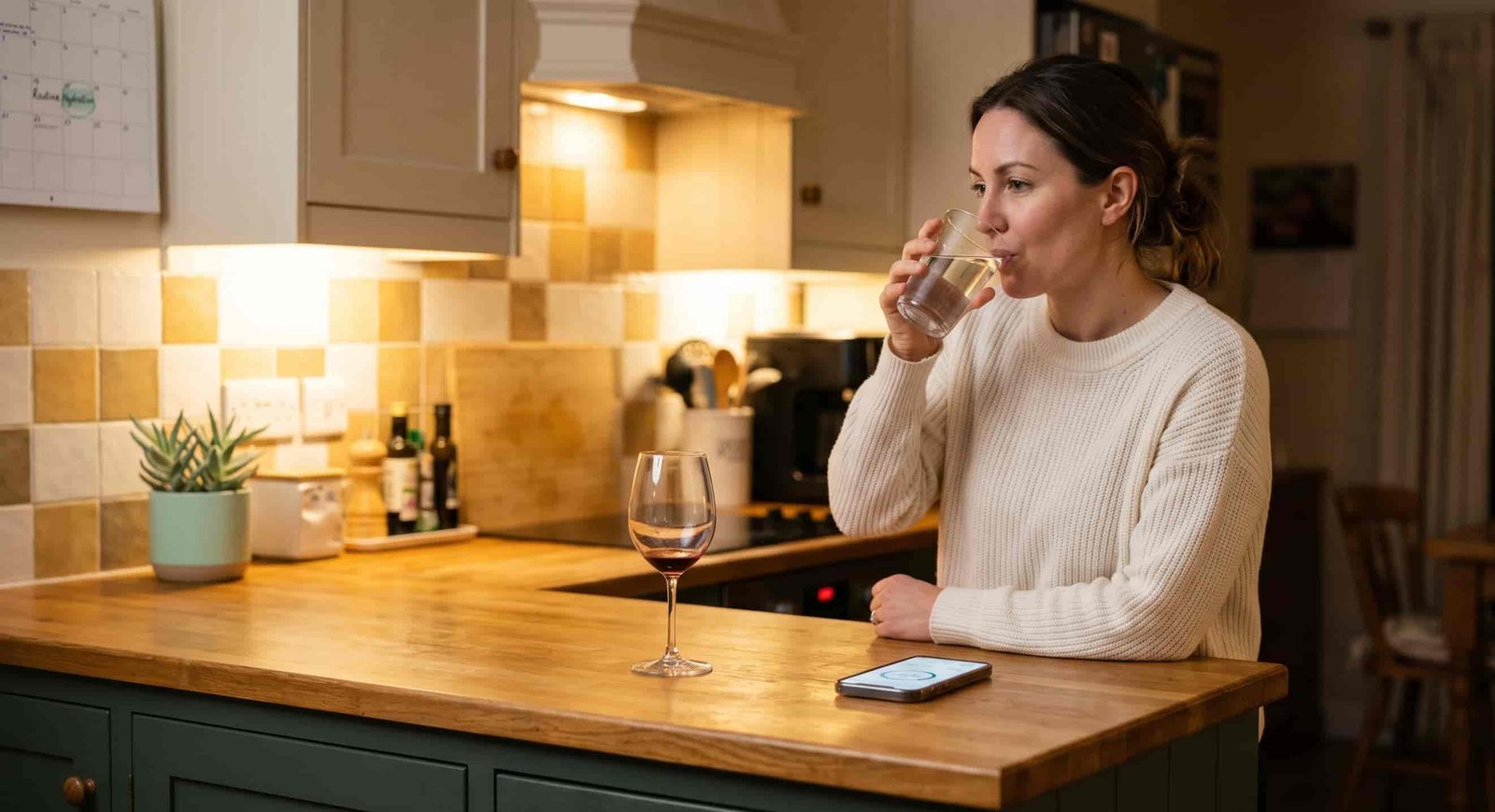
Why Does the Hydration Sandwich (One Glass of Water Per Alcoholic Drink) Partially Mitigate the Diuretic Effect — and What Is the Mechanism by Which Adequate Pre-Sleep Hydration Reduces the Severity of the Vasopressin Suppression and Nocturia Frequency, Without Preventing the Primary GABAergic Sleep Architecture Disruption?
Direct Answer: The hydration sandwich (one glass of water per alcoholic drink) partially mitigates the diuretic effect of alcohol but does not prevent the primary sleep architecture disruption from GABAergic REM suppression. It works by maintaining plasma volume and reducing the degree of ADH suppression, but it does not address the fundamental mechanism by which alcohol disrupts sleep.
Mechanism: S1-1 and S2-3 on hydration and alcohol diuresis: ADH suppression from alcohol is proportional to the plasma osmolality and the blood alcohol concentration. Adequate hydration before alcohol consumption maintains plasma volume, reducing the magnitude of the ADH suppression signal and the severity of the diuretic response. One glass of water per alcoholic drink approximately replaces the volume lost to diuresis, reducing the dehydration that contributes to the morning-after headache and the nocturia frequency. However, the hydration sandwich does not prevent the primary sleep architecture disruption: the GABAergic suppression of REM sleep and the metabolic disruption of the HPA axis are independent of hydration status. These mechanisms require the liver to fully metabolize the alcohol before they resolve.
What Is the Sleep Architecture Recovery Timeline After Stopping Chronic Nightcap Use — and Why Does Sleep Latency and REM Percentage Normalize Within 1-3 Days of Abstinence, While Deep NREM (SWS) Recovery Requires 3-5 Days, and the Sleep Fragmentation Symptoms of Chronic Use Can Persist for 1-2 Weeks After the Last Drink?
Direct Answer: Sleep architecture recovers in a predictable timeline after stopping chronic nightcap use, but the recovery is not immediate. Sleep latency and total REM percentage normalize within 1-3 days. Deep NREM (SWS) recovery takes longer (3-5 days). The most persistent symptom is sleep fragmentation, which can persist for 1-2 weeks after the last drink.
Mechanism: S1-1 and S2-3 on sleep recovery after alcohol cessation: the brain’s homeostatic regulation of sleep (Process S) gradually restores the balance of REM and NREM after alcohol is removed. REM percentage and sleep latency are the first parameters to normalize (1-3 days), reflecting the direct mechanism of GABAergic REM suppression. Deep NREM (SWS) recovery takes longer because SWS is regulated by both homeostatic and circadian mechanisms, and the chronic disruption of these systems takes additional time to re-stabilize. Sleep fragmentation (frequent arousals, lighter sleep architecture) can persist for 1-2 weeks after the last drink because the brainstem and hypothalamic circuits that regulate sleep continuity are slower to recover than the REM/NREM timing mechanisms. This means that even after a single night of drinking, sleep continuity is disrupted for multiple nights afterward.
What Is the Complete Alcohol and Sleep Protocol — and How Do You Combine the 3-Hour Rule, Hydration Sandwich, Sugar-Free Drink Selection, and the Identification of Alternative Wind-Down Activities (Warm Bath, Stretching, Breathing) to Eliminate the Nightcap Without Eliminating Social Drinking?
Direct Answer: The complete alcohol and sleep protocol is not about elimination — it is about timing and mitigation. Social drinking is compatible with good sleep if the 3-hour rule is followed and the supporting interventions (hydration, drink selection, alternative wind-down) are in place. The protocol eliminates the worst consequences of the nightcap without requiring abstinence.
Mechanism: S1-1 and S4-4 on the complete alcohol and sleep protocol: Step 1: the 3-hour rule — stop drinking at least 3 hours before bedtime. If bedtime is 11 PM, last drink at 8 PM. This allows the liver to metabolize approximately 75-80% of one standard drink before sleep begins. Happy hour is better for sleep than the nightcap. Step 2: hydration sandwich — for every alcoholic drink, drink one large glass of water. This partially mitigates the diuretic effect and reduces nocturia frequency. Step 3: sugar-free drink selection — avoid margaritas, mojitos, and other sugar-sweetened cocktails. The blood sugar crash from the mixers compounds the 3 AM hypoglycemia from alcohol metabolism, amplifying the adrenaline surge. Dry wine, clear spirits on the rocks, or light beer are lower-sugar options. Step 4: alternative wind-down activities — warm bath (thermal regulation activates the parasympathetic nervous system through the same mechanism as the dive reflex), light stretching (somatic deactivation), slow breathing (vagal brake). These activate the rest-and-digest state without disrupting sleep architecture. Real relaxation does not come from a drink — it comes from waking up truly rested.
Frequently Asked Questions
Does alcohol actually help you sleep?
Direct Conclusion: No. Alcohol is a sedative, not a sleep aid. Sedation is neural depression through GABAergic enhancement — it is the same mechanism as benzodiazepines. Sleep is a cyclical architecture of REM and NREM stages mediated by the VLPO. When you fall asleep faster after drinking, you are entering a pharmacological semi-coma, not natural sleep. The subjective feeling of falling asleep faster is real, but the sleep quality is severely degraded.
Why do I wake up at 3 AM after drinking?
Direct Conclusion: The 3 AM wake-up is the physiological signature of alcohol withdrawal in the sleeping brain. As blood alcohol falls below the threshold for GABAergic suppression, the HPA axis rebounds with cortisol release, and blood glucose crashes to 65-70 mg/dL. The adrenal medulla responds with an adrenaline surge, producing the 3 AM wake-up, heart pounding, and sweating that characterize the ‘adrenaline spike’ of alcohol withdrawal.
How much does alcohol reduce REM sleep?
Direct Conclusion: Moderate to high alcohol consumption (2-3 standard drinks) reduces REM sleep by 20-30% in the first 3-4 hours after ingestion. This is a direct GABAergic effect on the REM-generating nuclei in the brainstem. The REM deficit is not compensated within the same night — it accumulates, producing emotional processing dysfunction and memory consolidation failure that persists into the next day.
What is the 3-hour rule for alcohol and sleep?
Direct Conclusion: Stop drinking at least 3 hours before bedtime. The liver metabolizes approximately one standard drink per hour. If bedtime is 11 PM, the last drink should be finished by 8 PM. This allows near-complete metabolic clearance before sleep, minimizing GABAergic REM suppression during the first sleep cycles. Happy hour is physiologically superior to the nightcap.
Does the type of alcohol matter for sleep?
Direct Conclusion: Yes — sugar-sweetened cocktails (margaritas, mojitos) are worse than sugar-free options because the blood sugar crash from the mixers compounds the hypoglycemia from alcohol metabolism, amplifying the 3 AM adrenaline surge. Red wine contains histamines and tannins that can also disrupt sleep. Clear spirits, dry wine, or light beer are better choices. The quantity matters more than the type — one drink metabolized before sleep is better than three drinks metabolized during sleep.
Why does alcohol make snoring worse?
Direct Conclusion: Alcohol relaxes the upper airway muscles (particularly the genioglossus and pharyngeal dilators), increasing the collapsibility of the airway during sleep. Combined with the reduced hypoxic ventilatory response from alcohol’s CNS depression, this can increase the AHI (Apnea-Hypopnea Index) by 25-50%, turning a mild snorer into a moderate obstructive sleep apneic. Even non-apneic individuals experience increased snoring and hypopnea frequency after drinking.
How long does it take for sleep to recover after quitting alcohol?
Direct Conclusion: Sleep latency and REM percentage normalize within 1-3 days of alcohol cessation. Deep NREM (SWS) recovery requires 3-5 days. Sleep fragmentation (frequent arousals) can persist for 1-2 weeks. The recovery timeline means that even a single night of heavy drinking disrupts sleep architecture for multiple nights afterward.
Does the hydration sandwich actually help?
Direct Conclusion: Partially — the hydration sandwich (one glass of water per alcoholic drink) reduces the severity of the diuretic effect and the morning dehydration. It does not prevent the primary GABAergic sleep architecture disruption. It is a useful mitigation for the secondary symptoms (nocturia, dehydration) but does not address the fundamental mechanism of REM suppression.
Is one drink before bed really that bad?
Direct Conclusion: One standard drink metabolized before bedtime (under the 3-hour rule) has minimal sleep architecture impact. One drink consumed within 1-2 hours of bedtime (the nightcap) produces measureable REM suppression, especially in sensitive individuals. The dose matters: 1-2 drinks with 3+ hours before bed is defensible; 3+ drinks within 1 hour of bed is damaging regardless of the 3-hour rule.
What are better alternatives to a nightcap?
Direct Conclusion: The alternatives that activate the parasympathetic nervous system without disrupting sleep architecture are: warm bath (thermal regulation and the dive reflex), light stretching (progressive somatic deactivation), slow breathing at 6 BPM (vagal brake through the Hering-Breuer reflex), and reading fiction (DMN engagement in a non-anxiety-generating mode). These wind-down activities produce the subjective feeling of relaxation without the metabolic disruption of alcohol.
Ready to Transform Your Recovery?
The nightcap habit is ruining your recovery without you knowing it. The 3-hour rule, hydration sandwich, and alternative wind-down activities let you enjoy social drinking without sacrificing sleep architecture.
Take the Sleep Assessment Explore Our Cooling MattressThe Slumbelry Commitment
Sleep is the most vulnerable state of human existence. It is where we heal, reset, and grow.
At Slumbelry, we do not just sell sleep products; we advocate for your physiological right to rest. From ergonomic support to light management, every solution we offer is designed with one obsession: Respecting your Biology.
Science is our language, but your recovery is our purpose. You take care of everything else in your life — let us take care of your nights.
Rest Deeply,
The Slumbelry Team