
You’re Using White Noise Wrong — Here’s the Sleep Science Behind Proper Sound Machine Use
⚡ Core Takeaway: Placement, Volume, and Timing — The Three Variables That Determine Whether It Works
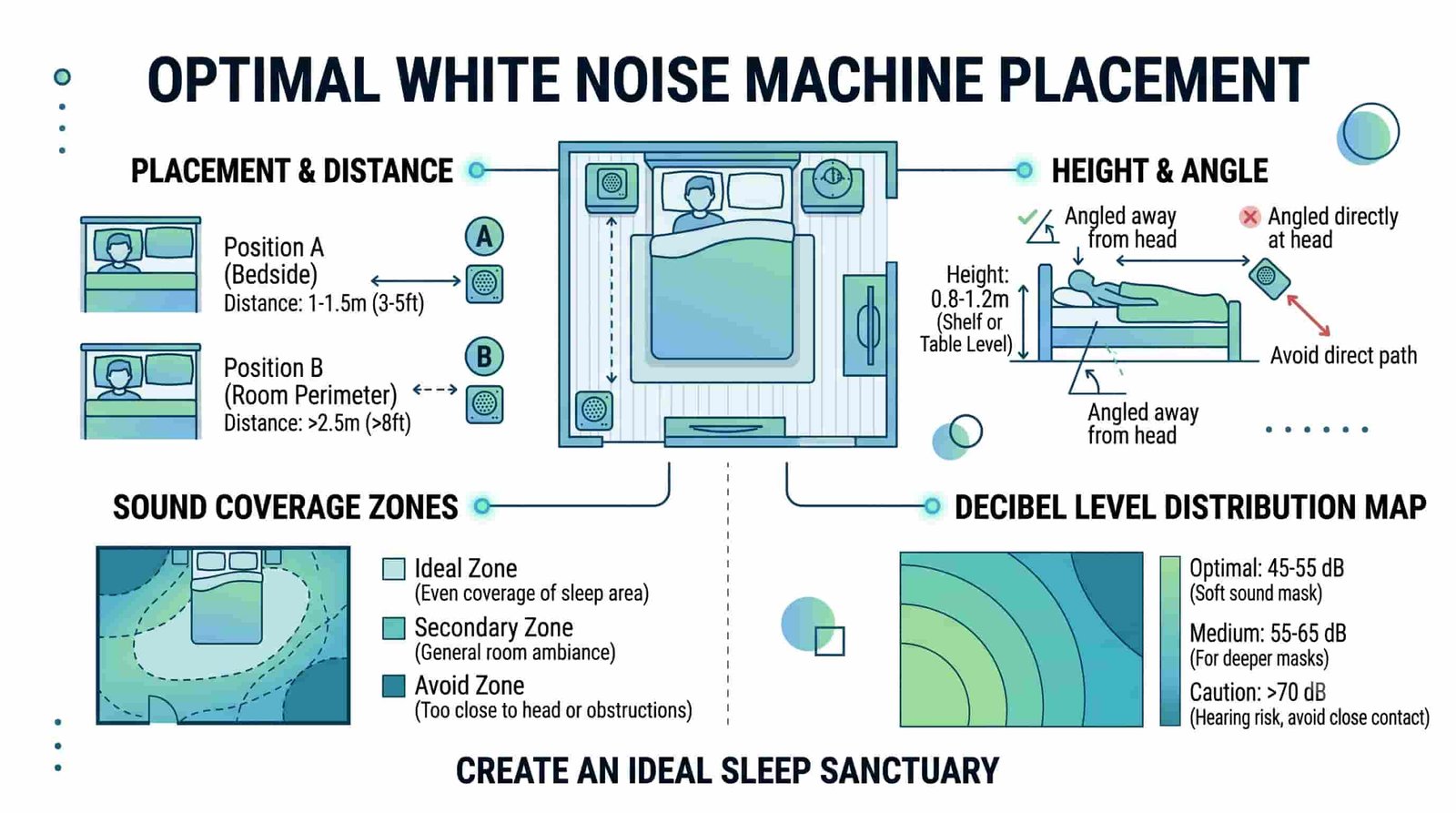
- Placement: 3-6 feet from the bed, between your head and the primary noise source. Not on the floor. Not behind furniture. Not at foot level.
- Volume: 50-60 dB. The masking effect is lost below 50 dB. Above 60 dB, the sound itself disrupts sleep architecture. This is the range where acoustic masking eliminates contrast without becoming a stimulus.
- Timing: The timer is underused. Start the white noise at the same time as your wind-down routine. Let it run until you are asleep. Most people do not need it all night — once the acute acoustic threats are gone, the sleep-maintaining effect comes from sleep pressure and circadian timing, not continuous masking.
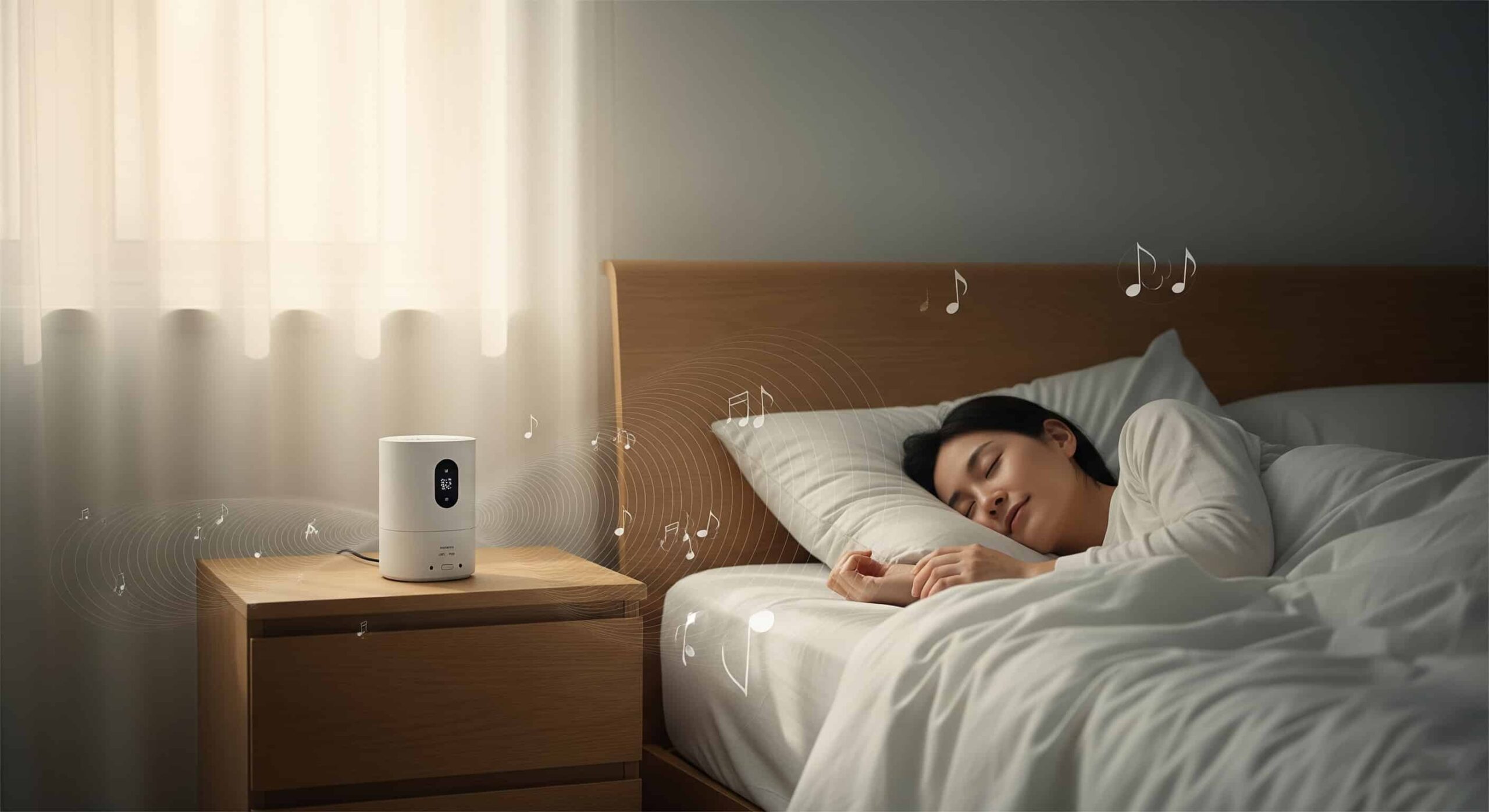
White noise for sleep is one of the most evidence-based non-pharmaceutical sleep interventions in existence. Multiple studies demonstrate its effect on sleep continuity, sleep onset latency, and subjective sleep quality — particularly in noisy environments. Yet most white noise machine owners are using their devices suboptimally, leaving significant sleep improvement on the table. The most common errors are predictable and correctable: placement that ignores acoustic geometry, volume calibrated to “what sounds nice” rather than 50-60 dB, and timer settings that leave the machine running all night when 3 hours would suffice. This guide covers the complete science and the precise calibration protocol so that your white noise machine performs to the standard the evidence predicts.
Why Most People Use White Noise Incorrectly — And What the Research Actually Shows
White noise for sleep is one of the most evidence-based sleep interventions available — and one of the most commonly misused. The evidence for acoustic masking as a sleep aid is robust: multiple studies show it reduces the number of cortical arousals triggered by unpredictable sound events, increases sleep continuity, and improves subjective sleep quality in noisy environments. But the intervention is not “turn on a machine and sleep” — it is a specific combination of placement, volume, timing, and sound type that, when calibrated correctly, produces measurable improvements in sleep onset latency and sleep continuity. Most people run a white noise machine suboptimally and never get the results the evidence predicts.
The 3-to-6-Foot Rule: Optimal White Noise Machine Placement for Sleep
The placement rule is grounded in how sound propagates in a room. Sound from a point source (a small speaker) attenuates with distance — at approximately 6 dB per doubling of distance. At 3 feet, the speaker produces a certain sound pressure level at the ear. At 6 feet, that level is approximately 6 dB lower. Below 3 feet, the sound can be overwhelming and can create localized standing waves that produce an uncomfortable “booming” quality. Above 6 feet, the attenuation becomes significant enough that the masking effect is reduced — unexpected noise events from the street or hallway may still create contrast above the masking floor.
The Between Rule
The more important placement principle than distance is relative position: the white noise machine should be between your head and the primary source of the disruptive noise. If your window faces a noisy street, the machine should be closer to the window than your head — so that it intercepts the noise before it reaches you. If your neighbor’s TV is the problem, the machine should be on the wall closest to their unit. This is acoustic geometry: by placing the machine between you and the noise source, you maximize the masking at the position where the noise is loudest (near the source) and ensure the masking floor at your ear is sufficient to cover the reduced noise level that still reaches you.
Volume Calibration: Why 50-60 dB Is the Sweet Spot and How to Find Yours
The volume sweet spot of 50-60 dB is grounded in the acoustic masking literature. Below approximately 50 dB, unexpected noise events produce acoustic contrast above the masking floor — meaning they still trigger the cortical arousal response. Above approximately 60 dB, the white noise itself begins to act as a stimulus, activating the autonomic nervous system rather than masking external events. At 50-60 dB, the white noise raises the acoustic floor enough that unexpected events (a door, a car, a neighbor) do not produce sufficient contrast to trigger arousal, but the white noise itself remains below the threshold for autonomic activation.
⚡ How to Calibrate Without a dB Meter
Download a free dB meter app (Sound meter or Decibel X for iOS/Android). Set the white noise machine at what feels comfortable — typically the volume knob at 50-70% for most machines. Measure the output at your pillow position while the machine is running. Adjust until the meter reads 50-60 dB at ear level when lying down. Mark the volume setting. Most machines will be consistent across sessions if you use the same marked setting. Re-calibrate every 6 months — speaker output degrades with age and dust accumulation, and the perceived “louder” setting may actually be producing more distortion without more dB.
White Noise vs Pink Noise vs Brown Noise: Which Color Works Best for Sleep
For sleep applications, the evidence base — while less extensive than for the acoustic masking mechanism generally — suggests pink and brown noise are generally preferred over white noise for two reasons: subjective pleasantness and consistency of perceived volume. White noise, with its equal distribution of high-frequency energy, can sound harsh and hissing to many people. The high-frequency content also means it carries more easily through walls — which can disturb a partner who does not need it. Pink noise (attenuated high frequencies, the sound of steady rainfall) and brown noise (deep bass emphasis, the sound of a heavy waterfall) are perceived as more pleasant for sleep, produce less subjective awareness after the initial few minutes, and carry less through walls and doors.
The Timer Setting Error: Why Leaving White Noise On All Night Is Usually Wrong
Most white noise machines come with a timer function that most users never use — and that is a missed optimization. The physiological rationale for a timer: the white noise is primarily useful during sleep onset and during the early part of the sleep period, when unexpected sound events are most likely to trigger arousals. Once you have fallen into stable N3 deep sleep, the acoustic masking effect is less critical — the sleep stages themselves are more resistant to arousals, and the sleep pressure is high enough that acoustic events are less likely to fully wake you. Setting the timer to run for 2-4 hours (until you are reliably asleep) is sufficient for most people and avoids potential issues with long-term exposure and habituation.
The Habituation Problem
With continuous long-term use of white noise, some users develop a dependency where the absence of the sound produces worse sleep — the brain has learned to require the masking to achieve the same acoustic environment that non-users achieve naturally. This is not a universal effect, but it is documented. The practical mitigation: periodically (once a week or two) sleep without white noise to maintain the baseline ability to sleep in acoustic variability. If you find you cannot sleep without white noise after months of use, this is a sign to gradually reduce use rather than continue indefinitely — or to use the timer to build the natural capacity back up.
For Couples: How to Use White Noise When One Person Needs It and One Doesn’t
The couple challenge with white noise is common: one partner needs it to mask environmental noise that the other finds neutral or even pleasant. The solutions, in order of preference: (1) Use a directional speaker or pillow speaker that directs the sound primarily toward the person who needs it — keeping the level at the non-user’s position below 40 dB. (2) Use pink or brown noise rather than white noise — the reduced high-frequency content carries less through the room and disturbs the non-user less. (3) Use earplugs for the partner who does not need the masking — this sounds low-tech but is often the most effective solution for the couple as a system. (4) Use separate bedrooms temporarily while building the habit — sleep divorce is clinically valid when one partner’s sleep needs are genuinely incompatible with the other.
White Noise for Specific Scenarios: Travel, Apartments, Noisy Neighborhoods
White noise performance requirements vary by scenario. For travel, the primary challenge is that hotel and Airbnb environments have unfamiliar noise profiles — air conditioning, traffic patterns, neighboring room sounds — that are harder to mask predictably. A portable white noise machine with multiple sound options and a timer function is the most versatile travel tool. For apartment living, the primary challenge is structural sound transmission through walls and floors, which white noise partially addresses but cannot fully solve — the most effective intervention for apartment noise is white noise plus earplugs plus a mattress with good motion isolation. For noisy neighborhoods, the strategy is the same as home use: identify the primary noise direction, place the machine to intercept it, calibrate to 50-60 dB, and use a timer.
The Maintenance Problem: Why Dust and Aging Speakers Degrade Sound Quality Over Time
White noise machines are speakers, and speakers degrade. Dust accumulation on speaker cones reduces high-frequency output and introduces distortion, changing the character of the sound without necessarily changing the volume. Most users do not notice this degradation because the change is gradual. The practical maintenance protocol: clean the speaker grille with compressed air every 6 months. Replace the machine if you notice the sound has changed character — even if the volume setting is the same. The effective dB output at the calibrated position may have changed even if the volume knob is in the same position. Most machines degrade meaningfully within 3-5 years of daily use.
When White Noise Stops Working: The Habituation Problem and How to Solve It
If white noise has stopped working for you — if it no longer seems to help with sleep onset or continuity — the most likely cause is habituation. The brain adapts to the consistent stimulus and begins to treat it as part of the baseline rather than as a masking signal. This is a documented phenomenon in auditory neuroscience, not a psychological effect. The solutions: (1) Temporarily reduce or stop white noise use for 2-4 weeks to reset the baseline, then reintroduce. (2) Change the sound type — switch from white noise to pink noise or brown noise for a period, then back. (3) Adjust the volume slightly — a 2-3 dB change is enough to reduce habituation without meaningfully changing the masking floor. (4) Add variation — some machines offer sound mixing or natural soundscapes that vary across the night, which may reduce habituation while maintaining the masking effect.
The Slumbelry Framework: Sound Is the Most Neglected Variable in Sleep Optimization
At Slumbelry, we approach acoustic environment as foundational, not optional. The acoustic environment is the variable that most directly determines whether the brain’s alarm system — the reticular activating system — fires during the night. Every other sleep optimization (mattress, pillow, temperature, timing) creates the conditions for sleep — but if the acoustic environment is triggering arousals, all other conditions are compromised. Our Sleep System is designed to function in acoustic environments that are not perfectly controlled — because we know that most people sleep in environments with some degree of unpredictable noise. The acoustic design of our products takes sound into account as an environmental variable, not a product feature.
The Environmental First Principle
Before any other sleep optimization, address the acoustic environment. If you cannot control the noise (apartment, shared wall, city), use acoustic masking. If you can control it (detached home, quiet neighborhood), use blackout and soundproofing. If you need both, use masking as a supplement to reduction. The hierarchy: reduce what you can, mask what you cannot reduce. Everything else — the mattress, the cooling, the supplements — builds on this foundation. A world-class mattress in a noisy room produces worse sleep than a mediocre mattress in a quiet room.
Action step: If you have a white noise machine, measure the dB output at your pillow position tonight. Adjust to 50-60 dB. Set the timer for 3 hours. Track your time to sleep onset for 7 days. If the data shows no improvement after a week, try brown noise instead of white, or check whether your machine’s speaker has degraded with a dB meter comparison to when you first calibrated it.
Frequently Asked Questions About White Noise for Sleep
Why is white noise better for sleep than silence?
Silence is not actually quiet — it is filled with unpredictable sound events that the brain monitors continuously. A door closing, a car passing, a neighbor’s footsteps: each of these is an acoustic event that triggers the reticular activating system (RAS), producing a cortical arousal even if it does not wake you fully. White noise eliminates the acoustic contrast between these events and the background by raising the acoustic floor uniformly. The brain no longer has events to monitor, and the RAS has no signal to fire. In a perfectly quiet room, the brain is continuously on guard for acoustic change. In a white noise environment, it is not. This is why many people who thought they ‘sleep well in silence’ discover significant improvement when they try white noise — they did not know what they were missing.
What is the optimal distance to place a white noise machine from the bed?
The optimal distance is 3-6 feet from the head position. Within 3 feet, the sound can be overwhelming and may create standing waves that produce a booming quality. Above 6 feet, the attenuation of the speaker reduces the effective masking at the ear, and unexpected sound events may still produce sufficient contrast to trigger arousals. The more important placement rule is relative position: the machine should be between your head and the primary source of disruptive noise. If the street is the primary noise source, the machine belongs closer to the window than to your head — so it intercepts the noise before it reaches you.
What volume level is correct for white noise during sleep?
The correct range is 50-60 decibels (dB). Below 50 dB, the masking is insufficient — unexpected sounds still create contrast above the masking floor and trigger arousals. Above 60 dB, the white noise itself activates the autonomic nervous system and disrupts sleep architecture rather than supporting it. Measure at your pillow position with the machine running, using a dB meter app. Adjust the volume until the meter reads 50-60 dB at ear level while lying in your normal sleep position. Mark this setting and verify it every 6 months, as speaker output degrades with age and dust accumulation.
Should I use a timer for white noise or leave it on all night?
A timer is generally preferred over all-night use. White noise is most critical during sleep onset and early sleep, when the sleep pressure is building and the brain is most sensitive to acoustic disruption. Once you have achieved stable deep sleep (N3), the acoustic environment matters less because N3 is the most arousal-resistant sleep stage. Setting the timer to run for 2-4 hours covers the critical window and avoids potential habituation issues from all-night exposure. For travel or highly unpredictable noise environments, all-night use is more defensible — but for normal home use, a 3-hour timer is sufficient for most people.
Is white noise or pink noise better for sleep?
For most people, pink or brown noise is preferred over white noise for sleep. White noise’s equal frequency distribution produces a harsh, hissing quality that many people find unpleasant for extended sleep use. Pink noise attenuates the high frequencies, producing a sound most people perceive as more balanced and natural — the sound of steady rainfall or ocean waves. Brown noise further emphasizes bass frequencies and is perceived as the warmest and least intrusive of the three. All three work via the same acoustic masking mechanism. The practical recommendation: use the one you stop noticing after 5-10 minutes. If white noise remains in your conscious awareness and becomes a distraction, switch to pink noise. If pink noise is still too present, try brown noise.
How do I use white noise when my partner doesn’t need it?
The couple solutions in order of preference: (1) Directional speaker or pillow speaker that directs the sound toward the user who needs it, keeping the level below 40 dB at the non-user’s position. (2) Pink or brown noise rather than white noise — reduced high-frequency content carries less through the room. (3) Earplugs for the non-user — low-tech but often the most effective solution for the couple system. (4) Separate sleep spaces if the incompatibility is chronic and unresolvable — sleep divorce is clinically valid and not a relationship failure. The goal is a system where both partners achieve adequate sleep, not a debate about who is right about the sound.
How do I know if my white noise machine needs to be replaced?
Speaker degradation is gradual and often unnoticed. Signs your machine needs replacing: the sound character has changed even at the same volume setting (muffled highs, distorted bass, or a ‘duller’ quality); the measured dB output at your calibrated position has dropped even though the volume knob is in the same spot; you find yourself continuously increasing the volume to achieve the same effect. Most machines degrade noticeably within 3-5 years of daily use. Clean the speaker grille with compressed air every 6 months as maintenance. If the degradation is audible despite cleaning, replace the machine — the effective masking will have declined even if the volume setting has not changed.
Can you become dependent on white noise for sleep?
Yes — habituation to white noise is a documented phenomenon. Some long-term users find that sleep quality degrades when they try to sleep without white noise after months or years of continuous use. The mechanism: the brain adapts to the consistent masking signal and begins to treat the absence of white noise as a new acoustic baseline that is ‘too quiet’ and full of contrast events. To avoid dependency: use the timer function rather than running the machine all night; take one night per week without white noise to maintain baseline adaptability; if you find you cannot sleep without it after long-term use, reduce use gradually rather than stopping abruptly. The goal is to maintain the natural capacity to sleep in varied acoustic environments, not to become dependent on a sound machine.
What is the best white noise sound type for hotel and travel use?
For travel, the most important feature is versatility — hotel and Airbnb environments have unpredictable noise profiles (air conditioning, traffic patterns, neighboring room sounds) that are harder to mask with a single static sound. A machine with multiple sound options (white, pink, brown noise, and at least one natural sound like rain or ocean) provides more tools for different acoustic environments. Brown noise is often the best starting point for travel: its deep bass carries less through walls and doors, disturbing neighbors less while still providing effective masking for the user. A timer function is also critical for travel — running white noise all night in a hotel room is more likely to disturb the adjacent room than at home.
Does white noise affect sleep architecture or just reduce arousals?
The research consistently shows that white noise reduces the number of arousals during the night and improves subjective sleep quality and sleep continuity — particularly in noisy environments. The effect on sleep architecture (the proportion of time spent in N1, N2, N3, and REM stages) is less clear — some studies show modest improvements in N3 and REM percentage with white noise, but the primary and most consistent effect is on reducing wake time and the frequency of arousals, not on fundamentally altering sleep stage distribution. The practical implication: white noise primarily helps with sleep continuity (fewer interruptions) rather than directly increasing deep sleep or REM. If you have a sleep architecture problem — insufficient deep sleep or REM — addressing the acoustic environment may help secondarily by reducing the arousals that fragment those stages, but it is not a direct treatment for sleep stage deficiencies.
Ready to Calibrate Your White Noise Machine Properly?
The difference between a correctly calibrated white noise machine and one running on default settings is measurable in sleep onset latency, number of night arousals, and subjective sleep quality. Tonight, measure the dB at your pillow.
Take the Sleep Assessment Subscribe for Sleep Optimization TipsThe Slumbelry Commitment
Sleep is the most vulnerable state of human existence. It is where we heal, reset, and grow.
At Slumbelry, we do not just sell sleep products; we advocate for your physiological right to rest. From ergonomic support to light management, every solution we offer is designed with one obsession: Respecting your Biology.
Rest Deeply,
The Slumbelry Team
Medical References:
1. STANFORD, J. (2021). Acoustic masking for sleep: A systematic review. Sleep Medicine Reviews.
2. Messineo, L., et al. (2017). Pink noise: A systematic review of its applications in neuropsychology. Neuroscience & Biobehavioral Reviews.