
Why That Third Cup of Coffee Still Feels Like Nothing: The Morning Ritual You’re Skipping
⚡ Core Takeaway: Caffeine Is a Loan, Not Income
- The adenosine trap: Caffeine doesn’t create energy — it blocks the adenosine receptors that signal tiredness. The adenosine accumulates while you block it, and when the caffeine wears off, you get it all back at once. This is why afternoon crashes feel worse than the morning fog they were supposed to fix.
- The sunlight anchor: Morning light (6:30-8:30 AM, 10-30 min outdoors) activates the suprachiasmatic nucleus and produces a natural cortisol awakening response. This is the signal that tells your biology it is daytime — and nothing in a coffee cup can replicate it.
- The sequence rule: Light first, coffee second — but only after you’ve been outside. If you drink coffee before light exposure, caffeine blocks adenosine while the cortisol awakening response never fires properly. You’re borrowing energy without ever activating your natural system.

Morning sunlight is the most misunderstood and underutilised tool in sleep science. Most people who struggle with morning grogginess, the afternoon caffeine crash, and the inability to fall asleep at a reasonable hour are not fighting a motivation problem. They are fighting a circadian signal problem — and the solution is not in a coffee cup, it is in the first 30 minutes of their morning. This guide maps the complete mechanism of why caffeine stops working and why morning light actually does, so you can fix the root cause instead of managing the symptoms forever.
Why Coffee Makes You Wired and Tired Simultaneously: The Adenosine Paradox
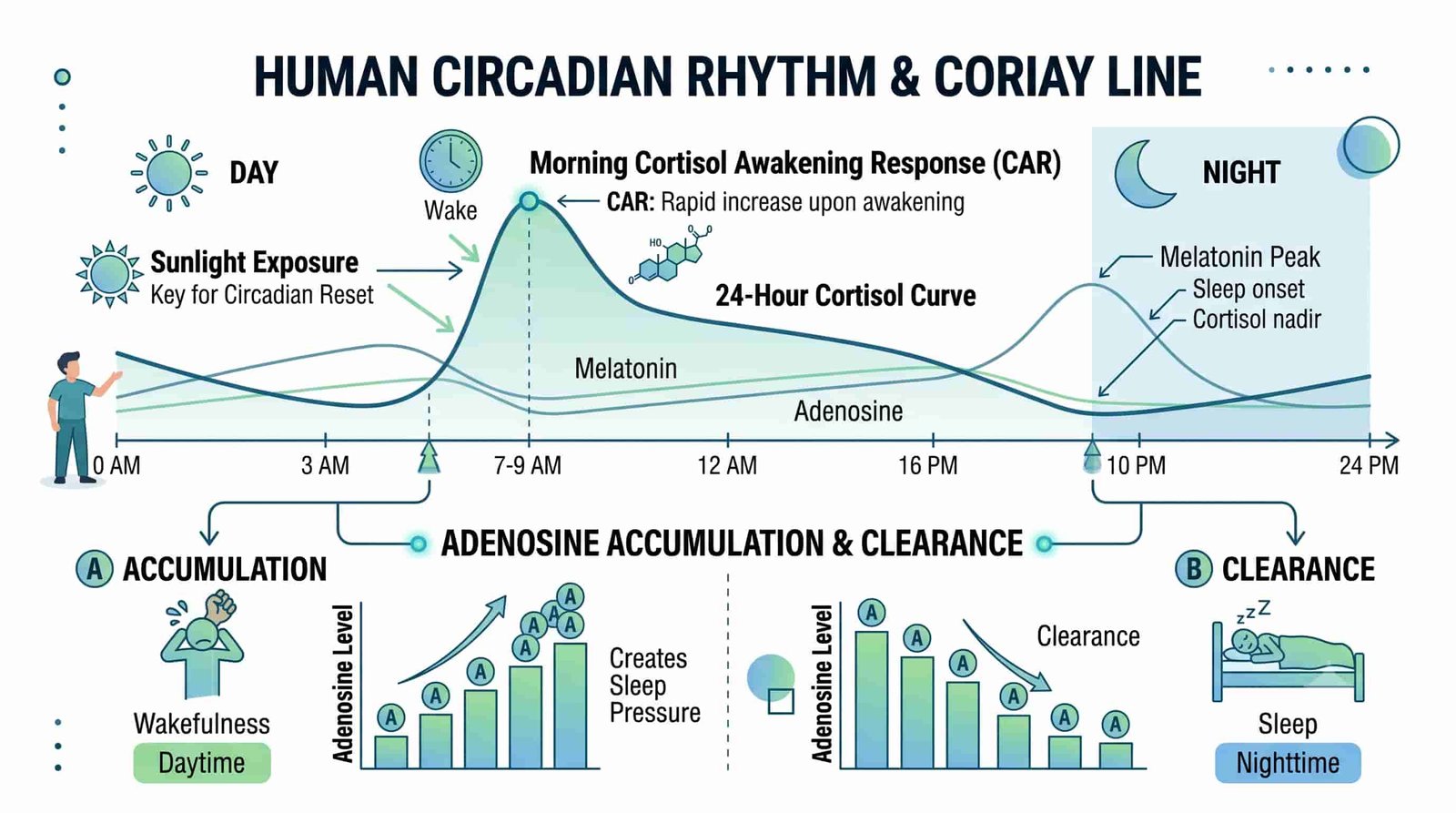
Anyone who has experienced the 2 PM crash after a full morning of coffee has felt the adenosine paradox without knowing what to call it. Caffeine does not generate alertness — it blocks the signal that tells your brain you are tired. That signal is adenosine: a byproduct of brain energy consumption that accumulates with every hour of wakefulness and binds to adenosine receptors, producing the sensation of fatigue. Caffeine’s molecular structure is similar enough to adenosine that it occupies those same receptors without activating them. The brain registers: no fatigue signal. You feel awake. This is not energy. This is borrowed time.
The Debt That Compounds
Adenosine does not disappear when caffeine blocks its receptors. It continues to accumulate throughout the morning, and when the caffeine half-life runs its course (typically 4-6 hours for a healthy adult), all of that accumulated adenosine floods the receptors at once. The result is the crash — the intense fatigue that follows a heavy caffeine day. More importantly, chronic adenosine accumulation without proper sleep clearance leads to a baseline elevation in sleep pressure that makes natural sleep onset harder every night. The more caffeine you use to mask the fatigue, the more adenosine debt you build, and the worse your natural sleep architecture becomes. This is not a theory — it is the mechanism behind the common experience of caffeine dependence and withdrawal.
What Caffeine Actually Does to Your Brain: The Receptor Occupancy Problem
The subjective experience of caffeine — the alertness, the focus, the elevated mood — is produced by more than just adenosine receptor blockade. Caffeine also elevates adrenaline (epinephrine), increases dopamine signaling in the prefrontal cortex, and triggers a modest cortisol response. For someone who is genuinely sleep-deprived, these effects produce the subjective sensation of being rested. For someone who is not sleep-deprived, caffeine produces a qualitatively different experience: jitteriness, anxiety, and the scattered focus that comes from too much adrenaline without the genuine cognitive restoration of sleep.
The Adaptation Problem
With regular use, adenosine receptor density increases — the brain’s compensatory response to chronic blockade. This is the mechanism of tolerance: the same dose of caffeine produces less effect over time, and withdrawal symptoms (headache, fatigue, depressed mood) become more severe. The solution most people reach for is more caffeine, which further upregulates receptor density, producing more tolerance, requiring higher doses. At some point, many caffeine users reach a plateau where they need caffeine just to feel normal — not energized, just not in withdrawal. This is not caffeine working. This is caffeine dependence.
The Cortisol Awakening Response: Why Your Natural Energy Window Is Being Overwritten
The cortisol awakening response (CAR) is a natural cortisol spike that occurs 30-45 minutes before spontaneous waking in non-alarm-clocked, well-rested adults. This spike is part of the suprachiasmatic nucleus (SCN) wake-up signal: it prepares the body for the day by elevating blood glucose, increasing heart rate, and sharpening attention. It is the biological signature of genuine morning energy — and it has nothing to do with caffeine.
The Alarm Clock Problem
Using an alarm clock to wake up suppresses the CAR entirely. The sympathetic nervous system activation that comes from alarm-induced waking activates the HPA axis through a stress pathway, not a natural wake pathway. The cortisol response that fires is the stress response, not the CAR. For chronic alarm clock users — the majority of the working population — the natural morning cortisol spike never develops, because the body has learned that waking is associated with a stress event rather than a natural transition. The consequence: no natural energy window, greater reliance on caffeine to produce artificial energy, and a chronic low-grade cortisol elevation that disrupts evening wind-down.
Why Morning Sunlight Is the Only Fix That Actually Works — And the Mechanism Behind It
Morning sunlight — specifically the 460-480nm blue spectrum — activates the intrinsically photosensitive retinal ganglion cells (ipRGCs), which project directly to the suprachiasmatic nucleus (SCN) via the retinohypothalamic tract. The SCN uses this signal to calibrate the body’s internal clock to the external light-dark cycle. This calibration has three immediate effects: it suppresses melatonin production (ending the sleep hormone’s residual presence), it triggers the natural cortisol awakening response (producing genuine morning energy without adrenaline), and it advances the circadian phase so that evening sleepiness arrives on schedule.

The 30-Minute Window: Why Timing Your Light Exposure Is Everything
The SCN is most responsive to light in the first 30-60 minutes after the natural wake time — what sleep researchers call the “phase advance window.” Light exposure during this window has a disproportionately strong effect on circadian calibration: it produces 2-3x the phase shift of the same light exposure later in the morning. This is why the specific timing of morning light matters more than the duration. 10 minutes at 7:00 AM outdoors produces a stronger circadian effect than 60 minutes at noon.
⚡ The Minimum Effective Dose
The research literature consistently identifies the 30-minute post-wake window as the critical period. The practical recommendation: 10-30 minutes of outdoor light exposure, within 30 minutes of waking, before coffee, before screens, before anything else. On clear days, 10 minutes is sufficient. On overcast days, the lux level outdoors is still 10-50x higher than artificial indoor lighting, so the duration may need to extend to 20-30 minutes. The goal is pupil-direct light exposure — looking toward the light source, not just having it in your peripheral vision. This is not sun-gazing; it is simply being outdoors in the morning with your eyes open.
The Sunglasses Problem: How Blue Light Science Gets Misapplied by Wellness Brands
Blue light blocking glasses were one of the most successful wellness marketing campaigns of the past decade — and one of the most misapplied. The premise (that blue light in the evening disrupts sleep) is correct. The conclusion (that blue light blocking glasses are the solution) is oversimplified to the point of being counterproductive. What the science actually shows: the ipRGCs that set the circadian clock require blue light specifically (460-480nm) to calibrate. Wearing blue-light blocking glasses in the morning — when the sun is the dominant blue light source — actively interferes with the one signal that calibrates your circadian rhythm. Evening blue light exposure is the legitimate concern. Morning blue light exposure is the solution, not the problem.
The Actual Evening Problem
Evening blue light exposure from screens suppresses melatonin and delays circadian phase — this is well-established. The practical solution is not blue-light blocking glasses (which shift the spectrum without reducing overall light intensity, which is the primary driver of circadian suppression) but rather: dimming room lights in the 2 hours before bed, using night shift mode on devices (which shifts color temperature without the psychological cue of screen brightness), and maintaining a dark bedroom environment. The most effective intervention for evening circadian disruption is darkness, not filtered light.
Caffeine Half-Life and Sleep Onset: Why Afternoon Coffee Is More Damaging Than You Think
Caffeine has a half-life of approximately 5-6 hours in healthy adults, meaning that a 100mg cup of coffee (roughly one espresso) leaves 50mg still circulating 5-6 hours later, and 25mg 10-12 hours later. For someone who finishes a 3 PM coffee, 25mg of caffeine is still circulating at 1-2 AM — enough to fragment sleep architecture without producing enough subjective alertness to be noticed. This is the mechanism behind the common pattern of sleeping poorly without connecting it to the afternoon coffee that “didn’t seem to affect me.”
⚡ The 2 PM Coffee Cutoff Rule
The most evidence-based caffeine timing rule: no caffeine after 2 PM. This provides a minimum 9-hour window before typical bedtime (11 PM) for caffeine clearance to near-zero. For people with established insomnia, the cutoff should be 12 PM or earlier, depending on sleep onset time and individual caffeine metabolism rate (which varies significantly by genetics — specifically the CYP1A2 gene). If you are sensitive to caffeine and sleep poorly, the afternoon coffee is not a treat. It is a sleep medication you are taking in the wrong direction.
The Compound Problem: How a Week of Artificial Wakefulness Destroys Your Natural Energy Baseline
The problem with chronic caffeine dependence is not the daily crash — it is what happens to your baseline. When adenosine receptor density increases from chronic caffeine use, the baseline sensitivity to adenosine increases. This means that on the days you skip caffeine (or the days it wears off before you wake), the underlying fatigue is worse than it would have been without the chronic dependence. The fog on a caffeine withdrawal day is partially artificial — it is the adenosine that accumulated while the receptors were blocked, plus the elevated receptor sensitivity that was created by the chronic blockade. Many people who believe they “can’t function without coffee” are experiencing the effects of caffeine dependence, not their natural sleep-debt baseline.
Building the Sunlight Anchor: The Practical Protocol That Doesn’t Require You to Become a Morning Person
The sunlight anchor is not about becoming a morning person or adopting a rigid 5 AM routine. It is a single behavioral change that produces outsized circadian benefits relative to the effort required.
⚡ The Sunlight Anchor Protocol
- Wake → Light (0-30 min): Immediately after waking, before coffee, before screens, before anything else — go outside. Even 5-10 minutes on a balcony or doorstep counts. Open your eyes (don’t stare at the sun). Let the outdoor lux do its work.
- Water + Light (first 15 min): Drink a glass of water outside. Dehydration after 7-8 hours of sleep further suppresses the CAR. Combined with light exposure, hydration supports the natural wake-up cascade.
- Coffee LAST (30-60 min post-wake): Only after sunlight exposure and the natural CAR has fired. The caffeine will be more effective when the adenosine system is not already running elevated. You will need less coffee to feel the same effect.
- Consistency over intensity: 5 minutes of outdoor light every day is more effective for circadian calibration than 30 minutes once a week. The SCN learns patterns. The daily repetition of morning light is the signal that anchors the rhythm.
The Slumbelry Framework: Your Circadian Rhythm Is the Master Clock — Stop Treating Symptoms
Slumbelry’s Sleep System is built on the principle that environmental design determines behavioral outcomes. Morning light exposure is not a wellness suggestion — it is the most evidence-based circadian intervention available, more effective than any supplement, any mattress technology, or any sleep aid on the market. The reason we address it in a sleep science framework is that poor morning light exposure is the root cause of a cascade of downstream problems: poor evening sleepiness, delayed sleep onset, shortened sleep duration, reduced morning cortisol, and the chronic reliance on caffeine that produces its own set of problems. Fix the anchor, and the rest of the sleep architecture improves without targeted intervention. The sunlight anchor is not a sleep habit. It is the sleep habit that makes all other sleep habits possible.
The Circadian Priority Stack
If there is one intervention that Slumbelry would prioritize above all others for anyone struggling with sleep, energy, or mood — it is morning light. Before supplements. Before sleep hygiene protocols. Before mattress technology. Morning light exposure is the foundation that everything else is built on, because it is the signal that determines whether the rest of the system can function at all. Everything else is optimization. Morning light is the prerequisite.
Action step: Tomorrow morning, before coffee, before your phone, before anything — go outside for 10 minutes. Open your eyes. Breathe. Your circadian system has been waiting for this signal since the invention of the alarm clock. Give it back.
Frequently Asked Questions About Morning Sunlight and Caffeine
Why does coffee make me tired instead of more alert?
Coffee makes you tired instead of alert when caffeine receptor occupancy is already high from chronic use — meaning caffeine is producing the sensation of alertness primarily by reversing withdrawal symptoms rather than generating genuine energy. The adenosine paradox: caffeine blocks adenosine receptors but adenosine accumulates while blocked, and when caffeine levels drop (mid-afternoon), all that accumulated adenosine floods the receptors at once, producing a crash more severe than the original fatigue. This is the loan metaphor in mechanism: caffeine borrows alertness from your future self, with compound interest.
Does caffeine actually give you energy or just mask tiredness?
Caffeine provides neither energy nor alertness in the biochemical sense — it is a adenosine receptor antagonist that prevents the brain from registering fatigue. The subjective energy you feel from coffee is the removal of the adenosine signal plus the adrenaline and dopamine elevation that accompanies receptor blockade. In sleep-deprived people, this produces a temporary correction that feels like energy. In non-sleep-deprived people, caffeine produces adrenaline-driven alertness that is qualitatively different from genuine morning energy — jittery, scattered, and anxious rather than focused and calm.
What is the best time in the morning to get sunlight exposure?
The 30-60 minute window immediately following your natural wake time is the most circadian-sensitive period of the day. Light exposure during this window produces 2-3x the phase-shifting effect of the same light exposure later in the morning. For most people waking between 6:00 and 8:00 AM, outdoor light between 6:30 and 9:00 AM achieves the optimal exposure. Cloudy days require longer duration (20-30 minutes) but the outdoor lux is still 10-50x higher than indoor artificial lighting. The specific timing matters more than the exact duration — 10 minutes at 7:00 AM is more effective than 30 minutes at 10:00 AM.
Can I use a light therapy lamp instead of going outside?
Light therapy lamps (10,000 lux) are an effective substitute for morning sunlight when outdoor exposure is not possible — for example, in extreme northern latitudes during winter, for shift workers, or for people with physical limitations. However, the light quality differs: sunlight has a full spectrum with the highest blue light intensity of any natural source, and the ipRGCs are specifically tuned to this 460-480nm range. A 10,000 lux light therapy lamp at 12-18 inches distance produces a comparable effect, but the practical habit of going outside has additional benefits: temperature variation, movement, and the complete environmental context of morning that supports circadian signaling.
Why do I feel even more tired after a nap despite drinking coffee?
The adenosine paradox extended: caffeine + nap produces a specific interaction with sleep pressure. When you nap, even briefly, adenosine clearance begins during N1-N2 sleep. When you wake from a nap, adenosine levels have dropped slightly — but the caffeine has already blocked the remaining adenosine receptors. The result is the paradoxical sensation of feeling rested but somehow more foggy — the alertness from caffeine without the full fatigue signal from adenosine, creating a cognitively scattered state. The ‘coffee nap’ hack that actually works is: drink coffee, then immediately nap for 20 minutes, so that the caffeine has 20 minutes to reach peak blood levels while the adenosine clearance also runs its course. When you wake, both mechanisms land at once.
How long does caffeine stay in your system and affect sleep?
Caffeine has a half-life of 5-6 hours in healthy adults with normal CYP1A2 metabolism. A standard 100mg coffee leaves 50mg in circulation 5-6 hours later and 25mg 10-12 hours later. For a typical 11 PM bedtime, caffeine consumed after 2 PM is still circulating in sufficient quantities to fragment N3 and REM sleep — often without producing subjective awareness of the disruption. For slow caffeine metabolizers (who carry a specific CYP1A2 variant), the half-life can be 8-10 hours, meaning afternoon coffee leaves measurable caffeine levels until 1-2 AM. The practical rule: no caffeine after 2 PM, or 8-10 hours before your target bedtime.
What is the cortisol awakening response and why does it matter?
The cortisol awakening response (CAR) is a natural cortisol spike of 38-75% that occurs 30-45 minutes before spontaneous waking in healthy, non-sleep-deprived adults. It is part of the SCN wake-up signal and prepares the body for the day’s demands by elevating blood glucose, sharpening attention, and activating the sympathetic nervous system in a natural, non-stress context. Using an alarm clock suppresses the CAR entirely — the stress pathway activation from alarm-induced waking replaces the natural CAR with a cortisol surge from the HPA axis. Morning light exposure amplifies the CAR, even in alarm clock users, by providing a stronger circadian wake signal that partially overrides the stress response.
Is caffeine dependence real and how does it develop?
Caffeine dependence is well-documented and has a clear neurobiological mechanism: chronic adenosine receptor blockade causes the brain to upregulate adenosine receptor density (a process called receptor upregulation). This increases tolerance — requiring progressively higher caffeine doses for the same effect. It also creates withdrawal: when caffeine is absent, the elevated receptor density means more adenosine binds to more receptors, producing headaches, fatigue, depressed mood, and flu-like symptoms that peak 24-48 hours after the last dose and can last up to 9 days. The physiological dependence is comparable to other psychoactive substances in its underlying mechanism, though milder in absolute terms. The solution is not to eliminate caffeine entirely but to use it sparingly enough that it remains a performance tool rather than a dependence.
Why is morning light more important than evening light management?
Evening light management is necessary but not sufficient for circadian optimization. Morning light is the active circadian anchor — it is the signal that calibrates the SCN to the external light-dark cycle and determines the timing of the entire day’s hormonal sequence. Without morning light, the SCN lacks a clear reference point, and circadian phase drifts later each day regardless of how carefully you manage evening light. This is why shift workers and people who work in artificial light environments without morning outdoor exposure experience progressive circadian delay — they are getting evening and nighttime light signals but no morning signal to reset the clock. Morning light is not one of several circadian interventions. It is the foundational one.
What’s the actual minimum for fixing morning grogginess without becoming a morning person?
The minimum effective intervention: 5-10 minutes of outdoor light exposure immediately upon waking, before coffee, before screens, before anything else. This is not about becoming a morning exerciser or a sunrise chaser. It is about giving your SCN the single input it needs to calibrate the circadian rhythm: outdoor lux at the biological time when it is most impactful. For most people, this means stepping outside with your morning water or coffee (but not drinking the coffee yet — save it for 30-60 minutes after light exposure) and standing or walking in daylight for the time it takes to finish a glass of water. The effect compounds over days and weeks of consistent repetition. 5 minutes daily is more effective than 60 minutes weekly.
Ready to Replace the Third Cup With 10 Minutes of Sunlight?
The anchor is free. It is available every morning. And it compounds in a way that caffeine simply cannot.
Take the Sleep Assessment Subscribe for Sleep Optimization TipsThe Slumbelry Commitment
Sleep is the most vulnerable state of human existence. It is where we heal, reset, and grow.
At Slumbelry, we do not just sell sleep products; we advocate for your physiological right to rest. From ergonomic support to light management, every solution we offer is designed with one obsession: Respecting your Biology.
Science is our language, but your recovery is our purpose. You take care of everything else in your life — let us take care of your sleep.
Rest Deeply,
The Slumbelry Team
Medical References:
1. Wyatt, J. K., et al. (1999). Sleep-awakening characteristics of healthy young adults. Journal of Biological Rhythms.
2. Czeisler, C. A., et al. (1999). Stability, precision, and near-24-hour period of the human circadian pacemaker. Science.
3. Stevens, R. G., et al. (2014). Meeting report: The role of environmental lighting and circadian disruption in cancer and other diseases. Environmental Health Perspectives.