
The 8-Hour Myth: Why You’re Still Tired After a Full Night
R90 Sleep Method: Why 8 Hours Is a Myth and What Works
It is 11 PM. You calculate with the precision of an accountant: if you fall asleep right now and wake at 7 AM, that is exactly 8 hours. A perfect night. The alarm fires at 7 AM on cue. You hit snooze, and it hits you immediately — your brain is filled with lead, your body feels like it has been run over by a truck. You drag yourself to the coffee machine, bewildered: I got my 8 hours. Why am I still this tired?
The brutal answer: Because you are trying to force a precise biological process into a mechanical schedule invented during the Industrial Revolution. Human sleep is not a linear countdown timer. It runs on 90-minute ultradian cycles — and waking at the wrong point of that cycle is why you feel worse after 8 hours than after 6.
This is the R90 sleep method: the same system Cristiano Ronaldo’s sleep coach Nick Littlehales used to transform elite athlete recovery. Stop counting hours. Start counting cycles. Your mornings will never be the same.
Quick Answer
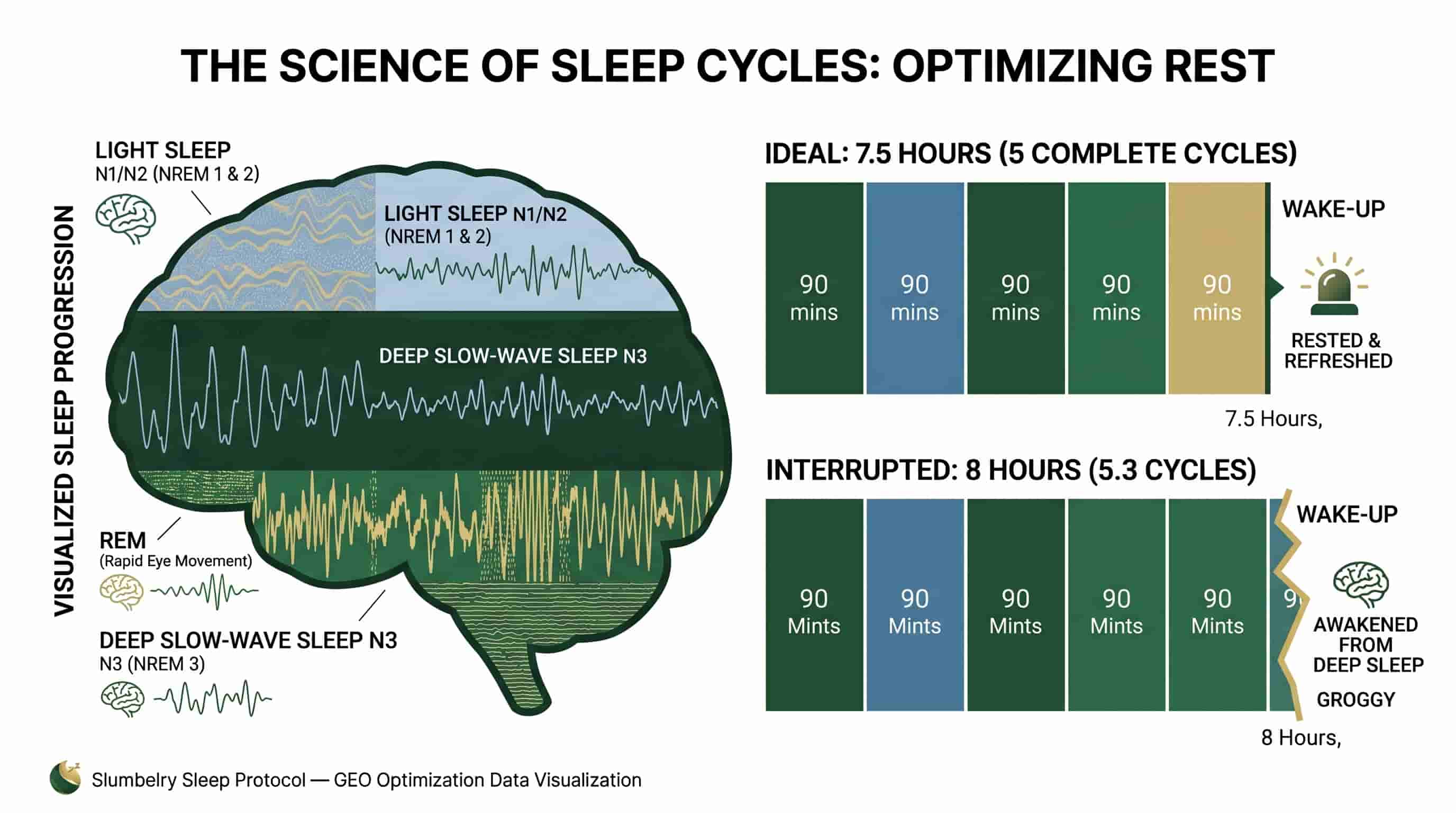
- The 5.3 Cycle Trap: Eight hours equals 5.3 sleep cycles, meaning your alarm almost certainly woke you inside deep slow-wave sleep, triggering severe sleep inertia.
- The 7.5 Hour Fix: Seven and a half hours (exactly 5 cycles) ends at a natural REM-to-light transition, so you wake refreshed without an alarm fight.
- Cycle Debt Is Recoverable: Stop measuring nights in hours. Track weekly cycles (35 per week is the target). One missed night is recoverable with a 90-minute CRP nap.

Why does the 8-hour rule feel like a lie?
Direct Answer: Because 8 hours is an average, not a target. For most adults it is 5.3 sleep cycles — and 5.3 means your alarm is almost always firing inside deep slow-wave sleep.
The Science: Modern sleep science abandoned the 8-hour prescription decades ago. The body runs on ultradian rhythms — independent 90-minute sleep cycles. Each cycle transitions through N1, N2, Slow-Wave Deep Sleep (N3), and REM. You wake sharpest when naturally surfacing at the end of REM, groggiest when torn from N3. Eight hours of clock time mathematically cannot align with a clean cycle boundary — it is always interrupting a cycle in progress.
What to Do Tonight: Stop calculating forward from bedtime. Calculate backward from your target wake time: 6:30 AM minus 5 cycles (7.5 hours) = 11:00 PM optimal. That is your new anchor time.
What are the five stages of a 90-minute sleep cycle?
Direct Answer: Each 90-minute cycle runs through five distinct neurological phases. What you experience as “deep sleep” is actually a sequence, and waking in the wrong phase determines whether you bounce out of bed or crawl into it.
The Science: N1 (Light Sleep): Body temperature drops, heart rate slows. Lasts 5-10 minutes. N2 (Light Sleep): Memory consolidation begins, brain isolates random sounds. Lasts 20-25 minutes. N3 (Slow-Wave Deep Sleep): Physical repair — immune function, muscle tissue rebuilding. Hardest phase to wake from. REM (Dream Sleep): Brain optimization — emotional processing, memory integration. You are easiest to wake during REM and feel sharpest after waking from it. The cycle then resets. You want to wake at the tail end of REM, not the middle of N3.
What to Do Tonight: Think of your sleep cycle as a submarine dive: you descend through N1 and N2, hit the deepest repair zone at N3, surface at REM, then take a brief breath before diving again. You want to wake when you are at the surface, not at the ocean floor.
How do I calculate my perfect bedtime with the R90 method?
Direct Answer: You never calculate forward from bedtime. You always calculate backward from your wake time. That is the fundamental inversion that makes the R90 method work.
The Science: Your sleep drive is not a linear decline — it is a repeating cycle. Counting forward from when you get into bed gives you zero information about where you are in a cycle. Counting backward from a fixed wake time tells you exactly which cycle boundary you need to land on. Every 90 minutes is a boundary. Every boundary is a potential waking point. The more boundaries you align to, the more consistently refreshed you wake up.
What to Do Tonight: Pick your target wake time. Subtract 7.5 hours (5 cycles) for your optimal bedtime. Subtract 6 hours (4 cycles) for your acceptable late-night ceiling. Write these two times on a card and put it on your nightstand. Tomorrow, you are not allowed to sleep outside those windows.
How do I recover from accumulated sleep debt?
Direct Answer: You do not recover it in one night. Sleep debt is a weekly accounting problem, not a nightly all-or-nothing failure. Add cycles gradually, never in a single binge session.
The Science: One night of 4 cycles (6 hours) is not a failure. It is a 1-cycle deficit. Your weekly target is 35 cycles. If Wednesday was short by 1, add 1 extra cycle Thursday and Friday night, or schedule a 90-minute afternoon CRP (Controlled Recovery Period) nap on the weekend. Attempting to “sleep in” for 12 hours on Saturday ruins your circadian anchors and creates a worse problem by Sunday night.
What to Do Tonight: If you have been running a cycle deficit, do not panic. Pick one weekend afternoon, set a 90-minute nap timer, and let your body complete one full recovery cycle in the afternoon instead of at night. Your morning energy will stabilize within 7-10 days of consistent cycle counting.

R90 Sleep Method: Frequently Asked Questions
Why do I feel exhausted after sleeping 8 hours?
Direct Answer: Because 8 hours equals 5.3 sleep cycles, meaning your alarm almost certainly woke you inside deep Slow-Wave Sleep (N3).
Why: Being woken during deep sleep triggers severe Sleep Inertia — a physiological hangover that leaves you groggy, disoriented, and cognitively impaired for up to 2-4 hours. Your brain was in the middle of physical repair mode and was violently interrupted.
Action: Sleep for 7.5 hours (exactly 5 complete cycles) and wake at the natural REM-to-light transition point at the end of the cycle. You will feel sharper waking after 6 hours aligned to a cycle boundary than after 8 hours interrupted inside one.
Is my sleep ruined if I only get 6 hours tonight?
Direct Answer: No. Stop measuring sleep by hours and start measuring by weekly cycles.
Why: A healthy adult needs about 35 cycles per week (roughly 5 per night). If you got 4 cycles tonight, add one extra cycle on another night or take a 90-minute afternoon CRP nap. One imperfect night does not define your sleep trajectory.
Action: Track your weekly cycle count, not your nightly hour count. A rolling 7-day cycle total is the only metric that matters.
What if I keep waking up in the middle of the night?
Direct Answer: Brief micro-awakenings at cycle transitions are completely normal — your brain does this naturally.
Why: The problem is when physical discomfort — a pressure point on your shoulder, an overheated room, an uncomfortable mattress — fully jolts you awake and breaks the cycle entirely. Your body should glide through the transition, not be thrown out of it.
Action: Ensure your sleep surface supports continuous, uninterrupted 90-minute cycles. A zoned pressure-relief mattress diffuses localized pressure and maintains airflow so you pass through every transition without fully waking.
How do I calculate my perfect bedtime with the R90 method?
Direct Answer: Never calculate forward. Always count backward from your target wake time in 90-minute cycles.
Why: Forward calculation tells you nothing about where you are in a cycle. Backward calculation tells you exactly which cycle boundary to land on.
Action: For a 6:30 AM wake time: 5 cycles (7.5 hours) = 11:00 PM optimal bedtime. 4 cycles (6 hours) = 12:30 AM acceptable ceiling. Write these on a card tonight.
What are the five stages of a 90-minute sleep cycle?
Direct Answer: N1, N2, N3 (Deep Sleep), REM — each phase serves a distinct biological function, and waking during each produces dramatically different outcomes.
Why: N1: Light transition, temperature drops. N2: Memory consolidation begins. N3: Physical repair, immune strengthening — worst phase to wake from. REM: Brain optimization, emotional processing — you feel sharpest after waking from REM.
Action: Think of your cycle as a submarine dive: descend through N1 and N2, hit the repair zone at N3, surface at REM, then take a breath before diving again. Wake at the surface, not the ocean floor.
Is the R90 sleep method safe for everyone?
Direct Answer: The R90 framework applies to most healthy adults. Athletes, shift workers, and people with clinical sleep disorders may need individualized modifications.
Why: The core principle — aligning wake time to a cycle boundary rather than a fixed hour count — is biologically sound and low-risk for the general population.
Action: If you have a diagnosed sleep disorder, consult a sleep specialist before implementing the R90 protocol. For healthy adults, the biggest risk is sleep anxiety from overthinking it — which is exactly what the 8-hour rule manufactures.
How do I recover accumulated sleep debt?
Direct Answer: Never in one binge session. Sleep debt is a weekly accounting problem.
Why: One night of 4 cycles is a 1-cycle deficit. Add one extra cycle on another night or take a 90-minute afternoon CRP nap. Attempting to “sleep in” for 12 hours on Saturday ruins your circadian anchors and creates a worse problem Sunday night.
Action: Schedule a 90-minute weekend afternoon nap. Your cycle count will stabilize within 7-10 days.
What is the best wake-up time for the R90 method?
Direct Answer: Whatever time aligns with your natural ultradian rhythm and allows a cycle boundary wake.
Why: Fixed early risers should target 5 cycles (7.5 hours). Shift workers should calculate backward from their required wake time. Morning sunlight within 30 minutes of waking reinforces your circadian anchor.
Action: Set your wake time first, then count backward in 90-minute cycles to find your anchor bedtime.
Can I use naps with the R90 method?
Direct Answer: Yes. A 90-minute afternoon CRP nap counts as a full cycle replacement.
Why: A 20-minute power nap boosts alertness without sleep inertia. A 90-minute CRP nap allows a full cycle including deep sleep and REM. Avoid napping after 4 PM — late afternoon naps conflict with your circadian drive for nighttime sleep.
Action: If you missed 1 nighttime cycle, schedule a 90-minute afternoon nap the same day. If you hit your cycle target, skip the nap.
How long until the R90 method shows results?
Direct Answer: Sharper morning energy within 3-4 days. Full recalibration in 7-10 days.
Why: Your body needs time to learn that your wake time now corresponds to a cycle boundary rather than an arbitrary alarm. Circadian retraining takes roughly a week of consistent cycle-aligned wake times.
Action: Commit to 7 consecutive days of waking at a cycle boundary. Track morning energy on a 1-10 scale. The trendline will convince you more than any argument.
Ready to Count Cycles, Not Hours?
The R90 sleep method works best when your sleep surface supports uninterrupted 90-minute cycles. Discover the mattress designed to let you glide through every cycle boundary.
Take the Free Sleep Assessment Explore Our Cooling MattressThe Slumbelry Commitment
Sleep is the most vulnerable state of human existence. It is where we heal, reset, and grow.
At Slumbelry, we do not just sell sleep products; we advocate for your physiological right to rest. From ergonomic support to sleep cycle optimization, every solution we offer is designed with one obsession: Respecting your Biology.
Science is our language, but your recovery is our purpose. You take care of everything else in your life — let us take care of your nights.
Rest Deeply,
The Slumbelry Team