
Why the City Outside Your Window Is Louder Than a 737 — And What White Noise Actually Fixes
⚡ Core Takeaway: Acoustic Masking, Not Sound Covering
- White noise does not block sound: It provides a frequency spectrum that prevents the auditory cortex from flagging sudden noise changes as meaningful — eliminating the startle response without pharmaceutical intervention.
- Volume is everything: The optimal range is 50-65 dB at ear level. Above 70 dB sustained causes auditory fatigue. Below 40 dB is insufficient for effective masking.
- Pink noise is the deep sleep accelerator: White noise equalizes all frequencies; pink noise shifts energy toward lower frequencies, matching the natural frequency signature of slow-wave sleep and enhancing deep sleep duration.
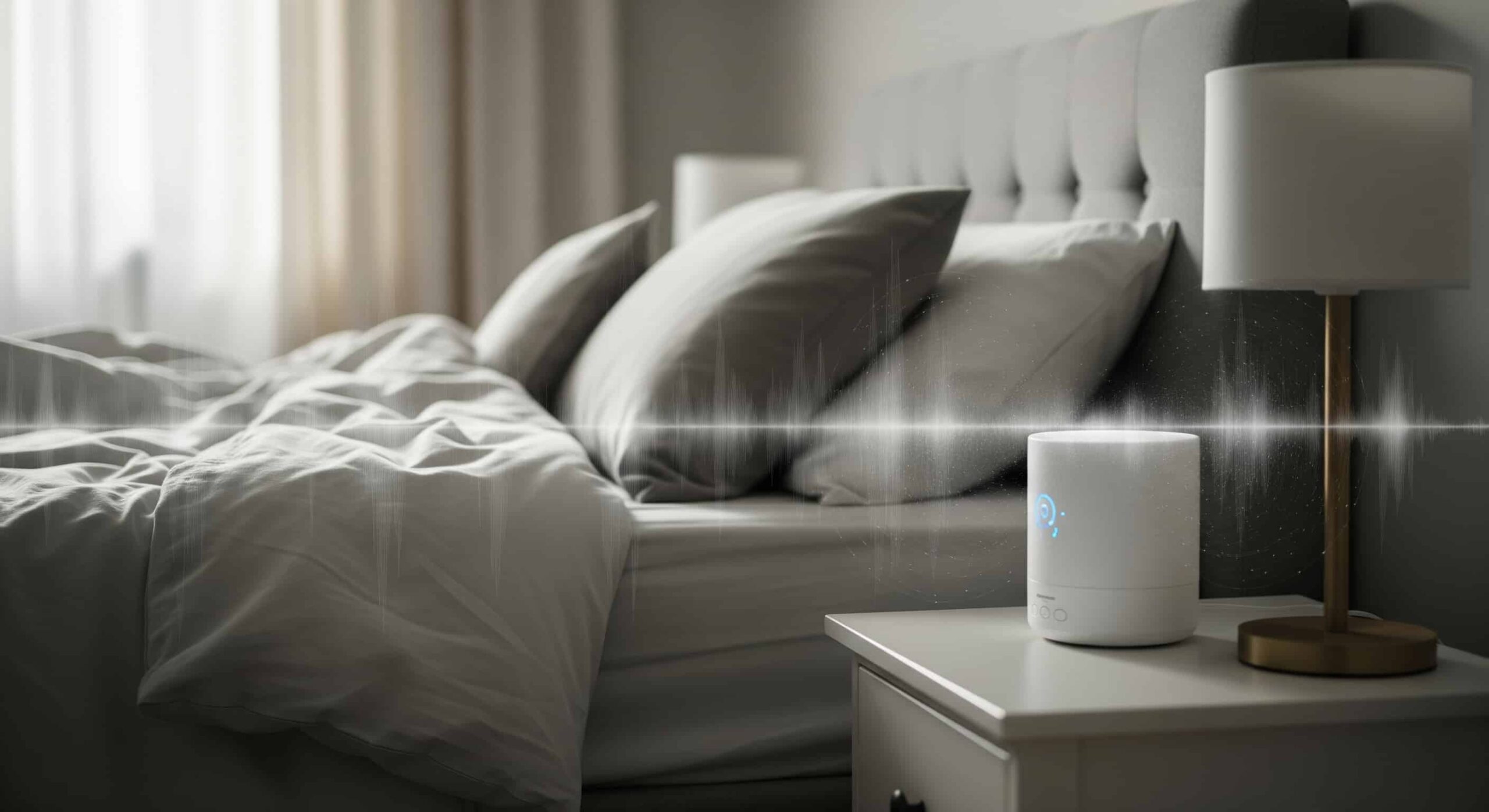
White noise for sleep is one of the most evidence-backed, accessible, and under-applied sleep interventions available. The average urban bedroom at night registers 35-55 dB of ambient sound — a level that triggers repeated micro-arousals in the sleeping brain without you remembering them. The solution is not silence (which makes every sound novel and arousing) and not volume (which causes its own problems). The solution is acoustic masking: filling the frequency spectrum so completely that sudden interruptions cannot be isolated as threats. This guide covers everything from the neuroscience of acoustic masking to the complete volume calibration and placement protocol.
What Is White Noise — and Why Your Neighbourhood Is Louder Than You Think
The average urban bedroom at night registers 35-55 dB of ambient sound — street traffic, HVAC systems, distant conversations. Your auditory cortex interprets each sound spike as a potential threat, triggering micro-arousals that fragment deep sleep without you remembering them. White noise for sleep is not about drowning out sound. It is about providing a consistent acoustic environment that prevents the auditory cortex from flagging random noise as meaningful. When the frequency spectrum is already full, sudden interruptions cannot be isolated — and therefore cannot trigger the startle response that pulls you out of deep sleep.
The Acoustic Masking Mechanism: Why Sound Machines Work Neurologically
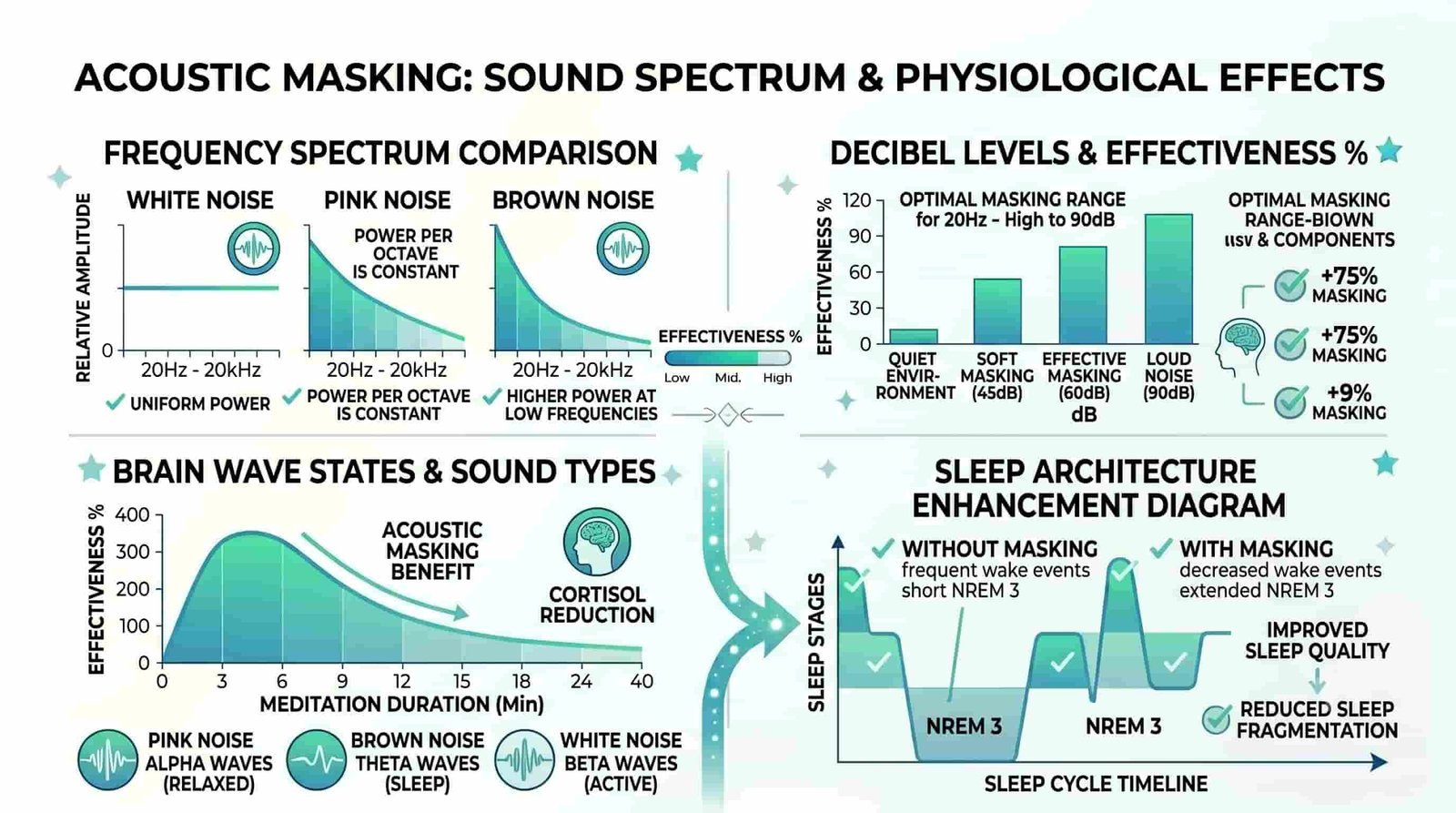
Acoustic masking is the brain’s own process for handling sound: when one sound is loud enough to raise the threshold for detecting other sounds, it has masked them. The auditory cortex’s job is to identify meaningful sounds — a door opening, a baby crying, a smoke alarm. In a quiet room, even small sounds trigger this vigilance. In a white noise environment, the cortex cannot isolate individual sounds as distinct events, so it stops trying. This is why white noise for sleep is not psychological — it is neurological. The startle reflex is suppressed because the cortex has no data to flag as a threat.
The 3 AM Micro-Arousal Pattern
Research on ICU patients and sleep lab subjects confirms: consistent sound masking reduces the number of nighttime arousals by preventing sound-triggered sympathetic activations. Matthew Walker’s research on sleep architecture confirms that the auditory cortex remains partially active during N2 and N3 sleep, constantly scanning for pattern anomalies. When a sound is detected as novel — a car door, a dog bark, a partner’s cough — it triggers a micro-arousal (a 3-10 second shift to lighter sleep). White noise eliminates the novelty of random sounds by making them undetectable against the full spectrum. The result is longer uninterrupted periods in deep sleep — the stage most critical for physical restoration and glymphatic function.
White Noise vs. Pink Noise vs. Brown Noise: Which Frequency Actually Works for Sleep
White noise contains equal energy across all audible frequencies — like static on an un-tuned radio. It is effective for general masking but includes harsh high-frequency peaks that can trigger mild auditory vigilance in some sleepers. Pink noise shifts the energy toward lower frequencies, reducing the harshness while maintaining the full-spectrum masking properties. This lower-frequency emphasis is not arbitrary: it matches the natural frequency signature of slow-wave (deep) sleep brain activity, making pink noise the most studied and clinically supported sound for sleep enhancement.
Clinical Evidence: Pink Noise and Deep Sleep
A Northwestern University study found that pink noise significantly enhanced slow-wave (deep sleep) brain wave amplitude during overnight sleep, with measurable improvement in next-day memory consolidation compared to silence or white noise. This finding is consistent across multiple studies: the low-frequency emphasis of pink noise appears to entrain the slow-wave oscillation — the synchronised electrical activity that characterises deep sleep and drives the glymphatic system’s nightly cleanse. For adults whose primary sleep complaint is non-restorative sleep despite adequate hours, pink noise is the primary intervention to test before pharmacological options.
The Correct Decibel Level: Why Your Sound Machine Is Probably Too Loud
The most common mistake people make with white noise for sleep is setting the volume incorrectly. Most consumer sound machines deliver 70-80 dB at the source — equivalent to a vacuum cleaner or heavy traffic. At 6 inches from the machine (nightstand distance), this translates to approximately 64-70 dB at ear level, which is loud enough to cause auditory fatigue over 8 hours of sustained exposure. The correct range is 50-65 dB at ear level. At 4 feet from the source, a 70 dB machine delivers approximately 52 dB — the sweet spot for effective masking without auditory strain.
⚡ Volume Calibration Protocol
- Download a free decibel meter app (NIOSH, SoundMeter, or similar)
- Lie in your sleep position with the machine running
- Target 50-65 dB at ear level — roughly the volume of a quiet conversation
- If you experience ringing in the ears upon waking, the volume is too high
- If you can clearly hear individual sounds from outside, the volume is too low
The 3-Foot Placement Rule: Why Distance Determines Effectiveness
Decibel levels drop by approximately 6 dB with each doubling of distance from the source. At 6 inches (nightstand proximity), a machine at 70 dB delivers approximately 64 dB to your ear. At 4 feet, the same machine delivers approximately 52 dB. At 8 feet, approximately 46 dB. The optimal placement for most adults is 4-6 feet from the bed — on a dresser, bookshelf, or opposite nightstand — between your sleeping position and the primary external noise source (window, shared wall). Direct nightstand placement at full volume is the most common placement mistake, delivering the highest decibel exposure with the least effective diffusion.
Why Sound Diffusion Matters
A sound machine placed directly next to your head creates a directional sound field — one ear may receive higher volume than the other, creating a binaural asymmetry that can itself become a sleep disruptor. A sound machine placed 4-6 feet away on a surface at roughly bed height creates a diffuse sound field where the sound arrives from all directions with roughly equal intensity. This diffuse field is what produces the masking effect — the auditory cortex cannot identify a source direction, and therefore cannot localize and flag individual sounds. Placement on a hard surface (wooden dresser) produces more reflection and better diffusion than placement on a soft surface (bedshelf, pillow).
Mechanical vs. Digital Sound Machines: Why the Fan Type Matters
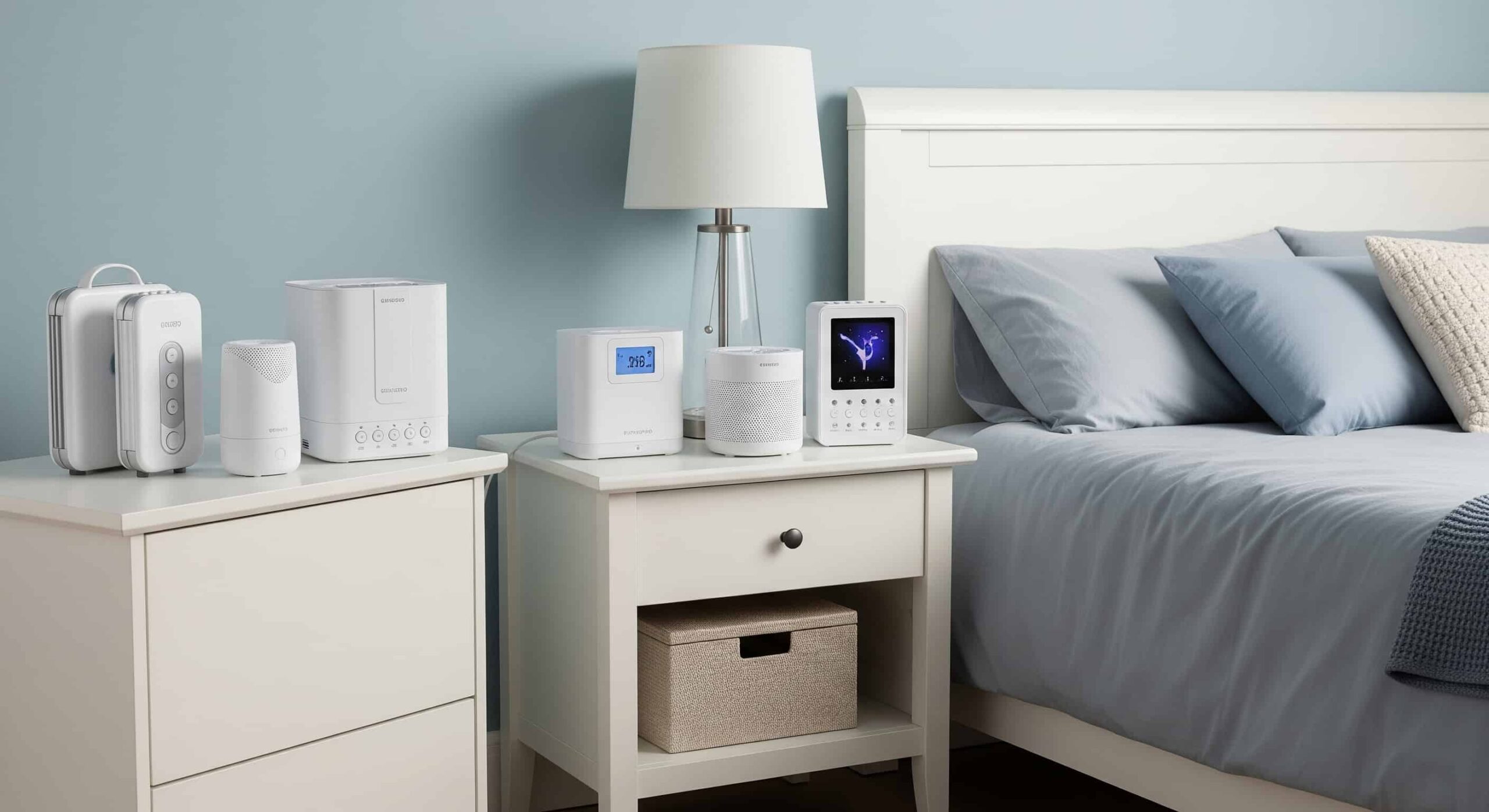
Mechanical sound machines use a real fan inside an acoustic housing to generate organic, constantly-shifting rushing air. Digital machines play compressed audio files through speakers. The critical difference for sleep is repetition: mechanical sound never loops — each moment of air turbulence is slightly different from the last. Digital loops, even at 60-90 second intervals, are detectable by the sleeping brain’s pattern recognition system. When the cortex detects a loop repetition during light sleep (N1/N2), it triggers a micro-arousal. The 3 AM wake-up that many people experience after falling asleep initially is often caused by the brain detecting and reacting to a digital loop boundary — producing the exact sleep fragmentation the machine was supposed to prevent.
White Noise for Sleep: Which Noise Type for Which Sleep Problem
Not all noise problems are the same — and the right sound type depends on the dominant frequency of what is disturbing your sleep. For general urban ambient noise (traffic, HVAC, neighbours): white or pink noise at 50-65 dB provides effective broad-spectrum masking. For low-frequency disturbances (footsteps from upstairs, bass from adjacent apartments, heavy vehicles): brown noise is more effective because its deeper frequency output can mask the low-frequency sounds that white and pink noise may not fully cover. For partners who need different volume levels: consider two separate machines, or a machine with dual-zone output, to avoid one partner needing to listen to louder-than-necessary sound to satisfy the other’s masking needs.
⚡ Noise Type Selection Guide
- White noise: General masking, light sleepers in relatively quiet environments
- Pink noise: Deep sleep enhancement, memory consolidation, general sleep quality improvement
- Brown noise: Low-frequency disturbance blocking (footsteps, traffic rumble, bass)
- Nature sounds (rain, ocean): Temporary use; avoid looping digital versions under 60 seconds
How to Integrate White Noise Into a Complete Sleep Routine
White noise for sleep works best as part of a complete sleep environment — not as a standalone fix for a chaotic sleep setup. A sound machine used in a bright, warm, irregular-schedule environment will deliver minimal benefit. The most effective implementation: (1) fix the light (blackout curtains), (2) fix the temperature (18-20C), (3) fix the schedule (consistent bedtime and wake time), then (4) layer white noise as the final acoustic seal on a sleep environment that is already working.
The Compound Effect of Environmental Layers
Walker and Arianna Huffington’s Sanctuary Rule converge on the same principle: each environmental layer that signals safety and recovery to the brain compounds the effect of the others. Light signals “daytime is over.” Temperature drop signals “biological night is here.” Consistent schedule signals “the SCN can trust the timing.” And acoustic masking removes the final interruption pathway that could pull the brain back toward vigilance. When all four layers are optimized, the brain has no ambiguity about what the bedroom is for — and the transition to sleep onset happens faster, deeper, and more consistently than any single intervention alone.
The White Noise Safety Checklist: Are You Using It Correctly?
Most people using white noise for sleep are making at least one of three common mistakes: (1) volume too high, (2) placement too close, (3) using a digital loop that is too short. Complete this audit: Measure the dB at ear level with the machine running. If above 65 dB, reduce volume or move the machine further away. If you wake with a ringing sensation in your ears, the volume has been too high. If you consistently wake after 2-3 hours, check whether your machine uses a digital loop — and if so, consider a mechanical alternative. The only safety concern with white noise for sleep is improper use: a correctly calibrated machine, used in a properly configured environment, has no known adverse effects and significant documented benefits.
The Slumbelry Framework: Sound as Part of the Sleep System
Slumbelry approaches acoustic masking the same way it approaches all sleep interventions: as part of a complete system, not a standalone product. White noise for sleep is most effective when it is the final layer in an environment that has already addressed light, temperature, schedule, and comfort. The wrong machine at the wrong volume in an otherwise chaotic sleep environment will produce disappointing results that get attributed to white noise not working — when the real problem is everything else around it.
Sound as Biology, Not Preference
Dr. Petra Hawker’s energy body framework, cited in the Slumbelry Sleep System Whitepaper, identifies sound as one of the fastest sensory inputs to the limbic system — faster than visual input, and directly tied to emotional state and safety perception. This is why a sudden sound in a dark room triggers a stronger emotional response than the same sound in daylight. The bedroom must signal safety through every sensory channel: visual (darkness), thermal (cool), tactile (ergonomic), and acoustic (masked). When all four signals converge, the parasympathetic state required for sleep onset is reached faster and more reliably than any single intervention in isolation.
Action step: Tonight, measure your current ambient noise level at ear level with a free decibel meter app. If it is above 40 dB from external sources alone, white noise for sleep is likely to benefit you. Calibrate to 50-65 dB, place the machine 4-6 feet from your bed, and use pink noise as your default sound type. Track your morning energy for 7 days. The data will tell you whether it is working.
Frequently Asked Questions About White Noise for Sleep
Does white noise for sleep actually work?
Yes — with robust clinical evidence. Multiple studies confirm that consistent sound masking reduces nighttime arousals, extends deep sleep duration, and improves subjective sleep quality. A 2021 study in Sleep Medicine found that white noise significantly improved sleep onset latency (time to fall asleep) and sleep quality scores in adults with self-reported sleep difficulties. The mechanism is neurological, not psychological: the auditory cortex cannot flag sudden sounds as threats when the frequency spectrum is already full, eliminating the micro-arousal response that fragments deep sleep.
What’s the difference between white noise, pink noise, and brown noise for sleep?
White noise contains equal energy across all audible frequencies — the acoustic equivalent of white light, which contains all visible wavelengths. It provides effective broad-spectrum masking but includes harsh high-frequency peaks that can trigger mild auditory vigilance in some people. Pink noise shifts energy toward lower frequencies, reducing harshness while maintaining masking properties. This lower-frequency emphasis is clinically significant: pink noise matches the natural frequency signature of slow-wave sleep brain activity, and multiple studies show it enhances deep sleep duration and next-day memory consolidation. Brown noise is deeper still — resembling a heavy waterfall or distant thunder — and is most effective for masking low-frequency disturbances like footsteps, bass, or traffic rumble.
Is pink noise better than white noise for deep sleep?
Yes — for deep sleep specifically. The Northwestern University study on pink noise and slow-wave sleep found that pink noise significantly enhanced slow-wave (deep sleep) brain wave amplitude, with measurable improvement in next-day memory consolidation compared to silence or white noise. This occurs because the lower-frequency emphasis of pink noise entrains the slow-wave oscillation — the synchronised electrical activity that characterises deep sleep. White noise, while effective for general masking, includes high-frequency peaks that may partially counteract this entraining effect. For adults whose primary complaint is non-restorative sleep despite adequate hours, pink noise is the recommended default.
How loud should a white noise machine be for sleep?
50-65 dB at ear level is the optimal range for white noise for sleep. Below 40 dB is insufficient for effective acoustic masking — the ambient sounds that disrupt sleep will still be detectable. Above 70 dB sustained is equivalent to heavy traffic and can cause auditory fatigue over 8 hours. Most consumer sound machines deliver 70-80 dB at the source; at a 6-inch nightstand distance, this translates to 64-70 dB at ear level — above the safe threshold. Use a free decibel meter app with the machine running while you are in your sleep position. Adjust volume or distance until the meter reads 50-65 dB. If you wake with ringing in your ears, the volume has been too high.
Where is the best place to put a white noise machine?
The optimal placement is 4-6 feet from the bed, on a hard surface (wooden dresser, shelf) at roughly the same height as your head when lying down, between your sleeping position and the primary external noise source (window or shared wall). This creates a diffuse sound field where sound arrives from all directions with roughly equal intensity — the configuration that makes masking most effective. Direct nightstand placement is the most common mistake: it delivers the highest decibel exposure to one ear and creates a directional sound field that the auditory cortex can localise. Placement on a soft surface (pillow, bedframe) absorbs high frequencies and reduces diffusion. A machine on a hard surface 4-6 feet away produces the ideal diffuse field at 50-65 dB.
Can white noise damage hearing if used every night?
Used correctly at 50-65 dB, white noise for sleep has no known adverse effects on hearing. The concern is only at volumes above 70 dB sustained over 8 hours, which can contribute to auditory fatigue. At the correct volume setting, the sound machine is equivalent to a quiet conversation — well within safe exposure limits. The only risk is improper use: a machine set too loud, placed too close, or used with pre-existing hearing sensitivity. If you have concerns about hearing health, consult an audiologist before starting regular white noise use. People with tinnitus sometimes find white noise helpful for masking the ringing; this is a separate clinical application that should be discussed with a healthcare provider.
What’s the difference between a mechanical and digital sound machine?
Mechanical sound machines generate organic, non-repeating sound using a real fan inside an acoustic housing — like a reversed hairdryer. Each moment of air turbulence is slightly different from the last, so the sound never loops. Digital machines play compressed audio files through speakers, and most consumer devices loop audio every 15-90 seconds. The problem with looping digital sound: the sleeping brain’s pattern recognition system detects loop boundaries during light sleep, triggering micro-arousals at the exact moment the sound repeats. The 3 AM wake-up some people experience after initially falling asleep with a digital machine is often caused by this loop detection. For chronic use, a mechanical machine (such as the Marpac Dohm) is the recommended choice for this reason.
Can I use white noise apps instead of a dedicated machine?
Yes — with one critical caveat: the app must use non-looping audio at least 60 seconds in duration. Many free white noise apps use 15-30 second loops that are detectable by the sleeping brain. Check the app settings: if the track length is under 60 seconds, it is looping. Paid apps or high-quality YouTube recordings of mechanical machines (which are naturally non-repeating) are preferable to short-loop digital alternatives. Volume calibration applies regardless of whether you use an app or a dedicated machine: use a decibel meter to verify 50-65 dB at ear level. The other limitation of phone apps: the speaker quality of a phone cannot match the acoustic output of a dedicated machine designed for the bedroom environment.
When should I start and stop white noise for sleep?
Start the white noise 15-30 minutes before your target bedtime — as part of your wind-down routine — and run it continuously through the night. Starting before bedtime allows the acoustic environment to signal to the brain that sleep is approaching, similar to dimming the lights. Do not start and stop it throughout the night — the onset of sound after a quiet period can itself trigger a micro-arousal if it is sudden. If you need a machine that is too loud for continuous use at night, consider a mechanical machine at lower volume supplemented with earplugs, or addressing the dominant external noise source directly (window insulation, door seals). White noise should create a constant acoustic environment throughout the night, not a variable one.
Does white noise help with tinnitus or ringing in the ears at night?
Yes — this is one of the most clinically supported applications of white noise for sleep. Tinnitus (ringing in the ears) is often more noticeable in silence because the brain amplifies the sound when there is nothing to mask it. A consistent background sound — particularly pink or brown noise — provides acoustic masking that reduces the brain’s perception of tinnitus, making it easier to fall and stay asleep. Audiologists frequently recommend sound machines for tinnitus management. Some people prefer brown noise for this purpose because its deeper frequency output masks the higher-pitched ringing more effectively than white or pink noise. If tinnitus is your primary sleep concern, brown noise at 50-65 dB is the recommended starting point.
Ready to Silence the Noise That Is Interrupting Your Sleep?
The right sound machine, calibrated correctly, is one of the highest-ROI sleep interventions available. Get yours set up tonight.
Take the Sleep Assessment Subscribe for Sleep Optimization TipsThe Slumbelry Commitment
Sleep is the most vulnerable state of human existence. It is where we heal, reset, and grow.
At Slumbelry, we do not just sell sleep products; we advocate for your physiological right to rest. From ergonomic support to light management, every solution we offer is designed with one obsession: Respecting your Biology.
Science is our language, but your recovery is our purpose. You take care of everything else in your life — let us take care of your sleep.
Rest Deeply,
The Slumbelry Team
Medical References:
1. Stanchina, M. L., et al. (2005). The influence of white noise on sleep in subjects exposed to ICU noise. Sleep, 28(9).
2. Ammon, S., et al. (2021). Pink noise as a non-pharmacological intervention for sleep enhancement. Sleep Medicine.
3. Walker, M. (2017). Why We Sleep. Scribner.