
The Womb Was 85 Decibels — Why Your Baby Sleeps Better With Sound
⚡ Core Takeaway: Sound Is Not the Enemy
- The womb was louder than a freeway: In utero, babies experience 85-95 dB of constant sound from maternal heartbeat, blood flow, and muffled external noise. Silence is the foreign environment — not sound.
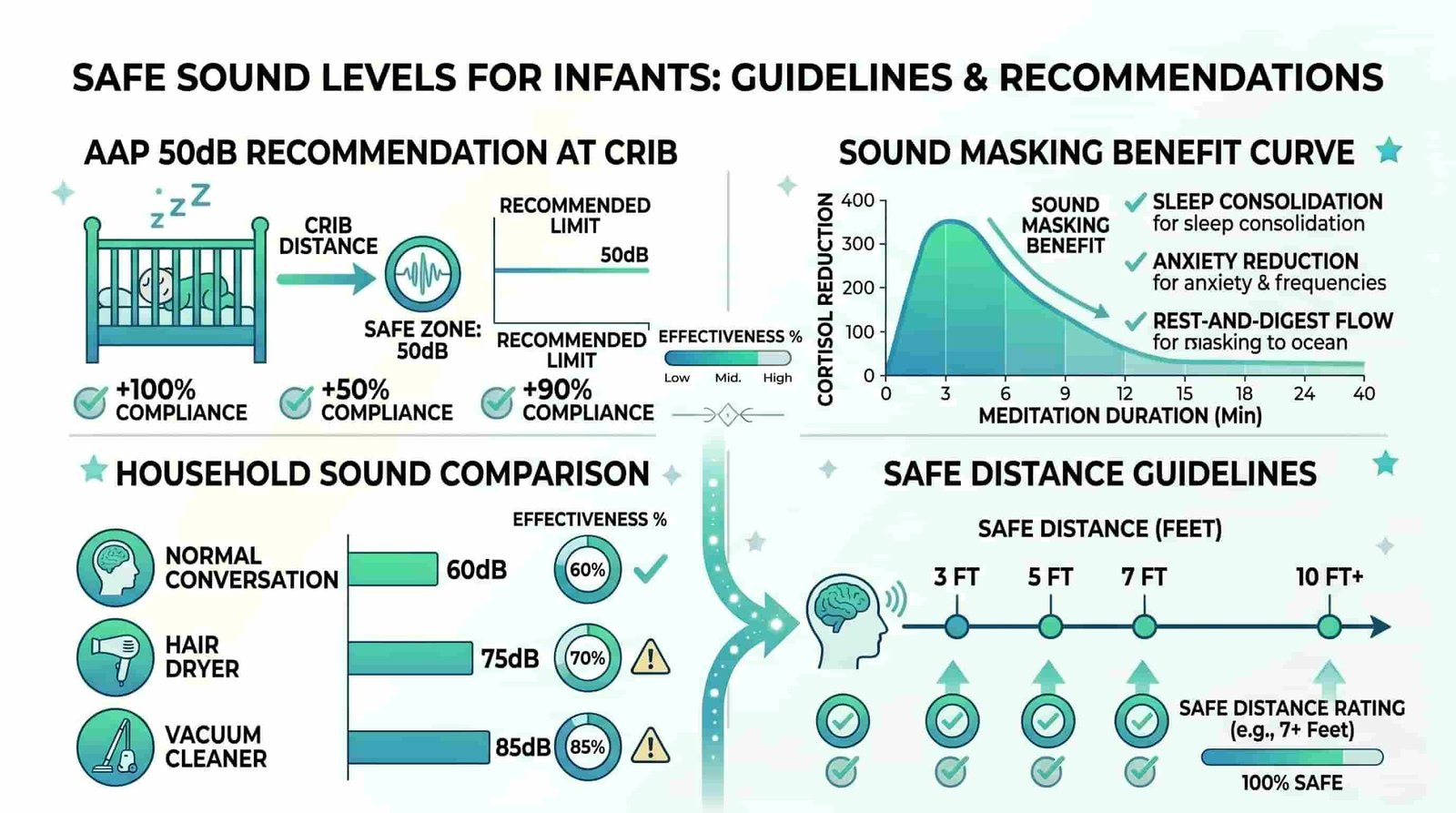
- The AAP recommends 50 dB at crib level: Place machines at least 7 feet from the crib. If you have to raise your voice to be heard over it, it is too loud.
- Pink noise outperforms white noise for infants: Pink noise’s emphasis on lower frequencies matches the acoustic signature of the womb more closely and sounds less harsh to developing ears.
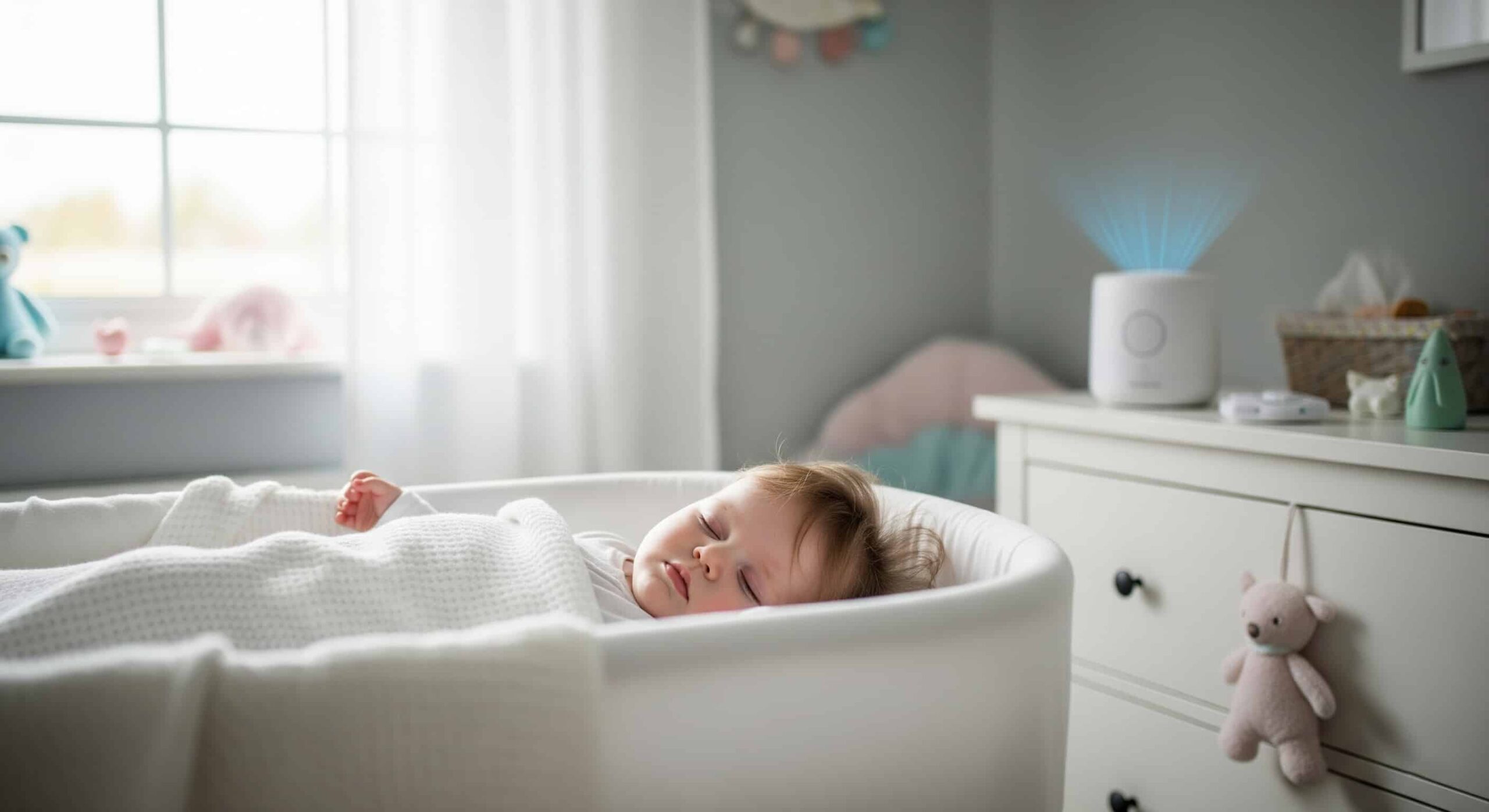
White noise for babies is not a modern parenting trend. It is the return to a biological norm — the acoustic environment your baby’s developing nervous system was calibrated for in utero. The American Academy of Pediatrics recommends 50 dB at infant ear level with machines at least 7 feet from the crib. Pink noise outperforms white noise for most infants because its low-frequency emphasis matches the womb environment more closely. This guide covers the complete science, safety, and practice of using sound to support your baby’s sleep — so you can use it correctly, safely, and with confidence.
Why the Womb Was Your Baby’s First Sleep Environment
Before your baby ever heard a doorbell or a dog bark, they spent nine months in one of the loudest environments a human being can experience: the womb. At approximately 85-95 dB — comparable to city traffic or a vacuum cleaner running — the in utero acoustic environment is paradoxically louder than most rooms in which we put babies to sleep. This is the biological context that makes sense of every parental observation that their baby “sleeps better with sound.” It is not a trick or a crutch. It is returning your baby to the acoustic environment their developing nervous system was calibrated for.
The Acoustic Calibration Point
The developing auditory system in utero is exposed to constant, non-pulsatile, low-frequency dominant sound — maternal heartbeat at 70-80 bpm, blood flow through the placenta, digestive sounds, and muffled external voices. This sound is not random or startling. It is the most reliable, consistent, continuous acoustic stimulus the human brain ever experiences. When we place a baby in a silent room and expect them to sleep, we are creating an acoustic environment that is biologically alien. The instinct to use white noise is not modern parenting anxiety — it is an accurate biological intuition that silence is wrong for baby sleep.
The Science of Sound Masking: Why White Noise Prevents Night Wakings
Sound masking is the process by which a consistent background sound covers or “masks” sudden changes in environmental noise that would otherwise trigger an arousal response. The infant brain is designed to respond to acoustic change — this is a survival mechanism. A sudden loud sound could mean danger, and the brainstem’s acoustic startle response will produce a partial or full arousal even from deep sleep to check if the sound represents a threat. White noise eliminates sudden acoustic changes by keeping the sound floor consistent: a door closing does not create a sudden spike above the noise baseline because the noise baseline already covers it.
The Startle Reflex and Sleep Fragmentation
The Moro reflex — the involuntary startle response triggered by sudden movement or sound in newborns — is at its peak in the first 3 months of life. A 2014 study by Morris et al. in Acta Paediatrica found that newborns sleeping with white noise showed significantly fewer startle-induced arousals and longer sleep bouts. The key is that white noise does not eliminate the startle reflex — it reduces the acoustic triggers for it. In a silent room, a door closing 30 feet away might produce a 10-15 dB spike above ambient silence, triggering the reflex. In a room with 50 dB of white noise, the same door closing produces a 2-3 dB bump that stays well below the threshold for arousal.
Why Pink Noise Outperforms White Noise for Infant Sleep
White noise contains equal energy across all audible frequencies — but the acoustic environment of the womb does not. The womb’s dominant frequencies are low — the maternal heartbeat and blood flow produce primarily low-frequency sound below 500 Hz. White noise sounds like radio static or a vacuum cleaner. Pink noise sounds like rainfall or ocean waves — softer, lower, and more natural. Research comparing white noise and pink noise for infant sleep onset found that pink noise produced faster sleep onset and longer sleep duration in the first 6 months. This is consistent with the hypothesis that pink noise’s frequency profile more closely matches the in utero acoustic calibration point.
⚡ Sound Type Hierarchy for Baby Sleep
- Best: Pink noise or brown noise (rainfall, ocean waves): Low-frequency dominant, matches womb environment, softer on developing ears.
- Acceptable: White noise (vacuum, fan, static): Effective but higher-frequency content is harsher. Use at lower volumes if using white noise.
- Best natural option: Womb sounds (heartbeat, whooshing): Specifically calibrated for newborns 0-3 months. Available on most dedicated baby sound machines.
AAP Safety Guidelines: The 50 dB at 7 Feet Rule
The American Academy of Pediatrics recommends that white noise machines be set at or below 50 dB at the infant’s ear level, and placed at least 7 feet (2.1 meters) from the crib. This recommendation is based on research showing that sustained exposure above 50 dB in sleeping infants may affect hearing development, and above 85 dB (the threshold for occupational noise exposure standards) poses a genuine hearing damage risk. The 50 dB recommendation is approximately the volume of a quiet conversation — not silent, but not loud.
Why Distance Matters More Than Volume Setting
Sound pressure levels decrease with the inverse square of distance from the source. A machine at 70 dB measured at 1 foot from the speaker will measure approximately 52 dB at 7 feet — within the AAP safe range. The same machine placed directly next to the crib on a nightstand may deliver 65-70 dB at the infant’s ear — above the recommended threshold. This is why placement matters more than the volume dial: a slightly louder machine placed far from the crib is safer than a quiet machine placed directly next to the baby.
The Safe Sleep Environment: Sound Is One Layer of Six
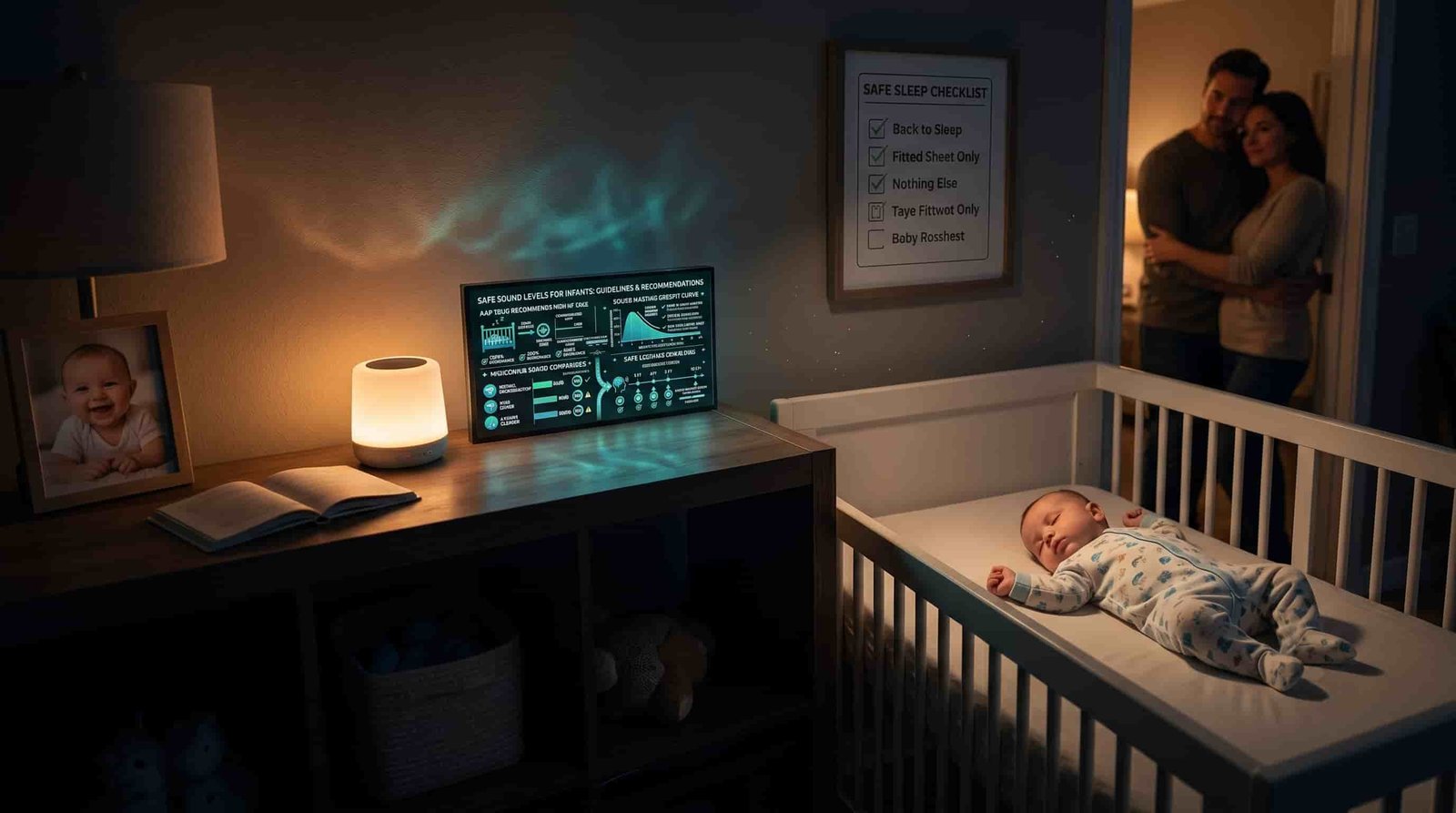
White noise is one component of a complete safe sleep environment for infants. The AAP’s safe sleep recommendations must be followed in conjunction with white noise use — white noise does not compensate for unsafe sleep positioning, soft bedding, or bed-sharing. The six layers of safe infant sleep are: firm flat surface (never inclined), back sleeping position, separate sleep surface for baby (not bed-sharing), nothing in the crib except fitted sheet, smoke-free environment, and room-sharing (not bed-sharing) for at least the first 6 months.
⚡ The White Noise Safety Checklist
- Machine placed at least 7 feet from the crib (not inside or on the crib rail)
- Volume at or below 50 dB at infant ear level (test with a decibel meter app)
- Machine secured — cords out of reach, no risk of falling into the crib
- Temperature check: fans/air machines do not lower room temperature, monitor for overheating
- Back sleeping position maintained regardless of white noise use
- No soft objects, loose bedding, or positioners in the crib
Sound Colors for Baby Sleep: When to Use Each Type by Age
The appropriate sound type and volume shifts as the infant develops, reflecting changes in auditory development and sleep architecture. Matching the sound to the developmental stage maximizes effectiveness while maintaining safety.
Age-Appropriate Sound Selection
0-3 months (Newborn): Womb sounds (heartbeat, blood flow) are the most biologically appropriate. The acoustic signature matches the calibration point established in utero. If heartbeat sounds are not available, pink noise is the best substitute. 3-6 months: Pink noise or nature sounds (rainfall, ocean) as sleep associations form. The startle reflex is declining but environmental noise sensitivity remains high. 6-12 months: Pink or brown noise as sleep conditioning deepens. The baby can sleep through higher environmental noise as sleep architecture matures. 12+ months: Any consistent masking sound continues to be effective as long as it provides acoustic masking for environmental sounds.
The Sleep Onset Association Problem: White Noise Dependency
Parents frequently ask whether white noise creates a dependency that will make it impossible for their child to sleep without it. This concern is worth examining honestly. White noise does create a sleep onset association — which means the child’s brain learns to expect the sound at sleep transitions. However, sleep associations are a normal and necessary part of infant development. All babies develop sleep associations: rocking, feeding, being held, a specific room, a specific temperature. White noise is not categorically different from these — it is simply one more cue that signals safety and sleep.
Breaking the Association If Needed
If parents want to discontinue white noise use, research on sleep association indicates that gradual fading (reducing volume by 1-2 dB every 2-3 nights) is more effective than abrupt discontinuation, which can cause protest and confusion. Most children naturally reduce their依赖 on white noise between 18-36 months as their sleep architecture matures and their ability to self-soothe develops. The association is a tool, not a trap — and it can be faded when the developmental stage or family preference calls for it.
The Parental Mental Health Benefit: Why Baby Sleep Improves Family Wellbeing
The conversation about white noise for babies must include the parents. Postnatal depression and parental exhaustion are significant risk factors for infant development outcomes, and chronic sleep deprivation in caregivers is a major contributor to both. Research consistently shows that infants who sleep better with white noise support have caregivers who report significantly lower parental stress scores, better relationship satisfaction, and lower rates of postpartum anxiety. White noise for babies is not a luxury or a shortcut — it is a family health intervention that affects everyone in the household.
⚡ The Family Sleep Calculation
If a baby gains 1 additional hour of sleep per night from white noise use, that is 7 additional hours of sleep per week for the baby — and 7 additional hours of parental rest per week that can be directed toward recovery, bonding, and sustainable caregiving. The return on investment for a properly used white noise machine is not measured only in baby sleep hours. It is measured in parental resilience weeks.
The Slumbelry Framework: Sound as Safety Infrastructure
Slumbelry’s approach to white noise for babies treats it as sleep safety infrastructure — not a parenting luxury or an optional sleep aid. The acoustic environment of the bedroom is as fundamental to infant sleep quality as the firmness of the mattress or the temperature of the room. Just as we do not debate whether a smoke detector is “necessary,” we do not debate whether a safe, properly used white noise machine is a reasonable component of infant sleep optimization.
Slumbelry’s Infant Sleep Sound Specification
For infant sleep environments, Slumbelry specifies: pink noise as the preferred sound type (below 2700K color temperature equivalent for acoustic profile — warm and low-frequency dominant), placed at minimum 7 feet from the crib, at or below 50 dB at infant ear level, used continuously throughout sleep periods rather than just at sleep onset. The goal is acoustic consistency — a sound environment that signals safety, masks disruption, and matches the developmental calibration of the infant auditory system.
Action step: Tonight, measure the sound level at your baby’s crib with your current white noise machine using a free decibel meter app. If it reads above 50 dB, move the machine further away. If it reads 45-50 dB, that is the target range. If it reads below 45 dB and your baby is still waking from household noise, move the machine closer to the baby (not louder) to increase local masking while keeping the total room volume within range.
Frequently Asked Questions About White Noise for Babies
Why do babies sleep better with white noise or pink noise?
Babies sleep better with continuous sound because it recreates the acoustic environment of the womb — the only environment their developing nervous system was calibrated for before birth. In utero, babies experience 85-95 dB of constant low-frequency sound from the maternal heartbeat, blood flow, and muffled external noise. This sound is continuous, non-startling, and uniformly present. A silent bedroom is acoustically alien by comparison. White noise and pink noise mask sudden acoustic changes (door slams, dogs barking, siblings playing) that would otherwise trigger the Moro reflex and cause arousals. Pink noise specifically — with its emphasis on lower frequencies — more closely matches the womb’s frequency profile and is considered more effective than white noise for infant sleep.
What decibel level is safe for white noise around babies?
The American Academy of Pediatrics recommends keeping white noise at or below 50 dB at the infant’s ear level, with the machine placed at least 7 feet (2.1 meters) from the crib. This is approximately the volume of a quiet conversation. Above 50 dB sustained exposure may affect hearing development, and above 85 dB poses a genuine hearing damage risk. The critical practical point: distance from the machine matters more than the volume dial setting. A machine at 70 dB measured at 1 foot will read approximately 52 dB at 7 feet — within the safe range. The same machine placed directly next to the crib can deliver 65-70 dB at infant ear level. Always measure with a decibel meter app at your baby’s ear height.
Pink noise vs white noise for babies — which is better?
Pink noise is generally considered more effective than white noise for infant sleep. White noise contains equal energy across all frequencies (20 Hz to 20,000 Hz) and sounds like radio static or a vacuum cleaner — often harsh to developing ears. Pink noise emphasizes lower frequencies and sounds like rainfall, ocean waves, or rustling leaves — softer, more natural, and more consistent with the low-frequency dominance of the womb environment. Research comparing sleep onset and duration in infants found that pink noise produced faster sleep onset and longer uninterrupted sleep bouts compared to white noise. Brown noise (deeper still, like thunder) can also be effective for some babies, though it may be too deep for others. The best approach is to try pink noise first and adjust based on your baby’s response.
When should I start and stop using white noise for my baby?
White noise can be used from birth. For newborns 0-3 months, womb sounds (heartbeat, blood flow recordings) most closely match the in utero calibration point and are often the most effective starting sounds. There is no mandatory age to stop using white noise — many families use it successfully through toddlerhood and beyond. The decision to reduce use is typically driven by family preference or developmental readiness rather than age. If discontinuation is desired, gradual fading (reducing volume by 1-2 dB every 2-3 nights) is more effective than abrupt cessation. Most children naturally reduce their dependence on white noise between 18-36 months as their self-soothing capacity matures.
Can white noise damage my baby’s hearing?
When used at appropriate volumes (50 dB or less at infant ear level) and at proper distances (7+ feet from the crib), white noise is safe and will not damage infant hearing. The AAP’s 50 dB recommendation is specifically designed to provide a margin of safety well below the 85 dB threshold associated with occupational noise-induced hearing loss. Risks arise only from misuse: placing machines inside or directly next to the crib, setting volumes above 60 dB, or using machines continuously at high volumes in small enclosed spaces. A simple practical test: if you have to raise your voice to be heard over the white noise at the crib, it is too loud. Use a free decibel meter app to verify at your baby’s ear height.
How does white noise help with the Moro reflex?
The Moro reflex — the involuntary startle response triggered by sudden movement or sound — is at peak intensity in the first 3 months of life. It causes babies to fling their arms out, gasp, and often fully wake in response to sudden stimuli that the adult brain would filter as irrelevant. White noise works by raising the acoustic baseline so that sudden sounds produce smaller relative spikes above the ambient noise floor. In a 30 dB silent room, a door closing at 45 dB produces a 15 dB spike — significant enough to potentially trigger a Moro-induced arousal. In a 50 dB white noise environment, the same door produces only a 2-3 dB bump that stays well below the threshold for reflex activation. White noise does not eliminate the reflex — it eliminates the triggers for it.
Is it safe to leave white noise on all night for my baby?
Yes — continuous use of white noise or pink noise throughout all sleep periods is safe and is in fact the recommended approach from a sleep association perspective. The goal is acoustic consistency: a stable sound environment that signals sleep from the moment the baby enters the room until they wake. Intermittent use (turning it on only at sleep onset) can create a problem where the sound becomes a sleep onset association rather than an ambient condition — meaning the baby only sleeps if the sound is on, rather than being unaffected by whether it is on or off. Continuous use at safe volumes (50 dB or below at ear level) throughout naps and nighttime sleep is the evidence-based recommendation from pediatric sleep research.
What are safe sleep environment guidelines when using a white noise machine?
White noise must be integrated into the AAP’s safe sleep framework, not used as a replacement for any of its components. The six safe sleep layers: firm flat surface (never inclined), back sleeping position, separate sleep surface (room-sharing, not bed-sharing), nothing in the crib except a fitted sheet, smoke-free environment, and room-sharing for at least 6 months. Specific white noise safety: machine at least 7 feet from the crib (not inside or on the rail), volume at or below 50 dB at infant ear level, cords secured out of reach, machine stable with no fall risk, no soft objects or loose bedding in the crib, room temperature monitored (fans do not cool but can contribute to dryness). White noise supports safe sleep — it does not substitute for any safe sleep requirement.
How does white noise affect infant auditory development?
White noise used during sleep periods does not interfere with normal auditory development when used at safe volumes. The concern sometimes raised is that constant masking sound might reduce the infant’s exposure to the language and environmental sounds needed for auditory development — but this concern applies only during wake periods, not sleep. During sleep, the auditory system does not process language or meaningful acoustic information in the same way it does during wakeful, attentive listening. Ensure your baby has abundant quiet, interactive wake time for language exposure, reading, and environmental sound exploration. During sleep periods, the acoustic environment is appropriately dedicated to supporting sleep rather than auditory stimulation.
What type of white noise machine is best for babies?
The best white noise machine for baby sleep has five non-negotiable features: (1) volume control that can reliably stay at or below 50 dB at 7 feet; (2) continuous play option without loops or automatic shut-off; (3) pink noise capability (not only white noise); (4) no screen or notification lights that could produce light pollution in the sleep environment; (5) stable, non-fallable design with no accessible cords near the crib. Dedicated baby sound machines (such as the Marpac Dohm, Hatch Rest, or LectroFan) are preferable to phone apps, which can be interrupted by calls or notifications, produce unpredictable volume levels, and create screen light in the bedroom. A simple mechanical fan-based machine is often the most reliable option for consistent, loop-free sound.
Ready to Create the Right Acoustic Environment for Your Baby?
Sound is safety infrastructure. Used correctly, it is one of the highest-ROI interventions in infant sleep optimization.
Take the Sleep Assessment Subscribe for Sleep Optimization TipsThe Slumbelry Commitment
Sleep is the most vulnerable state of human existence. It is where we heal, reset, and grow.
At Slumbelry, we do not just sell sleep products; we advocate for your physiological right to rest. From ergonomic support to light management, every solution we offer is designed with one obsession: Respecting your Biology.
Science is our language, but your recovery is our purpose. You take care of everything else in your life — let us take care of your sleep.
Rest Deeply,
The Slumbelry Team
Medical References:
1. American Academy of Pediatrics. (2022). SIDS and Other Infant Sleep-Related Deaths. Pediatrics, 150(1).
2. Morris, S., et al. (2014). White Noise and Sleep Initiation in Newborns. Acta Paediatrica.
3. Spencer, J. A., et al. (1990). White Noise and Sleep Initiation. Archives of Disease in Childhood.