
The One Home Factor That Ruins Your Sleep Before You Even Close Your Eyes
⚡ Core Takeaway: Light Is Your Most Powerful Sleep Drug
- Light before bed suppresses melatonin: Even modest light exposure (20-50 lux) at 470nm blue wavelength delays sleep onset measurably. The screen you hold 12 inches from your face delivers 100+ lux of blue light.
- The 3000K myth: 3000K amber is better than 5000K cool white but still contains significant blue spectrum. True sleep-supportive lighting is below 2700K with zero blue content above 550nm.
- The one morning habit that fixes everything: 20 minutes of outdoor sunlight immediately after waking does more for your circadian rhythm than any evening intervention.
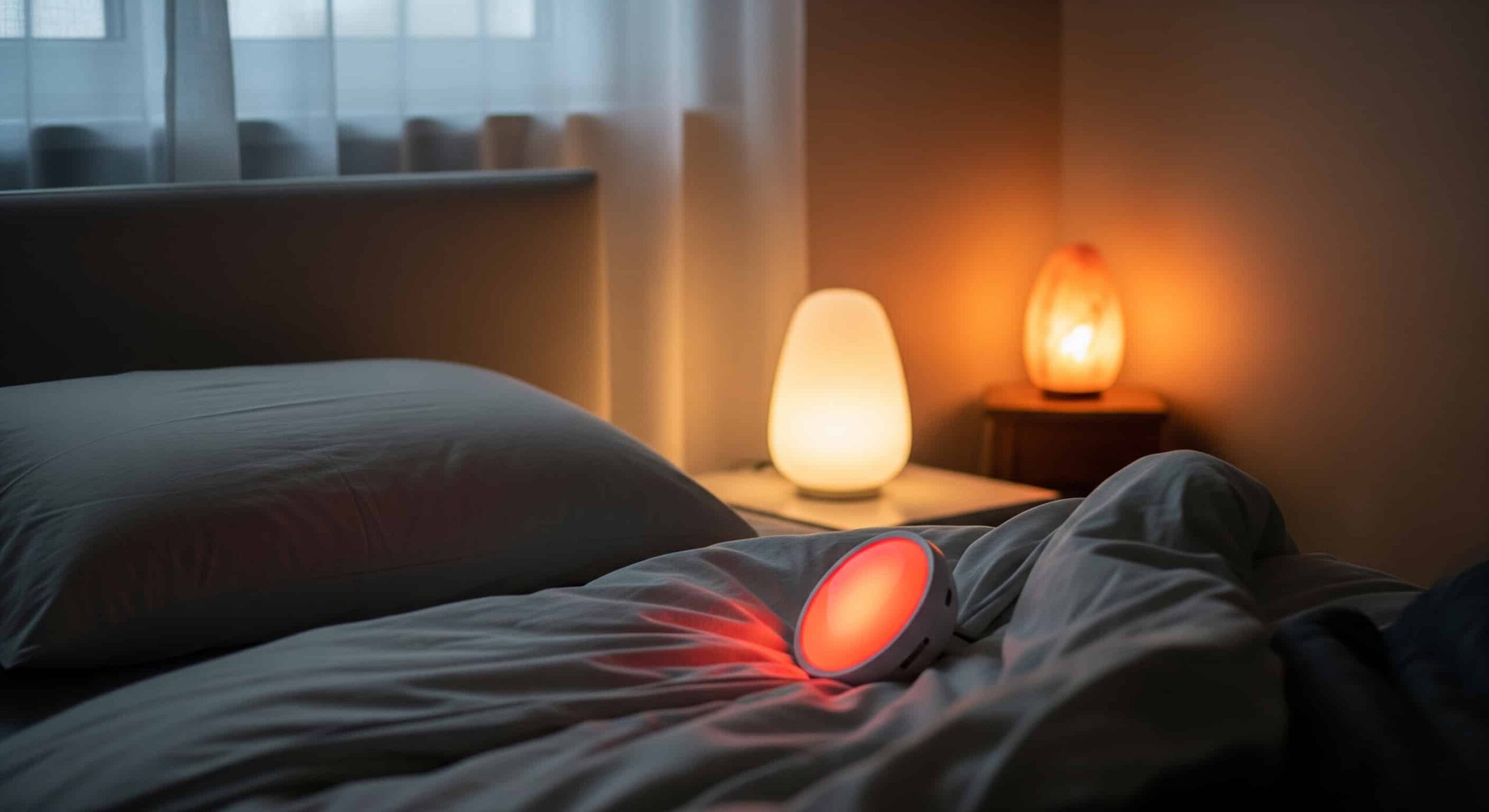
Sleep lighting is the most powerful environmental tool for circadian control — and the most ignored. Before you spend money on supplements, trackers, or sleep technology, consider this: the light in your bedroom and the two hours before bed is the signal that determines whether your SCN tells your brain it is day or night. Every other sleep intervention operates downstream of this signal. Get the light right, and everything else becomes easier. Get it wrong, and no supplement compensates.
How Light Actually Controls Your Sleep: The Suprachiasmatic Nucleus Explained
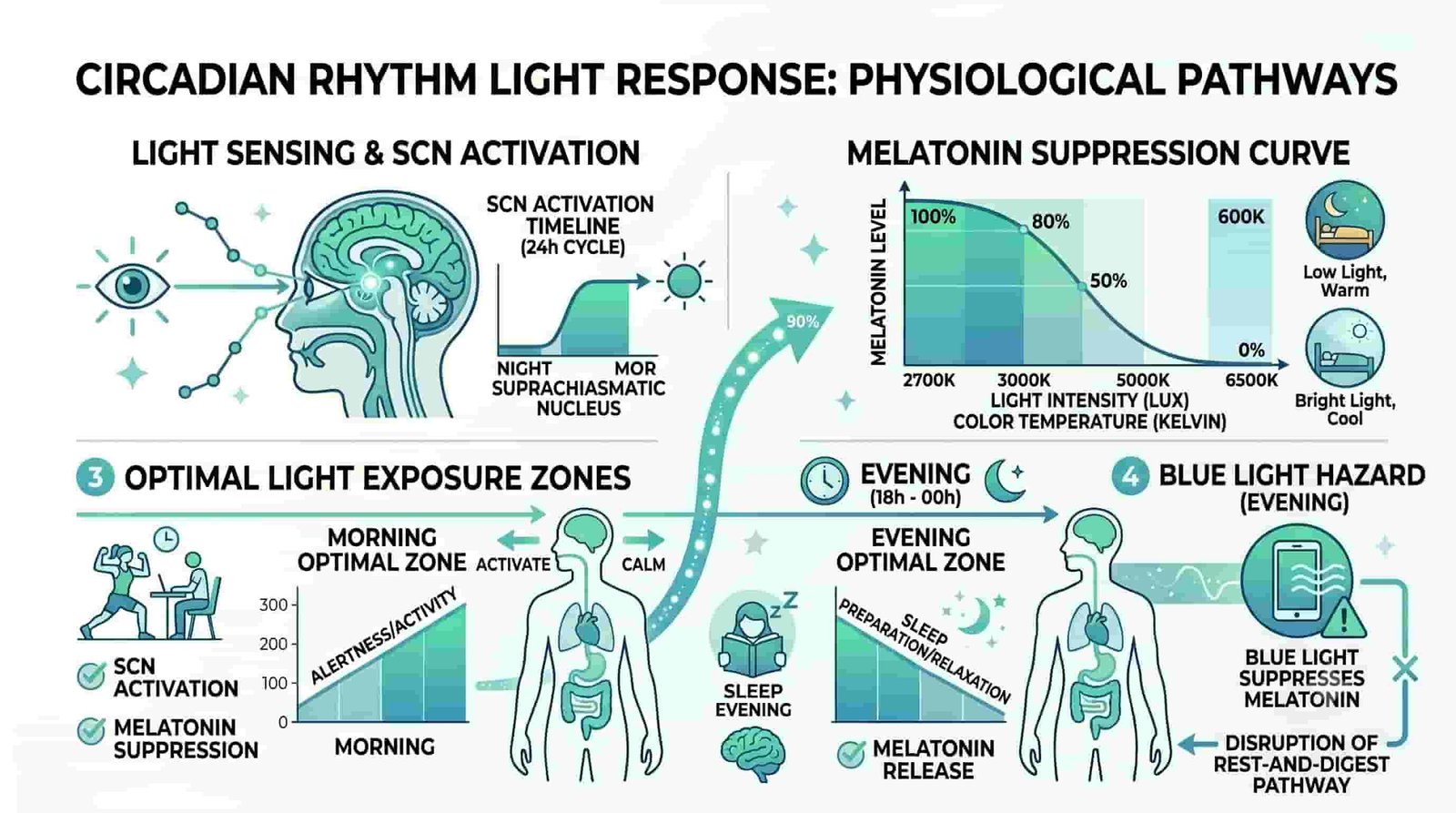
Every sleep system in your body — melatonin release, cortisol awakening response, core temperature drop, adenosine clearance — is calibrated by one master clock in your brain: the suprachiasmatic nucleus (SCN), a cluster of approximately 20,000 neurons located in the hypothalamus. The SCN’s only function is to read light signals and use them to set the body’s internal time. Every other physiological process in your body — sleep onset, hormone release, alertness, digestion — derives its timing from the SCN’s reading of ambient light. This is why light is not decoration. It is the primary signal your body uses to determine when to be awake and when to sleep.
How the SCN Reads Light
Specialized photoreceptor cells in your retinas (intrinsically photosensitive retinal ganglion cells, or ipRGCs) contain melanopsin, a photopigment maximally sensitive to 460-480nm blue-wavelength light. These cells send direct signals to the SCN, which suppresses melatonin production in response to blue light detection. Unlike rods and cones (which process visual images), ipRGCs do not contribute to sight — they exist solely to communicate light exposure data to the master clock. This is why light can affect your sleep even through closed eyelids and when you are not consciously aware of it.
Color Temperature, Kelvin, and the Melatonin Suppression Curve
Color temperature, measured in Kelvin (K), describes the visual color of a light source — not its brightness, but its hue. A camp fire is approximately 1,800K (deep amber). A traditional incandescent bulb is 2,700K (warm white). A white LED is 4,000-5,000K. Direct sunlight at noon is 5,500-6,500K. The critical distinction for sleep: as color temperature rises above 3,000K, the blue-wavelength content of the light increases significantly, triggering progressively stronger melanopsin activation and SCN-mediated melatonin suppression.
The Melatonin Suppression Curve
Research by Brainard et al. and later confirmed by Gooley et al. established the dose-response curve for light-induced melatonin suppression. At 460nm (blue), significant suppression occurs at light levels as low as 2-10 lux — dim enough that a single bedside lamp at full brightness delivers 30-50 lux and produces measurable suppression within 15 minutes. At 555nm (green), it requires approximately 10x more light to produce the same suppression. This is why color temperature matters independently of brightness: a 3,000K bulb at 50 lux suppresses more melatonin than a 2,200K bulb at the same brightness, because the 3,000K spectrum contains more shorter-wavelength (blue-adjacent) light.
Why 3000K Amber Light Is Not Enough — The Real Red-Flag for Sleep Disruption
Most sleep hygiene advice recommends warm light (2,700-3,000K) in the evening, which is a significant improvement over cool white or blue-rich lighting. But 3,000K is not sleep-optimized light. A 3,000K LED still emits a meaningful proportion of its energy in the 450-500nm blue-wavelength range that triggers melanopsin. The data: melatonin suppression studies show 3,000K light suppresses melatonin at roughly 60% the rate of 5,000K light — which means you are getting 40% of the circadian disruption for 60% of the “fix.” True sleep-supportive lighting should be 2,200-2,700K, ideally with zero measurable emission below 530nm.
The 2-Hour Light Dimming Protocol: Timing Your Circadian Wind-Down
The most effective light management intervention is not what you do with screens — it is what you do with the ambient light in your home during the two hours before your target bedtime. The SCN requires approximately 2 hours of dim, amber-predominant light to initiate the physiological wind-down: melatonin begins rising, core temperature starts dropping, and the parasympathetic nervous system gradually takes control. Every bright light source — overhead fixtures at full brightness, kitchen lights, phone screens, TVs — during this window delays this process.
⚡ The Evening Light Timeline
- 2-3 hours before bed: Reduce all overhead lighting to 50% or replace with floor lamps at maximum distance from eye level
- 1-2 hours before bed: Switch all bulbs to 2,200-2,700K. Eliminate all blue-rich light sources above 3,000K.
- 30-60 minutes before bed: Bedroom lighting maximum 100-200 lux at eye level (a single dim lamp achieves this)
- In bed: Zero overhead lighting. Total darkness (below 1 lux) is the target for sleep itself.
Smart Bulbs vs. Traditional Bulbs: The ROI on Circadian Lighting
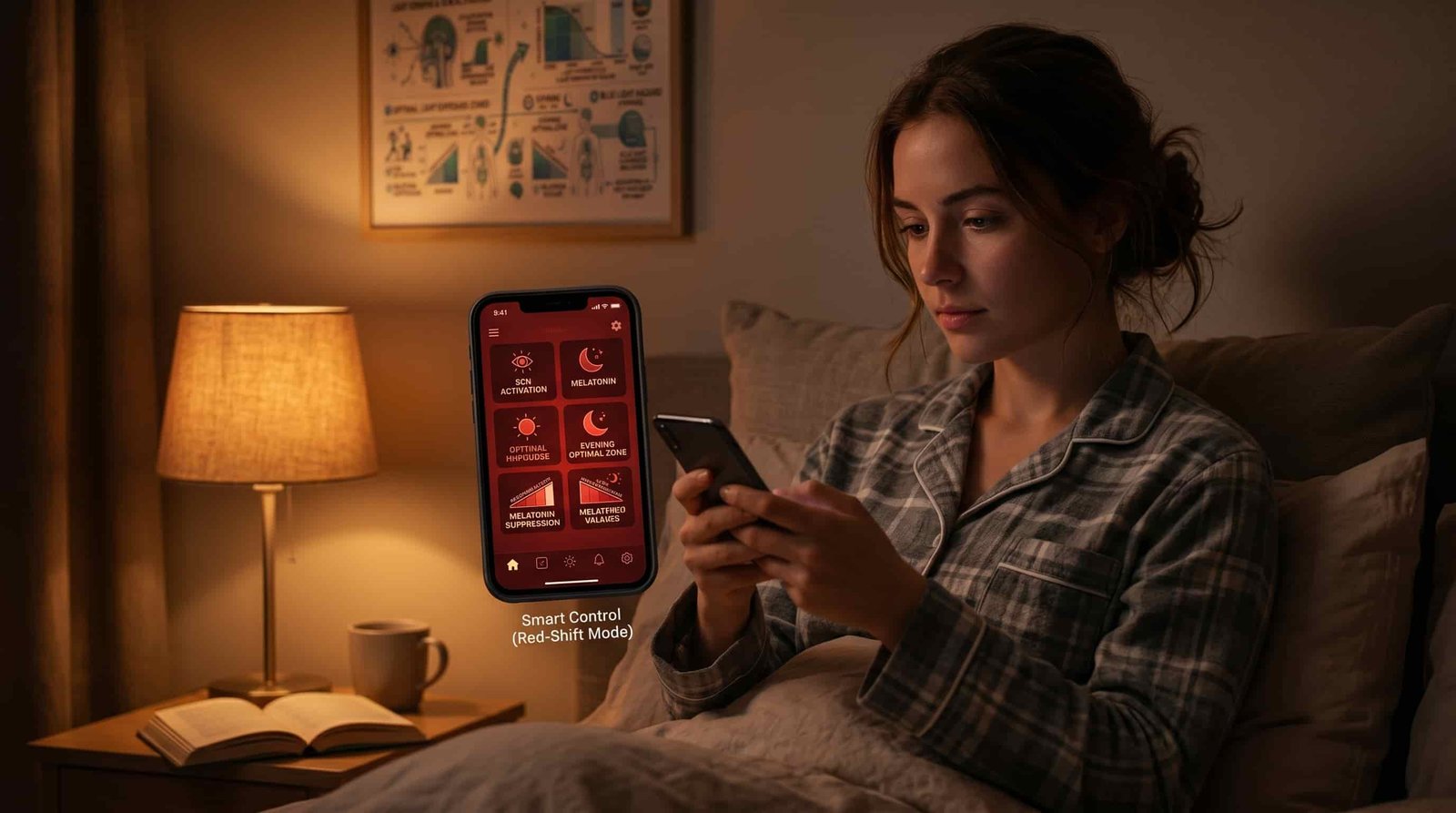
Smart bulbs (Philips Hue, LIFX, Nanoleaf, etc.) deliver one thing that traditional bulbs cannot: programmable color temperature scheduling without manual switching. The ROI case is simple: a $40-60 smart bulb that automatically dims and warms on a schedule eliminates the behavioral friction of manual light management. You set the schedule once; the bulb enforces it every night regardless of whether you remember. For people who share a household, smart bulbs also prevent the conflict of someone forgetting to switch lights or leaving overheads on at full brightness.
The Automation Advantage
The SCN responds to light exposure automatically, without requiring conscious awareness or intention. This means that the behavioral challenge of “remembering to dim the lights” is actually a neurological problem: by the time bedtime approaches, executive function (prefrontal cortex) is already declining due to sleep pressure — making it harder to remember and execute the light dimming action. Automating the lighting removes the evening executive function requirement. The bulbs dim on schedule regardless of how tired you are.
Screen Light and Night Mode: Why “Night Shift” Is a Placebo at Best
Apple Night Shift, Android Night Light, and similar blue-light filtering modes reduce the blue-wavelength emission of screens, which is a scientifically correct direction. But the clinical evidence for screen-based blue light filtering improving sleep is surprisingly weak — for one fundamental reason: the problem with screens before bed is not primarily the blue light wavelength. The problem is the proximity, duration, and cognitive content of the screen use itself.
The Real Mechanism: Proximity and Cortisol
When you hold a phone 12-18 inches from your face, you are exposing your eyes to 100+ lux of light — far exceeding the 2-10 lux threshold for measurable melatonin suppression at blue wavelengths. A book held at the same distance delivers 5-10 lux. The gap is enormous. Holding a phone with Night Shift enabled at full brightness still delivers 80+ lux of blue-adjacent light to the ipRGCs. The more effective intervention is: hold any screen farther from your face (arm’s length minimum), reduce brightness to minimum sustainable level, and keep total screen time in the final 60 minutes before bed to under 15 minutes. The Night Shift feature adds marginal benefit on top of these three changes.
Morning Light: Why 20 Minutes of Sunlight Is the Cheapest Sleep Aid in the World
If you do only one thing to improve your sleep through light management, do this: get 20 minutes of outdoor sunlight within 30 minutes of waking. Not through a window (glass filters approximately 50% of visible light and nearly all UV), and not sitting next to a bright indoor lamp. Actual outdoor light, with your eyes open (not staring at the sun — just being outdoors). This single habit does more for your circadian rhythm than any other intervention on this list.
Why Morning Light Is the Anchor
Morning light exposure (specifically 460-480nm blue-wavelength light at dawn) triggers the strongest cortisol awakening response of the day, sets the SCN’s internal clock to a 24-hour cycle, and — crucially — causes earlier melatonin release the following night. Research shows that 20 minutes of outdoor morning light advances circadian phase by 30-60 minutes over 3-4 days, making it easier to fall asleep at a consistent earlier time and wake without an alarm. The investment is zero dollars, 20 minutes of time, and the discipline to go outside before coffee or screens.
Blackout Curtains, Eye Masks, and the 1-Lux Threshold: The Darkness Hierarchy
Even with perfect light management during the wind-down period, sleep quality can be destroyed by ambient light during sleep itself. The SCN continues monitoring light levels even during sleep — studies show that light exposure as low as 1-3 lux during sleep (the equivalent of a streetlight through thin curtains) is associated with degraded sleep quality, increased sleep fragmentation, and reduced melatonin production. This is why blackout curtains are not a luxury — they are a physiological requirement for genuine sleep quality.
⚡ The Darkness Hierarchy
- Stage 1 (minimum): Light-blocking curtains or blinds that prevent streetlight and ambient outdoor light from entering. Cost: $20-50. ROI: measurable improvement in sleep onset and maintenance.
- Stage 2 (recommended): Total blackout — zero visible light from curtains, doors, or electronics. Use blackout shades and a door draft blocker. Cover all LED indicators on electronics with electrical tape.
- Stage 3 (optimal): A sleep mask in addition to total blackout. This handles the scenario where a partner has a different sleep schedule or must use light in the same room. The eye mask creates a portable darkness environment that travels with you.
Shift Workers and Light Management: How to Fake a Daytime Schedule at Night
For shift workers who sleep during the day, light management is not a sleep optimization — it is a fundamental circadian disruption management tool. Day sleep (after a night shift) faces a fundamental biological problem: the SCN is programmed for daytime wakefulness by 200,000 years of evolution, and no behavioral intervention fully overrides it. However, strategic light management can significantly improve daytime sleep quality for shift workers.
The Shift Work Protocol
Research by Boivin and Boudreau on circadian adaptation in shift workers shows that strategic light exposure timing — combined with blackout curtains and morning light avoidance — can produce measurable circadian phase shifts that partially adapt the SCN to inverted schedules. The key principle: when you are trying to sleep during the day, you want to minimize blue-rich light exposure (wear blue-light blocking glasses, use blackout curtains, keep the bedroom completely dark). When you are working a night shift, you want maximum blue-rich light exposure (bright overhead lights, outdoor light if possible) to maintain alertness and signal wakefulness to the SCN.
The Slumbelry Framework: Light Is Not Decoration — It Is the Most Powerful Drug in Your Home
Slumbelry’s Sleep System treats light as a primary engineering specification, not an aesthetic preference. The bedroom light environment is designed to deliver two things simultaneously: warm, amber, zero-blue light during the evening wind-down that supports parasympathetic activation, and complete darkness during sleep that maximizes melatonin efficiency. Every Slumbelry lighting recommendation is built on this dual-function principle.
The Slumbelry Lighting Specification
For any bedroom environment, Slumbelry specifies: 2,200-2,700K color temperature for all evening lighting (below 3,000K to minimize blue-wavelength content); maximum 200 lux at eye level during the final 60 minutes before bed; zero overhead lighting use during wind-down (floor lamps only, positioned below eye level); total blackout capability for sleep; and one non-negotiable morning habit: 20 minutes of outdoor sunlight before coffee or screens. These four specifications — evening temperature, evening brightness, darkness, morning light — cover the complete light management requirements for circadian optimization. Everything else is secondary to these four.
Action step: Tonight, set your phone to the lowest brightness that remains readable. Set a reminder to dim your overhead lights by 50% at 9 PM (or 3 hours before your target bedtime). Tomorrow morning, before you check your phone or make coffee, go outside for 20 minutes. That is the complete light protocol. Everything else is elaboration.
Frequently Asked Questions About Sleep Lighting
How does light control the sleep-wake cycle through the suprachiasmatic nucleus?
The suprachiasmatic nucleus (SCN) is your body’s master clock — approximately 20,000 neurons in the hypothalamus that set the timing for every physiological process via light signals from the retina. Specialized photoreceptor cells (intrinsically photosensitive retinal ganglion cells, or ipRGCs) contain melanopsin, maximally sensitive to 460-480nm blue-wavelength light. These ipRGCs send direct signals to the SCN, which suppresses melatonin production in response to blue light detection. Unlike rods and cones, ipRGCs do not contribute to sight — they exist solely to communicate ambient light levels to the master clock. This is why light can affect your sleep even through closed eyelids and without conscious awareness.
What color temperature is best for sleep and evening lighting?
True sleep-supportive evening lighting is 2,200-2,700K (deep amber to warm white), with zero measurable emission below 530nm. Most conventional advice suggests 3,000K, but 3,000K still emits significant blue-wavelength content that suppresses melatonin at roughly 60% the rate of 5,000K cool white — meaning you receive 40% of the circadian disruption you would from bright fluorescent lighting. The target for the final 60 minutes before bed is below 200 lux at eye level from a source below 2,700K. This typically means a single low-output floor lamp positioned below eye level, with a 2,200-2,700K warm bulb.
How many lux are needed to suppress melatonin and affect sleep?
Significant melatonin suppression occurs at light levels as low as 2-10 lux at 460nm blue wavelength — far lower than most people realize. A single bedside lamp at full brightness delivers 30-50 lux. A smartphone held 12 inches from your face delivers 100+ lux. A TV across the room at typical viewing distance delivers 10-30 lux. This means that virtually every common evening light source in a modern home exceeds the threshold for measurable melatonin suppression. The practical implication: evening light management is not about achieving perfect darkness — it is about keeping ambient light below 10-20 lux at eye level during the final 2 hours before bed.
Do smart bulbs actually improve sleep compared to regular bulbs?
Smart bulbs (Philips Hue, LIFX, etc.) deliver their sleep benefit through automation rather than any special light quality. A standard 2,200K warm bulb provides the same spectral quality as a smart bulb set to warm mode. The value of smart bulbs is behavioral: they can be programmed to automatically dim and warm on a schedule, removing the evening executive-function requirement that makes manual light management unreliable. By automating the 2-hour light dimming protocol, smart bulbs eliminate the main failure mode of evening light management — forgetting to dim the lights when tired. For households with multiple people or inconsistent schedules, smart bulbs are particularly high-ROI.
Does Night Shift mode on phones actually help with sleep?
Night Shift and similar blue-light filters reduce blue-wavelength emission, which is a scientifically correct intervention — but the clinical evidence for these modes improving sleep is surprisingly weak. The primary problem with screens before bed is not the blue wavelength: it is proximity, duration, and cognitive content. A phone held 12 inches from your face delivers 100+ lux of light to the ipRGCs — with Night Shift at full brightness, approximately 80+ lux still reaches the retina. The more effective interventions are: (1) hold any screen at arm’s length minimum, (2) reduce brightness to the minimum still readable, (3) limit total screen use in the final 60 minutes before bed to under 15 minutes. Night Shift adds marginal benefit on top of these three changes.
Why is morning sunlight more important than evening light management?
Morning sunlight is the anchor that makes all other sleep interventions more effective. Exposure to outdoor light (not through glass) within 30 minutes of waking triggers the strongest cortisol awakening response of the day, sets the SCN’s 24-hour clock, and — crucially — causes earlier melatonin release the following night. Research shows 20 minutes of outdoor morning light advances circadian phase by 30-60 minutes over 3-4 days, making it easier to fall asleep at a consistent earlier time and wake without an alarm. Even on cloudy days, outdoor light is 10-50x brighter than indoor artificial light. Morning light exposure compounds — one day of good morning light makes the next night slightly easier to fall asleep. This compounds over weeks into a fundamentally stronger circadian rhythm that makes all other light management interventions more effective.
What are blackout curtains and do they actually improve sleep?
Blackout curtains block ambient outdoor light from entering the bedroom — streetlights, car headlights, neighbour’s lights, and early morning sunlight. Studies show light exposure as low as 1-3 lux during sleep (the equivalent of streetlight glow through thin curtains) is associated with degraded sleep quality, increased fragmentation, and reduced melatonin production. Blackout curtains address this by reducing ambient light during sleep to below 1 lux. The minimum viable blackout setup costs $20-50 and delivers measurable improvement in sleep onset and maintenance for most people. The optimal setup combines blackout curtains with a door draft blocker and electrical tape over all LED indicators on electronics in the bedroom.
How should shift workers manage light to improve daytime sleep?
For shift workers, light management is circadian disruption management rather than optimization. During day sleep (after a night shift): use blackout curtains to create complete bedroom darkness, wear blue-light blocking glasses (orange-tinted, which filter 100% of blue light), and avoid all morning sunlight. The goal is to signal ‘night’ to the SCN during the day. During the night shift: maximize blue-rich light exposure from overhead lights and outdoor light when possible to maintain alertness and signal wakefulness to the SCN. Research by Boivin and Boudreau confirms strategic light timing can produce measurable circadian phase shifts in shift workers. The key principle: light exposure at the ‘wrong’ circadian time actively disrupts adaptation, while strategic light avoidance at the wrong time is the primary tool for partial circadian inversion.
What is the 2-hour light dimming protocol and how does it work?
The 2-hour light dimming protocol is the most evidence-based evening light management intervention: during the 2 hours before target bedtime, gradually reduce both the brightness and color temperature of all ambient light sources in the home. The SCN requires approximately 2 hours of dim, amber-predominant light to initiate the physiological wind-down — melatonin rise, core temperature drop, and parasympathetic activation. Every bright light source (overhead fixtures, kitchen lights, phones, TVs) during this window delays this process. Implementation: 2-3 hours before bed, reduce overhead lighting to 50%; 1-2 hours before bed, switch all bulbs to 2,200-2,700K; 30-60 minutes before bed, bedroom lighting maximum 100-200 lux; in bed, total darkness below 1 lux. The target is progressive dimming, not a single switch.
How does Slumbelry approach bedroom lighting in its sleep system?
Slumbelry’s Sleep System treats light as a primary engineering specification, not an aesthetic preference. The specification has four components: (1) Evening color temperature below 2,700K — eliminating blue-wavelength content above 530nm from all bedroom and evening home lighting. (2) Evening brightness below 200 lux at eye level during the final 60 minutes before bed — typically achieved with one dim floor lamp below eye level. (3) Total blackout capability for sleep — no visible light from any source in the bedroom during sleep. (4) A non-negotiable morning habit: 20 minutes of outdoor sunlight within 30 minutes of waking, before coffee or screens. These four specifications cover the complete light management requirements for circadian optimization, and they apply regardless of which Slumbelry products are in use.
Ready to Engineer Your Bedroom Light Environment?
Light is not decoration. It is the most powerful drug in your home. Design it accordingly.
Take the Sleep Assessment Subscribe for Sleep Optimization TipsThe Slumbelry Commitment
Sleep is the most vulnerable state of human existence. It is where we heal, reset, and grow.
At Slumbelry, we do not just sell sleep products; we advocate for your physiological right to rest. From ergonomic support to light management, every solution we offer is designed with one obsession: Respecting your Biology.
Science is our language, but your recovery is our purpose. You take care of everything else in your life — let us take care of your sleep.
Rest Deeply,
The Slumbelry Team
Medical References:
1. Brainard, G. C., et al. (2001). Action Spectrum for Melatonin Regulation in Humans. Journal of Neuroscience, 21(16).
2. Gooley, J. J., et al. (2010). Spectral Responses of the Human Circadian System Depend on Irradiance. Journal of Physiology, 588(Pt 14).
3. Walker, M. (2017). Why We Sleep. Scribner.