
Your Best Sleep Sound Isn’t From a $100 Machine — It’s Already in Your House
⚡ Core Takeaway: Use What You Have
- You already own a white noise machine — your box fan, air purifier, or AC unit produces a 40-60dB masking sound that costs nothing to run.
- The color of noise matters — white noise is bright and harsh; pink noise (more bass) is better for sleep; brown noise is deepest and most relaxing for anxiety-driven insomnia.
- Free apps > paid machines — for most people, a free app like Toast菲 offers better sound variety than a $100 dedicated white noise machine, with zero investment.
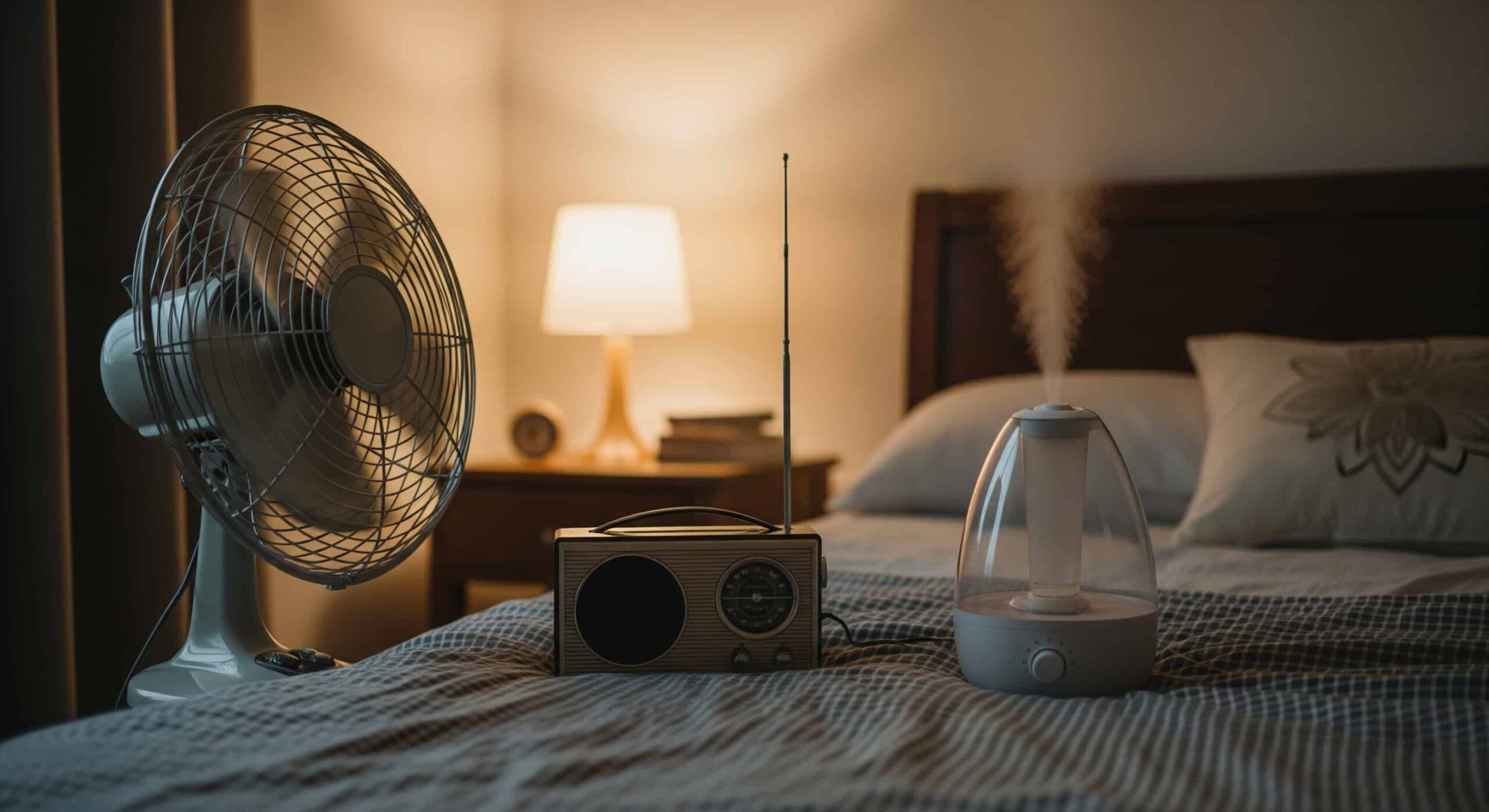
DIY white noise costs nothing. Before buying a $100+ white noise machine, consider what you already own: a box fan, an air purifier, an air conditioner, or a smartphone. All of these produce masking sounds that match or exceed what dedicated machines deliver — at a fraction of the cost. This guide covers how white, pink, and brown noise work, the seven household appliances that already produce sleep-enhancing sound, the five free apps that outperform $100 machines, and the specific mistakes that make DIY white noise ineffective.
What Is White Noise Actually Doing to Your Brain — And Why It Works
The first question most people ask is: why does white noise actually help you sleep? The answer is not mystical — it is neuroscience, specifically the concept of auditory masking. Your auditory cortex processes sound continuously, even in sleep. When the environment is silent, your brain catalogs every sound: a car outside, a neighbor’s footsteps, a radiator click. Each of these triggers a micro-arousal — a brief shift from deep sleep toward lighter sleep — that you may not consciously remember but that fragments your sleep architecture. White noise does not silence these sounds. It covers them. By presenting a constant broadband signal across all frequencies, white noise raises the floor of ambient sound so that transient noises fall below the threshold of conscious detection. The result: fewer micro-arousals, more stable deep sleep, and less conscious awareness of environmental disturbance.
The Micro-Arousal Mechanism
Every sound louder than approximately 40dB during deep sleep triggers a micro-arousal — a brief cortical activation that fragments sleep stages, particularly the N3 deep sleep and REM stages that are most physiologically restorative. Research published in Sleep Medicine found that bedroom sound events above 40dB increased micro-arousals by 300-500% in sleeping subjects, even when the subjects did not consciously wake. White noise at 50-55dB effectively masks most environmental sounds, raising the threshold for what triggers an arousal response.
White Noise vs. Pink vs. Brown: The Color Spectrum Explained
The “color” terminology for noise comes from audio engineering, where different noise types are distinguished by their frequency distribution. Understanding the spectrum helps you choose the right sound for your specific sleep challenge.
The Noise Color Spectrum
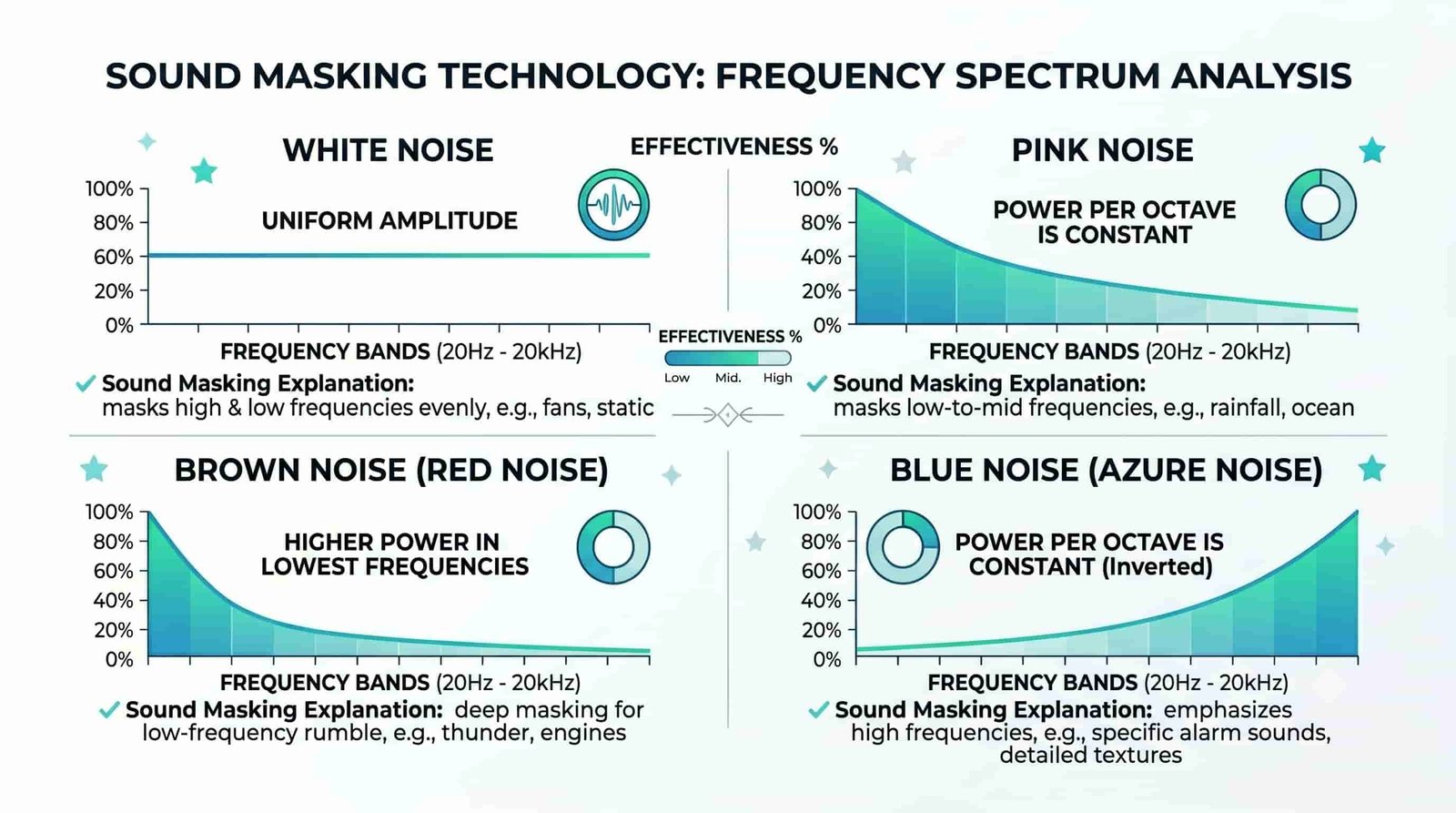
White noise: Equal energy across all audible frequencies (20Hz–20kHz). Sounds bright, hissy, and slightly harsh to most ears. Best for: people who need maximum masking power — heavy city noise, thin walls, snoring partners. The tradeoff: some people find the brightness overstimulating rather than relaxing.
Pink noise: Equal energy per octave — bass-weighted, treble-attenuated. Sounds more balanced and natural — like rain or ocean waves. Sounds more natural because most environmental sounds (wind, rain, waterfalls) approximate pink noise. Best for: sleep generally. Research from Northwestern showed pink noise increased time in N3 deep sleep by 23% and improved memory consolidation compared to normal sleep. Recommended by sleep scientists as the default “sleep sound.”
Brown (Red) noise: Even more bass-weighted, deeper frequency emphasis than pink noise. Sounds like a rushing waterfall or heavy rain. The most deeply relaxing of the three for anxious sleepers. Best for: people whose main sleep障碍 is racing thoughts and hyperarousal. The deep bass frequencies activate the parasympathetic nervous system.
Free Household White Noise: The 7 Appliances You’re Already Owning
Before buying a white noise machine, check what you already own. Seven common household appliances produce masking sounds that match or exceed most dedicated machines — and you already paid for them.
The Big Three: Fan, AC, Air Purifier
Box fan (40-55dB): The gold standard for household white noise. Produces a broadband sound with strong low-frequency content, excellent masking properties, and costs $20-50 to purchase. Running cost: approximately $0.03-0.08 per night. Available at any hardware store. Best practice: clean the blades before first use to eliminate imbalance noise, and use a fan with a built-in timer so it runs all night without cooling the room excessively.
Air conditioner (45-60dB): Whether window unit or central AC, the steady drone produces consistent broadband noise. A bonus for warm climates — you get noise masking and temperature control simultaneously. Central AC typically produces 45-50dB from the vents; a window unit can reach 55-60dB. Lower running temperatures also lower your core body temperature, which supports sleep onset — a double benefit.
Air purifier (35-55dB): Particularly effective in bedroom environments where clean air is already desirable. Most purifiers have multiple fan speeds — the low and medium settings (35-45dB) are ideal for sleep. High-quality HEPA purifiers like Levoit or Coway are widely available for $100-200, producing both clean air and sleep-enhancing noise at the same time.
The Supporting Four
Dehumidifier (40-50dB): Produces a consistent low hum, particularly useful in basements or humid climates. Runs warm — but the moisture reduction improves breathing comfort in some sleepers. Humidifier (35-45dB): Especially ultrasonic humidifiers produce a consistent low-frequency hum. Particularly effective in dry winter climates. Vacuum cleaner (60-80dB): Not recommended as a sleep mask — too loud and inconsistent — but running it in an adjacent room during the day creates residual noise that makes the bedroom quieter by contrast at night (the contrast effect). Washing machine/dryer (50-65dB): If your laundry is adjacent to your bedroom, running a load at night can provide masking noise — but only if it is not audible from the bedroom, as the cycling sounds can be disruptive.
Best Free White Noise Apps: The Science Behind the Top 5
Smartphone apps have democratized ambient sound more effectively than any dedicated machine. The best apps now offer studio-quality sound generation at zero cost — eliminating the need to buy a $100+ dedicated white noise machine.
Top Free Sleep Sound Apps
myNoise (free + paid): The gold standard for sound customization. Created by an audio engineer and researcher, myNoise generates mathematically precise soundscapes using band-pass filters. The free tier offers full access to all sound generators — white, pink, brown noise, and hundreds of custom environments (rain, café, forest, train). The spatial sound design is significantly superior to most dedicated machines. Available on iOS, Android, and browser. Noisli (free tier): Mix up to 3 sounds simultaneously in the free tier — ideal for creating custom soundscapes (rain + fan, ocean + brown noise). Clean, intuitive interface. The premium tier ($10.99/mo) adds unlimited mixing and extra sounds, but the free tier is sufficient for most users.
Dark Noise (iOS, free): Beautiful, minimal interface. Offers white, pink, brown, and 12+ natural sound options. Background playback is reliable — essential for an overnight app. Timer function allows auto-shutoff after sleep onset. White Noise+ (Android, free): Reliable, simple, and includes a widget for quick access. Multiple sound options and mixing capability. Sleep Tone (Android, free): Produced by a sleep researcher, offers scientifically grounded soundscapes and includes a sleep timer with gradual fade-out.
Online Generators: MyNoise and the Custom Sound Architecture
The most powerful free white noise resource available is not an app — it is a website. MyNoise.net is an audio engineering project that generates real-time, customizable soundscapes using sophisticated filter networks. The site was built by a Belgian sound engineer who applies psychoacoustic research to create soundscapes that are perceptually optimized for focus, relaxation, or sleep.
⚡ MyNoise Quick Start for Sleep
Visit myNoise.net and try these presets: Rain on Tent — pink noise approximation with gentle amplitude modulation that sounds like rainfall; Studio Brown Noise — pure brown noise at adjustable intensity, ideal for anxious sleepers; Tropical Rainforest — layered ambient sound with consistent masking properties. Adjust the sliders to tune the frequency balance to your preference. The site works on mobile browsers and can be left running overnight on a plugged-in device.
Smart Speaker Commands: 30-Second Setup for Free Ambient Sound
If you own a smart speaker, you already have a white noise machine that costs nothing extra. Smart speakers from Amazon (Alexa), Google (Nest), and Apple (HomePod) all have built-in ambient sound capabilities — activated in seconds with a voice command.
Smart Speaker Voice Commands
Alexa: “Alexa, play white noise” — plays Amazon’s white noise track. “Alexa, play rain sounds” — plays ambient storm sounds. “Alexa, play brown noise” — plays Amazon Music’s brown noise track. You can also create a routine: “Alexa, goodnight” triggers a scene that dims lights, sets the thermostat, and plays your chosen ambient sound for 8 hours.
Google Home: “Hey Google, play white noise” — plays ambient sounds. “Hey Google, play ocean waves” — nature sounds. “Hey Google, play rain sounds” — rainfall ambient. Google Assistant also supports routines: “Hey Google, goodnight” can trigger ambient sound + smart lights off + thermostat adjustment simultaneously.
Apple HomePod: “Hey Siri, play white noise” — built-in. “Hey Siri, play rain sounds” — built-in. HomePod’s audio quality is significantly superior to most dedicated white noise machines at the same price point.
The Sound Masking Principle: Why White Noise Improves Sleep (And When It Doesn’t)
Sound masking is not the same as sound blocking. Understanding when white noise works — and when it doesn’t — requires understanding the difference.
When White Noise Works
Environmental noise: Thin walls, street noise, city sounds, neighboring apartments. White noise raises the ambient floor so that these intermittent sounds fall below the arousal threshold. Predictable intermittent noise: A snoring partner, a dog that barks at 2 AM, a noisy HVAC system. The consistent masking sound prevents these predictable sounds from triggering micro-arousals. Light sleepers: People who wake easily to sound benefit most from masking — particularly in environments where the ambient noise floor varies unpredictably.
When White Noise Doesn’t Work
Extreme noise environments: If your bedroom is exposed to >70dB ambient noise (near airports, major highways, construction zones), the masking sound required to cover it would be at 75dB — loud enough to potentially damage hearing over time and cause its own sleep disruption. Solution: earplugs + white noise for the residual noise floor. Emotional hyperarousal: If your primary sleep障碍 is anxiety, racing thoughts, or stress, white noise addresses the symptom (environmental sound) but not the cause. The fix for this is behavioral — CBT-I techniques, breathing exercises, parasympathetic activation — not sound masking. Temperature: If your room is too warm, adding a fan or air purifier that raises the temperature will worsen sleep. Use cooling capacity as a selection criterion when choosing a masking appliance.
Pink Noise for Deep Sleep: The 4Hz Connection to Memory Consolidation
Among the noise color spectrum, pink noise has attracted the most scientific attention for sleep applications — particularly for its effects on deep sleep quality and memory consolidation.
The Research: Pink Noise and Deep Sleep
A 2017 study from Northwestern University found that sleeping with pink noise playing during N3 deep sleep cycles resulted in a 23% increase in time spent in N3 deep sleep and measurable improvement in memory consolidation compared to normal sleep. The mechanism is thought to involve the entrainment of slow oscillations in the 4Hz range — the frequency at which the brain’s slow wave activity (SWA) operates during deep sleep. Pink noise, with its natural emphasis around 4Hz per octave, appears to amplify and synchronize this activity. A 2023 follow-up study found similar effects, with participants who slept with pink noise showing improved next-day cognitive performance on working memory tasks.
Practical application: If you are specifically trying to improve deep sleep quality — for recovery, memory consolidation, or athletic performance — pink noise is the most evidence-supported choice. Most free apps and myNoise offer pink noise generators. Use pink noise with a volume setting of 40-55dB and a timer to auto-stop after 7-8 hours.
DIY White Noise Mistakes That Sabotage Your Sleep (And What to Do Instead)
White noise, used incorrectly, can be counterproductive. These are the most common mistakes people make with DIY white noise setups.
The Seven Mistakes
Mistake 1: Volume too high. More than 60dB can damage hearing over time and paradoxically trigger arousals. Target 40-55dB — loud enough to mask, not to hear from outside the room. Mistake 2: Volume too low. Below 35dB, most environmental sounds are not masked. The sweet spot is 40-55dB for most environments. Mistake 3: Using a fan that oscillates. Oscillating fans create an inconsistent sound field that triggers more arousals than they prevent. Use a fixed-direction fan or an air purifier on fixed speed. Mistake 4: White noise from phone speakers. Phone speakers are too small to produce low-frequency content and too quiet to mask effectively. Use a Bluetooth speaker or dedicated appliance for actual masking. Mistake 5: No timer. Running white noise all night is fine for most adults — but if the sound disturbs your partner who falls asleep later, add a timer to fade out after 60-90 minutes. Mistake 6: Wrong noise color for your needs. White noise is harsh for anxious sleepers — brown noise is more effective. Pink noise is better for deep sleep enhancement. Choose based on your primary sleep challenge. Mistake 7: Temperature trade-off ignored. If you run a fan or AC too cold to mask noise, the temperature disruption will override the noise benefit. Keep the room at 18-20°C regardless of which masking method you choose.
The Slumbelry Approach: Free Is Best, Except When It Isn’t
Slumbelry’s position on DIY white noise is pragmatic: for most people, a free or near-free solution is sufficient. The $100 white noise machine is justified only when it offers capabilities that free solutions cannot — precise frequency control, sleep lab-quality sound, or white noise specifically tuned for sleep architecture enhancement.
For everyone else: start with the box fan you already own. If that works, you are done. If you need more control, use myNoise on a Bluetooth speaker — free, precise, and more capable than any dedicated machine under $200. If you need a dedicated appliance, an air purifier provides white noise plus air quality improvement — the best dual-function investment under $150.
The Slumberly White Noise Hierarchy
Tier 1 (Free): Box fan, AC, air purifier — any household appliance you already own. Target 40-55dB. Tier 2 (Free apps): myNoise, Dark Noise, Noisli free tier — for sound variety and mixing capability. Tier 3 (Under $50): A Bluetooth speaker + phone app gives you better sound quality than any dedicated machine under $100. Tier 4 ($100+): Only if you need clinical-grade precision, have exhausted Tier 1-3 and found them insufficient, or want a specifically engineered sleep soundscape from a research-backed brand.
Action step: Tonight, turn on your box fan, AC, or air purifier and measure the sound level with a free dB meter app (Sound Meter or similar). Adjust to 45-55dB. See if you sleep more consistently. If yes, you just solved your white noise problem for the cost of a $30 appliance you probably already own.
Frequently Asked Questions About DIY White Noise
What is white noise and how does it help sleep?
White noise is a consistent sound containing all audible frequencies at equal intensity — creating a ‘hiss’ that masks environmental noise. During sleep, your auditory cortex processes sound continuously. When the bedroom is quiet, every transient sound (car outside, neighbor’s footsteps, radiator clicks) triggers a micro-arousal — a brief shift from deep sleep toward lighter sleep that fragments sleep architecture. White noise raises the ambient sound floor to 50-55dB, so these transient sounds fall below the arousal threshold and go undetected. This reduces micro-arousals, stabilizes N3 deep sleep and REM stages, and reduces conscious awareness of environmental disturbance.
What is the difference between white noise, pink noise, and brown noise?
The color terminology describes frequency distribution: White noise has equal energy across all audible frequencies (20Hz-20kHz) — bright and hissy, maximum masking power. Pink noise has equal energy per octave — bass-weighted and more natural-sounding, like rain or ocean waves. Most environmental sounds approximate pink noise. Best for general sleep use. Brown (red) noise is the most bass-heavy — deep, rumbling, like a rushing waterfall. Most relaxing for anxious sleepers because the low frequencies activate the parasympathetic nervous system. For deep sleep enhancement, pink noise has the most scientific evidence (23% increase in N3 deep sleep in a Northwestern University study). For anxiety-driven insomnia, brown noise is typically most effective.
Which household items produce white noise for free?
Seven appliances you probably already own: (1) Box fan — the gold standard, 40-55dB broadband sound, costs $0.03-0.08/night to run. (2) Air conditioner — 45-60dB, especially effective if you live in a warm climate where AC is already running. (3) Air purifier — 35-55dB, dual benefit of clean air + masking sound. (4) Dehumidifier — 40-50dB, useful in basements or humid climates. (5) Humidifier — 35-45dB, particularly ultrasonic models produce consistent low-frequency hum. (6) Refrigerator — 40-50dB from the compressor hum, usually not noticeable but can provide consistent bass. (7) Dishwasher or washing machine — can be run in an adjacent room at night to create residual masking noise.
What are the best free white noise apps?
The top free apps by capability: myNoise (free, browser + iOS/Android) — the gold standard for sound customization, mathematically precise soundscapes, hundreds of presets, full free access. Dark Noise (iOS, free) — minimal interface, reliable background playback, white/pink/brown + 12 natural sounds, timer function. Noisli (free tier) — mix up to 3 sounds simultaneously, clean interface, sufficient for most users. White Noise+ (Android, free) — reliable, includes widget, multiple sounds and mixing. Sleep Tone (Android, free) — created by a sleep researcher, includes gradual fade-out timer. All of these outperform $50-100 dedicated white noise machines in sound quality and variety.
How do I use my smart speaker for white noise?
All major smart speakers have built-in ambient sounds: Alexa — ‘Alexa, play white noise’ or ‘Alexa, play rain sounds.’ You can create a routine: ‘Alexa, goodnight’ triggers ambient sound + lights off + thermostat adjustment. Google Home — ‘Hey Google, play white noise’ or ‘Hey Google, play ocean waves.’ Google routines work similarly: ‘Hey Google, goodnight’ triggers multi-action scenes. Apple HomePod — ‘Hey Siri, play white noise’ or ‘Hey Siri, play rain sounds.’ HomePod audio quality is significantly superior to most dedicated white noise machines at the same price point. Tip: set a sleep timer so the sound stops after 7-8 hours to avoid disturbing a partner who wakes later.
What volume should I use for white noise?
Target 40-55dB for most environments. Below 35dB: most environmental sounds are not masked — minimal benefit. 40-50dB: the sweet spot for most bedrooms in urban or suburban environments. 50-55dB: for louder environments (thin walls, city noise, snoring). Above 60dB: too loud for overnight use — can damage hearing with prolonged exposure and paradoxically cause arousals. Use a free dB meter app (Sound Meter on iOS/Android) to measure your actual bedroom noise. Set the white noise source to the lowest volume that achieves consistent masking of your loudest intermittent sounds.
Can white noise help with snoring?
White noise can mask the audible disturbance of snoring for the snorer’s sleep partner — but it does not reduce the snorer’s own sleep fragmentation from breathing interruptions. If the snoring is accompanied by gasping, morning headaches, or daytime sleepiness, the snorer may have obstructive sleep apnea (OSA) — which requires clinical diagnosis, not white noise. White noise as a snoring mask works best when the snorer sleeps in a separate room and the partner uses masking in the bedroom, or when a white noise app is played at the bedside of the non-snoring partner.
Is it safe to run a box fan all night?
Yes — running a box fan all night is safe for most adults, with three caveats: (1) Fire hazard: Keep the fan clean, stable, and away from flammable materials. Dust buildup on blades can cause imbalance and overheat the motor. (2) Temperature: A running fan cools the room — keep the thermostat at 18-20C for optimal sleep temperature. If you run the fan at full speed in a cold room, the temperature disruption will undermine the sleep benefit. (3) Noise quality: Clean the fan blades before first use and check monthly for dust accumulation that causes rattling or clicking sounds. A clean, well-maintained box fan can run 8+ hours nightly for years without issue.
What is pink noise and why is it better for deep sleep?
Pink noise is a frequency-weighted sound where each octave contains equal energy — bass-weighted relative to white noise, more natural-sounding, closer to rain or ocean waves. A 2017 Northwestern University study found that sleeping with pink noise during N3 deep sleep cycles increased time spent in N3 by 23% and improved next-day memory consolidation. The mechanism: pink noise’s frequency emphasis around 4Hz per octave synchronizes with the brain’s slow wave activity (4Hz oscillations) during deep sleep, amplifying and stabilizing this physiologically restorative stage. For anyone prioritizing recovery, athletic performance, or memory consolidation, pink noise is the evidence-based choice over white noise. Most free apps (myNoise, Dark Noise, Noisli) offer pink noise generators.
When should I not use white noise?
White noise is not appropriate in three situations: (1) Extreme noise environments (>70dB ambient): The masking volume required would be >75dB — loud enough to cause hearing damage over time. Solution: earplugs + low-volume white noise for the residual floor. (2) Emotional/mental hyperarousal: If your primary sleep障碍 is anxiety, racing thoughts, or stress, white noise treats the symptom (sound) but not the cause (hyperarousal). CBT-I techniques, breathing exercises, and parasympathetic activation are more effective. (3) Temperature trade-off: If your masking appliance (fan, AC) makes the room too warm or cold, the temperature disruption will override the noise benefit. Maintain 18-20C regardless of which masking method you choose.
Your Best White Noise Is Already in Your House
Turn on your box fan tonight. Measure the volume (40-55dB). Sleep. You’ve already solved the problem.
Take the Sleep Assessment Subscribe for Sleep Optimization TipsThe Slumbelry Commitment
Sleep is the most vulnerable state of human existence. It is where we heal, reset, and grow.
At Slumbelry, we do not just sell sleep products; we advocate for your physiological right to rest. From ergonomic support to light management, every solution we offer is designed with one obsession: Respecting your Biology.
Science is our language, but your recovery is our purpose. You take care of everything else in your life — let us take care of your sleep.
Rest Deeply,
The Slumbelry Team
Medical References:
1. Walker, M. (2017). Why We Sleep. Scribner.
2. Papalambros, N. A., et al. (2017). Acoustic Enhancement of Sleep Slow Oscillations and Associated Memory Improvement. Frontiers in Human Neuroscience.
3. Zhou, J., et al. (2012). Pink Noise: Effect on Complexity Synchronization of Sleep EEG. Sleep.