
The Chicken-and-Egg Problem No One Talks About: When Sleep Deprivation and Anxiety Feed Each Other
⚡ Core Takeaway: The Bidirectional Trap Is the Real Problem
- The trap: Poor sleep triggers anxiety and depression. Anxiety and depression fragment sleep. The result is a self-reinforcing loop where each condition worsens the other — and neither gets treated because the cause is invisible.
- The amygdala effect: After one night of sleep deprivation, emotional reactivity increases by 60%. After chronic deprivation, the prefrontal cortex loses its ability to regulate the amygdala. This is not mood — this is neurology.
- The way out: CBT-I treats both simultaneously — fixing sleep often fixes the mood. Sleep optimization is not a supplement to mental health treatment. In many cases, it IS the treatment.

Sleep and mental health exist in a bidirectional relationship that clinical science has only begun to fully map in the past 15 years. Poor sleep makes anxiety and depression neurochemically more likely. Anxiety and depression make deep, restorative sleep physically impossible. The result is a self-reinforcing loop where each condition amplifies the other — and most treatments only address one side of it. This guide maps the complete bidirectional mechanism and provides the evidence-based protocol for treating both simultaneously.
The Bidirectional Crisis: Why Sleep and Mental Health Cannot Be Treated Separately
Sleep and mental health are not two problems that happen to coexist. They are one problem with two symptoms. The bidirectional relationship between them means that each condition is simultaneously a cause and a consequence of the other — and that treating only one while ignoring the other is why most interventions fail. Approximately 75% of patients with depression also experience insomnia. 50% of patients with chronic insomnia develop clinically significant anxiety or depression within 5 years. These are not coincidence statistics. They reflect a shared neurobiological mechanism that, once understood, changes the entire treatment approach.
How Poor Sleep Triggers Anxiety: The Amygdala-Prefrontal Cortex Breakdown
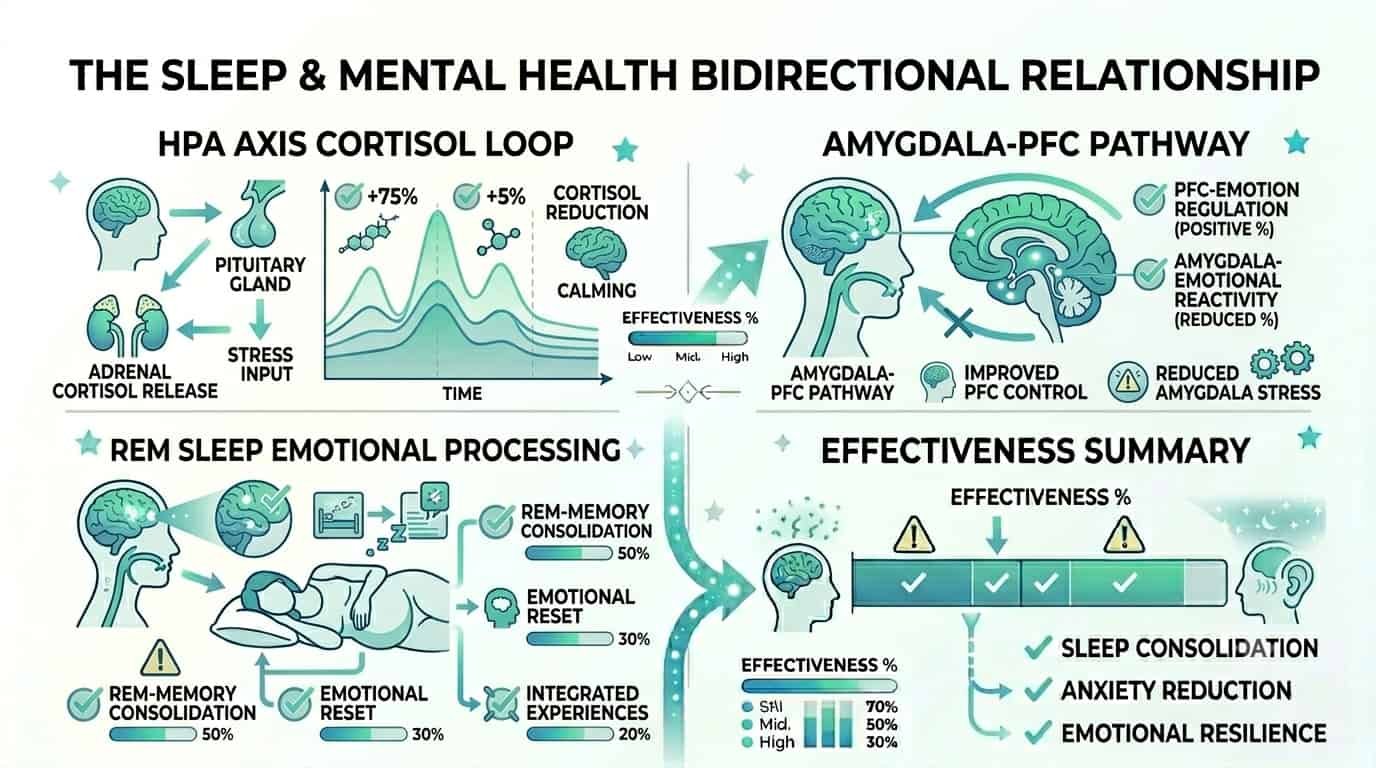
Matthew Walker’s research at UC Berkeley established the definitive mechanism: after one night of sleep deprivation, the amygdala (the brain’s threat-detection center) shows a 60% increase in emotional reactivity to negative stimuli. The prefrontal cortex — the region responsible for regulating that reactivity — shows a comparable decrease in connectivity. The result is a brain that over-reacts to minor stressors and lacks the regulatory capacity to calm itself down. This is not personality. This is not weakness. This is sleep deprivation changing the neurochemistry of emotional regulation in real time.
The Anatomy of the Breakdown
Under normal sleep conditions, the prefrontal cortex exerts top-down regulation over the amygdala — recognizing that the threat level is low, releasing the brake on emotional reactivity, and allowing the parasympathetic system to dominate. After sleep deprivation, this regulation fails: the prefrontal cortex is itself depleted of the metabolites that sleep restores, and its ability to suppress the amygdala is significantly impaired. The person experiences emotions that feel disproportionate to the situation — and they are correct about that disproportion. It is not them. It is the sleep deprivation.
How Poor Sleep Triggers Depression: The HPA Axis and Serotonin Connection
Depression and sleep share at least three neurobiological pathways: the HPA axis (the system’s cortisol stress response), serotonin regulation, and the glymphatic cleansing process. Chronic sleep deprivation elevates baseline cortisol through HPA axis dysregulation — the system that should return to baseline overnight fails to do so, leaving cortisol elevated throughout the day. This chronic elevation is associated with reduced serotonin receptor sensitivity, which is the primary mechanism of the most commonly prescribed antidepressants. Poor sleep doesn’t just make you feel sad. It changes the neurochemistry that makes feeling good possible.
The Glymphatic Link to Depression
During N3 deep sleep, the glymphatic system clears metabolic waste including beta-amyloid and stress-related inflammatory compounds. When sleep is chronically shortened or fragmented, this clearance is reduced. Accumulating inflammatory compounds in the brain are directly associated with depression pathophysiology — the “inflammatory cytokine hypothesis” of depression. This means chronic poor sleep can create a physiological environment in the brain that is literally more conducive to depressive cognitions, not because of character but because of chemistry.
The REM Sleep Paradox: Why Dreaming Is the Brain’s Emotional Detox Mechanism
REM sleep is when the brain shuts off noradrenaline completely — the only stress-free state in a 24-hour cycle. During REM, the hippocampus replays emotional memories from the day without the limbic system’s emotional tagging, stripping the emotional charge from memories that would otherwise accumulate as unprocessed trauma. Walker’s research shows this process requires sufficient REM duration to be effective: people who are REM-deprived carry the full emotional weight of their experiences without the overnight processing that normally reduces it.
⚡ Why Sleep Medication Can Make Depression Worse
Most prescription sleep aids (benzodiazepines, Z-drugs) suppress REM sleep by 20-50%. They produce sedation that resembles sleep but does not include the REM-dependent emotional processing that real sleep provides. Patients on these medications may sleep longer but wake without the emotional clarity that REM provides — and over time, the accumulation of unprocessed emotional experiences compounds into something that looks like worsening depression. This is one reason CBT-I is preferred over medication: it improves real sleep architecture, including REM, rather than producing a sedated imitation of it.
How Anxiety and Depression Destroy Sleep: The Hyperarousal Loop
Mental health conditions disrupt sleep through a mechanism called hyperarousal: the chronic activation of the sympathetic nervous system that makes genuine relaxation impossible. In generalized anxiety disorder, this shows up as a persistent elevated cortisol pattern across the day and into the night — the brain does not receive the signal that it is safe to stand down. In depression, the mechanism is different: the dysregulation of the circadian pacemaker produces a phase delay, making sleep onset difficult even when physical exhaustion is profound.
The Rumination Trap: Why 3 AM Is Your Brain’s Most Dangerous Hour
Rumination — the repetitive focusing on negative thoughts — has a specific relationship to sleep: the quieter the external environment, the louder the internal one becomes. At 3 AM, with no sensory input to compete with, the anxious brain’s threat-assessment system runs without the normal environmental filters. Every worry that was suppressed during the day surfaces with full intensity. This is why sleep-onset insomnia and 3 AM waking are the most common presentations of anxiety-related sleep disruption — and why the standard advice to “just stop thinking” is as useless as it is well-intentioned.
⚡ The Paradox of Intention for Rumination
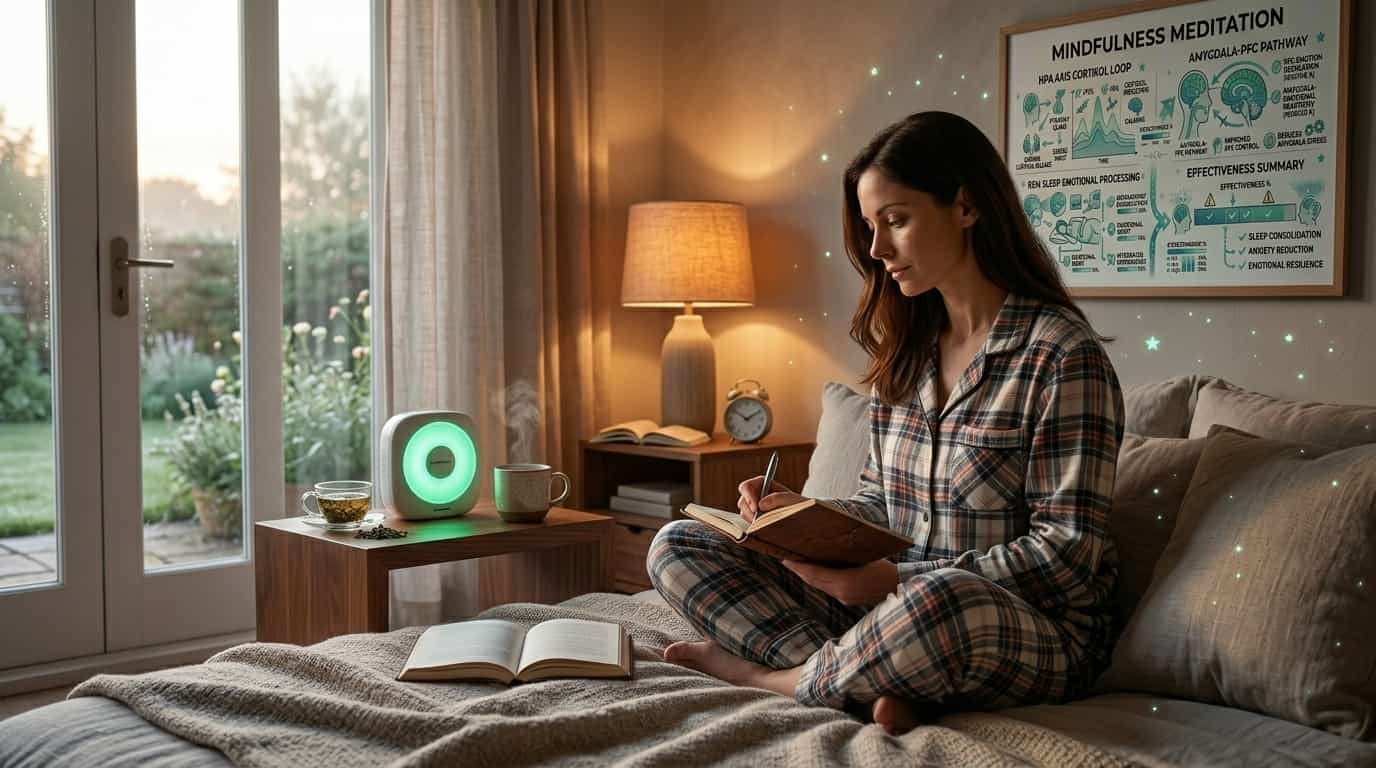
The same paradoxical intention technique that works for insomnia works for rumination: rather than trying to suppress the worried thoughts, give them explicit time. Keep a notebook by the bed. When the anxious brain raises its concerns at 3 AM, write them down — not to solve them, just to acknowledge them. The act of writing signals to the brain that the concern has been received and logged. This can reduce the urgency of the rumination cycle enough to allow sleep to arrive. This is a cognitive offloading mechanism, not a problem-solving exercise.
CBT-I for Mental Health Sleep: Why Fixing Sleep Often Fixes the Mood
Cognitive Behavioral Therapy for Insomnia (CBT-I) was designed for insomnia — but clinical trials have demonstrated something unexpected: CBT-I reduces depression and anxiety symptoms by 40-50% in patients who received no specific mood treatment. The mechanism is not mysterious: by improving sleep architecture, CBT-I restores the neurobiological processes — glymphatic clearance, REM emotional processing, HPA axis normalization — that the brain uses to maintain emotional equilibrium. Better sleep produces better mental health as a consequence, not as a coincidence.
The Order of Operations Question
For patients with both sleep disturbance and mood disorders, the clinical question is always: which do we treat first? The evidence strongly suggests: treat sleep first. Mood improvements from CBT-I appear as early as 2-3 weeks into treatment, often before the sleep metrics themselves have fully normalized. This suggests that the neurobiological restoration from improved sleep begins producing mental health benefits before the full sleep architecture is rebuilt — and that waiting for mood to improve before addressing sleep is the wrong sequence in most cases.
The Circadian-Stress Connection: Why Cortisol Timing Matters More Than Cortisol Volume
The cortisol awakening response (CAR) — the natural cortisol peak that occurs 30-45 minutes before waking — is both the signal that prepares the body for the day and a key regulator of the circadian system. In depression, this CAR is often blunted or absent, a finding associated with treatment resistance and chronic fatigue. In chronic stress, the CAR can be elevated throughout the day, producing a pattern of constant high cortisol that is associated with anxiety, visceral fat accumulation, and immune suppression. Sleep is the primary regulator of CAR: good sleep produces a strong CAR; disrupted sleep flattens it. This is why morning light exposure — which amplifies the CAR and strengthens the circadian signal — is one of the most underutilized mental health interventions available.
Building a Sleep-Mental Health Protocol: The Evidence-Based Order of Interventions
Given the bidirectional relationship, the practical protocol must address both sleep and mood simultaneously — but in a specific order that sets up success at each step.
⚡ The Slumbelry Mental Health Sleep Protocol
- Step 1 (Week 1-2): Fix the anchor — fixed wake time, morning light exposure (10 min outdoor or 30 min sunrise simulation). Do nothing else until the wake time is locked.
- Step 2 (Week 2-3): Remove the barriers — eliminate alcohol, caffeine after 2 PM, screens 60 min before bed, heavy evening meals. These are the most common self-inflicted sleep disruptors.
- Step 3 (Week 3-4): Add CBT-I techniques — stimulus control, sleep restriction if needed, paradoxical intention for rumination. If no improvement after 3 weeks, seek a CBT-I provider.
- Step 4 (Ongoing): Maintain the gains — the protocol is only as good as its consistency. Sleep hygiene is not a one-time fix; it is a permanent environmental commitment.
The Slumbelry Framework: Sleep Is Not a Luxury for People With Mental Health Issues — It Is Treatment
Slumbelry’s Sleep System was developed from the understanding that sleep is not separate from mental health — it is upstream of it. Every layer of our product engineering is designed to support the physiological processes that maintain emotional equilibrium: the spinal alignment that prevents middle-of-the-night physical awakenings from discomfort; the cooling technology that maintains the core temperature drop required for genuine N3 deep sleep; the acoustic environment that prevents the micro-arousals from noise that fragment REM. These are not comfort features. They are the minimum environmental conditions for a brain that needs to use sleep to process the emotional weight of modern life.
The Evidence Base for Environmental Sleep Optimization in Mental Health
Research on environmental sleep optimization shows that improving the bedroom environment — specifically targeting light, temperature, sound, and mattress comfort — produces measurable improvements in sleep onset latency and sleep continuity. For patients with mood disorders, these improvements in sleep quality produce downstream improvements in depression and anxiety symptom scales within 4-8 weeks. Slumbelry’s engineering is calibrated to address each of these environmental variables — not as a wellness product, but as a mental health support tool.
Action step: If you have been treating your mental health separately from your sleep, this is the shift that changes outcomes. Treat them as one system. Fix the sleep first. Watch what happens to the mood.
Frequently Asked Questions About Sleep and Mental Health
How does sleep deprivation affect anxiety and emotional regulation?
Sleep deprivation directly impairs the brain’s two primary emotional regulation mechanisms: the prefrontal cortex’s top-down regulation of the amygdala, and the parasympathetic nervous system’s ability to counterbalance sympathetic activation. After one night without sleep, the amygdala shows a 60% increase in reactivity to negative emotional stimuli. After chronic sleep deprivation, the prefrontal cortex loses its regulatory connectivity to the amygdala permanently — meaning the emotional dysregulation compounds. This is the mechanism behind the common experience of being ‘more anxious’ after a poor night’s sleep: it is not psychological fragility, it is neurochemistry. The brain’s threat-detection system is running without its normal regulatory brake.
What is the relationship between insomnia and depression?
The relationship is bidirectional and well-documented: 75% of patients with depression experience insomnia, and people with chronic insomnia have a 2-8x higher risk of developing depression within 1-5 years. The mechanisms overlap significantly: both involve HPA axis dysregulation (elevated cortisol), reduced serotonergic function, and impaired glymphatic clearance of inflammatory compounds. Importantly, treating insomnia with CBT-I reduces depression symptoms by 40-50% even without any specific mood treatment — demonstrating that sleep restoration is not merely supportive of mental health treatment, it is often the primary intervention.
Why does the rumination problem get worse at 3 AM?
Rumination at 3 AM is worse because of the absence of competing sensory input. The brain’s default mode network (DMN) — the system responsible for self-referential thought and autobiographical memory — is normally modulated by external sensory input. At 3 AM in a dark, quiet room, there is nothing to compete with DMN activity. The anxious brain, which has been suppressing threat-related cognitions all day during activities, has no resources left to suppress them at night. The result is unopposed rumination on real and imagined threats. The intervention: provide the brain with a competing task (writing the concerns down) or remove yourself from the environment (get up, go to another room, do something boring).
How does REM sleep process emotions and why does this matter for mental health?
During REM sleep, noradrenaline — the primary stress-related neurotransmitter — is completely shut off throughout the brain. This is the only stress-free state in a 24-hour cycle. In this neurochemical context, the hippocampus replays emotional memories from the day and the prefrontal cortex processes them without the limbic system’s emotional tagging — essentially extracting the informational content from experiences without the emotional charge. This is why sufficient REM sleep feels like ’emotional recovery.’ When REM is insufficient (due to shortened sleep duration or medication-suppressed REM), the emotional charge of experiences accumulates without processing, contributing to the development of anxiety and depression over time.
Why do sleep medications sometimes worsen mental health outcomes?
Most prescription sleep aids — benzodiazepines (Valium, Xanax, Klonopin) and Z-drugs (Ambien, Lunesta) — suppress REM sleep by 20-50%. This is significant because REM is when the brain performs its emotional detox function. Patients using these medications may achieve longer sleep duration, but the quality of that sleep — specifically the REM-dependent processing — is compromised. Over time, the accumulation of unprocessed emotional experiences from suppressed REM can manifest as worsening anxiety or depression. This does not mean no one should ever use these medications — but it explains why they should be time-limited tools, not long-term solutions, and why CBT-I is preferred as a first-line intervention.
How does the cortisol awakening response (CAR) relate to depression?
The cortisol awakening response (CAR) is the natural peak in cortisol that occurs 30-45 minutes before waking — it is part of the SCN’s wake-up signal and prepares the body for the day’s demands. In depression, the CAR is frequently blunted or absent, a finding that is associated with treatment resistance: patients with a blunted CAR are less likely to respond to SSRIs and psychotherapy. Morning light exposure directly amplifies the CAR by acting on the SCN through the 460-480nm blue-light photoreceptors. This means 10 minutes of outdoor morning light is one of the most evidence-based interventions for improving CAR function in depression — and it costs nothing.
What is the connection between poor sleep and suicidal ideation?
Sleep deprivation is associated with increased suicidal ideation and suicide attempt risk through several mechanisms: impaired prefrontal cortex function reduces the ability to inhibit impulsive responses; negative cognitive bias from sleep deprivation makes the world appear more threatening and hopeless; and the accumulation of unprocessed emotional distress from REM deprivation creates emotional pain that has no resolution. Critically, treating insomnia with CBT-I reduces suicidal ideation even in patients receiving no specific suicide-focused treatment. Improving sleep is not merely supportive of suicide prevention — it is a direct intervention.
How does CBT-I improve mental health symptoms alongside insomnia?
CBT-I improves mental health through the restoration of normal sleep architecture — specifically, the return of sufficient N3 deep sleep (for glymphatic clearance and physical restoration) and REM sleep (for emotional processing). As these neurobiological processes normalize, the downstream effects include: reduced baseline cortisol, improved serotonin receptor sensitivity, normalized amygdala-prefrontal cortex regulatory connectivity, and restored CAR. These are the same neurobiological changes targeted by antidepressant medications — but CBT-I produces them without pharmaceutical side effects. The 40-50% reduction in depression and anxiety symptoms seen in CBT-I clinical trials reflects this restoration, not a psychological placebo effect.
What morning habits most support both sleep and mental health?
The three most evidence-based morning interventions: (1) Morning light exposure — 10 minutes outdoor or 30 minutes sunrise simulation within 30 minutes of waking, which amplifies the CAR, advances circadian timing, and reduces cortisol at night. (2) Consistent wake time — not varying by more than 30 minutes on any day, including weekends, which is the primary signal the SCN uses to calibrate the circadian rhythm. (3) Physical movement within 2 hours of waking — 20-30 minutes of any activity, which elevates cortisol to normal morning levels and produces adenosine clearance that builds sleep pressure for the following night. These three interventions cost nothing and require no equipment, yet are consistently underused.
When should someone with sleep and mental health concerns seek professional help?
Seek professional help when: (1) Sleep problems persist beyond 3-4 weeks despite consistent application of sleep hygiene; (2) Low mood, anhedonia, or loss of interest in activities has persisted for more than 2 weeks; (3) Anxiety is significantly interfering with daily function — work, relationships, basic self-care; (4) Suicidal thoughts or self-harm urges are present at any time; (5) Sleep problems are severe enough that you are considering alcohol, over-the-counter medications, or other substances to manage them. The appropriate professional is a sleep specialist (for CBT-I) and/or a psychiatrist (for mood disorder evaluation). Sleep and mental health are medically intertwined — there is no reason to treat them separately.
Ready to Treat Sleep and Mental Health as One System?
The bidirectional trap breaks when you interrupt it from either direction. Fixing sleep is often the fastest way to help the mood.
Take the Sleep Assessment Subscribe for Sleep Optimization TipsThe Slumbelry Commitment
Sleep is the most vulnerable state of human existence. It is where we heal, reset, and grow.
At Slumbelry, we do not just sell sleep products; we advocate for your physiological right to rest. From ergonomic support to light management, every solution we offer is designed with one obsession: Respecting your Biology.
Science is our language, but your recovery is our purpose. You take care of everything else in your life — let us take care of your sleep.
Rest Deeply,
The Slumbelry Team
Medical References:
1. Walker, M. (2017). Why We Sleep. Scribner.
2. Riemann, D., et al. (2010). The neurobiology, investigation, and treatment of chronic insomnia. The Lancet Neurology.
3. Freeman, D., et al. (2017). The effects of improving sleep on mental health (OASIS): a randomised controlled trial. The Lancet Psychiatry.