
Why Waking Up Screaming Feels Different From a Bad Dream — and Why the Wrong Treatment Makes It Worse
You wake up with your heart pounding. Your partner is staring at you from across the bed, terrified.
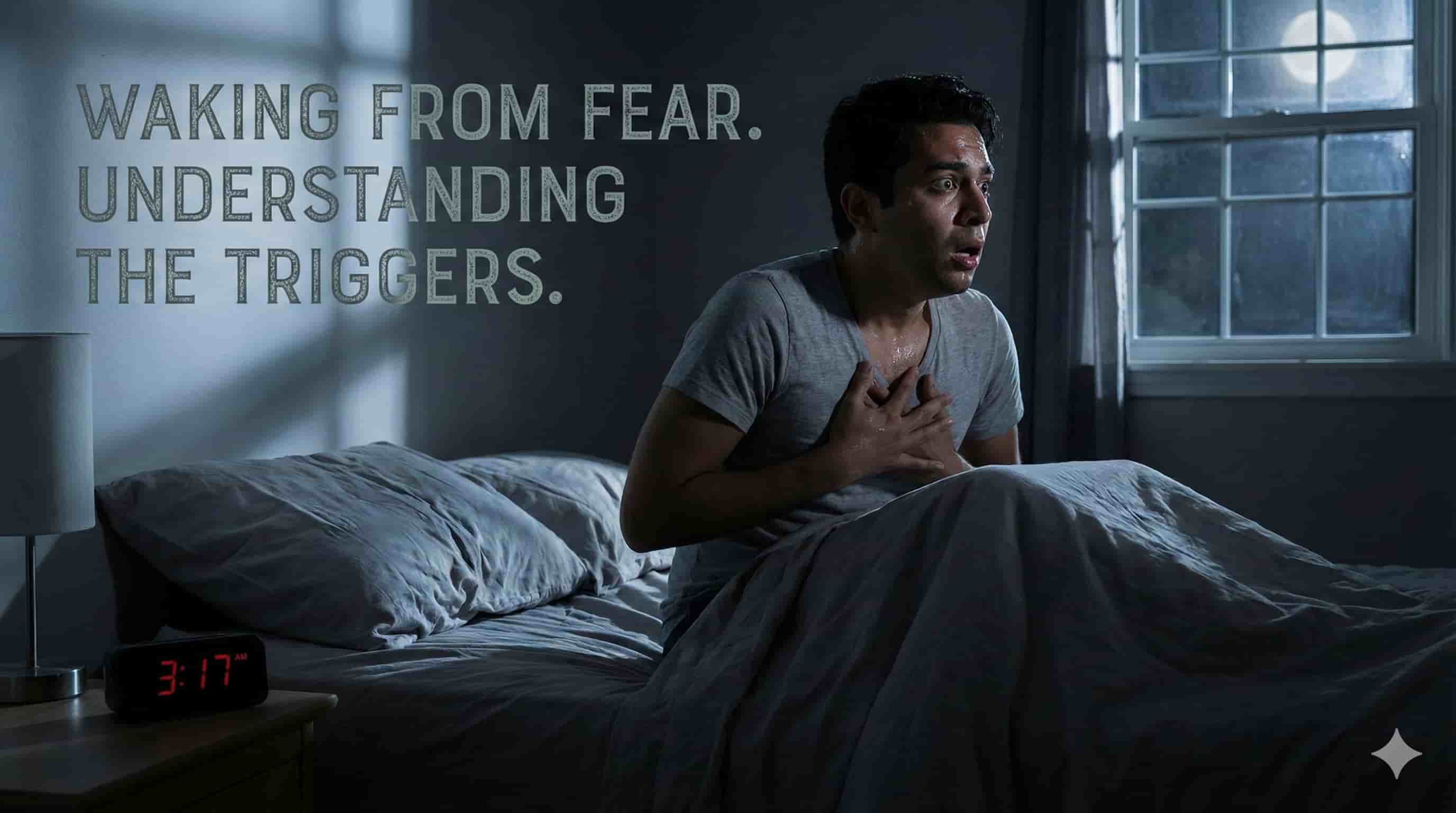
Was it a nightmare — an unpleasant dream you will barely remember by morning? Or was it something else entirely: a night terror, with screaming, thrashing, and no memory at all?
Most people use these terms interchangeably. They are not just different — they are as different as sleepwalking is from dreaming. And confusing the two is not an academic error: the wrong treatment for the wrong condition makes both worse.
This is the nightmares vs night terrors guide that explains exactly what is happening in your brain, which type of episode you are experiencing, and what actually works for each. Understanding nightmares vs night terrors is not optional — applying nightmare treatment to night terrors, or vice versa, is the most common reason both conditions worsen despite well-intentioned intervention.
⚡ Core Takeaway: Same Screaming, Completely Different Brains
- The Core Distinction: Nightmares occur in REM sleep with full narrative recall; night terrors occur in NREM deep sleep (N3) with zero recall — they are physiologically distinct parasomnias that require different interventions
- The TIME Test: T = Timing (terrors in first 3h, nightmares after 4h); I = Involvement (terrors = no interaction, nightmares = interactive); M = Memory (terrors = zero recall, nightmares = detailed recall); E = Emotional state (terrors = confused/disoriented, nightmares = fearful/alert)
- The Critical Risk: Waking someone from a night terror prolongs the episode and risks injury; IRT treats nightmares but worsens night terrors — misidentification is not a benign mistake
What Is the Fundamental Difference Between a Nightmare and a Night Terror?
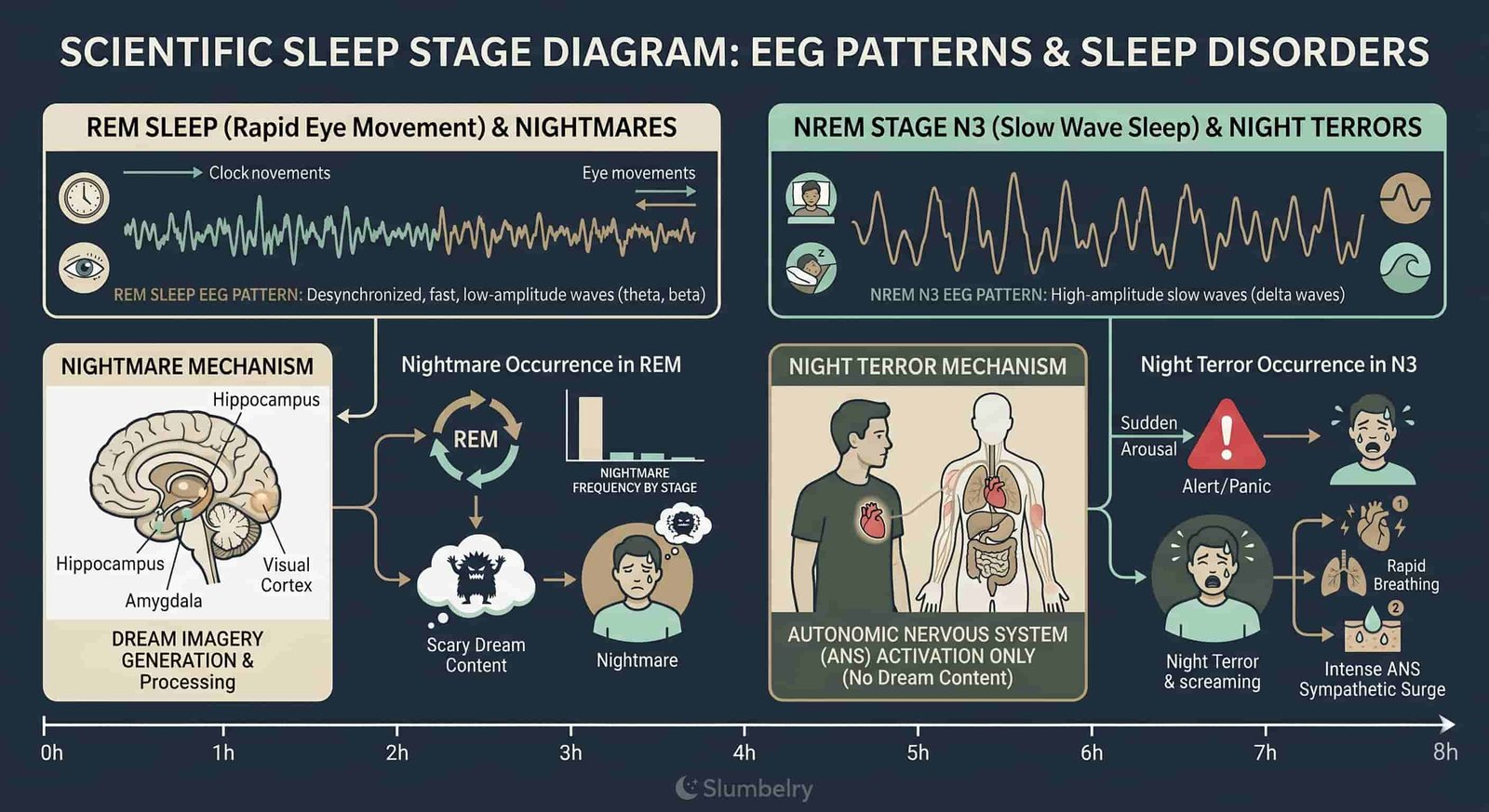
Direct Answer: A nightmare is an unpleasant dream that occurs in REM sleep and causes you to wake up with full recall of the dream narrative. A night terror (sleep terror) is an episode of intense fear, screaming, and autonomic activation that occurs during NREM deep sleep (N3) — with zero recall of the event the following morning. They are as different from each other as dreaming is from sleepwalking.
Mechanism: S2-3 of the whitepaper and ICSD-3 classification: these are two distinct parasomnias with fundamentally different sleep stage origins, neurological mechanisms, and clinical presentations. A nightmare is a REM sleep phenomenon — the brain is generating narrative dream content through the activation of the limbic system, visual cortex, and emotional memory circuits during REM. A night terror is a NREM parasomnia — specifically a partial arousal from deep N3 sleep, where the cortical higher-order processing is simultaneously activated (producing fear and autonomic arousal) while the frontal cortical inhibition that normally distinguishes dream from reality has not fully come online. The result is intense fear behavior without the dream narrative structure or subsequent recall.
Actionable Advice: The first step is identifying which one you — or your child — is experiencing. The treatment and safety implications are completely different for each.
Why Can You Remember a Nightmare in Detail But Have Zero Recall of a Night Terror?
Direct Answer: Memory formation requires cortical consolidation — and different sleep stages produce fundamentally different types of memory storage. REM sleep is when the brain actively consolidates emotional and narrative memories from the previous wake period, including dream content. N3 deep sleep does not support declarative (narrative) memory consolidation — the cortical structures needed to encode and store a continuous narrative are largely offline.
Mechanism: S1-1/S2-3 of the whitepaper and sleep memory research: during REM sleep, the hippocampus, medial temporal lobe, and visual cortex are highly active, generating and encoding the narrative content of dreams. This is why you can wake from a nightmare with vivid, detailed recall — the dream content has been actively processed and stored during REM. During N3 deep sleep, the hippocampus and neocortex are in slow oscillation mode — processing procedural memories and homeostatic sleep pressure but not consolidating narrative episodic content. The fear and autonomic activation during a night terror are real but occur without the narrative encoding needed for later recall. This is the same reason you cannot “remember” being in deep sleep — there is nothing to remember because the memory systems were offline. Patients who report partial recall of night terrors are typically remembering fragments of the brief arousal itself rather than the terror content.
Actionable Advice: If you or your partner can recall detailed dream content, it is a nightmare. If there is screaming and thrashing but no narrative recall, it is a night terror. Zero recall of a frightening event is the hallmark of night terrors.
Why Do Nightmares Occur in REM Sleep and Night Terrors in Deep NREM Sleep?
Direct Answer: Because the brain states of REM and N3 are fundamentally different — REM generates dreams through limbic and cortical activation; N3 produces terror through partial arousal combined with incomplete cortical inhibition. They are not variations of the same phenomenon; they are two separate systems producing two different outputs.
Mechanism: S1-1 and S2-3 of the whitepaper: REM sleep is characterized by high-frequency EEG activity, vivid dream generation, active limbic system (emotional processing), and activated visual cortex — this is the substrate for nightmares. The brain is generating a narrative threat scenario using the same neural circuits it uses for imagination and memory. Night terrors, by contrast, occur during the transition out of N3 deep sleep — the sleep inertia state where the brain is partially awake but not fully conscious. N3 is physiologically defined by slow-wave delta oscillations produced by the thalamocortical system in a hyperpolarized state. When this slow-wave state is interrupted by a partial arousal, the autonomic nervous system (sympathetic activation) fires without the cortical monitoring and narrative generation systems being fully online — producing terror behavior without the dream content.
Actionable Advice: The sleep stage timing is a diagnostic clue: night terrors cluster in the first third of the night (during maximum N3 pressure); nightmares cluster in the final third (during maximum REM pressure).
What Does a Night Terror Actually Look Like From the Outside — and Why Is It So Alarming?
Direct Answer: From the outside, a night terror looks like someone who is awake but is not present — eyes may be open, the person may scream, sit up, thrash, or run from the bed, but they do not respond to their name, touch, or voice. They are in a state of extreme autonomic activation without conscious awareness.
Mechanism: S2-3 and S1-2 of the whitepaper: the autonomic activation during night terrors — heart rate, blood pressure, pupil dilation, sweating, respiratory rate — is among the most intense states the human body can produce outside of maximal physical exertion. This is the body producing a full fight-or-flight response without any cortical narrative to contextualize it. The person’s eyes may be open and they may appear to see something in the room, but they are experiencing only raw fear activation without perceptual content — they are not seeing a monster, they are experiencing the physiological state of terror with no story to attach it to. This is why the person appears conscious but is entirely inaccessible during the episode — and why attempts to wake them typically fail and can prolong the episode.
Actionable Advice: If you witness a night terror, your job is to keep the person safe and wait. The episode will end in 1–10 minutes without intervention. The more you try to wake them, the longer it lasts.
Why Is Attempting to Wake Someone During a Night Terror Dangerous and Counterproductive?
Direct Answer: Because the person is in a state of altered consciousness where they are not fully present — and forcing them into wakefulness can produce agitation, panic, and in rare cases physical violence directed at whoever is trying to help.
Mechanism: S2-3 and S1-2: the partial arousal that produces night terrors means the person’s cortical inhibition systems are offline. When forced into full wakefulness during a night terror, the person experiences a state called “sleep inertia” — the disorientation of being pulled from deep sleep without the normal wake-transition processing. This can produce confusion, agitation, and in severe cases a fight-or-flight response directed at whoever is holding or shaking them. The standard clinical recommendation is: do not attempt to wake the person during the episode. Instead, guide them gently back to the bed if they have left it, keep the environment safe, and wait. The episode self-terminates when the N3-to-wake transition completes naturally. Forcing the transition by shaking, calling loudly, or carrying someone out of the room is the most common cause of injury to both the person experiencing the terror and whoever is trying to help them.
Actionable Advice: Safety first: if the person is thrashing near furniture or the edge of the bed, gently guide them away from hazards without fully waking them. Then wait. They will settle in 1–10 minutes and have no memory of the episode.
Why Are Night Terrors More Common in Children and What Makes Adults Susceptible?
Direct Answer: Night terrors in children are a developmental phenomenon related to brain maturation — specifically, the slow maturation of the frontal cortical inhibition systems that keep sleep and wakefulness cleanly separated. In adults, night terrors are typically a sign of either genetic predisposition, sleep deprivation, or an underlying medical condition disrupting N3 sleep.
Mechanism: S2-3 and ICSD-3 diagnostic criteria: in children (ages 4–12), night terrors are the most common NREM parasomnia and are considered developmentally normal — up to 30% of children experience at least one episode. The frontal cortex, which provides inhibitory control over subcortical arousal systems, matures slowly through late childhood, meaning children have a higher threshold for partial arousal from N3. Adult-onset night terrors are far less common and require clinical investigation: the most common triggers are (1) genetic predisposition (70% of adults with night terrors have a first-degree relative with the same history), (2) severe sleep deprivation, which increases N3 pressure and fragments the normal N3-to-wake transition, (3) sleep-disordered breathing (UARS and OSA both increase NREM parasomnia frequency), (4) medications that suppress REM and increase N3 rebound, and (5) alcohol, which suppresses REM and disrupts the NREM-Wake boundary.
Actionable Advice: If your child has night terrors, the most important thing is to ensure sleep safety (bed rails, no sharp furniture nearby) and understand that the episodes are not psychologically harmful to the child. If you as an adult begin having night terrors for the first time, investigate sleep quality, sleep apnea risk, and genetic predisposition before assuming it is stress-related.
How Does Trauma Create Nightmares but Not Night Terrors — and Vice Versa?
Direct Answer: Because trauma creates the specific conditions for nightmare replay (REM intrusion on emotional memory) but does not produce the partial arousal pattern from N3 that causes night terrors. They are separate neurological pathways — trauma drives emotional memory reprocessing, which happens during REM, not N3.
Mechanism: S2-3 and Horowitz (1975), Stress Response syndromes: trauma creates persistent fear memory networks that the brain attempts to process overnight via the amygdala-hippocampus REM processing loop (S2-3). This processing happens during REM — which is why PTSD and trauma are specifically associated with nightmares (REM phenomenon) and not night terrors. Night terrors, by contrast, are a disorder of N3-to-wake transitions — triggered by sleep deprivation, genetic predisposition, sleep apnea, and conditions that disrupt N3 architecture. Trauma does not specifically disrupt N3 transitions — it disrupts REM emotional processing. This is why PTSD nightmare treatment (IRT, prazosin) has no effect on night terrors and why sleep terror disorder requires an entirely different treatment pathway focused on N3 stability rather than fear memory rewriting.
Actionable Advice: If you have trauma history and are experiencing night terrors (not nightmares), the priority is investigating the N3 transition trigger — sleep apnea, sleep deprivation, genetic predisposition — rather than trauma processing modalities.
What Is Sleep Terrors Disorder and When Do Night Terrors Require Clinical Intervention?
Direct Answer: Occasional night terrors in children are developmentally normal. Sleep Terrors Disorder (ICSD-3) is the clinical diagnosis when episodes are frequent (typically >2 per week), cause significant sleep avoidance, produce daytime impairment, or pose safety risks due to sleepwalking or injurious behavior.
Mechanism: ICSD-3 and S2-3: Sleep Terrors Disorder is distinguished from occasional developmental night terrors by frequency, severity, and functional impact. The diagnostic criteria: (1) recurrent episodes of abrupt terror arousal from N3 sleep, (2) typically screaming and intense fear with autonomic activation, (3) relative unresponsiveness to efforts to arouse or comfort, (4) no detailed dream recall, (5) episodes cause clinically significant distress or impairment in functioning, (6) symptoms not attributable to another condition or substance. Clinical intervention is warranted when: frequency exceeds 2x/week, there is dangerous sleepwalking associated with the episodes, daytime sleepiness is significant (episodes cause full awakening with residual sleep inertia), school/work performance is affected, or the episodes are producing significant caregiver burden or fear of sleep. The most evidence-based treatment for Sleep Terrors Disorder is scheduled awakenings — waking the person 15–30 minutes before the typical episode time for 2–4 weeks — which interrupts the N3-to-terror cycle without medication.
Actionable Advice: If you are having night terrors more than twice a week, or if they are accompanied by sleepwalking, injury risk, or significant daytime impairment, consult a sleep specialist. This is Sleep Terrors Disorder, not normal.
Why Does Treating Night Terrors Like Nightmares (and Vice Versa) Make Both Worse?
Direct Answer: Because nightmares and night terrors require opposite treatment strategies: nightmares (REM phenomenon) are treated by rewriting the fear memory script — through IRT or trauma processing. Night terrors (N3 transition disorder) are treated by stabilizing N3 sleep, removing triggers, and using scheduled awakenings. Applying the wrong treatment activates the other system without addressing the actual problem.
Mechanism: S2-3 and Krakow (2001), Sound Sleep, Sound Mind: IRT — the first-line treatment for chronic nightmares — requires conscious engagement with the nightmare script during wakefulness (writing the rescript, rehearsing it mentally). This process activates the cortical narrative and REM memory systems. If applied to a night terror patient, IRT does nothing to address the N3-to-wake transition problem — the patient has no nightmare script to rewrite because there is no narrative memory. Similarly, sleep hygiene improvements that reduce N3 fragmentation (which help night terrors) actually worsen nightmares by reducing total sleep time and increasing REM pressure — producing more vivid, emotionally intense dreams. For night terrors, the treatment hierarchy is: (1) eliminate sleep deprivation and apnea, (2) scheduled awakenings for recurrent cases, (3) medication only as last resort; for nightmares, the hierarchy is: (1) IRT, (2) trauma processing if PTSD-related, (3) prazosin if pharmacological adjunct needed.
Actionable Advice: If you have been treating your night terrors with IRT without improvement, you are treating the wrong condition. If your nightmares are worsening after improving sleep hygiene, your REM pressure may have increased — work with a sleep specialist to balance N3 and REM recovery.

How to Tell Them Apart in 60 Seconds Using the TIME Test
Direct Answer: The TIME test is a four-question rapid differentiation tool: T = Timing, I = Interaction, M = Memory, E = Emotional state upon waking. Four questions, 60 seconds, complete differentiation.
Mechanism: Stanley (2018), How to Sleep Well, and S2-3: T — Timing: Night terrors occur in the first 1/3 of the night during deep N3 sleep. Nightmares occur in the final 1/2 of the night when REM periods are longest and most vivid. I — Interaction: During a night terror, the person is inaccessible — eyes open but unseeing, no response to their name. During a nightmare, the person may call out, thrash briefly, or reach for someone before fully waking. M — Memory: Zero dream recall the next morning = night terror. Detailed, vivid narrative recall = nightmare. If they say “I can’t remember anything, I just woke up terrified” — night terror. E — Emotional state upon waking: Night terror: confusion, disorientation, no recognition of why they are afraid (no narrative to explain it). Nightmare: fear, anxiety, but with full awareness of where they are and what happened — the fear is attached to a specific remembered content.
Actionable Advice: Use the TIME test tonight: T (when did it happen?), I (were they accessible during the episode?), M (do they remember it?), E (are they confused or fearful?). Two or fewer “night terror” answers = likely nightmare. Three or four = likely night terror.
Frequently Asked Questions
What is the difference between a nightmare and a night terror?
Direct Conclusion: A nightmare is an unpleasant REM sleep dream with full narrative recall; a night terror is a partial arousal from N3 deep sleep with screaming, autonomic activation, and zero recall. They are physiologically distinct parasomnias occurring in different sleep stages with different mechanisms and different treatments.
Why can I remember my nightmares but not my night terrors?
Direct Conclusion: REM sleep actively consolidates narrative memories — including dream content — which is why you wake with vivid nightmare recall. N3 deep sleep does not support declarative memory consolidation — the memory systems are offline during the terror episode, so there is nothing to remember. Zero recall is the clinical hallmark of night terrors.
Do nightmares and night terrors happen in the same sleep stage?
Direct Conclusion: No — nightmares occur exclusively in REM sleep (typically late-night REM periods in the final third of sleep); night terrors occur during partial arousal from N3 deep sleep (typically in the first third of the night during maximum slow-wave sleep pressure). This is one of the most reliable differentiators.
How do I know if I had a nightmare or a night terror?
Direct Conclusion: The TIME test: T = timing (terrors in first 3 hours, nightmares after 4 hours); I = interaction (terrors = unseeing/unresponsive eyes, nightmares = partially interactive); M = memory (terrors = zero recall, nightmares = detailed recall); E = emotional state (terrors = confused/disoriented upon waking, nightmares = fearful but oriented). Three or four terror answers = night terror.
Why shouldn’t you wake someone during a night terror?
Direct Conclusion: Waking someone mid-terror prolongs the episode, increases agitation and confusion, and can produce a fight-or-flight response directed at whoever is trying to help. The terror is a partial arousal that self-completes in 1-10 minutes. Your job is to ensure safety (prevent injury from thrashing) and wait. They will not remember the episode regardless of whether you woke them.
Can night terrors be treated the same way as nightmares?
Direct Conclusion: No. Nightmares (REM parasomnia) are treated with nightmare rescripting (IRT), trauma processing, and sometimes prazosin. Night terrors (NREM parasomnia) are treated by stabilizing N3 sleep: eliminating sleep deprivation, treating sleep apnea, scheduled awakenings, and in severe cases medication. Applying IRT to night terrors has no effect because there is no nightmare script to rewrite.
Are night terrors more common in children or adults?
Direct Conclusion: Night terrors are common and developmentally normal in children ages 4-12 (up to 30% prevalence). Adult-onset night terrors are less common and require clinical investigation — the most common triggers are genetic predisposition (70% have a family history), sleep deprivation, sleep apnea, and medications that increase N3 rebound.
What causes night terrors and why do they run in families?
Direct Conclusion: The primary triggers are genetic predisposition (strong familial pattern, 70% of adult patients have affected first-degree relatives), sleep deprivation (increases N3 pressure and fragments transitions), sleep apnea (increases arousals from N3), alcohol (suppresses REM and disrupts NREM-wake boundary), and medications that increase slow-wave sleep. The underlying mechanism is a partial arousal from N3 triggered by an unstable transition between deep sleep and wakefulness.
When should someone see a doctor about night terrors?
Direct Conclusion: Consult a sleep specialist when: episodes occur more than twice per week, they involve dangerous sleepwalking or injurious behavior, daytime impairment is significant (excessive sleepiness, mood disturbance, school/work impact), adult-onset with no family history, or the episodes are causing significant fear of sleep or sleep avoidance. This is Sleep Terrors Disorder and requires clinical evaluation.
How do nightmares and night terrors affect sleep quality differently?
Direct Conclusion: Nightmares fragment REM sleep — reducing sleep efficiency and producing daytime fatigue, mood disturbance, and fear of sleep. Night terrors fragment N3 deep sleep — which is the physiologically restorative stage, so N3 fragmentation produces severe unrefreshing sleep, excessive daytime sleepiness, and cognitive impairment that is disproportionate to total sleep time. Both conditions require treatment but through entirely different pathways.
Know What You’re Dealing With
The wrong treatment for the wrong condition makes both nightmares and night terrors worse. Use the TIME test to identify which one you’re facing.
Sleep Masks for Better Sleep Take the Sleep AssessmentThe Slumbelry Commitment
Sleep is the most vulnerable state of human existence. It is where we heal, reset, and grow.
At Slumbelry, we do not just sell sleep products; we advocate for your physiological right to rest. From ergonomic support to light management, every solution we offer is designed with one obsession: Respecting your Biology.
Science is our language, but your recovery is our purpose. You take care of everything else in your life — let us take care of your nights.
Rest Deeply,
The Slumbelry Team