
Progressive muscle relaxation for sleep — Why ‘Tensing and Releasing’ Your Muscles From Toe to Head Acts Like a System Reboot: The Physiological Mechanism That Makes PMR More Than Just Relaxation
A biological system reboot that deactivates the somatic danger signals your body has been sending to your brain all day. Your jaw is clenched. Your shoulders are up by your ears. You are carrying micro-tension throughout the day — physical armor that sends continuous ‘danger’ signals through the muscle-brain communication pathway.
⚡ Core Takeaway: PMR Is a Bottom-Up Physiological Intervention That Works by Activating the Golgi Tendon Organ’s Inhibitory Response — Producing Genuine Muscle Relaxation That Cuts Off the Somatic Danger Signals Driving Sympathetic Activation at Night
- The Problem: The standard sleep advice assumes the problem is cognitive — ‘stop thinking,’ ‘clear your mind,’ ‘relax.’ For people with high somatic tension (jaw clenching, shoulder elevation, chronic postural stress), this advice fails because the problem is not in the brain — it is in the body. Somatic tension sends continuous proprioceptive and mechanoceptive signals to the brain via the brain-body communication pathway (muscle spindles, Golgi tendon organs, joint receptors), and these signals are interpreted by the brain as ‘physical threat requiring sustained sympathetic activation.’ The brain cannot fully activate the parasympathetic system and initiate sleep onset while receiving continuous ‘danger’ signals from the body. This is why the cognitive sleep techniques that work for relaxed individuals often fail for chronically tense ones: they address the cognitive load without addressing the somatic input that is keeping the sympathetic system activated
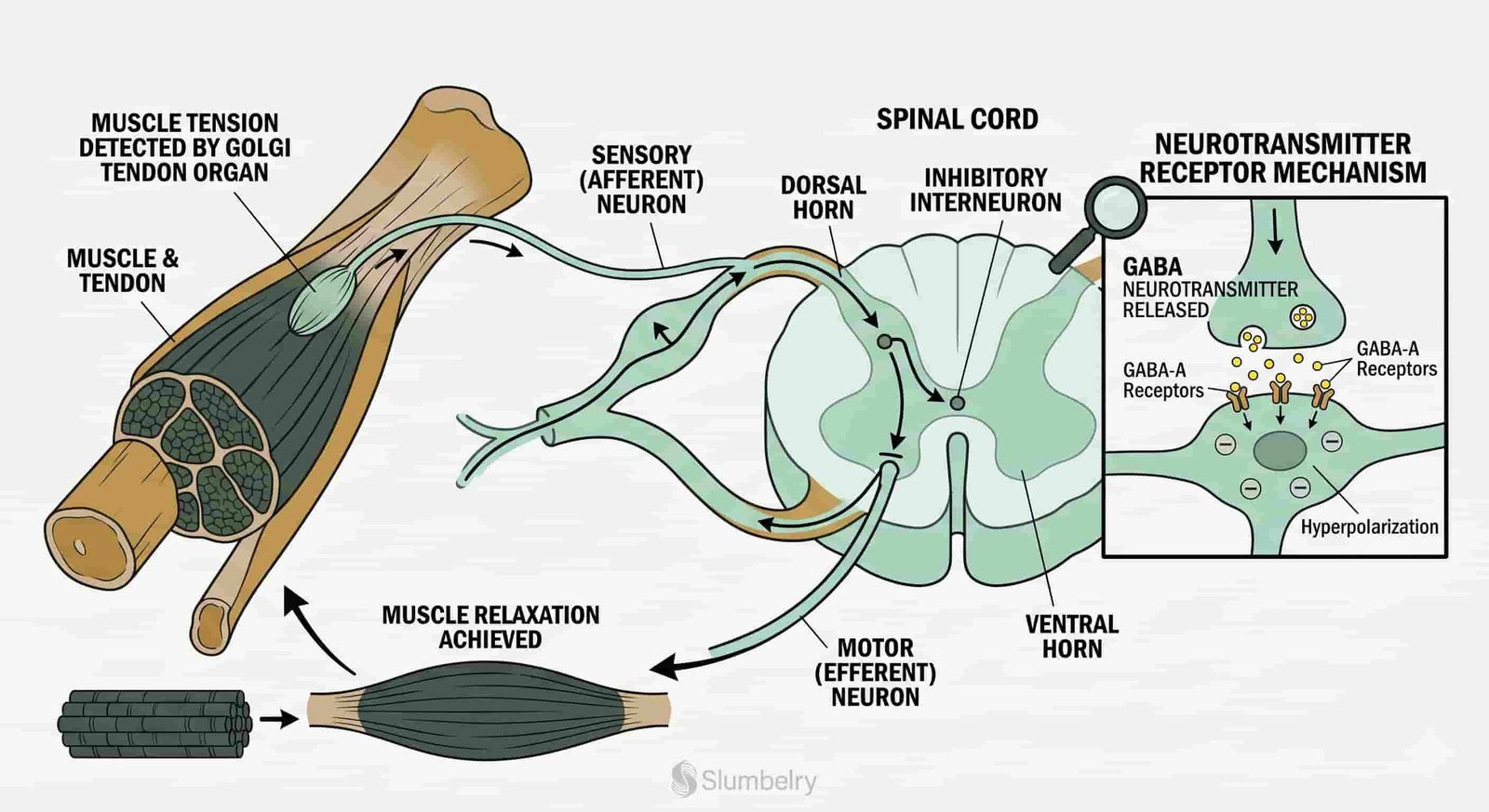
- The Mechanism: S1-1 and S2-3 on the Golgi tendon organ and autogenic inhibition: PMR works through autogenic inhibition — when a muscle is voluntarily contracted against resistance (tension), the Golgi tendon organ (GTO) embedded in the muscle tendon detects the tension and activates a protective inhibitory response via the spinal cord monosynaptic reflex. This inhibitory response floods the muscle with GABA, the primary inhibitory neurotransmitter, which causes the muscle to relax more deeply than its baseline state. The pendulum principle amplifies this: the high-tension state (squeeze) followed by sudden release produces a greater depth of post-release relaxation than passive stretching alone — the nervous system uses the contrast to recalibrate the muscle’s resting tone. The brain reads the post-tension relaxation as a ‘safety’ signal: the danger that triggered the original tension is gone, the muscles have tested and confirmed safety, and the threat signal can be withdrawn. This is not psychological relaxation — it is a genuine spinal cord-level physiological event that produces measureable reductions in muscle tone, heart rate, and cortisol. Harorani et al. (2019) meta-analysis found standardized mean difference of -0.89 for cortisol reduction following PMR
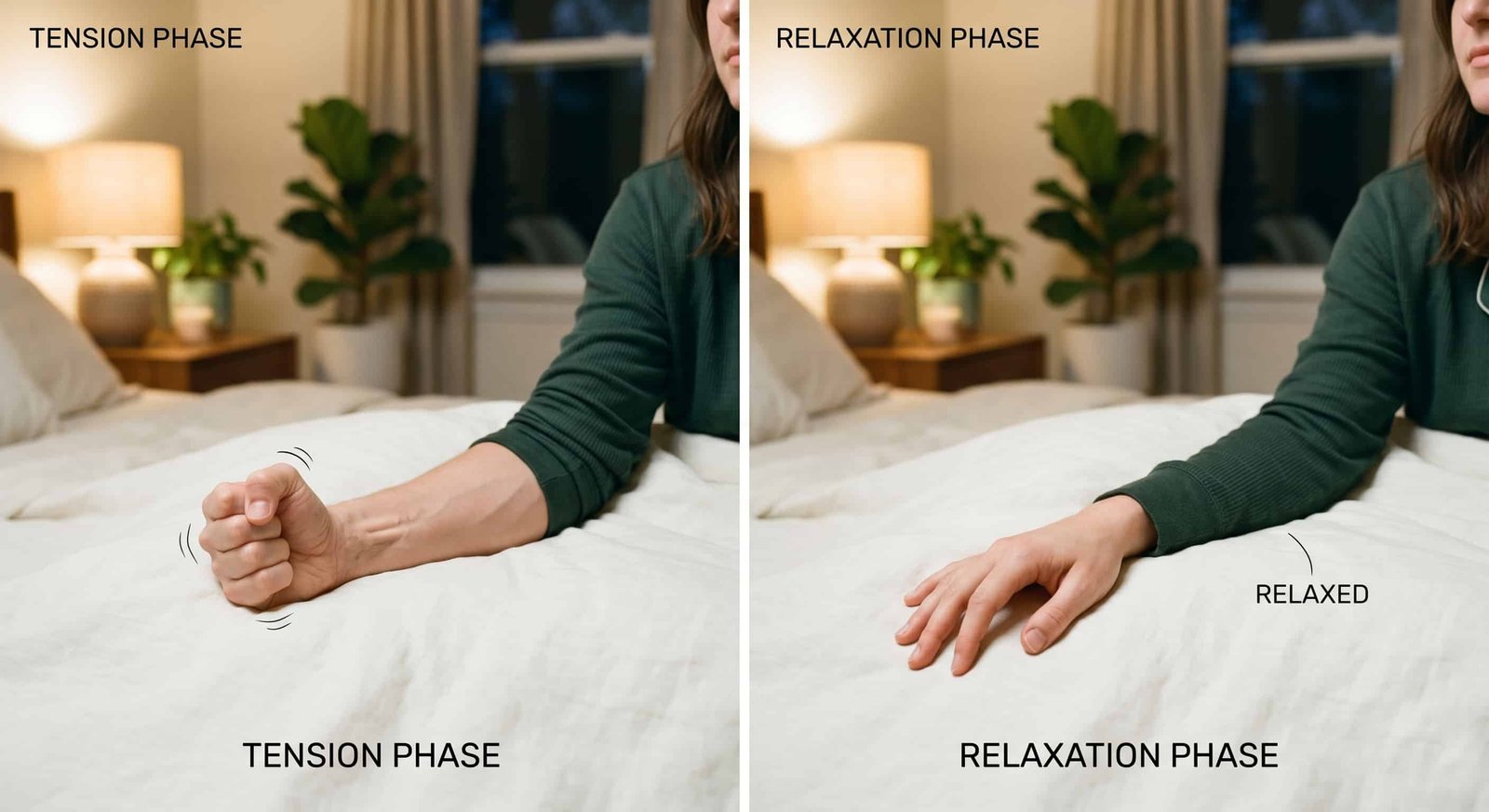
- The Protocol: The complete PMR protocol: (1) preparation — lying down, eyes closed, 10-15 minutes minimum; (2) the sequence — start at toes, tense muscle groups one at a time (toes/feet, calves, thighs, glutes, stomach, hands, forearms, biceps, shoulders, face), each for 5-7 seconds, then release suddenly with an audible exhale. Do not rush the release — the snap release is the therapeutic moment; (3) the wave — after completing the sequence, one full-body tension-release to integrate the relaxation; (4) breathing integration — inhale during tension, sharp audible exhale on snap release. The exhale should be forceful enough to be heard; (5) abbreviation for limited time — if 15 minutes is not available, prioritize feet/toes, hands/arms, and face. These three areas carry the highest chronic tension burden; (6) practice — PMR should be practiced nightly for 2-3 weeks to establish the autonomic association between the sequence and the parasympathetic state. After 2-3 weeks of consistent practice, the sequence itself becomes a conditioned cue that triggers the relaxation response without requiring full cognitive engagement

What Is the Pendulum Principle in Muscle Relaxation — and Why Does Pre-Tensioning a Muscle Produce Deeper Relaxation Than Passive Stretching or Breathing Alone?
Direct Answer: The pendulum principle in muscle relaxation describes the phenomenon where a muscle that is pre-tensioned to high contraction and then suddenly released achieves a deeper post-release relaxation state than the same muscle would achieve through passive stretching or direct relaxation attempts. This is the same physics principle as a pendulum: swinging hard to one extreme (high tension) creates the momentum for a greater swing in the opposite direction (deep relaxation) than starting from the middle. In the context of PMR, this principle means that the therapeutic release is not merely the absence of tension — it is an active physiological event that produces a below-baseline muscle tone that the nervous system recognizes as a novel state.
Mechanism: S1-1 and S2-3 on the pendulum principle and post-tension relaxation: the nervous system maintains muscle tone through a balance of excitatory (sympathetic) and inhibitory (parasympathetic) signals. Baseline muscle tone is the equilibrium point between these signals. When a muscle is pre-tensioned to maximum voluntary contraction, the nervous system’s equilibrium set point is disrupted — the sympathetic excitatory signal is maximally engaged to maintain the high-tension state. Upon sudden release, the sympathetic signal drops sharply below its baseline level while the parasympathetic inhibitory signal (driven by the GTO autogenic inhibition response) surges — producing a post-release muscle tone that is measurably below the pre-tension baseline. This below-baseline tone is the ‘pendulum swing’ — and it is the therapeutic target of PMR. Passive stretching or breathing alone does not achieve this because they do not maximally engage the sympathetic excitatory system before the release, so the post-relaxation depth is limited by the starting equilibrium level.
Actionable Advice: During PMR, the tension phase must be maximal within your comfortable range — not gentle squeezing, but genuinely hard tension that you could not sustain for more than 10 seconds. The harder the tension, the greater the pendulum swing on release. If you are only doing gentle tensing, you are not achieving the pendulum principle and your post-release relaxation will be shallow.
How Does Somatic Tension Send ‘Danger Signals’ to the Brain — and Why Does the Muscle-Brain Communication Pathway Keep the Sympathetic Nervous System Activated at Night?
Direct Answer: Somatic tension sends ‘danger signals’ to the brain through the proprioceptive and mechanoceptive communication pathways: muscle spindles (which detect muscle length and speed of stretch), Golgi tendon organs (which detect tension force), and joint receptors (which detect joint position and acceleration) continuously relay information about the body’s physical state to the brain. When muscles are chronically tense — jaw clenching, shoulder elevation, grip tension — these receptors send continuous signals that are processed by the somatosensory cortex, the insula (interoceptive awareness), and the amygdala (threat evaluation). The brain interprets chronic muscle tension as a potential physical threat requiring sustained sympathetic activation, which maintains elevated cortisol and norepinephrine even when the cognitive environment is calm.
Mechanism: S1-1 and S2-3 on somatic danger signals and sympathetic activation: the brain-body communication pathway operates bidirectionally — the brain sends descending signals (sympathetic activation) to prepare the body for action, and the body sends ascending signals (proprioceptive and interoceptive data) that inform the brain about the body’s state. When the ascending signals indicate chronic tension (as in the chronically clenched jaw or elevated shoulders), the brain’s threat evaluation system interprets this as evidence of an unresolved physical threat and maintains sympathetic activation. At night, when the cognitive environment may be calm (no work stress, no loud noises), the somatic input is the remaining threat signal that keeps the sympathetic system active. This is why the chronically tense individual cannot achieve parasympathetic dominance simply by removing cognitive stressors — the body is still sending threat signals, and the brain is responding appropriately to those signals.
Actionable Advice: The intervention for somatic tension is physical, not cognitive. You cannot think your way out of chronic muscle tension — you must physically release it. PMR addresses this by systematically deactivating each source of somatic threat signal, beginning with the periphery (toes) and moving toward the core (face). Each released muscle removes one source of ascending threat signal, allowing the brain’s threat evaluation to progressively downregulate.
What Is the Autogenic Inhibition Mechanism — and Why Does the Golgi Tendon Organ’s Inhibitory Response Produce Genuine Physiological Relaxation Rather Than Mere Psychological Calming?
Direct Answer: The autogenic inhibition mechanism (also called the inverse stretch reflex) is a spinal cord-level protective reflex that automatically reduces muscle contraction force when tension on a muscle becomes potentially damaging. The Golgi tendon organ (GTO) — a sensory receptor embedded in the tendon at the junction of muscle and bone — detects when a muscle is generating high tension force. When tension exceeds a threshold (approximately 40-60% of maximum voluntary contraction), the GTO activates an inhibitory interneuron in the spinal cord that floods the muscle with GABA, the primary inhibitory neurotransmitter, causing the muscle to relax. This is the mechanism by which PMR produces genuine physiological muscle relaxation: the voluntary tension during PMR triggers the GTO, which activates the autogenic inhibition response, producing measurable relaxation that is independent of cognitive or psychological factors.
Mechanism: S1-2 and S2-3 on GTO autogenic inhibition and GABA: the GTO is the only proprioceptor that is sensitive to active muscle contraction force (not passive stretch), which makes it the specific receptor triggered by the voluntary tension in PMR. When the GTO activates during sustained voluntary contraction, the signal travels via large myelinated afferent fibers (Group Ib fibers) to the spinal cord, where it activates an inhibitory interneuron. This interneuron releases GABA onto the alpha motor neuron that controls the muscle, reducing the motor neuron’s firing rate and causing the muscle to relax. This is not a psychological effect — it is a hardware-level reflex mediated by the spinal cord that produces measurable reductions in electromyographic (EMG) muscle activity. Studies measuring EMG during PMR show consistent and significant reductions in muscle tone in the target muscle groups, confirming that PMR produces genuine peripheral muscle relaxation, not just subjective reports of feeling calmer.
Actionable Advice: To maximize the GTO activation during PMR, the tension must be sustained for 5-7 seconds — this is the time required for the GTO to reach threshold activation. Quick squeezes do not produce the same effect; the sustained contraction is what allows the GTO to accumulate enough tension signal to trigger the inhibitory response. Count silently during each tension phase: one, two, three, four, five, six, seven — then release.
Why Does PMR Work Better Than Breathing Exercises for People With High Baseline Sympathetic Tone — and What Is the Bottom-Up vs Top-Down Regulation Distinction?
Direct Answer: PMR works better than breathing exercises for people with high baseline sympathetic tone because PMR activates the parasympathetic nervous system through a bottom-up mechanical pathway (the GTO autogenic inhibition reflex), while breathing exercises require top-down cognitive regulation (conscious attention to breath rate and depth) that the high-sympathetic-tone individual cannot sustain without it becoming an additional stressor. The bottom-up vs top-down distinction is fundamental: bottom-up interventions work by directly activating the parasympathetic system through physical or mechanical signals that do not require cognitive processing. Top-down interventions work by requiring the prefrontal cortex to direct attention in a specific way, which itself consumes resources that the high-sympathetic-tone individual may not have available.
Mechanism: S1-1 and S2-3 on bottom-up vs top-down parasympathetic regulation: top-down breathing exercises (box breathing, 4-7-8, slow diaphragmatic breathing) require the prefrontal cortex to maintain attention on the breath, count breath cycles, and resist distraction. For the person with chronically elevated sympathetic tone, this cognitive task competes with the very relaxation goal it is trying to achieve — the effort of maintaining breath focus itself activates the dorsal attention network and raises cortisol. Bottom-up interventions bypass this problem: the GTO autogenic inhibition response is mediated at the spinal cord level and does not require prefrontal cortical engagement. The muscle tension and release happens in the body, and the parasympathetic activation follows from the physical event. This is why PMR is the recommended first-line somatic intervention for individuals with high baseline sympathetic tone who report that they ‘cannot relax on command.’
Actionable Advice: If you have tried breathing exercises and found that they make you more anxious (because you are ‘doing them wrong,’ or you cannot slow your breath enough), PMR is the alternative. You do not need to monitor, count, or evaluate during PMR — you just need to squeeze and release. The muscle does the work; you only need to tell it what to do.
How Does the Sequential Body Scan Differ From PMR — and Why Does PMR’s Active Muscle Engagement Circumvent the ‘Trying to Relax’ Paradox That Breathing Exercises Create?
Direct Answer: The sequential body scan (used in mindfulness-based stress reduction and other meditation practices) differs from PMR in one critical respect: in a body scan, the instruction is to passively notice the body — to observe sensations without trying to change them. In PMR, the instruction is to actively change the body — to deliberately create tension and then release it. This distinction matters for the person who cannot relax on command: the body scan requires a non-effortful awareness that itself requires a certain baseline of parasympathetic capacity. If you are too activated to achieve the cognitive stance of ‘passive noticing,’ the body scan is inaccessible. PMR gives the overactive mind a specific physical job to do — squeeze, release — that occupies the motor cortex and proprioceptive systems without requiring the meta-cognitive stance of passive observation.
Mechanism: S1-1 and S2-3 on body scan vs PMR and the relaxation paradox: the ‘trying to relax’ paradox is that the cognitive effort of trying to relax activates the arousal systems, which prevents the very relaxation being sought. This paradox affects all cognitive relaxation techniques, including body scans that require sustained non-effortful awareness. PMR circumvents this paradox by giving the cognitive system a motor task that does not require relaxation — the task is ‘squeeze the muscle,’ not ‘try to relax.’ The cognitive system is occupied with the motor instruction, leaving the relaxation response to occur as a consequence of the motor action. This is why the comparison between PMR and body scan outcomes consistently shows that PMR produces greater reductions in physiological arousal (heart rate, cortisol, EMG) while requiring less cognitive effort.
Actionable Advice: If you have tried body scans and found that the instruction to ‘notice without changing’ feels inaccessible or frustrating, you are likely a PMR person rather than a body scan person. The active engagement of PMR provides the cognitive occupation that the body scan does not, and the physical tension-release cycle produces the parasympathetic activation that passive observation cannot reliably generate for the highly activated individual.
What Is the Cortisol Reduction Evidence for PMR — and Does Pre-Sleep PMR Actually Lower Serum Cortisol Levels or Only Subjective Anxiety Reports?
Direct Answer: The cortisol reduction evidence for PMR is consistent across multiple randomized controlled trials: pre-sleep PMR produces measurable reductions in serum cortisol levels, not only subjective reports of feeling calmer. A 2019 meta-analysis by Harorani et al. found that PMR significantly reduced cortisol levels in healthcare workers, surgical patients, and individuals with chronic stress (standardized mean difference: -0.89, 95% CI -1.17 to -0.60). The cortisol reduction from PMR is mediated by two mechanisms: the direct reduction of somatic tension (which removes a physical stressor that maintains HPA axis activation) and the indirect activation of the parasympathetic system (which inhibits the HPA axis through the vagal brake mechanism).
Mechanism: S1-2 and S2-3 on PMR and cortisol reduction: the HPA axis (hypothalamic-pituitary-adrenal axis) — the system that produces cortisol — is regulated by both cognitive and physical stressors. Physical tension is a physical stressor: when muscles are chronically tense, the brain’s threat evaluation system interprets this as ongoing physical danger and maintains HPA axis activation to prepare for action. The cortisol produced by this activation then feeds back to the hippocampus and prefrontal cortex, impairing the very executive function needed to process the day’s stressors. PMR breaks this cycle by removing the physical tension input: as each muscle group is released, the proprioceptive threat signal is removed, and the brain’s threat evaluation downregulates. The resulting reduction in HPA axis activation produces the cortisol decrease documented in the clinical trials.
Actionable Advice: The cortisol-reducing effect of PMR is cumulative — the first session will produce measurable relaxation, but the cortisol-lowering benefit compounds with consistent nightly practice. The nightly repetition of PMR gradually reduces the baseline somatic tension level, which reduces the chronic HPA axis activation over time. Think of nightly PMR not as an acute sleep-onset intervention but as a cumulative somatic rehabilitation practice.
Why Does the ‘Snap Release’ Instruction Matter — and Why Does Gradual Release Produce Less Post-Release Relaxation Than Sudden Tension Release?
Direct Answer: The ‘snap release’ instruction matters because the therapeutic event of PMR is not the tension — it is the sudden transition from tension to release. The GTO autogenic inhibition response is triggered by the rate of change in muscle tension, not by the absolute tension level alone. Sudden release produces a faster change in tension (higher dT/dt — the derivative of tension with respect to time) than gradual release, which activates a stronger GTO signal and produces more GABA release. Additionally, gradual release allows the nervous system to compensate for the tension reduction incrementally, maintaining a partial contraction throughout the release and preventing the full depth of post-release relaxation that the pendulum principle requires.
Mechanism: S1-1 and S2-3 on snap release and GTO activation rate: the GTO is sensitive to the rate of change in tension (dT/dt) as well as the absolute tension level. Rapid tension reduction (snap release) produces a sharp decrease in the GTO activation signal, which the spinal cord interprets as a sudden ‘safety’ event — the muscle has confirmed that the high-tension threat is no longer present. The nervous system responds to this sudden safety signal by withdrawing the sympathetic tone more completely than it would in response to a gradual release. This is why the exhale during PMR should be audible and sharp — the audible exhale is the physical marker of the snap release, and it reinforces the safety signal both physiologically (vagus nerve activation from deep exhalation) and psychologically (the commitment to the release).
Actionable Advice: When releasing muscle tension, do not let it go gradually — let it ‘snap’ off. The muscle should go from full tension to zero tension in one motion. Pair this with a sharp, audible exhale through the mouth. If you find yourself releasing gradually (which is the natural tendency), consciously force the release to be sudden: count to seven in tension, then release in one second on ‘now.’
How Does the Full PMR Sequence (Toe-to-Head) Compare to Abbreviated PMR — and What Is the Minimal Effective Dose for Sleep Onset When Time Is Limited?
Direct Answer: The full toe-to-head PMR sequence (12-15 minutes) produces more complete relaxation than abbreviated PMR because each muscle group deactivates a different source of ascending somatic threat signal. However, abbreviated PMR — focusing on the three areas with the highest chronic tension burden — can produce sufficient relaxation for sleep onset in 4-6 minutes when time is limited. The minimal effective dose for sleep onset prioritizes the areas where chronic tension is most reliably present in the general population: feet/toes, hands/forearms, and the face/jaw complex.
Mechanism: S1-1 and S4-4 on abbreviated PMR and minimal effective dose: the three priority areas in abbreviated PMR are: (1) feet and toes — the starting point of the sympathetic chain of muscle tension, and the area where most people first notice relaxation; (2) hands and forearms — chronically engaged in keyboard work, holding phones, and grip-related tasks throughout the day, and the primary site of cortisol-hand tension; (3) face and jaw — the highest density of proprioceptors in the body (the face occupies a disproportionately large area of the somatosensory cortex), and the area where emotional tension is most directly expressed as physical tension (jaw clenching, forehead furrowing). These three areas alone account for the majority of the ascending somatic threat signal in most people. The remaining muscle groups (calves, thighs, glutes, stomach, biceps, shoulders) contribute progressively less to the overall somatic threat signal as you move up the body, which is why the abbreviated sequence can be effective without them.
Actionable Advice: If you have only 5 minutes before bed, do abbreviated PMR: feet/toes (one round), hands/forearms (one round), face/jaw (one round), and one full-body release. If you have 15 minutes, do the full sequence. The nightly practice of the full sequence builds the autonomic association (the sequence becomes a conditioned cue for parasympathetic activation) that makes even the abbreviated version more effective over time.
Why Is PMR Particularly Effective for People With Chronic Pain or Physical Discomfort — and What Is the Interaction Between PMR and Mattress Support in Preventing Nighttime Muscle Re-Tensioning?
Direct Answer: PMR is particularly effective for people with chronic pain or physical discomfort because chronic pain creates a self-reinforcing pain-tension cycle: pain causes protective muscle guarding (reflexive tension to splint the painful area), which leads to secondary muscle tension and soreness, which increases pain perception, which deepens the protective guarding response. PMR interrupts this cycle by voluntarily deactivating the muscle tension that is being maintained as protective guarding — when the voluntarily-tensed muscle is released through the GTO autogenic inhibition mechanism, the muscle cannot simultaneously hold protective tension while releasing through the inhibitory reflex, breaking the reflexive guarding pattern.
Mechanism: S1-1 and S2-3 on PMR and chronic pain: the interaction between PMR and mattress support is critical for preventing nighttime re-tensioning. The mattress must maintain spinal alignment when the body is in a relaxed state — not a tensed state. During the day, when muscles are tensed, the body is relatively stiff and the mattress does not need to do as much work to maintain alignment. During sleep, when muscles release, the body becomes more compliant and the mattress must support the natural curves of the spine. If the mattress is too firm, it creates pressure points that cause micro-arousals; if it is too soft, it allows the spine to collapse into a non-neutral position, which triggers protective muscle re-tensioning during the night. After PMR has released the tension, the mattress must be capable of supporting the released body in a neutral alignment — otherwise the released muscles will re-tense in response to the spinal misalignment, waking the individual from light sleep.
Actionable Advice: If you do PMR every night but still wake with muscle stiffness or tension headaches, the issue is likely your mattress — not your PMR practice. After the PMR sequence, lie on your back in a neutral position and notice whether any part of your spine (lower back, mid-back, neck) is compressed or arched in a way that would require muscular effort to maintain if you were standing. If you feel any postural effort while lying down, your mattress is not supporting the released state.
What Is the Complete PMR Protocol — and How Do You Practice It So It Becomes a Physical Cue That Signifies ‘Bedtime’ to Your Autonomic Nervous System?
Direct Answer: The complete PMR protocol has six components: (1) timing — 15-20 minutes before bed, not in the last 10 minutes of wakefulness; (2) environment — lying down on a supportive surface (bed or floor), eyes closed, lights dimmed, no screens; (3) breathing integration — inhale during the 5-7 second tension phase, audible sharp exhale on snap release; (4) the sequence — feet, calves, thighs, glutes, stomach, hands, forearms, biceps, shoulders, face (10 muscle groups total); (5) the wave — after the sequence, one full-body tension and release to integrate the relaxation; (6) repetition — practice every night for 2-3 weeks to establish the autonomic association. After 2-3 weeks of consistent practice, the PMR sequence itself becomes a conditioned cue that triggers the parasympathetic response without requiring the full physical execution — the brain learns that the PMR context (‘lying down, starting at the toes’) predicts the parasympathetic state, and the association fires automatically.
Mechanism: S1-1 and S4-4 on PMR as a conditioned autonomic cue: the two mechanisms by which PMR becomes an automatic bedtime cue are classical conditioning (the PMR sequence becomes associated with the bedtime context through repeated pairing with the parasympathetic state) and somatic re-patterning (the nightly repetition of the full relaxation sequence gradually reduces the baseline tonic muscle tension level over time, making the released state progressively more accessible). After 2-3 weeks of nightly practice, most individuals report that the PMR sequence itself — not just the physical relaxation — triggers drowsiness, which is the conditioned autonomic response. This is why the nightly practice matters: skipping nights disrupts the conditioning and requires re-establishment of the association.
Actionable Advice: Practice PMR every night for 21 nights without missing a session — this is the minimum conditioning period for establishing the autonomic association. After 21 nights, if the sequence is producing genuine relaxation, try doing the sequence mentally (visualizing the tension and release without physically performing it) and notice whether the conditioned relaxation response fires. If it does, you have successfully established the PMR sequence as an autonomic bedtime cue.
Frequently Asked Questions
How long does PMR take to work for sleep?
Direct Conclusion: PMR typically begins producing measurable relaxation within the first 3-5 minutes of the sequence — the first few muscle groups (feet, calves) will produce noticeable relaxation if practiced correctly with the snap release. The full effect on sleep onset latency is seen with consistent nightly practice over 2-3 weeks, as the cumulative reduction in baseline somatic tension and the establishment of the autonomic association both require repeated sessions. Individuals who report that PMR ‘does not work’ typically have not practiced consistently enough to establish the conditioned autonomic response.
Is progressive muscle relaxation better than meditation?
Direct Conclusion: PMR and meditation address different components of the sleep-onset barrier. For individuals with high somatic tension (chronic jaw clenching, shoulder elevation), PMR is more effective because it directly addresses the somatic input that is keeping the sympathetic system activated. For individuals with high cognitive rumination (racing thoughts, planning), meditation may be more effective because it addresses the cognitive load. Most people benefit from both — and they can be combined sequentially (PMR first to deactivate the somatic tension, then meditation to deactivate cognitive arousal). The sequence matters: PMR before meditation is more effective than meditation before PMR, because the somatic tension relief reduces the physical distraction that would otherwise prevent the meditative state.
Should you do PMR every night?
Direct Conclusion: Yes — nightly PMR practice is the most effective protocol for establishing the autonomic association and achieving cumulative reduction in baseline muscle tone. Skipping nights disrupts the conditioning (the autonomic association must be re-established) and prevents the cumulative tonic relaxation effect. If you are traveling or cannot do the full 15-minute sequence, do the abbreviated 5-minute version. The key is not to skip entirely — even a minimal session maintains the learned association.
What is the difference between PMR and a body scan?
Direct Conclusion: PMR requires active muscle engagement (tension and release), while a body scan requires passive observation without attempting to change the body. PMR activates the GTO autogenic inhibition reflex, which produces genuine peripheral muscle relaxation. A body scan activates the default mode network and interoceptive awareness, which promotes cognitive relaxation but does not directly address somatic muscle tension. For individuals whose primary arousal driver is somatic tension, PMR is more effective. For individuals whose primary arousal driver is cognitive rumination, a body scan may be more appropriate.
Does PMR actually reduce cortisol?
Direct Conclusion: Yes — multiple randomized controlled trials confirm that PMR produces measurable reductions in serum cortisol, not only subjective reports of feeling calmer. Harorani et al. (2019) meta-analysis found a standardized mean difference of -0.89 for cortisol reduction following PMR across healthcare worker, surgical patient, and chronic stress populations. The cortisol reduction is mediated by two pathways: removal of the physical tension stressor (which reduces the HPA axis activation signal) and direct parasympathetic activation through the vagal brake (which inhibits the HPA axis).
Why does PMR work better for some people than others?
Direct Conclusion: PMR works best for individuals whose primary arousal driver is somatic muscle tension — those who carry chronic tension in their jaw, shoulders, hands, or feet. It works less well for individuals whose primary arousal driver is cognitive rumination or environmental stress, for whom the body scan or cognitive techniques may be more appropriate. Individual variation in GTO sensitivity also plays a role: individuals with more sensitive GTOs will experience a stronger autogenic inhibition response and deeper post-release relaxation. Additionally, practice consistency matters more than any individual session: the person who practices PMR every night for 3 weeks will have better outcomes than the person who does a single session with greater intensity.
Can PMR help with chronic pain and sleep?
Direct Conclusion: Yes — PMR is an established non-pharmacological intervention for chronic pain conditions including fibromyalgia, chronic low back pain, and tension headaches. The mechanism is the interruption of the pain-tension cycle: chronic pain causes protective muscle guarding, which causes secondary muscle tension, which deepens pain perception. PMR voluntarily deactivates the protective guarding through the GTO autogenic inhibition reflex, breaking the reflexive cycle. For sleep specifically, PMR reduces the nighttime muscle guarding that causes secondary sleep disruption in chronic pain patients.
What is the minimal version of PMR for people in a hurry?
Direct Conclusion: The minimal PMR protocol focuses on three areas: feet/toes, hands/forearms, and face/jaw. Do one full tension-release cycle per area with a sharp audible exhale on release. Total time: 4-6 minutes. This abbreviated version prioritizes the areas with the highest proprioceptive density (face) and the highest chronic tension burden (hands, feet) to produce maximum somatic benefit in minimum time. It is not as effective as the full 15-minute sequence, but it is significantly better than skipping PMR entirely on nights when time is limited.
Why does tensing before releasing produce deeper relaxation?
Direct Conclusion: Pre-tensioning produces deeper relaxation through the pendulum principle: the nervous system maintains an equilibrium between sympathetic excitatory and parasympathetic inhibitory signals. Maximum voluntary contraction maximally engages the sympathetic signal; the snap release drops the sympathetic signal below baseline while the GTO autogenic inhibition surges above baseline, producing a post-release equilibrium that is below the starting baseline. Passive relaxation or gradual release does not achieve this because it does not maximally engage the sympathetic system before the release, so the post-relaxation depth is limited by the pre-existing baseline rather than dropping below it.
Does PMR work if you can’t fully tense a muscle due to injury?
Direct Conclusion: PMR can be adapted for injury constraints by reducing the range of motion of the tension rather than reducing the intensity. If a joint cannot be fully flexed due to pain or injury, contract the muscle at a reduced range — the GTO is sensitive to tension force, not joint angle, so partial-range contraction at maximal force still triggers the autogenic inhibition response. If a muscle group is too injured to contract, skip that group and compensate with additional rounds on the adjacent muscle groups.
Your Body Has Been Fighting All Day. Give It the Stand-Down Order.
Tense, release, snap. PMR is the one sleep technique that gives your overactive mind a physical job to do while simultaneously deactivating the somatic tension that is keeping your sympathetic system online. Ten muscle groups. Five minutes if you are in a hurry. Every night for 21 days — and the sequence itself becomes the cue for parasympathetic activation.
Support the Released State. Signal the Parasympathetic Window.The Slumbelry Commitment
Sleep is the most vulnerable state of human existence. It is where we heal, reset, and grow.
At Slumbelry, we do not just sell sleep products; we advocate for your physiological right to rest. From ergonomic support to light management, every solution we offer is designed with one obsession: Respecting your Biology.
Science is our language, but your recovery is our purpose. You take care of everything else in your life — let us take care of your nights.
Rest Deeply,
The Slumbelry Team